Nearly one in four new-build homebuyers in the UK reports significant defects within the first two years of moving in, yet fewer than 15% commission an independent snagging survey before legal completion. That gap between risk and action costs buyers thousands of pounds in remediation disputes every year. Understanding New Build Snagging and Defects Liability: What Surveyors Look For Before and After Completion is not simply a matter of ticking a box, it is a structured, legally meaningful process that determines who pays for what, and when.
Key Takeaways
- A snagging survey is fundamentally different from a standard RICS Level 2 or Level 3 homebuyer survey and is specifically designed for newly built properties.
- The optimal time to commission a snagging inspection is before legal completion, giving buyers documented leverage with the developer.
- The defects liability period (typically two years in the UK) places a contractual obligation on the developer to remedy reported defects at no cost to the buyer.
- Independent surveyors following RPSA and RICS standards typically identify between 50 and 200 individual snags in a new-build property.
- Longer-term structural warranties (such as NHBC Buildmark) provide cover for up to 10 years, with regulatory proposals in the UK exploring extension to 15 years.
How a Snagging Survey Differs from a Standard Homebuyer Report
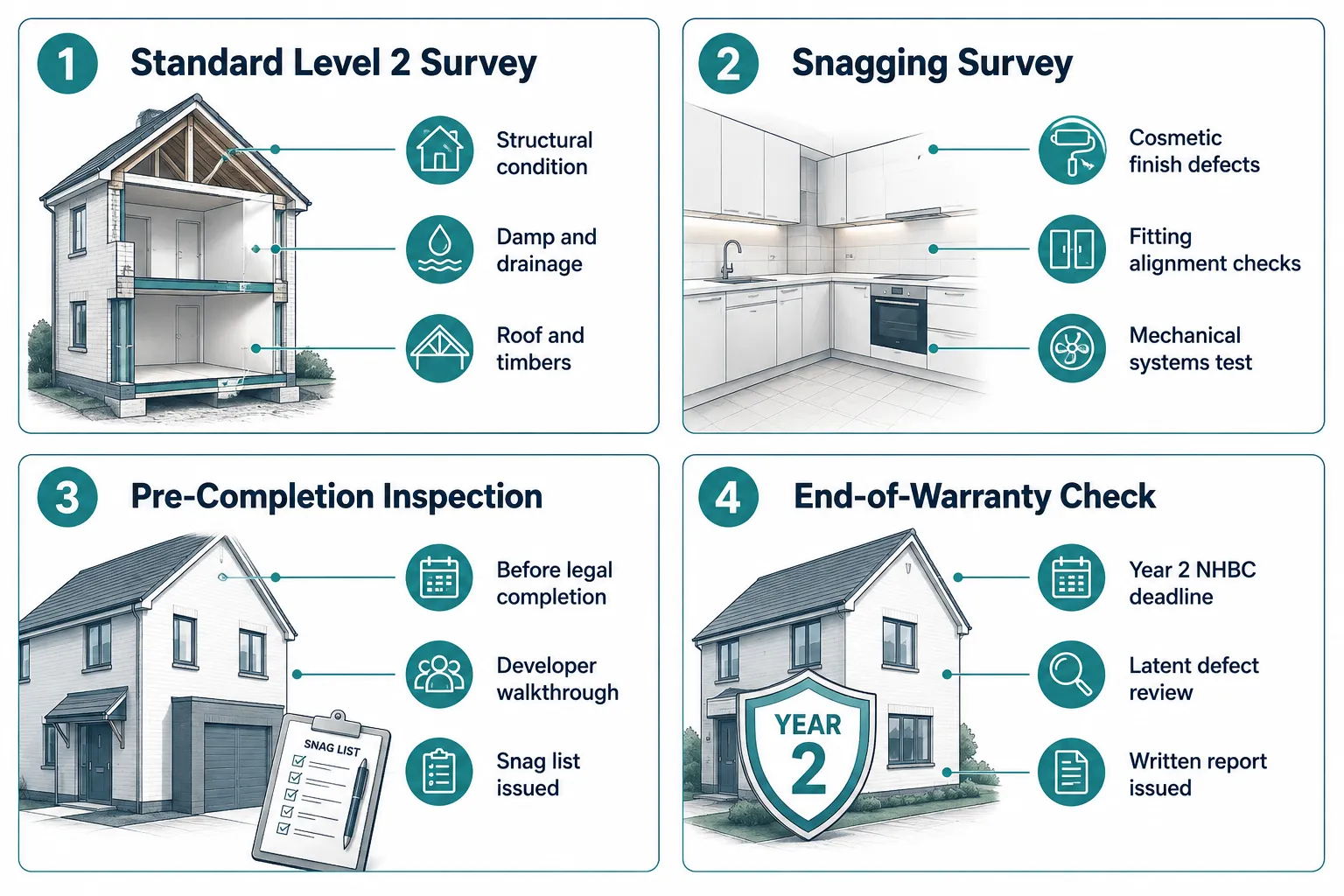
When a buyer purchases an older property, their solicitor will typically recommend a RICS Level 2 (HomeBuyer Report) or Level 3 (Building Survey). These reports assess structural integrity, damp, drainage, roof condition, and other elements that deteriorate over time. They are backward-looking documents, designed to identify problems that have accumulated over a property's lifespan.
A snagging survey serves an entirely different purpose. It is a forward-looking quality audit of a brand-new property, checking whether the developer has built to the standard promised in the contract, the specification, and current building regulations [1]. Rather than investigating structural failure, a snagging inspector is looking for:
- Cosmetic defects: scratches, paint misses, uneven plasterwork, stained grout
- Fitting and alignment issues: doors that do not hang correctly, tiles that are not level, skirting boards with visible gaps
- Mechanical and electrical checks: sockets that do not function, boilers not commissioned correctly, extractor fans not connected
- Regulatory compliance: fire doors not closing fully, missing insulation, inadequate ventilation
"A snagging survey is not about finding catastrophic failure. It is about holding a developer to the standard they contractually promised."
Because new-build properties carry an implied warranty of quality, the buyer has a legal right to expect the home is built to specification. An independent snagging report creates a timestamped, written record of every deviation from that standard, a document with real legal weight during the defects liability period [2].
Why not rely on the developer's own completion inspection? Developers conduct their own pre-handover checks, but these are internal quality controls, not independent audits. Buyers who rely solely on the developer's sign-off regularly discover defects after moving in, at which point the burden of proof shifts. An independent report commissioned before completion removes that ambiguity entirely [3].
RICS and RPSA Standards for New-Build Inspections
The Royal Institution of Chartered Surveyors (RICS) publishes specific guidance on new-build homes. The RICS New Build Homes guidance (3rd edition) sets out the professional obligations of surveyors working on new-build properties, including the requirement for clear, impartial reporting and adherence to current building regulations [6]. The Residential Property Surveyors Association (RPSA) similarly provides a framework for snagging inspectors, covering inspection methodology, reporting format, and professional indemnity requirements.
Buyers should look for inspectors who are members of one of these bodies, or who hold equivalent professional qualifications. Unregulated snagging companies exist in large numbers, and the quality of their reports varies significantly [4].
What Surveyors Look For: The Inspection Process in Practice
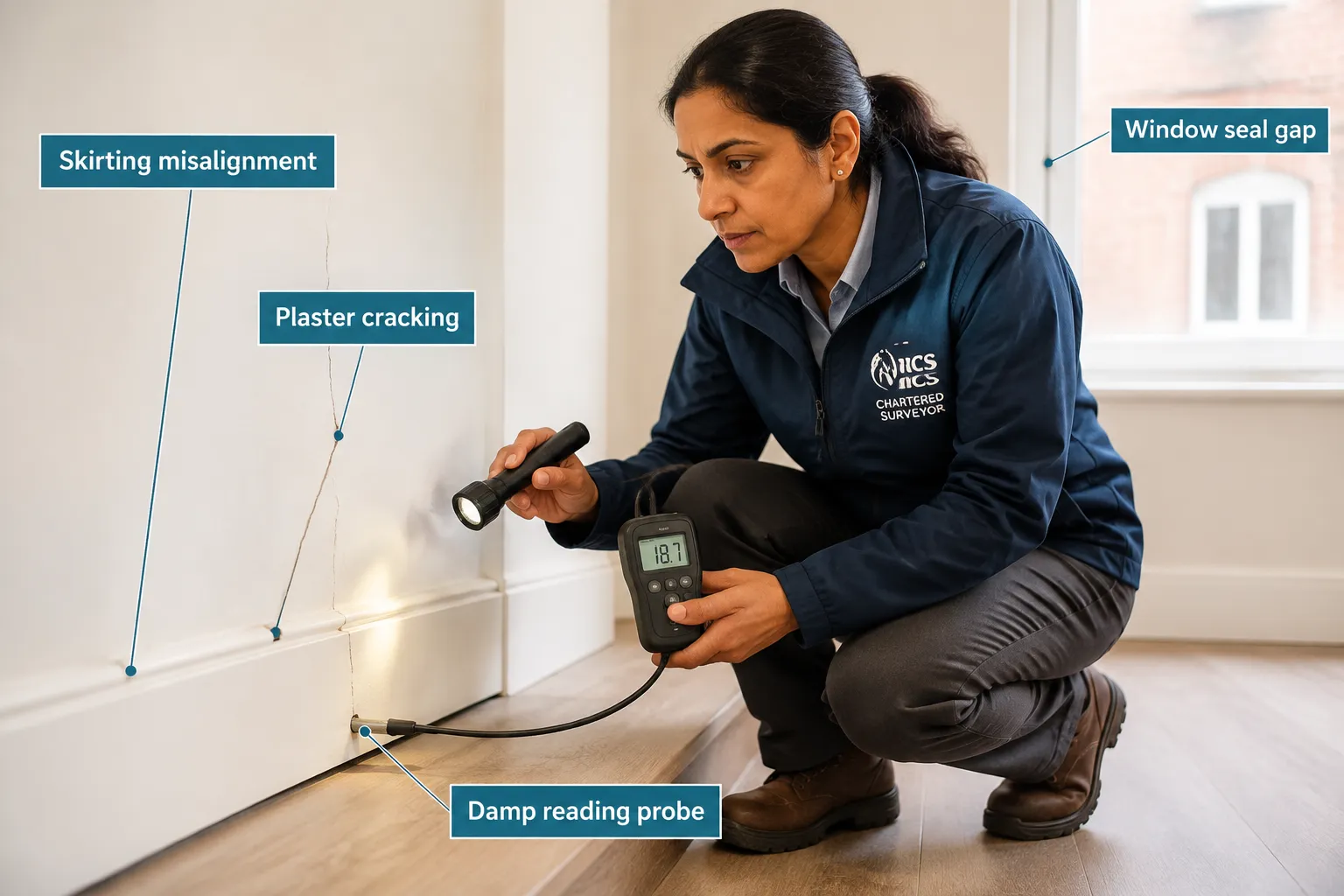
A professional snagging inspection on a typical three-bedroom new-build home takes between three and five hours. The surveyor works systematically through every room, using a combination of visual inspection, physical testing, and specialist equipment. The process for New Build Snagging and Defects Liability: What Surveyors Look For Before and After Completion follows a structured methodology rather than an ad hoc walkthrough.
Room-by-Room Inspection Categories
| Area | Typical Defects Found |
|---|---|
| Walls and ceilings | Cracking, uneven plaster, paint holidays, damp patches |
| Floors | Squeaking boards, uneven tiling, gaps at skirting |
| Windows and doors | Misalignment, poor seals, draughts, hardware faults |
| Kitchen and bathrooms | Poorly grouted tiles, silicone gaps, appliance faults |
| Electrical | Non-functioning sockets, missing covers, unfinished wiring |
| Plumbing | Dripping fittings, slow drainage, boiler commissioning |
| External | Pointing defects, drainage falls, render cracking |
| Roof (where accessible) | Missing tiles, flashing gaps, poor ridge pointing |
Surveyors use damp meters, spirit levels, torch inspection, and, in some cases, thermal imaging cameras to identify defects not visible to the naked eye. Digital reporting platforms are increasingly common, allowing surveyors to attach photographs directly to each snag item, creating a precise, navigable report [10].
The average number of snags found in a new-build property by an independent surveyor ranges from 50 to over 200 items, depending on the developer and the stage of completion at inspection [4]. This figure consistently surprises buyers who assumed a new property would be defect-free.
Timing: When to Commission the Survey
Timing is critical. There are three optimal windows for snagging inspections:
-
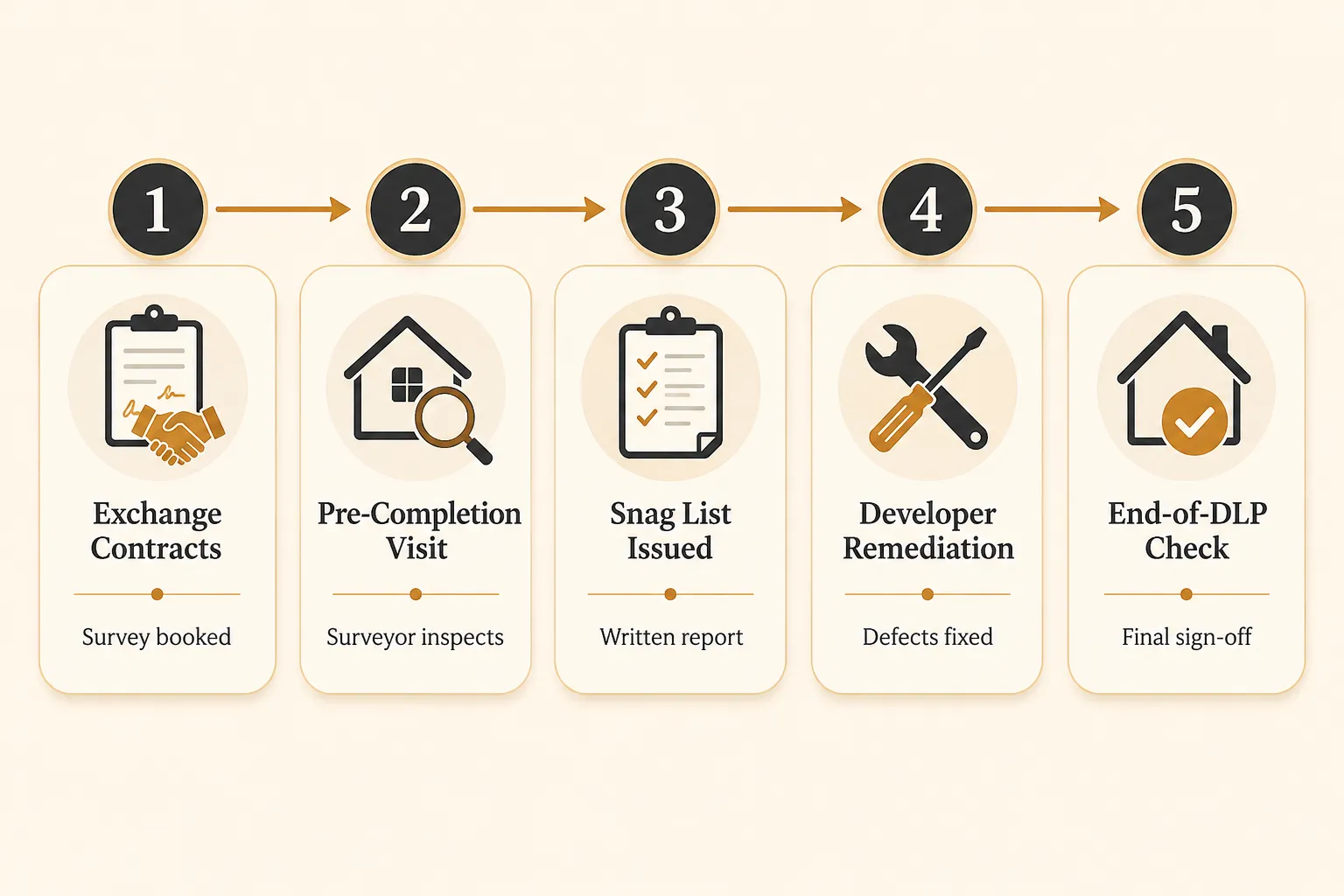
Pre-completion (before legal completion): This is the most powerful position. The buyer has not yet handed over the full purchase price, giving them maximum leverage to require the developer to remedy defects before completion. Most professional snagging companies and surveyors recommend this window above all others [1].
-
Move-in (within the first few weeks): If pre-completion access was not granted, a survey conducted immediately after moving in still falls within the early part of the defects liability period. Defects reported promptly are harder for developers to attribute to the buyer's own occupation.
-
End-of-warranty (approaching the two-year mark): A final inspection before the developer's defects liability period expires ensures that latent defects, those which have developed over time, are formally reported before the buyer loses their contractual right to free remediation [2].
A note on access: Developers are not legally obliged to grant pre-completion access to independent surveyors in all cases, though many will do so under pressure. Buyers should raise this requirement early in the conveyancing process and include it as a condition of exchange where possible [9].
The Defects Liability Period and Developer Obligations
The defects liability period (DLP) is the contractual window, typically two years from legal completion in the UK, during which the developer is obligated to remedy defects in the property at their own cost [2]. This is distinct from the longer structural warranty provided by bodies such as the National House Building Council (NHBC) under its Buildmark scheme.
Understanding how the DLP works in practice is central to New Build Snagging and Defects Liability: What Surveyors Look For Before and After Completion. The mechanics are straightforward in principle but frequently contentious in practice.
How the DLP Works
- The buyer reports defects in writing to the developer (or their customer care team).
- The developer is obliged to inspect and remedy defects within a reasonable timeframe.
- Defects caused by the buyer's own misuse or wear and tear are excluded.
- Disputes over whether a defect is a "snag" or "fair wear and tear" are common.
"The defects liability period is only as useful as the documentation behind it. A formal snagging report transforms a verbal complaint into a legally supported claim."
The written snag list produced by an independent surveyor is the most effective tool a buyer has during this period. It establishes the condition of the property at a defined point in time, making it far harder for a developer to argue that a defect was caused by the buyer [2].
NHBC Buildmark and Structural Warranties
Beyond the two-year DLP, most new-build homes in the UK are covered by a structural warranty. The NHBC Buildmark warranty is the most widely used, providing:
- Years 1-2: Developer responsible for all defects (the DLP period)
- Years 3-10: NHBC covers major structural defects if the developer fails to remedy them
- Years 1-10: NHBC deposit protection if the developer becomes insolvent before completion
The UK government has been consulting on extending the mandatory warranty period to 15 years, which would bring the UK closer to standards in countries such as France (10-year structural guarantee known as the garantie décennale) and Australia, where warranty periods vary by state but commonly extend to six or seven years for structural defects [5][8].
What Happens When Developers Dispute Defects
Disputes arise when developers classify reported items as cosmetic, as buyer-caused damage, or as items outside the specification. In these cases, the buyer's independent snagging report carries significant weight. If the dispute cannot be resolved directly, buyers can escalate to:
- The New Homes Ombudsman Service (NHOS), introduced in the UK to provide independent dispute resolution
- The NHBC resolution service
- Legal action in the small claims court for lower-value disputes
Having a professionally produced, timestamped snagging report from a qualified surveyor substantially strengthens the buyer's position in any of these forums [3].
Costs, Value, and the Consumer Case for Independent Snagging
The cost of a professional snagging survey in the UK in 2026 typically ranges from approximately £300 for a one-bedroom flat to £600 or more for a larger detached house, depending on the property size, location, and the surveyor's qualifications [4][10]. Some firms charge on a per-room or per-square-metre basis; others offer fixed-fee packages.
Community feedback consistently supports the value of independent surveys. Buyers who commissioned independent snagging inspections report that the cost was recovered many times over through defects remedied at the developer's expense, defects that would have cost significantly more to fix privately after the DLP expired [7].
Typical costs by property type (UK, 2026):
| Property Type | Approximate Survey Cost |
|---|---|
| 1-2 bedroom flat | £300 – £400 |
| 3 bedroom semi-detached | £400 – £500 |
| 4-5 bedroom detached | £500 – £700+ |
These figures represent independent professional inspections. Lower-cost services exist, but buyers should verify the surveyor's qualifications and professional indemnity insurance before commissioning any report [1].
The Emerging Role of Digital Reporting
A growing number of snagging companies now deliver reports through digital platforms that allow buyers to track defect status, upload additional photographs, and communicate directly with developers through a shared portal [10]. This shift toward structured digital documentation is making defect management more transparent and reducing the ambiguity that historically allowed disputes to drag on.
RICS guidance continues to evolve in this direction, with updated standards emphasising clear, evidence-based reporting and the use of technology to support post-completion defect management [6]. The formalisation of snagging standards, long overdue given the volume of new-build completions each year, is expected to accelerate as the New Homes Ombudsman embeds itself in the dispute resolution landscape.
Conclusion
New build snagging and defects liability is a process that rewards preparation and penalises passivity. Buyers who commission an independent inspection before legal completion, document every defect in writing, and understand the mechanics of the defects liability period are in a fundamentally stronger position than those who rely on the developer's assurances alone.
Actionable next steps for new-build buyers in 2026:
- Book an independent snagging survey from a qualified RICS or RPSA member before exchange of contracts, and negotiate pre-completion access with the developer.
- Request a written snag list in a format that can be shared directly with the developer's customer care team.
- Report all defects in writing within the first few weeks of occupation, keeping copies of all correspondence.
- Diary the two-year DLP expiry date and commission a final end-of-warranty inspection at least four weeks before it lapses.
- Escalate unresolved disputes to the New Homes Ombudsman or NHBC resolution service rather than accepting a developer's refusal without challenge.
The investment in a professional snagging survey is modest relative to the purchase price of a new home. The protection it provides, legally, financially, and practically, is disproportionately large.
References
[1] New Build Snagging Guide – housesurveys.co.uk
[2] Legal Rights Defect Liability Period New Build – new-builds.co.uk
[3] Snagging Survey Guide – strutsurveyors.com
[4] snaggingcompany – snaggingcompany.com
[5] Duration Of Defects Liability Period For New – reddit.com
[6] New Build Homes 3rd Edition – rics.org
[7] Snagging Survey For The New Build Is It Worth The – reddit.com
[8] Warranties New Homes – consumer.ftc.gov
[9] New Build Survey Vs Snagging Report – reddit.com
[10] homesnag.co.uk – homesnag.co.uk