
As UK high streets experience a renaissance in 2026, retail businesses are seizing opportunities to expand, renovate, and modernise their premises. However, the densely packed nature of urban commercial districts means that Party Wall Surveys for Retail Expansion Projects: Navigating 2026 High Street Revitalisation Agreements has become an essential consideration for retailers, property owners, and developers alike. Understanding the legal framework and surveyor requirements can mean the difference between a smooth expansion and costly neighbour disputes that derail your project timeline.
The Party Wall etc. Act 1996 governs all work affecting shared walls and boundaries in England and Wales, and with construction activity surging across high streets, compliance has never been more critical[3]. This comprehensive guide explores the essential surveyor checklists, notification requirements, and dispute resolution processes that retail businesses must navigate when expanding their premises in 2026's revitalised commercial landscapes.
Key Takeaways
- Formal notification is mandatory: Building owners must serve party wall notices with a 2-month notice period for works affecting shared walls, or face potential legal action and project delays[2]
- Professional surveys prevent disputes: Comprehensive party wall surveys and schedules of condition protect both building and adjoining owners from costly neighbour conflicts[5]
- Budget for surveyor costs: Party wall awards typically cost around £1,000, though complex retail projects in dense urban areas may incur higher expenses[2]
- Understand the 14-day response window: Adjoining owners have just 14 days to consent or dissent, triggering the formal surveyor appointment process[3]
- RICS compliance is essential: The 2026 construction uptick has brought enhanced scrutiny to party wall procedures, making professional surveyor involvement crucial[5]
Understanding Party Wall Legislation for Retail Properties
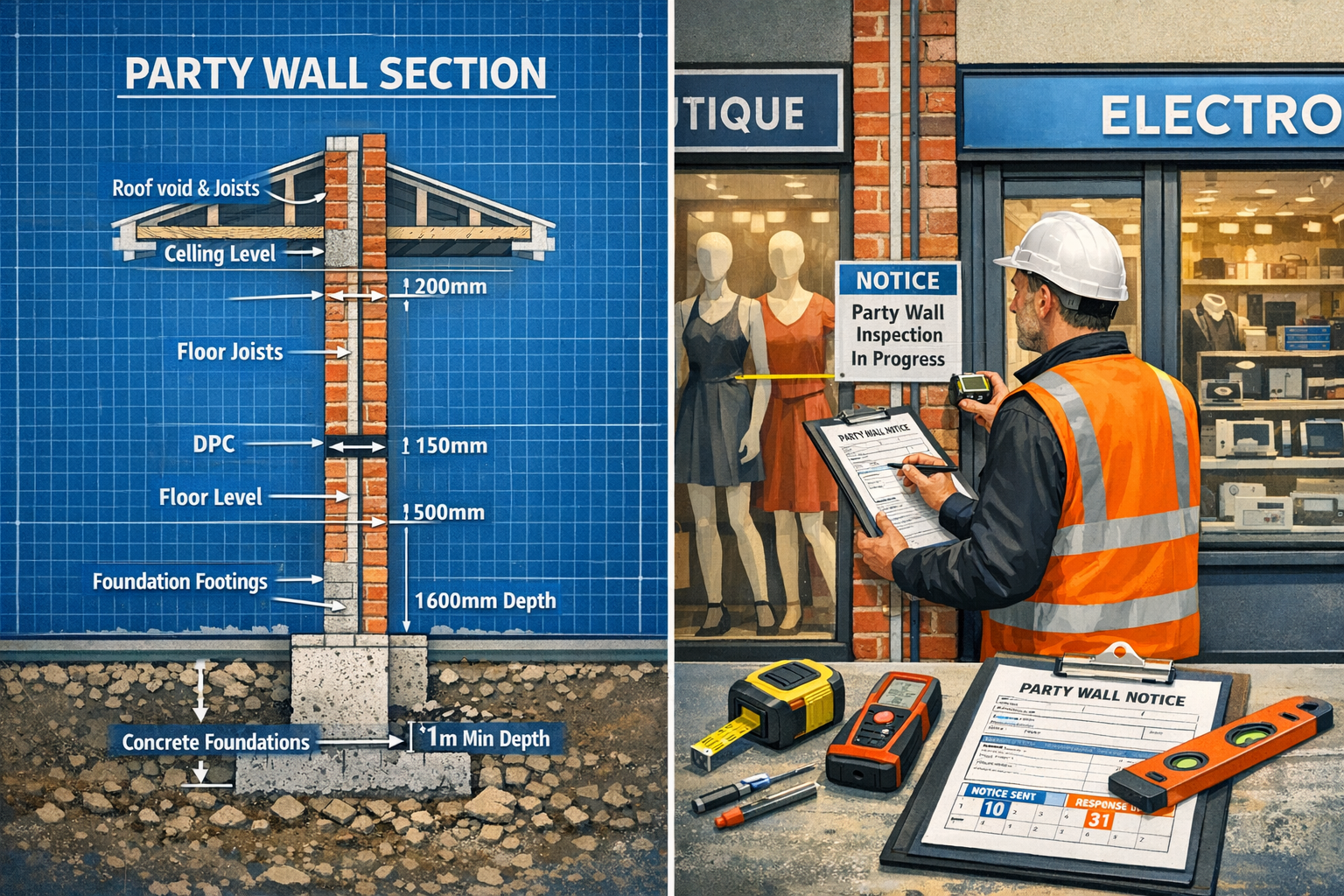
What the Party Wall etc. Act 1996 Covers
The Party Wall etc. Act 1996 provides the legal framework for Party Wall Surveys for Retail Expansion Projects: Navigating 2026 High Street Revitalisation Agreements. This legislation applies to three main categories of work[3]:
- Works to existing party walls – alterations, repairs, or modifications to walls shared between properties
- New party wall construction – building new walls on or at the boundary line between properties
- Excavation near neighbouring buildings – digging within 3 metres of an adjoining structure
For retail expansion projects, these provisions are particularly relevant when:
- 🏗️ Knocking through to an adjacent unit to create larger retail space
- 🔨 Installing new structural supports or beams into shared walls
- 🏪 Excavating for basement storage or expanded retail floors
- 🛠️ Raising party walls to accommodate mezzanine levels or additional floors
Understanding what constitutes a party wall is the first step in determining whether your retail expansion requires formal notices and surveys.
The 2026 High Street Context
The UK government's high street revitalisation initiatives in 2026 have created unprecedented opportunities for retail businesses. However, the historic nature of many commercial districts means that properties are often interconnected, with shared walls dating back decades or even centuries. This density creates unique challenges that require careful navigation of party wall procedures[5].
Modern retail expansion projects must balance commercial ambitions with legal obligations to neighbouring property owners. The enhanced RICS compliance framework introduced in 2026 has raised professional standards, ensuring that party wall surveys meet rigorous quality benchmarks[4].
Essential Surveyor Checklists for Party Wall Surveys for Retail Expansion Projects: Navigating 2026 High Street Revitalisation Agreements
Pre-Work Survey Requirements
Before commencing any retail expansion work, professional surveyors must complete comprehensive assessments. The essential checklist includes:
| Survey Element | Purpose | Key Documentation |
|---|---|---|
| Structural Assessment | Identify existing wall condition and load-bearing capacity | Photographic evidence, structural measurements |
| Schedule of Condition | Record pre-work state of adjoining properties | Detailed written descriptions, dated photographs |
| Foundation Analysis | Assess excavation impact on neighbouring structures | Depth measurements, soil reports |
| Access Requirements | Determine if entry to adjoining property is needed | Access agreements, timing schedules |
| Risk Assessment | Identify potential damage or disruption scenarios | Mitigation strategies, insurance verification |
A thorough schedule of condition is absolutely critical for retail projects. This document provides baseline evidence of the adjoining property's state before work begins, protecting both parties from spurious damage claims.
Notification Timeline and Process
The notification process for Party Wall Surveys for Retail Expansion Projects: Navigating 2026 High Street Revitalisation Agreements follows strict timelines[2]:
For party wall works:
- Serve notice at least 2 months before intended start date
- Include detailed descriptions of proposed works
- Specify the intended start date
For excavation works:
- Serve notice at least 1 month before intended start date
- Include depth and proximity details
- Provide structural calculations if required
"Failure to serve proper party wall notices can result in injunctions that halt your retail expansion project entirely, causing significant financial losses and reputational damage to your business."
Many retail owners make the costly mistake of not having a party wall agreement in place before starting work. This oversight can lead to legal action, forced work stoppages, and expensive remediation.
Surveyor Appointment and the Party Wall Award
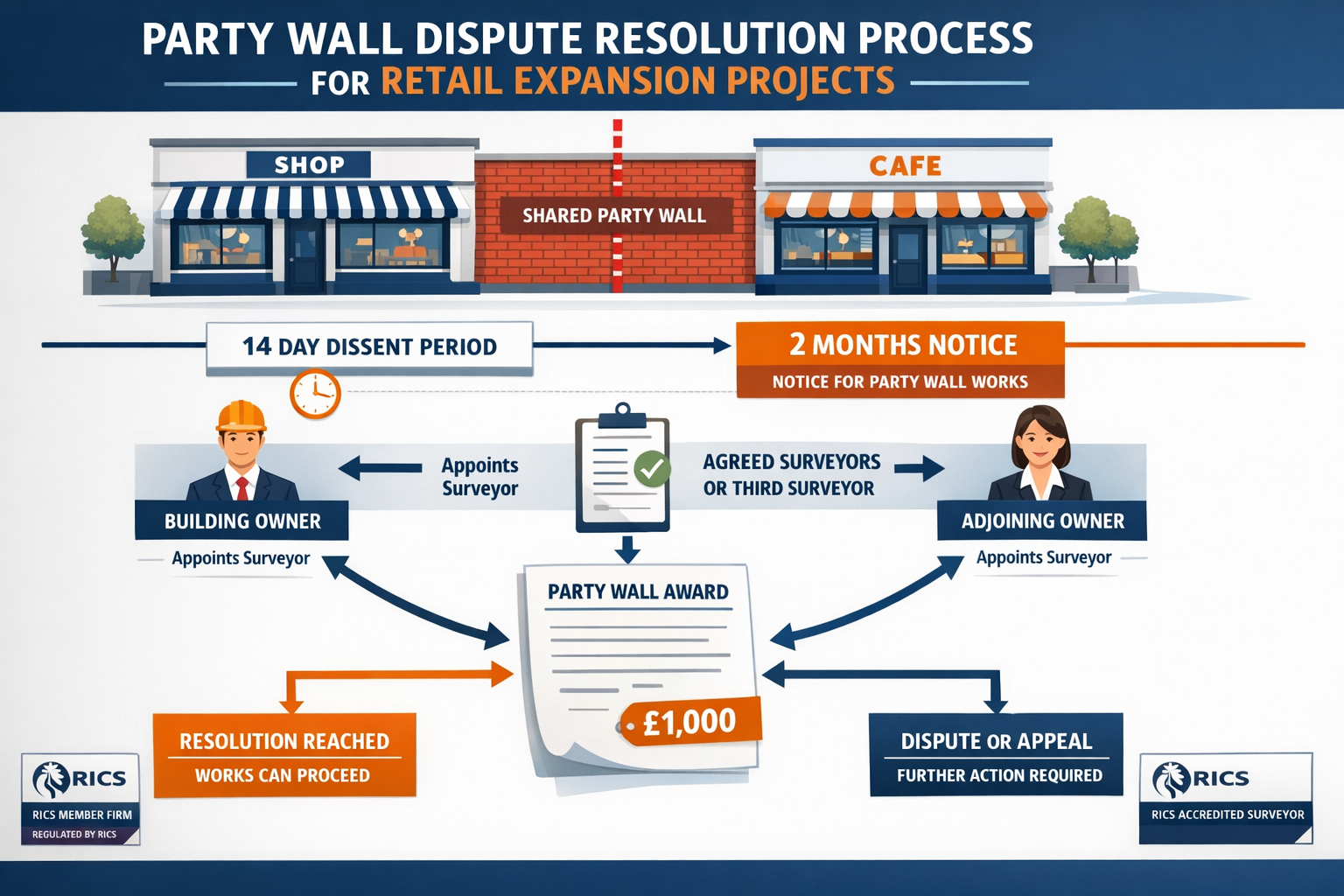
When an adjoining owner dissents to proposed works (or fails to respond within 14 days), the formal dispute resolution process begins[3]:
- Each party appoints a surveyor – Building owner and adjoining owner select qualified professionals
- Surveyors negotiate terms – The appointed surveyors work together to create a fair agreement
- Party Wall Award issued – A legally binding document outlining work conditions, timings, and protections
The average cost of a party wall award is approximately £1,000, though complex retail projects in high-value urban locations may incur higher fees[2]. Building owners typically bear all reasonable costs associated with the party wall process.
Professional surveyors conducting retail expansion assessments must ensure compliance with the enhanced 2026 RICS standards, which emphasise thorough documentation and neighbour communication protocols[5].
Common Neighbour Disputes in Retail Expansion Projects
Typical Conflict Scenarios
Densely packed high street properties create unique challenges for Party Wall Surveys for Retail Expansion Projects: Navigating 2026 High Street Revitalisation Agreements. Common dispute triggers include:
Structural concerns:
- Fears about wall stability during demolition or alteration
- Worries regarding foundation excavation near adjoining buildings
- Concerns about increased loading on shared walls
Operational disruption:
- Noise and vibration affecting neighbouring retail operations
- Dust and debris impacting adjacent businesses
- Access restrictions during construction phases
Property damage:
- Cracks appearing in adjoining walls or ceilings
- Damage to shared chimneys or roof structures
- Settlement issues from excavation work
Understanding what constitutes a party wall dispute helps retail owners anticipate potential conflicts and take preventative measures.
Preventing Disputes Through Proper Documentation
The most effective way to avoid costly neighbour conflicts is through meticulous documentation and professional survey work. Key preventative measures include:
✅ Comprehensive photographic records – Document every aspect of adjoining properties before work begins
✅ Detailed written descriptions – Create thorough schedule of condition guidance documentation
✅ Regular communication – Keep adjoining owners informed throughout the project
✅ Professional monitoring – Arrange periodic inspections during construction phases
✅ Insurance verification – Ensure adequate coverage for potential party wall damage
When disputes do arise, understanding the formal resolution process outlined in party wall award guidance becomes essential.
Addressing Damage Claims
Despite careful planning, damage to property in party wall scenarios can occur during retail expansion projects. The party wall framework provides clear mechanisms for addressing such issues:
- Immediate notification – Inform the appointed surveyor(s) as soon as damage is discovered
- Assessment and documentation – Professional evaluation of the extent and cause
- Remediation plan – Agreed approach to repairs and compensation
- Implementation – Completion of necessary repairs to restore the property
The pre-work schedule of condition becomes invaluable evidence when determining whether damage resulted from the expansion works or pre-existed the project.
Excavation Work and the 3-Metre Rule
Understanding Excavation Notice Requirements
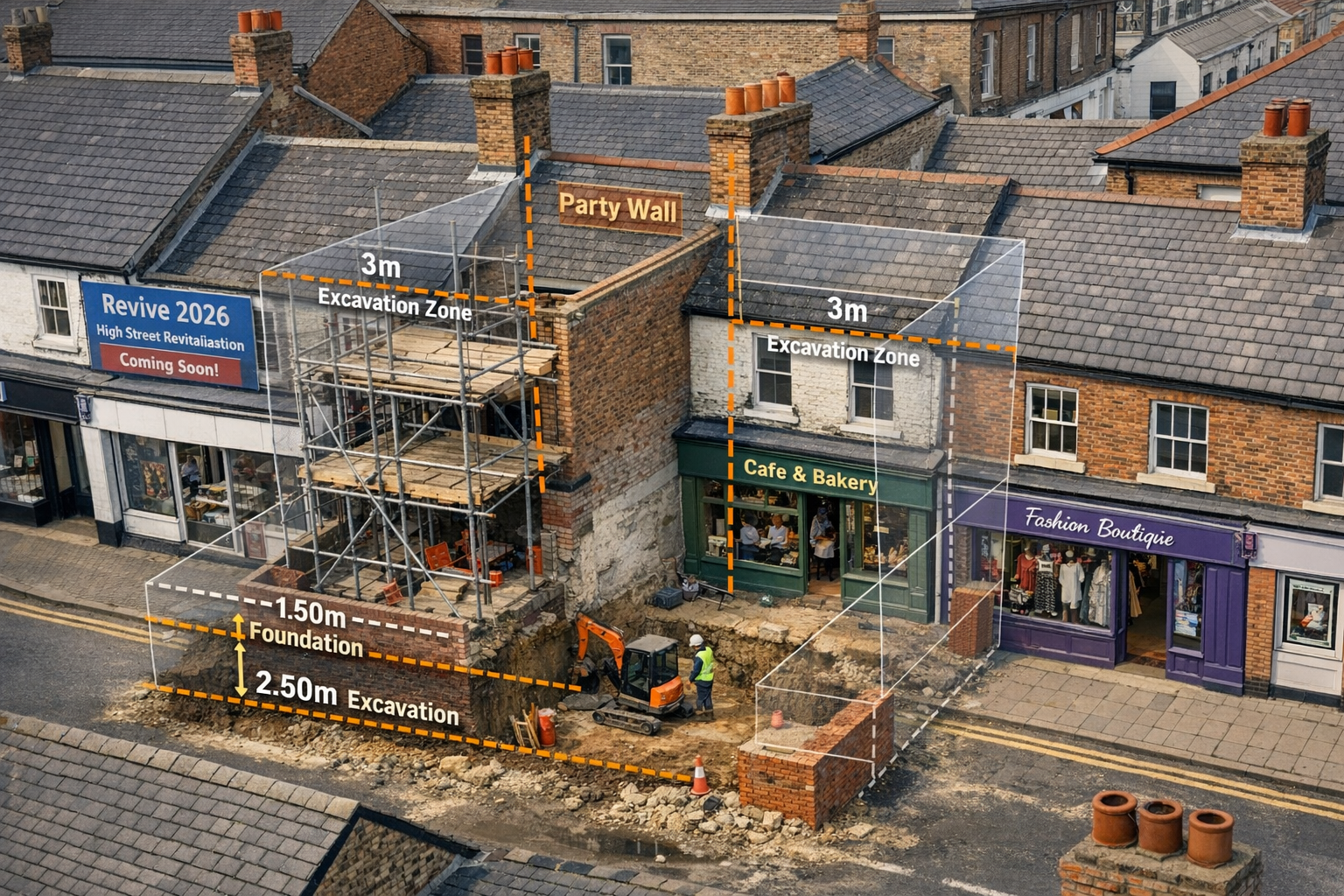
Retail expansion projects frequently involve excavation work for basements, extended foundations, or underground storage facilities. The 3-metre rule is a critical consideration for such projects.
Under the Party Wall etc. Act 1996, excavation notice for party wall purposes is required when:
- Excavating within 3 metres of a neighbouring building's structure, and
- The excavation will go deeper than the neighbour's foundations
Or when:
- Excavating within 6 metres of a neighbouring structure, and
- The excavation will cut a line drawn downward at 45 degrees from the bottom of the neighbour's foundations
These technical requirements necessitate professional surveyor involvement to ensure compliance and protect all parties' interests.
Foundation Impact Assessments
For high street retail properties, foundation work poses particular challenges due to:
- Age and construction methods – Historic buildings may have shallow or unconventional foundations
- Soil conditions – Urban environments often have varied ground conditions
- Interconnected structures – Multiple properties may share foundation systems
Professional surveyors must conduct thorough foundation impact assessments, including:
📋 Soil analysis and ground condition reports
📋 Structural calculations for proposed excavations
📋 Temporary support requirements
📋 Monitoring protocols during excavation phases
📋 Contingency plans for unexpected conditions
Cost Considerations for Party Wall Surveys in Retail Projects
Budgeting for Party Wall Expenses
Understanding the cost of party wall procedures is essential for retail expansion project budgeting. Typical expenses include:
| Cost Component | Estimated Range | Notes |
|---|---|---|
| Initial survey and notice preparation | £500 – £1,500 | Varies by property complexity |
| Party wall award (agreed surveyor) | £800 – £1,200 | Single surveyor acting for both parties |
| Party wall award (separate surveyors) | £1,500 – £3,000+ | Two surveyors plus third surveyor fees |
| Schedule of condition | £300 – £800 | Per adjoining property |
| Monitoring during works | £200 – £500 | Per inspection visit |
| Dispute resolution | £2,000 – £10,000+ | If formal disputes arise |
The building owner typically bears all reasonable costs associated with party wall procedures, including the adjoining owner's surveyor fees[2].
Hidden Costs and Contingencies
Beyond direct surveyor fees, retail expansion projects should budget for:
- Project delays – If no party wall notice served properly, work stoppages can occur
- Additional insurance premiums – Enhanced coverage for party wall work
- Remediation costs – Repairs to any damage caused during construction
- Legal fees – If disputes escalate beyond the surveyor process
Proper planning and professional surveyor engagement from the outset typically results in lower overall costs than attempting to navigate the process without expert guidance.
Special Considerations for High Street Retail Properties
Historic Building Constraints
Many high street retail properties occupy historic buildings with unique characteristics that complicate Party Wall Surveys for Retail Expansion Projects: Navigating 2026 High Street Revitalisation Agreements:
- Listed building status – Additional consents beyond party wall requirements
- Conservation area restrictions – Limitations on structural alterations
- Traditional construction methods – Lime mortar, timber frames, or unusual materials
- Shared architectural features – Party wall shared chimneys and decorative elements
Surveyors must coordinate party wall procedures with heritage considerations, ensuring that expansion plans comply with all relevant regulations.
Mixed-Use Property Challenges
High street properties frequently combine retail and residential uses, creating additional complexity:
🏢 Retail units with flats above – Multiple adjoining owners to notify
🏢 Different ownership structures – Freeholders, leaseholders, and tenants
🏢 Varied operational hours – Balancing construction timing with residential quiet enjoyment
🏢 Access complications – Coordinating entry to residential areas for surveys
Professional surveyors must navigate these complexities while ensuring all legal obligations are met and stakeholder relationships are maintained.
Obtaining Party Wall Consent
The process of securing party wall consent in retail environments requires diplomatic communication and professional presentation of proposals. Best practices include:
- Clear, jargon-free explanations of proposed works
- Visual aids showing the scope and impact of expansion plans
- Realistic timelines with consideration for adjoining businesses
- Mitigation measures to minimise disruption
- Professional surveyor involvement from initial contact
When adjoining owners understand the process and feel their interests are protected, consent is more readily obtained, avoiding the time and expense of formal dispute procedures.
Navigating Common Obstacles and Obstructions
Dealing with Existing Obstructions
Retail expansion projects frequently encounter obstruction in party wall scenarios, such as:
- Services (plumbing, electrical, gas) running through shared walls
- Historical modifications or additions
- Structural elements from previous alterations
- Undocumented construction from decades past
Professional surveyors must identify these obstructions during initial assessments and develop strategies for working around or safely removing them while protecting adjoining owners' interests.
Addressing Non-Responsive Neighbours
When adjoining owners fail to respond to party wall notices, the Act provides clear procedures:
- 14-day response period – Adjoining owners have two weeks to consent or dissent
- Deemed dissent – Silence after 14 days is treated as dissent
- Surveyor appointment – Building owner can appoint a surveyor on behalf of the non-responsive neighbour
- Proceed with award – The process continues despite lack of engagement
While this ensures projects aren't indefinitely delayed, proactive communication and professional surveyor involvement typically yield better outcomes than relying on deemed dissent provisions.
Frequently Asked Questions About Party Wall Surveys for Retail Expansion
Do All Retail Expansion Projects Require Party Wall Notices?
Not all projects trigger party wall requirements. Work that doesn't affect shared walls, boundaries, or involve excavation near neighbours may proceed without formal notices. However, professional surveyor assessment is recommended to confirm whether the Act applies to your specific project.
For comprehensive answers to common questions, consult our party wall FAQ resource.
Can Work Begin Before the Notice Period Expires?
No. The law requires that work cannot commence until the notice period has fully elapsed (2 months for party wall works, 1 month for excavation)[2]. Starting work prematurely can result in injunctions and legal action from adjoining owners.
What Happens If Neighbours Refuse to Allow Access?
The Party Wall Award can include provisions for reasonable access to adjoining properties when necessary for the works. If access is unreasonably refused, surveyors can include access terms in the award, providing legal backing for entry at specified times.
How Long Does the Party Wall Process Take?
From initial notice to commencement of work, the minimum timeline is:
- 2 months for party wall structure works
- 1 month for excavation works
- Additional 2-4 weeks if disputes arise and surveyors must be appointed
- Further time if complex negotiations are required
Retail businesses planning expansion should factor these timelines into their overall project schedules.
Best Practices for Smooth Party Wall Procedures
Early Engagement with Professional Surveyors
The single most effective strategy for successful Party Wall Surveys for Retail Expansion Projects: Navigating 2026 High Street Revitalisation Agreements is early professional surveyor engagement. Benefits include:
✨ Accurate timeline planning – Understanding notice periods and potential delays
✨ Cost certainty – Budgeting for all party wall expenses upfront
✨ Risk mitigation – Identifying potential disputes before they escalate
✨ Compliance assurance – Meeting all legal and RICS requirements
✨ Professional communication – Surveyors manage neighbour relations effectively
Maintaining Positive Neighbour Relations
Retail businesses rely on positive relationships within their commercial communities. Party wall procedures handled professionally strengthen rather than damage these relationships:
- Transparent communication throughout the process
- Respect for business operations when scheduling disruptive work
- Prompt response to concerns or complaints
- Fair compensation for any disruption or damage
- Professional conduct by contractors and surveyors
Documentation and Record-Keeping
Meticulous records protect all parties and facilitate smooth dispute resolution if issues arise:
📁 Copies of all notices served and responses received
📁 Photographic and written schedules of condition
📁 Party wall awards and agreed work specifications
📁 Progress reports and inspection records
📁 Correspondence with adjoining owners and surveyors
📁 Contractor compliance documentation
The 2026 Regulatory Landscape
Enhanced RICS Standards
The 2026 construction uptick has brought renewed focus to party wall compliance, with RICS introducing enhanced quality standards for building surveys and party wall procedures[4][5]. These updates emphasise:
- Comprehensive risk assessment protocols
- Enhanced documentation requirements
- Improved neighbour communication frameworks
- Regular professional development for surveyors
- Quality assurance mechanisms
Retail expansion projects must work with RICS-qualified surveyors who understand and implement these enhanced standards.
Integration with High Street Revitalisation Initiatives
Government-backed high street revitalisation programmes in 2026 have created additional considerations for party wall procedures:
- Accelerated planning processes that must coordinate with party wall timelines
- Grant funding that may have specific compliance requirements
- Heritage considerations in conservation areas
- Community engagement expectations
- Sustainability standards affecting construction methods
Professional surveyors familiar with both party wall legislation and current revitalisation initiatives provide invaluable guidance for navigating this complex regulatory landscape.
Conclusion
Party Wall Surveys for Retail Expansion Projects: Navigating 2026 High Street Revitalisation Agreements represents a critical competency for retail businesses seeking to capitalise on the current commercial property renaissance. The Party Wall etc. Act 1996 provides a clear legal framework, but successful navigation requires professional expertise, careful planning, and diplomatic neighbour relations.
The key to smooth retail expansion lies in early engagement with qualified surveyors, comprehensive documentation through schedules of condition, and transparent communication with adjoining property owners. While party wall procedures add time and cost to projects, they ultimately protect all parties' interests and prevent costly disputes that could derail expansion plans.
Actionable Next Steps
For retail businesses planning expansion in 2026:
- Engage a RICS-qualified surveyor as early as possible in your planning process
- Conduct preliminary assessments to determine whether party wall procedures apply
- Budget appropriately for surveyor fees, notices, and potential dispute resolution
- Factor notice periods into your project timeline (minimum 2 months for party wall works)
- Prepare comprehensive documentation including detailed work specifications
- Communicate proactively with adjoining owners before formal notices
- Ensure contractor compliance with party wall award terms throughout construction
The 2026 high street revitalisation presents unprecedented opportunities for retail growth. By properly navigating party wall requirements with professional surveyor support, businesses can expand confidently while maintaining positive relationships with their commercial neighbours and full compliance with legal obligations.
Don't risk project delays, legal disputes, or damaged neighbour relations by attempting to navigate party wall procedures without expert guidance. Professional surveyors provide the expertise, documentation, and dispute resolution skills that transform potentially contentious expansion projects into smooth, compliant, and successful business growth initiatives.
References
[1] Party Wall Neighbourly Matters – https://www.stace.co.uk/our-services/party-wall-neighbourly-matters/
[2] Party Wall Agreement – https://hoa.org.uk/advice/guides-for-homeowners/i-am-improving/party-wall-agreement/
[3] Party Walls – https://www.carterjonas.co.uk/building-surveying/party-walls
[4] Building Survey Quality Standards 2026 Navigating Rics Updates And Enhanced Home Inspection Requirements – https://nottinghillsurveyors.com/blog/building-survey-quality-standards-2026-navigating-rics-updates-and-enhanced-home-inspection-requirements
[5] Party Wall Surveys And Neighbour Disputes During 2026s Construction Uptick Rics Compliance Framework – https://nottinghillsurveyors.com/blog/party-wall-surveys-and-neighbour-disputes-during-2026s-construction-uptick-rics-compliance-framework