As the housing market accelerates recovery in 2026, construction defect claims are surging across recovery properties. Building surveyors face unprecedented demand for expert witness testimony in litigation cases involving structural failures, damp issues, and building code violations. Understanding the evolving landscape of Expert Witness Roles in 2026 Construction Defect Litigation: RICS Guidelines for Building Surveyors has become essential for professionals navigating this complex field. 🏗️
The Royal Institution of Chartered Surveyors (RICS) continues to refine standards for expert witnesses, with recent updates addressing new legislation and courtroom expectations. For surveyors providing expert witness reports, staying current with these guidelines ensures credibility, compliance, and effective testimony in increasingly technical disputes.
Key Takeaways
- RICS launched a global consultation on the 5th edition expert witness standard in 2026, applying worldwide while recognizing local legal differences[3]
- Awaab's Law became effective in October 2025, creating new legal requirements that expert witnesses must address in housing disrepair claims[3]
- CPR 35 compliance remains mandatory, requiring experts to prioritize duty to the court over instructing parties with complete independence[2]
- Expert witness credibility depends on three core factors: technical knowledge, presentation clarity, and acknowledgment of analytical limitations[4]
- Housing disrepair claims now require HHSRS consideration alongside evolving legislation to meet current legal standards[3]
Understanding Expert Witness Roles in Construction Defect Cases
The Fundamental Duty to the Court
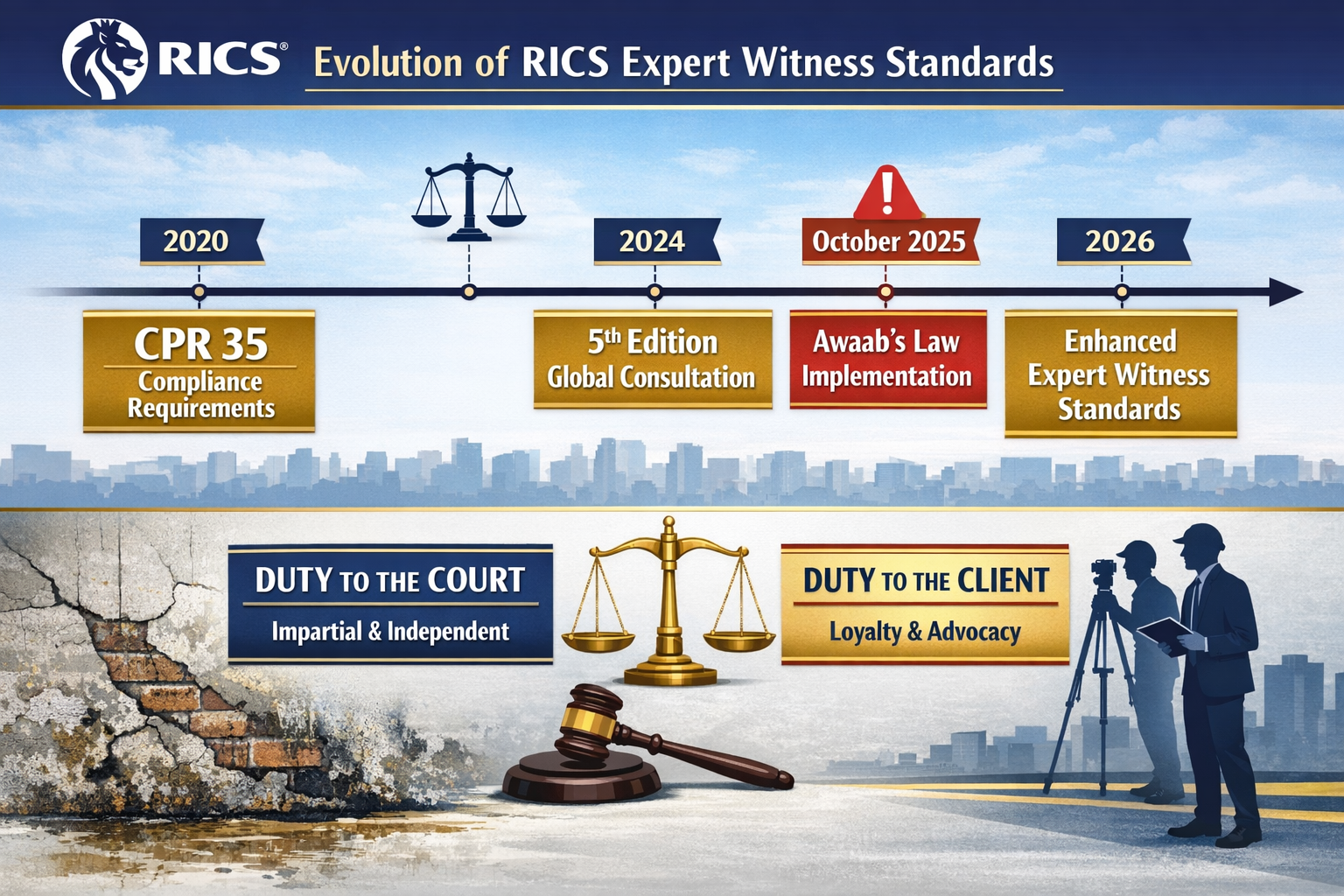
Expert witnesses in construction defect litigation occupy a unique position. Unlike typical consultants hired to support a client's position, expert witnesses owe their primary duty to the tribunal or court, not the instructing party[3][4]. This fundamental principle shapes every aspect of their work.
In 2026, this duty has become even more critical as courts scrutinize expert testimony with heightened rigor. Building surveyors must provide independent, unbiased opinions based solely on their professional expertise. The moment an expert crosses the line into advocacy, their credibility—and potentially the entire case—collapses.
RICS members providing expert witness services must operate strictly within their areas of genuine competence. Taking on cases outside one's expertise violates professional standards and undermines the justice system[3]. For those seeking qualified professionals, working with an RICS chartered building surveyor ensures appropriate expertise and ethical compliance.
Types of Construction Defect Issues Addressed
Expert witnesses in construction defect disputes handle a diverse range of technical issues[4]:
- Building defects: Structural failures, foundation problems, water ingress, and building envelope failures
- Valuation disputes: Property devaluation due to defects, cost of remediation, and diminution in value
- Delay analysis: Construction timeline disputes, critical path analysis, and extension of time claims
- Professional negligence: Failures in design, supervision, or certification by construction professionals
Each category requires specialized knowledge. A surveyor expert in structural assessment may lack the qualifications to opine on valuation matters. Understanding these boundaries protects both the expert's reputation and the client's interests.
Recent Regulatory Changes Affecting Expert Witnesses
The regulatory landscape governing Expert Witness Roles in 2026 Construction Defect Litigation: RICS Guidelines for Building Surveyors has evolved significantly:
Awaab's Law Implementation (October 2025)
This landmark legislation established strict timeframes for landlords to address housing hazards. Expert witnesses in housing disrepair cases must now incorporate these legal requirements into their assessments[3]. Reports that fail to address Awaab's Law compliance risk being deemed inadequate or outdated.
RICS 5th Edition Expert Witness Standard Consultation
RICS launched a global consultation on updated expert witness standards in 2026, creating a worldwide framework while acknowledging local legal variations[3]. This consultation signals RICS's commitment to maintaining the highest professional standards across jurisdictions.
April 2025 Practice Alert
RICS issued a critical reminder to members about their obligations in expert witness work, particularly in housing disrepair cases[3]. This alert emphasized the importance of staying current with evolving legislation and maintaining independence.
RICS Guidelines for Building Surveyors in Expert Witness Roles
CPR 35 Compliance Requirements
Civil Procedure Rule Part 35 (CPR 35) establishes the framework for expert evidence in UK courts. For building surveyors engaged in Expert Witness Roles in 2026 Construction Defect Litigation: RICS Guidelines for Building Surveyors, CPR 35 compliance is non-negotiable[2].
Key CPR 35 Requirements:
| Requirement | Description | Purpose |
|---|---|---|
| Compliance Statement | Declaration that the expert understands and has complied with their duty to the court | Ensures expert awareness of obligations |
| Full Disclosure of Instructions | Complete transparency about what the expert was asked to do | Prevents hidden agendas or biased framing |
| Evidence-Based Opinions | All conclusions must be supported by verifiable evidence | Maintains scientific rigor and credibility |
| Clear Assumptions | Any assumptions must be explicitly stated | Allows court to assess opinion validity |
| Acknowledged Limitations | Experts must identify gaps in evidence or expertise | Demonstrates professional honesty |
These requirements create a rigorous framework that protects the integrity of expert testimony. Surveyors conducting specific defect reports for litigation must ensure every element meets these standards.
Essential Components of Expert Witness Reports
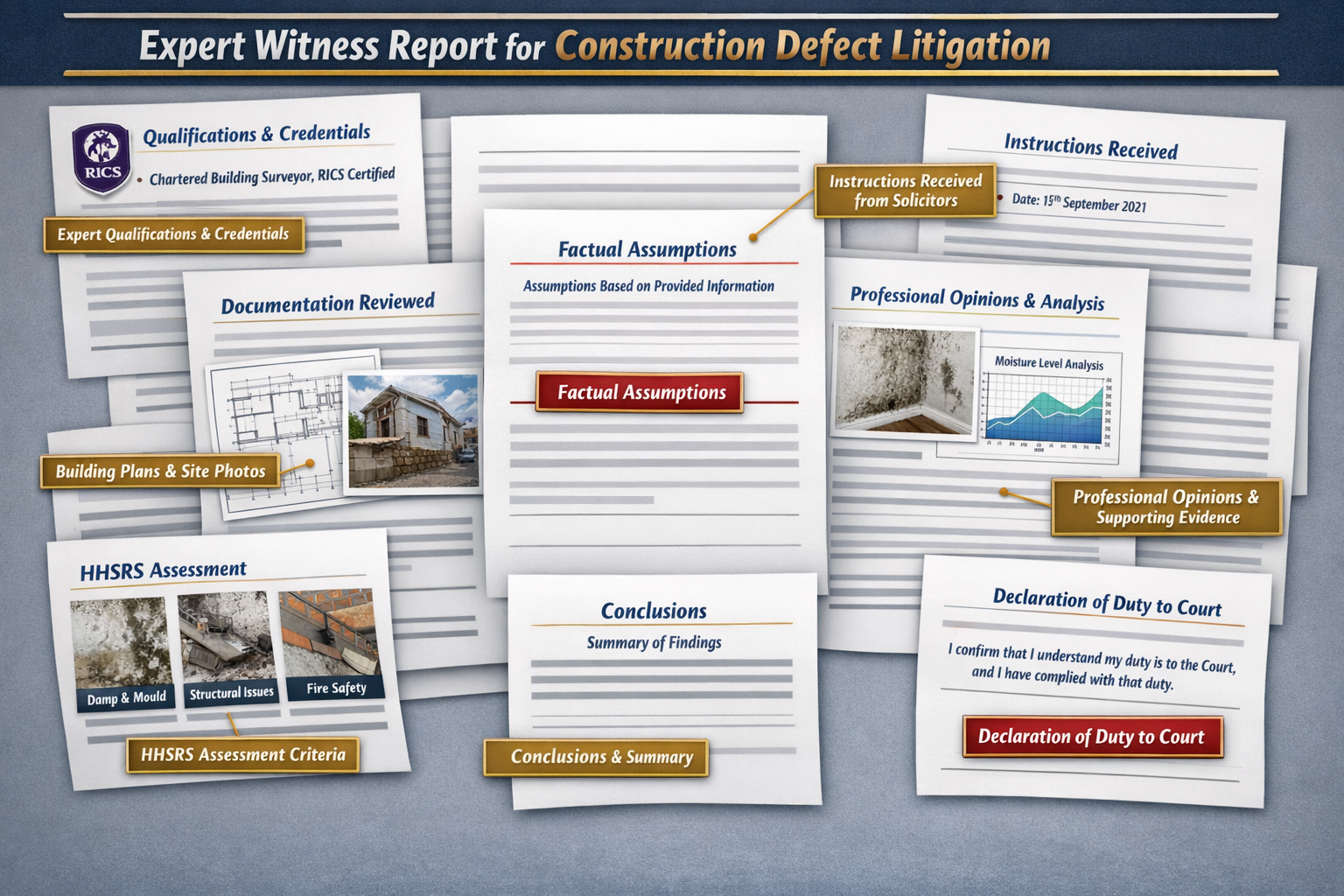
A comprehensive expert witness report in construction defect litigation must include specific elements[5]:
1. Qualifications and Credentials 📋
The report must clearly establish the expert's qualifications, including:
- Professional certifications (RICS membership, specialized credentials)
- Relevant experience in similar cases
- Specific expertise in the defect type under consideration
- Continuing professional development in relevant areas
2. Instructions Received
Complete transparency about what the expert was asked to investigate and opine upon. This section prevents accusations of hidden agendas or selective analysis.
3. Documentation Considered
A comprehensive list of all materials reviewed, including:
- Building plans and specifications
- Construction records and correspondence
- Inspection photographs and videos
- Previous survey reports
- Relevant building regulations and standards
4. Factual Assumptions
Any facts the expert has assumed to be true (but hasn't personally verified) must be clearly identified. This allows the court to assess how changes in factual circumstances might affect the opinion.
5. Professional Opinions
The core technical analysis, including:
- Identification of defects and their causes
- Assessment of compliance with building standards
- Evaluation of remediation options and costs
- Consideration of alternative explanations
For housing disrepair cases, this must include Housing Health and Safety Rating System (HHSRS) assessments alongside Awaab's Law compliance considerations[3].
6. Conclusions
Clear, concise summary of findings that directly address the questions posed in the instructions.
7. Declaration of Duty to Court
A formal statement confirming that the expert understands their duty to the court supersedes any obligation to the instructing party.
Housing Disrepair and HHSRS Considerations
The Housing Health and Safety Rating System (HHSRS) provides a risk-based evaluation method for potential hazards in residential properties. Expert witnesses in housing disrepair claims must demonstrate competence in HHSRS assessment[3].
Key HHSRS Hazard Categories Relevant to Construction Defects:
- Damp and mould growth
- Excess cold or heat
- Structural collapse and falling elements
- Entry by intruders
- Fire hazards
- Water supply issues
Surveyors providing RICS home surveys may already be familiar with these categories, but expert witness work requires deeper analysis and formal documentation of hazard severity and likelihood.
With Awaab's Law now in effect, expert reports must explicitly address whether landlords have met their legal obligations regarding hazard remediation timelines. Failure to incorporate this analysis renders reports incomplete under current legal standards.
Building Credibility as an Expert Witness in 2026
The Three Pillars of Expert Witness Credibility
Courts evaluate expert witnesses based on three critical factors[4]:
1. Technical Knowledge and Expertise 🎓
Credibility begins with genuine expertise. This means:
- Deep understanding of construction standards, building regulations, and industry practices
- Hands-on experience with the specific type of defect under consideration
- Familiarity with relevant case law and legal precedents
- Current knowledge of evolving standards and technologies
Building surveyors should limit their expert witness work to areas where they possess demonstrable expertise. Accepting cases outside one's competence undermines credibility and violates professional obligations.
2. Presentation Clarity and Communication
Even the most knowledgeable expert becomes ineffective if they cannot communicate clearly. Effective expert witnesses:
- Explain complex technical concepts in accessible language
- Use visual aids (photographs, diagrams, models) to illustrate points
- Organize reports logically with clear headings and summaries
- Anticipate questions and address them proactively
The ability to maintain composure under cross-examination while explaining technical matters to non-technical audiences separates exceptional expert witnesses from merely competent ones.
3. Acknowledgment of Analytical Limitations
Paradoxically, acknowledging limitations enhances credibility. Courts expect measured communication that recognizes:
- Areas where evidence is incomplete or ambiguous
- Alternative explanations that cannot be definitively ruled out
- The probabilistic nature of many technical conclusions
- The boundaries of the expert's personal expertise
An expert who claims absolute certainty on every point appears biased or naive. One who carefully delineates what can and cannot be determined appears thoughtful and trustworthy.
Courtroom Preparation Strategies
Effective courtroom testimony requires preparation beyond technical knowledge:
Pre-Hearing Preparation:
- Review all case materials thoroughly, including opposing expert reports
- Anticipate weaknesses in your analysis and prepare honest responses
- Practice explaining technical concepts without jargon
- Coordinate with instructing solicitors on presentation strategy
- Visit the defective property if possible to refresh observations
During Testimony:
- Listen carefully to each question before responding
- Answer only what is asked—avoid volunteering additional information
- Maintain professional demeanor regardless of aggressive cross-examination
- Admit when you don't know something rather than speculating
- Refer to your report and supporting documentation as needed
Common Cross-Examination Challenges:
- Attacks on qualifications or experience
- Highlighting assumptions or limitations in analysis
- Presenting alternative explanations for defects
- Questioning methodology or standards applied
- Suggesting bias toward the instructing party
Preparation for these challenges distinguishes effective expert witnesses from those who damage their client's case under pressure.
Maintaining Independence and Objectivity
The cornerstone of Expert Witness Roles in 2026 Construction Defect Litigation: RICS Guidelines for Building Surveyors is unwavering independence[3][4]. This requires:
Structural Independence:
- Separate expert witness work from other commercial relationships with the instructing party
- Avoid financial dependence on any single client or firm
- Decline cases where personal relationships might create conflicts
Analytical Independence:
- Form opinions based solely on evidence and professional judgment
- Resist pressure to modify conclusions to support the client's position
- Report findings that may be unfavorable to the instructing party when evidence requires it
Communicative Independence:
- Clearly distinguish between facts, assumptions, and opinions
- Acknowledge strengths in opposing expert arguments when warranted
- Avoid advocacy language that suggests partisan alignment
For surveyors offering commercial building surveys, maintaining this independence when transitioning to expert witness work requires conscious effort and clear boundaries.
Practical Application: Expert Witness Roles in 2026 Construction Defect Litigation
Case Study Scenarios
Scenario 1: Water Ingress and Mould in Social Housing
A tenant claims severe damp and mould caused by construction defects. The expert witness must:
- Identify the source of water ingress (defective construction vs. tenant behavior)
- Assess HHSRS hazard ratings for damp and mould
- Evaluate landlord compliance with Awaab's Law remediation timelines
- Determine appropriate remediation approach and costs
- Consider health impacts and causation
This scenario requires integration of construction knowledge, regulatory compliance, and health hazard assessment—all documented in accordance with CPR 35 requirements.
Scenario 2: Structural Movement in New-Build Property
Cracks appear in a recently completed residential development. The expert must:
- Distinguish between settlement (expected) and structural failure (defective)
- Assess whether movement exceeds acceptable tolerances
- Determine causation (design defect, construction defect, or ground conditions)
- Evaluate remediation options and associated costs
- Consider implications for property value
This scenario demands structural expertise, knowledge of building standards, and valuation competence—or collaboration with specialists in each area.
Scenario 3: Building Envelope Failure in Commercial Property
A commercial building experiences widespread water penetration through the facade. Expert analysis requires:
- Assessment of design compliance with building regulations
- Evaluation of construction quality and workmanship
- Determination of whether defects constitute breach of contract or professional negligence
- Analysis of remediation costs and business interruption impacts
- Expert coordination with other specialists (architects, engineers)
Fee Structures and Professional Conduct
Expert witness fees should reflect the complexity and time requirements of the case, not the outcome. Contingency fees or success-based compensation are strictly prohibited as they create obvious conflicts with the duty to the court[3].
Typical fee structures include:
- Hourly rates for report preparation and case review
- Day rates for site inspections and court attendance
- Fixed fees for standard report types
- Separate rates for travel and expenses
Transparency about fees prevents later disputes and demonstrates professional integrity. All fee arrangements should be documented in writing before work commences.
Technology and Tools for Expert Witnesses in 2026
Modern expert witnesses leverage technology to enhance analysis and presentation:
Inspection and Documentation Tools:
- Thermal imaging cameras for moisture and insulation defects
- Laser measuring devices for precise dimensional analysis
- Drone photography for roof and facade inspection
- Moisture meters and environmental monitoring equipment
Analysis and Reporting Software:
- CAD programs for technical drawings and defect mapping
- 3D modeling for visualization of complex defects
- Report templates ensuring CPR 35 compliance
- Document management systems for case file organization
Presentation Technologies:
- Digital exhibits and annotated photographs
- Video presentations for courtroom use
- Interactive models for explaining technical concepts
- Remote testimony platforms for virtual hearings
Effective use of these tools enhances credibility by demonstrating thorough, systematic analysis using current professional methods.
Training and Certification for Expert Witnesses
RICS Expert Witness Certificate
RICS offers specialized training for members seeking to develop expert witness capabilities[6]. The Expert Witness Certificate program covers:
- Legal framework and CPR 35 requirements
- Report writing and evidence presentation
- Courtroom procedures and cross-examination techniques
- Professional ethics and independence
- Practical case studies and role-playing exercises
This certification demonstrates commitment to professional development and provides valuable preparation for the demands of expert witness work.
Continuing Professional Development Requirements
Expert witnesses must maintain current knowledge through ongoing CPD in:
- Evolving building regulations and standards
- New construction technologies and materials
- Recent case law affecting expert witness practice
- Updates to RICS guidance and professional standards
- Specialized knowledge areas (structural engineering, building pathology, etc.)
The rapidly changing regulatory environment in 2026, including Awaab's Law and updated RICS standards, makes continuous learning essential for maintaining competence and credibility.
Building a Portfolio of Expertise
Developing a reputation as a credible expert witness requires:
Strategic Case Selection:
- Focus on areas of genuine expertise
- Build depth in specific defect types or property categories
- Maintain balance between claimant and defendant work to demonstrate objectivity
Professional Networking:
- Develop relationships with solicitors specializing in construction litigation
- Participate in professional organizations and conferences
- Publish articles or present on technical topics
- Seek mentorship from experienced expert witnesses
Documentation and Track Record:
- Maintain detailed records of cases and outcomes
- Collect testimonials from instructing solicitors
- Document successful courtroom testimony and report acceptance
- Track professional development and specialized training
Common Pitfalls and How to Avoid Them
Overstepping Expertise Boundaries
The Problem: Accepting cases outside one's genuine competence or opining on matters beyond professional knowledge.
The Solution: Honestly assess expertise limitations before accepting instructions. When cases involve multiple technical disciplines, recommend collaboration with other specialists rather than attempting to cover all areas personally.
Advocacy Creep
The Problem: Gradually shifting from objective analysis toward supporting the instructing party's position.
The Solution: Regular self-assessment of report language and conclusions. Ask: "Would I reach the same conclusion if instructed by the opposing party?" Maintain structural independence through diverse client base.
Inadequate Documentation
The Problem: Failing to maintain comprehensive records of site visits, analysis, and reasoning process.
The Solution: Systematic documentation protocols from case inception. Assume every observation, measurement, and intermediate conclusion may need to be explained under cross-examination months or years later.
Ignoring Evolving Standards
The Problem: Applying outdated standards or failing to incorporate recent regulatory changes.
The Solution: Systematic monitoring of regulatory updates, RICS guidance, and relevant legislation. Incorporate new requirements like Awaab's Law into standard report templates and analysis protocols.
Poor Communication with Instructing Solicitors
The Problem: Misunderstanding instructions, missing deadlines, or failing to highlight weaknesses in the case.
The Solution: Clear written confirmation of instructions, regular progress updates, and proactive communication about potential issues. Establish realistic timelines and flag concerns early.
Conclusion
Expert Witness Roles in 2026 Construction Defect Litigation: RICS Guidelines for Building Surveyors represent a specialized, demanding, yet professionally rewarding area of practice. As construction defect claims surge alongside housing market recovery, the need for qualified, credible expert witnesses has never been greater.
Success in this field requires technical excellence, unwavering independence, and effective communication. Building surveyors must master not only the technical aspects of defect analysis but also the legal framework governing expert evidence, particularly CPR 35 compliance and recent regulatory changes like Awaab's Law.
The evolving RICS standards, including the 5th edition consultation and recent practice alerts, demonstrate the profession's commitment to maintaining the highest standards of expert witness practice. Surveyors who invest in proper training, maintain current knowledge, and prioritize their duty to the court will find themselves well-positioned to serve this critical role in the justice system.
Actionable Next Steps
For building surveyors considering or currently engaged in expert witness work:
- Obtain specialized training through the RICS Expert Witness Certificate program[6]
- Review and update report templates to ensure CPR 35 compliance and incorporation of Awaab's Law requirements
- Assess current expertise areas honestly and decline cases outside genuine competence
- Establish clear fee structures that maintain independence and avoid conflicts of interest
- Develop systematic documentation protocols for all expert witness cases
- Monitor regulatory updates including the RICS 5th edition expert witness standard consultation outcomes
- Build relationships with construction litigation solicitors while maintaining diverse client base
The intersection of technical expertise, legal knowledge, and professional ethics makes expert witness work both challenging and essential. Those who approach it with appropriate preparation, integrity, and commitment to continuous improvement will find it a valuable dimension of professional practice in 2026 and beyond. 🏛️
References
[1] How Expert Witness Testimony Strengthens Complex Construction Claims – https://www.dac-consultingservices.co.uk/how-expert-witness-testimony-strengthens-complex-construction-claims
[2] Construction Dispute Resolution 101 – https://www.oseimc.com/construction-dispute-resolution-101
[3] Rics Launches Global Consultation On Updated Expert Witness Standard – https://www.rics.org/news-insights/rics-launches-global-consultation-on-updated-expert-witness-standard
[4] Role Responsibilities Expert Witnesses Built Environment – https://www.rics.org/news-insights/role-responsibilities-expert-witnesses-built-environment
[5] How Expert Witness Surveyors Help Resolve Construction Disputes – https://novusresolve.com/knowledge-base/how-expert-witness-surveyors-help-resolve-construction-disputes
[6] Expert Witness Certificate – https://www.rics.org/training-events/training-courses/expert-witness-certificate
[7] Building Survey Quality Standards 2026 Navigating Rics Updates And Enhanced Home Inspection Requirements – https://nottinghillsurveyors.com/blog/building-survey-quality-standards-2026-navigating-rics-updates-and-enhanced-home-inspection-requirements