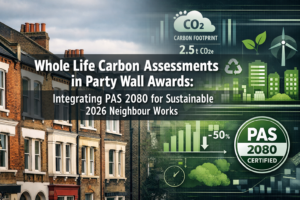
Buildings and infrastructure account for 39% of global carbon emissions, yet most property surveys still focus exclusively on structural defects and market value. As of March 2026, UK Government guidance now mandates whole life carbon (WLC) management across public sector projects, fundamentally transforming how chartered surveyors must approach RICS Building Surveys Level 3 assessments. Whole Life Carbon Assessments in Building Surveys: Integrating PAS 2080:2023 for Level 3 Compliance in 2026 represents not just an environmental imperative but a professional obligation that affects property valuations, lending decisions, and regulatory compliance across the UK construction sector.
The National Infrastructure and Service Transformation Authority (NISTA) released comprehensive WLC Management guidance on March 5, 2026, establishing best practices for assessing and reducing carbon impacts across the full lifecycle of built environment projects.[2] This guidance, aligned with PAS 2080:2023, clarifies how whole-life carbon assessments should integrate into the HM Treasury Project Business Case process and routine property surveys.[2]
For surveyors conducting commercial building surveys or residential assessments, understanding Whole Life Carbon Assessments in Building Surveys: Integrating PAS 2080:2023 for Level 3 Compliance in 2026 has become essential to meeting lender requirements, satisfying regulatory demands, and providing comprehensive property advice in an increasingly carbon-conscious market.
Key Takeaways
✅ PAS 2080:2023 provides the management framework while RICS WLCA standards deliver the measurement methodology for calculating whole life carbon in building surveys
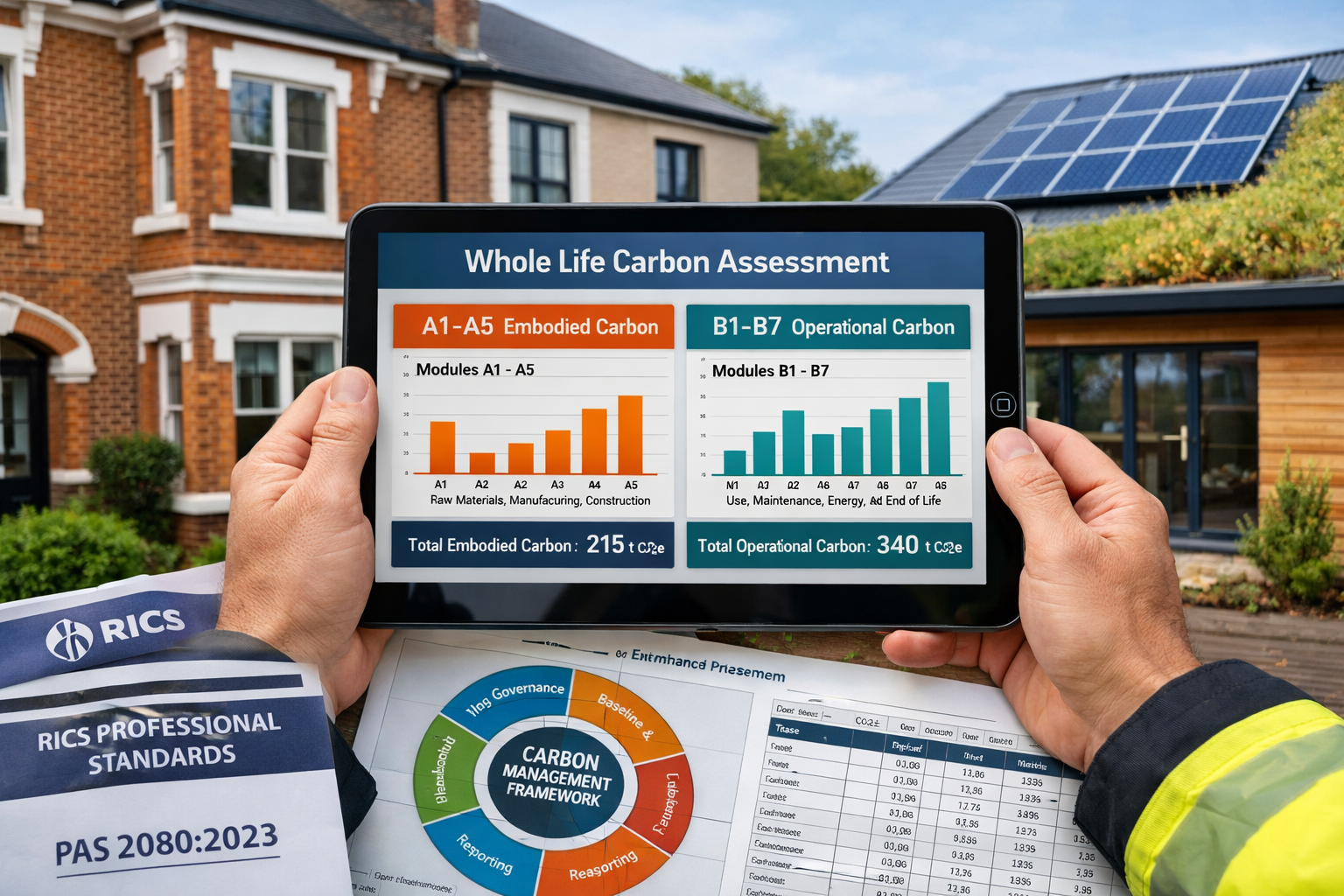
✅ Level 3 surveys must now assess both embodied carbon (materials, construction) and operational carbon (energy use, maintenance) across the entire building lifecycle
✅ Government mandates from March 2026 require WLC assessments for public sector projects, with private sector lenders increasingly following suit
✅ Practical implementation requires new surveyor competencies including carbon calculation tools, material databases, and lifecycle assessment methodologies
✅ Supply chain collaboration is mandatory under PAS 2080:2023, requiring surveyors to engage with designers, contractors, and material suppliers throughout the assessment process
Understanding the PAS 2080:2023 Framework for Building Surveys
What is PAS 2080:2023?
PAS 2080:2023 is a publicly available specification published by the British Standards Institution (BSI) that establishes a framework for managing carbon in infrastructure and buildings. The 2023 update strengthened its focus on whole-life carbon by ensuring carbon management is tackled across the entire asset lifecycle rather than in isolated stages, covering concept through design, construction, operation, maintenance, and end-of-life.[3]
The specification comprises 12 core clauses plus multiple annexes and guidance sections, covering:
- 🎯 Decarbonization principles and leadership
- 📊 Carbon management integration
- 🔍 Whole-life carbon assessment methodologies
- 🎯 Target setting and baseline establishment
- 📈 Monitoring, reporting, and verification
- 🤝 Procurement and supply chain engagement
- ♻️ Continual improvement processes
PAS 2080:2023 applies to asset owners, managers, designers, constructors, product and material suppliers, subcontractors, and all members involved in infrastructure project delivery or execution, covering both new projects and existing assets.[5]
How PAS 2080:2023 Integrates with RICS Standards
A critical distinction exists between management approach and measurement methodology. PAS 2080:2023 serves as the management framework governing targets, decision-making, monitoring, and reporting, while the RICS Whole Life Carbon Assessment standard provides the calculation methodology for measuring and reporting whole-life carbon emissions across the built environment.[5]
For chartered surveyors conducting Level 3 building surveys, this dual-standard framework means:
PAS 2080:2023 provides:
- Strategic carbon management approach
- Governance and leadership requirements
- Target-setting frameworks
- Reporting and verification protocols
- Supply chain engagement mandates
RICS WLCA provides:
- Standardized calculation methodologies
- Lifecycle module definitions (A1-D)
- Carbon coefficient databases
- Measurement boundaries and scopes
- Reporting templates and formats
Key Changes in the 2023 Update
The 2023 revision introduced several significant changes affecting building survey practice:
-
Enhanced Supply Chain Collaboration: Increased emphasis on engagement across the entire value chain, ensuring carbon emissions are approached collectively rather than in isolation.[3]
-
Lifecycle Coverage Expansion: Strengthened requirements to assess carbon across all lifecycle stages, not just construction or operational phases.
-
Mandatory Implementation Deadlines: National Highways required contractors and sub-contractors to implement accredited PAS 2080:2023 carbon management systems by the end of 2025, with expectations that other infrastructure agencies and the wider construction industry would follow suit.[3]
-
Integration with Government Processes: The March 2026 NISTA guidance explicitly aligned PAS 2080:2023 with HM Treasury Project Business Case processes, making it relevant for public sector property transactions and surveys.[2]
Whole Life Carbon Assessment Components for Level 3 Surveys
Understanding Lifecycle Modules (A-D)
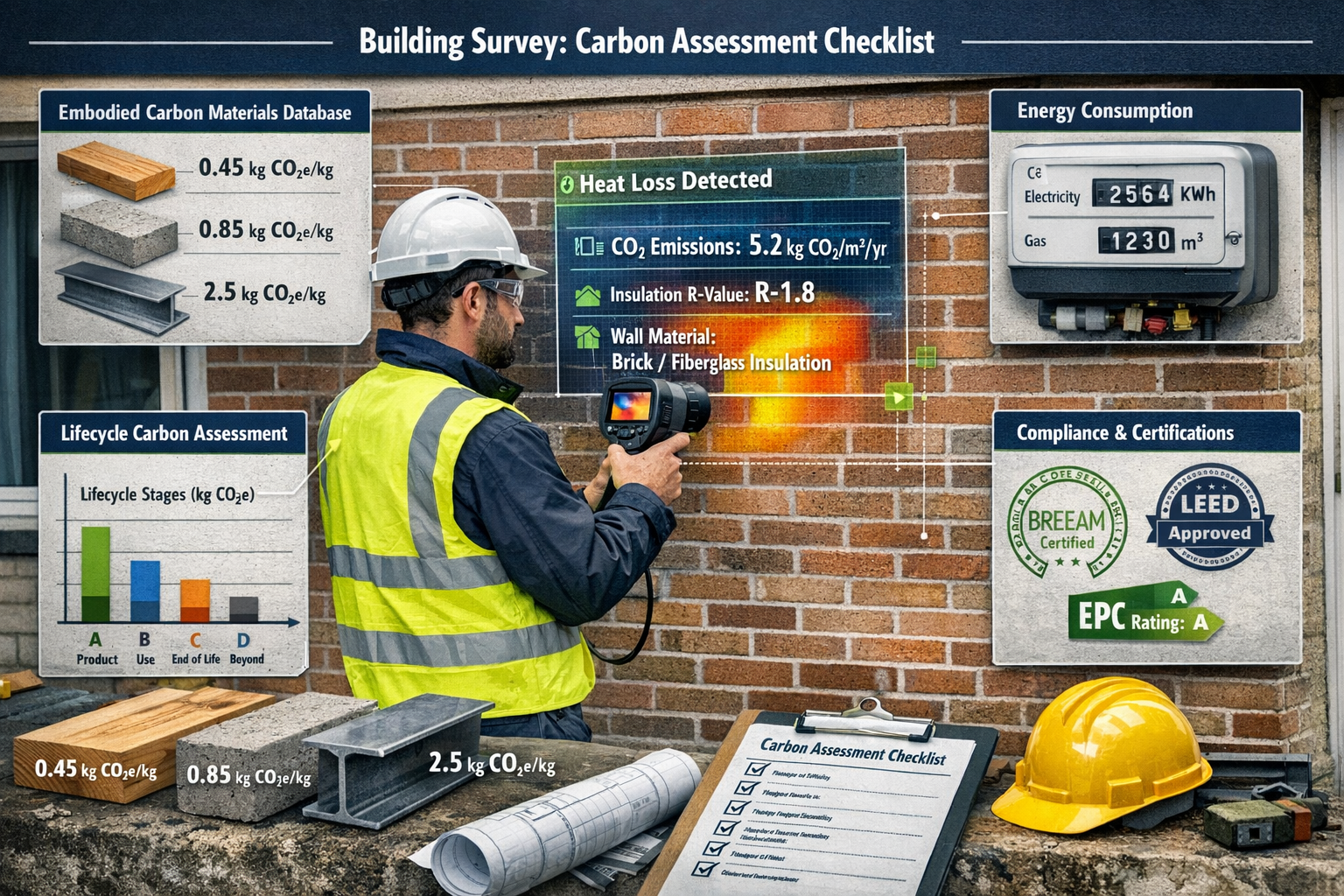
Whole life carbon assessment divides a building's carbon impact into distinct lifecycle modules following EN 15978 standards:
| Module | Stage | Components | Survey Focus |
|---|---|---|---|
| A1-A3 | Product Stage | Raw material extraction, transport, manufacturing | Material specifications, quantities, carbon coefficients |
| A4-A5 | Construction Stage | Transport to site, construction installation | Construction methods, waste, temporary works |
| B1-B5 | Use Stage – Building | Maintenance, repair, replacement, refurbishment | Maintenance schedules, component lifespans, replacement cycles |
| B6-B7 | Use Stage – Operations | Operational energy and water use | Energy performance, heating systems, insulation quality |
| C1-C4 | End of Life | Deconstruction, transport, waste processing, disposal | Demolition methods, recyclability, waste streams |
| D | Beyond Life Cycle | Reuse, recovery, recycling potential | Material circularity, salvage value |
When conducting Whole Life Carbon Assessments in Building Surveys: Integrating PAS 2080:2023 for Level 3 Compliance in 2026, surveyors must evaluate each module systematically, though the depth of assessment varies based on survey scope and client requirements.
Embodied Carbon Assessment in Building Surveys
Embodied carbon refers to greenhouse gas emissions associated with materials and construction processes throughout a building's lifecycle (Modules A, B1-B5, C, and D).[8]
Practical Assessment Steps for Surveyors:
1. Material Identification and Quantification
- Document all major building materials (foundations, structure, envelope, finishes)
- Measure quantities using site measurements and drawings
- Identify material specifications (concrete grade, steel type, insulation material)
2. Carbon Coefficient Application
- Use recognized databases (ICE Database, EPD Library, RICS Carbon Database)
- Apply appropriate carbon factors (kgCO2e per unit)
- Calculate embodied carbon for each material category
3. Construction Process Assessment
- Evaluate construction methods and temporary works
- Assess waste generation and management
- Consider transport distances and logistics
Example Calculation:
Brick facade: 1,200 m² × 150 kg/m² × 0.23 kgCO2e/kg = 41,400 kgCO2e
Concrete foundation: 80 m³ × 2,400 kg/m³ × 0.15 kgCO2e/kg = 28,800 kgCO2e
Steel frame: 15 tonnes × 1,460 kgCO2e/tonne = 21,900 kgCO2e
Operational Carbon Assessment
Operational carbon encompasses emissions from energy and water use during building occupation (Module B6-B7).[8]
Survey Assessment Checklist:
✅ Heating Systems
- Boiler type, age, and efficiency rating
- Fuel source (gas, oil, electric, renewable)
- Distribution system condition
- Control systems and zoning
✅ Insulation and Building Fabric
- Wall construction and insulation thickness
- Roof insulation type and condition
- Window glazing specifications (single, double, triple)
- Air tightness and draught proofing
✅ Renewable Energy Systems
- Solar PV panels (capacity, age, condition)
- Heat pumps (type, efficiency, installation quality)
- Solar thermal systems
- Battery storage capacity
✅ Energy Performance Data
- EPC rating and recommendations
- Annual energy consumption (kWh)
- Smart meter data (if available)
- Historical utility bills
✅ Water Systems
- Water heating method and efficiency
- Low-flow fixtures and water-saving devices
- Rainwater harvesting or greywater systems
For RICS building surveys, operational carbon typically represents 70-80% of total lifecycle emissions in residential properties, making it a critical assessment component.
Practical Implementation: Integrating WLC into Level 3 Surveys
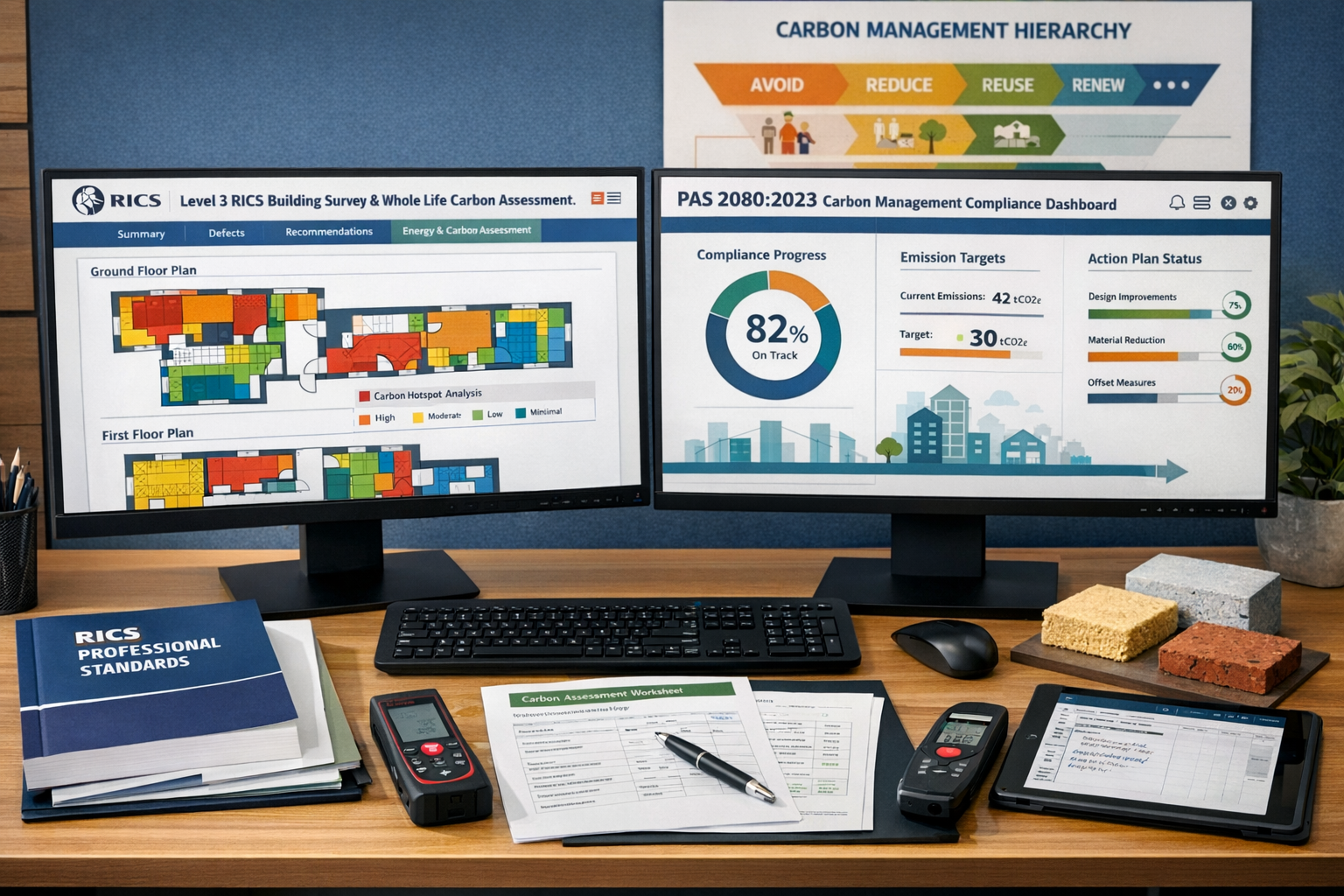
Step-by-Step Integration Process
Phase 1: Pre-Survey Preparation
1. Client Brief and Scope Definition
- Clarify whether WLC assessment is required or recommended
- Define assessment boundaries (full WLC or specific modules)
- Establish reporting format and detail level
- Confirm data access (EPCs, utility bills, maintenance records)
2. Tool and Resource Preparation
- Select appropriate carbon calculation software
- Access relevant carbon databases and coefficients
- Prepare data collection templates
- Review property documentation and drawings
3. Competency Verification
- Ensure surveyor team has WLC assessment training
- Verify understanding of PAS 2080:2023 requirements
- Confirm familiarity with RICS WLCA methodology
- Arrange specialist support if needed (M&E, energy assessors)
Phase 2: On-Site Assessment
Material and Construction Survey:
- Photograph and document all major building elements
- Measure dimensions and quantities systematically
- Record material specifications and conditions
- Identify any unusual or non-standard materials
- Assess construction quality and waste potential
Operational Systems Survey:
- Inspect heating, ventilation, and cooling systems
- Test insulation effectiveness (thermal imaging if available)
- Document renewable energy installations
- Assess building fabric performance
- Review maintenance history and replacement schedules
Data Collection:
- Obtain EPC certificates and recommendations
- Request utility consumption data (minimum 12 months)
- Review maintenance and repair records
- Document any recent upgrades or retrofits
- Photograph key carbon-relevant features
Phase 3: Post-Survey Analysis
Carbon Calculation:
- Input material quantities into calculation tool
- Apply appropriate carbon coefficients
- Calculate embodied carbon by lifecycle module
- Model operational carbon based on energy data
- Sum total whole life carbon (tCO2e)
Benchmarking and Interpretation:
- Compare against RICS benchmarks for property type
- Identify carbon hotspots and high-impact areas
- Assess performance against regulatory targets
- Evaluate improvement opportunities
Reporting Integration:
- Incorporate WLC findings into main survey report
- Present carbon data clearly with visualizations
- Provide context and benchmarking
- Recommend carbon reduction measures
- Estimate carbon and cost savings potential
Essential Tools and Resources for Surveyors
Carbon Calculation Software:
- One Click LCA: Comprehensive WLC assessment platform
- eTool: Building lifecycle assessment software
- RICS Carbon Database: Free carbon coefficient resource
- ICE Database: Inventory of Carbon & Energy (University of Bath)
Standards and Guidance:
- PAS 2080:2023 specification (BSI)
- RICS Whole Life Carbon Assessment professional standard[6]
- UK Government WLC Management Handbook (March 2026)[4]
- EN 15978 sustainability assessment methodology
Training and Certification:
- RICS WLC Assessment training courses
- PAS 2080:2023 implementation workshops
- Carbon Literacy Project certification
- Institution of Environmental Sciences (IES) programs
Common Challenges and Solutions
Challenge 1: Data Availability
- Issue: Limited access to historical energy data or material specifications
- Solution: Use proxy data from similar properties, conduct targeted testing, request data from current owners early in process
Challenge 2: Time and Cost Constraints
- Issue: WLC assessment adds survey time and complexity
- Solution: Develop streamlined assessment protocols, use templated calculation tools, offer tiered assessment levels
Challenge 3: Client Understanding
- Issue: Clients unfamiliar with WLC concepts and value
- Solution: Provide clear explanations, link to property value and running costs, emphasize regulatory trends
Challenge 4: Competency Gaps
- Issue: Surveyors lack carbon assessment training
- Solution: Invest in professional development, partner with carbon specialists, join professional networks
Regulatory Context and Market Drivers in 2026
Government Mandates and Public Sector Requirements
The March 2026 NISTA guidance established mandatory WLC assessment requirements for UK public sector infrastructure and building projects.[2] Key mandates include:
🏛️ NHS Net Zero Building Standard: All new healthcare buildings and major refurbishments must undertake whole-life carbon assessments covering both embodied and operational emissions.[4]
🛣️ National Highways Requirements: Contractors and sub-contractors must implement accredited PAS 2080:2023 carbon management systems, with compliance verification required for project approval.[3]
🏗️ Environment Agency Projects: Continuous development of WLC tools, processes, and expertise to reduce emissions from construction and maintenance activities to meet net zero targets.[4]
📋 HM Treasury Integration: WLC assessments must integrate into Project Business Case processes for all major public infrastructure investments.[2]
Private Sector Adoption and Lender Requirements
While government mandates drive public sector compliance, private sector adoption of Whole Life Carbon Assessments in Building Surveys: Integrating PAS 2080:2023 for Level 3 Compliance in 2026 is accelerating due to:
Lender Requirements:
- Major UK banks incorporating carbon risk into lending decisions
- Preferential mortgage rates for low-carbon properties
- Green finance products requiring WLC verification
- Portfolio carbon reporting obligations under climate disclosure rules
Investment and Valuation Impacts:
- Institutional investors demanding carbon performance data
- Property valuations increasingly reflecting carbon risk
- Stranded asset concerns for high-carbon buildings
- ESG reporting requirements for commercial portfolios
Market Differentiation:
- Low-carbon properties commanding premium prices
- Faster sales for energy-efficient homes
- Tenant preferences shifting toward sustainable buildings
- Corporate occupiers prioritizing low-carbon workspaces
Future Regulatory Trajectory
The regulatory landscape continues evolving rapidly:
2026-2027 Expected Developments:
- Extension of mandatory WLC assessment to private sector projects above certain thresholds
- Integration of carbon performance into Building Regulations Part L
- Enhanced EPC requirements incorporating whole life carbon metrics
- Potential carbon taxation or levy systems for high-carbon buildings
Carbon Reduction Hierarchy and Surveyor Recommendations
When identifying improvement opportunities in Whole Life Carbon Assessments in Building Surveys: Integrating PAS 2080:2023 for Level 3 Compliance in 2026, surveyors should apply the carbon management hierarchy:
1️⃣ Avoid (Highest Priority)
- Retain existing structures rather than demolish and rebuild
- Eliminate unnecessary building elements or oversizing
- Question the need for carbon-intensive materials
- Consider adaptive reuse of existing buildings
2️⃣ Reduce
- Specify lower-carbon material alternatives (timber vs. concrete)
- Optimize structural design for material efficiency
- Improve building fabric to reduce operational energy demand
- Enhance insulation, airtightness, and glazing performance
3️⃣ Replace
- Substitute high-carbon materials with sustainable alternatives
- Upgrade inefficient heating systems to heat pumps
- Install renewable energy generation (solar PV, solar thermal)
- Replace fossil fuel systems with electric alternatives
4️⃣ Offset (Last Resort)
- Purchase verified carbon credits for residual emissions
- Invest in nature-based solutions (tree planting, habitat restoration)
- Support renewable energy projects
- Contribute to carbon sequestration initiatives
Example Recommendations for Victorian Terrace Survey:
"The property's whole life carbon assessment reveals total lifecycle emissions of 185 tCO2e, approximately 35% above the RICS benchmark for similar properties. Key improvement opportunities include:
High Impact (Reduce):
- Upgrade loft insulation from 100mm to 300mm (saving 12 tCO2e over 30 years)
- Install external wall insulation to solid walls (saving 28 tCO2e)
- Replace single-glazed windows with triple-glazed units (saving 8 tCO2e)
Medium Impact (Replace):
- Replace gas boiler with air source heat pump (saving 45 tCO2e)
- Install 4kW solar PV system (saving 32 tCO2e)
Total potential reduction: 125 tCO2e (68% reduction), estimated investment: £35,000-£45,000"
Building a WLC-Integrated Survey Practice
Developing Surveyor Competencies
To effectively deliver Whole Life Carbon Assessments in Building Surveys: Integrating PAS 2080:2023 for Level 3 Compliance in 2026, surveying practices should invest in:
Technical Skills:
- Carbon calculation methodologies and tools
- Lifecycle assessment principles
- Material carbon coefficients and databases
- Energy modeling and thermal performance assessment
- Renewable energy system evaluation
Standards Knowledge:
- PAS 2080:2023 framework and requirements
- RICS WLCA professional standard[6]
- EN 15978 sustainability assessment
- Building Regulations Part L and Future Homes Standard
- Green building certification schemes (BREEAM, LEED, Passivhaus)
Soft Skills:
- Client education and communication about carbon
- Cross-disciplinary collaboration with M&E engineers, architects, energy assessors
- Report writing for carbon performance
- Visual data presentation and infographics
Marketing WLC-Enhanced Services
Forward-thinking surveying practices can differentiate their RICS building surveys by promoting WLC capabilities:
Service Positioning:
- "Future-proof property assessments incorporating whole life carbon"
- "PAS 2080:2023 compliant building surveys"
- "Carbon-conscious property advice for sustainable investment"
- "Integrated WLC assessment with Level 3 surveys"
Target Markets:
- Environmentally conscious homebuyers
- Green mortgage applicants
- Commercial property investors with ESG mandates
- Public sector clients requiring compliance
- Developers seeking planning advantages
Value Propositions:
- Identify hidden carbon costs affecting long-term property value
- Unlock green finance and preferential mortgage rates
- Support informed retrofit investment decisions
- Ensure regulatory compliance and future-proofing
- Demonstrate professional leadership in sustainability
Conclusion
Whole Life Carbon Assessments in Building Surveys: Integrating PAS 2080:2023 for Level 3 Compliance in 2026 represents a fundamental evolution in surveying practice, transforming property assessment from purely structural and valuation concerns to comprehensive lifecycle carbon evaluation. The March 2026 UK Government guidance, combined with PAS 2080:2023 requirements and RICS professional standards, establishes clear expectations that surveyors must assess both embodied and operational carbon across the entire building lifecycle.[2][3][6]
For chartered surveyors, this shift creates both challenges and opportunities. The integration of WLC assessment into routine Level 3 building surveys requires new competencies, tools, and methodologies, but also positions forward-thinking practices as leaders in an increasingly carbon-conscious property market. As lenders, investors, and regulators demand comprehensive carbon performance data, surveyors who can deliver integrated WLC assessments will provide essential value to clients navigating the transition to net zero.
The practical implementation framework outlined in this article—from pre-survey preparation through on-site assessment to post-survey analysis—provides a roadmap for surveyors to incorporate WLC evaluation systematically and efficiently. By applying the carbon management hierarchy and providing actionable recommendations, surveyors transform from passive property reporters to active advisors supporting the built environment's decarbonization.
Next Steps for Surveying Practices
✅ Invest in Training: Enroll surveyors in RICS WLC Assessment and PAS 2080:2023 training programs
✅ Acquire Tools: License carbon calculation software and access recognized databases
✅ Develop Protocols: Create standardized WLC assessment procedures integrated with existing survey workflows
✅ Build Partnerships: Establish relationships with energy assessors, M&E engineers, and carbon specialists
✅ Update Marketing: Promote WLC-enhanced survey services to target environmentally conscious clients
✅ Pilot Projects: Begin with voluntary WLC assessments on selected projects to build experience
✅ Monitor Regulations: Track evolving requirements and prepare for expanded mandates
The transition to carbon-conscious surveying is not optional—it's inevitable. Practices that embrace Whole Life Carbon Assessments in Building Surveys: Integrating PAS 2080:2023 for Level 3 Compliance in 2026 today will lead the profession tomorrow, providing essential guidance as the UK property sector navigates its path to net zero by 2050.
For expert guidance on incorporating WLC assessment into your property survey, contact Manchester Surveyors to discuss how our RICS chartered surveyors can support your carbon-conscious property decisions.
References
[1] Carbon Management In Buildings And Infrastructure – https://www.bsigroup.com/en-GB/insights-and-media/insights/brochures/carbon-management-in-buildings-and-infrastructure/
[2] Uk Government Whole Life Carbon Management Guidance – https://circularecology.com/news/uk-government-whole-life-carbon-management-guidance
[3] Pas2080 Understanding The Basics – https://www.nqa.com/en-gb/resources/blog/february-2025/pas2080-understanding-the-basics
[4] Nista Wlc Management Handbook 2026 – https://assets.publishing.service.gov.uk/media/69a81a47b9bd90e63a252292/NISTA_WLC_Management_Handbook_2026.pdf
[5] Pas 2080 Suppliers Subcontractors Bids Delivery – https://www.seedling.earth/post/pas-2080-suppliers-subcontractors-bids-delivery
[6] Whole Life Carbon Assessment – https://www.rics.org/profession-standards/rics-standards-and-guidance/sector-standards/construction-standards/whole-life-carbon-assessment
[7] All You Need To Know About The Revised Pas 2080 Standard On Carbon Management – https://insights.aecom.com/insights/article/all-you-need-to-know-about-the-revised-pas-2080-standard-on-carbon-management
[8] Whole Life Carbon Assessment Wlca Built Environment – https://globalabc.org/sustainable-materials-hub/resources/whole-life-carbon-assessment-wlca-built-environment
[9] Whole Life Carbon Assessment Wlca – https://blue-marble.co.uk/sustainability-guides/whole-life-carbon-assessment-wlca/