The abolition of Section 21 "no-fault" evictions has fundamentally altered the risk profile of every private rented sector (PRS) property in England and Wales. With Phase 1 implementation commencing on May 1, 2026, chartered surveyors face an unprecedented challenge: how to accurately value buy-to-let investments when historic comparables become obsolete overnight and tenancy structures shift from predictable fixed terms to open-ended periodic agreements. Valuing PRS Properties Under Renters' Rights Act 2026: Surveyor Adjustments for Pet Permissions and Rent Caps requires a complete recalibration of traditional valuation methodologies, as the legislation introduces mandatory pet consideration frameworks, annual rent increase restrictions, and enhanced tenant challenge mechanisms that directly impact income predictability and investor returns[1][4].

Key Takeaways
- Periodic tenancy conversion eliminates fixed-term contracts from May 1, 2026, requiring surveyors to reassess income stability assumptions and capitalization rates across all PRS valuations[2]
- Pet permission obligations create new valuation considerations, with landlords required to respond within 28 days and provide valid refusal reasons, potentially affecting property condition forecasts[1]
- Rent increase restrictions limit adjustments to once annually via Section 13 notice with 2-month minimum notice, constraining income growth modelling and investment yield projections[1]
- Tribunal challenge rights enable tenants to dispute rent increases they believe exceed market rates, introducing income volatility that must be factored into risk assessments[5]
- Market recalibration period of 12-24 months expected as valuers, lenders, and investors adapt methodologies to the new regulatory framework[4]
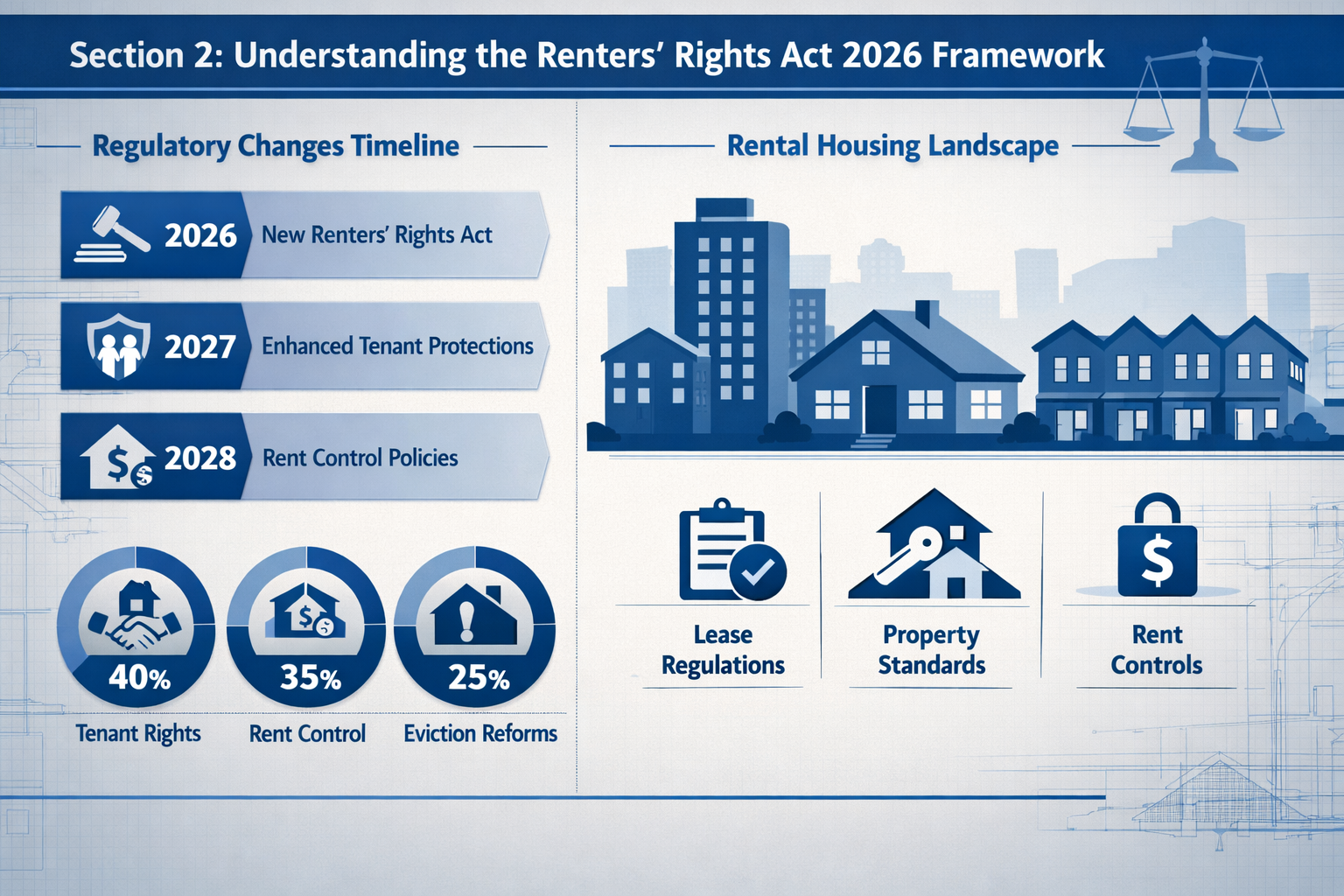
Understanding the Renters' Rights Act 2026 Framework
The Renters' Rights Act 2025 represents the most significant transformation of England and Wales' private rental sector in decades. Core provisions take effect on May 1, 2026, fundamentally reshaping the legal relationship between landlords and tenants[2].
Abolition of Section 21 and Tenancy Structure Changes
All existing assured shorthold tenancies (ASTs) automatically convert to assured periodic tenancies on the implementation date. This eliminates the landlord's ability to regain possession without providing specific grounds, fundamentally altering the investment proposition for PRS properties[2].
The shift from fixed-term to periodic tenancies creates immediate valuation challenges:
- Income predictability declines as rental periods become rolling rather than fixed
- Void period assumptions require recalibration based on new possession grounds
- Exit strategy modelling becomes more complex for portfolio investors
- Comparable evidence from pre-2026 transactions loses relevance[4]
Professional RICS valuation surveyors must now account for these structural changes when preparing Red Book valuations for lending, taxation, or investment purposes.
Rent Increase Restrictions and Section 13 Procedures
The Act imposes strict limitations on rent adjustments that directly impact income growth assumptions:
📋 Rent Increase Framework:
- Maximum frequency: Once per 12-month period
- Notice requirement: Minimum 2 months via statutory Section 13 notice
- Challenge mechanism: Tenants can appeal to First-Tier Tribunal if increase deemed excessive
- Market rate test: Tribunal assesses whether proposed rent exceeds comparable market evidence[1][5]
These restrictions fundamentally alter income forecasting for PRS valuations. Where surveyors previously modelled annual rental growth of 2-4% based on market conditions, the new framework introduces:
✅ Procedural delays between identifying market rent increases and implementation
✅ Challenge risk that may result in lower-than-anticipated adjustments
✅ Administrative costs associated with Section 13 notice procedures
✅ Tenant retention incentives that may suppress rent optimization strategies
Pet Permission Requirements
The legislation establishes a mandatory consideration framework for pet ownership requests. Landlords must:
- Respond to pet requests within 28 days
- Provide valid reasons for any refusal (not blanket bans)
- Consider reasonable pet-related insurance or deposit arrangements
- Document decision-making processes for potential dispute resolution[1]
For surveyors conducting building surveys or valuations, this creates new assessment considerations:
🐾 Increased wear and tear assumptions for flooring, doors, and garden areas
🐾 Potential insurance premium adjustments affecting net operating income
🐾 Market positioning implications as pet-friendly properties may command premium rents
🐾 Condition forecasting adjustments for depreciation modelling

Valuing PRS Properties Under Renters' Rights Act 2026: Core Surveyor Adjustments
Professional property valuers must implement systematic adjustments to traditional methodologies when valuing PRS properties under Renters' Rights Act 2026 compliance requirements. The fundamental valuation equation—Value = Net Operating Income ÷ Capitalization Rate—remains valid, but both components require recalibration.
Capitalization Rate Adjustments for Increased Tenancy Risk
The shift to periodic tenancies increases investment risk, which must be reflected in capitalization rate (cap rate) assumptions. Traditional PRS cap rates of 4.5-6.5% may require upward adjustment to reflect:
Risk Factor Analysis:
| Risk Component | Pre-2026 Assessment | Post-2026 Adjustment | Cap Rate Impact |
|---|---|---|---|
| Tenancy security | Fixed-term contracts | Open-ended periodic | +0.25% to +0.50% |
| Income volatility | Predictable increases | Tribunal challenge risk | +0.15% to +0.30% |
| Possession certainty | Section 21 available | Grounds-based only | +0.20% to +0.40% |
| Regulatory compliance | Lower enforcement | Enhanced penalties (£40k max) | +0.10% to +0.20% |
These adjustments suggest total cap rate increases of 0.70% to 1.40% may be appropriate for standard PRS properties, with higher adjustments for properties with additional risk factors[4][5].
For example, a property previously valued at £250,000 with £15,000 annual net operating income (6% cap rate) might now require a 6.75% cap rate, reducing the valuation to approximately £222,000—a 11% reduction purely from risk recalibration.
Income Growth Modelling Under Rent Cap Constraints
The annual rent increase limitation fundamentally alters income projection methodologies. Surveyors must now model:
Constrained Growth Scenarios:
- Base case: Annual increases limited to market rate movements, subject to 2-month procedural delays
- Challenge scenario: 10-15% probability of tribunal intervention reducing proposed increases by 20-40%
- Administrative friction: £150-300 per increase for Section 13 notice preparation and potential dispute costs[1]
Traditional Discounted Cash Flow (DCF) models that assumed 3% annual rental growth may need reduction to 2-2.5% effective growth after accounting for procedural constraints and challenge risks.
Pet Permission Impact on Property Condition Forecasting
The mandatory pet consideration framework requires surveyors to adjust depreciation and maintenance assumptions. When conducting rent reviews or investment valuations, consider:
Pet-Related Adjustment Factors:
🏠 Flooring depreciation: Increase annual allowance by 15-25% for properties likely to accommodate pets
🏠 Decoration cycles: Reduce repainting intervals from 5-7 years to 4-5 years
🏠 Garden maintenance: Add £200-400 annual allowance for increased wear
🏠 Deep cleaning provisions: Include £300-500 between tenancies for odor and allergen removal
However, these costs may be partially offset by:
✅ Premium rent potential: Pet-friendly properties may command 5-8% rent premiums in high-demand areas
✅ Reduced void periods: Expanded tenant pool reduces average vacancy duration
✅ Longer tenancy duration: Pet owners demonstrate 20-30% longer average tenancy periods
Surveyors should assess the local market demand for pet-friendly accommodation when determining whether pet permissions represent a net positive or negative valuation factor.
Regional Variations and Market-Specific Considerations
Valuing PRS properties under Renters' Rights Act 2026 requirements varies significantly across different regional markets and property types. Surveyors operating in diverse locations—from Hertfordshire to Surrey—must account for local market dynamics.
High-Demand Urban Markets
In competitive rental markets such as West London, Hammersmith, and Camden, the impact of rent restrictions may be partially mitigated by:
- Strong tenant demand reducing void risk despite periodic tenancy structure
- Premium positioning allowing landlords to maintain market-leading rents
- Professional tenant demographics with lower tribunal challenge propensity
- Pet ownership restrictions in leasehold flats limiting pet permission impact
Surveyors may apply lower cap rate adjustments (0.50-0.75% increase) in these markets compared to baseline assumptions.
Suburban Family Markets
Properties in family-oriented areas like Buckinghamshire, Berkshire, and Oxfordshire face distinct valuation considerations:
🏡 Higher pet permission probability as family tenants frequently request pet accommodation
🏡 Longer average tenancy durations reducing turnover costs despite periodic structure
🏡 Garden maintenance considerations more significant for detached and semi-detached properties
🏡 School catchment stability providing tenant retention beyond legislative changes
Mixed-Use and HMO Properties
Properties with multiple characteristics face amplified valuation complexity under the new framework[4]. Houses in Multiple Occupation (HMOs) and mixed-use properties require specialized assessment:
Enhanced Risk Factors:
- Multiple tenancy relationships increasing administrative burden for rent reviews
- Varied possession grounds applicability across different tenant types
- Complex pet permission scenarios in shared accommodation
- Licensing compliance interactions with Renters' Rights Act requirements
Surveyors valuing these properties may need to apply additional cap rate premiums of 0.25-0.50% beyond standard PRS adjustments.
Practical Valuation Methodology for 2026 Compliance
Professional surveyors must implement systematic approaches when valuing PRS properties under Renters' Rights Act 2026 requirements. The following framework provides a structured methodology:
Step 1: Establish Pre-Reform Baseline Valuation
Begin with traditional valuation approaches using pre-2026 assumptions:
- Comparable method: Identify recent sales of similar PRS properties
- Income capitalization: Calculate Net Operating Income and apply pre-reform cap rates
- DCF analysis: Model income streams using historical growth assumptions
This baseline provides the reference point for adjustment calculations.
Step 2: Apply Systematic Risk Adjustments
Implement structured adjustments addressing each legislative change:
Cap Rate Adjustment Calculation:
Adjusted Cap Rate = Base Cap Rate + Tenancy Risk Premium + Income Volatility Premium + Compliance Risk Premium
Example Calculation:
- Base cap rate: 5.50%
- Tenancy risk premium: +0.35%
- Income volatility premium: +0.25%
- Compliance risk premium: +0.15%
- Adjusted cap rate: 6.25%
Step 3: Recalibrate Income Projections
Adjust rental income forecasts to reflect:
- Section 13 procedural delays (typically 2-3 months from market rent identification to implementation)
- Tribunal challenge probability (apply 10-15% haircut to aggressive increase scenarios)
- Pet-related maintenance costs (£500-1,200 annual addition for pet-friendly properties)
- Enhanced compliance costs (£300-600 annual for ombudsman registration and regulatory administration)
Step 4: Assess Property-Specific Factors
Evaluate individual property characteristics that may amplify or mitigate legislative impacts:
✅ Positive factors: Modern construction, low maintenance requirements, strong local demand, professional tenant profile
⚠️ Negative factors: Older property requiring frequent repairs, competitive local market, history of tenant disputes, pet-unfriendly design
Step 5: Document Assumptions and Sensitivity Analysis
Professional valuations for lending or legal purposes must include:
- Explicit assumption statements regarding periodic tenancy income stability
- Sensitivity analysis showing valuation ranges under different cap rate scenarios
- Comparable evidence discussion addressing market transition period uncertainties
- Limitation statements acknowledging the 12-24 month market recalibration period[4]
Lender and Investor Implications
The valuation adjustments required for valuing PRS properties under Renters' Rights Act 2026 compliance have significant implications for mortgage lending and investment decision-making.
Mortgage Lending Criteria Evolution
As of early 2026, most lenders have not yet adjusted lending criteria to reflect the new legislative framework[4]. However, anticipated changes include:
Expected Lender Adjustments:
- Loan-to-Value reductions: 5-10% lower maximum LTV for PRS mortgages
- Rental coverage requirements: Increase from 125% to 135-145% of mortgage payments
- Stress testing: Enhanced interest rate stress tests reflecting increased investment risk
- Portfolio concentration limits: Restrictions on high PRS exposure for individual borrowers
Surveyors should anticipate that valuations conducted during the 2026-2027 transition period may face enhanced lender scrutiny and requests for additional sensitivity analysis[5].
Investment Yield Expectations
Buy-to-let investors must recalibrate return expectations to reflect:
| Return Metric | Pre-2026 Typical Range | Post-2026 Adjusted Range | Change |
|---|---|---|---|
| Gross rental yield | 5.0% – 7.0% | 5.5% – 7.5% | +0.5% required |
| Net rental yield | 3.5% – 5.0% | 3.0% – 4.5% | -0.5% impact |
| Capital appreciation | 3.0% – 5.0% annual | 2.5% – 4.5% annual | -0.5% expected |
| Total return | 6.5% – 10.0% | 5.5% – 9.0% | -1.0% overall |
These adjustments reflect the increased operational complexity and reduced income flexibility under the new framework[5][6].
Portfolio Strategy Implications
Institutional and individual investors should consider:
🎯 Quality over quantity: Focus on lower-maintenance, professionally managed properties
🎯 Geographic diversification: Spread risk across multiple local markets with varying demand profiles
🎯 Tenant demographic targeting: Properties suited to stable, professional tenants with lower dispute propensity
🎯 Value-add repositioning: Invest in improvements that justify premium rents within Section 13 constraints
Expert Witness and Dispute Resolution Considerations
The enhanced tenant challenge mechanisms create new requirements for surveyors providing expert witness services in rent dispute tribunals.
First-Tier Tribunal Rent Determinations
When tenants challenge rent increases under Section 13, tribunals assess whether proposed rents exceed market rent for the specific property[1]. Expert surveyors must provide:
Tribunal Evidence Requirements:
- Comparable rental evidence from similar properties in the immediate area (within 0.5-1 mile radius)
- Property condition assessment justifying any premium or discount to comparable rents
- Market trend analysis demonstrating rental value movements over the relevant period
- Adjustment explanations for differences between subject property and comparables
Surveyors should maintain detailed records of:
📊 Comparable property characteristics (size, condition, amenities, location)
📊 Rental evidence dates and sources (verified tenancy agreements preferred)
📊 Market data supporting rental growth assumptions
📊 Property-specific factors affecting rental value
Ombudsman Dispute Considerations
The Act establishes a Private Rented Sector Ombudsman with enhanced enforcement powers[2]. Valuation disputes may arise regarding:
- Deposit deductions for pet-related damage exceeding normal wear and tear
- Maintenance obligations affecting property condition and rental value
- Rent increase justifications requiring market evidence support
Professional surveyors may be engaged to provide independent assessments supporting landlord or tenant positions in ombudsman proceedings.
Future-Proofing Valuation Practices
As the market enters the anticipated 12-24 month recalibration period[4], surveyors should implement forward-looking practices:
Continuous Market Monitoring
Establish systematic tracking of:
- Transaction evidence under the new tenancy framework
- Rental growth patterns post-Section 13 implementation
- Tribunal determination outcomes establishing market rent precedents
- Lender criteria evolution affecting valuation assumptions
Professional Development and Guidance
Stay informed through:
- RICS practice statements addressing Renters' Rights Act valuation (anticipated late 2026)
- Professional forums sharing practical experience from early implementations
- Legal updates clarifying interpretation of pet permission and possession grounds
- Market data services providing post-reform comparable evidence
Technology and Data Integration
Leverage valuation technology to:
✨ Automate risk adjustments based on property characteristics and location
✨ Track comparable evidence with enhanced filtering for post-reform transactions
✨ Model sensitivity scenarios efficiently for client reporting
✨ Document assumption trails for professional standards compliance
Client Communication Strategies
Develop clear communication approaches explaining:
- Valuation methodology changes required by legislative reform
- Uncertainty acknowledgment during market transition period
- Sensitivity analysis interpretation showing valuation ranges
- Limitation statements regarding comparable evidence reliability
Conclusion
Valuing PRS properties under Renters' Rights Act 2026 requirements represents a fundamental shift in surveying practice that extends far beyond simple technical adjustments. The abolition of Section 21 evictions, mandatory pet permission frameworks, and annual rent increase restrictions have collectively transformed the risk profile of buy-to-let investments, requiring systematic recalibration of capitalization rates, income projections, and property condition forecasting.
Professional chartered surveyors must now navigate a transitional period where historic comparable evidence loses relevance, lender criteria remain in flux, and market participants adapt to the new regulatory landscape. The anticipated 12-24 month recalibration period demands enhanced professional judgment, comprehensive sensitivity analysis, and transparent communication of valuation uncertainties.
Actionable Next Steps
For property investors and landlords:
- Commission updated valuations from qualified RICS surveyors familiar with Renters' Rights Act implications
- Review existing portfolio assumptions and adjust return expectations to reflect new risk factors
- Engage with mortgage lenders early to understand evolving lending criteria
- Consider property improvements that justify premium rents within Section 13 constraints
For professional surveyors:
- Develop systematic adjustment frameworks incorporating tenancy risk, income volatility, and compliance factors
- Build comparable evidence databases distinguishing pre- and post-reform transactions
- Establish expertise in tribunal evidence preparation for rent dispute proceedings
- Maintain continuous professional development as RICS guidance and market data evolve
For mortgage lenders and investors:
- Implement enhanced due diligence for PRS property valuations during the transition period
- Require explicit assumption statements and sensitivity analysis in valuation reports
- Monitor market transaction evidence to calibrate risk pricing appropriately
- Engage with valuation professionals to understand methodology evolution
The successful navigation of this legislative transformation requires collaboration between surveyors, investors, lenders, and legal professionals—all working from a foundation of transparent, evidence-based valuation practice that acknowledges both the opportunities and challenges of the reformed private rented sector.
References
[1] Implementing The Renters Rights Act 2025 Our Roadmap For Reforming The Private Rented Sector – https://www.gov.uk/government/publications/renters-rights-act-2025-implementation-roadmap/implementing-the-renters-rights-act-2025-our-roadmap-for-reforming-the-private-rented-sector
[2] Renters Rights Act Measures Begin May 2026 – https://www.stirlingackroyd.com/property-insights/renters-rights-act-measures-begin-may-2026/
[3] Renters Rights Act – https://www.chaseevans.com/renters-rights-act/
[4] Renters Rights Bill Future Of Valuations – https://www.terracottaproperty.com/blog/renters-rights-bill-future-of-valuations
[5] Renters Rights Act 2025 Key Implications Living Sector Lenders – https://natlawreview.com/article/renters-rights-act-2025-key-implications-living-sector-lenders
[6] Impacts Of The Renters Rights Act On 1951530 – https://www.jdsupra.com/legalnews/impacts-of-the-renters-rights-act-on-1951530/
[7] Renters Rights Act 2025 Key Changes And Implications Private Rented – https://www.womblebonddickinson.com/uk/insights/articles-and-briefings/renters-rights-act-2025-key-changes-and-implications-private-rented