The Prime Central London (PCL) property market stands at a critical juncture in 2026. After years of correction and uncertainty, valuing prime London properties in 2026 requires a fundamentally different approach than the boom-era strategies of the past decade. With national house price forecasts pointing to modest 2% growth and PCL experiencing a stabilisation phase rather than a rebound, chartered surveyors are recalibrating their valuation methodologies to reflect this new reality of flat growth and evolving investor returns.
For investors, developers, and homeowners navigating this transformed landscape, understanding how professional surveyors adjust their assessments becomes essential. The techniques employed by chartered surveyors in London have evolved to account for regional disparities, changing fiscal policies, and the unique characteristics of a market heavily influenced by international capital flows and wealth taxation considerations.
Key Takeaways
- Prime Central London is stabilising rather than rebounding, with surveyors adjusting valuation approaches to reflect modest 2% national growth forecasts and regional underperformance compared to Northern markets
- RICS-backed metrics show improving sentiment with transaction volume expectations reaching their strongest reading in over a year, though buyer enquiries and agreed sales remain cautiously negative
- Surveyor adjustments now prioritise comparative regional analysis, factoring in London's -1.2% annual change against Northern regions showing 4-6% growth when establishing realistic valuations
- Interest rate cuts and reduced fiscal uncertainty are rebuilding buyer confidence, requiring valuers to incorporate forward-looking monetary policy impacts into their assessments
- Investment return calculations must account for stamp duty increases effective April 2025, fundamentally altering net yield projections and capital appreciation models for prime properties
The 2026 Prime London Market Context: Understanding the Stabilisation Phase

Regional Performance Disparities Shape Valuation Benchmarks
The UK property market in 2026 presents a tale of two markets—and valuing prime London properties in 2026 requires acknowledging this fundamental divide. While national house prices are forecast to rise by approximately 2% throughout the year, London properties have shown a -1.2% annual change, creating a stark contrast with Northern regions experiencing robust growth.[2]
Regional Performance Comparison (2026):
| Region | Annual Price Change | Market Characteristics |
|---|---|---|
| North East | +6.8% | Strong affordability, wage growth |
| North West | +4.1% | Robust buyer demand, employment growth |
| London | -1.2% | Affordability pressures, fiscal sensitivity |
| South East | Subdued | Similar affordability challenges to London |
| Prime Central London | Stabilising | International capital dependent |
This regional disparity fundamentally impacts how chartered surveyors approach valuations. When conducting homebuyer surveys in prime London areas, professionals must now incorporate comparative regional analysis as a core adjustment factor—something that was less critical during periods of uniform national growth.
The Correction Phase Transition 📊
Prime Central London is entering what market analysts describe as a stabilisation phase rather than experiencing the sharp rebound many anticipated.[1] This distinction matters enormously for valuation purposes. The correction phase that dominated 2023-2025 is easing, with sentiment improving gradually and transaction momentum building—though not surging.
According to RICS three-month price metrics from January 2026, price falls may be nearing their trough, marking a potential turning point rather than a dramatic recovery.[1] For surveyors, this means adjusting comparable sales data to account for this transitional market state, where historical peak values no longer serve as reliable benchmarks.
"Buyers and sellers breathed a collective sigh of relief when property tax changes in the budget proved not as punitive as many expected." — Jeremy Leaf, former RICS residential chair[2]
Sentiment Indicators and Transaction Momentum
The net balance of surveyors now expect transaction volumes to rise over the next 12 months—the strongest reading in over a year.[1] Price expectations for the same period are also the most positive since early 2025. However, buyer enquiries and agreed sales metrics remain in negative territory, though becoming less negative.
In January 2026, the balance of surveyors reporting rising buyer enquiries improved compared with late 2025, and agreed sales recorded their least negative reading since mid-2025.[1] These "tentative signs" from the Royal Institution of Chartered Surveyors suggest the market could be turning a corner after prolonged caution shaped by interest rate volatility, political change, and tax reform.
For professionals conducting valuations in areas like Hampstead or South West London, these sentiment indicators provide crucial context for forward-looking adjustments in their assessments.
Surveyor Methodologies for Valuing Prime London Properties in 2026: Technical Adjustments
Comparable Sales Analysis in Flat Growth Environments
The cornerstone of property valuation—the comparable sales approach—requires significant recalibration when valuing prime London properties in 2026 amid flat growth conditions. Traditional comparable analysis assumes relatively stable or predictable market trajectories. In a stabilising market with regional disparities, surveyors must apply more sophisticated adjustment factors.
Key Adjustment Categories:
- Temporal adjustments: Accounting for the transition from correction to stabilisation phase
- Location premiums: Recognising micro-market variations within PCL postcodes
- Condition differentials: Enhanced weighting given reduced renovation appetite in uncertain markets
- Market timing factors: Adjusting for whether comparable sales occurred during peak uncertainty or emerging stability
When examining comparable properties, chartered surveyors now place greater emphasis on transactions from the past 3-6 months rather than the traditional 6-12 month window. This shorter timeframe better captures the current stabilisation phase and avoids distortions from the more pessimistic late-2025 market conditions.
Income Capitalisation Adjustments for Investment Properties
For investors evaluating prime London properties as income-generating assets, the income capitalisation approach requires careful recalibration. This methodology values properties based on their rental income potential, applying capitalisation rates (cap rates) that reflect market risk and return expectations.
2026 Income Valuation Considerations:
✅ Rental yield compression: Prime London rental yields remain relatively modest (typically 2.5-4%) compared to regional markets
✅ Cap rate adjustments: Reflecting improved confidence but ongoing fiscal sensitivity
✅ Void period assumptions: Accounting for potentially longer letting periods in stabilising markets
✅ Tenant quality premiums: Enhanced value for properties with established, creditworthy tenants
✅ Lease structure impacts: Greater differentiation between short-term and long-term lease valuations
The stamp duty changes enacted April 1, 2025, which increased costs for homebuyers (first-time buyers now pay on properties over £300,000, down from £425,000, and home movers on properties over £125,000, down from £250,000), have fundamentally altered net yield projections.[2] Surveyors must factor these transaction cost increases into investment return calculations, as they directly impact investor acquisition costs and subsequent yield expectations.
The Residual Valuation Method for Development Potential
In prime London markets where development potential significantly influences value, the residual valuation method becomes particularly important. This approach calculates property value by estimating the completed development value and subtracting all development costs, fees, and developer profit.
For 2026 valuations, this methodology requires adjustments for:
- Construction cost inflation: Building materials and labour costs remain elevated
- Extended planning timelines: Regulatory processes continue to lengthen
- Financing cost reductions: Expected Bank of England rate cuts improving development viability
- Exit value uncertainty: Modest 2% growth forecasts limiting speculative premiums
Professionals conducting building surveys must carefully assess structural condition and development constraints, as these factors carry heightened weight when growth projections are modest and development margins are compressed.
RICS Red Book Compliance and Professional Standards
All professional valuations must adhere to the RICS Valuation – Global Standards (the "Red Book"), which provides the framework for consistent, transparent, and ethical valuation practice. In 2026, several Red Book considerations take on enhanced importance:
Market Value Definition: The estimated amount for which an asset should exchange on the valuation date between a willing buyer and willing seller in an arm's-length transaction, after proper marketing and where parties acted knowledgeably, prudently, and without compulsion.
In stabilising markets, the "proper marketing" and "willing buyer/seller" assumptions require careful interpretation. Extended marketing periods may be necessary to achieve market value, and surveyors must distinguish between distressed sales and genuine market transactions when selecting comparables.
Understanding factors of valuation becomes critical for ensuring compliance while delivering accurate assessments that reflect current market realities rather than historical norms.
Investor Return Calculations: Adapting Strategies for Modest Growth Scenarios
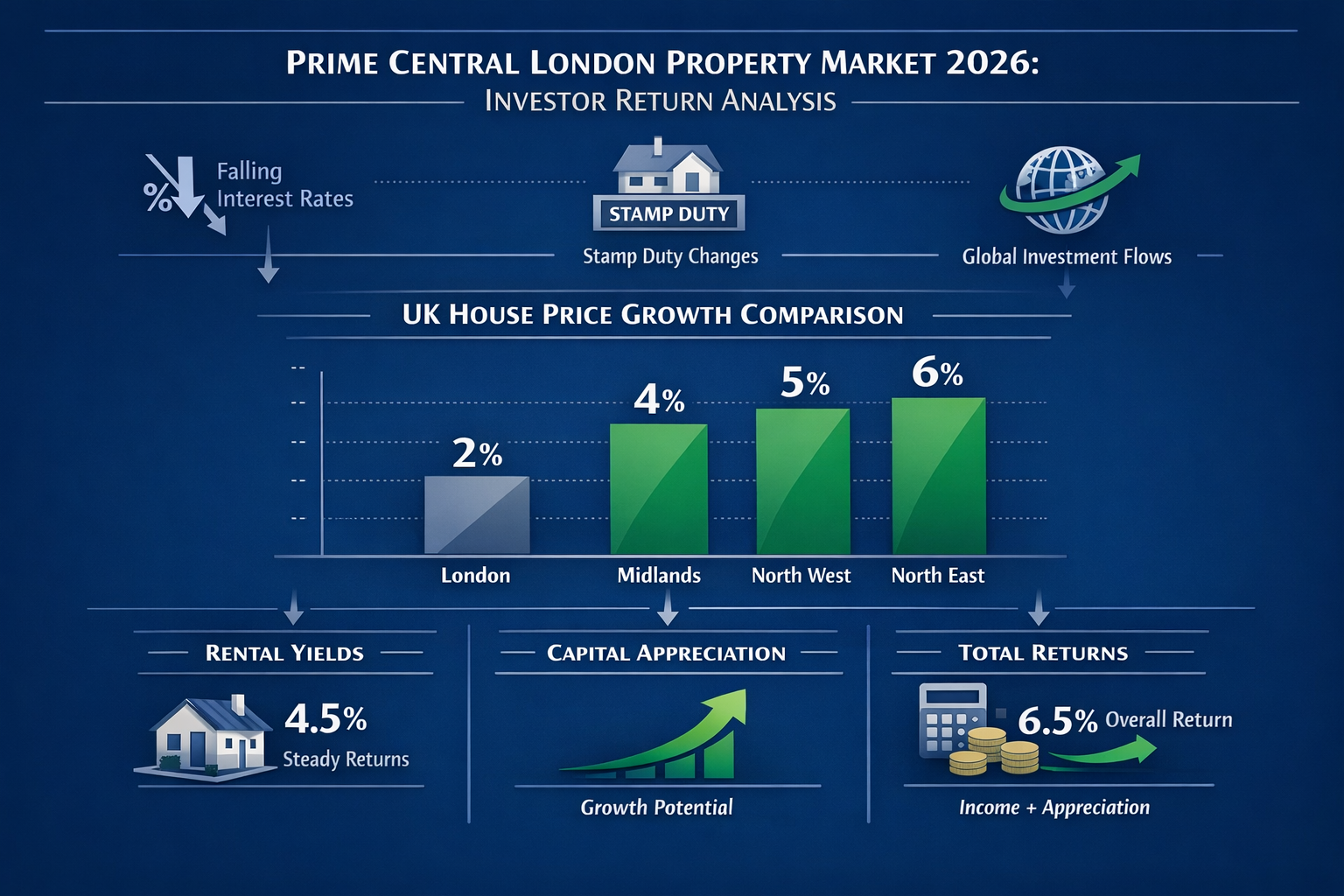
Total Return Framework: Capital Appreciation Plus Income
Investors evaluating prime London properties in 2026 must adopt a total return framework that balances modest capital appreciation expectations with income generation potential. Unlike boom periods where capital gains dominated investment rationale, the current environment requires a more balanced approach.
Total Return Components:
📈 Capital Appreciation: Forecast at approximately 2% annually for national markets, with PCL potentially lagging
💷 Rental Income: Gross yields typically 2.5-4% in prime areas, with net yields after costs around 1.5-3%
📉 Transaction Costs: Stamp duty, legal fees, and survey costs now representing larger proportion of returns
🔄 Holding Period Optimisation: Longer holding periods increasingly necessary to achieve acceptable returns
For a £2 million prime London property, the return calculation might look like this:
5-Year Investment Scenario:
- Purchase price: £2,000,000
- Stamp duty (12% band): £213,750
- Legal and survey fees: £15,000
- Total acquisition cost: £2,228,750
- Annual rental income (3% gross yield): £60,000
- Annual costs (management, maintenance, void): £18,000
- Net annual income: £42,000
- 5-year cumulative income: £210,000
- Property value after 5 years (2% annual growth): £2,208,000
- Gross proceeds: £2,418,000
- Net return: £189,250
- Annualised return: ~1.7%
This modest return profile underscores why professional valuation accuracy has become paramount. Even small valuation errors can transform marginal investments into loss-making propositions.
Interest Rate Sensitivity and Financing Strategies
The Bank of England is expected to cut interest rates further in 2026, reducing mortgage costs and supporting modest price growth.[2] This monetary policy trajectory represents a key driver of the improved 12-month outlook noted by RICS and fundamentally impacts investor return calculations.
Financing Considerations for 2026:
- Mortgage rate trends: Declining from 2025 peaks, improving affordability
- Loan-to-value ratios: Lenders maintaining conservative positions for prime properties
- Interest coverage requirements: Buy-to-let investors facing stricter stress testing
- Fixed vs. variable strategies: Enhanced value in medium-term fixed rates given expected further cuts
For leveraged investors, even a 0.5% reduction in mortgage rates can significantly improve net returns. On a £1.5 million mortgage (75% LTV on a £2 million property), a rate reduction from 5.5% to 5.0% saves £7,500 annually—representing a meaningful proportion of net rental income.
Surveyors conducting valuations for mortgage purposes must understand these financing dynamics, as lender requirements increasingly influence achievable transaction prices. Understanding whether a mortgage valuation is the same as a survey helps investors recognise the distinct purposes these assessments serve.
Tax Efficiency and Structural Considerations
The fiscal landscape significantly impacts net investor returns in prime London properties. Buyer confidence is being rebuilt by improving clarity around taxation and fewer anticipated fiscal surprises.[1] However, several tax considerations remain critical:
Key Tax Factors:
🏛️ Stamp Duty Land Tax: Increased thresholds from April 2025 raising acquisition costs
🏠 Capital Gains Tax: Potential changes affecting disposal strategies and holding period decisions
💼 Income Tax: Rental income taxation and mortgage interest relief limitations
🌍 Non-Dom Status Changes: Affecting international investor demand in PCL
🏗️ Inheritance Tax: Estate planning considerations for high-value property holdings
For international investors, PCL remains highly sensitive to global economic factors, international capital flows, fiscal policy shifts, and wealth taxation considerations.[1] Recovery will not mirror the mainstream market and will be more dependent on these macro-level dynamics.
Professional valuations must increasingly account for these tax implications, as they directly affect the pool of potential buyers and achievable prices for prime properties. Surveyors working in areas like South East London must understand how tax positioning influences buyer behaviour and pricing dynamics.
Portfolio Diversification and Risk Management
In an environment of modest growth and regional disparities, portfolio diversification becomes a critical risk management strategy. Investors concentrating exclusively in prime London face specific risks that can be mitigated through geographic and asset class diversification.
Diversification Strategies:
- Geographic spread: Balancing PCL holdings with stronger-performing regional markets
- Asset type variation: Mixing residential, commercial, and mixed-use properties
- Value vs. prime positioning: Incorporating properties across the value spectrum
- Development vs. stabilised assets: Balancing risk-return profiles
The regional performance data showing Northern markets outperforming London by 5-8 percentage points annually suggests that pure PCL concentration may underperform diversified strategies.[2] Surveyors can add value by helping investors understand relative value across different markets and property types.
Practical Implementation: Working with Chartered Surveyors in 2026
Selecting the Right Surveyor for Prime Property Valuations
Not all chartered surveyors possess equal expertise in prime London markets. When valuing prime London properties in 2026, selecting a surveyor with specific PCL experience and RICS certification becomes essential.
Selection Criteria:
✅ RICS membership: Ensuring adherence to professional standards and Red Book compliance
✅ PCL specialisation: Demonstrated experience in prime central London submarkets
✅ Recent transaction knowledge: Active involvement in current market conditions, not just historical expertise
✅ Valuation methodology expertise: Proficiency across comparable sales, income capitalisation, and residual methods
✅ Professional indemnity insurance: Adequate coverage for high-value property assessments
Engaging chartered surveyors in London with specific prime market credentials ensures valuations reflect nuanced understanding of micro-market dynamics, international buyer behaviour, and the unique factors influencing PCL pricing.
Understanding Survey Types and Their Valuation Components
Different survey types serve distinct purposes, and understanding which assessment best suits specific needs prevents both over-spending and inadequate due diligence.
Survey Type Comparison:
| Survey Type | Valuation Component | Best For | Typical Cost Range |
|---|---|---|---|
| Mortgage Valuation | Basic market value | Lender requirements only | £300-£800 |
| Homebuyer Survey (Level 2) | Market value + condition overview | Standard properties | £500-£1,500 |
| Building Survey (Level 3) | Detailed condition assessment | Older/complex properties | £800-£2,500+ |
| RICS Valuation Report | Comprehensive market valuation | Investment decisions | £1,000-£5,000+ |
For prime properties, a comprehensive RICS valuation report typically provides the most thorough analysis, incorporating multiple valuation methodologies and detailed market analysis. However, understanding survey pricing helps investors budget appropriately while selecting the right level of assessment.
When purchasing properties requiring renovation or with structural concerns, combining a building survey with a valuation ensures both condition and value are properly assessed. Specialists offering structural surveys can identify issues that significantly impact value but might be missed in basic valuations.
Interpreting Valuation Reports in Stabilising Markets
Reading and interpreting valuation reports requires understanding the assumptions, limitations, and methodologies employed. In 2026's stabilising market, several report elements deserve particular attention:
Critical Report Sections:
- Market commentary: How the surveyor characterises current conditions and trends
- Comparable evidence: Quality, recency, and adjustment factors applied to comparables
- Assumptions and special assumptions: Any departures from standard Red Book assumptions
- Valuation approach: Which methodologies were employed and why
- Market value vs. investment value: Distinction between general market value and value to specific investor types
- Sensitivity analysis: How value might change under different scenarios
In stabilising markets, the market commentary section becomes particularly valuable, as it reveals the surveyor's interpretation of whether the property is positioned for the emerging recovery or still reflecting correction-phase pricing.
Timing Considerations and Market Monitoring
Given the transitional nature of the 2026 market, timing decisions around valuations and transactions carry heightened importance. Enquiry levels in Prime Central London are stabilising with serious buyers re-engaging, particularly where pricing reflects current realities.[1]
Optimal Timing Strategies:
- Quarterly revaluations: For investment portfolios, updating valuations quarterly captures market shifts
- Pre-listing valuations: Obtaining professional valuations before marketing prevents unrealistic pricing
- Offer validation: Independent valuations confirming offer prices reflect true market value
- Portfolio reviews: Annual comprehensive reviews ensuring holdings remain appropriately valued
The RICS sentiment indicators provide valuable market monitoring tools. When surveyor expectations turn decisively positive and transaction volume forecasts strengthen further, it may signal optimal timing for acquisitions. Conversely, renewed pessimism might suggest delaying purchases or accelerating disposals.
Conclusion: Navigating Prime London Valuations in an Era of Modest Growth

Valuing prime London properties in 2026 demands a fundamentally recalibrated approach that acknowledges the market's transition from correction to stabilisation rather than anticipating a dramatic rebound. With national growth forecasts at modest 2% levels and Prime Central London experiencing regional underperformance, surveyor methodologies must incorporate sophisticated adjustments for temporal factors, regional disparities, and evolving fiscal considerations.
The professional expertise of RICS-certified chartered surveyors becomes increasingly valuable in this environment, where marginal valuation errors can transform viable investments into loss-making propositions. By understanding how surveyors adjust their comparable sales analysis, income capitalisation approaches, and residual valuations for flat growth scenarios, investors can make more informed decisions and set realistic return expectations.
Actionable Next Steps
For property investors, developers, and homeowners navigating the 2026 prime London market:
-
Engage qualified professionals early: Select chartered surveyors in London with specific PCL expertise before making acquisition or disposal decisions
-
Adopt total return frameworks: Shift investment analysis from capital appreciation focus to balanced total return models incorporating income, appreciation, and tax efficiency
-
Monitor sentiment indicators: Track RICS monthly surveys and market commentary to identify inflection points in the stabilisation-to-recovery transition
-
Reassess existing holdings: Commission updated valuations for portfolio properties to ensure accurate understanding of current positions and potential repositioning opportunities
-
Understand regional context: Compare prime London opportunities against stronger-performing regional markets to optimise portfolio allocation
-
Factor fiscal changes: Incorporate April 2025 stamp duty increases and other tax considerations into all return calculations and pricing decisions
The tentative signs of market recovery identified by RICS and market analysts suggest that 2026 may represent a transitional year—neither the depths of correction nor the heights of boom, but rather a period of recalibration and cautious optimism. Success in this environment requires abandoning outdated assumptions, embracing professional valuation expertise, and maintaining realistic expectations about growth trajectories and investment returns.
For those willing to engage with market realities rather than historical norms, prime London properties in 2026 can still offer attractive opportunities—provided valuations accurately reflect current conditions and investment strategies align with modest growth scenarios. The surveyor's role in this process has never been more critical, serving as the essential bridge between market sentiment and investment reality.
To discuss your specific prime London property valuation needs or to schedule a professional assessment, contact our team of RICS-certified experts who specialise in navigating the complexities of the 2026 market landscape.
References
[1] Market Confidence Edges Higher In Early 2026 – https://www.winkworth.co.uk/articles/market-confidence-edges-higher-in-early-2026
[2] House Price Forecast – https://hoa.org.uk/advice/guides-for-homeowners/i-am-buying/house-price-forecast/
[3] Party Wall Surveys Amid 2026 Construction Boom Handling Disputes In High Demand Uk Housing Markets – https://nottinghillsurveyors.com/blog/party-wall-surveys-amid-2026-construction-boom-handling-disputes-in-high-demand-uk-housing-markets