
London's property market has entered a pivotal phase in 2026, where Prime Central London prices hold steady while buyer enquiries surge—particularly from first-time purchasers targeting the affordable flat segment. For valuation surveyors navigating this stabilising landscape, the challenge lies in applying precise yield adjustments and comparable sales analysis to capitalise on emerging demand for lower-priced flats. Understanding the tools and methodologies that drive accurate valuations has never been more critical as the market transitions from years of stagnation to cautious recovery.
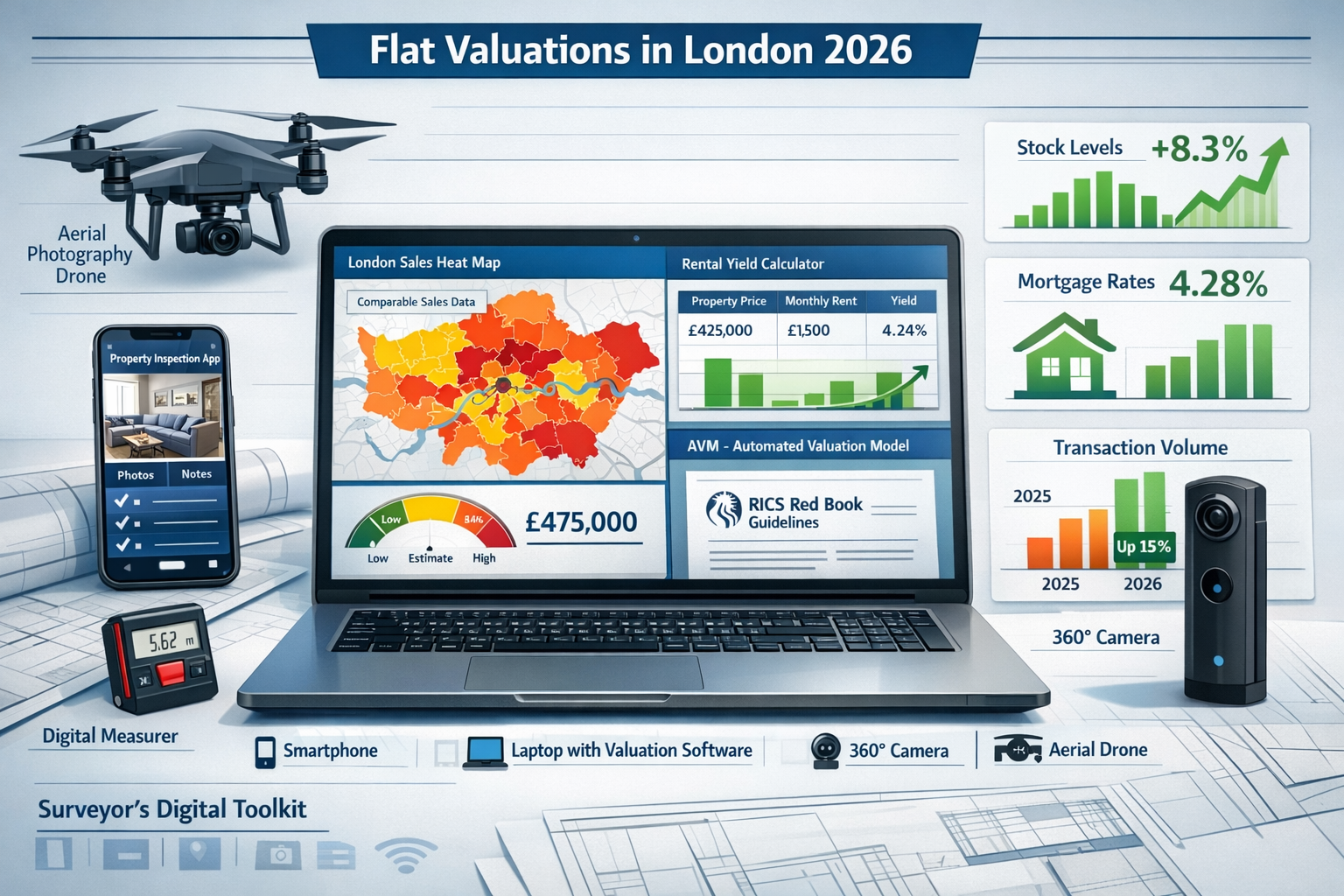
The dynamics of Valuing Flats in London's 2026 Stabilising Market: Surveyor Tools for Affordable Segment Recovery require a sophisticated blend of traditional surveying expertise and modern analytical techniques. With first-time buyers now representing nearly half of all London sales and stock levels climbing 8.3% year-on-year, surveyors must recalibrate their approaches to reflect shifting purchasing patterns and renewed market confidence.[1]
Key Takeaways
- 📊 First-time buyers dominate: These purchasers account for 48.3% of London sales in early 2026, the highest share nationally, driving demand in the affordable flat segment
- 💰 Improved affordability ratios: Mortgage rates have dropped to 4.28% while wage growth outpaces price stagnation at 4.7%, creating favorable conditions for entry-level buyers
- 🏘️ Geographic price divergence: Areas like Bayswater show 21% five-year growth while traditional prime locations decline, requiring nuanced comparable analysis
- 📈 Strong buyer's market conditions: Increased stock levels (+8.3%) combined with reduced transaction volumes create significant negotiating power for purchasers
- 🔧 Advanced surveyor tools essential: Digital valuation platforms, automated comparable selection, and yield modeling software enable precise flat valuations in this transitional market
Understanding London's 2026 Market Stabilisation Context

The London property market's performance in 2026 represents a stark contrast to the broader UK housing landscape. While northern England regions experience robust growth, London's annual house price appreciation averaged just 1.3% through the first nine months of 2025, with forecasts predicting a modest 1.2% decline for 2026.[2][3] This underperformance creates unique challenges and opportunities for surveyors specializing in flat valuations.
The First-Time Buyer Revolution
A fundamental shift has reshaped London's buyer demographics. First-time purchasers now constitute 48.3% of all sales in January 2026, nearly doubling from 22.4% a decade earlier.[1] However, these buyers aren't following traditional patterns—they're entering the market in their thirties with substantial budgets ranging from £1.5m to £2m, prioritizing family homes in well-connected areas with excellent schools.
This demographic transformation has significant implications for flat valuations:
- Entry-level flats face reduced demand as first-time buyers skip traditional starter properties
- Family-sized flats in suburban locations command premium valuations due to school catchment areas
- Transport connectivity becomes a critical valuation factor, with properties near Elizabeth Line stations showing price resilience
For surveyors conducting RICS home surveys, understanding these buyer preferences is essential when determining comparable properties and market value adjustments.
Stock Levels and Transaction Dynamics
The supply-demand equation has shifted dramatically in early 2026. Total stock available for sale increased 8.3% compared to early 2025, with the luxury segment (£5m+) seeing new instructions surge 12.5%.[1] Yet paradoxically, transaction volumes remain historically weak—January 2026 recorded 30% fewer completions than January 2025 and 20% below pre-pandemic averages.
| Market Indicator | 2026 Figure | Year-on-Year Change |
|---|---|---|
| Total Stock Available | +8.3% | ↑ Increased |
| Transaction Volume (Jan) | -30% vs 2025 | ↓ Decreased |
| First-Time Buyer Share | 48.3% | ↑ +26% (vs 2016) |
| Average 2-Year Fixed Rate | 4.28% | ↓ -0.68% |
| Wage Growth | 4.7% | ↑ Positive |
This combination creates what industry analysts describe as "the best buyers' market in ten years"[1]—a scenario where purchasers enjoy substantial choice and negotiating leverage, requiring surveyors to factor in realistic achievable sale prices rather than optimistic asking prices.
Surveyor Tools for Valuing Flats in London's 2026 Stabilising Market
Professional surveyors employ a comprehensive toolkit when Valuing Flats in London's 2026 Stabilising Market: Surveyor Tools for Affordable Segment Recovery. These methodologies combine traditional RICS-compliant approaches with cutting-edge digital analytics to deliver accurate, defensible valuations.
Comparable Sales Analysis (Comps) 🏘️
The cornerstone of flat valuation remains comparable sales analysis, but 2026's market conditions demand heightened sophistication. Surveyors must navigate significant geographic price divergence—for instance, Bayswater properties jumped 21% over five years to £1.7m average, while nearby Knightsbridge fell 15% to £2.6m and Kensington declined 12% to £1.8m.[1]
Key considerations for selecting comparables in 2026:
- Temporal proximity: Sales from 3-6 months prior carry more weight than older transactions due to rapid market shifts
- Geographic radius: Restrict comps to 0.5-mile radius in dense urban areas, adjusting for micro-market variations
- Property characteristics: Match bedroom count, floor level, aspect, parking availability, and lease length
- Transaction type: Distinguish between motivated sales, off-market deals, and arms-length transactions
- Market conditions: Adjust for whether comparable sold in rising, falling, or stable price environment
Chartered surveyors in South West London and West London frequently encounter micro-markets where adjacent postcodes show divergent price trends, making precise comparable selection critical.
Yield and Investment Return Calculations 💷
For buy-to-let flats and investment properties, yield analysis provides essential valuation context. The 2026 market's improved affordability—with mortgage rates at 4.28% and wage growth at 4.7%[2][4]—has rekindled investor interest in London's rental market.
Gross yield calculation:
Gross Yield (%) = (Annual Rental Income / Property Value) × 100
Net yield considerations:
- Deduct service charges, ground rent, maintenance costs
- Factor in void periods (typically 4-8 weeks annually)
- Account for letting agent fees (8-12% of rental income)
- Include insurance, safety certificates, and compliance costs
Surveyors must benchmark yields against comparable rental properties and adjust valuations accordingly. A flat generating 4.5% net yield in an area where comparable properties achieve 5.2% may warrant a downward valuation adjustment of 10-15% to align with investor expectations.
Digital Valuation Platforms and AVMs 📱
Automated Valuation Models (AVMs) have evolved significantly, incorporating machine learning algorithms that analyze millions of data points. While these tools cannot replace professional surveyor judgment, they provide valuable initial valuation ranges and help identify outlier properties requiring additional scrutiny.
Leading AVM platforms used in 2026:
- RICS Valuation Analytics: Integrates Land Registry data with local market intelligence
- Property Data Hub: Combines sales history, rental yields, and demographic trends
- Comparable Intelligence Systems: AI-powered comparable selection with adjustment factors
- Geospatial Valuation Tools: Heat mapping for micro-market price variations
When comparing different types of survey, surveyors increasingly incorporate AVM outputs as supporting evidence within comprehensive valuation reports, particularly for standard flat configurations in established developments.
Physical Inspection and Defect Assessment 🔍
No digital tool can substitute for on-site inspection by qualified surveyors. The physical condition of London flats—particularly in older conversions and purpose-built blocks from the 1960s-1980s—significantly impacts valuation.
Critical inspection elements for flat valuations:
- Structural integrity: Evidence of subsidence, movement, or structural alterations
- Building envelope: Condition of roof, windows, external walls, and weatherproofing
- Services condition: Age and functionality of heating, electrical, and plumbing systems
- Fire safety compliance: Post-Grenfell cladding issues, compartmentation, escape routes
- Lease terms: Remaining lease length, ground rent escalation, service charge history
- Building management: Quality of freeholder/management company, maintenance standards
Surveyors conducting RICS building surveys frequently identify defects that necessitate valuation adjustments ranging from 5-30% depending on severity and remediation costs. For instance, flats in buildings requiring cladding remediation may face unmarketability until works complete, regardless of internal condition.
Lease Extension Valuation Methodology ⏰
For leasehold flats—the predominant tenure type in London—remaining lease length critically affects value. Properties with leases below 80 years face the "marriage value" threshold, where valuation calculations become more complex.
Professional lease extension valuations follow the statutory formula under the Leasehold Reform Act, incorporating:
- Diminution in landlord's interest: Value loss to freeholder from extending lease
- Landlord's development value: Potential for redevelopment if lease expires
- Marriage value: Additional value created by lease extension, split 50/50 between parties (applies when lease <80 years)
A flat worth £500,000 with 65 years remaining might cost £80,000-£120,000 to extend to 990 years, but the same flat with 55 years remaining could require £140,000-£180,000 due to marriage value calculations. Surveyors must accurately model these scenarios when valuing flats with marginal lease terms.
Affordable Segment Recovery: Opportunities for Surveyors in 2026
The affordable flat segment—typically defined as properties under £600,000 in London—shows distinct recovery patterns compared to prime and super-prime markets. Surveyors specializing in this segment can capitalize on emerging opportunities by understanding buyer motivations and market dynamics.
Geographic Hotspots for Affordable Flat Growth 📍
While central London stagnates, outer London boroughs demonstrate stronger fundamentals for affordable flat appreciation:
High-growth potential areas:
- Bayswater and Paddington: Elizabeth Line connectivity, 21% five-year growth, average £1.7m[1]
- Clapham and Battersea: Family-friendly amenities, excellent transport, regeneration projects
- Kingston and Twickenham: Suburban appeal, green spaces, strong schools
- Ilford and Bexley: Affordability entry points, improving infrastructure
Chartered surveyors in Clapham, Battersea, Kingston, Ilford, and Bexley report increased valuation instructions as buyers recognize value opportunities in these locations.
Transport Infrastructure Impact on Valuations 🚇
The Elizabeth Line (Crossrail) continues to reshape London's property landscape in 2026. Flats within 800 meters of Elizabeth Line stations command premium valuations of 10-25% compared to equivalent properties further from stations.
Surveyors must quantify transport accessibility when valuing affordable flats:
- Journey time to central London: Each 10-minute reduction adds approximately 3-5% to value
- Station frequency: Stations with 4+ trains per hour justify higher valuations than 2 trains per hour
- Interchange capability: Access to multiple lines increases desirability and value
- Future infrastructure: Planned improvements (e.g., Bakerloo Line extension) create anticipatory value uplift
Build Quality and Modern Specifications 🏗️
Newer purpose-built flats with modern specifications increasingly outperform older conversions in the affordable segment. Buyers prioritize energy efficiency, low maintenance costs, and warranty protection—factors that directly impact valuation.
Value-adding specifications in 2026:
- ✅ EPC rating B or higher: Energy efficiency reduces running costs, attracts environmentally conscious buyers
- ✅ NHBC or similar warranty: 10-year structural warranty provides buyer confidence
- ✅ Secure underground parking: Adds £25,000-£50,000 to flat values in outer London
- ✅ Private outdoor space: Balconies or terraces command 8-15% premiums
- ✅ Concierge/security: Enhances desirability in competitive developments
When conducting specific defect reports or stock condition surveys, surveyors should quantify how specification upgrades or deficiencies impact market value relative to comparable properties.
Mortgage Affordability and Buyer Capacity 💳
The improved mortgage landscape in 2026 fundamentally alters buyer capacity for affordable flats. With two-year fixed rates at 4.28%—down from 4.96% a year earlier—and wage growth at 4.7%, affordability ratios have improved significantly.[2][4]
Typical buyer profile for £500,000 flat in 2026:
- Required deposit (10%): £50,000
- Mortgage amount: £450,000
- Monthly payment (4.28%, 25 years): Approximately £2,450
- Required household income (4.5x multiple): £100,000
- Stress test rate: Typically 6.5-7%, monthly payment ~£3,100
Surveyors must understand lender lending criteria when assessing marketability. Flats in buildings with cladding issues, lease lengths below 70 years, or high service charges (>£5,000 annually) may face mortgage restrictions that suppress achievable sale prices below theoretical market value.
Service Charge and Ground Rent Considerations 💰
Ongoing costs associated with leasehold flats significantly impact buyer decisions and valuations. The 2026 market shows increased buyer scrutiny of service charges and ground rent obligations following legislative changes.
Service charge impact on valuations:
- Annual charges £2,000-£3,000: Minimal impact on value
- Annual charges £3,000-£5,000: May reduce buyer pool by 10-15%
- Annual charges >£5,000: Significant marketability impact, potential 5-10% value reduction
- Escalating ground rents: Doubling ground rents severely impact value; flat ground rents preferred
Surveyors should obtain three years of service charge accounts and assess:
- Historical cost trends and inflation rates
- Adequacy of sinking fund reserves
- Planned major works and special levy risks
- Management company competence and responsiveness
Properties with well-managed service charges and transparent accounting command premiums over those with poor management or deferred maintenance issues.
Strategic Valuation Approaches for Different Flat Types
Not all London flats require identical valuation methodologies. Valuing Flats in London's 2026 Stabilising Market: Surveyor Tools for Affordable Segment Recovery demands tailored approaches based on property type, buyer profile, and investment characteristics.
Studio and One-Bedroom Flats 🏢
Compact flats targeting young professionals and investors require distinct valuation considerations:
Primary buyer segments:
- First-time buyers (single professionals, age 25-35)
- Buy-to-let investors seeking rental yield
- International students and corporate tenants (rental market)
Valuation factors:
- Rental yield focus: Investors prioritize net yields of 4.5-5.5% in 2026 market
- Size efficiency: Well-designed 450-550 sq ft studios outperform poorly configured 600 sq ft units
- Amenity access: Proximity to gyms, restaurants, nightlife adds value for target demographic
- Comparable density: High volume of similar properties creates liquid, transparent pricing
Two-Bedroom Family Flats 👨👩👧
Family-oriented flats represent the sweet spot in London's affordable segment recovery:
Target buyers:
- Young families seeking school catchment areas
- Upsizing first-time buyers with growing households
- Downsizing empty-nesters from larger houses
Critical valuation elements:
- School proximity: Flats within catchment of "Outstanding" rated schools command 15-25% premiums
- Bedroom configuration: Two genuine double bedrooms valued higher than one double + one single
- Storage and parking: Essential for families; absence reduces value by 8-12%
- Outdoor space: Gardens, terraces, or balconies add significant family appeal
Converted Period Flats vs. Purpose-Built 🏛️
The conversion vs. purpose-built distinction creates substantial valuation variations:
Period conversions (Victorian/Edwardian):
- ✅ Advantages: Character features, high ceilings, larger room sizes, period appeal
- ❌ Disadvantages: Higher maintenance, potential structural issues, service charge volatility
- Typical premium/discount: -5% to +10% depending on conversion quality and building management
Purpose-built modern blocks:
- ✅ Advantages: Warranties, modern specifications, predictable maintenance, energy efficiency
- ❌ Disadvantages: Lower ceilings, standardized layouts, less character
- Typical premium/discount: +5% to +15% for well-specified developments with amenities
Surveyors must assess conversion quality when valuing period flats—professional conversions by reputable developers warrant minimal discount, while poor-quality conversions with inadequate soundproofing or fire separation require significant downward adjustments.
New-Build Flats and Help to Buy 🆕
New-build flats in the affordable segment often involve Help to Buy equity loans, creating unique valuation scenarios:
Help to Buy implications:
- Government holds 20% equity loan (40% in London)
- Loan is interest-free for first five years
- Valuation required at resale to calculate government's share
- RICS Help to Buy valuations must follow specific protocols
New-build premium considerations:
- Developers typically charge 10-20% premium over equivalent resale properties
- Premium justified by warranties, modern specs, incentives (stamp duty paid, furniture packages)
- Resale values often stabilize 5-10% below new-build prices after initial sale
- Surveyors must distinguish between developer asking prices and realistic market value
Navigating Regulatory and Compliance Issues in Flat Valuations

London's leasehold flat market operates within a complex regulatory framework that directly impacts valuations. Surveyors must stay current with evolving legislation and compliance requirements.
Building Safety and Cladding Crisis 🔥
The post-Grenfell regulatory environment continues to shape flat valuations in 2026. Properties in buildings over 18 meters face enhanced scrutiny:
Essential documentation:
- EWS1 forms: External Wall Survey certificates (required for buildings >18m)
- Fire Risk Assessments: Current FRA identifying remediation requirements
- Building Safety Certificates: New regulatory requirement under Building Safety Act
- Remediation plans: Timelines and funding for identified defects
Valuation impact of cladding issues:
- Buildings with unsafe cladding but funded remediation: 10-20% discount during works
- Buildings with unsafe cladding, no remediation plan: Potentially unmarketable, 30-50% discount
- Buildings with clean EWS1: No discount, potential premium for buyer confidence
Leasehold Reform and Ground Rent Legislation 📜
Legislative changes in 2025-2026 have transformed the leasehold landscape:
Key reforms affecting valuations:
- Ground rents capped at peppercorn for new leases
- Simplified lease extension process with reduced costs
- Enhanced leaseholder rights regarding service charges
- Potential future commonhold conversion rights
Surveyors must understand how these reforms impact lease extension valuations and overall flat marketability. Properties with onerous historical ground rent terms may see improved values as extension costs decrease under new legislation.
Energy Performance and Sustainability Requirements ♻️
Energy efficiency has transitioned from peripheral concern to central valuation factor:
Minimum Energy Efficiency Standards (MEES):
- Rental properties must achieve EPC rating E or higher (current requirement)
- Potential future requirement for EPC C by 2028 for rental properties
- Owner-occupied properties face no current minimum, but buyer preferences shifting
Valuation adjustments for EPC ratings:
- EPC A-B: Premium of 5-8% over equivalent C-rated properties
- EPC C-D: Market standard, no adjustment
- EPC E-F: Discount of 5-12% due to improvement costs and rental restrictions
- EPC G: Significant discount (15-25%), rental prohibition, improvement mandatory
Surveyors should quantify improvement costs to achieve higher EPC ratings when valuing poorly performing properties, as buyers increasingly factor these expenses into purchase decisions.
Conclusion: Capitalizing on London's Affordable Flat Segment in 2026
Valuing Flats in London's 2026 Stabilising Market: Surveyor Tools for Affordable Segment Recovery requires surveyors to blend traditional expertise with modern analytical tools while navigating a uniquely favorable buyer's market. The convergence of improved mortgage affordability, wage growth outpacing prices, and increased stock levels creates exceptional opportunities for buyers and challenges for sellers—making accurate, defensible valuations more critical than ever.
The affordable segment shows the strongest recovery potential, driven by first-time buyers who now dominate nearly half of London sales. However, these buyers have evolved beyond traditional entry-level expectations, seeking family-appropriate homes in well-connected locations with excellent amenities. Surveyors must recalibrate their comparable selection and adjustment methodologies to reflect these shifting preferences.
Actionable Next Steps for Property Professionals 🎯
For surveyors and valuers:
- Invest in digital tools: Integrate AVM platforms and geospatial analytics to enhance comparable selection accuracy
- Specialize geographically: Develop deep expertise in specific London boroughs to understand micro-market dynamics
- Master lease valuation: With 80% of London flats leasehold, comprehensive lease extension expertise is essential
- Stay regulatory compliant: Monitor building safety, EPC requirements, and leasehold reform developments
- Build data repositories: Maintain comprehensive databases of local transactions, rental yields, and service charge benchmarks
For buyers and investors:
- Engage qualified surveyors early: Commission professional valuations before making offers in this complex market
- Leverage buyer's market conditions: Use increased stock levels and reduced competition to negotiate favorable terms
- Focus on transport connectivity: Prioritize flats near Elizabeth Line and other major transport hubs for long-term value retention
- Scrutinize ongoing costs: Assess service charges, ground rent, and potential remediation liabilities thoroughly
- Consider future-proofing: Prioritize energy-efficient properties and buildings with clean safety certificates
For sellers:
- Price realistically: Understand that 2026 favors buyers; overpricing extends marketing time and reduces final sale price
- Address defects proactively: Resolve cladding issues, improve EPC ratings, and extend short leases before marketing
- Provide comprehensive documentation: Assemble service charge accounts, building safety certificates, and warranties upfront
- Highlight value-adding features: Emphasize transport links, parking, outdoor space, and specification upgrades
- Choose experienced agents: Work with professionals who understand current valuation methodologies and buyer priorities
The London flat market's stabilization in 2026 represents a transitional moment—neither the euphoria of previous boom years nor the despair of crash scenarios. For surveyors equipped with the right tools, methodologies, and market intelligence, this environment offers opportunities to deliver exceptional value to clients navigating one of the world's most complex property markets.
By combining rigorous comparable analysis, sophisticated yield modeling, comprehensive physical inspections, and deep understanding of regulatory requirements, property professionals can confidently navigate Valuing Flats in London's 2026 Stabilising Market: Surveyor Tools for Affordable Segment Recovery and position clients for success in this evolving landscape.
References
[1] March 2026 – https://www.black-brick.com/insights/market-update/march-2026/
[2] Nationwide House Price Review And Outlook For 2026 Slight Easing In Affordability Pressures Helps Underpin Buyer Demand – https://www.nationwide.co.uk/media/hpi/reports/nationwide-house-price-review-and-outlook-for-2026-slight-easing-in-affordability-pressures-helps-underpin-buyer-demand
[3] House Price Forecast – https://hoa.org.uk/advice/guides-for-homeowners/i-am-buying/house-price-forecast/
[4] House Price Index – https://www.rightmove.co.uk/news/house-price-index/
[5] House Prices – https://moneyweek.com/investments/house-prices/house-prices