
Northern England is experiencing a remarkable construction renaissance in 2026, outpacing Southern regions and creating unprecedented opportunities for property valuers and surveyors. Recent RICS data reveals a striking divergence: while Southern markets plateau, the North West and North East are witnessing robust growth fueled by government infrastructure commitments, AI investment zones, and regional regeneration initiatives. This dynamic shift demands sophisticated valuation techniques that can accurately capture price momentum in real-time surveys.
For chartered surveyors operating across Manchester, Liverpool, Newcastle, and Leeds, understanding how to apply advanced valuation methodologies in this rapidly evolving landscape has become essential. The Valuation Techniques for Northern England Construction Uptick: Capturing Price Momentum in 2026 Surveys represent a critical skillset for professionals seeking to deliver accurate, defensible valuations that reflect genuine market conditions.

Key Takeaways
- Northern England construction output is projected to grow 2.3% in 2026, significantly outperforming Southern regions, driven by £30 billion AI Growth Zone investments and infrastructure spending[1]
- Comparative valuation methods require regional recalibration to account for price momentum differentials between Northern and Southern markets
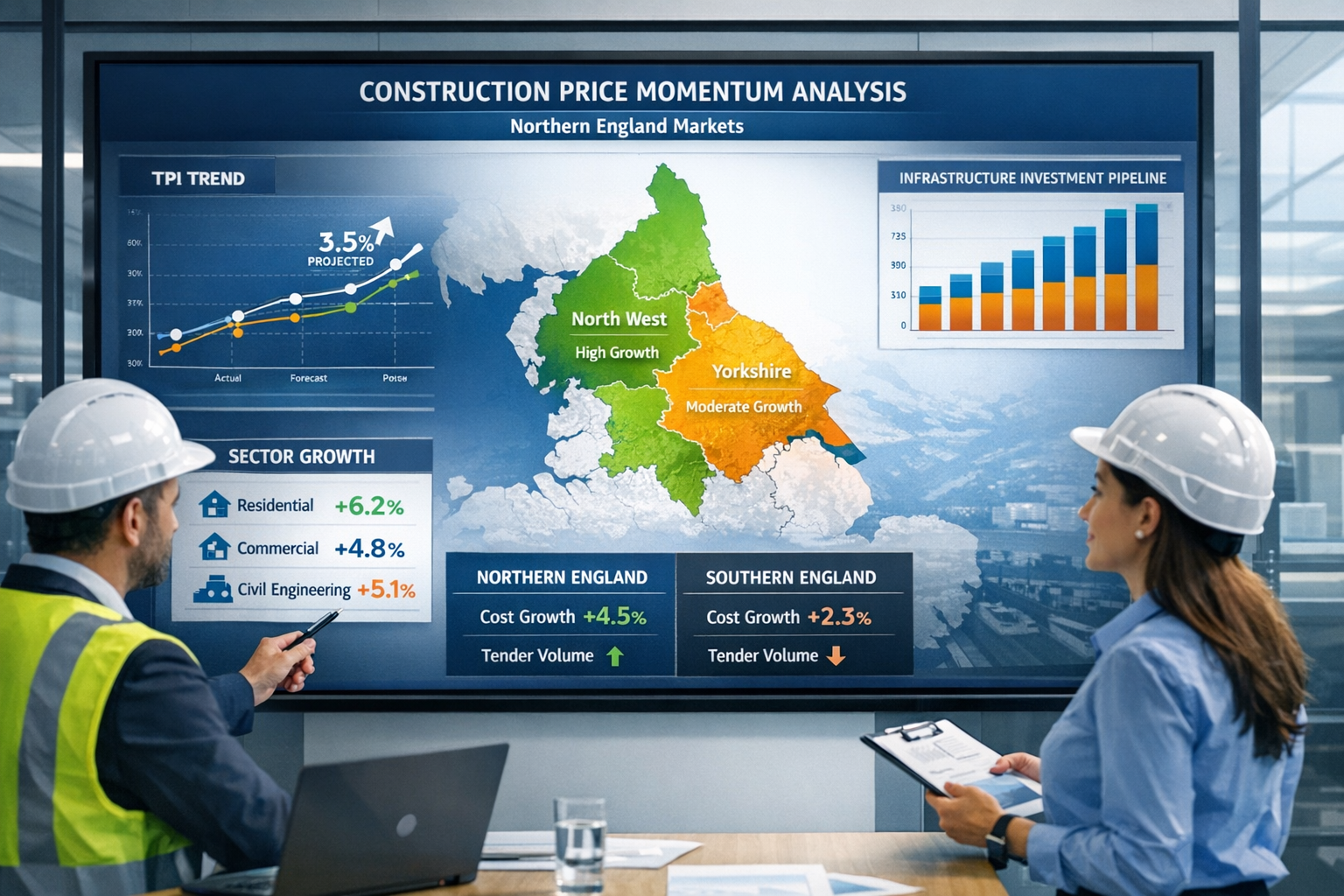
- Tender Price Index (TPI) projections of 3.5% for 2026 must be integrated into residual valuation calculations to maintain accuracy[2]
- Infrastructure investment pipeline exceeding £725 billion over the next decade creates unique valuation challenges for surveyors assessing development potential[1]
- Advanced survey techniques including drone technology and real-time market data integration are becoming essential for capturing accurate price momentum in fast-moving Northern markets
Understanding the Northern England Construction Boom in 2026
Regional Growth Dynamics
The Northern England construction sector has emerged as the unexpected powerhouse of UK property development in 2026. Predicted UK construction output growth of 2.3% masks significant regional variation, with the North West and North East experiencing substantially higher growth rates[1]. This divergence stems from targeted government investment, particularly the £30 billion commitment to an AI Growth Zone in the North East, which is driving unprecedented demand for office space, data centres, and supporting infrastructure[3].
The construction landscape across Manchester, Liverpool, Newcastle, Leeds, and Sheffield has transformed dramatically. Civils construction is projected to increase by 17% in 2026, driven by investments in roads, harbours, ports, electricity networks, renewables, and water infrastructure[3]. This surge creates complex valuation scenarios where traditional methods must be adapted to reflect rapid market evolution.
Infrastructure Investment Impact
The infrastructure investment pipeline of at least £725 billion over the next decade represents a fundamental shift in regional development patterns[1]. For 2026/27 alone, over £150 billion in regional spend is forecasted across transport, utilities, and social infrastructure. This unprecedented capital deployment directly impacts property valuations through:
- Enhanced connectivity increasing land values in previously peripheral locations
- Improved utilities infrastructure supporting higher-density development
- Social infrastructure investment creating new residential demand clusters
- Transport upgrades reducing journey times and expanding commuter catchments
For surveyors conducting RICS valuations, understanding these infrastructure impacts on comparable evidence becomes critical to accurate assessment.
Cost Pressure Considerations
Despite strong growth, cost pressures remain significant with TPI (Tender Price Index) projected at 3.5% average for 2026[2]. This reflects ongoing challenges including:
- Labour cost inflation as demand for skilled construction workers outstrips supply
- M&E (Mechanical and Electrical) technology costs rising due to sustainability requirements
- Geopolitical uncertainty affecting material supply chains and pricing
- Regulatory compliance costs associated with building safety and environmental standards
These cost pressures create valuation complexity, particularly when applying residual valuation methods to development sites where construction cost assumptions directly impact land value calculations.
Core Valuation Techniques for Northern England Construction Uptick: Capturing Price Momentum in 2026 Surveys

Comparative Method Adaptation
The comparative method remains the foundation of property valuation, but its application in Northern England's dynamic 2026 market requires sophisticated adaptation. Traditional approaches relying on historical comparable evidence become problematic when price momentum accelerates beyond historical norms.
Regional Recalibration Strategies
Surveyors must implement regional recalibration techniques that account for the Northern-Southern divergence. This involves:
1. Time-Weighted Comparable Adjustment
Recent transactions carry disproportionate weight in fast-moving markets. Comparables from 6-12 months ago may require upward adjustments of 5-8% to reflect current momentum, compared to 2-3% in stable markets.
2. Location Premium Reassessment
Infrastructure investment is reshaping traditional location hierarchies. Areas within 15 minutes of new transport links or AI Growth Zone developments command premiums that didn't exist in previous valuation cycles.
3. Cross-Regional Comparable Filtering
Using Southern England comparables for Northern properties has become increasingly problematic. Surveyors should prioritize intra-regional comparables and apply explicit adjustments when cross-regional evidence is unavoidable.
Quality and Quantum Adjustments
Standard adjustment factors require recalibration for Northern England's 2026 market:
| Adjustment Factor | Traditional Range | 2026 Northern England Range | Rationale |
|---|---|---|---|
| Location Premium | 10-15% | 15-25% | Infrastructure investment impact |
| New Build Premium | 5-10% | 12-18% | Supply constraints and quality demand |
| Size Quantum | -5% per 100 sq ft | -3% per 100 sq ft | Larger unit demand from relocating businesses |
| Condition Adjustment | 10-20% | 8-15% | Renovation cost inflation reduces differential |
These adjusted ranges reflect the unique dynamics of Northern England's construction uptick and should be applied with professional judgment based on specific property circumstances.
Residual Valuation Method Enhancement
For development sites, the residual valuation method provides the most appropriate framework, but 2026's cost and value dynamics require enhanced application techniques.
Dynamic Cost Modeling
Traditional residual valuations use static construction cost assumptions. In 2026's environment, surveyors should implement dynamic cost modeling that incorporates:
TPI Projection Integration: With TPI forecast at 3.5% for 2026[2], construction cost assumptions must reflect this inflation across the development timeline. A 24-month build programme requires mid-point cost adjustments of approximately 4.2% above current rates.
Labour Cost Escalation: Regional labour shortages in Northern England create premium rates for skilled trades. Surveyor cost assumptions should include 6-8% labour cost premiums compared to national averages for projects commencing in H2 2026.
M&E Technology Premiums: Sustainability requirements and smart building technology integration add 12-15% to M&E costs compared to 2024 specifications. These must be explicitly modeled in residual calculations.
Value Growth Assumptions
The flip side of cost inflation is value growth during the development period. For Northern England projects in 2026:
- Residential values: 4-6% annual growth assumptions are justified in prime locations near infrastructure investment
- Commercial office: 6-8% annual growth in AI Growth Zone catchments
- Industrial/logistics: 5-7% annual growth reflecting e-commerce and manufacturing reshoring
These growth assumptions should be stress-tested at -2% and +2% to demonstrate valuation sensitivity and provide clients with range-based advice rather than single-point estimates.
Income Capitalization Approach
For investment properties, the income capitalization approach requires careful yield selection that reflects Northern England's improving investment profile.
Yield Compression Recognition
Northern England has historically traded at yield premiums to Southern markets, but 2026's construction boom is driving yield compression:
- Prime office yields: Compressed from 6.5% (2024) to 5.75% (2026) in Manchester and Newcastle
- Industrial yields: Compressed from 5.5% (2024) to 4.75% (2026) for Grade A logistics
- Residential investment yields: Compressed from 5.0% (2024) to 4.5% (2026) for purpose-built rental
Surveyors applying income capitalization must justify yield selection with reference to recent investment transactions and explicit recognition of the regional investment thesis.
Rental Growth Projections
Income capitalizations incorporate explicit or implicit rental growth assumptions. For Northern England in 2026:
Office Sector: AI Growth Zone proximity commands 5-7% annual rental growth, while secondary locations see 3-4% growth as occupiers upgrade.
Industrial Sector: Supply constraints and e-commerce demand support 4-6% annual rental growth across most Northern locations.
Residential Sector: Build-to-rent developments in city centres see 3-5% annual rental growth, supported by employment growth and lifestyle migration.
These projections should be supported by monitoring surveys that track actual rental evidence across comparable properties.
Advanced Survey Methodologies for Capturing Price Momentum
Technology-Enhanced Data Capture
Modern valuation accuracy depends on comprehensive data capture that goes beyond traditional inspection methods. In 2026's fast-moving Northern England market, technology integration has become essential.
Drone Survey Integration
Drone surveys provide unprecedented data quality for construction site valuations:
- Site context analysis: Aerial perspectives reveal proximity to infrastructure, neighboring developments, and environmental constraints
- Progress monitoring: Regular drone captures on development sites enable accurate percentage completion assessments for stage payment valuations
- Comparable identification: Aerial surveys identify similar developments across wider geographic areas than ground-based research
- Measurement accuracy: Photogrammetry techniques deliver precise site dimensions and building footprints
For residual valuations of development sites, drone data provides the foundation for accurate GDV (Gross Development Value) and cost assumptions.
Real-Time Market Data Integration
Static valuation reports based on historical data become obsolete quickly in momentum markets. Progressive surveying firms now integrate real-time market data feeds that provide:
- Live comparable transactions: API connections to Land Registry and commercial property databases deliver transaction evidence within days of completion
- Construction cost indices: Real-time TPI and material cost data ensure residual valuations reflect current market conditions
- Rental evidence tracking: Automated monitoring of rental listings and lettings across target areas
- Investment yield benchmarking: Live tracking of investment transactions and yield movements
This technology infrastructure enables surveyors to deliver valuations that reflect current market momentum rather than lagging indicators.
Specialized Survey Types for Construction Valuations
Different construction scenarios require specialized survey approaches that capture relevant valuation factors.
Development Monitoring Surveys
For projects under construction, monitoring surveys provide the framework for accurate stage payment valuations. These surveys assess:
- Percentage completion: Detailed measurement of completed works against programme schedule
- Quality standards: Verification that construction meets specification requirements affecting end value
- Defect identification: Early identification of issues that may impact completion costs or end values
- Programme assessment: Evaluation of construction progress against timeline, affecting financing costs in residual calculations
Regular monitoring surveys throughout the construction period enable dynamic valuation updates that reflect actual progress rather than theoretical assumptions.
Comparative Survey Analysis
When applying the comparative method in Northern England's diverse construction landscape, comparing different types of survey data becomes essential:
Level 2 RICS Homebuyer Surveys: Provide condition assessment data that informs adjustment factors when using older properties as comparables for new construction valuations.
Level 3 Building Surveys: Deliver comprehensive condition analysis for complex comparables, enabling accurate adjustment calculations for construction quality differentials.
Specific Defect Reports: Identify particular issues affecting comparable evidence, such as subsidence or structural problems that may distort apparent market values.
This multi-survey approach ensures comparable evidence is properly adjusted for condition and quality factors.
Valuation Reporting Best Practices
The Valuation Techniques for Northern England Construction Uptick: Capturing Price Momentum in 2026 Surveys culminate in clear, defensible reporting that communicates methodology and conclusions effectively.
Assumption Transparency
Given the dynamic market conditions, valuation reports must explicitly state all key assumptions:
- Market condition date: Clear statement of the valuation date and market conditions assessment
- Comparable evidence date range: Specification of the time period from which comparable evidence is drawn
- Growth rate assumptions: Explicit statement of any value growth assumptions applied
- Cost inflation assumptions: Clear articulation of TPI and cost escalation factors used
- Infrastructure impact assessment: Explanation of how planned infrastructure investments affect the valuation
This transparency enables clients and third parties to understand the valuation basis and assess its continued relevance as market conditions evolve.
Sensitivity Analysis
Single-point valuations provide false precision in momentum markets. Best practice reporting includes sensitivity analysis that demonstrates:
- Value range: Presentation of valuation as a range (e.g., £2.4M – £2.6M) rather than single point
- Key variable impact: Tabular presentation showing how changes in key assumptions (yield, rental growth, construction costs) affect valuation
- Scenario modeling: Best case, base case, and worst case scenarios reflecting different market trajectory assumptions
This approach provides clients with decision-making intelligence rather than just a number.
Regional Context Integration
Valuations for Northern England properties in 2026 should explicitly address the regional construction context:
- Regional growth drivers: Explanation of how AI Growth Zone investment, infrastructure spending, and other regional factors affect the specific property
- Comparative regional performance: Benchmarking against Southern England and national trends to contextualize value movements
- Local market dynamics: Specific assessment of the local sub-market within the broader Northern England context
This contextualization demonstrates professional understanding of the unique market dynamics affecting the valuation.
Regulatory and Professional Standards Compliance
RICS Red Book Requirements
All formal valuations must comply with RICS Valuation – Global Standards (the "Red Book"). For Red Book valuations in Northern England's 2026 construction market, particular attention is required to:
Market Value Definition: Ensuring the valuation reflects "the estimated amount for which an asset should exchange on the valuation date between a willing buyer and a willing seller in an arm's length transaction, after proper marketing and where the parties had each acted knowledgeably, prudently and without compulsion."
In momentum markets, this requires careful consideration of whether recent transaction evidence reflects "proper marketing" or represents opportunistic pricing.
Basis of Value: Clear statement of whether the valuation is Market Value, Market Rent, Investment Value, or another basis, with explicit explanation of how the chosen basis affects methodology.
Assumptions and Special Assumptions: Explicit statement of all assumptions, particularly regarding planning status, construction completion, and market conditions.
Professional Indemnity Considerations
The dynamic nature of Northern England's 2026 construction market creates heightened professional indemnity risk. Surveyors should:
✅ Document methodology comprehensively: Detailed working papers demonstrating how comparable evidence was selected, adjusted, and applied
✅ Retain market evidence: Comprehensive files of all market data, comparable evidence, and research materials supporting the valuation
✅ Communicate uncertainty: Clear client communication about market volatility and valuation uncertainty in fast-moving conditions
✅ Update valuations promptly: Establish clear validity periods for valuations and proactive client communication when market conditions change materially
✅ Seek peer review: Internal quality assurance processes for complex or high-value construction valuations
These practices protect both clients and surveyors in an environment where rapid market changes can quickly date valuation conclusions.
Sector-Specific Valuation Considerations
Residential Construction Valuations
Northern England's residential construction sector presents unique valuation challenges in 2026:
New Build Premium Quantification: With supply constraints and quality demand, new builds command significant premiums over existing stock. Surveyors must quantify this premium through careful analysis of new build versus resale comparables in similar locations.
Help to Buy Implications: For properties eligible for Help to Buy valuations, surveyors must consider how government support schemes affect market value assessment and whether scheme-assisted sales provide appropriate comparable evidence.
Shared Ownership Complexity: Valuation of shared ownership properties requires careful consideration of how the shared ownership model affects market value and whether comparable evidence from outright sale properties requires adjustment.
Commercial Construction Valuations
The commercial sector, particularly office and industrial, drives much of Northern England's 2026 construction boom:
AI Growth Zone Premium: Properties within or adjacent to the North East AI Growth Zone command significant premiums. Commercial property valuations must explicitly quantify this location premium through analysis of rental and investment evidence.
Specification Quality Impact: Modern commercial construction incorporates sustainability features, smart building technology, and flexible workspace design. These specification enhancements affect both rental values and investment yields, requiring explicit adjustment in comparable analysis.
Lease Structure Considerations: Commercial valuations must account for lease terms, rent review mechanisms, and tenant quality, all of which affect investment value and yield selection.
Infrastructure and Civils Valuations
With civils construction projected to increase 17% in 2026[3], infrastructure asset valuation becomes increasingly important:
Cost Approach Dominance: Infrastructure assets typically rely on depreciated replacement cost methodology given limited transaction evidence. Accurate cost data becomes critical, requiring integration of current TPI projections and specialist construction cost consultants.
Special Purchaser Considerations: Infrastructure assets often have limited market participants, requiring consideration of special purchaser premiums or discounts in market value assessments.
Regulatory Asset Base Valuations: Utility infrastructure may require valuation for regulatory purposes, necessitating specialist knowledge of regulatory valuation frameworks.
Future-Proofing Valuation Practices
Emerging Technology Integration
Looking beyond 2026, surveyors must prepare for continued technology evolution:
🚀 AI-Powered Valuation Models: Machine learning algorithms analyzing vast datasets to identify comparable evidence and suggest adjustment factors
🚀 Blockchain Transaction Records: Distributed ledger technology providing transparent, immutable transaction evidence
🚀 Virtual Reality Site Inspections: VR technology enabling remote detailed property inspections and client presentations
🚀 IoT Building Data: Internet of Things sensors providing real-time building performance data affecting valuations
Progressive surveying practices should begin integrating these technologies now to maintain competitive advantage.
Continuous Professional Development
The pace of market change in Northern England's construction sector demands ongoing professional development:
- Regional market intelligence: Regular attendance at regional property conferences and networking events
- Technical skills enhancement: Training in advanced valuation software, data analytics, and technology tools
- Regulatory updates: Staying current with RICS guidance updates and regulatory changes
- Sector specialization: Developing deep expertise in specific property sectors (residential, commercial, industrial)
RICS chartered surveyors must treat professional development as an ongoing investment rather than a compliance requirement.
Building Institutional Knowledge
Surveying firms should systematically capture and share knowledge about Northern England's evolving construction market:
Internal Comparable Databases: Comprehensive databases of transaction evidence, rental data, and yield information specific to Northern England sub-markets
Methodology Documentation: Detailed documentation of valuation approaches, adjustment factors, and assumption bases that create institutional consistency
Market Intelligence Sharing: Regular internal briefings and knowledge-sharing sessions ensuring all valuers understand current market dynamics
Client Feedback Integration: Systematic capture of client feedback and market intelligence from client interactions
This institutional knowledge infrastructure enables consistent, high-quality valuations across the organization.
Conclusion
The Valuation Techniques for Northern England Construction Uptick: Capturing Price Momentum in 2026 Surveys represent a critical evolution in surveying practice. As Northern England outperforms Southern regions with projected 2.3% construction output growth, £30 billion AI Growth Zone investment, and £725 billion infrastructure pipeline[1][3], surveyors must adapt traditional valuation methodologies to capture genuine market momentum.
The key principles for success include:
✅ Regional recalibration of comparative methods to reflect Northern-Southern divergence
✅ Dynamic cost modeling incorporating 3.5% TPI projections and regional labour premiums[2]
✅ Technology integration through drone surveys, real-time data feeds, and advanced analytics
✅ Transparent reporting with explicit assumptions, sensitivity analysis, and regional context
✅ Continuous professional development to maintain expertise in fast-evolving markets
For property professionals, developers, investors, and lenders operating in Northern England's construction sector, partnering with surveyors who understand these advanced valuation techniques is essential. The region's construction boom creates significant opportunities, but only for those who can accurately assess value in dynamic market conditions.
Actionable Next Steps
-
Engage specialist surveyors: Select chartered surveyors with demonstrated Northern England expertise and advanced valuation capabilities
-
Request comprehensive reporting: Ensure valuation reports include sensitivity analysis, explicit assumptions, and regional context rather than just single-point values
-
Establish monitoring protocols: For development projects, implement regular monitoring surveys to track value evolution throughout the construction period
-
Leverage technology: Adopt drone surveys, real-time data integration, and advanced analytics to enhance valuation accuracy
-
Stay informed: Monitor regional construction data, infrastructure investment announcements, and market intelligence to understand how macro trends affect specific properties
The Northern England construction uptick of 2026 represents a generational opportunity for property professionals who can accurately capture price momentum through sophisticated valuation techniques. By applying the methodologies outlined in this guide, surveyors and their clients can navigate this dynamic market with confidence and precision.
References
[1] The Outlook And Trends For The Uk Construction Industry In 2026 – https://infobric.com/uk/en/blogs/the-outlook-and-trends-for-the-uk-construction-industry-in-2026/
[2] Uk Construction Perspective – https://www.jll.com/en-uk/insights/uk-construction-perspective
[3] Uk Construction Outlook 2026 – https://buildindigital.com/uk-construction-outlook-2026/