The West Midlands property market is experiencing a remarkable transformation in 2026, with recovery signs emerging across Birmingham, Coventry, and surrounding areas. As national house price forecasts predict 4-5% growth over the coming years, property valuations in the Midlands require careful recalibration to reflect both regional momentum and broader economic trends. Valuation Surveys for Midlands Recovery 2026: Adjusting for 4-5% National Growth Forecasts represents a critical framework for surveyors, buyers, and investors navigating this evolving landscape.
The surveying sector is witnessing an uplift in volumes across both lending and surveys in 2026, with lenders forecasting increased demand and a strong start to the year [1]. This surge comes at a pivotal moment when the West Midlands recorded +2.4% annual house price growth as of January 2026, with average prices reaching £247,251 [4]. Understanding how to adjust valuations for these growth patterns while maintaining professional accuracy has never been more important.

Key Takeaways
- 📈 National growth forecasts predict 2% growth in 2026, accelerating to 4-5% by 2027-2028, requiring surveyors to adjust valuation methodologies accordingly
- 🏘️ West Midlands outperforms national averages with +2.4% annual growth, while Coventry and Rugby lead as the region's strongest prime markets
- 📊 Professional RICS valuations must account for regional variations, with northern regions showing +3% growth while southern markets remain flat or negative
- 🔄 Government reforms may mandate upfront property condition assessments, significantly increasing survey demand and requiring surveyor adaptation
- 💼 Surveyor volumes are rising in 2026, creating opportunities for professionals who can accurately calibrate valuations amid market recovery
Understanding the 2026 Market Context for Valuation Surveys
National Growth Forecasts and Regional Variations
The UK housing market in 2026 presents a complex picture that demands sophisticated valuation approaches. While UK house prices are forecast to grow 2% in 2026, projections increase substantially to 4% in 2027 and 5% in 2028 [4]. This gradual acceleration reflects easing mortgage rates and steady wage growth supporting modest price increases rather than sharp rebounds.
However, these national figures mask significant regional disparities that surveyors must understand when conducting RICS valuations. A February 2026 survey of 2,000 UK adults found that 47% expect house prices to rise in 2026, 24% expect stability, and only 9% anticipate falls [4], demonstrating widespread confidence in market recovery.
The north-south divide has intensified dramatically:
| Region | Annual Growth (Jan 2026) | Average Price |
|---|---|---|
| North West | +3.1% | £234,890 |
| Yorkshire & Humber | +3.0% | £218,450 |
| West Midlands | +2.4% | £247,251 |
| East Midlands | +1.8% | £256,780 |
| London | -1.7% | £523,670 |
| South East | -0.5% | £398,920 |
| South West | -0.1% | £345,230 |
This data [4] demonstrates that Valuation Surveys for Midlands Recovery 2026: Adjusting for 4-5% National Growth Forecasts must account for the region's position as a mid-performing market with strong momentum.
West Midlands Specific Recovery Indicators
The West Midlands housing market showed recovery signs in early 2026 following a quieter end to 2025, with resilient transaction activity and modest price growth supported by post-Budget clarity [3]. This regional performance creates unique opportunities for accurate valuation work.
Coventry and Rugby are the best-performing prime markets in the West Midlands region currently [3], offering surveyors clear benchmarks for comparable sales analysis. These areas demonstrate how localized demand factors—including employment growth, infrastructure investment, and affordability relative to southern markets—drive valuation adjustments.
When conducting surveys, professionals must recognize that the Midlands occupies a "Goldilocks" position: neither experiencing the dramatic price declines of London and the South East, nor the rapid appreciation of the North West, but maintaining steady, sustainable growth that appeals to both first-time buyers and investors.
Adjusting Valuation Methodologies for Growth Forecasts

Incorporating Forward-Looking Growth Assumptions
Traditional valuation methods rely heavily on comparable sales data from recent transactions. However, Valuation Surveys for Midlands Recovery 2026: Adjusting for 4-5% National Growth Forecasts requires surveyors to integrate forward-looking assumptions without compromising professional standards.
Professional RICS-qualified surveyor assessments form the cornerstone of effective valuation strategies [2], particularly when markets are transitioning from stagnation to growth. Surveyors must balance three critical factors:
- Historical comparable sales (typically 3-6 months old)
- Current market sentiment and transaction velocity
- Forecast growth trajectories (2% in 2026, 4-5% in 2027-2028)
For RICS Homebuyer Surveys Level 2 and comprehensive RICS Building Surveys Level 3, this means:
✅ Adjusting comparable sales upward by appropriate monthly percentages to reflect market momentum
✅ Documenting regional growth differentials between Midlands sub-markets
✅ Accounting for property-specific factors that may outperform or underperform regional trends
✅ Providing range valuations that reflect forecast uncertainty
Time-Adjusting Comparable Sales Data
A critical technical skill for 2026 valuations involves time-adjusting comparable sales. If a similar property sold six months ago for £250,000, and the West Midlands has experienced +2.4% annual growth, the time-adjusted value becomes:
Time-Adjusted Value = Original Sale Price × (1 + (Monthly Growth Rate × Months Elapsed))
For the Midlands' +2.4% annual rate:
- Monthly growth rate = 2.4% ÷ 12 = 0.2% per month
- Six-month adjustment = £250,000 × (1 + (0.002 × 6)) = £253,000
This methodology ensures valuations reflect current market conditions rather than outdated transaction data. Surveyors conducting chartered surveyor assessments must apply these adjustments consistently while documenting their rationale.
Regional Premium and Discount Factors
Within the West Midlands, micro-market variations require additional adjustments. Properties in Coventry and Rugby—the region's strongest performers [3]—may warrant premium adjustments of 0.5-1.0% above regional averages, while areas with weaker employment prospects or infrastructure may require discount adjustments.
Key factors influencing these adjustments include:
🏢 Employment growth and major employer presence
🚆 Transport connectivity (HS2 impact, motorway access)
🏫 School quality and Ofsted ratings
🏗️ Development pipeline and regeneration projects
💰 Affordability ratios relative to local wages
When determining which survey you need, buyers should ensure their surveyor explicitly addresses these regional factors in valuation reports.
Practical Implementation for Surveyors and Stakeholders
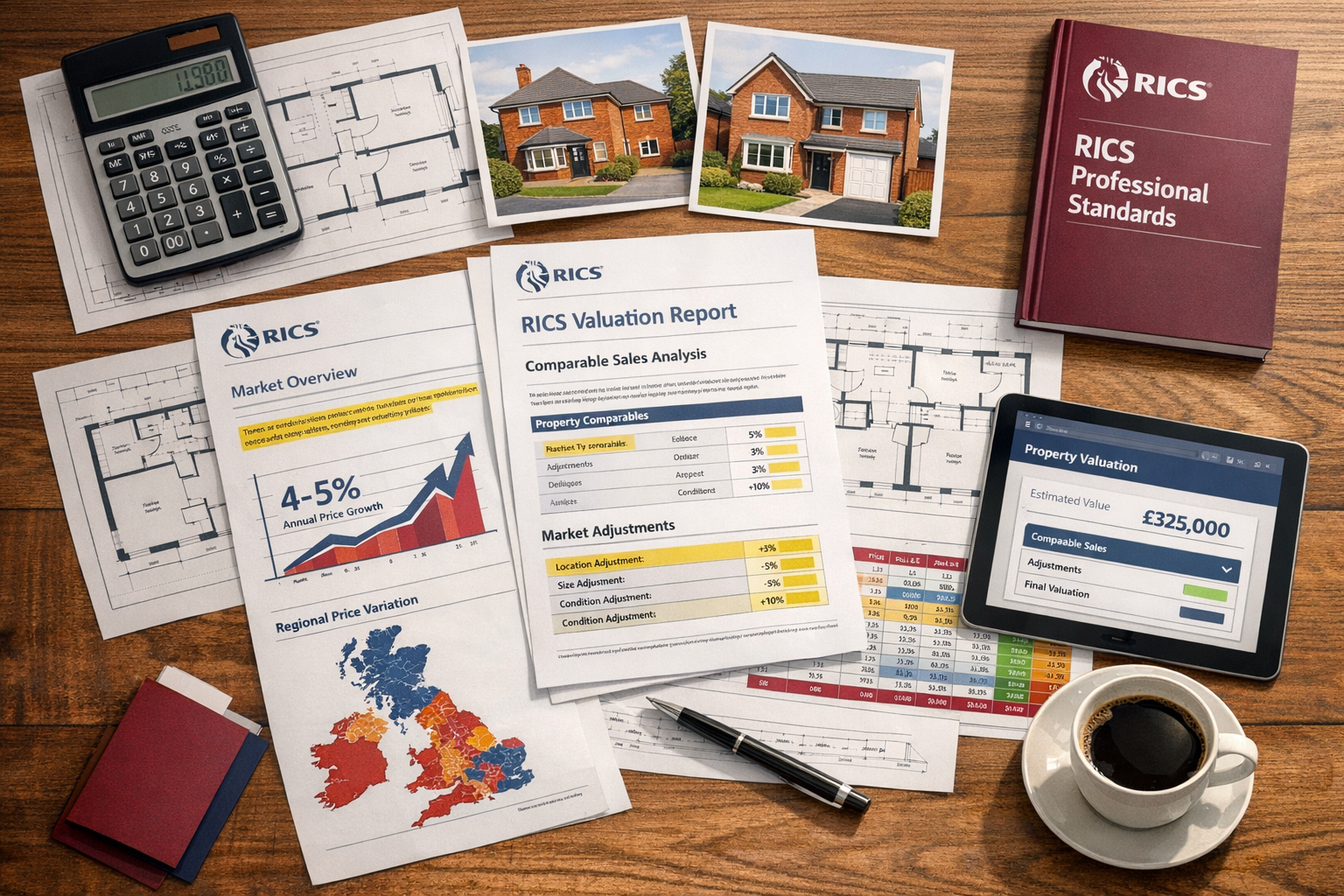
Enhanced Survey Reporting for 2026 Market Conditions
The surveying sector expects significant changes in 2026, with government-proposed reforms potentially making property condition assessments a standard upfront requirement [1]. This shift will substantially increase demand for surveys earlier in the buying process and require surveyor retraining to meet new demands.
For Valuation Surveys for Midlands Recovery 2026: Adjusting for 4-5% National Growth Forecasts, enhanced reporting should include:
Market Context Section:
- Current regional growth rates and trends
- Comparison to national forecasts
- Local sub-market performance indicators
- Forward-looking growth assumptions applied
Valuation Methodology Transparency:
- Comparable sales with time adjustments documented
- Regional premium/discount factors explained
- Range valuations reflecting forecast uncertainty
- Sensitivity analysis for different growth scenarios
Risk Factors and Caveats:
- Economic assumptions underpinning forecasts
- Potential downside scenarios
- Property-specific factors affecting value trajectory
This enhanced approach aligns with professional standards while providing clients with actionable intelligence for decision-making. Whether conducting specific defect surveys or comprehensive building surveys, context-rich reporting adds significant value.
Technology and Data Integration
Modern valuation work increasingly relies on technology integration to improve accuracy and efficiency. Surveyors should leverage:
📱 Digital survey tools including drone surveys for comprehensive property assessment
📊 Real-time market data platforms providing up-to-date comparable sales
🤖 AI-assisted valuation models as supporting tools (not replacements for professional judgment)
📈 Geographic information systems (GIS) for micro-market analysis
However, technology must augment rather than replace professional expertise. The nuanced understanding of local market conditions, property-specific factors, and professional judgment remains irreplaceable—particularly in transitional markets where historical data may not fully predict future performance.
Addressing Common Valuation Challenges in Recovery Markets
Recovery markets present unique challenges that require experienced professional judgment:
Challenge 1: Limited Recent Comparable Sales
In areas with low transaction volumes, surveyors may need to expand their geographic search radius or use older comparables with appropriate time adjustments. Factors of valuation become more critical when direct comparables are scarce.
Challenge 2: Divergent Buyer and Seller Expectations
Sellers may expect prices reflecting future growth, while buyers focus on current market evidence. Professional valuations must navigate this gap with transparent methodology and clear communication.
Challenge 3: Property Condition vs. Market Momentum
A property requiring significant repairs may not benefit fully from market growth. Subsidence surveys or specific defect reports help quantify condition-related value impacts.
Challenge 4: New Build Premium Erosion
In recovering markets, the premium for new builds may compress as existing stock becomes more attractive. Surveyors must adjust new build valuations accordingly.
Specialized Valuation Scenarios
Different transaction types require tailored approaches to Valuation Surveys for Midlands Recovery 2026: Adjusting for 4-5% National Growth Forecasts:
Matrimonial Valuations 🏠
Matrimonial valuations require particular care in growth-adjusting markets, as timing differences between valuation date and final settlement can significantly impact equity division.
Probate Valuations 📋
Valuation for probate must reflect market value at the date of death, but executors benefit from understanding likely appreciation during estate administration.
Right to Buy Valuations 🔑
Right to Buy valuations in the Midlands must account for regional growth patterns while adhering to statutory discount frameworks.
Reinstatement Valuations 🏗️
Reinstatement build cost valuations require separate analysis, as construction costs may not track house price growth directly.
Strategic Considerations for Buyers, Sellers, and Investors
Buyer Strategy in a Growth Market
For buyers navigating the Midlands market in 2026, understanding valuation dynamics offers strategic advantages:
Timing Considerations:
With forecasts predicting acceleration from 2% growth in 2026 to 4-5% in 2027-2028 [4], buyers face a classic dilemma: purchase now before further appreciation, or wait for potential rate reductions? Professional RICS home surveys help buyers make informed decisions by providing accurate current valuations.
Negotiation Leverage:
Buyers can use professional valuations to negotiate effectively, particularly if comparable sales data suggests asking prices exceed market value. Independent commercial building surveys or residential assessments provide objective evidence for negotiations.
Investment vs. Owner-Occupation:
Investors should focus on areas with strongest growth potential (Coventry, Rugby) [3], while owner-occupiers may prioritize lifestyle factors. Both groups benefit from understanding how Valuation Surveys for Midlands Recovery 2026: Adjusting for 4-5% National Growth Forecasts impact their specific circumstances.
Seller Positioning
Sellers in the Midlands can leverage recovery momentum by:
✅ Timing listings strategically to capture peak demand periods
✅ Commissioning pre-sale surveys to address issues proactively
✅ Pricing based on current market evidence plus modest growth premiums
✅ Highlighting location-specific advantages that support premium valuations
A schedule of condition report before listing can identify and address issues that might otherwise reduce negotiated prices.
Investor Due Diligence
Property investors require enhanced due diligence in recovery markets:
Rental Yield Analysis:
Growth forecasts impact capital appreciation, but investors must also assess rental yields. The Midlands offers attractive yields compared to southern markets, with potential for both income and capital growth.
Portfolio Diversification:
Geographic diversification within the Midlands—balancing high-growth areas like Coventry with stable, established neighborhoods—reduces risk while capturing upside potential.
Exit Strategy Planning:
Understanding growth trajectories helps investors plan optimal holding periods and exit timing. Professional valuations should inform both acquisition and disposal decisions.
Future-Proofing Valuation Practices
Preparing for Regulatory Changes
Government-proposed reforms may fundamentally alter the surveying landscape in 2026 and beyond [1]. Surveyors must prepare for:
Mandatory Upfront Surveys:
If property condition assessments become standard requirements before marketing, surveyor capacity and turnaround times become critical competitive factors.
Standardized Reporting Formats:
Regulatory changes may mandate specific reporting formats, requiring practice management system updates and surveyor training.
Enhanced Professional Standards:
Increased survey volumes and regulatory scrutiny may drive higher professional standards and continuing professional development requirements.
Continuous Market Monitoring
Effective Valuation Surveys for Midlands Recovery 2026: Adjusting for 4-5% National Growth Forecasts requires ongoing market intelligence:
📊 Monthly transaction data analysis from Land Registry
📈 Mortgage approval trends as leading indicators
🏦 Interest rate movements and their impact on affordability
🏗️ Supply pipeline monitoring for new developments
💼 Employment and wage growth in key Midlands sectors
Surveyors who maintain robust market intelligence systems can provide more accurate, timely valuations that reflect emerging trends before they appear in historical data.
Professional Development and Specialization
As the market evolves, surveyors should consider:
Regional Specialization:
Deep expertise in specific Midlands sub-markets (Birmingham, Coventry, Rugby, Wolverhampton) enables more accurate valuations and stronger professional reputations.
Property Type Expertise:
Specializing in particular property types (Victorian terraces, new builds, commercial conversions) allows surveyors to develop nuanced valuation approaches.
Technology Adoption:
Embracing tools like drone surveys, thermal imaging, and advanced data analytics enhances service quality and efficiency.
Cross-Disciplinary Knowledge:
Understanding related fields—structural engineering, drainage surveys, damp surveys—enables more comprehensive property assessments.
Conclusion
Valuation Surveys for Midlands Recovery 2026: Adjusting for 4-5% National Growth Forecasts represents both a challenge and an opportunity for property professionals, buyers, sellers, and investors. The West Midlands market's +2.4% growth trajectory [4], positioned between sluggish southern markets and rapidly appreciating northern regions, requires sophisticated valuation approaches that balance historical data, current conditions, and forward-looking projections.
The surveying sector's anticipated volume increases [1], combined with potential regulatory reforms mandating upfront property assessments, create an environment where accurate, professional valuations become more critical than ever. Surveyors must enhance their methodologies to incorporate time-adjusted comparable sales, regional premium factors, and transparent growth assumptions while maintaining rigorous professional standards.
Key Action Steps
For Surveyors:
- Implement systematic time-adjustment protocols for comparable sales data
- Develop regional expertise in high-performing Midlands sub-markets
- Enhance reporting to include explicit growth assumptions and market context
- Invest in technology and data systems to improve accuracy and efficiency
- Prepare for regulatory changes through training and practice management updates
For Buyers:
- Commission professional RICS valuations before making offers
- Understand regional growth differentials when selecting locations
- Use valuation evidence to negotiate effectively
- Consider timing strategies based on growth forecasts
For Sellers:
- Obtain pre-sale surveys to identify and address issues proactively
- Price properties based on current market evidence plus modest growth premiums
- Highlight location-specific advantages that justify premium valuations
For Investors:
- Focus on high-growth areas like Coventry and Rugby for capital appreciation
- Balance rental yields with capital growth potential
- Plan holding periods and exit strategies based on growth trajectories
The Midlands property market in 2026 offers compelling opportunities for those equipped with accurate valuation intelligence and strategic insight. As national forecasts predict acceleration from 2% growth in 2026 to 4-5% by 2027-2028 [4], the region's steady performance and relative affordability position it as an attractive market for diverse stakeholders.
By embracing enhanced valuation methodologies, leveraging professional expertise, and maintaining rigorous standards, surveyors and property professionals can navigate this recovery period successfully—delivering value to clients while contributing to a more transparent, efficient property market. The foundation of success remains unchanged: professional RICS-qualified assessments [2] that combine technical expertise, local knowledge, and transparent methodology.
Whether you're conducting a RICS Building Survey, Homebuyer Survey, or specialized assessment, the principles outlined here provide a framework for accurate, professional valuations that serve clients' needs while maintaining the highest standards of the surveying profession.
References
[1] Surveying In 2026 Reform Recovery And Renewed Demand – https://www.lrg.co.uk/news-and-insights/surveying-in-2026-reform-recovery-and-renewed-demand/
[2] Valuation Strategies For First Time Buyers In 2026 Leveraging Affordability Gains And Regional Price Variations – https://nottinghillsurveyors.com/blog/valuation-strategies-for-first-time-buyers-in-2026-leveraging-affordability-gains-and-regional-price-variations
[3] West Midlands Regional Market Report – https://www.fineandcountry.co.uk/insights/property-market-reports/west-midlands-regional-market-report
[4] House Price Forecast – https://hoa.org.uk/advice/guides-for-homeowners/i-am-buying/house-price-forecast/