
The London property market stands at a critical crossroads in 2026. While national buyer enquiries show signs of recovery with only a -15% dip compared to previous lows, London continues to lag behind the broader UK market, presenting unique challenges for property valuers and chartered surveyors. Understanding Valuation Challenges in London's Stabilising Market: Countering -15% Buyer Enquiry Dip with RICS Insights has become essential for professionals navigating this complex landscape, where affordability pressures, shifting buyer sentiment, and stabilised pricing signals create both obstacles and opportunities.
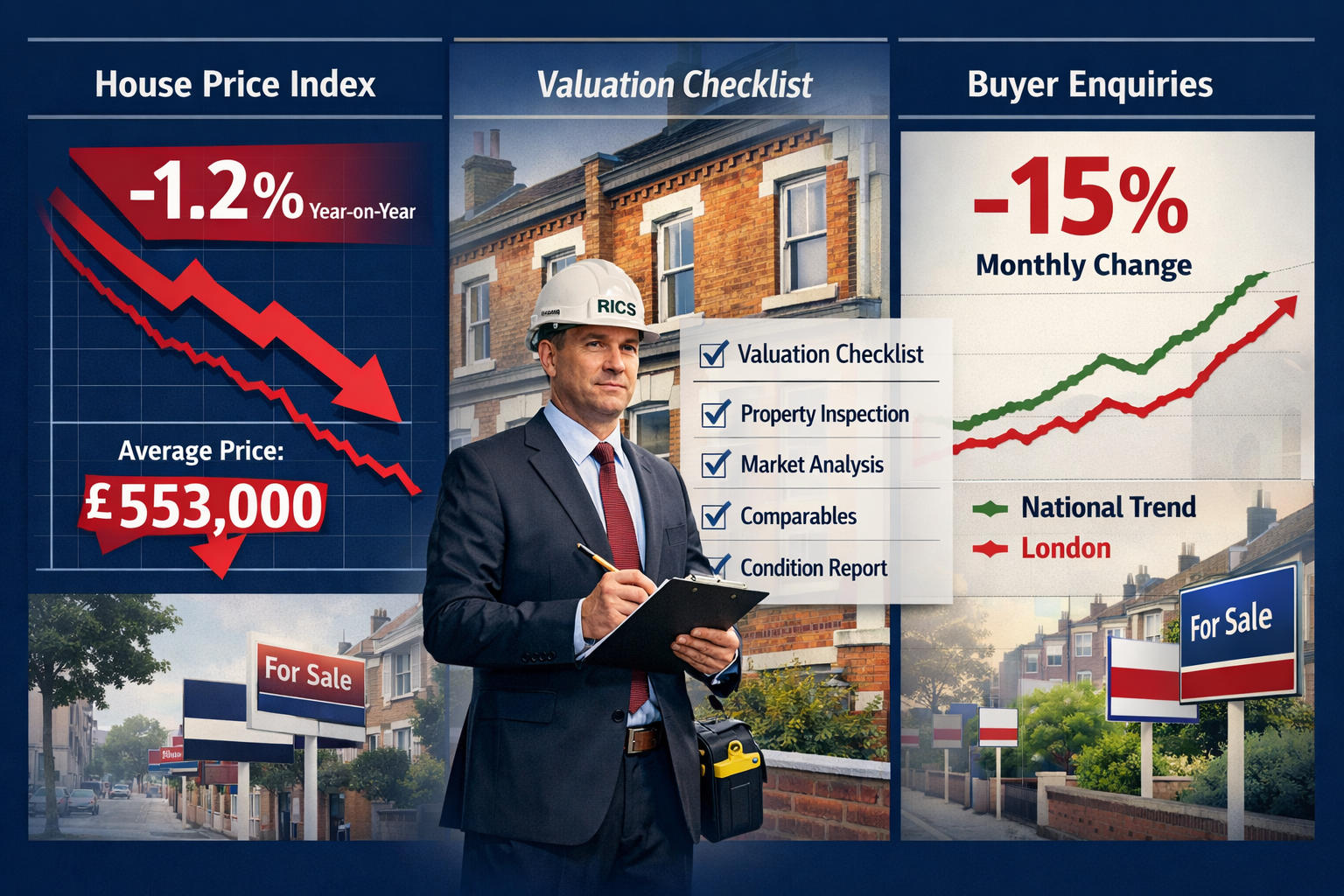
The capital's property market tells a different story than the rest of the UK. While national house prices grew by 2.4% year-over-year, London's House Price Index showed a concerning -1.2% decline to an average of £553,000 as of November 2025[4]. This divergence demands a sophisticated approach to property valuation—one that accounts for local market dynamics, emerging buyer behaviour patterns, and the pent-up demand that industry experts believe is building beneath the surface.
For RICS-certified surveyors and valuation professionals, 2026 presents a unique challenge: how to accurately assess property values in a market that's simultaneously stabilising and underperforming. The answer lies in understanding the nuanced factors driving London's market conditions and applying rigorous, evidence-based valuation methodologies that reflect current realities while anticipating future trends.
Key Takeaways
- 📉 London lags national trends with -1.2% year-over-year house price decline versus +2.4% UK growth, requiring adjusted valuation approaches
- 🏘️ Prime property opportunities exist with prices 10.3% below peak, creating a highly negotiable market for informed buyers and valuers
- 📊 RICS valuation standards provide essential frameworks for navigating market uncertainty through Red Book methodologies and comparable analysis
- 💼 Buyer enquiry recovery at -15% nationally signals potential market stabilisation, though London-specific factors demand careful interpretation
- 🔮 Pent-up demand indicators including 173% surge in property launches suggest future market momentum that valuers must factor into assessments
Understanding London's Market Divergence from National Trends
The Tale of Two Markets: London vs. UK Performance
The property market across the United Kingdom has shown resilience in early 2026, with January seeing annual house price growth tick up to 1.0%—marking the first positive momentum in months following the uncertainty created by the November 2025 budget[6]. However, London's performance tells a starkly different story, one that requires valuers to fundamentally recalibrate their assessment approaches.
According to Office for National Statistics data, London's average house price stood at £553,000 in November 2025, representing a -1.2% year-over-year decline[4]. This underperformance relative to the national market stems from several interconnected factors:
Affordability Constraints 🏠
London property prices remain significantly elevated relative to local wages, creating persistent affordability challenges. While wage growth is beginning to outpace house price growth nationally[6], helping ease affordability pressures for buyers, London's premium pricing continues to present barriers to entry for many potential purchasers.
Supply and Demand Imbalance 📈
The market shows increased supply coupled with relatively low buyer demand as primary contributors to London's underperformance[9]. This dynamic creates downward pressure on valuations and requires surveyors to carefully assess comparable properties within specific micro-markets rather than relying on broader regional trends.
Consumer Confidence Factors 💭
Consumer confidence in London stood at -16 as of January 2026, representing a modest one-point month-over-month improvement[4]. While this slight uptick suggests stabilisation, the negative reading indicates continued caution among potential buyers and sellers—a sentiment that directly impacts transaction volumes and pricing negotiations.
For professionals conducting RICS valuations, these divergent trends necessitate a hyper-local approach to property assessment. Broad regional comparables may no longer provide sufficient accuracy; instead, valuers must examine neighbourhood-specific data, recent transaction patterns, and local economic indicators to arrive at defensible valuations.
Rental Market Dynamics and Their Valuation Implications
While capital values have declined, London's rental market presents a different picture that valuers must incorporate into their assessments, particularly for investment property valuations. Rents grew 2.1% year-over-year to December 2025 across the UK, though London's rent annual inflation remained the lowest nationally at just 1.1%[1][4].
This rental growth dynamic creates several implications for property valuation:
| Metric | London | UK Average | Implication for Valuers |
|---|---|---|---|
| House Price Growth (YoY) | -1.2% | +2.4% | Capital value compression |
| Rental Growth (YoY) | +1.1% | +2.1% | Improving yield prospects |
| Price-to-Rent Ratio | Decreasing | Stable | Enhanced investment case |
| Consumer Confidence | -16 | Higher | Transaction uncertainty |
The narrowing gap between capital value decline and rental growth suggests that investment yields are improving in London properties. For surveyors conducting valuation assessments, this trend supports using income capitalisation approaches alongside traditional comparable methods, particularly for buy-to-let properties and portfolio valuations.
Prime Property Market Opportunities
While mainstream London property faces headwinds, the prime property segment presents distinct opportunities that require specialised valuation expertise. The Coutts Prime Property Index indicates that prime London properties are trading 10.3% below their peak values, with widespread discounts driving a highly negotiable market environment[8].
This pricing adjustment in the prime sector creates several valuation considerations:
- Negotiability Premium: Properties may sell significantly below asking prices, requiring valuers to weight recent transaction evidence more heavily than listing prices
- Buyer Leverage: Enhanced buyer negotiating power means comparable sales from 6-12 months ago may overstate current market values
- Quality Flight: Buyers are increasingly selective, favouring exceptional properties while discounting those with defects or limitations
For chartered surveyors working in London's prime markets, understanding these dynamics is essential for providing accurate Red Book valuations that reflect current market realities rather than historical precedents.
Valuation Challenges in London's Stabilising Market: RICS Methodologies and Best Practices
Applying RICS Red Book Standards in Uncertain Markets
The RICS Valuation – Global Standards (commonly known as the Red Book) provides the foundational framework for professional valuations, but applying these standards in London's current market requires careful interpretation and adaptation. The Red Book's emphasis on market value as "the estimated amount for which an asset should exchange on the valuation date between a willing buyer and a willing seller in an arm's length transaction" becomes particularly challenging when market signals are mixed.
Key Red Book principles for navigating London's stabilising market include:
1. Comparable Evidence Selection 🔍
In a declining market with limited transaction volumes, selecting appropriate comparables becomes both more critical and more challenging. Valuers must:
- Prioritise recent transactions (within 3-6 months) over older sales
- Apply time adjustments to account for market movement
- Consider withdrawn listings and price reductions as negative evidence
- Weight actual sales more heavily than asking prices
2. Market Conditions Adjustments 📊
The Red Book requires valuers to reflect current market conditions rather than historical trends. With London showing -1.2% annual decline while national markets grow at 2.4%[1], valuers must resist the temptation to apply national trends to London properties.
3. Assumptions and Special Assumptions ⚖️
In uncertain markets, clearly stating assumptions becomes paramount. Valuers should explicitly document:
- Market condition assumptions (stabilising, declining, or recovering)
- Typical marketing period estimates (which may be extended in current conditions)
- Buyer profile assumptions (investor vs. owner-occupier)
- Any special assumptions regarding future market movements
For professionals seeking comprehensive guidance on RICS building surveys and valuation integration, understanding how physical property conditions interact with market dynamics provides crucial context for defensible valuations.
Addressing the -15% Buyer Enquiry Dip in Valuation Assumptions
The -15% dip in buyer enquiries nationally—with London experiencing potentially steeper declines—directly impacts several valuation assumptions that surveyors must address:
Marketing Period Extensions ⏰
Reduced buyer enquiries typically translate to extended marketing periods. While a typical London property might historically sell within 8-12 weeks, current conditions may require 16-20 weeks or longer. This extended timeline affects:
- Holding cost calculations for development valuations
- Urgency discounts in forced sale scenarios
- Investment appraisal cashflow timing
Negotiability Factors 💷
With fewer buyers competing for properties, successful transactions often occur at significant discounts to asking prices. The Coutts Prime Property Index's finding that prime properties trade 10.3% below peak[8] suggests substantial negotiability. Valuers should:
- Analyse achieved price vs. asking price ratios in recent local transactions
- Apply appropriate discounts to reflect realistic transaction prices
- Consider buyer leverage in current market conditions
Demand Segmentation 👥
Not all buyer segments are equally affected by the enquiry dip. Valuers must differentiate between:
- First-time buyers: Benefiting from improving affordability as wage growth outpaces price growth[6]
- Investors: Attracted by improving yields as capital values compress
- Downsizers: Often less price-sensitive but more quality-focused
- International buyers: Subject to currency fluctuations and geopolitical factors
Understanding these segments helps valuers apply appropriate demand assumptions to different property types and price points.
Incorporating Stabilisation Signals and Pent-Up Demand
While current market conditions present challenges, several indicators suggest potential stabilisation and recovery that forward-looking valuations should consider:
Property Launch Surge 🚀
Property launches surged 173% between late November and early December 2025 compared to the same period in 2024[6]. This dramatic increase suggests:
- Sellers gaining confidence in market stability
- Pent-up supply coming to market
- Potential increase in transaction volumes ahead
Positive Price Momentum 📈
January 2026's return to positive annual house price growth (1.0% nationally)[6] marks a potential inflection point. While London lags this trend, the national recovery often precedes regional improvements by several months.
Affordability Improvements 💰
Wage growth outpacing house price growth[6] gradually improves affordability metrics, potentially unlocking demand from buyers previously priced out of the market. For valuers, this suggests:
- Stabilising entry-level property values
- Potential demand recovery in lower price brackets
- Reduced downward pressure on valuations
When conducting homebuyer surveys integrated with valuations, these forward-looking indicators should inform professional judgement about short-to-medium term value trajectories.
Strategic Approaches for Valuers: Navigating Complexity with Professional Rigour
Multi-Method Valuation Approaches for Validation
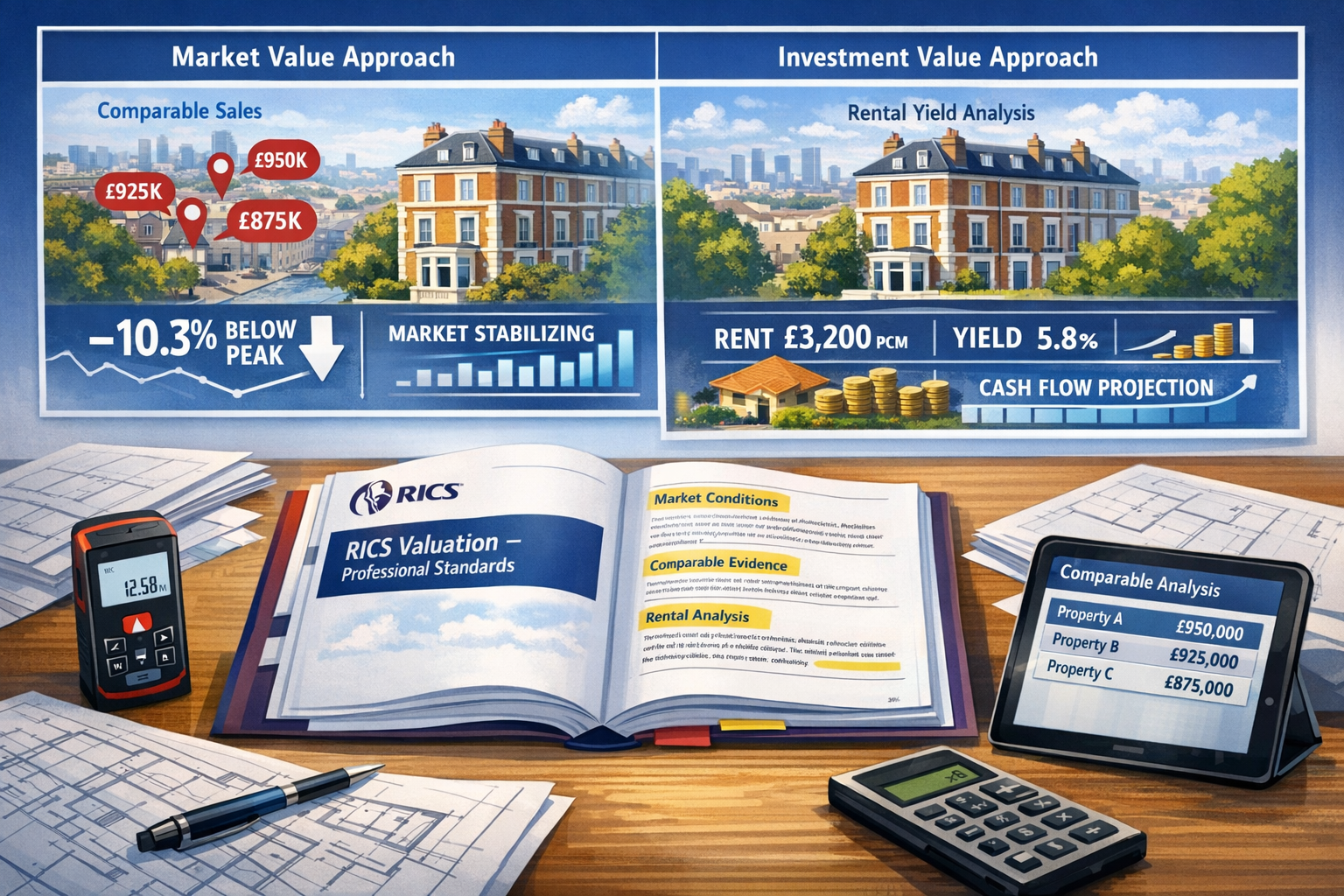
In uncertain markets, relying on a single valuation method increases the risk of material misstatement. Best practice involves employing multiple approaches and triangulating results:
Comparative Method 🏘️
The primary approach for residential valuations, but requiring careful application:
- Micro-market focus: Compare properties within 0.5-mile radius rather than broader areas
- Condition adjustments: Account for property condition differences more rigorously
- Time adjustments: Apply monthly market movement factors to older comparables
- Transaction type weighting: Prioritise actual sales over asking prices and withdrawn listings
Investment Method 💼
Particularly relevant given improving yield dynamics:
- Rental value assessment: Use recent lettings evidence to establish market rent
- Yield selection: Apply yields reflecting current investor sentiment and risk perception
- Growth assumptions: Conservative rental and capital growth projections given market uncertainty
- Void and management costs: Realistic allowances for tenant finding and property management
Residual Method 🏗️
For development sites and properties with improvement potential:
- Conservative GDV assumptions: Use lower quartile comparable evidence rather than average
- Extended build periods: Account for potential construction delays and market absorption
- Enhanced contingencies: Increase contingency allowances for market uncertainty
- Realistic profit margins: Reflect current developer risk appetite and funding costs
For professionals working on commercial property valuations, these multi-method approaches provide essential validation and defensibility.
Technology-Enhanced Valuation Accuracy
Modern valuation practice increasingly incorporates technology and data analytics to enhance accuracy and reduce subjective bias:
Automated Valuation Models (AVMs) 🤖
While not replacing professional judgement, AVMs provide useful benchmarking:
- Cross-reference professional valuations against AVM outputs
- Investigate significant variances between methods
- Use AVM confidence intervals to assess valuation uncertainty
- Leverage machine learning insights on price-influencing factors
Geospatial Analysis 🗺️
Location-specific factors significantly impact London property values:
- Proximity to transport links (particularly Elizabeth Line stations)
- School catchment areas and Ofsted ratings
- Crime statistics and neighbourhood safety metrics
- Planned infrastructure developments and regeneration schemes
Transaction Data Platforms 📊
Real-time access to market data improves comparable evidence quality:
- Land Registry price paid data for verified transaction evidence
- Rightmove and Zoopla analytics for asking price trends
- EPC database for energy efficiency comparables
- Planning portal for development potential assessment
Market Sentiment Indicators 📈
Quantifying market sentiment helps validate assumptions:
- RICS Residential Market Survey data for buyer enquiry trends
- Mortgage approval volumes indicating transaction pipeline
- Consumer confidence indices for demand forecasting
- Days-on-market statistics for marketing period assumptions
Communicating Uncertainty and Risk in Valuation Reports
Professional valuers must transparently communicate uncertainty rather than presenting false precision. In London's current market, this requires:
Explicit Uncertainty Statements ⚠️
Valuation reports should clearly articulate:
"The London property market is experiencing a period of stabilisation following -1.2% year-over-year price decline. This valuation reflects current market conditions as of [date], but material uncertainty exists regarding short-term price movements. The valuation should be reviewed if the transaction does not complete within 90 days."
Sensitivity Analysis 📉
For investment and development valuations, present scenarios:
- Base case: Most likely outcome given current trends
- Downside case: Continued market weakness (-5% to -10% adjustment)
- Upside case: Demand recovery and price stabilisation (+3% to +5% adjustment)
Market Context Sections 📝
Include dedicated sections explaining:
- Local market performance vs. national trends
- Recent transaction evidence and pricing patterns
- Buyer enquiry levels and marketing period data
- Forward-looking indicators and stabilisation signals
For surveyors providing matrimonial valuations or other litigation-related assessments, this transparency becomes particularly important as valuations may face scrutiny in legal proceedings.
Specialised Valuation Scenarios in Current Market Conditions
Different valuation purposes require adapted approaches in London's stabilising market:
Mortgage Lending Valuations 🏦
Lenders require conservative valuations that protect their security:
- Apply prudent comparable selection favouring lower transaction prices
- Consider forced sale scenarios and achievable prices under time pressure
- Account for potential further market decline in loan-to-value calculations
- Highlight any material uncertainty affecting value stability
Probate and Tax Valuations 💷
These valuations require specific date-of-death or tax event values:
- Use comparables from the specific valuation date period
- Avoid hindsight bias from subsequent market movements
- Document market conditions at the relevant date
- Consider whether capital gains tax valuations require different approaches
Lease Extension and Enfranchisement 🔑
Statutory valuations under the Leasehold Reform Act require specialist approaches:
- Apply appropriate capitalisation rates for current market conditions
- Consider marriage value in light of market weakness
- Account for relativity curves reflecting current buyer preferences
- Review lease extension valuation methodologies for current market applicability
Portfolio Valuations 📁
Investment portfolios require consistent methodology across multiple properties:
- Apply uniform assumptions across the portfolio
- Highlight properties with material uncertainty or valuation risk
- Consider portfolio effect and bulk sale scenarios
- Provide aggregated sensitivity analysis for the entire portfolio
Future Outlook: Positioning for Market Recovery
Indicators Suggesting Potential Market Stabilisation
While Valuation Challenges in London's Stabilising Market: Countering -15% Buyer Enquiry Dip with RICS Insights remain significant in 2026, several indicators suggest the market may be approaching an inflection point:
Improving Affordability Metrics 📊
The combination of modest price declines and wage growth creates a more favourable affordability environment:
- House price-to-earnings ratios declining from peak levels
- First-time buyer deposits becoming more achievable
- Mortgage serviceability improving with wage growth
- Potential demand unlocking from previously priced-out buyers
Transaction Activity Signals 🏡
The 173% surge in property launches[6] between late November and early December 2025 suggests:
- Seller confidence returning after budget uncertainty
- Pent-up supply coming to market
- Potential for increased transaction volumes in 2026
- Market normalisation as buyers and sellers adjust expectations
Prime Market Opportunities 💎
The 10.3% discount from peak in prime properties[8] creates compelling value propositions:
- Attracting domestic and international buyers seeking entry points
- Quality properties receiving multiple offers despite broader market weakness
- Potential for prime market recovery leading mainstream segments
- Investment opportunities for long-term holders
Rental Market Fundamentals 🏠
Despite modest 1.1% rental growth in London[4], underlying fundamentals remain supportive:
- Limited new rental supply due to reduced development activity
- Demographic trends supporting rental demand
- Improving yields attracting investor interest
- Potential for rental growth acceleration as economy strengthens
For professionals conducting chartered surveyor assessments in West London and other prime areas, these recovery indicators should inform medium-term value projections.
Adapting Valuation Practice for Emerging Trends
Forward-thinking valuers are adapting their practice to address emerging market trends:
Sustainability and Energy Efficiency 🌱
EPC ratings increasingly impact property values and marketability:
- Properties with poor EPC ratings facing value discounts
- Retrofit potential becoming a value consideration
- Future regulatory changes affecting long-term value
- Green premium for highly efficient properties
Hybrid Working Impact 💻
Post-pandemic working patterns continue influencing property preferences:
- Home office space commanding premium valuations
- Central London flats facing relative weakness
- Suburban properties with gardens outperforming
- Transport accessibility remaining crucial for hybrid workers
Technology Integration 🏠
Smart home technology and digital infrastructure affecting values:
- Fibre broadband availability becoming essential
- Smart home systems adding marginal value
- Future-proofing for technology integration
- Digital infrastructure in new developments
Demographic Shifts 👨👩👧👦
Changing household composition influencing demand patterns:
- Downsizing demand from aging population
- Multi-generational living requirements
- Single-person households driving flat demand
- Family formation patterns affecting house types
Professional Development and Market Knowledge
Maintaining valuation accuracy in challenging markets requires ongoing professional development:
Continuous Market Monitoring 📈
- Regular review of RICS Residential Market Survey data
- Tracking Land Registry price paid information
- Monitoring mortgage approval and lending trends
- Attending property market briefings and seminars
Peer Review and Collaboration 🤝
- Engaging with fellow valuers on challenging assignments
- Participating in RICS regional valuation forums
- Seeking second opinions on material uncertainty cases
- Sharing market intelligence and comparable evidence
Technical Skills Enhancement 🎓
- Advanced training in statistical analysis and data interpretation
- Technology platforms for market data and comparable evidence
- Specialist valuation methodologies for complex scenarios
- Communication skills for explaining uncertainty to clients
Regulatory Awareness ⚖️
- Staying current with RICS guidance notes and updates
- Understanding lender requirements and risk appetite changes
- Monitoring regulatory developments affecting property markets
- Compliance with money laundering and due diligence requirements
For those seeking to enhance their expertise, exploring resources on factors of valuation provides valuable foundational knowledge.
Conclusion: Navigating Uncertainty with Professional Expertise

The London property market in 2026 presents unprecedented challenges for valuation professionals. With the capital experiencing -1.2% year-over-year price decline while the broader UK market grows at 2.4%, and buyer enquiries down -15% nationally, valuers must navigate complex, divergent trends that demand sophisticated analysis and professional judgement.
Understanding Valuation Challenges in London's Stabilising Market: Countering -15% Buyer Enquiry Dip with RICS Insights requires more than mechanical application of valuation formulas. It demands:
✅ Rigorous application of RICS Red Book standards adapted to current market conditions
✅ Multi-method valuation approaches providing validation and reducing reliance on single methodologies
✅ Transparent communication of uncertainty and market risks to clients and stakeholders
✅ Forward-looking analysis incorporating stabilisation signals and pent-up demand indicators
✅ Continuous professional development maintaining market knowledge and technical expertise
The opportunities emerging from London's market adjustment—including prime properties trading 10.3% below peak[8], improving affordability as wage growth outpaces price growth[6], and the 173% surge in property launches[6]—suggest that today's challenges may create tomorrow's opportunities for informed buyers, sellers, and investors.
Actionable Next Steps for Property Professionals
For RICS Chartered Surveyors:
- Review and update comparable evidence databases with recent London transactions
- Implement multi-method validation for all significant valuations
- Enhance valuation reports with explicit market context and uncertainty statements
- Invest in technology platforms providing real-time market data and analytics
- Engage in peer review for complex or high-value assignments
For Property Investors:
- Commission professional RICS valuations before making acquisition decisions
- Focus on improving yield opportunities as capital values compress
- Consider prime market opportunities trading below peak values
- Assess properties with enhancement potential in stabilising market
- Maintain long-term perspective despite short-term market volatility
For Homebuyers and Sellers:
- Seek professional homebuyer survey advice before committing to transactions
- Understand that asking prices may not reflect achievable transaction prices
- Consider timing decisions based on personal circumstances rather than market timing
- Obtain independent valuations for price negotiation leverage
- Factor in extended marketing periods when planning property sales
For Lenders and Financial Institutions:
- Ensure valuation instructions clearly communicate risk appetite and requirements
- Consider enhanced monitoring for properties in declining micro-markets
- Review loan-to-value policies in light of market uncertainty
- Implement robust comparable evidence verification processes
- Maintain dialogue with valuation professionals on market trends
The London property market's stabilisation phase, while challenging, ultimately creates opportunities for those equipped with professional expertise, rigorous methodology, and market insight. By applying RICS standards with appropriate adaptation for current conditions, valuers can provide the accurate, defensible assessments that clients, lenders, and the market require.
As 2026 progresses, monitoring key indicators—buyer enquiry levels, transaction volumes, affordability metrics, and rental market dynamics—will provide early signals of sustained recovery or continued adjustment. Whatever the market brings, professional valuers armed with comprehensive market knowledge and robust methodologies will continue providing the essential foundation for informed property decisions.
For expert guidance on navigating London's complex property market, professional RICS chartered surveyors offer the expertise, independence, and rigour necessary to address today's valuation challenges while positioning for tomorrow's opportunities.
References
[1] February2026 – https://www.ons.gov.uk/economy/inflationandpriceindices/bulletins/privaterentandhousepricesuk/february2026
[2] 262593 Londons Prime Property Market Offers New Opportunities Coutts Index – https://www.crowdfundinsider.com/2026/02/262593-londons-prime-property-market-offers-new-opportunities-coutts-index/
[3] London Housing Market Hits Bottom Leaving Opportunities For Land Acquisition And Alternative Use – https://www.costar.com/article/2036418953/london-housing-market-hits-bottom-leaving-opportunities-for-land-acquisition-and-alternative-use
[4] Move Or Wait Londons February 2026 Property Signal – https://hub.entralon.com/move-or-wait-londons-february-2026-property-signal/
[5] London Housing Market – https://wowa.ca/london-housing-market
[6] London Spring Property Market 2026 – https://www.featheringtoninteriors.com/post/london-spring-property-market-2026
[7] Weekly Summary 13th February 2026 – https://builtplace.com/weekly-summary-13th-february-2026/
[8] Coutts Prime Property Index Highlights Exceptional Value In Cent – https://www.natwestgroup.com/news-and-insights/news-room/press-releases/ai-and-data/2026/feb/coutts-prime-property-index-highlights-exceptional-value-in-cent.html
[9] London Office For National Statistics Wales North East England B2922668 – https://www.the-independent.com/money/london-office-for-national-statistics-wales-north-east-england-b2922668.html
[10] London Property Market Update 2026 A Market Reset Or Opportunity – https://www.lysshomes.co.uk/london-property-market-update-2026-a-market-reset-or-opportunity/