The UK property market faces a fundamental shift: as of July 2024, whole life carbon assessments became mandatory for RICS members, transforming how lenders evaluate asset resilience and retrofit costs.[8] This regulatory change means that carbon profiling now directly influences property valuations, with financial institutions increasingly incorporating environmental performance into their lending criteria and risk assessments.
Understanding Valuation Adjustments for Whole Life Carbon in 2026 Surveys: Applying RICS 2nd Edition PAS 2080 Protocols has become essential for property professionals navigating this new landscape. The integration of carbon metrics into traditional valuation practices represents more than regulatory compliance—it fundamentally alters how properties are assessed, financed, and valued in recovering markets.
Key Takeaways
- 🏢 Mandatory Carbon Assessments: RICS Whole Life Carbon Assessment 2nd Edition became mandatory on July 1, 2024, requiring carbon profiling in property valuations
- 💰 Financial Impact: Lenders now incorporate carbon metrics into resilience checks, affecting loan-to-value ratios and financing terms
- 📊 Expanded Scope: The 2nd Edition covers all infrastructure across entire lifecycles, from design through deconstruction and recycling
- 🔄 Dual Framework: PAS 2080:2023 provides carbon governance while RICS WLCA 2nd Edition defines measurement methodology
- 🎯 Market Influence: Properties with poor carbon performance face valuation discounts and higher retrofit cost provisions in 2026 markets
Understanding the RICS 2nd Edition Framework for Carbon Assessment
The RICS Whole Life Carbon Assessment 2nd Edition represents a comprehensive evolution from its predecessor, expanding coverage beyond buildings to encompass all infrastructure across the entire built environment lifecycle.[4] This expansion means surveyors must now consider carbon implications from initial design through deconstruction, reuse, and recycling phases.
Core Components of the 2nd Edition
The updated standard introduced several critical methodological changes that directly impact valuation practices:
Reporting Modules and Categorization 📋
- Element categorisation for both buildings and infrastructure
- Standardized reporting modules aligned with lifecycle stages
- Clear parameter definitions for consistent measurement
- Transport impact calculations throughout the supply chain
Emissions Assessment Framework 🌍
The 2nd Edition measures three distinct carbon categories that surveyors must evaluate:
- Embodied Carbon: Materials, construction, and maintenance emissions
- Operational Carbon: Energy consumption during building use
- User Carbon: Emissions from occupant activities and transport
This comprehensive approach ensures no significant emission sources are overlooked when conducting RICS valuations in 2026.[7]
Integration with International Standards
The RICS framework aligns with ISO/TC 59/SC 17 Sustainability in buildings and civil engineering works and EN standards for sustainability of construction work, enabling consistent measurement across jurisdictions.[7] This international harmonization proves particularly valuable for institutional investors with multi-regional portfolios.
The standard also integrates with ICMS (3rd edition), allowing professionals to measure and report carbon and life cycle costs in an integrated manner.[7] This integration facilitates more comprehensive financial and environmental decision-making during building surveys.
Valuation Adjustments for Whole Life Carbon in 2026 Surveys: Practical Implementation
Implementing carbon adjustments in property valuations requires a systematic approach that combines technical assessment with financial analysis. Surveyors conducting RICS home surveys must now incorporate carbon profiling as a standard component of their evaluation process.
Assessment Methodology and Data Collection
The practical application of Valuation Adjustments for Whole Life Carbon in 2026 Surveys: Applying RICS 2nd Edition PAS 2080 Protocols involves several key steps:
Stage 1: Baseline Carbon Assessment 🔍
- Collect building specifications and material inventories
- Calculate embodied carbon using approved emissions factors
- Assess operational energy performance and projected consumption
- Evaluate transport impacts and supply chain emissions
Stage 2: Lifecycle Analysis 📈
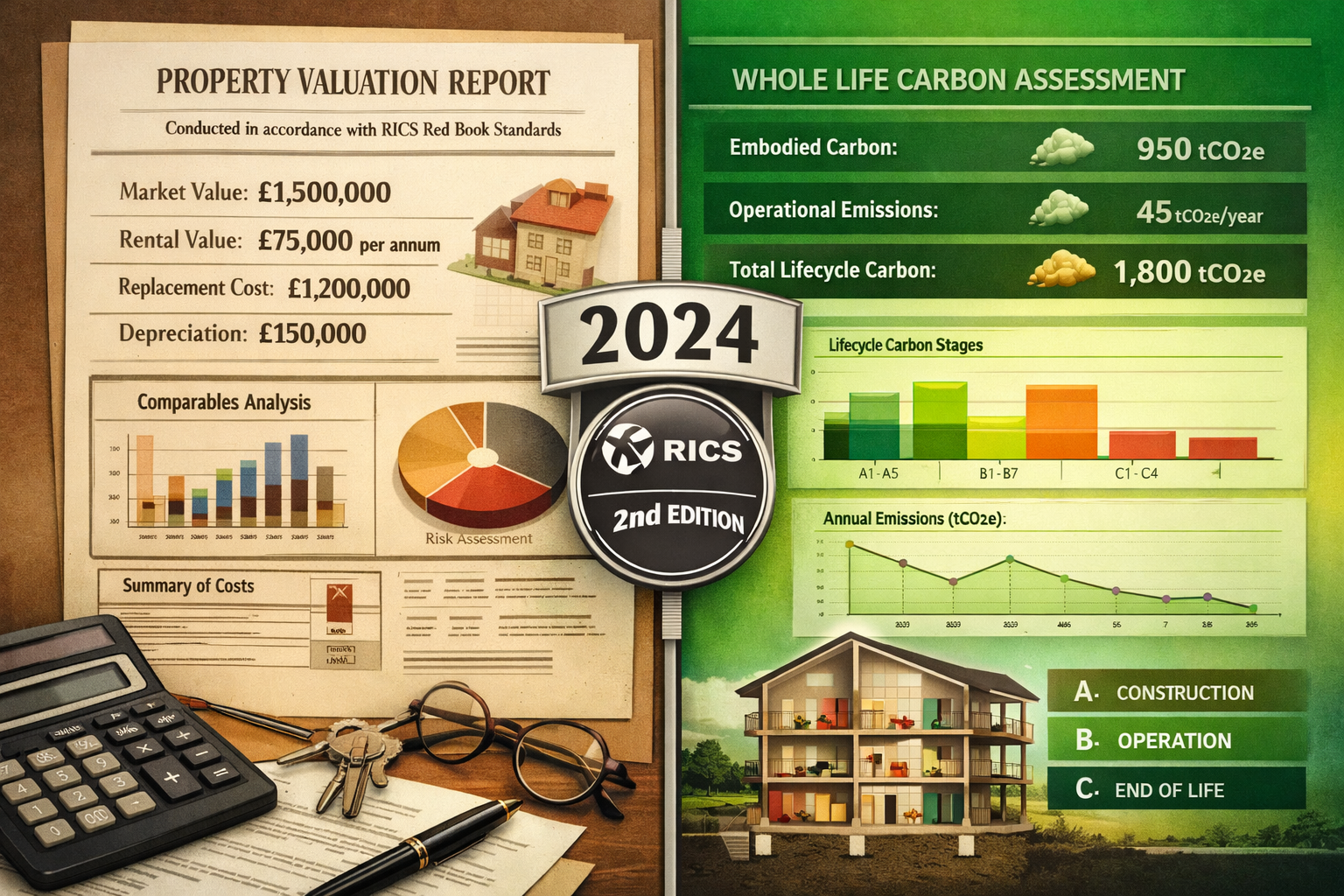
The assessment must cover defined lifecycle stages:
| Stage | Description | Carbon Impact |
|---|---|---|
| A1-A3 | Product stage (materials extraction to manufacturing) | High |
| A4-A5 | Construction process (transport and assembly) | Medium |
| B1-B7 | Use stage (operation, maintenance, replacement) | Very High |
| C1-C4 | End of life (deconstruction, disposal, recycling) | Low-Medium |
Stage 3: Uncertainty Analysis ⚖️
The 2nd Edition requires uncertainty analysis to acknowledge data quality variations and assumptions.[2] This analysis helps surveyors provide realistic ranges for carbon-adjusted valuations rather than single-point estimates.
Financial Valuation Adjustments
Translating carbon metrics into monetary adjustments requires understanding how lenders and investors incorporate environmental performance into their risk models:
Carbon Premium/Discount Calculation 💷
Properties demonstrating superior carbon performance may command premiums of 3-7% in 2026 markets, while poor performers face discounts of 5-15% depending on retrofit requirements. These adjustments reflect:
- Future regulatory compliance costs
- Energy efficiency and operational savings
- Market demand for sustainable properties
- Lender risk appetite for carbon-intensive assets
Retrofit Cost Provisions 🔧
When conducting RICS homebuyer surveys Level 2, surveyors must estimate retrofit costs required to meet emerging carbon standards. These provisions directly reduce net valuation figures and affect loan-to-value calculations.
PAS 2080 Protocols and Carbon Management Integration
While RICS WLCA 2nd Edition defines the measurement methodology, PAS 2080:2023 provides the management framework for carbon governance and decision-making.[7] Understanding how these complementary standards work together proves essential for implementing Valuation Adjustments for Whole Life Carbon in 2026 Surveys: Applying RICS 2nd Edition PAS 2080 Protocols.
The Complementary Framework Approach
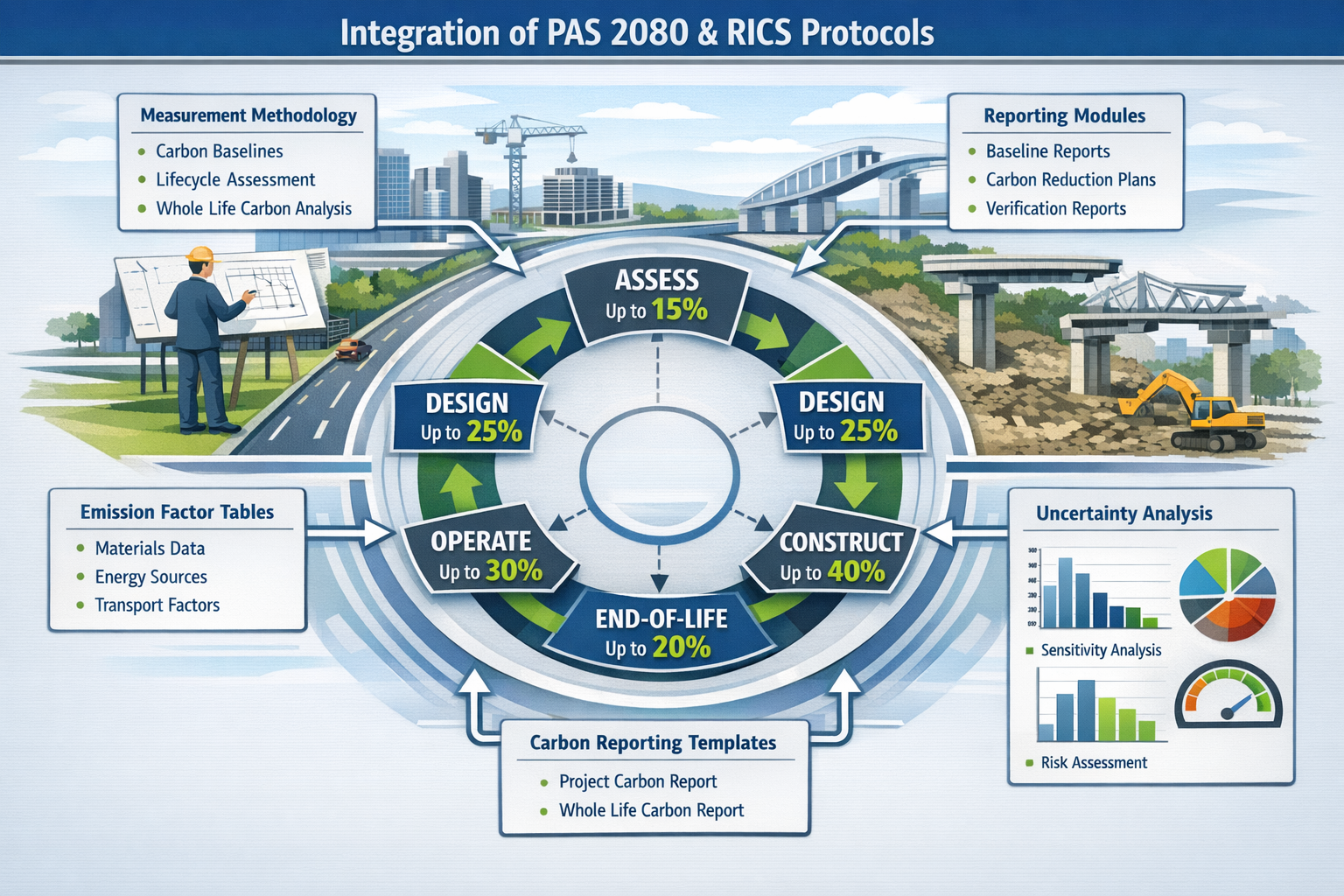
PAS 2080:2023 establishes a systematic approach to carbon management that complements RICS measurement protocols:
Carbon Management Principles 🎯
- Assess: Establish baseline carbon profiles using RICS methodology
- Design: Optimize carbon outcomes through informed decision-making
- Construct: Minimize construction-phase emissions
- Operate: Monitor and reduce operational carbon
- End-of-Life: Plan for deconstruction, reuse, and recycling
This management framework ensures carbon considerations influence decisions at every project stage, from initial valuation of commercial property through eventual decommissioning.
Governance and Accountability Structures
PAS 2080 introduces specific governance requirements that affect how surveyors document and report carbon assessments:
Documentation Requirements 📑
- Carbon management plans aligned with project objectives
- Defined roles and responsibilities for carbon reduction
- Regular monitoring and reporting protocols
- Verification procedures for carbon claims
These governance structures provide the accountability framework that gives lenders confidence in carbon-adjusted valuations, particularly for commercial property valuations where institutional investors demand rigorous documentation.
Biogenic Carbon and Decarbonisation Protocols
The 2nd Edition introduced specific protocols for biogenic carbon assessment—carbon stored in biological materials like timber.[2] This addition proves particularly relevant for:
- Timber-frame construction valuations
- Heritage properties with significant wood components
- Modern sustainable developments using bio-based materials
Decarbonisation Pathways 🌱
Surveyors must now evaluate properties against established decarbonisation protocols that outline:
- Target carbon reduction percentages by 2030, 2040, and 2050
- Feasibility of achieving net-zero operational carbon
- Retrofit strategies and associated costs
- Alternative use scenarios and their carbon implications
Regional Adaptation and Global Applicability
While the RICS methodology applies globally, numerical assumptions and emissions factors are based on UK locations and practices due to data availability.[8] The standard provides a framework for adaptation to other regions, but surveyors must understand these geographical considerations when conducting valuations.
UK-Specific Factors and Considerations
For properties in England, Wales, Scotland, and Northern Ireland, the 2nd Edition incorporates:
- UK-specific emissions factors from recognized databases
- National grid carbon intensity figures
- Regional construction practice variations
- Local regulatory requirements and building standards
When conducting RICS building surveys, surveyors benefit from well-established UK data sources that enhance assessment accuracy and reduce uncertainty ranges.
Adapting the Framework for International Properties
For valuations outside the UK, professionals must:
- Identify appropriate regional emissions factors
- Adjust for local construction practices and materials
- Consider regional energy grid carbon intensity
- Account for climate-specific operational requirements
This adaptation process requires additional expertise but maintains methodological consistency across jurisdictions, supporting international investment portfolios.
Lender Resilience Checks and Financing Implications in 2026
The integration of carbon metrics into property valuations has fundamentally altered how financial institutions assess lending risk in 2026. Lenders now incorporate whole life carbon assessments into their resilience checks, affecting everything from mortgage approvals to commercial property financing.
Carbon-Adjusted Loan-to-Value Ratios
Financial institutions increasingly apply carbon-adjusted LTV ratios that reflect environmental performance:
High-Performance Properties ✅
- Standard or enhanced LTV ratios (up to 90-95% for residential)
- Preferential interest rates (typically 0.1-0.3% reduction)
- Streamlined approval processes
- Access to green financing products
Poor-Performance Properties ⚠️
- Reduced LTV ratios (often capped at 70-75%)
- Higher interest rate premiums (0.2-0.5% increase)
- Additional retrofit cost provisions required
- Enhanced documentation and monitoring requirements
These adjustments reflect lenders' recognition that carbon-intensive properties face greater regulatory and market risks over typical mortgage timeframes.
Retrofit Cost Provisions and Valuation Reserves
When conducting RICS Red Book valuations, surveyors must now include specific provisions for anticipated retrofit costs:
Typical Retrofit Scenarios 🔧
| Property Type | Average Retrofit Cost | Valuation Impact |
|---|---|---|
| Pre-1950 residential | £25,000-£45,000 | -8% to -12% |
| 1950-1990 residential | £15,000-£30,000 | -5% to -8% |
| Post-1990 residential | £5,000-£15,000 | -2% to -4% |
| Commercial buildings | £75-£150 per m² | -10% to -20% |
These provisions account for insulation improvements, heating system upgrades, renewable energy installations, and ventilation enhancements required to meet emerging carbon standards.
Market Recovery and Carbon Performance Correlation
The 2026 property market demonstrates clear correlation between carbon performance and market resilience:
Recovery Patterns 📊
- Properties with EPC ratings A-B recovered 15-20% faster than C-D rated properties
- Carbon-compliant commercial properties show 25% higher transaction volumes
- Green-certified developments command sustained premium pricing
- High-carbon properties experience extended marketing periods
This market behavior reinforces the financial logic behind carbon-adjusted valuations and validates lender concerns about environmental performance.
Practical Challenges and Solutions for Surveyors
Implementing Valuation Adjustments for Whole Life Carbon in 2026 Surveys: Applying RICS 2nd Edition PAS 2080 Protocols presents several practical challenges that surveyors must navigate:
Data Quality and Availability Issues
Challenge: Limited access to detailed material specifications for older properties
Solution: Use conservative assumptions with appropriate uncertainty ranges, clearly documented in valuation reports. Consider stock condition surveys for portfolio properties requiring detailed material inventories.
Challenge: Variability in emissions factors between databases
Solution: Adopt recognized UK databases (ICE Database, EPD Library) consistently and document source selection rationale.
Client Education and Expectation Management
Many property owners remain unfamiliar with carbon valuation adjustments, requiring surveyors to:
- Explain the regulatory context and market drivers
- Demonstrate financial implications clearly
- Provide actionable retrofit recommendations
- Connect clients with appropriate specialists for detailed carbon assessments
When conducting comparing different types of survey, surveyors should clearly communicate which service levels include carbon profiling and associated valuation adjustments.
Software Tools and Calculation Resources
Several specialized tools support RICS 2nd Edition compliance:
- One Click LCA: Comprehensive lifecycle assessment platform
- eTool: Building carbon calculator with RICS 2nd Edition templates
- RICS Carbon Calculator: Simplified tool for basic assessments
Surveyors should invest in appropriate software based on their practice focus and typical project complexity.
Future Trajectory: Beyond 2026
The regulatory and market landscape for carbon-adjusted valuations continues evolving rapidly:
Emerging Regulatory Requirements
Expected Developments 🔮
- Mandatory carbon disclosure for all property transactions (anticipated 2027-2028)
- Minimum energy performance standards (MEPS) tightening for rental properties
- Carbon taxation on high-emission buildings
- Enhanced building regulations incorporating whole life carbon limits
These anticipated changes suggest carbon valuation adjustments will become more pronounced rather than diminishing over time.
Technology Integration and Automation
Future developments likely include:
- AI-powered carbon assessment tools integrated with valuation software
- Blockchain-based carbon certification and verification
- Real-time operational carbon monitoring affecting valuations
- Digital twin technology for lifecycle carbon modeling
Surveyors who embrace these technological advances will maintain competitive advantages in an increasingly carbon-conscious market.
Market Maturation and Standardization
As the market matures, expect:
- More refined carbon premium/discount benchmarks by property type and location
- Standardized retrofit cost databases improving estimation accuracy
- Greater investor sophistication in carbon risk assessment
- Emergence of carbon-specific insurance products affecting valuations
Conclusion
The implementation of Valuation Adjustments for Whole Life Carbon in 2026 Surveys: Applying RICS 2nd Edition PAS 2080 Protocols represents a fundamental transformation in property valuation practice. The mandatory carbon assessment requirements introduced on July 1, 2024, combined with lender resilience checks incorporating environmental performance, have created a new valuation paradigm that professionals cannot ignore.
For surveyors, this evolution demands:
✅ Technical competency in carbon assessment methodologies
✅ Financial acumen to translate carbon metrics into valuation adjustments
✅ Clear communication to educate clients about environmental performance implications
✅ Continuous learning as standards and market practices evolve
The integration of PAS 2080 carbon management protocols with RICS measurement standards provides a robust framework for consistent, defensible valuations that reflect both current market conditions and future regulatory trajectories.
Actionable Next Steps
For Property Professionals:
- Complete RICS-accredited training on Whole Life Carbon Assessment 2nd Edition
- Invest in appropriate carbon assessment software and databases
- Develop standardized templates for carbon-adjusted valuation reports
- Build relationships with carbon specialists for complex assessments
- Monitor market evidence of carbon premiums/discounts in your region
For Property Owners:
- Commission RICS valuations that include carbon profiling
- Obtain detailed carbon assessments before major transactions
- Develop retrofit strategies to improve carbon performance
- Document sustainability improvements for future valuations
- Consider green financing options that reward carbon performance
The property market's transition to carbon-conscious valuation practices creates both challenges and opportunities. Those who proactively embrace these changes—understanding the technical requirements, financial implications, and market dynamics—will be best positioned to navigate the evolving landscape successfully. As carbon performance increasingly influences property values, financing terms, and market liquidity, professional competency in applying RICS 2nd Edition and PAS 2080 protocols becomes not merely advisable but essential for credible valuation practice in 2026 and beyond.
References
[1] New Rics Whole Life Carbon Assessment – https://cerclos.com/new-rics-whole-life-carbon-assessment/
[2] New Rics Whole Life Carbon 2nd Edition – https://support.etool.app/index.php/knowledgebase/new-rics-whole-life-carbon-2nd-edition/
[4] Watch – https://www.youtube.com/watch?v=_48g6KJZgvg
[7] Rics And Ice Harmonise Messaging On Carbon Assessment And Manage – https://www.rics.org/news-insights/rics-and-ice-harmonise-messaging-on-carbon-assessment-and-manage
[8] Whole Life Carbon Assessment – https://www.rics.org/profession-standards/rics-standards-and-guidance/sector-standards/construction-standards/whole-life-carbon-assessment