The UK property market in 2026 tells a tale of two nations. While some regions experience steady growth, South East England, East Anglia, and London face unprecedented downward pressure on property values. For chartered surveyors and property professionals, this regional divergence demands sophisticated valuation adjustment techniques that reflect local market realities rather than national trends.
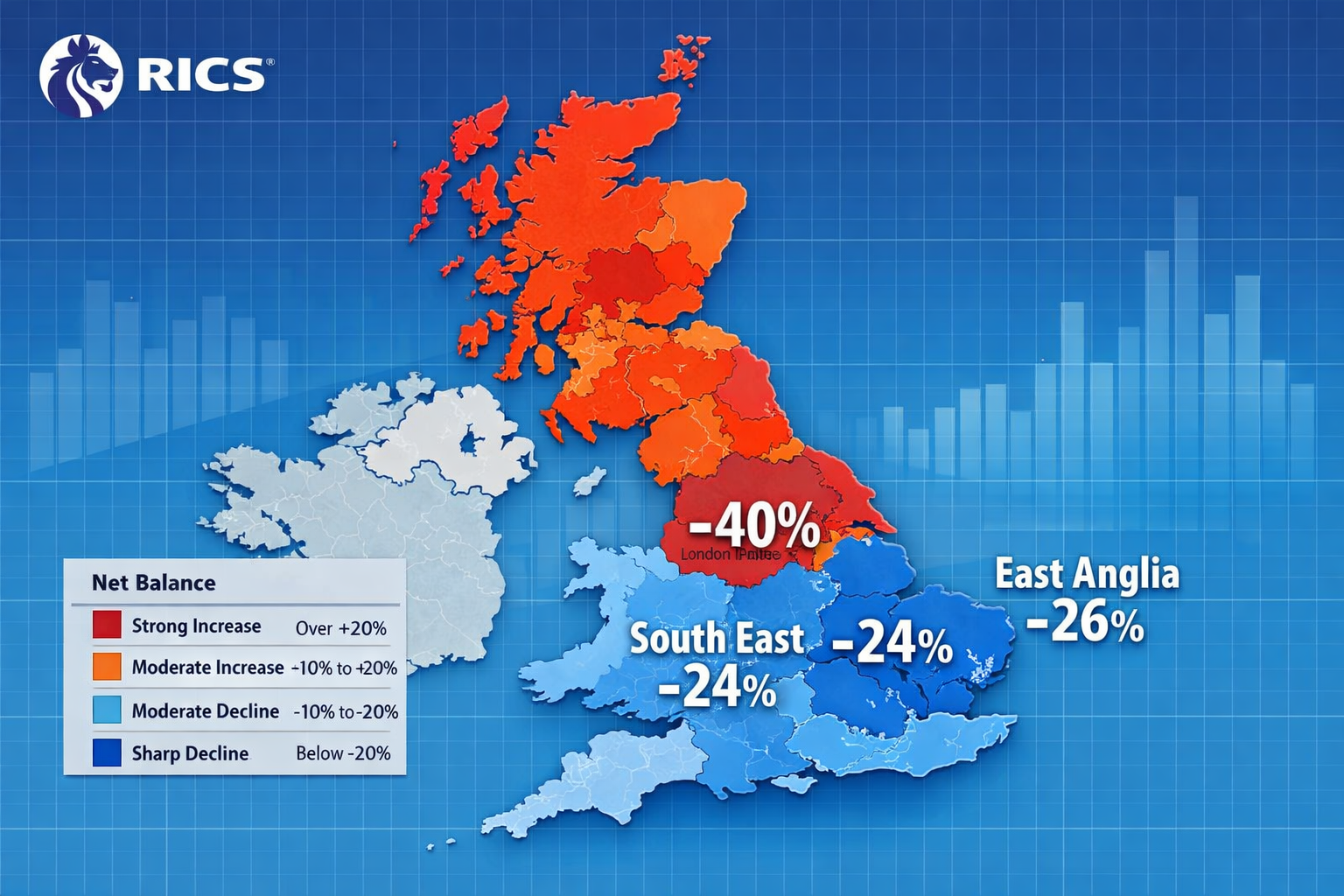
Understanding Valuation Adjustments for Regional Affordability Divergence: RICS Strategies for Assessing Properties in Lagging South East and East Anglia Markets has become essential for accurate property assessments in these challenging regions. Recent RICS data reveals London reported a -40% net balance on prices, South East recorded -24%, and East Anglia showed -26% in February 2026—representing the most significant regional weakness across the UK[4].
This article explores practical strategies for surveyors working in these lagging markets, examining how to adjust valuations appropriately while maintaining professional standards and supporting realistic market transactions.
Key Takeaways
- 📉 London, South East, and East Anglia experienced dramatic sentiment shifts, with London's 12-month price expectations collapsing from +56% in January to just +7% in February 2026[1][4]
- 📊 Regional valuation strategies must account for local affordability constraints and elevated inventory levels at 11-year highs creating downward pressure[1]
- 🎯 Accurate pricing remains critical for successful sales, with surveyors noting that realistically priced properties continue to transact while overpriced listings stagnate[1]
- 🔄 Price adjustments to realistic levels attract renewed buyer interest, particularly for lower-priced flats and mid-market family houses[3]
- 📋 RICS-compliant valuation adjustments require comprehensive comparable analysis, stress-tested lending considerations, and transparent methodology documentation
Understanding Regional Market Divergence in 2026
The Scale of Regional Weakness
The regional affordability divergence affecting South East and East Anglia markets represents more than temporary fluctuation—it signals fundamental shifts in buyer capacity and market dynamics. February 2026 data shows near-term price expectations deteriorated significantly, falling to -18% from -6% in January, indicating surveyors became considerably more cautious on short-term valuations[4].
This regional weakness contrasts sharply with other UK areas. Scotland and Northern Ireland continue reporting upward price trends, highlighting why national valuation approaches fail in localized assessment contexts[4]. Chartered surveyors must recognize these geographical disparities when conducting RICS valuations across different regions.
Factors Driving Regional Underperformance
Several interconnected factors contribute to the lagging performance of South East and East Anglia property markets:
Affordability Constraints 🏠
Higher baseline property prices in these regions mean affordability ratios have stretched beyond sustainable levels for many buyers. References to stress test flexibility and 6x loan-to-income lending suggest valuers must account for tightened lending standards when assessing property values[1].
Inventory Accumulation 📦
Stock levels reaching 11-year highs create supply-side pressure that directly impacts valuation strategies[1]. When properties remain unsold for extended periods, this signals that asking prices exceed market-clearing levels.
Sentiment Deterioration 📉
The dramatic collapse in London's 12-month outlook—from +56% to +7% in a single month—demonstrates how quickly confidence can evaporate in previously strong markets[1][4]. This psychological shift affects both buyer willingness and appropriate valuation benchmarks.
Economic Headwinds 💨
Broader economic uncertainty, employment concerns in specific sectors, and changing work patterns post-pandemic continue influencing regional property demand differently across the UK.
RICS Valuation Principles for Lagging Markets
Red Book Compliance in Challenging Conditions
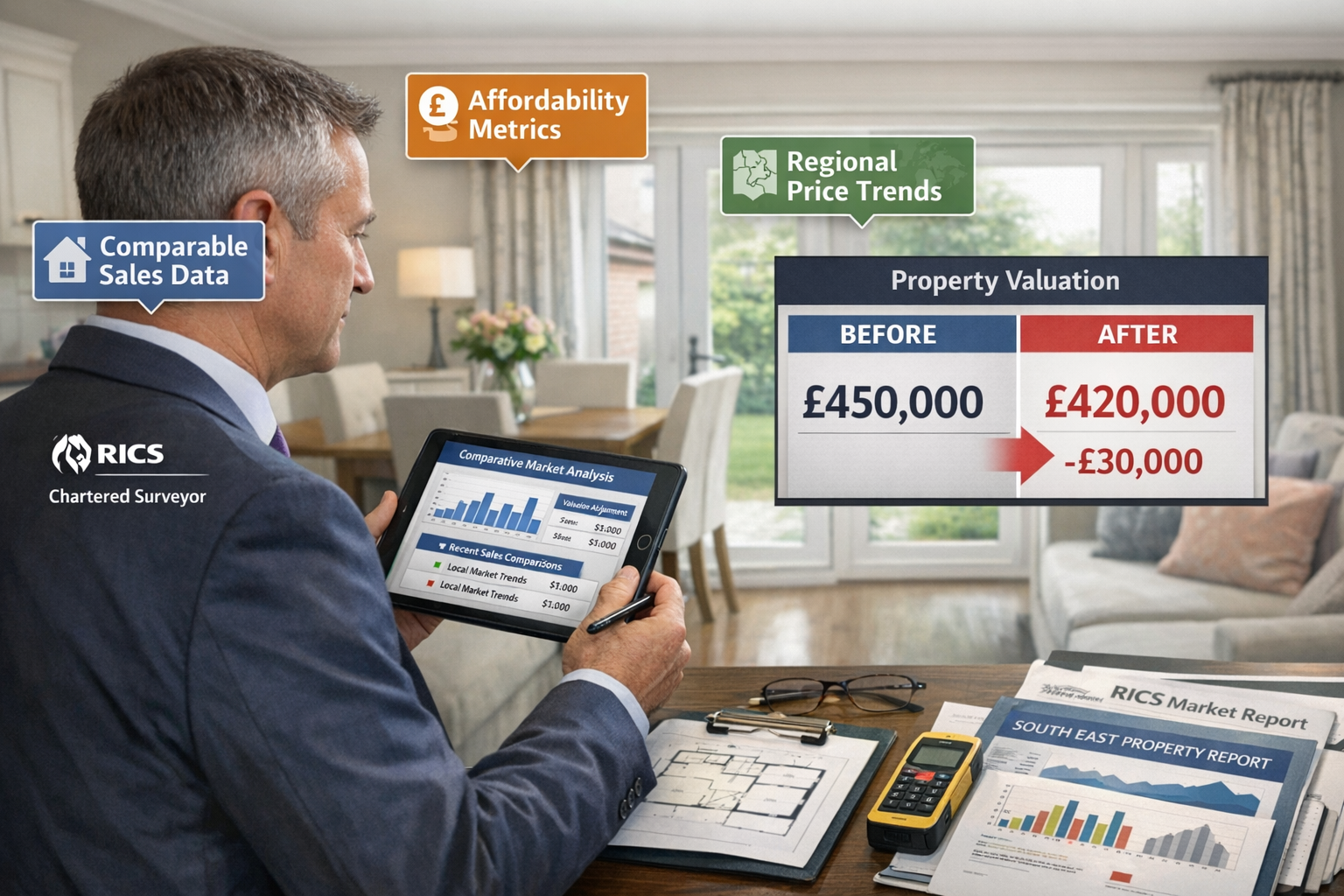
The RICS Valuation – Global Standards (Red Book) provides the framework for professional valuations, but application in declining markets requires particular attention to several key principles. Valuers registered with RICS must balance objective market evidence with professional judgment when markets show volatility.
Market Value Definition 💷
Market value represents "the estimated amount for which an asset should exchange on the valuation date between a willing buyer and a willing seller in an arm's length transaction, after proper marketing and where the parties had each acted knowledgeably, prudently and without compulsion."
In lagging South East and East Anglia markets, this definition becomes critical. Surveyors must assess what a knowledgeable buyer would actually pay given current market conditions, not what sellers hope to achieve or what properties sold for during stronger market periods.
Comparable Evidence Selection
Selecting appropriate comparable evidence represents the foundation of sound valuation adjustments. In declining markets, this process demands heightened scrutiny:
Time Adjustments ⏰
When markets move rapidly, comparables from even three to six months prior may require significant time adjustments. The dramatic sentiment shift between January and February 2026 illustrates how quickly market conditions can change[1][4].
Transaction vs. Asking Price Analysis 📊
Market commentary from surveyors notes that "accurately priced" properties continue to sell in South East markets like Portsmouth and Southampton, while "properties priced too high are taking longer to sell"[1]. This distinction between asking prices and achieved prices becomes crucial for valuation accuracy.
Location Micro-Markets 🗺️
Even within the broader South East and East Anglia regions, significant variation exists. Chartered surveyors in Essex may encounter different market dynamics than those working in other parts of East Anglia, requiring granular comparable selection.
Adjustment Methodology Table
| Adjustment Factor | Typical Range | Application in Lagging Markets |
|---|---|---|
| Time Adjustment | ±0.5-2% per month | Apply negative adjustments when recent comparables from stronger periods |
| Location Premium | ±5-15% | Reduce premiums for areas showing elevated inventory |
| Condition Differential | ±10-20% | Maintain standard ranges but consider buyer renovation appetite |
| Size/Configuration | ±5-10% per bedroom | Consider changing preferences (e.g., home office space) |
| Market Conditions | ±5-15% | Apply negative adjustment for current buyer caution |
Implementing Valuation Adjustments for Regional Affordability Divergence: RICS Strategies for Assessing Properties in Lagging South East and East Anglia Markets
Quantifying Affordability Constraints
Affordability analysis should form an explicit component of valuation reports in these challenging markets. Surveyors can incorporate several metrics:
Income Multiples 💰
Calculate the property value as a multiple of typical local household incomes. When this ratio exceeds sustainable levels (typically 4-5x for mainstream markets), downward valuation pressure exists regardless of recent comparable sales.
Mortgage Affordability 🏦
With references to 6x loan-to-income lending and stress testing[1], surveyors should consider whether typical buyers can actually secure financing at the assessed value. Help to Buy valuations and shared ownership assessments particularly require this analysis.
Rental Yield Comparison 📈
For investment properties, compare achievable rental yields against alternative investments and historical norms. Compressed yields may indicate overvaluation relative to income-generating capacity.
Price Adjustment Strategies That Work
Evidence from early 2026 demonstrates that price adjustments to realistic levels attract renewed buyer interest. In areas where asking prices adjusted downward, lower-priced flats and mid-market family houses began attracting increased activity[3].
Staged Reduction Approach 🎯
Rather than recommending dramatic single reductions, surveyors might suggest:
- Initial 5-8% reduction to test market response
- Monitor viewing and offer activity over 4-6 weeks
- Further 5-7% adjustment if activity remains insufficient
- Reassess comparables as new transactions complete
This approach maintains seller confidence while moving toward market-clearing prices.
Segment-Specific Adjustments 🏘️
Different property types within lagging regions show varying resilience:
- Lower-priced flats: Often show stronger demand when priced realistically
- Mid-market family houses: Attract activity when adjusted to affordability sweet spots
- Premium properties: May require larger percentage reductions due to smaller buyer pools
- Rural properties: Face additional challenges with limited comparable evidence
Documentation and Transparency
Professional valuation reports in declining markets require enhanced documentation explaining adjustment rationale. This protects both the surveyor and client while maintaining RICS standards.
Essential Report Elements 📋
✅ Market Context Section: Explicitly reference regional market conditions, citing RICS survey data and local market intelligence
✅ Comparable Analysis Table: Show unadjusted comparable values, each adjustment applied with justification, and final adjusted values
✅ Adjustment Justification: Explain percentage adjustments with reference to market evidence, not just professional judgment
✅ Uncertainty Statement: In volatile markets, consider including appropriate uncertainty ranges or caveats
✅ Revaluation Recommendation: Suggest timeframes for revaluation given market volatility
Practical Application Across Different Valuation Types
Mortgage Valuations in Declining Markets
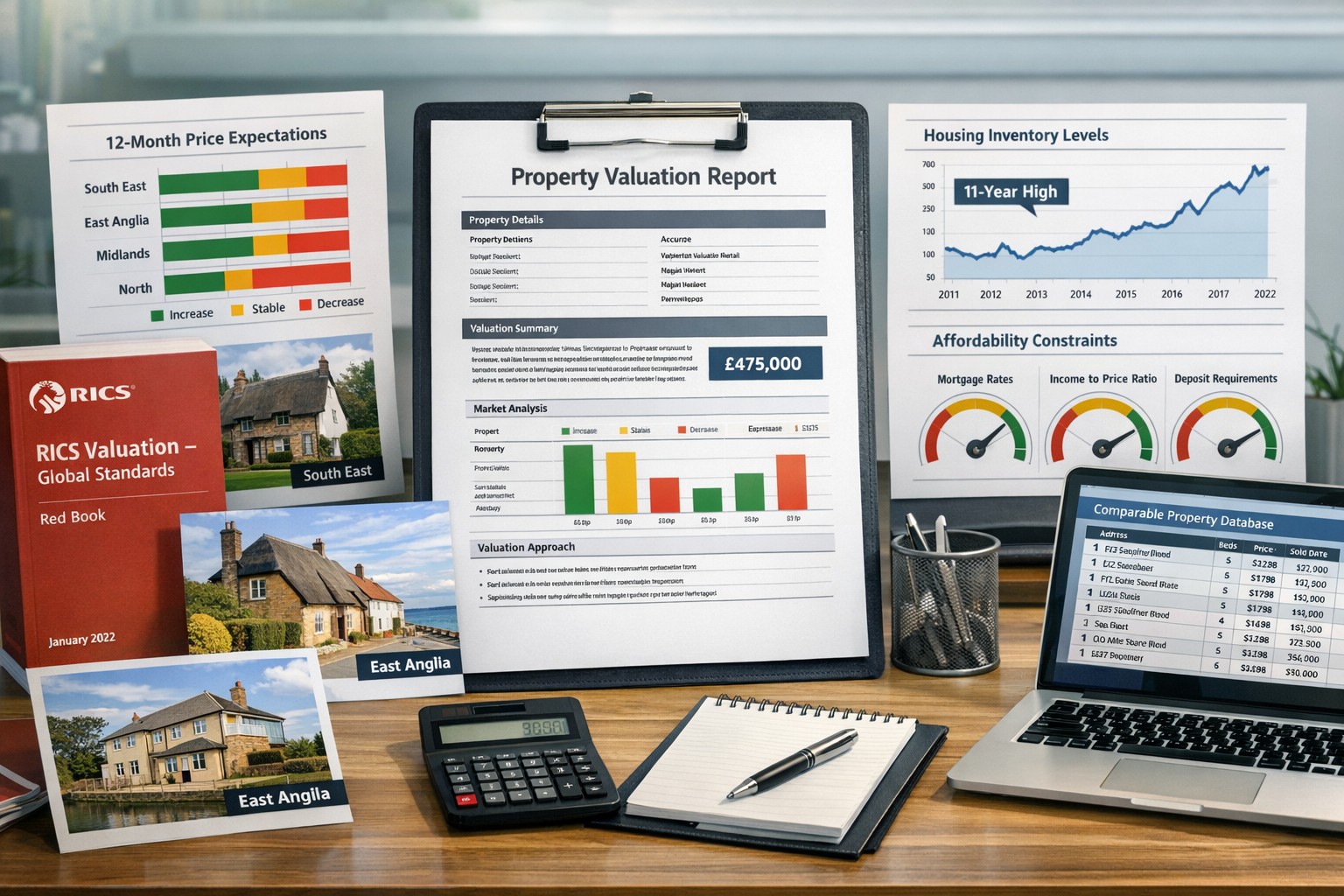
Lenders require particular assurance that valuations reflect sustainable market values rather than peak pricing. For RICS homebuyer surveys and mortgage valuations in South East and East Anglia:
Conservative Approach 🛡️
When market direction remains uncertain, adopt conservative comparable selection favoring recent completed transactions over asking prices. This protects lenders from negative equity scenarios if markets continue declining.
Forced Sale Considerations ⚖️
While market value assumes proper marketing time, surveyors should note if current market conditions might extend typical marketing periods, affecting liquidity assumptions.
Probate and Matrimonial Valuations
Valuation for probate and matrimonial valuations require particular care in declining markets, as these often have legal and tax implications.
Valuation Date Significance 📅
These valuations typically require assessment at specific dates (date of death, separation date). In rapidly moving markets, the difference between January and February 2026 valuations could be substantial given the sentiment collapse[1][4].
Market Value vs. Achievable Price 💷
Courts and HMRC require market value assessments, but surveyors should note if current market conditions might mean actual sale prices differ from market value due to forced sale circumstances or extended marketing requirements.
Commercial Property Considerations
While this article focuses primarily on residential markets, RICS commercial building surveys in South East and East Anglia face similar regional challenges:
- Yield expansion as investors demand higher returns for perceived risk
- Tenant affordability concerns affecting rental value assessments
- Vacancy rate impacts on investment valuations
- Lease renewal assumptions requiring adjustment for market weakness
Regional Strategies: South East vs. East Anglia
South East Specific Considerations
The South East's -24% net balance[4] reflects diverse sub-markets from coastal towns to London commuter belt. Surveyors working with chartered surveyors in locations like Guildford or Oxfordshire should consider:
Commuter Premium Erosion 🚂
Post-pandemic working patterns have reduced commuter premiums for some locations. Properties previously valued for London accessibility may require adjustment if hybrid working reduces this advantage.
Coastal vs. Inland Dynamics 🌊
Coastal South East markets often show different patterns than inland areas, with lifestyle buyers showing different price sensitivity than commuters.
East Anglia Market Characteristics
East Anglia's -26% net balance[4] reflects its own unique challenges. The region combines rural areas, market towns, and coastal communities with varying economic drivers.
Agricultural Land Influence 🌾
Rural property valuations may be influenced by agricultural land values and rural economy health, requiring specialized comparable selection.
Second Home Market 🏖️
Coastal East Anglia areas with significant second home ownership may show different volatility patterns than primary residence markets.
Cambridge Effect 🎓
The Cambridge sub-market often outperforms broader East Anglia trends due to university and technology sector strength, requiring separate comparable analysis.
Risk Management for Surveyors
Professional Indemnity Considerations
Valuing properties in declining markets increases professional risk. Surveyors should:
Document Decision-Making 📝
Maintain detailed file notes explaining valuation reasoning, comparable selection, and adjustment methodology. This documentation proves invaluable if valuations are later questioned.
Conservative Judgments ⚖️
When evidence supports a range of values, consider adopting the lower end in declining markets to reduce risk of overvaluation claims.
Clear Communication 💬
Ensure clients understand market conditions and valuation limitations through clear report language and, where appropriate, pre-valuation discussions.
Managing Client Expectations
Vendors in lagging markets often struggle to accept valuation reductions. Professional surveyors must:
Present Market Evidence 📊
Use RICS survey data, local market statistics, and comparable evidence to demonstrate valuation rationale objectively[1][4].
Explain Regional Context 🗺️
Help clients understand that their property isn't necessarily deficient—the entire regional market faces headwinds requiring realistic pricing.
Highlight Successful Strategies ✅
Reference evidence that realistically priced properties continue to sell, while overpriced listings languish[1], framing appropriate valuation as enabling successful transactions.
Future Outlook and Adaptive Strategies
Monitoring Market Recovery Signals
Surveyors in South East and East Anglia should monitor several indicators for market stabilization:
Sentiment Metrics 📈
Track RICS monthly survey data for improvements in near-term and 12-month price expectations for these specific regions.
Transaction Velocity ⚡
Increasing transaction volumes and reducing time-on-market indicate improving market health, potentially allowing less conservative valuation approaches.
Inventory Normalization 📦
If stock levels decline from current 11-year highs[1], this reduces supply-side pressure on valuations.
Affordability Improvements 💰
Changes in mortgage rates, lending criteria, or income growth that improve affordability ratios support valuation recovery.
Adaptive Valuation Frameworks
Professional surveyors should develop adaptive frameworks that adjust methodology as market conditions evolve:
Quarterly Review Cycles 🔄
Reassess adjustment factors and comparable selection criteria quarterly, updating internal guidance as regional markets evolve.
Peer Consultation 👥
Engage with other RICS members working in the same regions to share market intelligence and validate adjustment approaches.
Continued Professional Development 📚
Participate in RICS training specifically addressing valuation in challenging market conditions and regional divergence scenarios.
Conclusion
Valuation Adjustments for Regional Affordability Divergence: RICS Strategies for Assessing Properties in Lagging South East and East Anglia Markets requires sophisticated, evidence-based approaches that recognize local market realities while maintaining professional standards. The dramatic sentiment shifts observed in early 2026—with London dropping from +56% to +7% on 12-month expectations and South East and East Anglia showing significant negative net balances[1][4]—demand that surveyors adapt their methodologies accordingly.
Success in these challenging markets comes from:
✅ Rigorous comparable analysis that accounts for rapidly changing market conditions
✅ Transparent adjustment methodology clearly documented in valuation reports
✅ Affordability-informed assessments that consider actual buyer capacity
✅ Conservative professional judgment that protects clients and manages surveyor risk
✅ Clear client communication that sets realistic expectations
The evidence demonstrates that accurately priced properties continue to transact even in lagging markets[1], while overpriced listings stagnate. Professional surveyors who provide realistic valuations enable market function, protect clients from overvaluation risks, and maintain the integrity of the valuation profession.
Actionable Next Steps
For surveyors working in South East and East Anglia markets:
- Review your comparable database monthly, ensuring recent transaction evidence receives appropriate weight
- Develop regional adjustment matrices documenting typical adjustments for time, market conditions, and affordability constraints
- Enhance report templates to explicitly address regional market conditions and adjustment rationale
- Engage with local market intelligence through estate agent networks, auction results, and RICS regional forums
- Consider additional training in valuation uncertainty and declining market methodologies
- Maintain detailed file documentation supporting all significant valuation judgments
The regional divergence affecting these markets in 2026 presents professional challenges, but also opportunities for surveyors who demonstrate expertise in navigating complex valuation scenarios. By applying rigorous RICS-compliant methodologies adapted to local conditions, chartered surveyors provide essential market intelligence that supports informed decision-making for buyers, sellers, lenders, and other stakeholders.
For professional valuation services that account for regional market dynamics, consider consulting with experienced chartered surveyors who understand the complexities of current market conditions and can provide comprehensive valuation reports tailored to your specific requirements.
References
[1] Uk Residential Market Survey February 2026 – https://www.rics.org/content/dam/ricsglobal/documents/market-surveys/uk-residential-market-survey/UK-Residential-Market-Survey_February-2026.pdf
[2] Uk Resi Survey Jan 2026 Report Shows Early Signs Market Recovery Despite Caution – https://www.rics.org/news-insights/uk-resi-survey-jan-2026-report-shows-early-signs-market-recovery-despite-caution
[3] Uk Residential Market Survey January 2026 – https://www.rics.org/content/dam/ricsglobal/documents/market-surveys/uk-residential-market-survey/UK-Residential-Market-Survey_January-2026.pdf
[4] Uk Residential Survey February 2026 – https://www.rics.org/news-insights/uk-residential-survey-february-2026