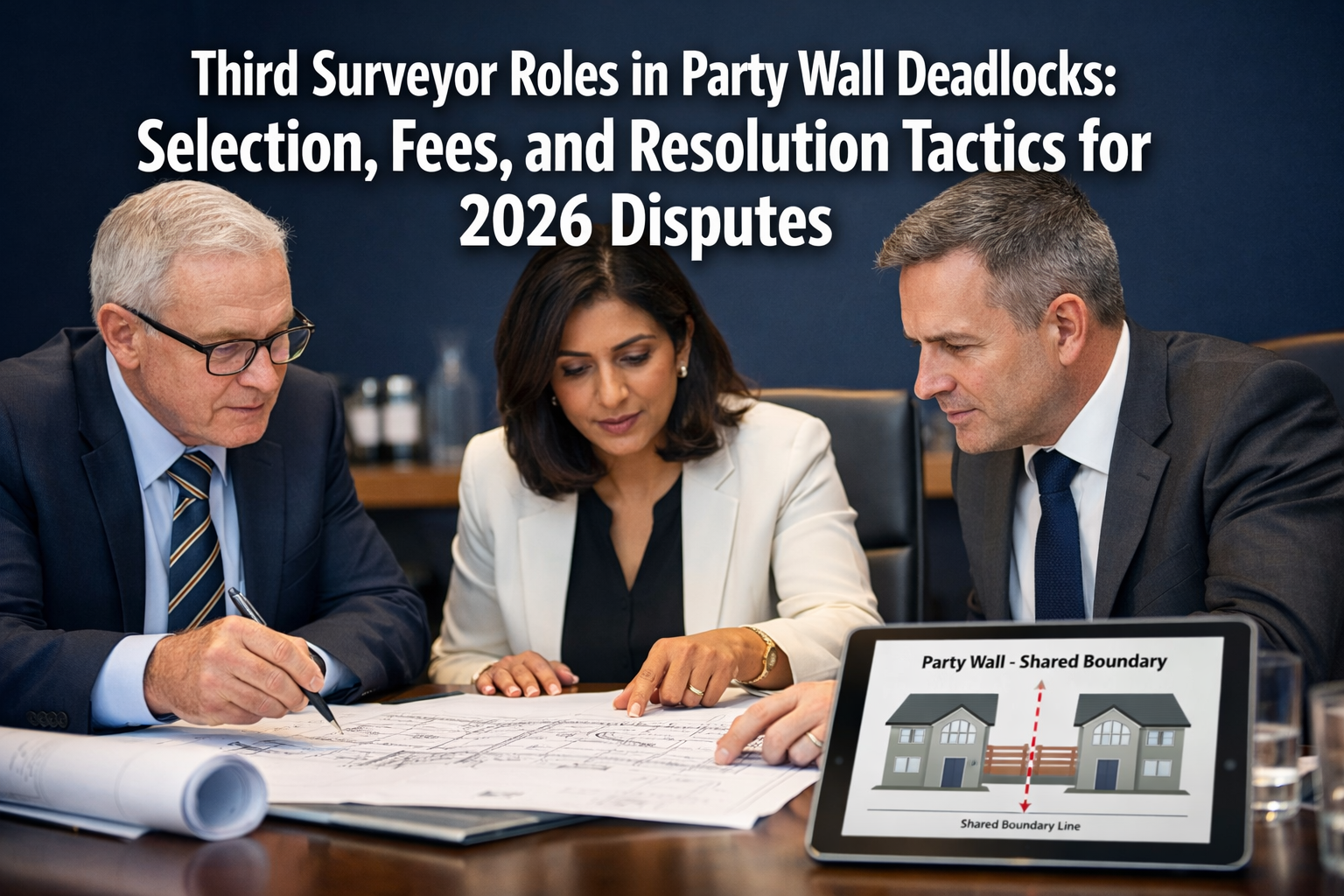
When two experienced party wall surveyors reach an impasse, the Party Wall etc. Act 1996 triggers a statutory safety valve: the appointment of a Third Surveyor. This neutral arbitrator holds the power to issue final and binding determinations that neither party can overturn without a costly County Court appeal. As construction activity surges across the UK in 2026, understanding Third Surveyor Roles in Party Wall Deadlocks: Selection, Fees, and Resolution Tactics for 2026 Disputes has become essential for property owners, developers, and construction professionals navigating complex boundary works.
Key Takeaways
- Third Surveyors are legally mandated when two appointed surveyors cannot agree on any matter within a party wall dispute, providing a binding resolution mechanism under the Party Wall etc. Act 1996
- Selection follows a structured negotiation process where appointed surveyors jointly choose from a small pool of highly experienced professionals, succeeding in approximately 99% of cases
- Fees are substantial and additional to existing surveyor costs, making Third Surveyor involvement an expensive escalation that professional surveyors actively work to avoid
- Determinations are final and binding on all parties, with appeals limited to a strict 14-day window through County Court proceedings
- RICS best practices emphasize swift resolution through collaborative negotiation between appointed surveyors before escalating to Third Surveyor intervention
Understanding Third Surveyor Roles in Party Wall Deadlocks
The Third Surveyor occupies a unique position within the party wall dispute resolution framework. Unlike the two appointed surveyors who represent the Building Owner and Adjoining Owner respectively, the Third Surveyor functions as an entirely impartial arbitrator tasked with breaking deadlocks that threaten to derail construction projects[3][5].
When Third Surveyor Appointment Becomes Necessary
A Third Surveyor must be appointed when the two appointed surveyors cannot reach agreement on any matter under dispute or on the final terms of the Party Wall Award[1]. This statutory requirement represents a legally mandated escalation mechanism designed to prevent indefinite stalemates.
Common scenarios triggering Third Surveyor involvement include:
- 🏗️ Fundamental disagreements on building methodology affecting structural integrity
- 💰 Disputes over compensation amounts for inconvenience or temporary loss of amenity
- 📋 Conflicting interpretations of survey findings regarding existing property conditions
- ⏰ Disagreements on working hours or construction access arrangements
- 🔧 Technical disputes about protective measures required during excavation or underpinning
Understanding what constitutes a party wall dispute helps property owners recognize when escalation to a Third Surveyor may become inevitable.
The Legal Framework Governing Third Surveyor Authority
The Party Wall etc. Act 1996 provides the statutory foundation for Third Surveyor powers. Section 10 of the Act establishes that the Third Surveyor's determination on the specific point of disagreement is final and legally binding on all parties and the two appointed surveyors[1]. This ruling must be incorporated into the final Party Wall Award and cannot be ignored or circumvented.
"The Third Surveyor is described as 'a safeguard in the process,' ensuring provisions of the Party Wall Act 1996 are carefully followed."[3][5]
Importantly, the Third Surveyor is called upon only to rule on the specific point of disagreement submitted by the two appointed surveyors, not to renegotiate the entire Award[1]. This limited scope keeps the process focused and prevents unnecessary delays.
Selection Process for Third Surveyors in 2026 Disputes
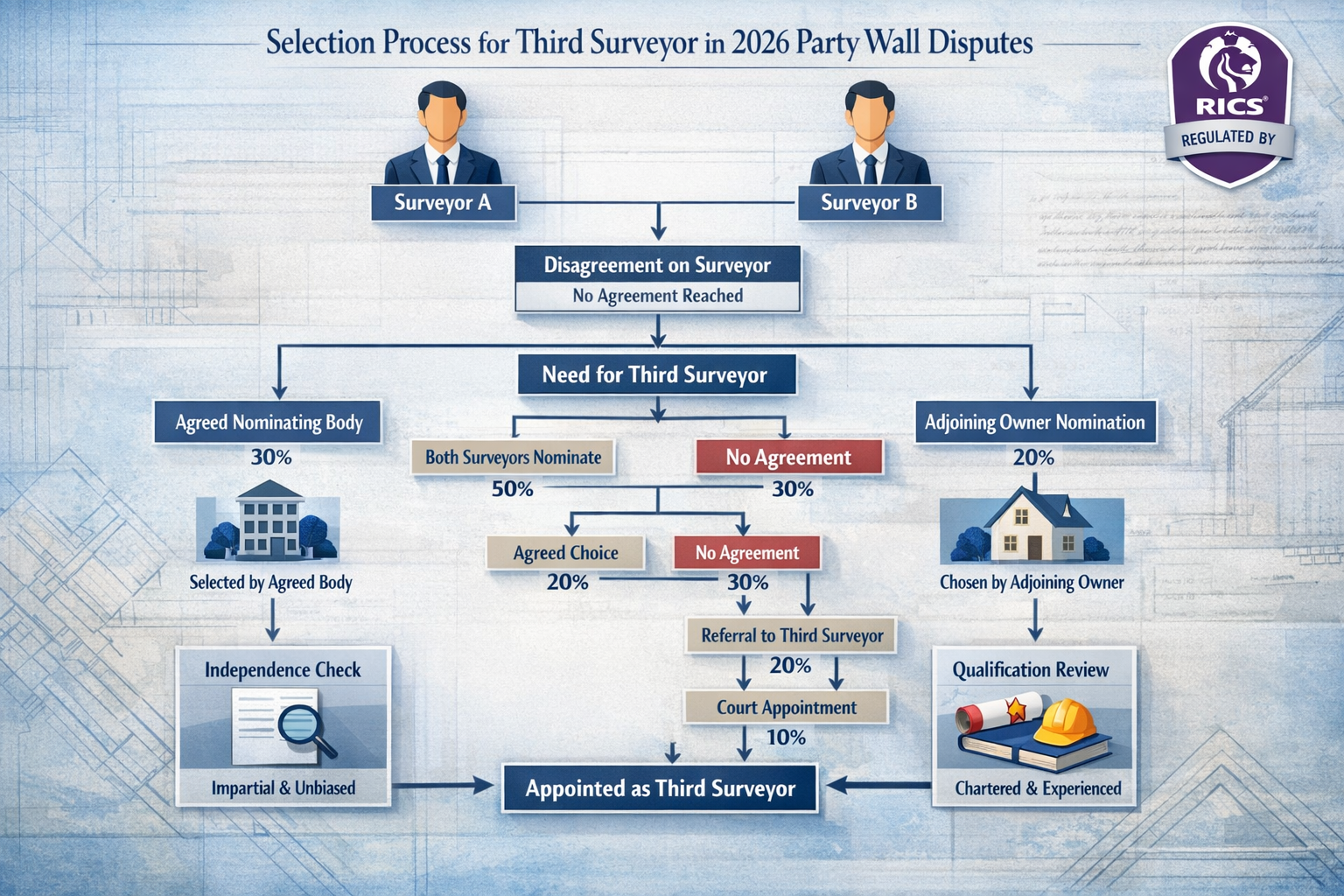
The selection of a Third Surveyor follows a carefully structured process designed to ensure impartiality while maintaining efficiency. Understanding Third Surveyor Roles in Party Wall Deadlocks: Selection, Fees, and Resolution Tactics for 2026 Disputes requires mastering this selection procedure.
How Appointed Surveyors Jointly Select the Third Surveyor
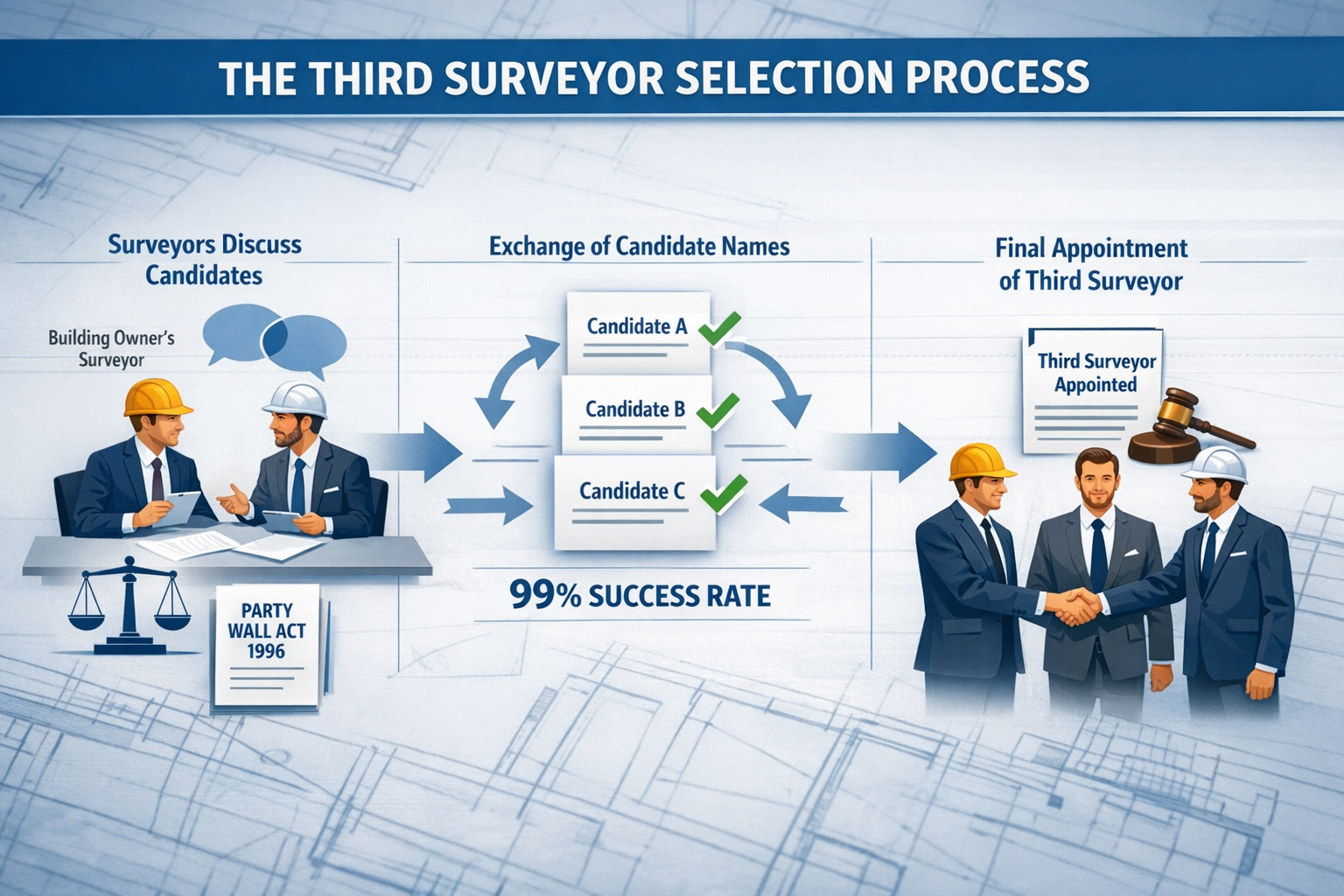
The two appointed surveyors—one representing the Building Owner, one representing the Adjoining Owner—jointly select the Third Surveyor, rather than either party choosing independently[2]. This selection should occur "forthwith" (immediately) after the two surveyors' own appointments are confirmed[4].
The standard selection procedure in practice:
- Initial nomination: The Building Owner's surveyor typically suggests three potential candidates to the Adjoining Owner's surveyor
- Review and response: The Adjoining Owner's surveyor either selects one candidate, requests additional names, or makes counterproposals
- Negotiation: Surveyors continue exchanging names until mutual agreement is reached
- Formal appointment: Once agreed, the Third Surveyor is formally appointed and named in the Award
This negotiated process succeeds in approximately 99% of cases[4], demonstrating the professional commitment of party wall surveyors to finding acceptable neutral arbitrators.
Qualifications and Experience Requirements
The Party Wall etc. Act 1996 does not stipulate specific qualifications for a Third Surveyor, but they should have extensive experience and knowledge in dealing with party wall disputes[3]. In practice, Third Surveyors typically possess:
- ✅ RICS (Royal Institution of Chartered Surveyors) membership
- ✅ Minimum 15-20 years of party wall surveying experience
- ✅ Proven track record of impartial decision-making
- ✅ Deep understanding of construction methodology and building pathology
- ✅ Strong knowledge of case law and statutory interpretation
- ✅ Excellent written communication skills for drafting determinations
The pool of qualified third surveyors is relatively small regionally[4], which explains why the same experienced professionals are frequently selected for this role across multiple disputes.
The Fallback Mechanism: Appointing Officer Intervention
If the two surveyors cannot agree on selecting a Third Surveyor, the task passes to "the appointing officer," typically the head of Building Control at the relevant local authority[4]. This fallback mechanism ensures disputes cannot remain indefinitely unresolved.
However, this scenario rarely occurs, happening in approximately 1% of cases[4]. The professional reputation concerns and practical difficulties of explaining such failure to clients motivate surveyors to reach agreement through the standard negotiation process.
For complex disputes involving damage to property in party wall matters, selecting an experienced Third Surveyor with relevant technical expertise becomes particularly critical.
Fee Structures and Cost Implications for Third Surveyor Roles
Understanding the financial implications of Third Surveyor involvement is essential for property owners budgeting for construction projects. Third Surveyor Roles in Party Wall Deadlocks: Selection, Fees, and Resolution Tactics for 2026 Disputes carry substantial cost considerations that extend beyond the fees already incurred with appointed surveyors.

Typical Fee Ranges and Billing Structures in 2026
Bringing in a Third Surveyor involves costly intervention, with their fees being substantial and coming in addition to costs already incurred with the two original surveyors[1]. While specific fee ranges vary based on dispute complexity and regional market conditions, typical Third Surveyor fees in 2026 include:
| Fee Component | Typical Range | Notes |
|---|---|---|
| Initial appointment and case review | £800-£1,500 | Includes reviewing all documentation and correspondence |
| Determination preparation | £1,200-£3,000 | Depends on technical complexity and research required |
| Site inspection (if necessary) | £400-£800 | Not always required for determination |
| Final written determination | £600-£1,200 | Formal binding decision document |
| Total typical engagement | £3,000-£6,500 | Can exceed £10,000 for highly complex disputes |
These fees are additional to the costs already paid to the Building Owner's surveyor and Adjoining Owner's surveyor, potentially doubling or tripling the total surveying costs for the project.
Who Pays Third Surveyor Fees?
Under the Party Wall etc. Act 1996, the Building Owner is generally responsible for all reasonable costs incurred in the party wall process, including Third Surveyor fees. This creates a strong financial incentive for Building Owners to appoint competent surveyors who can negotiate effectively and avoid escalation.
However, cost allocation can become more nuanced when:
- The Adjoining Owner's surveyor has acted unreasonably or obstructively
- The dispute arose from the Adjoining Owner's unreasonable demands
- The Building Owner failed to follow proper procedures outlined in party wall FAQ guidance
In exceptional circumstances, Third Surveyors may apportion costs differently based on the conduct of the parties and their appointed surveyors.
Fee Negotiation Best Practices
While Third Surveyor fees are not typically negotiable once appointment occurs, property owners can manage costs through:
- Requesting fee estimates upfront before formal appointment
- Clarifying billing structure (hourly vs. fixed fee)
- Defining scope limitations to prevent scope creep
- Establishing communication protocols to minimize billable time
- Requesting itemized invoices for transparency
Professional surveyors recognize that avoiding Third Surveyor involvement altogether represents the most effective cost management strategy, making collaborative negotiation between appointed surveyors the preferred approach.
Resolution Tactics and RICS Best Practices for Swift Awards
Professional surveyors employ various strategies to resolve disputes efficiently and avoid the expense and delay of Third Surveyor involvement. Understanding these resolution tactics illuminates how Third Surveyor Roles in Party Wall Deadlocks: Selection, Fees, and Resolution Tactics for 2026 Disputes function within the broader party wall framework.
Collaborative Negotiation Strategies Between Appointed Surveyors
Professional surveyors aim to resolve all matters swiftly and equitably without involving the Third Surveyor to save time, stress, and unnecessary expense[1]. Effective negotiation tactics include:
🤝 Building Professional Rapport
Establishing respectful working relationships between appointed surveyors facilitates compromise and creative problem-solving. Many experienced party wall surveyors work together repeatedly across multiple projects, creating incentives for fair dealing.
📊 Evidence-Based Discussions
Grounding negotiations in objective evidence—technical reports, precedent awards, construction standards—reduces subjective disagreements and builds consensus around factual foundations.
🎯 Identifying Core Interests
Understanding the underlying concerns driving each party's position (rather than focusing solely on stated demands) enables surveyors to craft solutions addressing both parties' fundamental interests.
⚖️ Proportionality Assessment
Evaluating whether disputed points justify the substantial costs and delays of Third Surveyor involvement often motivates compromise on minor issues.
📝 Incremental Agreement Building
Resolving undisputed matters first and documenting areas of agreement creates momentum and narrows the scope of potential Third Surveyor referral.
For projects involving the 3 metre rule or excavation near boundaries, early technical discussions can prevent later deadlocks.
When to Escalate to Third Surveyor Determination
Despite best efforts at negotiation, certain circumstances warrant Third Surveyor escalation:
- Fundamental technical disagreements affecting structural safety or building viability
- Irreconcilable valuation differences exceeding £5,000-£10,000
- Procedural impasses where one surveyor refuses to engage constructively
- Time-critical decisions where construction delays cost more than Third Surveyor fees
- Legal interpretation questions requiring authoritative determination
Recognizing when negotiation has reached its natural endpoint prevents wasteful prolonged discussions that merely delay inevitable escalation.
The 14-Day Appeal Window and County Court Procedures
An appeal of the Third Surveyor's determination can be lodged with a County Court under Section 10(17) of the Act, but must be filed within 14 days of the determination being served[1]. This strict timeline requires immediate legal consultation if parties wish to challenge a determination.
Appeals are rare, highly technical, and often very expensive[1], typically involving:
- Grounds limited to errors of law or procedural irregularities
- Full legal representation and court fees
- Potential for costs awards against unsuccessful appellants
- Further construction delays during appeal proceedings
The combination of strict timelines, limited grounds for appeal, and substantial costs makes Third Surveyor determinations effectively final in the vast majority of cases.
RICS Professional Standards for 2026 Disputes
The Royal Institution of Chartered Surveyors provides guidance emphasizing:
- Duty of impartiality: All party wall surveyors must act fairly, even when appointed by one party
- Timely communication: Prompt responses and clear communication prevent misunderstandings
- Technical competence: Surveyors should only accept appointments within their expertise
- Proportionate approach: Procedures should be proportionate to the scale and complexity of works
- Clear documentation: All decisions, agreements, and determinations must be clearly documented
These standards create a professional framework supporting efficient dispute resolution while maintaining fairness and technical rigor.
Property owners dealing with specialized scenarios like party wall shared chimneys benefit from surveyors who apply these RICS standards consistently.
Preventing Third Surveyor Involvement Through Proactive Measures
The most effective approach to managing Third Surveyor Roles in Party Wall Deadlocks: Selection, Fees, and Resolution Tactics for 2026 Disputes involves preventing the need for Third Surveyor intervention altogether.
Early Appointment of Experienced Surveyors
Selecting competent, experienced party wall surveyors from the outset dramatically reduces the likelihood of irresolvable disputes. Quality indicators include:
- RICS membership and professional indemnity insurance
- Specific party wall specialization (not general building surveying)
- Local market knowledge and established professional relationships
- Clear fee structures and communication protocols
- Positive references from previous clients
Working with chartered surveyors who specialize in party wall matters ensures technical competence and professional standards.
Comprehensive Pre-Construction Documentation
Thorough documentation before works commence prevents later disputes:
- Detailed schedules of condition: Photographic and written records of existing property conditions documented in a schedule of condition prevent disagreements about pre-existing damage
- Clear scope of works descriptions: Precise technical specifications reduce ambiguity about proposed construction methods
- Realistic timelines: Accurate project schedules manage neighbor expectations and prevent disputes over construction duration
- Proactive communication: Regular updates to adjoining owners build trust and prevent misunderstandings
Addressing Procedural Failures Early
Many disputes arise from procedural failures rather than substantive disagreements. Common issues include:
- Failure to serve proper party wall notices (see no party wall notice served for consequences)
- Inadequate description of proposed works
- Insufficient notice periods before construction commencement
- Failure to respond to counternotices within statutory timeframes
Addressing these procedural matters correctly from the beginning prevents disputes that might otherwise require Third Surveyor resolution.
Managing Neighbor Relations
Construction projects inevitably create inconvenience for adjoining owners. Proactive relationship management reduces the likelihood of disputes escalating:
- Pre-notice discussions: Informal conversations before formal notice service help identify concerns early
- Reasonable accommodations: Flexibility on working hours, access arrangements, and protective measures demonstrates good faith
- Prompt damage response: Immediate attention to any construction-related damage prevents minor issues becoming major disputes
- Regular communication: Keeping neighbors informed throughout the project maintains trust
These relationship management strategies complement the technical and legal aspects of party wall procedures, creating a comprehensive approach to dispute prevention.
Conclusion
Third Surveyor Roles in Party Wall Deadlocks: Selection, Fees, and Resolution Tactics for 2026 Disputes represent a critical safety valve within the UK's party wall framework, providing legally binding resolution when appointed surveyors reach impasse. The selection process—jointly controlled by appointed surveyors and succeeding in 99% of cases—ensures impartial arbitration while maintaining professional standards. However, the substantial fees (typically £3,000-£6,500 and potentially much higher) and additional delays make Third Surveyor involvement an outcome that property owners and professional surveyors actively work to avoid.
The most effective approach combines three elements: appointing experienced, RICS-qualified surveyors from the outset; maintaining comprehensive documentation and clear communication throughout the process; and employing collaborative negotiation tactics that address underlying interests rather than entrenched positions. When Third Surveyor determination becomes unavoidable, understanding the limited scope of their involvement, the finality of their decisions, and the strict 14-day appeal window helps parties navigate this escalation effectively.
Actionable Next Steps
For property owners planning construction work affecting party walls in 2026:
- Appoint qualified party wall surveyors early in your project planning, before serving formal notices
- Request clear fee structures from your surveyor, including potential Third Surveyor costs
- Invest in comprehensive pre-construction documentation, particularly detailed schedules of condition
- Maintain proactive communication with adjoining owners throughout the notice and construction process
- Address procedural requirements meticulously to prevent disputes arising from technical failures
- Budget for potential Third Surveyor costs (£3,000-£10,000) as a contingency in your project finances
For surveyors navigating party wall disputes:
- Establish professional rapport with the other appointed surveyor early in the process
- Ground negotiations in objective evidence and technical standards
- Document areas of agreement progressively to narrow dispute scope
- Recognize when escalation is appropriate rather than prolonging unproductive negotiations
- Follow RICS guidance on impartiality, proportionality, and professional conduct
By understanding the mechanics of Third Surveyor appointment, the financial implications of escalation, and the resolution tactics that prevent deadlocks, property owners and construction professionals can navigate party wall procedures efficiently while minimizing costs and delays in 2026's active construction market.
References
[1] Appointing The Third Surveyor When Disagreements Arise And Why This Costly Step Is Necessary – https://www.partywallslimited.com/blog/appointing-the-third-surveyor-when-disagreements-arise-and-why-this-costly-step-is-necessary
[2] Who Selects A Third Surveyor – https://partywallhelp.co.uk/who-selects-a-third-surveyor/
[3] Watch – https://www.youtube.com/watch?v=DDugYEoPSGg
[4] Role Of The Third Surveyor In Party Wall Matters – https://taylor-mitchell.co.uk/blog/role-of-the-third-surveyor-in-party-wall-matters/
[5] Who Is The Third Surveyor – https://christopheranthony.org.uk/who-is-the-third-surveyor/