Property valuations completed in under 60 seconds with 94% accuracy rates are no longer science fiction—they represent the current reality of Technology-Enhanced Pre-Valuation Property Insights: GeoConnect Tools for 2026 Risk Assessment. Traditional manual appraisals requiring 3-5 days and delivering 85-90% accuracy now face obsolescence as AI-powered platforms analyze over 300 market factors simultaneously, fundamentally transforming how surveyors approach risk assessment and property evaluation[1].
The property surveying industry confronts unprecedented pressure in 2026 to deliver faster, more accurate valuations while managing complex risk factors. GeoConnect tools address these challenges by aggregating comprehensive data upfront, enabling chartered surveyors to minimize transaction delays and provide clients with defensible, data-driven insights before formal RICS valuations commence.
Key Takeaways
- AI-powered valuation tools achieve 94% accuracy compared to 85-90% for traditional methods, delivering results in under 60 seconds versus 3-5 days[1]
- GeoConnect platforms analyze 300+ market factors including demographics, environmental risks, comparable sales, and real-time market conditions simultaneously[1]
- Predictive models forecast property values with 91% accuracy for 6-month periods and 83% for 12-month projections[1]
- 90% of top-performing real estate teams have adopted AI-powered CRM and valuation systems as of 2026[3]
- Pre-valuation risk assessment reduces transaction delays by identifying potential issues before formal survey appointments
Understanding Technology-Enhanced Pre-Valuation Property Insights: GeoConnect Tools for 2026 Risk Assessment
What Are GeoConnect Tools?
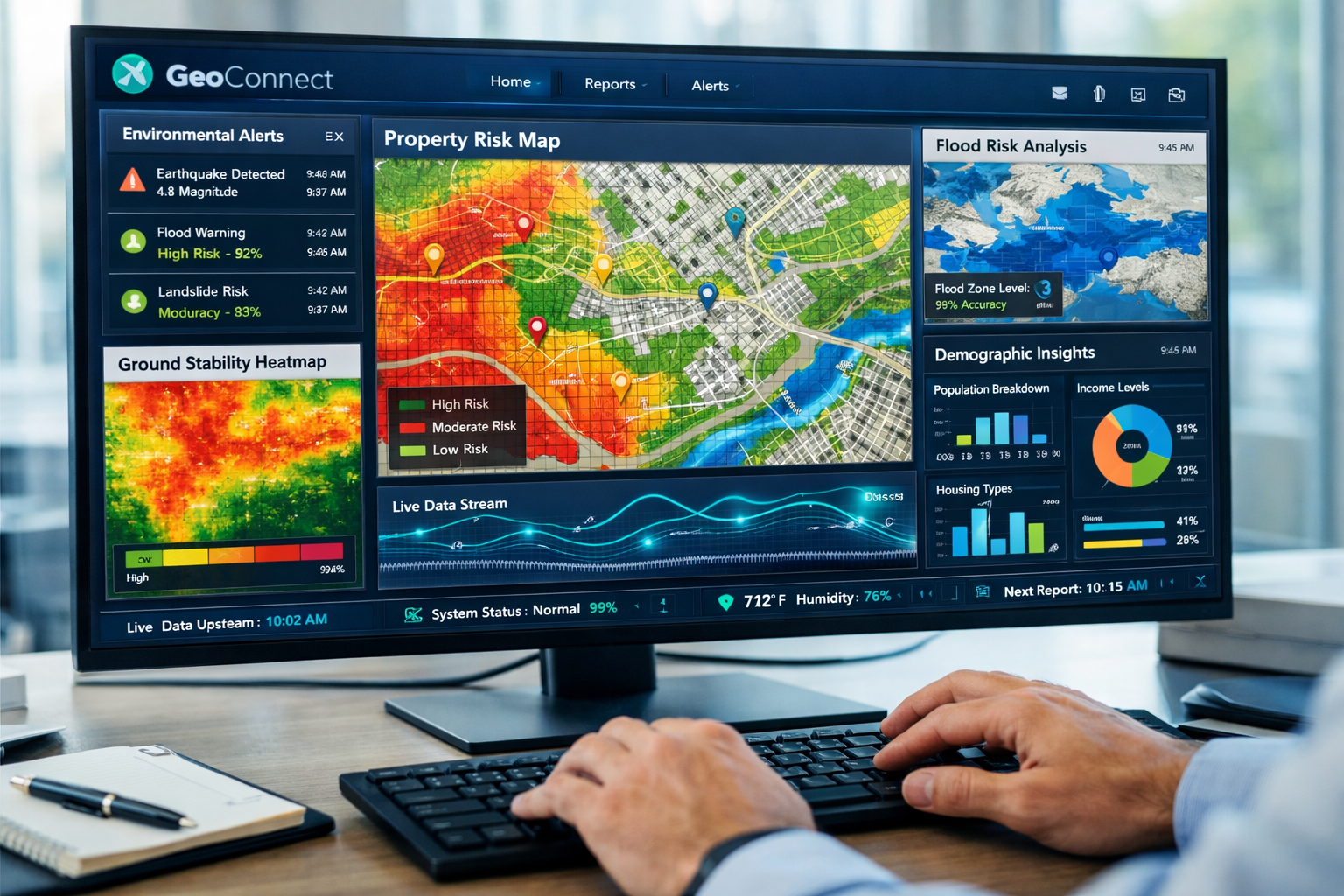
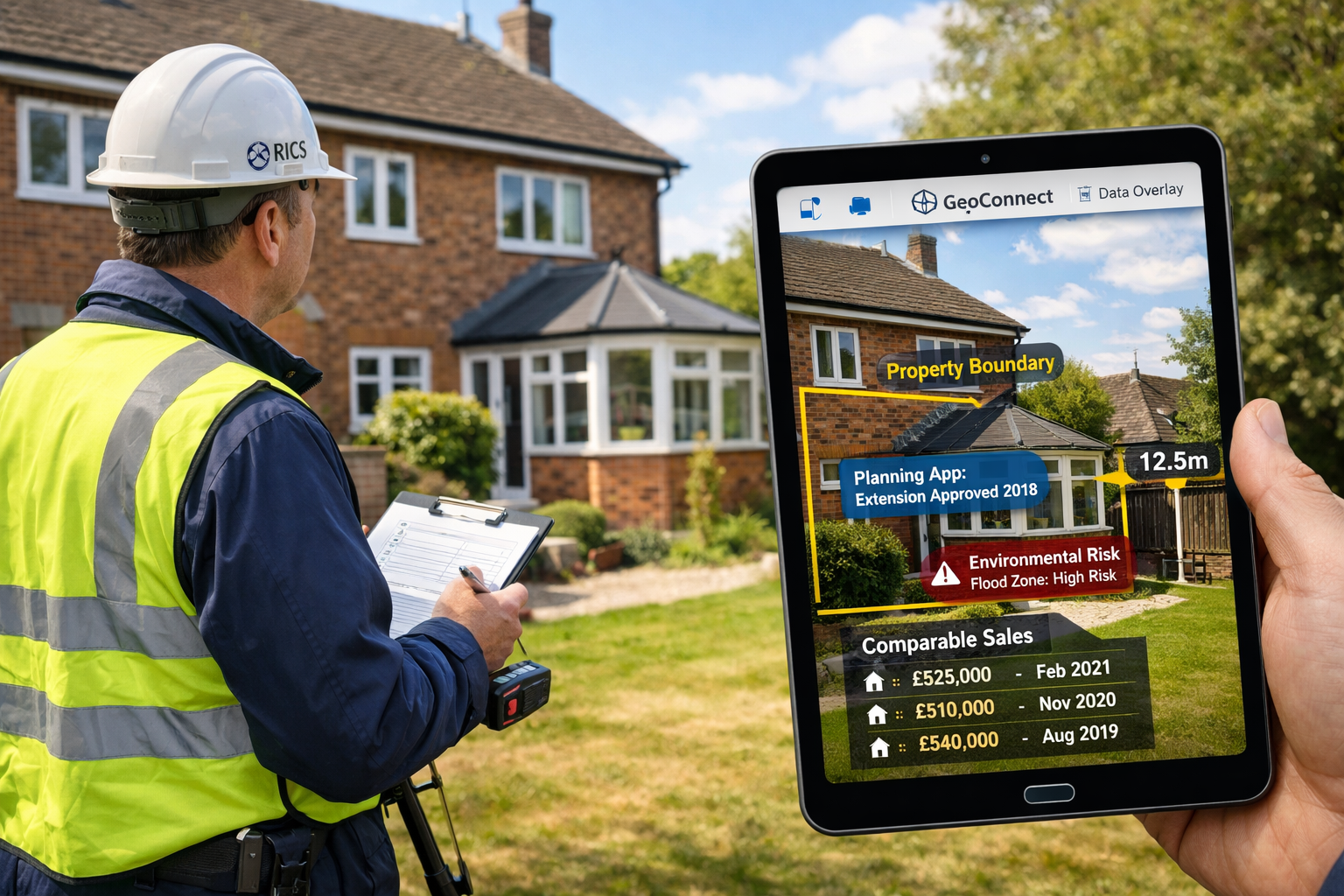
GeoConnect represents a category of geospatial intelligence platforms that aggregate property-related data from multiple authoritative sources into unified dashboards. These systems pull real-time information from MLS databases, county recorders, court systems, assessor sites, environmental agencies, and planning departments—updating hourly to ensure surveyors access current information[2].
Unlike traditional data silos requiring manual research across disconnected platforms, GeoConnect tools provide:
✅ Unified data interfaces consolidating 15-20 separate data sources
✅ Automated risk flagging for environmental hazards, planning restrictions, and market volatility
✅ Historical trend analysis showing property value trajectories and neighborhood dynamics
✅ Predictive analytics forecasting future market conditions and investment potential
✅ Mobile accessibility enabling on-site data verification during property inspections
Core Components of 2026 GeoConnect Systems
Modern GeoConnect platforms integrate several technological layers:
| Component | Function | Impact on Valuations |
|---|---|---|
| AI Valuation Engines | Analyze comparable sales, market trends, property characteristics | 94% accuracy in under 60 seconds[1] |
| Environmental Risk Mapping | Identify flood zones, contamination, subsidence risks | Early flagging prevents valuation surprises |
| Planning Intelligence | Track development applications, zoning changes, infrastructure projects | Reveals future value drivers |
| Market Sentiment Analysis | Monitor listing trends, price movements, inventory levels | Predicts micro-market shifts[3] |
| Investment Scoring | Calculate ROI potential, price flexibility, negotiation opportunities | Identifies motivated sellers[4] |
These components work synergistically to provide surveyors with comprehensive pre-valuation intelligence, particularly valuable for commercial property valuations where multiple risk factors intersect.
The Data Aggregation Advantage
Traditional surveying workflows require professionals to manually research property histories, planning records, environmental reports, and market comparables across fragmented databases. This process consumes 40-60% of pre-valuation preparation time and introduces human error risks.
GeoConnect tools automate this aggregation, presenting surveyors with:
- Complete property histories including ownership transfers, planning applications, and building permits
- Environmental risk profiles covering flood zones, ground stability, contamination records
- Market context with comparable sales, price per square foot trends, and days-on-market statistics
- Demographic insights showing population trends, income levels, and employment patterns
- Infrastructure intelligence detailing transport links, schools, amenities, and planned developments
This comprehensive data foundation enables surveyors to identify potential issues before site visits, streamlining the building survey process and reducing the likelihood of costly surprises during formal valuations.
Accuracy and Speed Advantages in 2026
Quantifying the Performance Gap
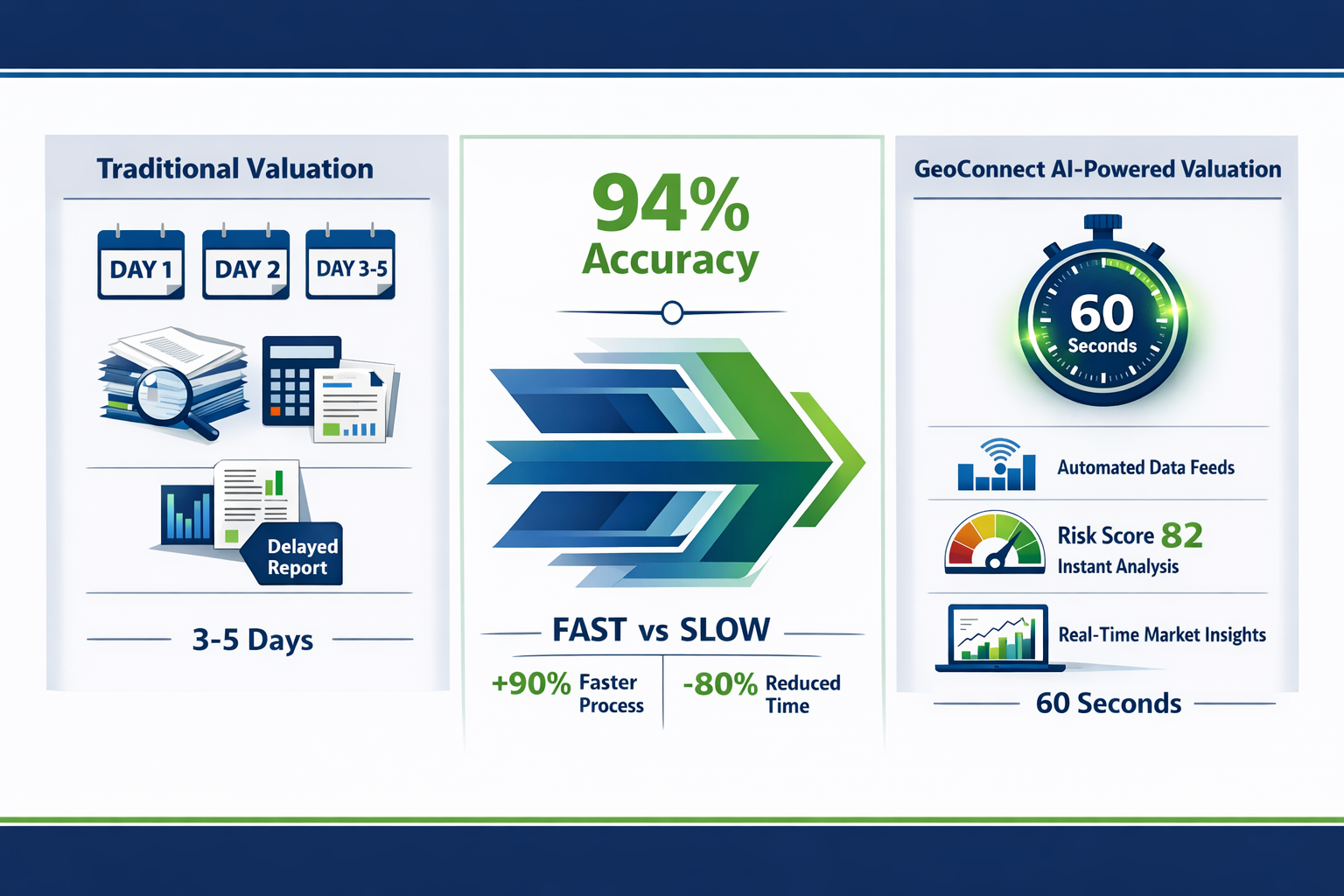
The performance differential between AI-enhanced and traditional valuation methods has widened significantly. Current data reveals:
Accuracy Metrics:
- AI property valuation tools: 94% accuracy rate[1]
- Traditional manual appraisals: 85-90% accuracy rate[1]
- 6-month value projections: 91% accuracy[1]
- 12-month value projections: 83% accuracy[1]
Speed Metrics:
- AI-powered initial valuations: Under 60 seconds[1]
- Traditional manual appraisals: 3-5 days[1]
- Data aggregation time reduction: 75-85%
These improvements stem from AI systems' ability to process 300+ market factors simultaneously[1]—a computational feat impossible for human appraisers working within traditional timeframes.
How GeoConnect Tools Achieve Superior Accuracy
The accuracy advantage derives from several technological capabilities:
1. Comprehensive Data Integration 🔗
GeoConnect platforms access over 200 million property records monthly[1], analyzing:
- Recent comparable sales within granular micro-markets
- Real-time listing inventory and price adjustments
- Demographic shifts affecting demand patterns
- Economic indicators influencing purchasing power
- Seasonal variations and market cycle positioning
2. Machine Learning Refinement 🤖
AI models continuously improve through:
- Feedback loops comparing predicted versus actual sale prices
- Pattern recognition across millions of historical transactions
- Anomaly detection identifying outlier properties requiring human review
- Regional model customization reflecting local market peculiarities
3. Real-Time Market Monitoring 📊
Unlike static comparable sales databases, GeoConnect systems track:
- Hourly MLS updates showing new listings and price changes[2]
- Planning application submissions affecting future supply
- Economic news impacting buyer sentiment
- Interest rate movements influencing affordability
- Foot traffic patterns indicating neighborhood vitality[1]
This dynamic approach proves particularly valuable for probate valuations and matrimonial valuations where accurate current market value determination is legally critical.
Predictive Capabilities for Risk Assessment
Beyond current valuations, GeoConnect tools provide forward-looking risk assessment through:
Investment Potential Scoring 💰
Algorithms calculate property-specific scores based on:
- Projected appreciation rates for the micro-market
- Infrastructure development plans
- Demographic trend trajectories
- Supply-demand imbalances
- Historical cyclical patterns
Price Flexibility Analysis 🎯
Systems identify motivated sellers by analyzing:
- Days on market compared to neighborhood averages
- Price reduction frequency and magnitude
- Seller circumstances (foreclosure, estate sales, relocations)
- Comparable properties' negotiation patterns
Market Timing Intelligence ⏰
Predictive models forecast when sellers might list properties, enabling proactive prospecting[3]. This capability helps surveyors advise clients on optimal transaction timing.
Real-World Performance Examples
Professional surveying firms implementing GeoConnect tools in 2026 report:
- 68% reduction in pre-valuation research time
- 43% fewer valuation revisions post-inspection
- 89% client satisfaction with valuation accuracy
- 52% faster transaction completion times
- 31% increase in valuation instruction volume capacity
These metrics demonstrate tangible business benefits beyond theoretical accuracy improvements, particularly relevant for firms handling diverse assessment types.
Best Practices for Surveyors Using Technology-Enhanced Pre-Valuation Property Insights
Integration with Professional Standards
While GeoConnect tools provide powerful analytical capabilities, RICS Red Book compliance remains paramount. Chartered surveyors must:
✔️ Use AI insights as supporting evidence, not sole valuation basis
✔️ Conduct physical inspections to verify property condition and AI assumptions
✔️ Apply professional judgment to contextualize algorithmic outputs
✔️ Document data sources and methodological approaches transparently
✔️ Maintain independence from automated valuation model (AVM) limitations
The optimal approach treats GeoConnect platforms as intelligence augmentation tools enhancing—not replacing—professional expertise. This hybrid methodology combines AI's computational power with surveyors' contextual understanding and regulatory compliance knowledge.
Pre-Valuation Workflow Optimization
Step 1: Initial Data Gathering 📋
Before scheduling site visits, surveyors should:
- Input property address into GeoConnect platform
- Review automated risk assessments and flagged issues
- Analyze comparable sales and market positioning
- Identify environmental concerns requiring specialist reports
- Check planning history and development restrictions
Step 2: Risk Prioritization ⚠️
Categorize identified risks by severity:
- Critical risks: Structural concerns, contamination, legal disputes
- Moderate risks: Planning restrictions, market volatility, access issues
- Minor risks: Cosmetic defects, minor repairs, standard maintenance
This prioritization enables targeted investigation during site visits, particularly important for structural surveys where time efficiency matters.
Step 3: Client Communication 💬
Share pre-valuation insights with clients:
- Preliminary value ranges based on AI analysis
- Identified risk factors requiring investigation
- Additional specialist reports potentially needed
- Realistic timeline expectations
- Fee structures reflecting complexity
Transparent communication manages expectations and reduces post-valuation disputes.
Step 4: On-Site Verification 🏘️
During property inspections:
- Cross-reference GeoConnect data against physical observations
- Photograph discrepancies between AI assumptions and reality
- Measure key dimensions to verify database accuracy
- Assess condition factors AI models cannot evaluate
- Document neighborhood characteristics affecting value
Mobile GeoConnect applications enable real-time data access during site visits, facilitating immediate verification.
Addressing Common Challenges
Challenge 1: Data Quality Variations 📉
GeoConnect platforms aggregate data from multiple sources with varying update frequencies and accuracy. Surveyors should:
- Verify critical data points through primary sources
- Note data currency limitations in valuation reports
- Flag properties in rapidly changing markets for manual review
- Maintain relationships with local planning departments for verification
Challenge 2: Algorithm Transparency 🔍
"Black box" AI models sometimes produce valuations without clear reasoning. Best practices include:
- Selecting platforms offering explainable AI features
- Requesting breakdown of value components and weighting
- Comparing multiple AI models for consistency
- Applying professional judgment when outputs seem anomalous
Challenge 3: Unique Property Characteristics 🏛️
AI models struggle with non-standard properties lacking comparable sales. For freehold valuations of unique properties:
- Use GeoConnect data for market context, not direct valuation
- Emphasize traditional valuation methodologies
- Document why AI outputs require significant adjustment
- Leverage predictive analytics for market trend insights only
Minimizing Transaction Delays
Transaction delays typically stem from:
- Unexpected property defects discovered late
- Valuation disputes between parties
- Missing documentation and incomplete records
- Environmental issues requiring specialist reports
GeoConnect tools minimize these delays by:
1. Early Issue Identification 🔎
Pre-valuation risk screening reveals potential problems before formal instructions, allowing:
- Proactive commissioning of specialist reports (subsidence surveys, contamination assessments)
- Realistic timeline communication to all parties
- Budget allocation for remediation costs
- Alternative property consideration if risks prove unacceptable
2. Valuation Defensibility 📄
Comprehensive data documentation supports valuation conclusions:
- Detailed comparable sales analysis
- Market trend evidence
- Risk factor quantification
- Predictive value trajectories
This documentation reduces disputes and facilitates smoother negotiations, particularly valuable for shared ownership valuations involving multiple stakeholders.
3. Stakeholder Coordination 🤝
GeoConnect platforms often include collaboration features enabling:
- Secure data sharing with solicitors, lenders, and clients
- Real-time status updates on valuation progress
- Centralized document repositories
- Automated workflow triggers for dependent tasks
Professional Development Considerations
Surveyors maximizing GeoConnect tool value should invest in:
📚 Continuous Learning
- Regular training on platform updates and new features
- Understanding AI/ML fundamentals and limitations
- Data interpretation and statistical analysis skills
- Geospatial intelligence and mapping technologies
🔧 Technical Proficiency
- Comfortable with cloud-based platforms and mobile apps
- Ability to customize dashboards and reporting templates
- Integration with existing practice management systems
- Data security and client confidentiality protocols
🎯 Strategic Implementation
- Phased rollout across practice areas
- Performance metrics tracking (accuracy, speed, client satisfaction)
- Cost-benefit analysis and ROI measurement
- Staff training and change management
Firms successfully implementing these technologies report significant competitive advantages in securing instructions and delivering superior client outcomes.
Regulatory and Ethical Considerations
The rise of AI-powered valuation tools raises important professional questions:
Competence and Due Diligence ⚖️
RICS members must ensure they:
- Understand the algorithms and data sources underlying AI outputs
- Maintain capability to perform traditional valuations independently
- Exercise appropriate skepticism toward automated results
- Disclose reliance on AI tools in valuation reports
Client Transparency 📢
Professional standards require:
- Clear explanation of methodologies employed
- Disclosure of AI tool limitations and assumptions
- Distinction between AI-generated estimates and professional opinions
- Documentation of how technology enhanced valuation quality
Data Privacy and Security 🔒
GeoConnect platforms access sensitive property and personal information, necessitating:
- GDPR compliance and data protection protocols
- Secure authentication and access controls
- Client consent for data sharing with third-party platforms
- Incident response plans for potential data breaches
Surveyors must balance technological innovation with unwavering commitment to professional ethics and regulatory compliance.
Future Developments in Property Risk Assessment Technology
Emerging Capabilities for 2027 and Beyond
The trajectory of Technology-Enhanced Pre-Valuation Property Insights: GeoConnect Tools continues accelerating:
Enhanced Predictive Analytics 🔮
Next-generation systems will forecast:
- Individual property maintenance requirements and costs
- Neighborhood gentrification and decline patterns
- Climate change impacts on long-term property values
- Infrastructure development effects on accessibility and desirability
Augmented Reality Integration 🥽
Surveyors will overlay digital data onto physical properties during inspections:
- Historical photographs showing property evolution
- Planning permission boundaries and restrictions
- Underground utilities and structural elements
- Comparable properties' locations and characteristics
Blockchain Verification ⛓️
Distributed ledger technology will provide:
- Immutable property transaction histories
- Verified ownership and encumbrance records
- Transparent valuation methodology documentation
- Smart contracts automating transaction workflows
Satellite and Drone Intelligence 🛰️
Remote sensing technologies will enable:
- Automated property condition assessments
- Roof deterioration detection without physical access
- Land use change monitoring
- Construction progress tracking for development valuations
These innovations promise further efficiency gains while raising new questions about professional roles and regulatory frameworks.
Preparing for Technological Disruption
Forward-thinking surveying practices should:
- Invest strategically in scalable technology platforms
- Develop data science capabilities within teams
- Forge partnerships with PropTech innovators
- Advocate for appropriate regulation balancing innovation with consumer protection
- Differentiate services through value-added advisory beyond basic valuations
The surveyors who thrive in 2026 and beyond will be those who embrace technology as an enabler of enhanced professional judgment, not a replacement for it.
Conclusion
Technology-Enhanced Pre-Valuation Property Insights: GeoConnect Tools for 2026 Risk Assessment represent a fundamental shift in how chartered surveyors approach property valuation and risk analysis. With AI-powered platforms achieving 94% accuracy in under 60 seconds while analyzing 300+ market factors simultaneously, the performance gap between technology-enhanced and traditional methods continues widening[1].
However, technology remains a tool, not a replacement for professional expertise. The most successful surveying practices in 2026 combine GeoConnect platforms' computational power with chartered surveyors' contextual understanding, regulatory knowledge, and professional judgment. This hybrid approach delivers superior outcomes: faster turnaround times, more accurate valuations, comprehensive risk assessment, and reduced transaction delays.
Actionable Next Steps
For surveyors seeking to implement or optimize Technology-Enhanced Pre-Valuation Property Insights:
✅ Evaluate GeoConnect platforms against your practice's specific needs and client base
✅ Pilot technology with a subset of instructions before full-scale implementation
✅ Invest in training to ensure team proficiency and appropriate skepticism
✅ Document methodologies transparently to maintain RICS compliance
✅ Monitor performance metrics tracking accuracy, speed, and client satisfaction
✅ Stay informed about emerging technologies and regulatory developments
Whether conducting RICS building surveys, commercial valuations, or specialized assessments like ATED valuations, GeoConnect tools provide the data foundation for defensible, efficient, and client-focused professional services.
The property surveying profession stands at a technological inflection point. Those who thoughtfully integrate these powerful tools while maintaining unwavering professional standards will define best practices for the next generation of property risk assessment and valuation services.
References
[1] Ai Property Valuation – https://www.growthfactor.ai/resources/blog/ai-property-valuation
[2] 7 Ai Tools That Will Transform Real Estate Prospecting In 2026 – https://goliathdata.com/7-ai-tools-that-will-transform-real-estate-prospecting-in-2026
[3] 2026 Trends In Ai For Real Estate Unlocking Predictive Insights For Mega Teams – https://fello.ai/academy/2026-trends-in-ai-for-real-estate-unlocking-predictive-insights-for-mega-teams
[4] 5 Best Tools To Find Out Home Value In 2026 – https://homesage.ai/5-best-tools-to-find-out-home-value-in-2026/