
The oldest baby boomers turn 80 in 2026, marking a historic demographic inflection point that will reshape the senior housing landscape for decades to come. As independent living occupancy exceeds 90 percent and demand surges toward record levels, developers, investors, and planners face an unprecedented challenge: delivering purpose-built communities that meet the evolving needs of America's largest generation while navigating severe supply constraints, rising construction costs, and increasingly complex regulatory requirements[1][2].
Surveying Senior Housing Developments: Meeting the 2026 Demographic Inflection Point with Precision Site Assessment has never been more critical. The specialized surveying requirements for independent living facilities, assisted care environments, and wellness-focused communities demand expertise that goes far beyond traditional residential development. From site constraints and topographic analysis to accessibility compliance, future-proofing infrastructure, and technology integration, precision site assessment forms the foundation for successful senior housing projects in this transformational era.
Key Takeaways
✅ Historic demand surge: The 75+ population will grow by more than 4 million people by 2030, with 2026 potentially marking the highest senior housing occupancy rate in 20 years of industry tracking[2]
✅ Supply-demand crisis: Year-over-year inventory growth has fallen to its lowest level since 2006, creating urgent need for new development despite financing and construction challenges[2]
✅ Specialized surveying imperatives: Senior housing developments require unique site assessments including accessibility compliance, continuum-of-care infrastructure planning, and technology integration capabilities
✅ Product diversification: Unit mix is shifting dramatically toward larger two-bedroom layouts (now 38% of new units), single-story cottages, and hybrid community models requiring flexible site design[2]
✅ Location strategy evolution: Suburban and mixed-use integration, healthcare proximity, and aging-in-place infrastructure are reshaping site selection criteria and surveying priorities[6]
Understanding the 2026 Demographic Inflection Point and Its Impact on Senior Housing Development
The Baby Boomer Wave Reaches Critical Mass
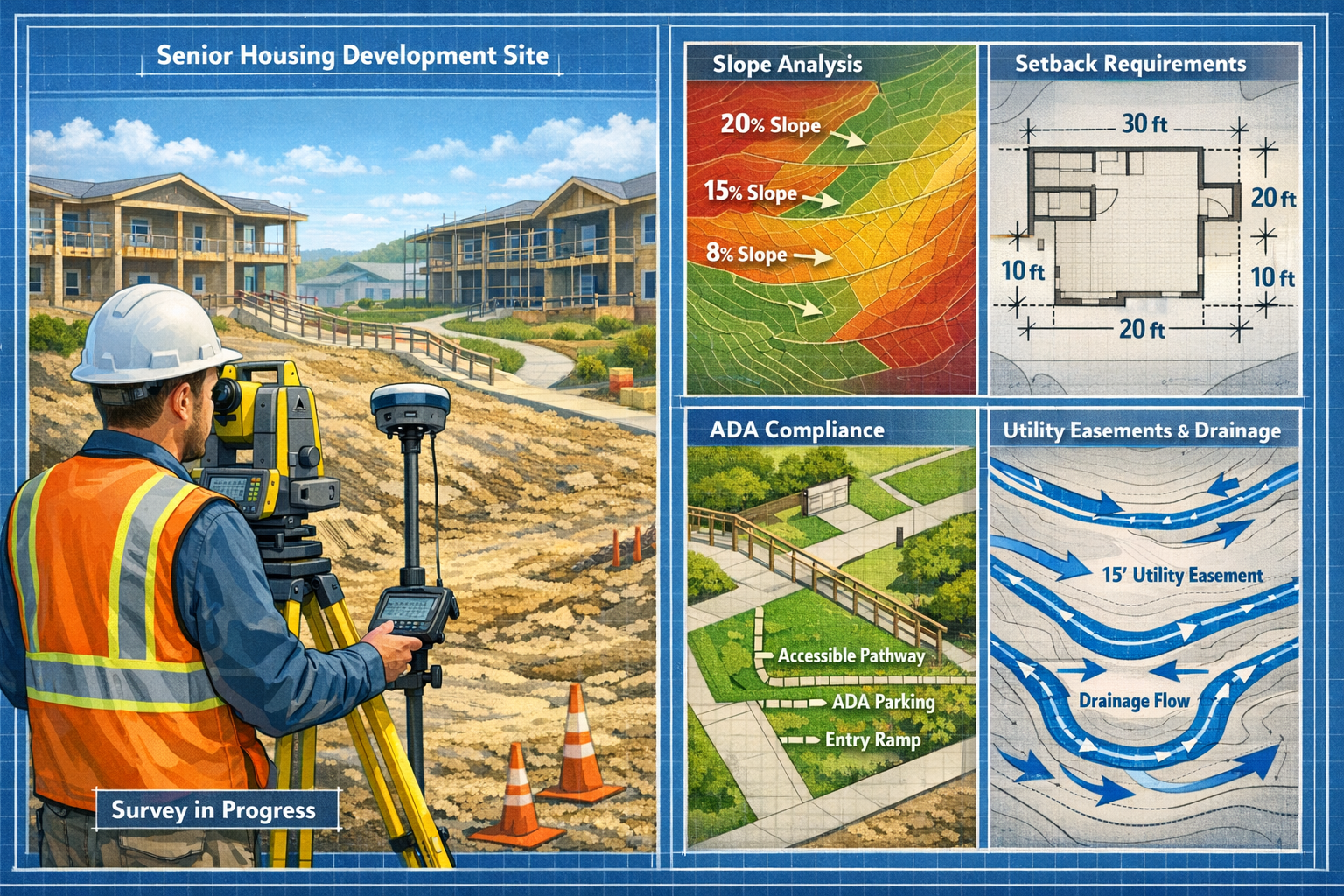
The demographic forces reshaping senior housing in 2026 represent more than gradual population aging—they constitute a fundamental market transformation. As the oldest baby boomers celebrate their 80th birthdays this year, the senior housing industry confronts demand levels unprecedented in modern history. According to U.S. Census Bureau projections, the age 75+ population will expand by more than 4 million people by 2030, creating sustained pressure on an already constrained inventory[2].
This demographic surge arrives precisely as occupancy across primary markets climbs steadily, with independent living exceeding 90 percent and assisted living rising toward pre-pandemic levels[1]. Industry analysts at NIC (National Investment Center for Seniors Housing & Care) project that 2026 could witness the highest occupancy rate reported in the 20 years that NIC MAP has tracked this data[2]. This convergence of demographic expansion and capacity constraints creates both opportunity and urgency for developers who can navigate the complex site assessment requirements that senior housing demands.
Supply-Demand Imbalance Creates Development Imperative
While demand accelerates, supply faces historic constraints. Year-over-year inventory growth has plummeted to its lowest level since 2006, with the number of new units breaking ground falling below the number arriving online—a trend last occurring in 2021 and before that in 2009 during the Global Financial Crisis[2]. New construction remains at historically low levels, with fewer units under development than in years past[1].
This supply-demand imbalance stems from multiple factors:
- 🏗️ Entitlement challenges and lengthy approval processes
- 💰 Debt financing constraints in higher interest rate environments
- 📈 Rising construction costs impacting project feasibility
- ⏱️ Extended development timelines from concept to occupancy
- 🔍 Increased regulatory scrutiny around accessibility and safety
These challenges make precision site assessment absolutely critical. Developers cannot afford costly surprises during construction or post-occupancy compliance issues. Professional RICS commercial building surveys and comprehensive site evaluations identify constraints early, enabling informed decision-making and risk mitigation.
Market Fundamentals Demonstrate Sector Strength
Despite development challenges, market fundamentals remain robust. Asking rents have stabilized above 4 percent annually across both independent and assisted living, reflecting balanced market conditions where income growth and operational stability coexist[1]. This pricing power demonstrates that well-located, properly designed senior housing communities can achieve sustainable economics even amid broader real estate market volatility.
The combination of strong occupancy, rent stability, and demographic tailwinds positions senior housing as an attractive investment class—provided developers can successfully navigate the specialized requirements that distinguish these properties from conventional multifamily or healthcare real estate.
Surveying Senior Housing Developments: Specialized Requirements for Independent Living, Assisted Care, and Wellness Communities
Independent Living Communities: Balancing Autonomy with Accessibility
Independent living facilities serve the youngest and healthiest older adults, typically aged 55-75, who desire maintenance-free living with optional amenities and social opportunities. Surveying these developments requires understanding how to create environments that preserve resident autonomy while incorporating accessibility features that support aging in place.
Critical site assessment elements for independent living include:
| Assessment Category | Key Considerations | Surveying Requirements |
|---|---|---|
| Topography & Grading | Minimize slopes; maximize walkability | Detailed contour mapping; slope analysis at 2% intervals |
| Unit Configuration | Two-bedroom layouts now 38% of new units | Larger footprints; parking ratios; setback calculations |
| Accessibility Pathways | ADA-compliant routes to all amenities | Grade verification; surface material specifications |
| Parking & Circulation | Attached garages for cottages/villas | Vehicle turning radii; accessible parking percentages |
| Amenity Placement | Dining, fitness, social spaces | Proximity analysis; pedestrian flow modeling |
The significant shift toward two-bedroom or larger units—which previously accounted for just 14 percent of new development but now represent 38 percent of new units—has profound implications for site planning[2]. Larger units require more land area, impact building footprints, and influence parking requirements. Precision surveying ensures optimal site utilization while maintaining the open, campus-like atmosphere that independent living residents prefer.
Increasingly, developers are creating single-story cottages and villas with attached garages, responding to preferences for private, home-like environments within a managed community[2]. These configurations require careful site layout to balance density with privacy, necessitating detailed boundary surveys and setback analysis.
Assisted Living and Memory Care: Prioritizing Safety and Therapeutic Design
Assisted living and memory care facilities serve residents requiring higher levels of support and supervision. These environments demand specialized surveying that accounts for safety systems, secure perimeters, and therapeutic outdoor spaces.
Specialized surveying considerations include:
🔒 Security and Containment: Memory care units require secure outdoor areas that prevent wandering while providing therapeutic garden access. Surveyors must map property boundaries with precision, identify fence line locations, and ensure compliance with state-specific regulations governing secure environments.
🚑 Emergency Access: Site plans must accommodate emergency vehicle access to all building entrances, with turning radii and approach grades meeting fire code requirements. Detailed site surveys identify constraints that could impede emergency response.
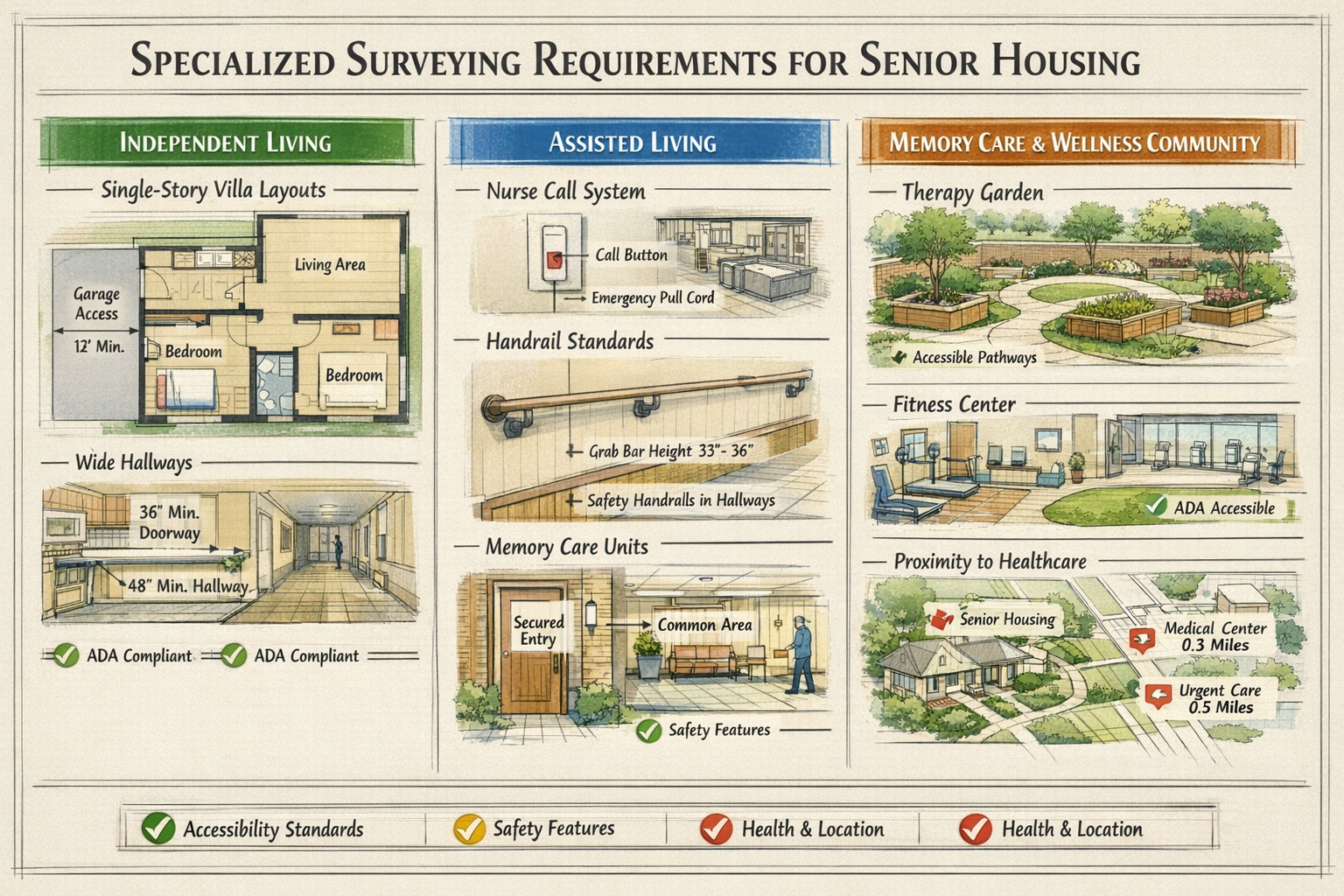
♿ Enhanced Accessibility: Beyond basic ADA compliance, assisted living facilities require wider corridors, zero-threshold entries, and continuous handrail systems. Site grading must minimize level changes, with ramp slopes not exceeding 1:12 ratios and landing areas at appropriate intervals.
🌳 Therapeutic Landscapes: Outdoor spaces serve therapeutic purposes in memory care settings. Surveyors work with landscape architects to identify optimal locations for walking loops, sensory gardens, and protected courtyards, considering sun exposure, wind patterns, and visual connections to interior spaces.
Professional structural surveys become essential when evaluating existing buildings for conversion to assisted living or memory care use, as these facilities often require structural modifications to accommodate accessibility features and life safety systems.
Wellness-Focused Communities: Integrating Healthcare and Lifestyle Amenities
The newest generation of senior housing developments emphasizes holistic wellness, integrating fitness facilities, rehabilitation services, and healthcare access within residential communities. This trend reflects changing preferences among baby boomers who prioritize active lifestyles and preventive health.
Surveying requirements for wellness-focused developments:
🏥 Healthcare Proximity Mapping: Location strategy increasingly centers on proximity to hospitals, specialty clinics, and rehabilitation services[5]. Site selection surveys should include distance analysis to medical facilities, emergency response times, and accessibility via multiple transportation modes.
🏋️ Fitness and Recreation Facilities: Modern senior communities feature fitness centers, pools, walking trails, and outdoor recreation areas. Site surveys must identify optimal locations for these amenities, considering:
- Solar orientation for outdoor pools and exercise areas
- Drainage patterns for walking trails and sports courts
- Noise buffering between active recreation and residential zones
- Accessibility from all residential buildings
🌿 Sustainable Site Design: Energy-efficient systems, durable materials, and water-conscious design help control operating expenses while appealing to environmentally conscious residents[6]. Site surveys should assess:
- Solar access for photovoltaic installations
- Geothermal potential for HVAC systems
- Stormwater management opportunities
- Native landscaping zones
💻 Technology Infrastructure: Smart-home features, wearable health monitoring, and telehealth access play growing roles in senior living by 2026[6]. Site surveys must verify adequate telecommunications infrastructure, identify locations for network equipment, and ensure connectivity throughout the development.
Site Constraints, Accessibility Compliance, and Regulatory Considerations in Senior Housing Development
Navigating Complex Zoning and Land Use Requirements
Senior housing developments often face unique zoning challenges that distinguish them from conventional residential or healthcare facilities. Many jurisdictions classify senior housing in special use categories requiring conditional use permits, public hearings, and enhanced review processes.
Critical zoning and land use assessments:
📋 Classification Verification: Surveyors must work with land use attorneys to verify how local ordinances classify different senior housing types—independent living may fall under residential zoning, while assisted living might require healthcare or institutional zoning.
📏 Density and Height Restrictions: Senior housing projects often seek density bonuses or height exceptions to achieve economic feasibility. Detailed site surveys document existing conditions and demonstrate compliance with modified requirements.
🚗 Parking Ratio Calculations: Parking requirements for senior housing typically differ from standard multifamily ratios, reflecting lower vehicle ownership among older residents. However, requirements vary by facility type, with independent living requiring higher ratios than assisted living. Accurate surveys ensure parking layouts meet jurisdiction-specific standards.
🌳 Setback and Buffer Requirements: Many communities require enhanced setbacks or landscape buffers when senior housing adjoins single-family residential zones. Boundary surveys with precise setback measurements prevent costly design revisions during permitting.
Working with valuers registered with the RICS ensures that site assessments meet professional standards and provide documentation acceptable to planning authorities and financial institutions.
ADA Compliance and Accessibility Standards
Senior housing developments must meet or exceed Americans with Disabilities Act (ADA) requirements, with many states and localities imposing additional accessibility standards. Compliance failures can result in costly retrofits, legal liability, and reputational damage.
Essential accessibility surveying elements:
♿ Accessible Routes: All paths of travel from parking areas to building entrances, between buildings, and to outdoor amenities must meet ADA slope requirements (maximum 1:12 for ramps, maximum 2% for walking surfaces). Detailed topographic surveys identify areas requiring grading modifications or alternative routing.
🚪 Building Entrance Grades: Entrances must be accessible without steps, requiring careful coordination between site grading and building floor elevations. Surveyors establish precise benchmark elevations and verify that finished grades achieve zero-threshold access.
🅿️ Accessible Parking: Minimum percentages of parking spaces must meet accessibility standards, with specific requirements for van-accessible spaces, access aisles, and maximum slopes. Site surveys document compliance with dimensional and slope requirements.
🔊 Visual and Audible Warning Systems: Exterior site elements including crosswalks, drop-offs, and hazard areas require detectable warning surfaces and appropriate signage. Site surveys identify locations requiring these features and verify proper placement.
Many developers exceed minimum ADA requirements, incorporating universal design principles that create environments usable by people of all abilities without specialized adaptation. This approach not only serves current residents but also future-proofs facilities for evolving needs as residents age in place.
Environmental and Geotechnical Considerations
Senior housing sites require thorough environmental and geotechnical assessment to identify constraints that could impact development feasibility, construction costs, or long-term operational safety.
Critical environmental surveying components:
🌊 Floodplain Analysis: Sites within or adjacent to floodplains face regulatory restrictions and increased insurance costs. FEMA flood map verification and elevation certificates document flood risk and inform building placement decisions.
💧 Wetlands Delineation: Wetlands and water bodies trigger federal and state regulatory jurisdiction. Professional wetlands delineation identifies jurisdictional features and establishes required buffer zones.
🏗️ Geotechnical Investigation: Subsurface conditions profoundly impact foundation design and construction costs. Geotechnical surveys including soil borings, percolation tests, and bearing capacity analysis inform structural engineering and site development approaches.
⚠️ Contamination Assessment: Phase I Environmental Site Assessments identify potential contamination from historical land uses. Sites with contamination concerns require Phase II investigations and potential remediation before development can proceed.
🌲 Tree Preservation and Landscape Assessment: Many jurisdictions require tree surveys and preservation plans. Mature trees provide aesthetic value and can be incorporated into therapeutic landscapes when properly protected during construction.
Professional commercial property surveying services coordinate these specialized assessments, ensuring comprehensive site evaluation that identifies constraints early in the development process.
Utility Infrastructure and Service Capacity
Adequate utility infrastructure is essential for senior housing operations, with capacity requirements often exceeding conventional residential developments due to higher occupancy densities and specialized systems.
Utility assessment priorities:
⚡ Electrical Capacity: Senior housing facilities require substantial electrical service for HVAC systems, commercial kitchens, emergency generators, and increasingly for EV charging infrastructure. Utility surveys verify available capacity and identify required upgrades.
💦 Water and Sewer Service: Assisted living and memory care facilities generate higher water demand and wastewater flows than independent living due to commercial laundry, food service, and healthcare functions. Flow calculations and capacity verification prevent service inadequacies.
🔥 Natural Gas Availability: Many senior housing developments rely on natural gas for heating, cooking, and emergency generators. Service availability and capacity assessments inform energy system design.
📡 Telecommunications Infrastructure: With telehealth access and smart-home features becoming standard expectations[6], robust telecommunications infrastructure is essential. Site surveys verify fiber optic availability and identify locations for network equipment.
🚨 Fire Protection Systems: Depending on jurisdiction and facility type, senior housing may require fire hydrants, sprinkler systems, and enhanced fire detection systems. Site surveys verify hydrant locations, water pressure, and flow rates to ensure adequate fire protection.
Future-Proofing Senior Housing Through Advanced Surveying and Technology Integration
Continuum-of-Care Campus Planning
Seniors increasingly want flexibility to transition from independent living to assisted living or memory care without leaving familiar surroundings[6]. This preference drives development of integrated campuses offering multiple care levels, requiring sophisticated site planning that accommodates diverse building types while maintaining cohesive community character.
Surveying strategies for continuum-of-care campuses:
🏘️ Phased Development Planning: Master-planned communities often develop in phases over multiple years. Initial site surveys must anticipate future phases, establishing control points, benchmark elevations, and utility corridors that support long-term buildout.
🔄 Flexible Infrastructure Sizing: Utility systems must accommodate ultimate buildout capacity even when initial phases serve only a portion of planned units. Surveyors work with engineers to verify that infrastructure sizing supports future expansion.
🚶 Internal Connectivity: Residents moving between care levels need safe, accessible pathways connecting different buildings. Site surveys identify optimal routing for covered walkways, underground corridors, or elevated connections that function in all weather conditions.
🏗️ Adaptive Reuse Potential: Some independent living units may eventually convert to assisted living as demographic needs shift. Site planning should allow for this flexibility, with surveys documenting how building locations and site infrastructure could support alternative configurations.
Technology Integration and Smart Community Infrastructure
The integration of smart-home features, wearable health monitoring, and telehealth access distinguishes modern senior housing from previous generations of development[6]. These technologies require infrastructure planning that begins with initial site surveys.
Technology-enabled surveying considerations:
📶 Wireless Coverage Mapping: Site surveys should assess cellular coverage and identify locations requiring distributed antenna systems or signal boosters to ensure connectivity throughout the community.
🖥️ Network Equipment Locations: Fiber optic termination points, network switches, and wireless access points require dedicated spaces with appropriate power, climate control, and security. Site surveys identify optimal locations that minimize cable runs while ensuring coverage.
🔌 EV Charging Infrastructure: As electric vehicle adoption accelerates, senior housing communities need charging infrastructure. Site electrical surveys verify capacity for current and future charging stations, with conduit pathways established during initial construction.
🎥 Security and Monitoring Systems: Modern senior communities employ security cameras, access control systems, and emergency call systems. Site surveys map camera sight lines, access control points, and emergency call station locations.
☀️ Renewable Energy Integration: Solar photovoltaic systems and battery storage increasingly feature in senior housing developments. Site surveys assess solar access, identify optimal panel placement, and locate equipment rooms for inverters and battery systems.
Professional RICS building surveys incorporate technology infrastructure assessment, ensuring that site planning supports both current operational needs and future technological advancement.
Sustainable Design and Climate Resilience
Sustainability and cost management have become development priorities, with energy-efficient systems and water-conscious design helping control operating expenses while reducing environmental impact[6]. Site surveying plays a crucial role in enabling sustainable design strategies.
Sustainability-focused surveying elements:
🌞 Solar Orientation Analysis: Building placement and orientation profoundly impact energy performance. Site surveys document solar access throughout the year, informing building positioning that maximizes passive solar gain in winter while minimizing summer heat gain.
💨 Wind Pattern Assessment: Understanding prevailing wind patterns enables natural ventilation strategies and informs placement of outdoor amenity spaces. Site surveys combined with microclimate analysis optimize comfort and energy efficiency.
💧 Stormwater Management: Low-impact development techniques including bioswales, rain gardens, and permeable paving reduce runoff while creating attractive landscapes. Topographic surveys identify optimal locations for these features based on drainage patterns and soil conditions.
♻️ Material Reuse Opportunities: Site surveys document existing features that could be preserved or repurposed, including mature trees, stone walls, or architectural elements that reduce material consumption and connect new development to site history.
🌡️ Climate Resilience Planning: With climate patterns shifting, site surveys should assess vulnerability to extreme heat, flooding, and severe weather. This analysis informs building placement, landscape design, and infrastructure protection strategies.
Addressing Affordability Through Efficient Site Utilization
Economic pressures are driving demand for a wider range of senior housing options, with developers exploring models that expand access without sacrificing quality[3]. Efficient site utilization, enabled by precision surveying, helps control development costs and support more attainable pricing.
Cost-optimization surveying strategies:
📐 Density Optimization: Detailed topographic surveys enable site plans that maximize allowable density while meeting all regulatory requirements, improving project economics through efficient land use.
🏗️ Construction Efficiency: Accurate surveys reduce field conflicts, change orders, and construction delays—all of which inflate costs. Precise site documentation enables contractors to bid accurately and execute efficiently.
🚜 Earthwork Balancing: Minimizing cut-and-fill operations reduces construction costs and environmental impact. Detailed topographic surveys enable grading plans that balance earthwork on-site, eliminating expensive material hauling.
⚙️ Standardized Building Placement: When topography permits, standardized building orientations and elevations enable repetitive construction processes that reduce costs. Site surveys identify areas suitable for standardized approaches versus locations requiring custom solutions.
The combination of precise surveying, thoughtful site planning, and value engineering creates opportunities for more attainable senior housing that serves middle-income seniors who might otherwise lack access to purpose-built communities.
Best Practices for Surveying Senior Housing Developments in 2026

Assembling the Right Professional Team
Successful senior housing development requires coordination among specialized professionals who understand the unique requirements of this property type. The surveying team forms the foundation for this collaboration.
Essential team members and their roles:
👷 Licensed Land Surveyors: Provide boundary surveys, topographic mapping, ALTA/NSPS surveys, and construction staking. Should have experience with senior housing and healthcare projects.
🏗️ Civil Engineers: Design site grading, utilities, stormwater management, and accessibility features. Rely on accurate survey data for design development.
🏛️ Architects: Create building designs that integrate with site conditions. Require detailed topographic information and utility locations for optimal building placement.
🌳 Landscape Architects: Design outdoor spaces, therapeutic gardens, and walking paths. Need accurate survey data for grading design and plant placement.
⚖️ Land Use Attorneys: Navigate zoning, permitting, and regulatory compliance. Rely on surveys to document compliance with dimensional requirements.
💰 Appraisers and Valuers: Assess property value for financing and investment decisions. Professional valuation reports depend on accurate site information.
Early engagement of the full professional team, with surveying as the first step, prevents costly redesigns and ensures that all disciplines work from common, accurate base information.
Leveraging Advanced Surveying Technologies
Modern surveying technologies enable faster, more accurate, and more comprehensive site assessment than traditional methods. Senior housing projects benefit from these advanced capabilities.
Technology applications in senior housing surveying:
🚁 Drone Photogrammetry: Unmanned aerial vehicles capture high-resolution imagery and create detailed topographic models quickly and cost-effectively. Particularly valuable for large campus sites or sites with challenging access.
📡 GPS/GNSS Positioning: Global Navigation Satellite Systems provide precise positioning for boundary surveys and control networks. Real-time kinematic (RTK) GPS enables rapid field data collection with centimeter-level accuracy.
📊 3D Laser Scanning: Terrestrial laser scanners capture millions of data points, creating comprehensive as-built documentation of existing buildings and site features. Valuable for renovation projects or additions to existing senior housing communities.
🖥️ Building Information Modeling (BIM): Integration of survey data into BIM workflows enables coordination among all design disciplines, reducing conflicts and improving construction efficiency.
📱 Mobile GIS Applications: Field crews use tablet-based GIS applications to collect and verify data in real-time, improving accuracy and reducing office processing time.
These technologies not only improve survey accuracy and efficiency but also provide documentation that supports long-term facility management and future expansion planning.
Timing Surveying Activities Within the Development Process
Strategic timing of surveying activities optimizes development schedules and ensures that accurate information is available when needed for decision-making.
Recommended surveying timeline:
Phase 1 – Site Selection (Weeks 1-4)
- Preliminary boundary verification
- Topographic reconnaissance
- Utility availability assessment
- Environmental constraints screening
Phase 2 – Due Diligence (Weeks 5-12)
- Complete boundary survey
- Detailed topographic survey
- ALTA/NSPS survey for financing
- Wetlands delineation if applicable
- Geotechnical investigation coordination
Phase 3 – Design Development (Weeks 13-26)
- Survey control network establishment
- Utility location verification
- Tree survey and landscape assessment
- Accessibility analysis
- Design coordination surveys
Phase 4 – Construction Documentation (Weeks 27-40)
- Final boundary certification
- Construction staking preparation
- Utility coordination surveys
- Permit compliance verification
Phase 5 – Construction (Months 10-24)
- Building layout and staking
- Utility staking
- Grade verification
- As-built documentation
- Final site certification
This phased approach ensures that appropriate survey information is available at each decision point while avoiding premature expenditure on detailed surveys before site viability is confirmed.
Quality Assurance and Regulatory Compliance
Senior housing developments face rigorous regulatory scrutiny from multiple agencies. Survey quality assurance processes ensure that documentation meets all applicable standards and withstands regulatory review.
Quality assurance best practices:
✅ Professional Standards Compliance: All surveys should meet applicable professional standards, including ALTA/NSPS standards for commercial surveys and state-specific minimum standards for boundary surveys.
📋 Third-Party Review: Complex projects benefit from independent survey review by qualified professionals who verify accuracy and completeness before submission to regulatory agencies.
🔍 Field Verification: Critical measurements and elevations should be independently verified through redundant observations and alternative measurement methods.
📁 Comprehensive Documentation: Survey deliverables should include detailed metadata, methodology descriptions, and accuracy statements that demonstrate professional competence and due diligence.
🏛️ Regulatory Coordination: Surveyors should maintain direct communication with building departments, planning agencies, and other regulatory bodies to ensure that deliverables meet specific submission requirements.
Working with firms experienced in commercial property surveying ensures that senior housing projects receive the specialized expertise and quality assurance necessary for successful regulatory approval and construction execution.
Conclusion: Precision Site Assessment as the Foundation for Meeting 2026's Senior Housing Challenge
As the oldest baby boomers turn 80 in 2026 and senior housing occupancy approaches historic highs, the industry confronts both unprecedented opportunity and formidable challenges. The severe supply-demand imbalance, with inventory growth at its lowest level since 2006, creates urgent need for new development[2]. Yet rising construction costs, financing constraints, and complex regulatory requirements demand that every new project be executed with precision and efficiency.
Surveying Senior Housing Developments: Meeting the 2026 Demographic Inflection Point with Precision Site Assessment provides the essential foundation for successful project delivery. From initial site selection through construction completion, accurate surveying enables informed decision-making, regulatory compliance, cost control, and quality outcomes.
The specialized requirements of senior housing—including accessibility compliance, continuum-of-care infrastructure, technology integration, and wellness-focused amenities—distinguish these projects from conventional residential development. Surveyors who understand these unique needs and apply advanced technologies including drone photogrammetry, 3D laser scanning, and BIM integration deliver value that extends far beyond basic boundary and topographic mapping.
Actionable Next Steps for Developers, Investors, and Planners
For stakeholders embarking on senior housing development in 2026 and beyond, consider these strategic actions:
-
Engage Professional Surveyors Early: Begin with comprehensive site assessment before committing to property acquisition. Early surveying identifies constraints that could impact feasibility or require costly mitigation.
-
Assemble Specialized Expertise: Work with professionals experienced in senior housing, healthcare, and accessibility requirements. Generic residential expertise may miss critical considerations specific to this property type.
-
Invest in Advanced Technology: Leverage drone surveys, 3D scanning, and BIM workflows that improve accuracy, reduce timelines, and support long-term facility management.
-
Plan for Flexibility: Design sites and infrastructure that accommodate future expansion, care level transitions, and evolving resident preferences as the baby boomer cohort ages.
-
Prioritize Sustainability: Incorporate energy-efficient design, water conservation, and climate resilience strategies that control operating costs while meeting environmental expectations.
-
Verify Regulatory Compliance: Ensure that all surveys meet professional standards and regulatory requirements. Documentation quality directly impacts permitting timelines and approval success.
-
Consider Continuum-of-Care Models: Explore campus configurations that integrate multiple care levels, responding to resident preferences for aging in place within familiar communities[6].
The demographic inflection point of 2026 represents a generational opportunity to create senior housing communities that serve baby boomers' distinct preferences and needs. Success requires precision, expertise, and strategic planning—beginning with comprehensive, professional site assessment that establishes the foundation for excellence in design, construction, and long-term operations.
Whether developing independent living communities, assisted care facilities, or integrated wellness campuses, the investment in professional surveying delivers returns through reduced risk, improved efficiency, regulatory compliance, and ultimately, communities that enhance quality of life for the seniors they serve. As occupancy rates climb toward historic highs and demand continues to outpace supply, those who execute with precision and professionalism will lead the industry through this transformational era.
For comprehensive surveying services tailored to senior housing development needs, professional RICS building surveys and specialized commercial assessments provide the expertise and documentation necessary for successful project delivery in 2026's competitive market environment.
References
[1] Five Senior Housing Trends Shaping Industry 2026 – https://www.hmpglobalevents.com/article/five-senior-housing-trends-shaping-industry-2026
[2] Senior Housing – https://www.pwc.com/us/en/industries/financial-services/asset-wealth-management/real-estate/emerging-trends-in-real-estate-pwc-uli/property-type-outlook/senior-housing.html
[3] Senior Housing Trends To Watch In 2026 – https://distinctivedev.com/senior-housing-trends-to-watch-in-2026/
[4] Hdg Execs These 6 Trends Could Reshape Senior Living In 2026 – https://seniorhousingnews.com/2026/01/16/hdg-execs-these-6-trends-could-reshape-senior-living-in-2026/
[5] What Will Drive Senior Living Occupancy Growth In 2026 – https://slfinvestments.com/2026/01/30/what-will-drive-senior-living-occupancy-growth-in-2026/
[6] Senior Living Trends To Watch In 2026 – https://www.theplazaco.com/knowledge-center/senior-living-trends-to-watch-in-2026/