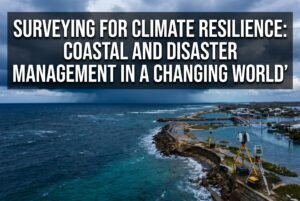
By 2050, up to one billion people worldwide could be living in low-elevation coastal zones exposed to regular flooding — a figure that makes the discipline of surveying for climate resilience: coastal and disaster management in a changing world not merely relevant, but urgent. As sea levels climb, storm surges intensify, and regulatory frameworks tighten, the role of the professional surveyor has expanded far beyond property boundaries and building conditions. Today, surveyors are on the front line of climate adaptation, providing the precise spatial data that governments, engineers, and communities need to survive what is coming.
Key Takeaways
- Coastal resilience depends on accurate, up-to-date survey data to identify flood risk, erosion rates, and vulnerable infrastructure.
- Technologies such as GNSS, LiDAR, and remote sensing have transformed how surveyors map and monitor climate-exposed areas.
- Stricter national and regional regulations now require climate-informed surveys as part of shoreline management and planning approval.
- Nature-based solutions and engineered defences both rely on precise ground-truth data gathered through professional surveying.
- Early investment in resilience surveys reduces long-term disaster recovery costs and protects property values in at-risk zones.
Why Climate Change Is Reshaping the Surveying Profession
The traditional scope of surveying — measuring land, assessing structures, defining boundaries — has always been shaped by the risks of the physical environment. What has changed is the speed and scale of those risks. The National Oceanic and Atmospheric Administration (NOAA) defines coastal resilience as a community's ability to "bounce back" after hazardous events such as hurricanes, coastal storms, and flooding, rather than merely reacting to impacts [1]. That definition places proactive data collection — surveying — at the very heart of resilience planning.
The U.S. Geological Survey (USGS) conducts ongoing research into coastal hazards including sea-level rise, erosion, flooding, and extreme storms, developing tools to assess risk and improve preparedness [4]. This scientific infrastructure only delivers value when it is connected to ground-level survey work that translates national models into site-specific intelligence.
Three forces are driving this shift:
- Regulatory pressure: Governments at every level are mandating climate-risk assessments as part of planning and development approvals.
- Insurance and finance: Lenders and insurers increasingly require verified flood-risk data before underwriting coastal properties.
- Community accountability: Residents and local authorities demand evidence-based plans, not assumptions.
The Regulatory Landscape in 2026
Regulations are tightening considerably. Washington State's Department of Ecology, for example, is developing new requirements for local governments to address sea-level rise and increased storm severity directly within shoreline master programs, and has released interim climate resilience planning guidance to align comprehensive plans with these requirements [3]. Similar frameworks are emerging across the UK, Europe, and Australia, where planning authorities now expect surveyors to deliver data that goes well beyond a standard structural or topographic report.
For property professionals, this means that a structural survey or commercial building survey conducted near a flood-prone area must increasingly account for climate trajectory, not just current condition. Surveyors who understand flood modelling, drainage behaviour, and coastal geomorphology are becoming indispensable.
How Resilience Is Measured
Measuring resilience is not straightforward. The National Centers for Coastal Ocean Science (NCCOS) has published research comparing different metrics for measuring the resilience of coastal communities, aiming to better target place-based studies, restoration investments, and adaptation efforts [9]. Their broader research programme covers climate impacts on ecosystems, community and social vulnerability, sea-level rise and inundation, restoration and nature-based solutions, and coastal ocean acidification [2].
| Resilience Metric | What It Measures | Survey Input Required |
|---|---|---|
| Flood Exposure Index | Probability and depth of inundation | LiDAR elevation, GNSS benchmarks |
| Social Vulnerability Score | Population risk factors | Land-use mapping, access surveys |
| Ecosystem Service Value | Natural buffer capacity | Habitat mapping, shoreline surveys |
| Infrastructure Condition | Asset integrity under stress | Structural and condition surveys |
| Recovery Time Estimate | Speed of post-event restoration | Baseline condition records |
Technology Driving Surveying for Climate Resilience: Coastal and Disaster Management in a Changing World
The tools available to surveyors have advanced dramatically, enabling a level of precision and coverage that was simply not achievable a decade ago. This technological leap is central to effective coastal and disaster management.

GNSS and Its Role in Flood-Zone Mapping
Global Navigation Satellite Systems (GNSS) have become the backbone of coastal survey work. By providing centimetre-level positional accuracy, GNSS allows surveyors to establish precise elevation benchmarks — critical when the difference between a property sitting above or below a flood threshold can be a matter of centimetres. In areas where ground subsidence compounds sea-level rise, continuous GNSS monitoring can detect vertical land movement over time, giving planners early warning of increasing risk.
GNSS data feeds directly into flood inundation models. When combined with tidal gauge records and storm surge projections, it allows engineers to produce reliable flood extent maps that inform both planning decisions and emergency response protocols.
LiDAR and Remote Sensing
Light Detection and Ranging (LiDAR) — whether deployed from aircraft, drones, or ground-based units — generates dense three-dimensional point clouds of terrain and structures. For coastal resilience work, this means:
- Bare-earth digital elevation models that strip away vegetation to reveal true ground levels
- Change detection surveys that compare current topography against historical baselines to quantify erosion or accretion
- Building vulnerability assessments that identify which structures sit within projected inundation zones
- Infrastructure mapping for seawalls, drainage channels, and coastal defences
The Nature Conservancy's Coastal Resilience Mapping Portal uses exactly this kind of data to help users visualise future flood risks from sea-level rise and storm surge, identifying areas and populations at risk and aiding understanding of ecological, social, and economic impacts [5].
Ground Investigation and Water Sampling
Coastal resilience is not only about surface topography. Subsurface conditions — soil bearing capacity, groundwater levels, contamination risk — are equally important when assessing whether land can support engineered defences or nature-based solutions. Ground water sampling forms an important part of site investigation in flood-prone areas, particularly where saltwater intrusion into freshwater aquifers is a growing concern.
Equally, subsidence surveys are critical in low-lying coastal zones where soft, saturated soils are prone to settlement — a risk that is amplified as water tables rise and storm loading increases on foundations.
"Resilience is not built from policy documents alone. It is built from data — and that data starts with the surveyor on the ground."
Damp, Drainage, and Structural Integrity
Properties in flood-prone areas face compounding risks that standard surveys must now address with greater rigour. Damp surveys are increasingly relevant in coastal communities where rising groundwater and increased rainfall frequency drive moisture into building fabrics. Identifying damp ingress pathways before a flood event — rather than after — is a fundamental part of climate-adaptive property management.
Similarly, solid floor slab surveys help determine whether ground-floor construction can withstand the hydrostatic pressure and scouring action associated with inundation events, providing owners and developers with evidence to support retrofit or remediation decisions.
Building Resilience Frameworks: From Local Plans to National Strategy
Surveying for climate resilience: coastal and disaster management in a changing world does not happen in isolation. It operates within a layered framework of local, regional, and national planning that is evolving rapidly in response to climate data.
Case Studies in Coastal Resilience Planning
Several jurisdictions provide instructive examples of how survey data drives resilience strategy.
Nantucket, Massachusetts has developed a comprehensive Coastal Resilience Plan outlining strategies to protect the island's community, economy, and environment from climate change and coastal hazards. The plan focuses on risk assessment, building resilience, and promoting the health of natural ecosystems [6]. Central to this plan is a detailed survey programme that established baseline conditions for beaches, bluffs, and built assets — without which no meaningful risk assessment would be possible.
Virginia's Coastal Zone Management Program has allocated nearly $5 million in federal funds over two decades to improve coastal resilience, including assessing and mapping potential impacts of sea-level rise and severe storms, and developing tools and plans to address these impacts [7]. This long-term investment in spatial data has allowed the state to move from reactive disaster response to proactive risk reduction.
North Carolina's Coastal Resilience Pilot Program has assisted communities in initiating resilience planning processes, providing forecasts, data, tools, planning guidance, and funding opportunities to support local action.
Nature-Based Solutions and the Surveyor's Role
Nature-based solutions — restoring wetlands, building oyster reefs, planting mangroves — are increasingly favoured over purely engineered defences because they provide multiple ecosystem services while absorbing storm energy. But they require rigorous survey input to design and monitor effectively.
The U.S. Climate Resilience Toolkit emphasises proactive community-led adaptation strategies, including nature-based solutions and planned relocation, to help communities adapt to increasing coastal hazards [8]. Surveyors contribute to this work by:
- Mapping existing habitat extent and condition
- Monitoring post-restoration change using repeat surveys
- Providing elevation data to determine where natural buffers can be established
- Assessing sediment dynamics that govern whether restored habitats will persist
Integrating Survey Data into Disaster Management
Effective disaster management depends on pre-event data. When a hurricane or storm surge strikes, emergency responders need accurate maps of road networks, building footprints, utility infrastructure, and topographic barriers. Surveyors who have conducted commercial property surveys or RICS building surveys in at-risk areas contribute directly to this intelligence base.
Post-disaster, surveyors play an equally vital role. Rapid damage assessment surveys establish the extent of structural harm, inform insurance claims, guide demolition decisions, and provide the baseline data needed to plan reconstruction that is more resilient than what existed before.
Key steps in a disaster-resilient survey programme:
- Establish pre-event baseline surveys for all critical assets
- Conduct regular monitoring surveys to detect incremental change
- Deploy rapid assessment teams immediately after events
- Compare post-event data against baseline to quantify damage
- Feed findings into updated risk models and planning frameworks
Choosing the Right Survey for Climate-Exposed Properties
Not every property in a flood-prone area requires the same level of investigation. Understanding which survey best fits a specific need is an important first step for owners, developers, and local authorities. A residential property near a tidal estuary may require a Level 3 RICS building survey with specific attention to damp, foundations, and drainage, while a commercial site on reclaimed land may need a full ground investigation including contamination and groundwater assessment.
For those comparing different types of survey, the key question in a climate resilience context is always: does this survey capture the data needed to assess long-term risk, not just current condition? A survey that meets minimum regulatory requirements today but ignores trajectory data may leave clients exposed to significant liability as climate impacts accelerate.
Conclusion
The convergence of climate change, tightening regulation, and advancing survey technology has created both a challenge and an opportunity for the surveying profession. Surveyors who develop expertise in GNSS-based elevation work, LiDAR terrain analysis, ground investigation, and resilience-focused condition assessment are positioned to deliver genuine value in one of the most consequential fields of the 2026 built environment.
Actionable next steps for property owners, developers, and planning professionals:
- Commission a climate-informed baseline survey for any asset in a coastal or flood-prone location, establishing elevation benchmarks, drainage performance, and structural condition.
- Request that surveyors include climate trajectory data — sea-level rise projections, updated flood zone classifications — within survey reports, not just current risk assessments.
- Engage with local shoreline management plans and resilience strategies to understand how regulatory requirements may affect development or insurance obligations.
- Invest in repeat monitoring surveys at defined intervals to detect incremental change before it becomes a crisis.
- Where nature-based solutions are being considered, ensure that habitat and topographic surveys are conducted before, during, and after restoration to measure effectiveness.
Resilience is ultimately a data problem. The communities and property owners who invest in precise, forward-looking survey work today will be far better placed to withstand the coastal and climate hazards that are already in motion. The surveyor's role in that future is not peripheral — it is foundational.
References
[1] Resilience – https://oceanservice.noaa.gov/facts/resilience.html?utm_source=openai
[2] Climate Change – https://coastalscience.noaa.gov/science-areas/climate-change/?utm_source=openai
[3] Climate Resilience And Shoreline Management – https://ecology.wa.gov/water-shorelines/shoreline-coastal-management/shoreline-coastal-planning/shoreline-planners-toolbox/climate-resilience-and-shoreline-management?utm_source=openai
[4] Coastal Hazards And Resilience – https://www.usgs.gov/index.php/science/science-explorer/coasts/coastal-hazards-and-resilience?utm_source=openai
[5] Coastalresilience – https://coast.noaa.gov/digitalcoast/tools/coastalresilience.html?utm_source=openai
[6] Coastal Resilience Plan – https://www.nantucket-ma.gov/2962/Coastal-Resilience-Plan?utm_source=openai
[7] Coastal Resilience – https://www.deq.virginia.gov/water/coastal-zone-management/coastal-resilience?utm_source=openai
[8] Coasts – https://toolkit.climate.gov/topic/coasts?utm_source=openai
[9] How Should Coastal Resilience Be Defined – https://coastalscience.noaa.gov/news/how-should-coastal-resilience-be-defined/?utm_source=openai