The surveying profession stands at a digital crossroads in 2026. Gone are the days when property surveyors relied solely on clipboards, measuring tapes, and handwritten notes. Today's surveying practices demand sophisticated technology ecosystems that seamlessly blend data collection, real-time collaboration, portfolio management, and client deliverables into unified platforms. The Survey Technology Stack 2026: Evaluating Integrated Platforms for Real-Time Collaboration and Portfolio Management has become a critical consideration for firms seeking competitive advantages in an increasingly digital marketplace.
Modern surveying firms face a complex decision: which technology platforms will streamline workflows, enhance accuracy, improve client communication, and ultimately drive profitability? The answer lies in understanding how integrated platforms can transform traditional surveying practices into agile, data-driven operations. Whether conducting commercial property surveying or specialized structural surveys, the right technology stack can mean the difference between operational excellence and competitive obsolescence.
Key Takeaways
- Cloud-based platforms dominate the 2026 surveying landscape, with 43.8% of data-driven professionals adopting cloud data warehouses for centralized information management[2]
- Real-time collaboration tools have become essential for multi-stakeholder projects, enabling surveyors, clients, and contractors to access synchronized data simultaneously
- AI integration is nearly universal, with 96.3% of surveyed professionals finding AI tools helpful in enhancing surveying accuracy and efficiency[2]
- Portfolio management capabilities within integrated platforms allow firms to track multiple projects, allocate resources effectively, and monitor profitability across their entire operation
- Organizational alignment matters more than technical capabilities—poor leadership direction and unclear requirements represent greater barriers than technology limitations[2]
Understanding the Modern Survey Technology Ecosystem

What Defines a Survey Technology Stack in 2026?
A survey technology stack represents the collection of software platforms, hardware devices, cloud services, and integration tools that surveying firms use to deliver their services. In 2026, this ecosystem has evolved far beyond simple data collection tools to encompass comprehensive platforms that manage the entire surveying lifecycle.
The modern stack typically includes:
- 📱 Field data collection tools: Mobile applications and devices for on-site measurements
- ☁️ Cloud storage and processing: Centralized repositories for survey data, photos, and documentation
- 🤝 Collaboration platforms: Real-time communication and document sharing systems
- 📊 Analytics dashboards: Visual representations of survey findings and project metrics
- 📋 Portfolio management systems: Tools for tracking multiple projects, deadlines, and resources
- 🔄 Integration middleware: APIs and connectors that link disparate systems
- 🤖 AI-powered analysis: Automated defect detection, measurement verification, and report generation
The Shift Toward Integrated Platforms
Historically, surveying firms cobbled together separate tools for different functions—one application for field notes, another for photo management, a third for report writing, and yet another for client communication. This fragmented approach created inefficiencies, data silos, and increased error risks.
The Survey Technology Stack 2026: Evaluating Integrated Platforms for Real-Time Collaboration and Portfolio Management emphasizes unified solutions that consolidate these functions. Integrated platforms offer several compelling advantages:
Reduced data entry duplication: Information captured in the field automatically populates reports, invoices, and client portals without manual re-entry.
Enhanced accuracy: Single-source-of-truth data models eliminate discrepancies between different systems.
Improved client experience: Clients access real-time project updates, preliminary findings, and final deliverables through branded portals.
Streamlined workflows: Automated routing moves projects through review, approval, and delivery stages without manual intervention.
According to recent technology trends, software development in 2026 increasingly prioritizes integration capabilities, with platforms offering robust APIs and pre-built connectors becoming industry standards[5].
Cloud Architecture Considerations
The foundation of any modern survey technology stack rests on its underlying cloud architecture. Data from the surveying sector reveals interesting patterns that parallel broader technology adoption trends.
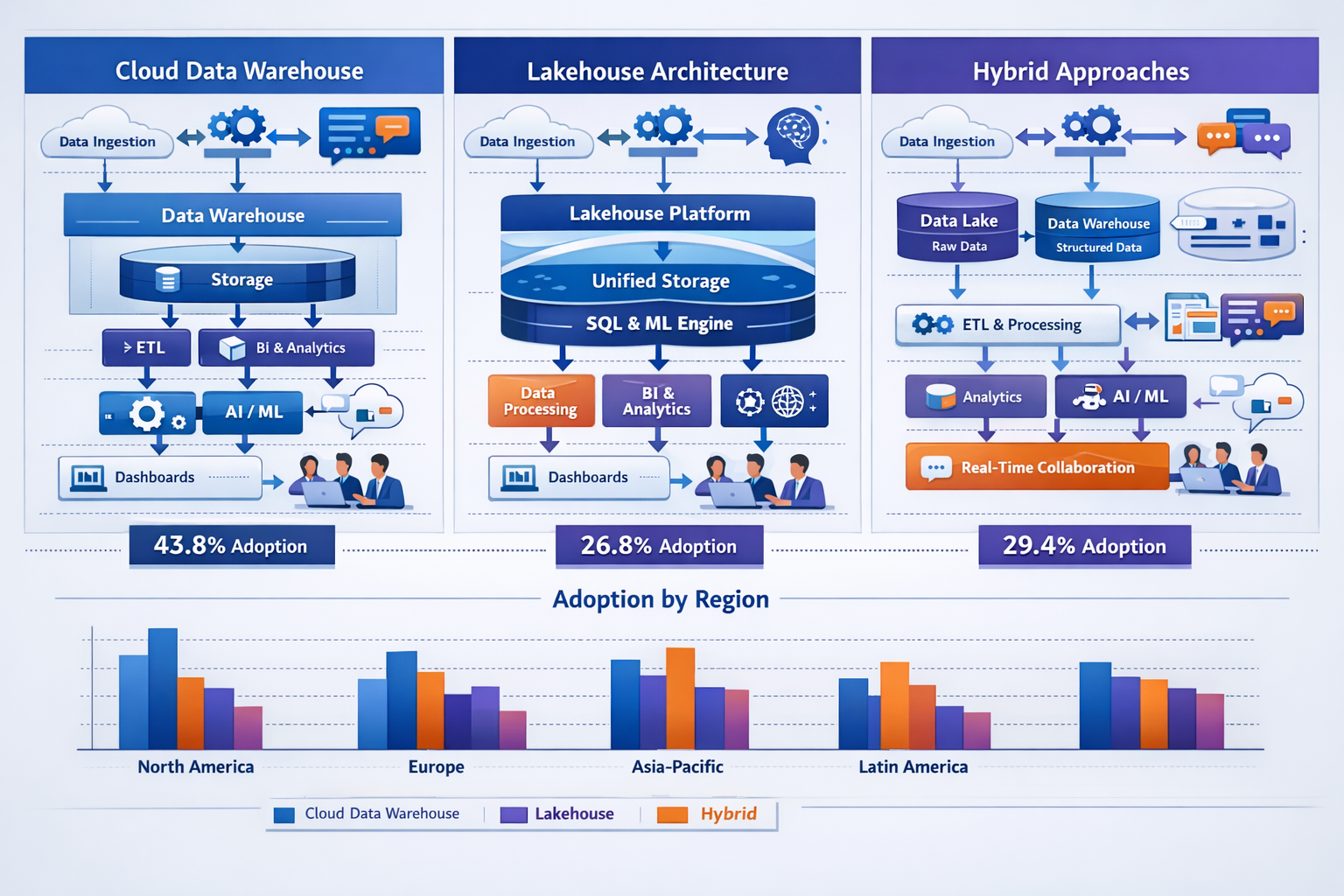
Cloud data warehouses maintain dominance at 43.8% adoption, providing centralized, structured storage for survey data, client information, and historical project records[2]. These systems excel at handling structured data and supporting complex queries across large datasets.
Lakehouse architectures have gained significant traction, reaching 26.8% adoption particularly in European and Latin American markets[2]. Lakehouses combine the flexibility of data lakes with the structure of warehouses, making them ideal for surveying firms that handle diverse data types—from traditional measurements to drone imagery, thermal scans, and 3D point clouds.
For surveying practices conducting specialized work like asbestos surveys or drone surveys, the ability to store and process varied data formats becomes particularly valuable.
"The choice between cloud warehouse and lakehouse architecture should align with your data diversity and analytical requirements, not just current trends." – Industry Technology Consultant
Evaluating Real-Time Collaboration Features in Survey Platforms
Why Real-Time Collaboration Matters for Surveyors
Surveying projects inherently involve multiple stakeholders: the surveyor conducting fieldwork, the senior surveyor reviewing findings, the client awaiting results, contractors planning remediation work, and often legal or financial advisors making decisions based on survey outcomes.
Traditional workflows created bottlenecks. A surveyor would complete fieldwork, return to the office, compile notes, draft a report, send it for review, incorporate feedback, and finally deliver the finished product—a process that could take days or weeks. Real-time collaboration compresses these timelines dramatically.
Modern platforms enable:
- Live field notes: Surveyors dictate or type observations that immediately appear in the project file
- Photo synchronization: Images captured on mobile devices instantly upload to cloud storage with automatic geotagging
- Concurrent editing: Multiple team members can work on different report sections simultaneously
- Instant notifications: Stakeholders receive alerts when new findings are added or project milestones are reached
- Virtual site visits: Clients can view annotated photos and videos without physical presence
Essential Collaboration Tools for Survey Teams
When evaluating platforms for the Survey Technology Stack 2026: Evaluating Integrated Platforms for Real-Time Collaboration and Portfolio Management, surveyors should assess these collaboration capabilities:
| Feature | Importance | Implementation Considerations |
|---|---|---|
| Multi-user editing | Critical | Ensure conflict resolution and version control |
| Mobile-first design | Critical | Field teams need full functionality on tablets/phones |
| Offline capability | High | Sites often lack reliable connectivity |
| Annotation tools | High | Mark-up photos and drawings collaboratively |
| Comment threads | Medium | Context-specific discussions reduce email clutter |
| Video integration | Medium | Record site conditions and walkthroughs |
| Client portals | High | Secure, branded access for external stakeholders |
For firms conducting detailed work such as RICS building surveys or homebuyer surveys, the ability to share preliminary findings with clients in real-time can significantly enhance the customer experience and build trust.
Integration with Communication Platforms
The most effective survey technology stacks don't exist in isolation—they integrate with the communication tools teams already use. In 2026, this means seamless connections with:
- Email systems: Automated notifications and report delivery
- Messaging platforms: Slack, Microsoft Teams, or WhatsApp integration for quick updates
- Video conferencing: Embedded Zoom or Teams calls for virtual consultations
- Project management tools: Synchronization with Asana, Monday.com, or Trello
This integration philosophy aligns with broader software industry trends emphasizing interoperability and ecosystem thinking[6]. Surveying firms benefit when their technology stack connects naturally with clients' existing systems, reducing friction in the collaboration process.
Orchestration and Workflow Automation
Despite technological advances, orchestration remains a challenge across data-driven industries. Research indicates that 20.5% of professionals have no orchestration tools or rely on ad-hoc approaches[2]—a concerning statistic that suggests many firms haven't fully optimized their workflows.
Workflow orchestration in surveying contexts means:
- Automatic routing of completed fieldwork to senior reviewers
- Triggering quality assurance checks when specific conditions are detected
- Scheduling follow-up surveys based on initial findings
- Generating invoices upon report delivery
- Updating portfolio dashboards as project statuses change
Platforms with robust orchestration capabilities reduce administrative burden, minimize human error, and ensure consistent processes across all projects—whether conducting dilapidation surveys or specialized specific defect reports.
Portfolio Management Capabilities in Integrated Survey Platforms
The Strategic Importance of Portfolio Visibility
Surveying firms managing multiple concurrent projects face complex resource allocation challenges. Which surveyor should handle the next assignment? Are we meeting profitability targets across our project mix? Which client segments generate the highest margins? Where are bottlenecks occurring in our delivery pipeline?
Portfolio management features within integrated platforms answer these questions through centralized dashboards that aggregate data across all active and historical projects. This bird's-eye view enables strategic decision-making that would be impossible with project-by-project management approaches.
Key Portfolio Management Features
When evaluating the Survey Technology Stack 2026: Evaluating Integrated Platforms for Real-Time Collaboration and Portfolio Management, firms should prioritize these portfolio capabilities:
📈 Financial tracking: Revenue, costs, and profitability metrics for each project and client segment
👥 Resource utilization: Surveyor workload balancing and capacity planning
⏱️ Timeline visualization: Gantt charts showing all project deadlines and dependencies
📊 Performance metrics: Completion rates, client satisfaction scores, and quality indicators
🎯 Pipeline management: Tracking prospects, quotes, and conversion rates
📍 Geographic distribution: Mapping project locations to optimize travel and scheduling
For surveying practices operating across multiple regions—such as those serving chartered surveyors in Hertfordshire, Surrey, and Essex—geographic visualization becomes particularly valuable for route optimization and regional performance analysis.
Data-Driven Resource Allocation
The integration of AI and analytics into portfolio management platforms has transformed resource allocation from an art into a science. Machine learning algorithms can:
- Predict project duration based on historical data from similar surveys
- Recommend optimal surveyor assignments based on expertise, location, and availability
- Identify scheduling conflicts before they become problems
- Forecast revenue based on pipeline conversion rates and seasonal patterns
- Flag at-risk projects showing warning signs of delays or budget overruns
This aligns with the near-universal AI adoption observed across data-driven professions, where 96.3% of surveyed professionals find AI tools helpful[2]. The key lies in selecting platforms that embed AI thoughtfully rather than superficially.
Client Relationship Management Integration
The most sophisticated survey technology stacks blur the line between portfolio management and client relationship management (CRM). Integrated platforms track:
- Client history: All previous surveys, findings, and interactions
- Relationship value: Lifetime revenue and profitability by client
- Communication logs: Complete record of emails, calls, and meetings
- Satisfaction metrics: Feedback scores and testimonial collection
- Renewal opportunities: Automated reminders for periodic surveys
This holistic view enables personalized service that strengthens client relationships. When a repeat client contacts the firm, surveyors can instantly access complete historical context, demonstrating professionalism and attention to detail.
Reporting and Analytics Dashboards
Executive dashboards transform raw project data into actionable insights. Effective portfolio management platforms offer customizable views for different roles:
For firm principals: High-level financial performance, growth trends, and strategic KPIs
For operations managers: Resource utilization, project pipeline, and bottleneck identification
For senior surveyors: Team performance, quality metrics, and training needs
For business development: Conversion rates, client acquisition costs, and market opportunities
The ability to drill down from summary metrics into individual project details provides the granularity needed for both strategic planning and operational troubleshooting. Firms conducting specialized work such as structural engineering or roof surveys can track performance metrics specific to these service lines.
Overcoming Implementation Challenges and Organizational Barriers
Technical Versus Organizational Challenges
A surprising finding from recent research reveals that organizational challenges outweigh technical barriers when implementing new technology stacks. Poor leadership direction and unclear requirements represent greater impediments than technical limitations[2].
This insight carries important implications for surveying firms evaluating new platforms. The technology itself—cloud infrastructure, collaboration tools, AI algorithms—has matured to the point where technical feasibility is rarely the constraint. Instead, success hinges on:
- Clear strategic vision: Why are we implementing this platform? What specific problems will it solve?
- Executive sponsorship: Does firm leadership actively champion the change?
- User involvement: Have surveyors who will use the system daily participated in selection and design?
- Change management: How will we train staff and manage the transition?
- Process redesign: Are we willing to change workflows to leverage new capabilities?
Common Implementation Pitfalls
Surveying firms frequently encounter these challenges when deploying new technology stacks:
❌ Insufficient training: Assuming surveyors will intuitively understand complex platforms
❌ Data migration issues: Underestimating the effort required to transfer historical project data
❌ Customization overload: Over-configuring platforms to replicate every legacy process
❌ Integration failures: Discovering incompatibilities with existing systems too late
❌ Resistance to change: Encountering pushback from staff comfortable with current methods
❌ Unclear success metrics: Failing to define measurable goals for the implementation
❌ Vendor dependency: Choosing platforms with limited export capabilities or proprietary formats
Best Practices for Successful Adoption
Firms that successfully implement comprehensive survey technology stacks typically follow these principles:
🎯 Start with pilot projects: Test the platform on a small subset of projects before full rollout
📚 Invest in comprehensive training: Provide hands-on instruction, documentation, and ongoing support
🔄 Iterate based on feedback: Regularly solicit user input and adjust configurations accordingly
📊 Define clear metrics: Establish KPIs to measure adoption rates, efficiency gains, and ROI
🤝 Maintain vendor relationships: Work closely with platform providers to address issues and leverage new features
⚖️ Balance standardization and flexibility: Create consistent processes while allowing reasonable customization
🔐 Prioritize data security: Ensure platforms meet industry standards for client data protection
For specialized surveying work requiring particular attention to detail—such as schedule of dilapidations or chartered surveyor services—the importance of thorough training and clear processes cannot be overstated.
Building Internal Champions
The most successful technology implementations identify and empower internal champions—enthusiastic staff members who become platform experts and help colleagues navigate the transition. These champions:
- Provide peer-to-peer training and support
- Identify workflow improvements and best practices
- Communicate feedback to platform vendors
- Demonstrate successful use cases to skeptical colleagues
- Maintain enthusiasm during the inevitable adjustment period
Investing in champion development accelerates adoption and builds organizational capability that extends beyond any specific platform.
Evaluating Vendor Options and Making Selection Decisions
The Vendor Landscape in 2026
The survey technology market in 2026 features diverse vendors ranging from established construction management platforms that have added surveying modules to specialized surveying software companies to general-purpose collaboration tools adapted for surveying workflows.
Major vendor categories include:
Specialized surveying platforms: Purpose-built for property surveyors with deep functionality for specific survey types
Construction management suites: Comprehensive platforms serving contractors, architects, and surveyors
Real estate technology platforms: Broader property management systems with surveying capabilities
General collaboration tools: Platforms like Microsoft 365 or Google Workspace customized for surveying
Open-source solutions: Community-developed platforms offering customization at the cost of self-support
Each category presents distinct advantages and tradeoffs. The optimal choice depends on firm size, service mix, technical capabilities, and strategic priorities.
Critical Evaluation Criteria
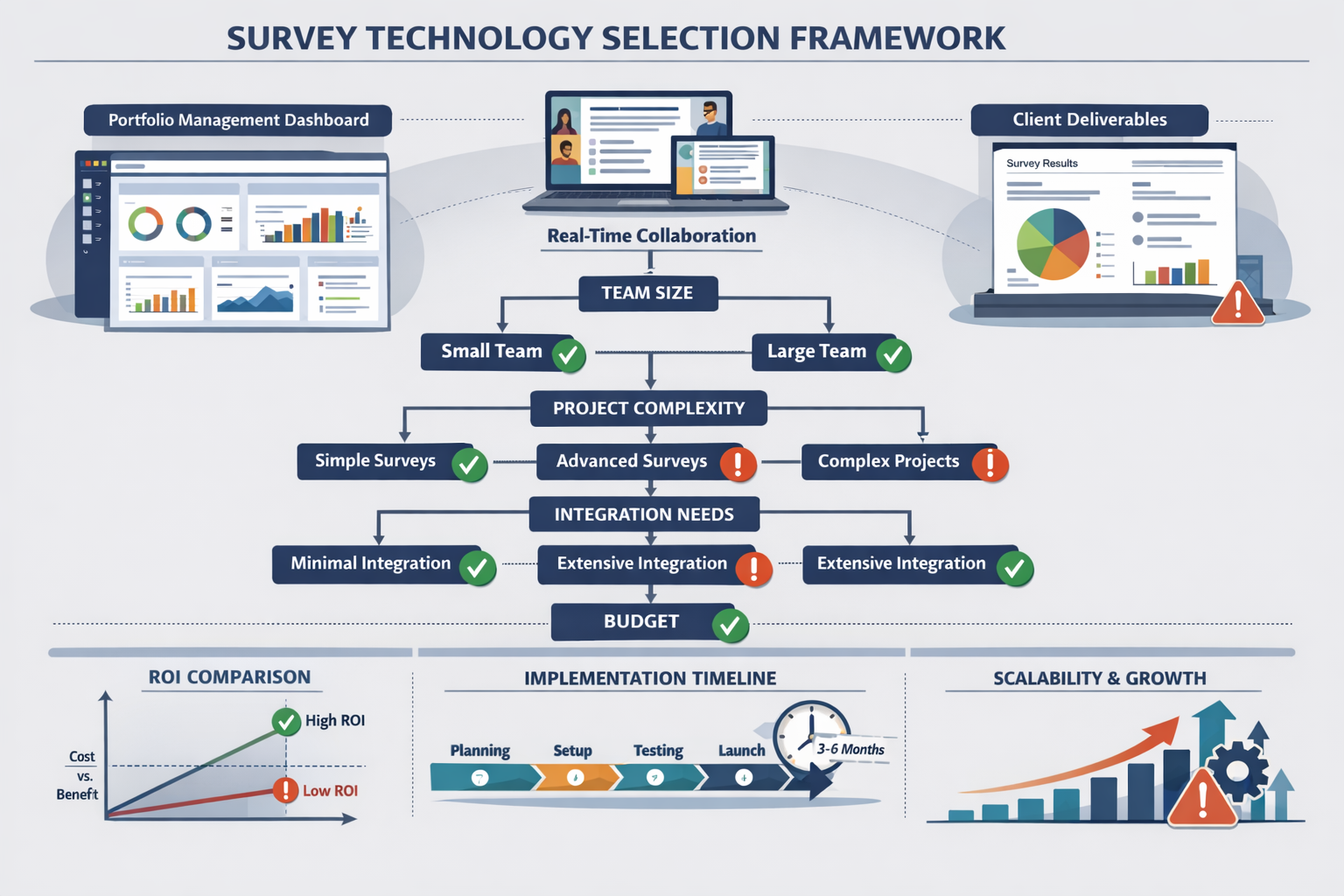
When assessing platforms for the Survey Technology Stack 2026: Evaluating Integrated Platforms for Real-Time Collaboration and Portfolio Management, firms should systematically evaluate these dimensions:
| Criterion | Key Questions | Weight |
|---|---|---|
| Functionality | Does it support our specific survey types? | High |
| Integration | Does it connect with our existing systems? | High |
| Scalability | Can it grow with our firm? | Medium |
| User experience | Will surveyors actually use it? | High |
| Mobile capability | Does it work seamlessly in the field? | Critical |
| Cost structure | Is pricing predictable and sustainable? | High |
| Vendor stability | Will the company be around long-term? | Medium |
| Support quality | Can we get help when needed? | High |
| Data ownership | Can we export our data if we switch? | Medium |
| Security | Does it meet industry standards? | Critical |
The Build Versus Buy Decision
Some surveying firms—particularly larger practices with in-house IT capabilities—face a fundamental question: should we build custom solutions or purchase commercial platforms?
Building custom solutions offers:
✅ Perfect alignment with unique workflows
✅ Complete control over features and roadmap
✅ No vendor lock-in or licensing fees
✅ Competitive differentiation through proprietary technology
But presents challenges:
❌ Significant upfront and ongoing development costs
❌ Requires specialized technical staff
❌ Slower time-to-market
❌ Maintenance burden falls entirely on the firm
❌ Difficulty keeping pace with industry innovations
Purchasing commercial platforms provides:
✅ Rapid deployment with proven functionality
✅ Regular updates and new features
✅ Vendor support and training resources
✅ Lower total cost of ownership for most firms
With tradeoffs:
❌ Less customization flexibility
❌ Ongoing subscription costs
❌ Dependence on vendor roadmap priorities
❌ Potential for vendor discontinuation or acquisition
For most surveying firms, commercial platforms represent the pragmatic choice, allowing focus on core surveying competencies rather than software development. However, firms with truly unique requirements or strategic technology advantages may justify custom development.
Conducting Effective Vendor Demonstrations
Vendor demonstrations often showcase ideal scenarios that may not reflect daily reality. To conduct meaningful evaluations:
📋 Prepare realistic scenarios: Ask vendors to demonstrate workflows based on your actual projects
👥 Include end users: Ensure surveyors who will use the system participate in demos
🔍 Test edge cases: Ask how the platform handles exceptions and unusual situations
📱 Evaluate mobile experience: Insist on seeing mobile functionality, not just desktop interfaces
🔗 Verify integrations: Request live demonstrations of connections to your existing systems
💰 Understand total costs: Clarify all fees including implementation, training, support, and add-ons
📞 Check references: Speak with current customers about their actual experiences
⏱️ Request trial periods: Insist on hands-on testing with your own data before committing
Future Trends Shaping Survey Technology Through 2026 and Beyond
The Continued Rise of AI and Machine Learning
Artificial intelligence has moved from experimental to essential in 2026, with near-universal adoption among data-driven professionals[2]. For surveying applications, AI capabilities continue expanding:
🔍 Automated defect detection: Computer vision algorithms identify structural issues, damp, subsidence indicators, and other defects from photos
📏 Measurement verification: AI cross-references measurements against typical ranges to flag potential errors
📝 Report generation: Natural language processing creates draft report sections from structured field data
🎯 Risk assessment: Machine learning models predict likelihood of specific issues based on building characteristics
📊 Predictive analytics: Algorithms forecast maintenance needs and property value trends
The key question for surveying firms isn't whether to adopt AI, but how to integrate it thoughtfully into quality assurance processes while maintaining professional judgment and accountability.
Digital Twin Integration
Digital twin technology—creating virtual replicas of physical properties—represents an emerging frontier for surveying practices. These comprehensive 3D models integrate:
- Architectural measurements and spatial data
- Structural condition information
- Building systems documentation
- Historical maintenance records
- Environmental monitoring data
Surveyors increasingly contribute to and leverage digital twins, particularly for complex commercial properties and ongoing facility management relationships. Platforms that facilitate digital twin creation and updates will gain competitive advantages.
Blockchain for Verification and Provenance
While blockchain hype has subsided, practical applications in surveying contexts are emerging, particularly for:
🔐 Survey report authentication: Immutable records proving report integrity and authorship
📜 Regulatory compliance: Timestamped proof of inspections and certifications
🔄 Transaction facilitation: Smart contracts triggering payments upon survey completion
📚 Historical tracking: Permanent records of property condition over time
These applications remain nascent but may become standard practice for high-value properties and regulated industries.
Team Growth and Technology Investment
Data regarding team growth expectations provides context for technology investment decisions. In 2026, 42% of data professionals expect team growth, while 43.7% anticipate teams remaining the same size[2]. This cautious optimism suggests:
- Firms are investing selectively in technology to enhance productivity rather than simply expanding headcount
- Platforms that improve efficiency and output quality justify investment even without team expansion
- Surveying practices should prioritize technologies that amplify existing team capabilities
The technology trends shaping 2026 emphasize automation, intelligence, and integration[7][8]—themes that align perfectly with the survey technology stack evaluation framework presented here.
Sustainability and Environmental Monitoring
Growing emphasis on environmental, social, and governance (ESG) considerations is driving demand for surveying services that assess:
- Energy efficiency and carbon footprint
- Renewable energy installation suitability
- Environmental hazard identification
- Sustainable material usage
- Climate resilience factors
Survey technology stacks increasingly incorporate environmental monitoring capabilities, from thermal imaging integration to carbon calculation tools to renewable energy assessment modules. Firms conducting solar panel roof engineer calculations or environmental surveys will find these capabilities particularly valuable.
Conclusion: Building Your Optimal Survey Technology Stack for 2026
The Survey Technology Stack 2026: Evaluating Integrated Platforms for Real-Time Collaboration and Portfolio Management represents more than a technology decision—it's a strategic choice that shapes operational efficiency, client satisfaction, competitive positioning, and ultimately, firm profitability.
The evidence is clear: cloud-based, integrated platforms with robust collaboration features and comprehensive portfolio management capabilities have become the industry standard. Firms still operating with fragmented, legacy systems face growing disadvantages in efficiency, accuracy, and client experience.
Yet technology alone doesn't guarantee success. The most sophisticated platform will fail without:
✅ Clear strategic vision guiding selection and implementation
✅ Executive commitment to change management and investment
✅ User involvement ensuring the system meets actual needs
✅ Comprehensive training building competence and confidence
✅ Ongoing optimization adapting workflows and configurations
Actionable Next Steps
Surveying firms ready to evaluate or upgrade their technology stack should:
1. Assess current state: Document existing tools, workflows, pain points, and integration gaps
2. Define requirements: Specify must-have features, nice-to-have capabilities, and deal-breakers
3. Establish evaluation criteria: Determine how you'll objectively compare vendor options
4. Engage stakeholders: Include surveyors, administrators, and leadership in the selection process
5. Request demonstrations: See platforms in action with realistic scenarios
6. Conduct trials: Test finalists with actual projects before committing
7. Plan implementation: Develop detailed rollout timeline, training program, and success metrics
8. Start small: Pilot with selected projects before full deployment
9. Gather feedback: Continuously collect user input and adjust accordingly
10. Measure results: Track defined KPIs to validate ROI and identify further improvements
The surveying profession's digital transformation continues accelerating. Firms that thoughtfully build integrated technology stacks positioned for real-time collaboration and comprehensive portfolio management will thrive. Those clinging to outdated approaches will find themselves increasingly unable to compete on efficiency, quality, or client experience.
The question isn't whether to modernize your survey technology stack—it's how quickly and effectively you can execute the transition. The tools, platforms, and capabilities exist today to transform surveying operations. The differentiator lies in strategic selection, thoughtful implementation, and organizational commitment to leveraging technology's full potential.
References
[1] Ai Tech Stack 2026 – https://www.kellton.com/kellton-tech-blog/ai-tech-stack-2026
[2] Practical Data Data Eng Survey – https://joereis.github.io/practical_data_data_eng_survey/
[3] Doubling Down On Digital Top 6 Surveying Trends Shaping 2026 From Trimble Experts – https://nottinghillsurveyors.com/blog/doubling-down-on-digital-top-6-surveying-trends-shaping-2026-from-trimble-experts
[4] Real Estate Tech Stack – https://www.avidxchange.com/blog/real-estate-tech-stack/
[5] Software Development Trends 2025 – https://tech-stack.com/blog/software-development-trends-2025/
[6] Software Industry Outlook – https://www.deloitte.com/us/en/insights/industry/technology/technology-media-telecom-outlooks/software-industry-outlook.html
[7] Mckinsey Global Tech Agenda 2026 – https://www.mckinsey.com/capabilities/mckinsey-technology/our-insights/mckinsey-global-tech-agenda-2026
[8] Key Trends To Watch In Technology And Software In 2026 – https://tolarsystems.com/key-trends-to-watch-in-technology-and-software-in-2026/