{"cover":"Professional landscape format (1536x1024) hero image with bold text overlay 'Snagging and Building Surveys for New-Build Homes: Protecting Yourself in a Volume-Builder Era' in extra large 70pt white sans-serif font with dark shadow, centered in upper third. Background shows modern new-build housing development with scaffolding, construction workers inspecting clipboard, partially completed brick homes, quality control theme. Color scheme: deep navy blue, white, safety orange accents. High contrast, magazine cover quality, editorial style with professional photography aesthetic.","content":["Landscape format (1536x1024) editorial image showing professional RICS surveyor in high-visibility vest and hard hat conducting detailed snagging inspection inside new-build property, holding tablet and camera, examining wall corners and window frames, natural daylight streaming through large windows, construction quality checklist visible, modern interior with unfinished details, professional documentation theme, sharp focus on inspection activity, realistic photography style with depth of field.","Landscape format (1536x1024) infographic-style image displaying split-screen comparison: left side shows common new-build defects with labeled photographs including cracked plaster, poorly fitted windows, uneven brickwork, water damage stains, missing insulation; right side shows detailed snagging report document with photographic evidence, defect categories, and builder remediation checklist. Clean professional layout with annotations, arrows pointing to specific issues, color-coded severity ratings (red, amber, green), construction quality assessment theme.","Landscape format (1536x1024) conceptual business image showing homebuyer protection timeline: foreground displays professional building survey report with NHQC logo and quality standards documentation on modern desk, middle ground shows new-build house keys and legal completion documents, background features row of contemporary new-build homes at golden hour. Visual elements include protective shield icon overlay, quality assurance badges, warranty documentation, professional advisory theme, warm confident color palette, depth of field emphasizing documentation."]}

The UK government's ambitious target to build 1.5 million new homes by 2029 has placed unprecedented pressure on volume housebuilders to accelerate construction timelines. While this push addresses the housing crisis, it also raises critical questions about build quality and workmanship standards. Snagging and Building Surveys for New-Build Homes: Protecting Yourself in a Volume-Builder Era has become essential for buyers navigating this high-output construction landscape, where speed often competes with quality control.
In 2026, purchasing a new-build property might seem like a safe investment—after all, everything is brand new with warranties attached. However, industry data reveals that new-build properties commonly have over 150 identified defects, ranging from cosmetic issues to serious structural concerns.[2] Understanding how professional snagging inspections and comprehensive building surveys can protect your investment has never been more important.
Key Takeaways
- Professional snagging surveys identify an average of 150+ defects in new-build homes, providing crucial quality assurance before legal completion
- The New Homes Quality Code (NHQC) gives buyers the explicit right to request pre-completion inspections from NHQC-registered developers
- Building surveys uncover hidden construction defects, fire-safety issues, and building code violations that basic snagging lists might miss
- Pre-completion timing (ideally 15 days before completion) maximizes your negotiating power to demand remedial work
- Professional surveys cost from £320 but can save thousands in future repair costs and provide essential documentation for warranty claims
Understanding Snagging Surveys in the Volume-Builder Context
What Is a Snagging Survey?
A snagging survey is a detailed inspection designed to identify defects, unfinished work, and poor workmanship in newly built homes, functioning as a professional quality assurance mechanism for new-build purchases.[1] Unlike traditional RICS building surveys conducted on older properties, snagging inspections focus specifically on construction quality issues that emerge during the rapid building processes typical of volume developers.
The term "snagging" refers to the process of identifying "snags"—problems that need fixing before a property meets acceptable quality standards. These inspections have become increasingly vital as the construction industry responds to government housing targets by building faster and in greater volumes.
The Regulatory Framework: New Homes Quality Code
The New Homes Quality Code (NHQC), introduced by the New Homes Quality Board (NHQB), provides the recognised framework governing snagging inspections and promoting consistency in build quality across the UK new homes sector.[1] This regulatory framework establishes minimum standards that participating developers must meet.
Crucially, homebuyers purchasing from developers signed up to the NHQC have the explicit right to request a professional pre-completion snagging inspection before legal completion.[2] This entitlement represents a significant consumer protection measure, though many buyers remain unaware of this right.
Why Volume Building Increases Defect Risk
The pressure to meet government housing targets has fundamentally changed construction dynamics:
- ⚡ Accelerated timelines reduce quality control checkpoints
- 👷 Labour shortages mean less experienced workers on critical tasks
- 📊 Output targets prioritize completion numbers over craftsmanship
- 💰 Cost pressures encourage corner-cutting on materials and finishes
- 🏗️ Sequential construction means defects in early phases affect later work
These factors don't necessarily indicate deliberate negligence—they reflect the realities of high-volume construction where human error becomes statistically inevitable.
The Scope and Process of Professional Snagging Inspections
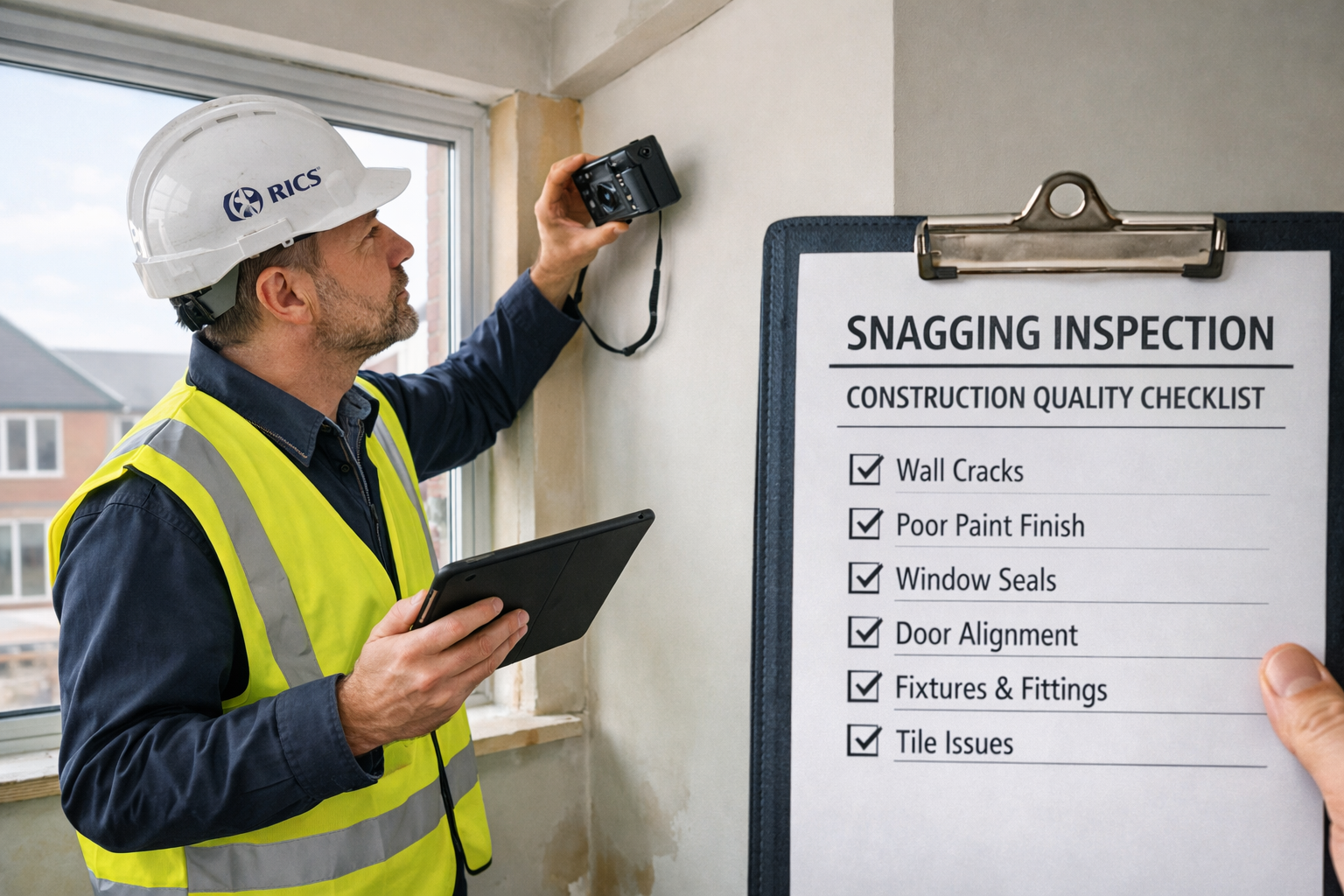
What Snagging Surveys Cover
Professional snagging surveys provide comprehensive room-by-room assessments that examine:
Structural Elements:
- Roofing integrity and waterproofing
- Wall construction and brickwork quality
- Foundation settlement indicators
- Structural timber condition
- Damp-proofing effectiveness
Building Services:
- Heating system installation and operation
- Plumbing connections and water pressure
- Electrical installations and safety compliance
- Ventilation and extraction systems
- Drainage and waste water systems
Finishes and Fixtures:
- Plastering quality and surface preparation
- Paintwork and decorative finishes
- Kitchen unit installation and alignment
- Bathroom fitting and sealing
- Door and window operation
- Flooring installation and levelness
Fire Safety Compliance:
- Fire door specifications and installation
- Cavity barrier placement
- Smoke detector positioning
- Escape route compliance
- Compartmentation integrity
Inspection Duration and Methodology
A snagging survey typically takes 2-6 hours depending on property size, with surveys conducted by experienced inspectors providing comprehensive assessment.[2] The inspection process follows a systematic approach:
- External envelope inspection (30-60 minutes)
- Room-by-room internal survey (60-180 minutes)
- Services and utilities testing (30-60 minutes)
- Photographic documentation (throughout inspection)
- Report compilation (post-inspection)
Professional snagging reports typically include photographic evidence and detailed written documentation with clear defect identification, delivered within 72 hours of inspection.[3] This rapid turnaround enables builders to remedy issues promptly before legal completion.
Limitations: Snagging vs. Full Building Surveys
It's crucial to understand that snagging surveys are visual inspections rather than structural or valuation reports, focusing on identifying visible defects rather than comprehensive building engineering analysis.[3] They don't typically include:
- Invasive structural testing
- Thermal imaging for insulation defects
- Drainage camera surveys
- Electrical circuit testing
- Detailed roof inspections requiring access equipment
For comprehensive protection, particularly with larger new-build properties or those with complex construction, combining a snagging survey with a full RICS building survey provides maximum assurance. Chartered surveyors can advise on the appropriate level of inspection for specific circumstances.
Common Defects Found in New-Build Properties
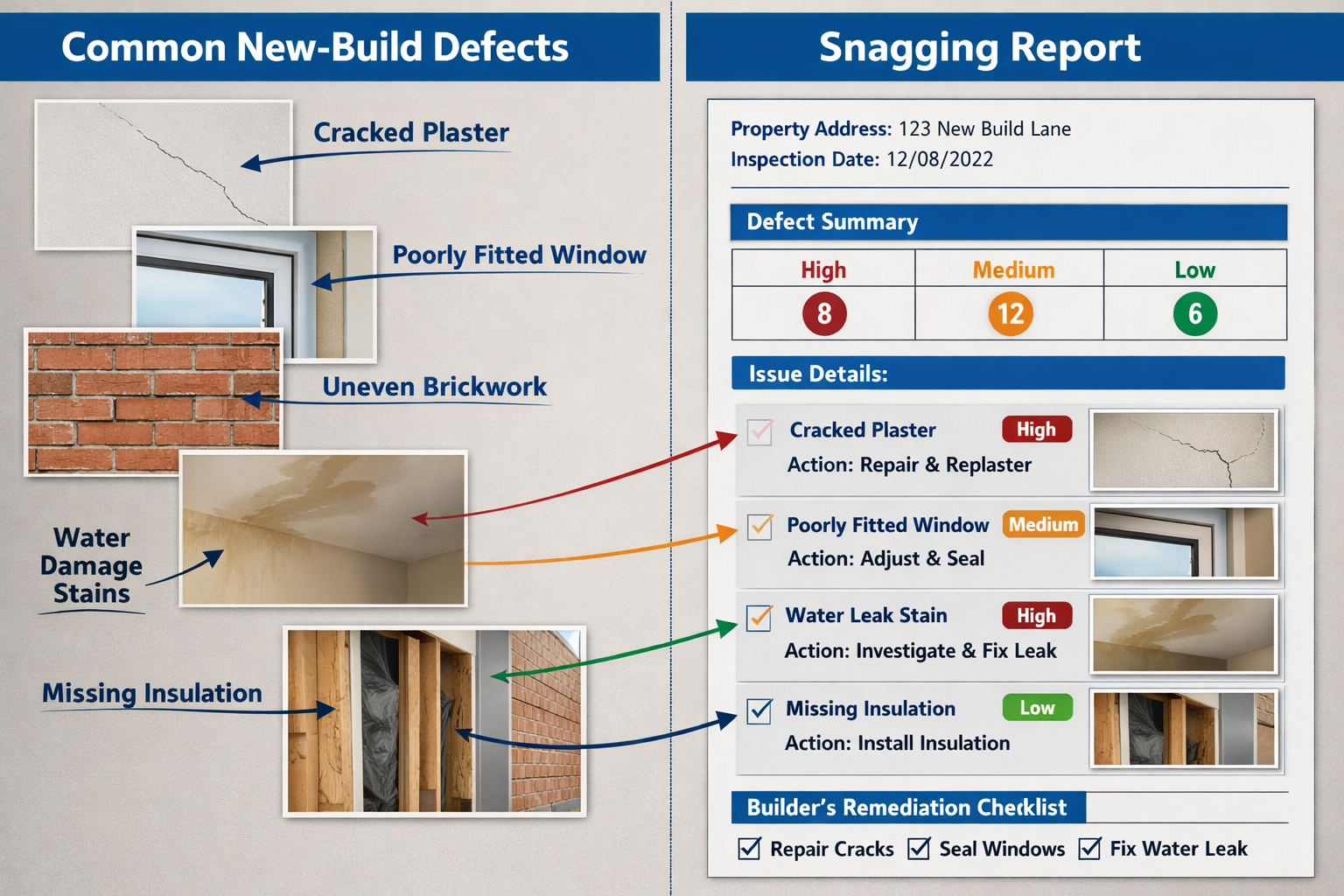
Structural and Envelope Issues
Recurring structural issues identified in professional snagging surveys include:
| Defect Category | Common Problems | Potential Consequences |
|---|---|---|
| Roofing | Missing tiles, poor flashing, inadequate ventilation | Water ingress, condensation, structural rot |
| Brickwork | Uneven mortar joints, cracked bricks, poor pointing | Water penetration, thermal bridges, aesthetic issues |
| Insulation | Missing cavity insulation, thermal bridges, gaps | High energy costs, condensation, mould growth |
| Windows/Doors | Poor sealing, misalignment, inadequate locks | Draughts, water ingress, security risks |
| Foundations | Settlement cracks, uneven floors, door jamming | Progressive structural movement |
Building Code Violations
Professional inspectors frequently identify building regulation non-compliance, including:
- 🚨 Fire safety defects: Missing cavity barriers, incorrect fire door specifications
- ⚡ Electrical violations: Insufficient socket provision, improper earthing
- 💧 Plumbing issues: Incorrect waste pipe falls, cross-contamination risks
- 🌡️ Thermal performance: Inadequate insulation thickness, thermal bridging
- 🪜 Means of escape: Non-compliant staircase dimensions, blocked escape routes
These violations may not be immediately apparent but can have serious implications for safety, insurance validity, and future resale value.
Cosmetic and Finishing Defects
While less serious than structural issues, cosmetic defects significantly impact property value and livability:
- Uneven plasterwork and visible joints
- Paint splashes and incomplete coverage
- Scratched or damaged kitchen units
- Poorly fitted skirting boards and architraves
- Cracked or chipped tiles
- Stained or damaged carpets
- Scratched window glass
- Damaged door furniture
Though individually minor, these defects collectively represent substandard workmanship that buyers shouldn't accept when purchasing a premium-priced new home.
Hidden Defects Requiring Enhanced Surveys
Some critical defects remain invisible during standard snagging inspections. Enhanced building surveys or specific defect surveys can identify:
- Insulation voids: Thermal imaging reveals missing cavity insulation
- Drainage defects: Camera surveys identify incorrect falls or blockages
- Structural movement: Monitoring surveys track progressive settlement
- Damp ingress: Moisture meters detect hidden water penetration
- Fire compartmentation: Invasive inspection reveals missing cavity barriers
For properties showing warning signs—unexplained cracks, damp patches, or unusual temperature variations—commissioning a structural survey alongside snagging inspection provides comprehensive protection.
Timing Your Snagging and Building Survey for Maximum Protection
Pre-Completion Inspections: The Ideal Scenario
Pre-completion inspections, ideally conducted 15 days before legal completion, offer maximum buyer protection.[2] This timing provides:
✅ Negotiating leverage: Defects identified before completion give buyers power to demand remediation before exchange
✅ Builder responsibility: Developers typically accept responsibility for pre-completion defects
✅ Delayed completion: Serious issues can justify postponing completion until rectified
✅ Cost avoidance: Buyers avoid the expense and inconvenience of post-completion repairs
✅ Documentation: Creates formal record of defects for warranty claims
However, many developers restrict pre-completion access, offering only brief "viewing appointments" insufficient for thorough inspection. The NHQC framework addresses this by establishing buyer rights to professional inspection access.
Post-Completion Surveys: Your Fallback Protection
When pre-completion access proves impossible, post-completion snagging surveys remain valuable:
- 📋 Warranty documentation: Creates formal defect record for NHBC or other warranty claims
- ⏰ Defect period coverage: Most builders offer 2-year defect rectification periods
- 🔍 Comprehensive assessment: Allows thorough inspection without time pressure
- 📸 Evidence gathering: Photographic documentation supports warranty claims
- 💪 Professional support: Surveyor expertise strengthens negotiations with builders
Post-completion surveys should ideally occur within the first month of occupation, while defects remain clearly attributable to construction rather than occupier damage.
The Two-Stage Approach
For maximum protection, consider a two-stage inspection strategy:
- Pre-completion snagging survey (if access permitted): Identifies major defects requiring remediation before completion
- Post-occupation follow-up inspection (3-6 months after moving in): Identifies defects that emerge during initial occupation, such as settlement cracks, heating system failures, or seasonal water ingress
This approach, while involving additional cost, provides comprehensive defect identification across the critical first year of ownership.
Cost-Benefit Analysis: Investing in Professional Surveys
Survey Costs in 2026
Professional snagging surveys start at £320, with costs varying based on property size and complexity.[2] Typical pricing structures include:
| Property Type | Snagging Survey | Enhanced Building Survey |
|---|---|---|
| 1-2 bed flat | £320-£450 | £500-£700 |
| 3-bed house | £450-£600 | £700-£950 |
| 4-5 bed house | £600-£850 | £950-£1,400 |
| Large detached | £850-£1,200 | £1,400-£2,000 |
For detailed pricing information, consult survey pricing guides that reflect current market rates.
Return on Investment
Consider the financial protection a professional survey provides:
Scenario 1: Cosmetic Defects
- Survey cost: £500
- Defects identified: 120 cosmetic issues
- Builder remediation value: £3,500
- Net benefit: £3,000
Scenario 2: Structural Issues
- Survey cost: £950
- Major defects identified: Roof water ingress, inadequate insulation
- Remediation cost avoided: £12,000
- Net benefit: £11,050
Scenario 3: Building Code Violations
- Survey cost: £750
- Fire safety defects identified: Missing cavity barriers
- Future remediation cost avoided: £8,500
- Insurance implications avoided: Priceless
- Net benefit: £7,750+
When purchasing a property worth hundreds of thousands of pounds, spending £320-£1,200 on professional quality assurance represents prudent risk management rather than unnecessary expense.
Hidden Value: Peace of Mind and Documentation
Beyond immediate defect identification, professional surveys provide:
- 📄 Warranty claim documentation: Formal evidence supporting NHBC or developer warranty claims
- 🛡️ Insurance protection: Demonstrates due diligence if future issues arise
- 💼 Resale value: Clean survey report enhances future marketability
- 🧠 Informed decisions: Knowledge enables confident completion or renegotiation
- ⚖️ Legal protection: Professional documentation supports potential legal claims
These intangible benefits often prove more valuable than the immediate cost savings from identified defects.
Choosing the Right Professional for Your Survey
Qualifications and Accreditation
When selecting a surveyor for new-build inspection, prioritize:
✅ RICS membership: RICS chartered building surveyors maintain professional standards and insurance
✅ New-build specialization: Experience with volume-builder construction methods
✅ NHQC familiarity: Understanding of regulatory framework and buyer rights
✅ Local knowledge: Awareness of regional builders and common issues
✅ Professional indemnity insurance: Protection if negligent inspection occurs
Industry-leading snagging companies have conducted over 20,000 inspections across 20+ years of operation, establishing specialized expertise in new-build property assessment.[4] This experience proves invaluable in identifying subtle indicators of poor workmanship.
Questions to Ask Prospective Surveyors
Before commissioning a survey, ask:
- How many new-build snagging surveys have you personally conducted?
- Are you familiar with [specific developer name]'s construction methods?
- What inspection tools do you use (thermal cameras, moisture meters, etc.)?
- How quickly will I receive the report after inspection?
- What format does the report take, and does it include photographs?
- Will you provide support during negotiations with the builder?
- Do you offer follow-up inspections to verify remediation?
- What professional indemnity insurance coverage do you maintain?
Comprehensive answers to these questions indicate professional competence and appropriate specialization.
Red Flags to Avoid
Beware of surveyors who:
❌ Offer suspiciously low prices (under £250 for standard properties)
❌ Lack RICS accreditation or professional insurance
❌ Cannot provide references from recent new-build inspections
❌ Promise to find a minimum number of defects
❌ Offer "guaranteed pass" or similar misleading assurances
❌ Refuse to provide sample reports for review
Professional snagging inspection requires specialized knowledge, appropriate insurance, and ethical practice—factors that command appropriate fees.
Taking Action: Your Snagging and Building Survey Strategy
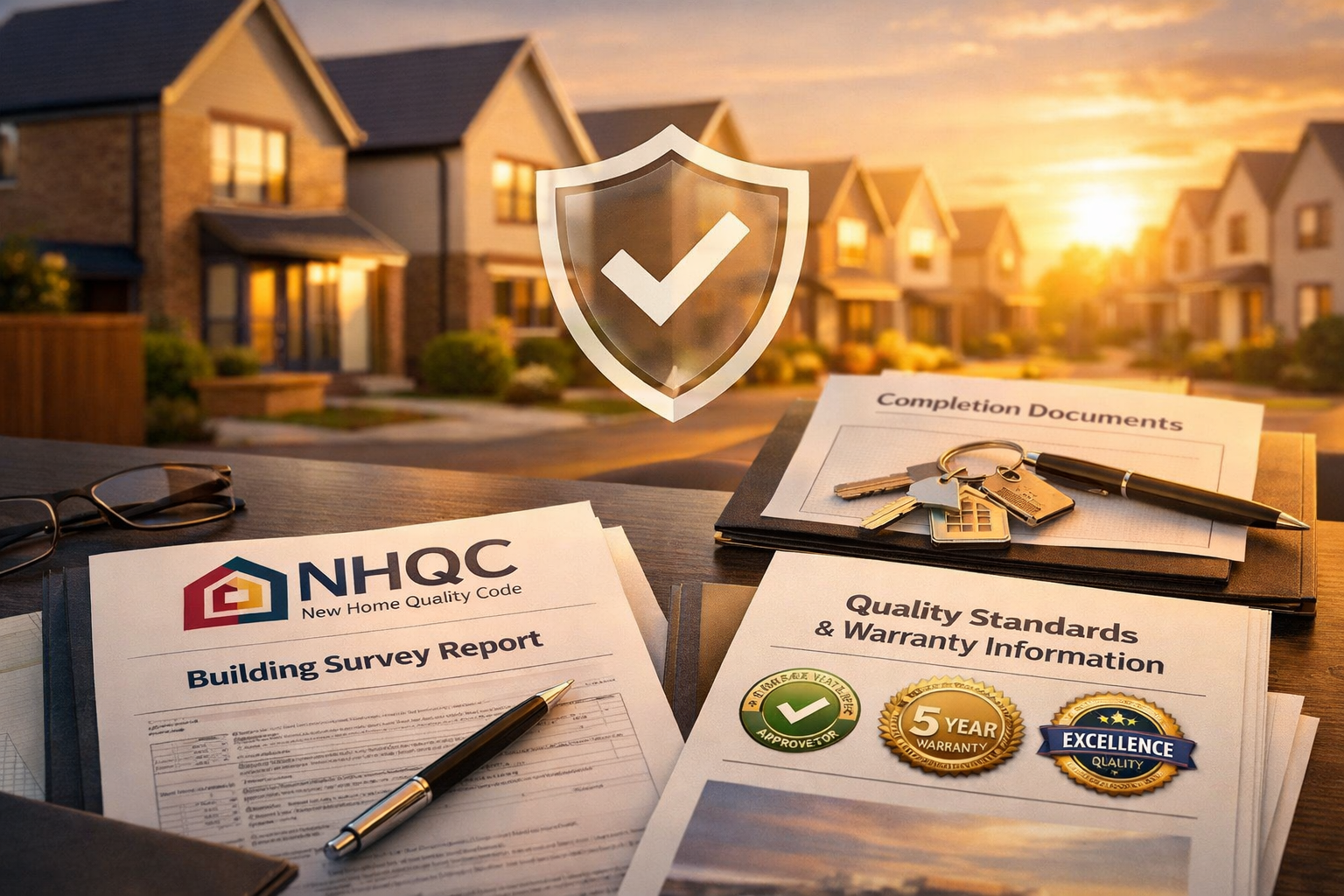
Before Purchasing: Due Diligence Steps
Research the Developer:
- Review NHQC membership status
- Check online reviews and complaint forums
- Investigate previous developments for recurring issues
- Verify warranty provider (NHBC, Premier Guarantee, etc.)
Understand Your Rights:
- Review contract terms regarding pre-completion access
- Identify defect rectification period duration
- Clarify warranty coverage and exclusions
- Understand completion delay rights if serious defects emerge
Plan Survey Timing:
- Request pre-completion inspection access in writing
- Schedule survey 15+ days before planned completion
- Arrange follow-up inspection 3-6 months post-occupation
- Budget for both snagging and enhanced surveys if needed
During the Survey Process
Attend the Inspection:
While not mandatory, attending your snagging survey provides valuable insights:
- 👀 Visual learning: See defects firsthand and understand their significance
- 🗣️ Direct communication: Ask questions and discuss concerns immediately
- 📝 Additional notes: Identify minor issues the surveyor might not formally record
- 🤝 Relationship building: Establish rapport for future consultation needs
Document Everything:
Take your own photographs and notes to supplement the professional report, creating comprehensive evidence for negotiations.
After Receiving the Report
Prioritize Defects:
Work with your surveyor to categorize issues:
- Critical: Structural, safety, or building regulation violations requiring immediate attention
- Significant: Issues affecting functionality, energy efficiency, or long-term durability
- Minor: Cosmetic defects affecting appearance but not performance
Negotiate Effectively:
Present the snagging report to your developer with clear expectations:
- Request written commitment to remedy all identified defects
- Establish realistic timescales for completion of works
- Arrange re-inspection to verify satisfactory remediation
- Consider retention of funds for unresolved issues
- Document all agreements in writing before legal completion
Know When to Walk Away:
If the survey reveals serious structural defects, building code violations, or fire safety issues that the developer refuses to address, consider whether proceeding with purchase remains prudent. The cost of a survey that prevents a disastrous purchase represents exceptional value.
Long-Term Protection Strategies
Maintain Documentation:
Create a property file containing:
- Original snagging report with photographs
- Builder's written commitments to remediation
- Re-inspection reports verifying completed works
- Warranty documentation and contact information
- Records of all communications regarding defects
Monitor Your Property:
During the first two years, remain vigilant for:
- Progressive cracking indicating settlement
- Seasonal water ingress during heavy rain
- Heating system inefficiency suggesting insulation defects
- Condensation or mould growth
- Door or window operation deterioration
Report issues promptly to maximize warranty coverage and maintain formal defect records.
Consider Additional Surveys:
For specific concerns, commission targeted inspections:
- Roof surveys for suspected water ingress
- Drainage surveys for plumbing issues
- Thermal imaging for insulation defects
- Structural monitoring for progressive movement
These specialized surveys provide detailed analysis beyond general snagging inspection scope.
Conclusion
Snagging and Building Surveys for New-Build Homes: Protecting Yourself in a Volume-Builder Era represents essential consumer protection in 2026's high-output construction environment. While the government's ambitious housing targets address critical supply shortages, they also create conditions where build quality can suffer under pressure to deliver volume at speed.
Professional snagging surveys, starting from £320, provide invaluable quality assurance by identifying the 150+ defects commonly present in new-build properties.[2] When combined with comprehensive RICS home surveys and enhanced building inspections, buyers gain maximum protection against poor workmanship, building code violations, and fire-safety deficiencies that might otherwise remain hidden until after legal completion.
The New Homes Quality Code framework establishes your right to pre-completion inspection, but exercising this right requires proactive planning and professional support. By commissioning qualified chartered surveyors with new-build specialization, documenting all identified defects, and negotiating effectively with developers, buyers can ensure their new home meets acceptable quality standards before committing to purchase.
Your Next Steps
- Research your developer's NHQC status and review their defect rectification policies
- Budget for professional surveys as essential purchase costs, not optional extras
- Request pre-completion inspection access in writing when reserving your property
- Commission a qualified RICS surveyor with proven new-build experience
- Attend the inspection to understand defects firsthand and ask questions
- Negotiate remediation before legal completion, obtaining written commitments
- Plan follow-up inspection 3-6 months post-occupation to identify emerging issues
- Maintain comprehensive documentation supporting warranty and potential legal claims
In an era where volume builders face unprecedented pressure to deliver homes quickly, professional snagging and building surveys represent your most effective protection against compromised construction quality. The modest investment in professional inspection can save thousands in future remediation costs while ensuring your new home provides the quality, safety, and performance you deserve.
Don't let the excitement of purchasing a brand-new property override prudent due diligence. Your home represents likely the largest financial commitment of your lifetime—protect it with professional expertise and thorough inspection before signing on the dotted line.
References
[1] New Build Snagging Survey – https://chekes.co.uk/residential/surveys/new-build-snagging-survey/
[2] Need Snagging List New Build Home – https://hoa.org.uk/advice/guides-for-homeowners/i-am-buying/need-snagging-list-new-build-home/
[3] New Build Snagging Surveys – https://andrewjamessurveyors.co.uk/new-build-snagging-surveys/
[4] newbuildinspections – https://www.newbuildinspections.com