The surveying profession stands at a critical crossroads in 2026. As demand for building surveys, property valuations, and sustainability assessments surges amid regulatory reforms and housing market pressures, the industry faces an unprecedented talent crisis. More than 25% of surveyors report the shortage is already critical, impacting cost, capacity, and innovation across the profession[1]. The RICS Training Pathways for 2026 Surveyor Talent Shortage: Building Capacity Amid Reform-Driven Demand represents not just an educational challenge, but a fundamental restructuring of how the profession attracts, trains, and retains talent in an era of digital transformation and environmental accountability.
Key Takeaways
- Critical shortage confirmed: Over 25% of surveyors report talent gaps are already impacting business operations, with building surveying, quantity surveying, and residential sectors most severely affected[1][2]
- New pathways launched: Two professional pathways in residential retrofit and sustainability were introduced in August 2025, with expanded alternative accreditation routes and V-Level vocational qualifications gaining priority[2][3]
- Technology integration essential: A new global AI ethics standard takes effect March 9, 2026, while firms must adopt digital tools and CPD programs to scale operations and meet increased survey mandates[2][6]
- Multi-stakeholder solution required: Industry, academia, education providers, and policymakers must collaborate to address aging demographics and insufficient replacement of departing professionals[1][2]
- Four critical skill areas identified: Business skills, sustainability competencies, data analytics, and big data management represent the evolving demands facing modern surveyors[3]
Understanding the 2026 Surveyor Talent Crisis
The Scale and Impact of Skills Shortages
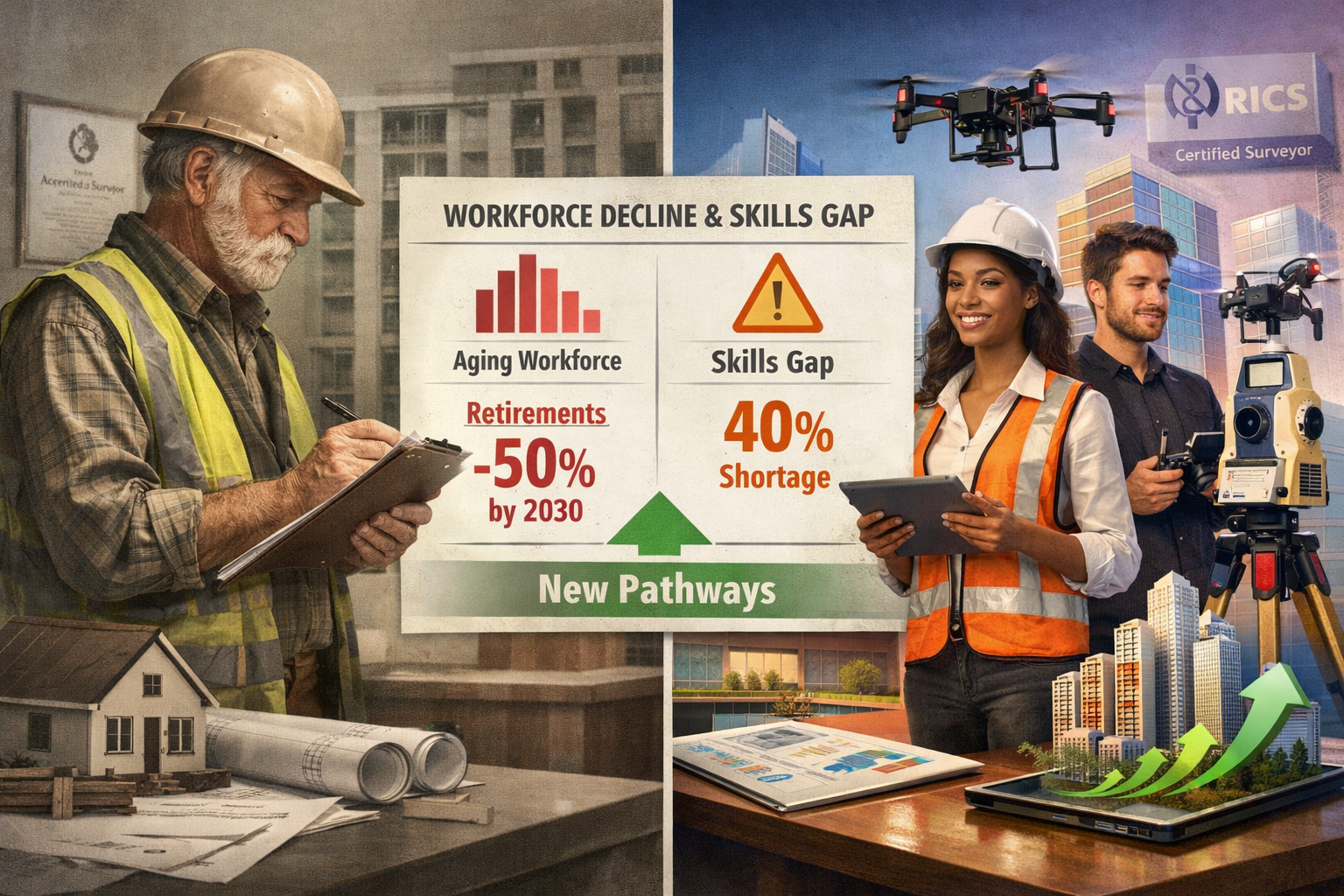
The surveying profession confronts a talent shortage that threatens to undermine the industry's capacity to deliver essential services. According to RICS President Nick Maclean, surveyors play a critical role in addressing global challenges in the built environment, meaning the impact of skills shortages are "wide-reaching and significant"[1][5].
The numbers paint a concerning picture:
- 25%+ of firms report critical shortages already affecting operations
- 60% view it as manageable but acknowledge growing challenges[2]
- Building surveying, quantity surveying, and residential disciplines show the highest concentration of skills gaps[2]
This shortage directly impacts firms' ability to deliver comprehensive building surveys and maintain service quality across expanding geographical markets.
Root Causes: Demographics and Replacement Failures
Two primary factors drive the current crisis:
Aging workforce demographics 🧓 represent the most significant challenge. The profession faces a retirement wave without sufficient new entrants to maintain capacity. Traditional recruitment pipelines have failed to replace departing professionals at the rate required to sustain current service levels, let alone accommodate growth[2].
Insufficient replacement mechanisms compound the demographic challenge. Historical reliance on traditional university pathways has proven inadequate to meet current demand, particularly as the profession's technical requirements have expanded to include sustainability, data analytics, and digital competencies[3].
"Current initiatives, though valuable, are not working fast enough." – RICS Leadership[1]
Geographic and Disciplinary Variations
The talent shortage manifests differently across regions and specializations. RICS has launched a "Shaping the Future tour" to gather local insights and understand unique skills challenges across geographical regions and practice areas[1]. This represents a shift toward region-specific solutions rather than one-size-fits-all approaches.
Firms operating across multiple locations—from chartered surveyors in London to chartered surveyors in Surrey—face varying challenges in recruitment, retention, and skills development based on local market conditions and educational infrastructure.
RICS Training Pathways for 2026 Surveyor Talent Shortage: Expanding Routes to Qualification
New Professional Pathways: Retrofit and Sustainability
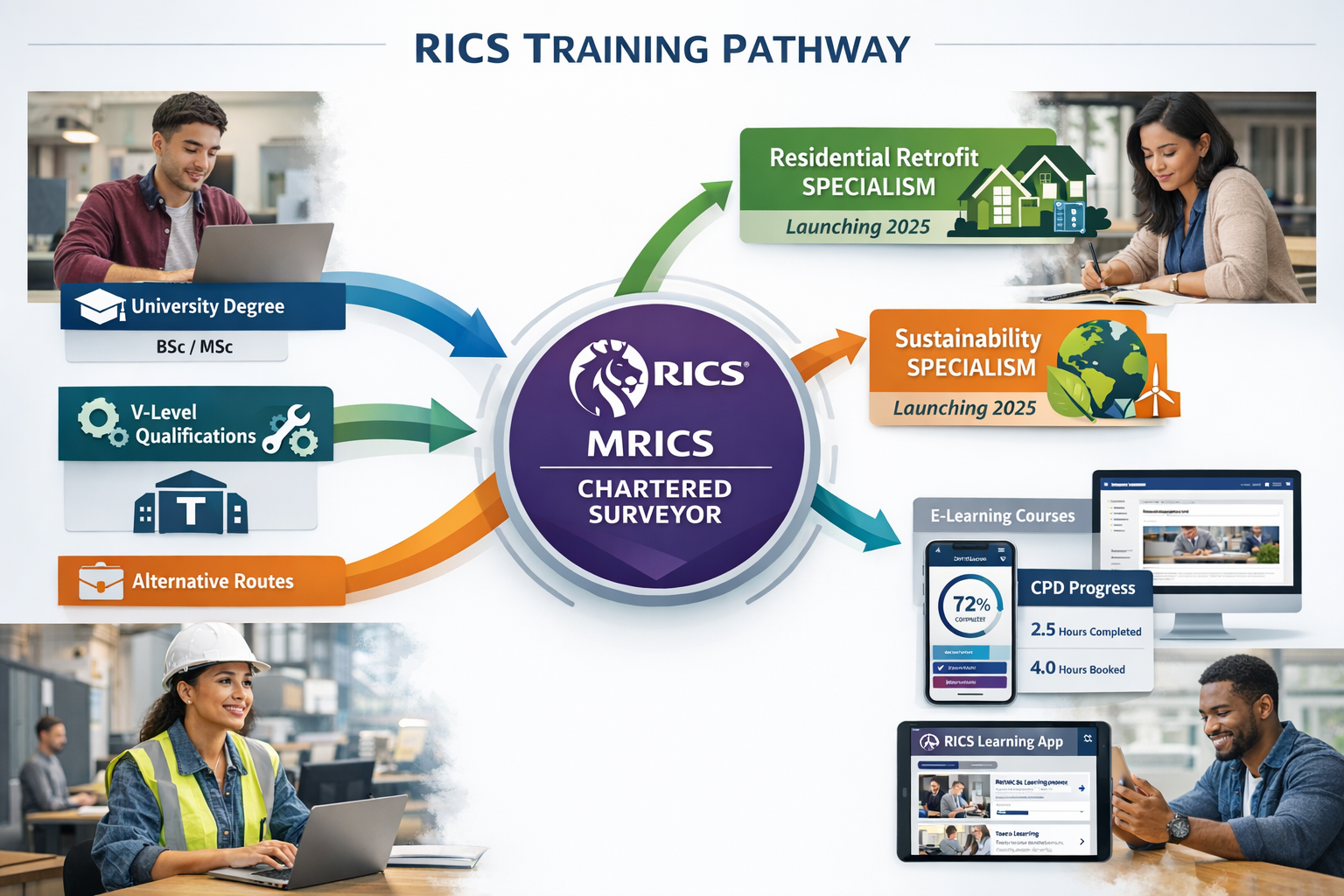
In August 2025, RICS announced two new professional pathways specifically designed to address critical industry needs: residential retrofit and sustainability. A possible third pilot programme is planned for 2026[2]. These pathways directly respond to the profession's need to meet decarbonisation targets and housing improvement demands.
The residential retrofit pathway equips surveyors with specialized knowledge in:
- Energy efficiency assessment and improvement
- Building fabric upgrades and thermal performance
- Renewable energy integration
- Regulatory compliance for retrofit projects
- Cost-benefit analysis for property improvements
The sustainability pathway addresses broader environmental competencies:
- Carbon assessment and net-zero strategies
- Sustainable materials and construction methods
- Environmental impact evaluation
- Green building certifications
- Climate resilience planning
These pathways enable firms to deliver specialized services such as RICS reinstatement build cost valuations with enhanced sustainability considerations.
Alternative Accreditation Routes
RICS has significantly expanded alternative accreditation routes into chartership, recognizing that valuable surveying expertise develops outside traditional qualification pathways. Approximately 50 senior professionals from government were recently supported through accreditation pathways, demonstrating the viability of experience-based qualification routes[4].
Key features of alternative routes include:
| Route Type | Target Audience | Duration | Key Requirements |
|---|---|---|---|
| Senior Professional | 10+ years experience | 6-12 months | Portfolio review, competency assessment |
| Specialist Pathway | Technical specialists | 12-18 months | Demonstrated expertise, CPD evidence |
| International Recognition | Overseas qualified | Varies | Credential evaluation, gap assessment |
| Apprenticeship Conversion | Apprentices completing programs | 2-3 years | Structured training, supervised practice |
These routes particularly benefit professionals who have developed surveying expertise through practical experience in roles such as project management or specialized assessment work.
V-Level and T-Level Vocational Pathways
The V-Level vocational pathway has become a priority initiative, building on the success of the T-Level in Design, Surveying and Planning[3]. RICS supports further expansion of Technical Qualifications that provide tangible routes into the profession for students who may not pursue traditional university degrees.
Benefits of vocational pathways:
✅ Earlier career entry – Students begin developing practical skills at 16-18
✅ Work-integrated learning – Combines classroom instruction with industry placements
✅ Cost-effective qualification – Reduces student debt compared to university routes
✅ Industry-aligned curriculum – Content developed with employer input
✅ Clear progression routes – Pathways to chartership and advanced qualifications
These vocational routes help address the profession's capacity challenges while providing accessible career pathways for diverse talent pools.
Graduate Qualifications and Academic Partnerships
Traditional graduate qualifications remain essential to the profession's talent pipeline, but require modernization to address current skills gaps. RICS-accredited degree programs are evolving to incorporate:
- Sustainability and environmental science modules
- Data analytics and digital technologies training
- Business and commercial skills development
- AI and automation competencies
- Collaborative project work with industry partners
Academic institutions are partnering with surveying firms to ensure curriculum relevance and provide students with practical experience through placements, case studies, and live project work.
Scaling Operations Through Digital Tools and CPD Programs
Digital Applications for Capacity Enhancement
To meet increased survey mandates and volume uplifts, firms must leverage digital applications that enhance surveyor productivity and service delivery capacity. Technology adoption represents a critical strategy for addressing talent shortages while maintaining service quality.
Key digital tools transforming surveying operations:
📱 Mobile survey applications – Enable real-time data capture, photo documentation, and report generation in the field
🤖 AI-powered analysis tools – Automate defect identification, risk assessment, and preliminary valuations
☁️ Cloud-based platforms – Facilitate collaboration, document management, and workflow optimization
📊 Data analytics dashboards – Provide insights into productivity, quality metrics, and resource allocation
🚁 Drone and imaging technology – Expand assessment capabilities for roof surveys and large-scale inspections
The new global standard for AI ethics, Responsible Use of Artificial Intelligence in Surveying Practice, takes effect March 9, 2026, providing essential guidance as the profession adopts these technologies[2][6].
Continuing Professional Development (CPD) Tools
Updated CPD tools enable existing surveyors to acquire new competencies without leaving the workforce. As upskilling existing professionals is seen as critical to improving productivity—with 60-69% of respondents across disciplines agreeing this is essential[2]—firms must invest in comprehensive development programs.
Modern CPD delivery methods include:
- Microlearning modules – Short, focused training sessions on specific topics
- Virtual reality simulations – Immersive training for complex assessment scenarios
- Peer learning networks – Communities of practice sharing expertise and challenges
- Online certification programs – Flexible pathways to specialized credentials
- Blended learning approaches – Combining digital and in-person instruction
Particularly high priority areas include project management (69% agreement on upskilling importance) and corporate real estate (68% agreement)[2], reflecting the business skills gap identified across the profession.
Workflow Optimization and Automation
Scaling operations to meet reform-driven demand requires systematic workflow optimization. Firms must identify processes suitable for automation while preserving the professional judgment that defines quality surveying work.
Optimization strategies include:
- Standardized templates and protocols for common survey types like RICS Building Surveys Level 3
- Automated scheduling and resource allocation systems
- Digital report generation with customizable templates
- Client portals for self-service information and document access
- Integrated quality assurance checkpoints throughout the workflow
These approaches enable firms to handle increased volume without proportional increases in staffing, partially mitigating talent shortage impacts.
Meeting Upfront Survey Mandates
Regulatory reforms and lender requirements have increased upfront survey mandates, creating volume pressures that exacerbate capacity constraints. Firms must strategically deploy resources to meet these obligations while maintaining comprehensive service offerings.
Strategies for meeting mandate requirements:
- Tiered service models – Offering basic compliance surveys alongside comprehensive assessments
- Regional specialist deployment – Positioning surveyors in high-demand areas like chartered surveyors in Hertfordshire or chartered surveyors in Buckinghamshire
- Partnership networks – Collaborating with other firms to manage overflow and specialty requirements
- Technology-enhanced triage – Using digital tools to prioritize complex cases requiring senior surveyor involvement
- Flexible capacity models – Engaging associate surveyors and contractors during peak periods
Understanding which survey clients need helps firms efficiently match resources to requirements.
Building Multi-Stakeholder Collaboration for Long-Term Solutions
Industry-Academia Partnerships
The recommended solution requires multi-stakeholder collaboration across industry, academia, education, and policymakers[1][2]. Current initiatives, while valuable, are not working fast enough according to RICS leadership[1].
Effective industry-academia partnerships involve:
🎓 Curriculum co-design – Practitioners contributing to course content and learning outcomes
💼 Placement programs – Structured work experience integrated into degree programs
🔬 Research collaboration – Joint projects addressing industry challenges
👥 Guest lecturing and mentorship – Professionals sharing real-world expertise
💰 Scholarship and bursary programs – Financial support attracting diverse talent
These partnerships ensure graduates possess the four critical skill areas identified as top priorities: business skills, sustainability, data analytics, and big data management[3].
Education Provider Engagement
Education providers beyond traditional universities play essential roles in expanding the talent pipeline. This includes:
- Further education colleges delivering T-Levels and V-Levels
- Private training organizations offering specialized courses
- Professional bodies providing CPD and certification programs
- Apprenticeship training providers
- Online learning platforms
RICS engagement with government curriculum and assessment reviews ensures surveying pathways receive appropriate recognition and support within the broader education system[3].
Policy and Regulatory Support
Policymakers must create enabling conditions for profession growth through:
- Funding for vocational education in surveying and built environment disciplines
- Apprenticeship levy optimization to support surveying training
- Immigration policies that address critical skills shortages
- Professional recognition frameworks that facilitate international mobility
- Research and development incentives for construction technology adoption
The profession's ability to deliver services from structural surveys to dilapidation surveys depends on supportive policy frameworks that recognize surveying's essential role in the built environment.
Employer Commitments and Investment
Surveying firms themselves must commit to talent development through:
- Offering training contracts and apprenticeships
- Investing in CPD and career progression
- Creating inclusive workplace cultures
- Providing competitive compensation and benefits
- Supporting work-life balance and flexible arrangements
Firms operating across diverse locations—from chartered surveyors in Central London to chartered surveyors in Richmond—must develop location-specific recruitment and retention strategies.
Conclusion

The RICS Training Pathways for 2026 Surveyor Talent Shortage: Building Capacity Amid Reform-Driven Demand represents both a significant challenge and an opportunity for profession transformation. With over 25% of surveyors reporting critical shortages already impacting operations[1], the urgency for comprehensive solutions cannot be overstated.
The profession's response encompasses multiple strategic initiatives: new pathways in residential retrofit and sustainability, expanded alternative accreditation routes, prioritization of V-Level vocational qualifications, and the integration of AI and digital tools governed by the new ethics standard effective March 9, 2026[2][3][6]. These initiatives address both immediate capacity constraints and long-term structural challenges.
Success requires sustained multi-stakeholder collaboration among industry, academia, education providers, and policymakers. No single entity can solve the talent shortage alone. The profession must continue evolving training pathways, embracing technology, and creating accessible routes to qualification that attract diverse talent pools.
Actionable Next Steps
For Surveying Firms:
- Audit current capacity and identify critical skills gaps
- Invest in digital tools and workflow optimization to scale operations
- Commit to apprenticeships, training contracts, and CPD programs
- Engage with local education providers to support pipeline development
For Aspiring Surveyors:
- Explore multiple pathways to qualification including vocational routes, traditional degrees, and alternative accreditation
- Develop competencies in the four priority skill areas: business, sustainability, data analytics, and big data
- Seek firms committed to professional development and career progression
- Engage with RICS resources and networking opportunities
For Education Providers:
- Align curriculum with industry needs, particularly in sustainability and digital competencies
- Expand work-integrated learning opportunities
- Support students from diverse backgrounds to enter the profession
- Collaborate with employers on placement and employment pathways
For Policymakers:
- Ensure adequate funding for surveying education and vocational training
- Support regulatory frameworks that recognize diverse qualification routes
- Address immigration policies to facilitate international talent mobility
- Invest in research supporting construction sector productivity
The surveying profession's ability to deliver essential services—from comprehensive homebuyer surveys to specialized expert witness reports—depends on successfully addressing the 2026 talent shortage through expanded training pathways, technological innovation, and collaborative action across all stakeholders.