
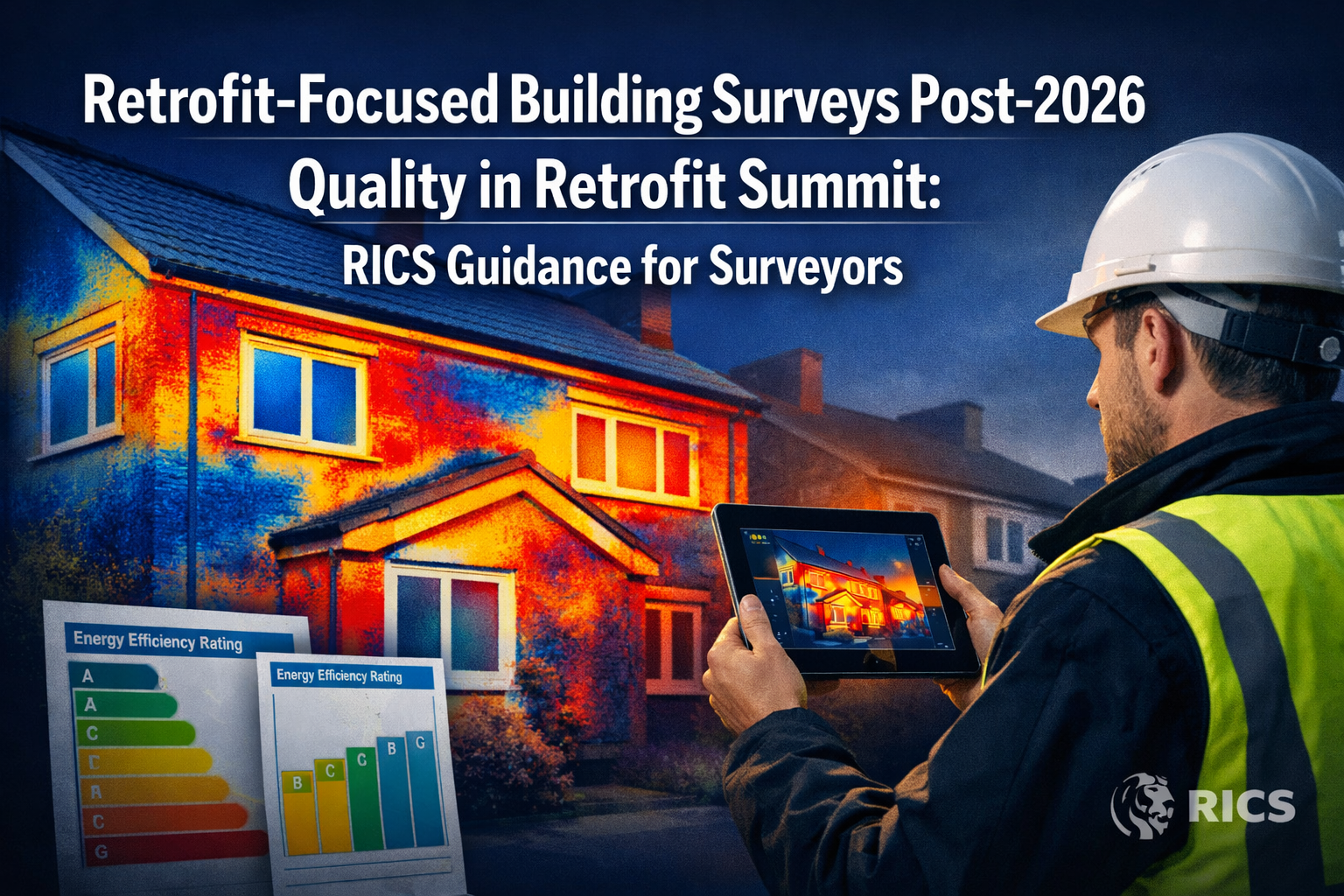
The landscape of building surveying in the UK has fundamentally shifted. Following the landmark Quality in Retrofit Summit held in January 2026 at RICS headquarters in London, surveyors now face unprecedented opportunities—and responsibilities—in delivering high-quality retrofit assessments that meet rigorous professional standards. As office buildings across Southern England undergo energy upgrades and residential properties require comprehensive thermal improvements, the need for competent, accountable retrofit-focused building surveys has never been more critical.
The Retrofit-Focused Building Surveys Post-2026 Quality in Retrofit Summit: RICS Guidance for Surveyors framework represents a transformative approach to building assessment, moving beyond traditional survey methodologies to embrace whole-house evaluation, energy performance analysis, and risk identification that addresses everything from cladding safety to thermal bridging. This evolution comes at a crucial time, as the UK government's Warm Homes Plan commits to a 5-year funding programme requiring skilled professionals who can deliver quality assurance at every stage of the retrofit process.[1]
Key Takeaways
- 🏗️ Professional competence is paramount: The RICS Residential Retrofit AssocRICS pilot pathway establishes rigorous standards for retrofit assessors, moving beyond inadequate 5-day training courses to comprehensive professional development
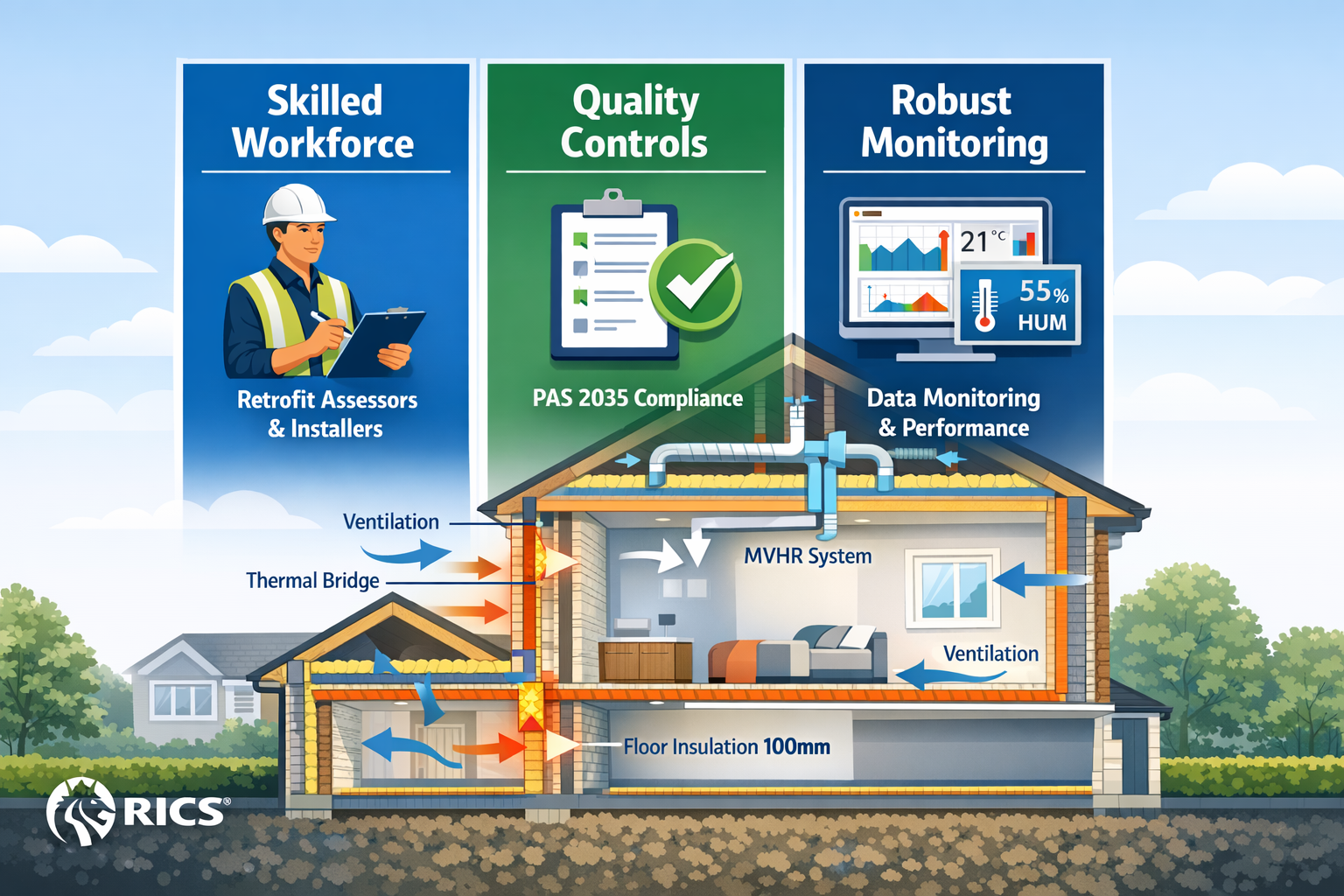
- 📊 Three pillars ensure quality: Successful retrofit delivery requires a skilled workforce, embedded quality controls (particularly PAS 2035:2023 compliance), and robust monitoring systems throughout project lifecycles
- 🔍 Surveyors have expanded roles: The Warm Homes Plan creates opportunities for whole-house assessments, stock condition surveys, neighbourhood-level planning, and quality assurance activities across residential and commercial properties
- ⚠️ Risk identification is critical: Retrofit surveys must identify cladding safety issues, thermal bridging, moisture management challenges, and compliance with Awaab's Law regarding damp and mould
- 📈 Data-driven outcomes matter: Monitoring and measuring retrofit performance through systematic data collection ensures projects deliver promised energy improvements and identifies issues before they escalate
Understanding the 2026 Quality in Retrofit Summit Framework
The Quality in Retrofit Summit, convened on January 20, 2026, brought together leading built environment professionals at Surveyor's House to address a fundamental question: how can retrofit projects consistently deliver high-quality outcomes? Co-hosted by The Retrofit Academy and RICS, the summit established that achieving quality retrofit requires three interconnected pillars.[1]
The Three Pillars of Quality Retrofit Delivery
Pillar 1: Skilled and Knowledgeable Workforce
The summit identified that competent building assessment forms the foundation of quality retrofit. Ben Nixon from Bailey Garner emphasized that the current practice of 5-day retrofit assessor training courses cannot adequately prepare professionals for the critical responsibilities of the Retrofit Assessor role.[1]
This recognition led to RICS launching the Residential Retrofit AssocRICS pilot pathway, which has already been reported as oversubscribed. This new entry route focuses on mainstream retrofit work and requires candidates to meet RICS standards of competence and ethics through:
- Core competencies in building pathology and construction technology
- Specialized training in retrofit testing, monitoring, and evaluation
- Risk assessment capabilities specific to retrofit scenarios
- Understanding of building performance in use
For surveyors seeking to understand the value of RICS qualifications, our guide on why choose an RICS chartered building surveyor provides essential context.
Pillar 2: Quality Controls Built Into the System
Ben Nixon presented PAS 2035:2023 as an excellent framework that embeds quality from the outset of retrofit projects. However, evidence presented at the summit suggests many sector participants are not following this framework properly.[1]
The summit established mandatory requirements including:
- Retrofit Coordinators must visit every site (not just coordinate remotely)
- Technical inspection protocols at critical project stages
- Quality assurance systems that verify work completion standards
- Documentation trails that demonstrate compliance
Pillar 3: Robust Monitoring and Measurement
Richard Ellis, Director of Sustainability at The Peabody Trust, stressed that "data is king" in retrofit delivery. The summit prioritized the need to monitor and measure retrofit outcomes throughout projects, not just at completion.[1]
This includes:
- Pre-retrofit baseline energy performance data
- In-progress monitoring during installation phases
- Post-completion verification of predicted improvements
- Long-term performance tracking to identify degradation
Retrofit-Focused Building Surveys Post-2026 Quality in Retrofit Summit: Practical Applications for Surveyors
The summit outcomes translate into specific survey methodologies that differ substantially from traditional building surveys. Retrofit-focused surveys require expanded scope, specialized equipment, and deeper technical analysis.
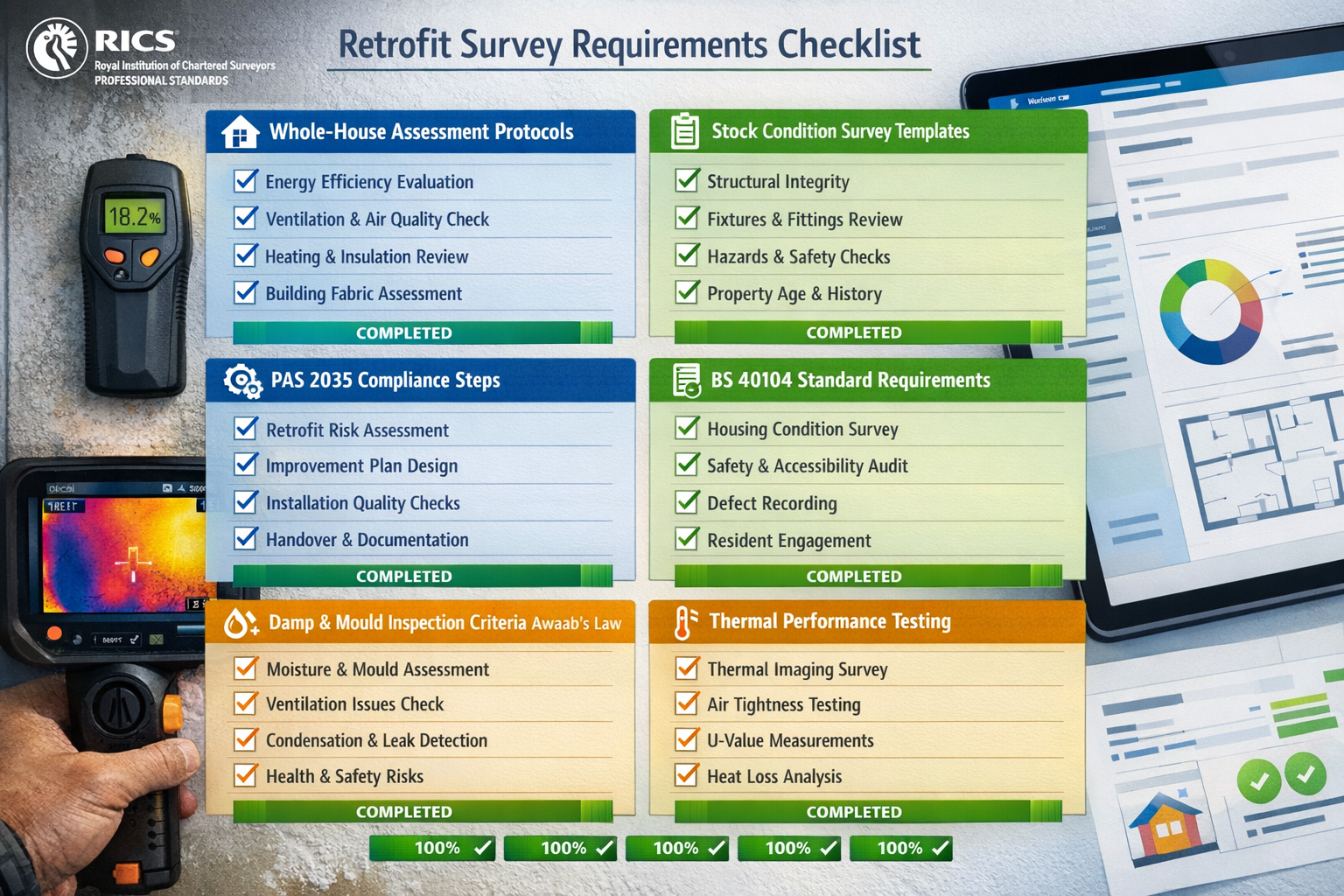
Whole-House Assessment Protocols
The UK Government's Warm Homes Plan, published in January 2026, creates significant opportunities for surveyors through whole-house assessments.[2] These comprehensive evaluations go beyond identifying defects to analyze:
Thermal Performance Analysis
- Heat loss calculations for walls, roofs, floors, and windows
- Thermal bridging identification at junctions and penetrations
- Air permeability testing and infiltration pathway mapping
- Thermal imaging to identify insulation gaps and cold spots
Building Fabric Evaluation
- Moisture risk assessment for proposed insulation installations
- Ventilation adequacy for planned airtightness improvements
- Structural capacity for additional insulation loads
- Heritage considerations for period properties
Systems Integration Assessment
- Heating system compatibility with improved building fabric
- Renewable energy integration potential (heat pumps, solar)
- Electrical capacity for electrification of heating
- Smart controls and monitoring system requirements
For properties requiring detailed analysis, our RICS home survey services provide the foundation for retrofit planning.
Office Revival and Commercial Retrofit Surveys
Southern England's commercial property market is experiencing significant retrofit activity as office buildings require energy upgrades to remain competitive and compliant with evolving regulations. Retrofit-focused commercial surveys must address:
Cladding Safety and Performance
- Fire safety compliance for external wall systems
- Thermal performance of existing cladding assemblies
- Moisture management and condensation risk
- Replacement or over-cladding feasibility
Energy Performance Optimization
- Current Energy Performance Certificate (EPC) ratings and improvement pathways
- Cost-benefit analysis of retrofit interventions
- Minimum Energy Efficiency Standards (MEES) compliance strategies
- Net-zero carbon roadmap development
Occupancy and Use Considerations
- Operational disruption minimization during retrofit works
- Phasing strategies for occupied buildings
- Tenant coordination and communication requirements
- Post-occupancy evaluation planning
Our commercial building surveys incorporate these retrofit-specific considerations.
Stock Condition Surveys for Portfolio Retrofit Planning
The Warm Homes Plan emphasizes neighbourhood-level retrofit planning, creating demand for systematic stock condition surveys that inform strategic retrofit programmes.[2]
These surveys provide:
| Survey Component | Purpose | Output |
|---|---|---|
| Building Typology Classification | Group similar properties for standardized retrofit approaches | Archetype categories with typical construction details |
| Condition Grading | Prioritize properties requiring urgent intervention | Risk-based maintenance and retrofit priority matrix |
| Energy Performance Baseline | Establish current performance across portfolio | EPC distribution analysis and improvement potential |
| Retrofit Suitability Assessment | Identify constraints and opportunities | Technology compatibility matrix by property type |
| Cost Estimation | Develop investment requirements | Budget forecasts with confidence ranges |
RICS Guidance for Retrofit Surveyors: Standards and Competencies
RICS has developed comprehensive guidance to support surveyors delivering retrofit-focused building surveys post-2026. This guidance reflects summit outcomes and establishes professional expectations across UK nations.
The RICS Residential Retrofit Standard
RICS has developed the Residential Retrofit Standard promoting best practices and placing the consumer at the center of delivery.[2] This standard requires surveyors to:
Prioritize Consumer Protection
- Clear communication of retrofit risks and benefits
- Transparent cost-benefit analysis
- Realistic performance expectations
- Quality assurance and warranty information
Follow Evidence-Based Assessment
- Use of calibrated measurement equipment
- Documented assessment methodologies
- Peer review for complex projects
- Continuous professional development in retrofit technologies
Maintain Professional Independence
- Separation of assessment and installation activities
- Disclosure of conflicts of interest
- Objective technology recommendations
- Client advocacy throughout the retrofit process
PAS 2035:2023 Compliance Requirements
Ben Nixon's summit presentation identified PAS 2035:2023 as the primary quality framework for retrofit projects.[1] Surveyors must understand and apply this standard, which requires:
Retrofit Assessment Stage
- Occupancy assessment to understand household needs
- Condition survey identifying defects requiring remediation
- Energy assessment establishing baseline performance
- Improvement option evaluation with risk assessment
Design and Specification Stage
- Whole-house retrofit plan development
- Unintended consequences evaluation (moisture risk, ventilation, overheating)
- Technology specification with performance criteria
- Quality assurance plan establishment
Installation and Handover Stage
- Site monitoring and inspection protocols
- As-built documentation verification
- Performance testing and commissioning
- Homeowner guidance and training
Understanding different types of surveys helps surveyors position retrofit assessments within their service portfolio.
BS 40104 Standard for Retrofit Assessment
Professor Richard Fitton, chair of the BS 40104 Standard for Retrofit Assessment, called at the summit for simplified and more accessible standards and guidelines.[1] The current BS 40104 framework requires surveyors to:
Conduct Systematic Building Investigation
- Non-invasive survey techniques as primary approach
- Invasive investigation where necessary (with client consent)
- Photographic documentation of key features
- Measured survey data collection
Assess Retrofit Suitability
- Technical feasibility of improvement measures
- Regulatory compliance pathways
- Heritage and aesthetic considerations
- Cost-effectiveness evaluation
Identify and Manage Risks
- Moisture and condensation risk assessment
- Structural implications of proposed works
- Fire safety considerations
- Indoor air quality impacts
The Retrofit Academy's Level 4 Ofqual qualification, which is fully compliant with PAS 2035:2023 and has been reviewed and approved by RICS as "of great value to RICS members," provides the training foundation for these competencies.[1]
Retrofit-Focused Building Surveys Post-2026: Risk Identification Checklist for Southern Markets
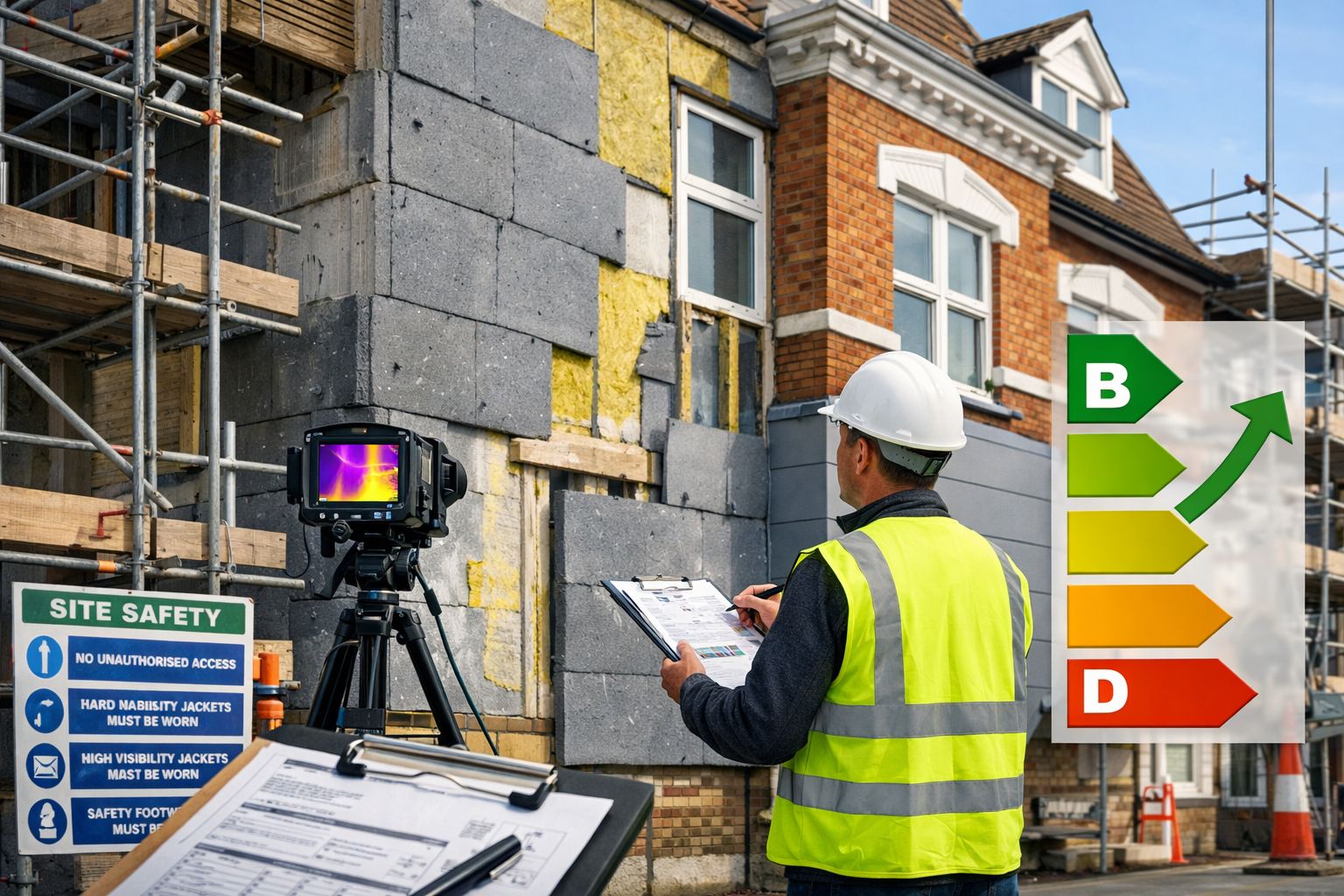
Southern England's property markets present specific retrofit challenges that surveyors must identify and address. The following checklist provides a systematic approach to risk identification in retrofit-focused building surveys.
Cladding and External Wall Systems ⚠️
Fire Safety Compliance
- Identify cladding materials and construction (combustible vs. non-combustible)
- Assess compliance with Building Regulations Approved Document B
- Review EWS1 form status and recommendations
- Evaluate cavity barriers and fire stopping adequacy
- Document escape route protection and compartmentation
Thermal Performance and Moisture Management
- Measure existing U-values of wall assemblies
- Identify thermal bridging at balconies, window reveals, and floor junctions
- Assess cavity ventilation and drainage provisions
- Evaluate condensation risk using hygrothermal modeling
- Inspect for existing moisture damage or staining
Retrofit Implications
- Determine if over-cladding is structurally feasible
- Assess planning constraints for external appearance changes
- Evaluate access requirements for installation
- Consider warranty and insurance implications
- Estimate whole-life costs including maintenance
Thermal Bridging and Insulation Continuity 🌡️
Critical Junction Assessment
- Window and door reveals (common thermal bridge locations)
- Floor-to-wall junctions (particularly ground and intermediate floors)
- Roof-to-wall junctions and eaves details
- Balcony penetrations through building envelope
- Service penetrations (pipes, cables, vents)
Insulation Strategy Evaluation
- Current insulation levels in walls, roof, and floors
- Accessibility for insulation upgrades
- Space constraints for internal insulation
- Structural capacity for external insulation systems
- Heritage considerations limiting insulation options
Moisture, Damp, and Mould Risk (Awaab's Law Compliance) 💧
The Warm Homes Plan emphasizes compliance with Awaab's Law regarding damp and mould management, creating specific obligations for surveyors.[2]
Existing Moisture Issues
- Rising damp evidence and damp-proof course condition
- Penetrating damp from defective building fabric
- Condensation and mould growth patterns
- Ventilation adequacy for current occupancy
- Plumbing leaks and water damage
Retrofit-Induced Moisture Risk
- Interstitial condensation risk from insulation changes
- Reduced ventilation from airtightness improvements
- Thermal bypass creating localized cold spots
- Changed vapor pressure profiles across building elements
- Occupant behavior impacts on moisture generation
Mitigation Measures
- Mechanical ventilation with heat recovery (MVHR) requirements
- Continuous extract ventilation specifications
- Moisture-tolerant insulation material selection
- Vapor control layer design and detailing
- Occupant guidance on ventilation use
For properties with suspected moisture issues, specialized damp surveys provide detailed investigation.
Structural Implications of Retrofit Works 🏗️
Load-Bearing Capacity
- Roof structure capacity for additional insulation weight
- Wall capacity for external insulation systems and fixings
- Floor capacity for solid floor insulation
- Foundation capacity for external wall insulation at ground level
- Existing structural defects requiring remediation
Movement and Stability
- Existing movement cracks and their causes
- Differential movement risk from retrofit interventions
- Thermal movement accommodation in new systems
- Foundation stability and settlement history
- Tie and restraint adequacy
For properties requiring detailed structural assessment, our structural surveys provide comprehensive analysis.
Heritage and Conservation Considerations 🏛️
Protected Building Status
- Listed building grade and listing description
- Conservation area location and policies
- Article 4 directions limiting permitted development
- Historic England guidance applicability
- Local planning authority conservation policies
Sympathetic Retrofit Approaches
- Internal insulation to preserve external appearance
- Secondary glazing vs. replacement windows
- Breathable insulation materials for solid walls
- Reversibility of proposed interventions
- Traditional building performance characteristics
Quality Assurance and Monitoring in Retrofit Projects
The summit established that robust monitoring systems are essential to ensure retrofit quality.[1] Surveyors play critical roles throughout the project lifecycle, not just at initial assessment.
Pre-Retrofit Baseline Establishment
Energy Performance Documentation
- Actual energy consumption data (minimum 12 months)
- Normalized consumption accounting for weather and occupancy
- Sub-metering of heating, hot water, and electrical loads
- Thermal imaging baseline survey
- Air permeability testing (blower door test)
Condition Baseline
- Photographic record of existing conditions
- Moisture content readings at key locations
- Indoor environmental quality measurements (temperature, humidity, CO₂)
- Structural movement monitoring baseline
- Services condition and performance
In-Progress Monitoring and Inspection
Quality Control Inspections
- Foundation and preparation works verification
- Insulation installation continuity checks
- Air barrier integrity testing
- Mechanical system installation compliance
- Workmanship quality assessment
Documentation Review
- Material certifications and test certificates
- Installation method statements and risk assessments
- As-built drawings reflecting actual installation
- Non-conformance reports and corrective actions
- Health and safety compliance records
Post-Completion Verification
Performance Testing
- Air permeability testing to verify airtightness improvements
- Thermal imaging to identify installation defects
- Heating system commissioning and efficiency testing
- Ventilation flow rate verification
- Indoor environmental quality assessment
Handover Documentation
- As-built drawings and specifications
- Operation and maintenance manuals
- Warranty and guarantee documentation
- Energy performance predictions vs. actual
- Homeowner guidance on system operation
Long-Term Performance Monitoring
Richard Ellis's emphasis on data as king reflects the need for ongoing performance tracking.[1] Surveyors can provide:
Monitoring System Design
- Smart meter data collection and analysis
- Temperature and humidity sensor networks
- Energy management system integration
- Automated reporting and alerting
- Benchmark comparison and trend analysis
Annual Performance Reviews
- Energy consumption vs. predictions
- Comfort and indoor air quality assessment
- System maintenance and degradation
- Occupant satisfaction surveys
- Continuous improvement recommendations
Regional Considerations for Southern England Markets
Southern England's property markets present specific characteristics that influence retrofit-focused building surveys.
Market Stabilization and Investment Confidence
Southern markets have shown stabilization following previous volatility, making retrofit investment more attractive for property owners seeking to:
- Enhance property values through improved EPC ratings
- Reduce operational costs through energy efficiency
- Future-proof assets against regulatory change
- Attract quality tenants in competitive rental markets
- Demonstrate ESG credentials for corporate portfolios
Building Stock Characteristics
Southern England's diverse building stock requires tailored retrofit approaches:
Victorian and Edwardian Terraces
- Solid wall construction requiring internal or external insulation
- Single-glazed sash windows with heritage considerations
- Suspended timber floors with underfloor ventilation
- Chimney breasts and flues requiring consideration
- Limited roof space for insulation upgrades
Inter-War and Post-War Housing
- Cavity wall construction (often with narrow cavities)
- Original metal-framed windows requiring replacement
- Concrete or timber construction variations
- Asbestos-containing materials requiring management
- Non-standard construction types
Modern Housing (1980s-2000s)
- Existing cavity insulation requiring upgrade
- Double glazing approaching end of life
- Combination boilers suitable for heat pump retrofit
- Adequate electrical capacity for electrification
- Regulatory compliance already closer to current standards
Planning and Regulatory Environment
Southern England's planning authorities vary in their approach to retrofit works:
Permitted Development Rights
- External wall insulation may require planning permission
- Conservation areas have restricted permitted development
- Article 4 directions remove specific permitted development rights
- Prior approval requirements for certain works
- Neighbor notification and consultation requirements
Building Control Compliance
- Building Regulations Part L (Conservation of fuel and power)
- Part F (Ventilation) requirements for airtightness improvements
- Part C (Site preparation and resistance to contaminants and moisture)
- Competent person schemes for self-certification
- Building Control approval routes and timescales
RICS Commitment Across UK Nations
RICS has developed nation-specific guidance recognizing the different policy and regulatory environments across the UK.[2]
Scotland: Meeting Scotland's Retrofit Challenge
RICS released "Meeting Scotland's Retrofit Challenge," identifying key policies for the Scottish Government including:
- Alignment with Scotland's net-zero targets
- Integration with Energy Efficient Scotland programme
- Support for mixed-tenure retrofit delivery
- Skills development for Scottish retrofit workforce
- Consumer protection in retrofit delivery
Northern Ireland: Developing Retrofit Services Market
RICS is working with Northern Ireland authorities to develop a retrofit services market supporting net-zero objectives, focusing on:
- Professional standards for retrofit assessors
- Quality assurance frameworks
- Consumer protection mechanisms
- Skills and training infrastructure
- Funding mechanism design
Wales: Decarbonization Pathway Support
Welsh Government's decarbonization targets create demand for retrofit services with:
- Welsh Housing Quality Standard compliance
- Social housing retrofit programmes
- Owner-occupier support schemes
- Heritage building retrofit guidance
- Rural property retrofit challenges
Actionable Next Steps for Surveyors
Surveyors seeking to deliver Retrofit-Focused Building Surveys Post-2026 Quality in Retrofit Summit: RICS Guidance for Surveyors should take the following actions:
Professional Development Priorities
- Pursue RICS Residential Retrofit AssocRICS qualification through the pilot pathway to establish professional credibility
- Complete PAS 2035:2023 training through accredited providers such as The Retrofit Academy's Level 4 Ofqual qualification
- Develop thermal imaging competence through thermography certification (minimum Level 1)
- Understand BS 40104 requirements for systematic retrofit assessment
- Maintain continuous professional development in emerging retrofit technologies and standards
Equipment and Technology Investment
- Thermal imaging camera (minimum 160×120 resolution, ideally 320×240)
- Blower door testing equipment for air permeability measurement
- Moisture meters (pin-type and non-invasive)
- Environmental monitoring equipment (temperature, humidity, CO₂)
- Laser distance measurers and digital survey tools
- Survey software with retrofit-specific reporting templates
Service Development Strategies
- Expand service offerings to include whole-house assessments and stock condition surveys
- Develop retrofit-specific survey products aligned with PAS 2035 requirements
- Create quality assurance services for in-progress and post-completion verification
- Establish monitoring and evaluation capabilities for long-term performance tracking
- Build partnerships with retrofit coordinators, designers, and installers
Marketing and Positioning
- Highlight RICS qualifications and professional standards compliance
- Showcase retrofit-specific competencies and equipment capabilities
- Develop case studies demonstrating successful retrofit assessments
- Engage with local authorities and housing associations on retrofit programmes
- Position as quality assurance providers in retrofit supply chains
For surveyors establishing their practice, understanding which survey clients need helps in service positioning.
Conclusion
The Retrofit-Focused Building Surveys Post-2026 Quality in Retrofit Summit: RICS Guidance for Surveyors framework represents a fundamental evolution in building surveying practice. The Quality in Retrofit Summit held in January 2026 established clear expectations: quality retrofit delivery requires skilled professionals, embedded quality controls, and robust monitoring systems.[1]
For surveyors, this creates unprecedented opportunities to deliver value through comprehensive building assessments that go beyond traditional defect identification to encompass energy performance, retrofit suitability, and risk management. The RICS Residential Retrofit AssocRICS pilot pathway provides the professional development route to establish competence and credibility in this expanding market.[2]
Southern England's stabilizing property markets, combined with the UK Government's Warm Homes Plan funding commitment, create favorable conditions for retrofit investment. Surveyors who develop retrofit-specific competencies, invest in appropriate equipment, and align their services with PAS 2035:2023 and BS 40104 standards will be well-positioned to capitalize on these opportunities.
The emphasis on quality, competence, and accountability reflects the sector's maturation beyond short training courses to genuine professional development. Surveyors who embrace this evolution and commit to the rigorous standards established by RICS and the retrofit industry will play critical roles in delivering the UK's net-zero ambitions while protecting consumers and ensuring quality outcomes.
Take action today: Assess your current competencies against the RICS Residential Retrofit Standard, identify professional development priorities, and begin positioning your practice to deliver the retrofit-focused building surveys that the market increasingly demands. The future of building surveying is retrofit-focused, and the guidance established post-2026 Quality in Retrofit Summit provides the roadmap for professional success.
For comprehensive surveying services aligned with RICS standards, explore our chartered surveyors and valuers services or contact us to discuss your specific requirements.
References
[1] Quality In Retrofit Summit 2026 – https://retrofitacademy.org/quality-in-retrofit-summit-2026/
[2] Retrofit Leaders Meet Rics Hq Discuss Importance Transformative Projects – https://www.rics.org/news-insights/retrofit-leaders-meet-rics-hq-discuss-importance-transformative-projects/