The Royal Institution of Chartered Surveyors (RICS) professional standard on artificial intelligence became mandatory on 9 March 2026, marking the first worldwide regulatory framework governing AI use in surveying practice.[1] For party wall surveyors managing high-volume urban projects, this represents a fundamental shift in how risk prediction and impartial decision-making must be documented, validated, and disclosed to all parties.
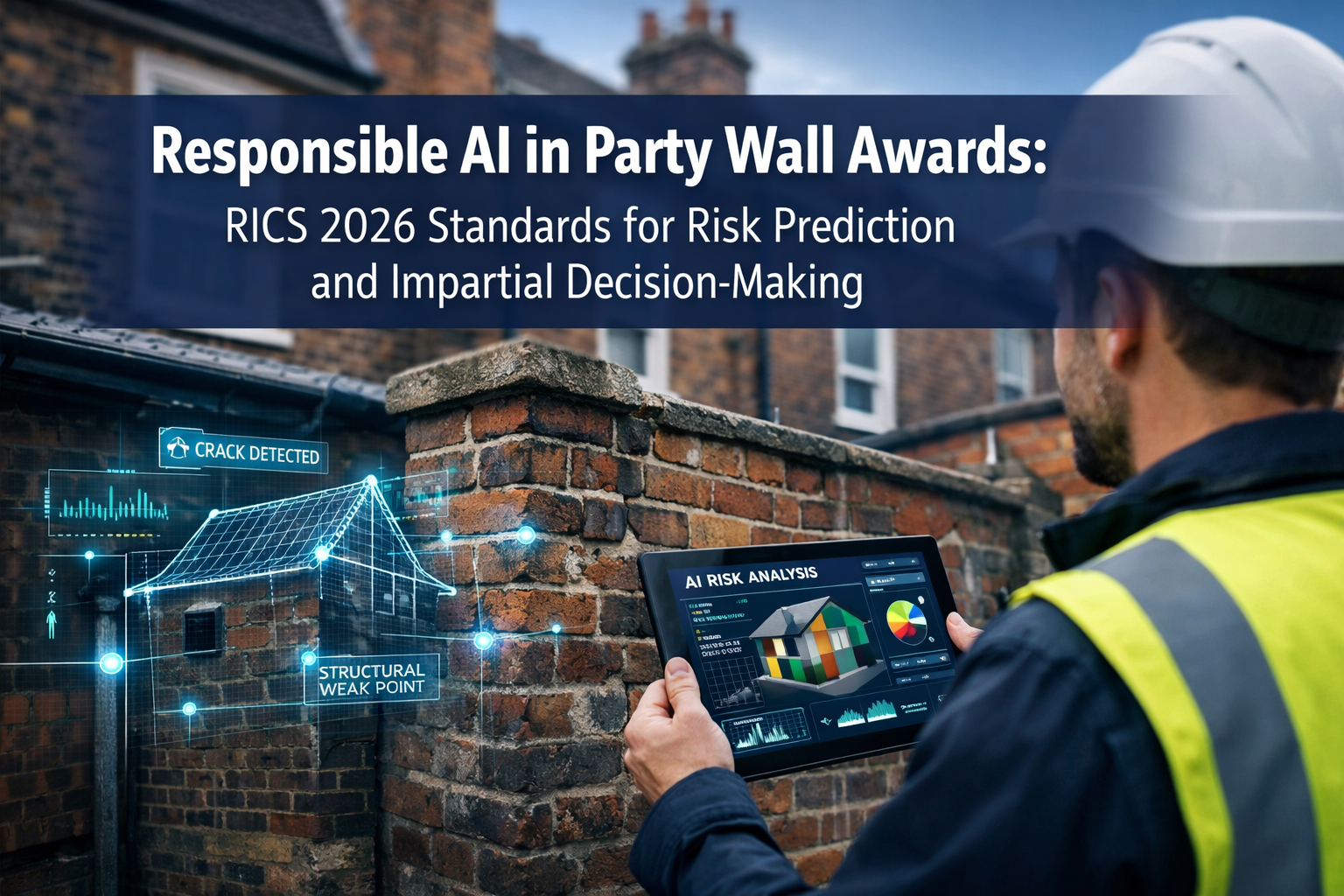
Responsible AI in Party Wall Awards: RICS 2026 Standards for Risk Prediction and Impartial Decision-Making now requires chartered surveyors to implement comprehensive risk registers, conduct quarterly reviews, and maintain transparent documentation when deploying AI systems for boundary assessments, structural analysis, or pre-notice risk evaluation. This article examines the practical implementation requirements for party wall professionals navigating these new obligations.
Key Takeaways
- ✅ Mandatory compliance from 9 March 2026 requires all RICS-regulated firms to maintain AI risk registers with quarterly updates and RAG rating systems[1]
- 📋 Risk register documentation must cover inherent bias, erroneous outputs, mitigation plans, and firm risk appetite for AI systems affecting party wall awards[1]
- 🔍 Due diligence requirements apply before procuring third-party AI systems, with written documentation provided on request to clients and stakeholders[1]
- ⚖️ Impartiality safeguards mandate that AI outputs cannot replace professional judgment in party wall award guidance or dispute resolution[3][7]
- 🏗️ Urban project applications include AI-powered condition recording for high-volume developments while maintaining human oversight and accountability[3]
Understanding the RICS 2026 AI Standards Framework
The RICS professional standard published in September 2025 (1st edition) establishes both mandatory requirements using "must" language and best-practice guidance for compliance.[1] This distinction is critical for party wall surveyors: mandatory provisions are non-negotiable regulatory obligations, while guidance represents recommended approaches to achieving compliance.
Global Scope and Application
The standard applies to all RICS members and regulated firms globally, covering valuation, construction, infrastructure, and land services.[2] For party wall practitioners, this means:
- Firms conducting party wall surveys must comply regardless of geographic location
- AI systems used for boundary risk assessment fall under regulatory oversight
- Third-party AI tools require the same scrutiny as internally developed systems
- Individual surveyors remain personally accountable for AI-assisted decisions
The framework recognizes that most surveying firms use externally-developed AI systems rather than building proprietary technology.[1] This reality shapes the due diligence requirements discussed later in this article.
Core Principles of Responsible AI
Responsible AI in Party Wall Awards: RICS 2026 Standards for Risk Prediction and Impartial Decision-Making rests on three foundational principles:
- Transparency: Clients and stakeholders must understand AI limitations and applications
- Accountability: Human surveyors retain ultimate responsibility for decisions
- Fairness: AI systems must not introduce bias or compromise impartiality
These principles directly address concerns about party wall disputes where perceived unfairness can escalate conflicts between building owners and adjoining owners.
Mandatory Risk Register Requirements for Party Wall AI Systems
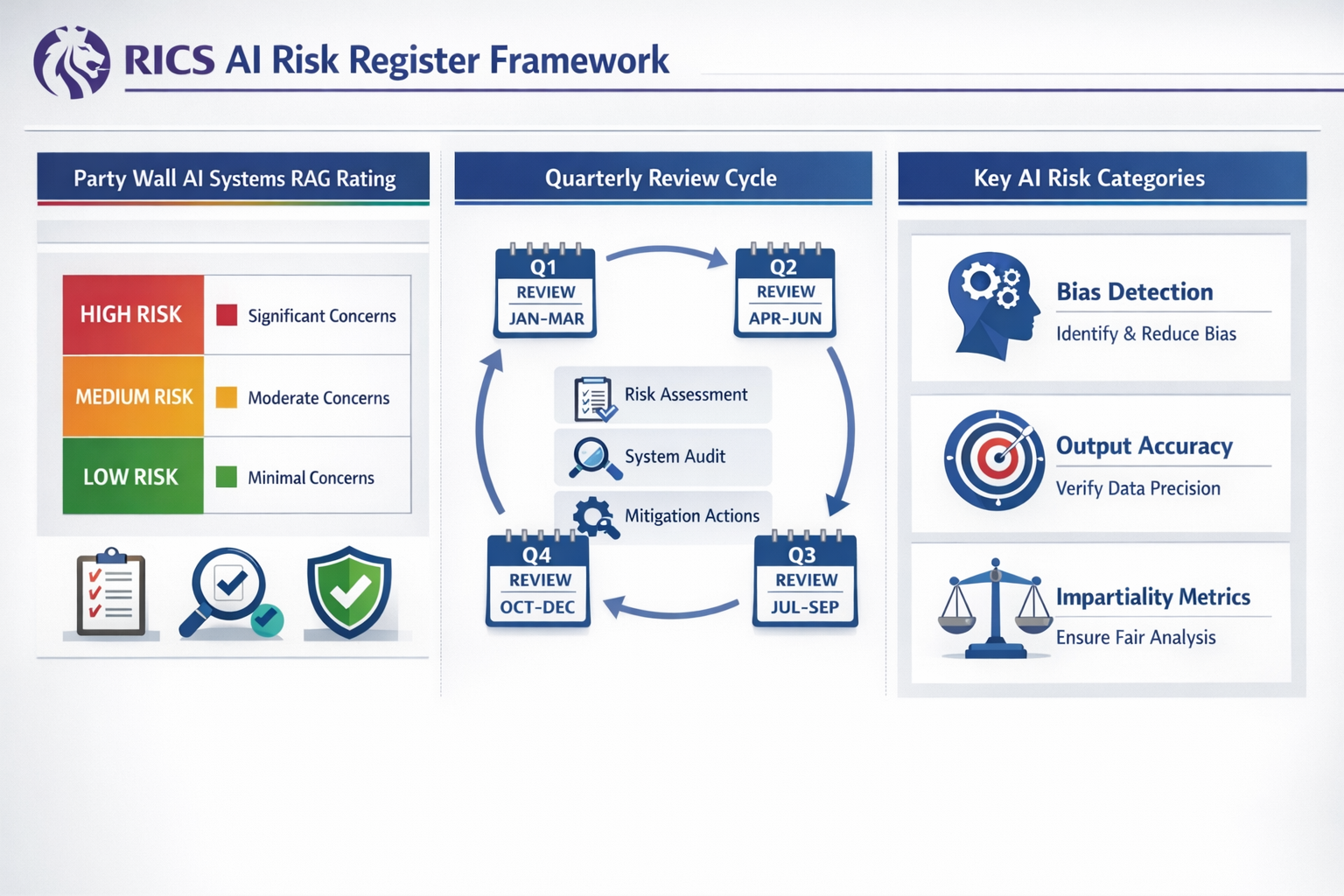
RICS-regulated firms must create and operate a risk register for any AI systems with material impact on surveying service delivery.[1] For party wall professionals, this requirement applies when AI tools influence:
- Pre-notice boundary risk analysis
- Schedule of condition documentation and photography
- Structural assessment and crack monitoring
- Cost estimation for party wall works
- Dispute resolution recommendations
Risk Register Components
The mandatory risk register must document:[1]
| Component | Description | Update Frequency |
|---|---|---|
| Overarching Risks | Inherent bias in AI systems, erroneous outputs, data quality issues | Quarterly minimum |
| RAG Rating | Red, amber, green categorization or similar risk classification method | Quarterly minimum |
| Mitigation Plans | Specific actions to reduce identified risks to acceptable levels | Quarterly minimum |
| Firm Risk Appetite | Threshold for acceptable risk in AI-assisted party wall decisions | Annual review |
| Progress Updates | Status of risk management implementation and effectiveness | Quarterly minimum |
Quarterly Review Obligations
Designated staff must review and update risk registers at least quarterly.[1] This cadence ensures that:
- 🔄 New AI capabilities are assessed before deployment
- 📊 Emerging risks from system updates are captured
- ✔️ Mitigation effectiveness is validated through actual case outcomes
- 📝 Documentation remains current for regulatory audits
For firms handling high-volume urban developments with multiple concurrent party wall agreements, quarterly reviews provide regular checkpoints to identify patterns in AI performance across different building types and boundary conditions.
Identifying Material Impact
Not every AI tool requires a full risk register. The standard applies to systems with material impact on service delivery.[1] Party wall surveyors should consider:
- Does the AI system influence award terms or conditions?
- Could AI outputs affect the impartiality of the appointed surveyor?
- Does the technology impact damage assessment accuracy?
- Would AI errors lead to financial consequences for either party?
If the answer to any question is "yes," the system requires risk register documentation under the 2026 standards.
Due Diligence and Procurement Standards for AI Tools
Responsible AI in Party Wall Awards: RICS 2026 Standards for Risk Prediction and Impartial Decision-Making places significant emphasis on detailed due diligence before procuring AI systems from third parties.[1] This reflects the reality that most surveying firms license external AI platforms rather than developing proprietary solutions.

Pre-Procurement Assessment Requirements
Before adopting AI tools for party wall work, firms must document:[1]
-
Identifiable Application: Specific tasks the AI system will perform (e.g., automated crack detection in boundary walls, predictive risk scoring for excavation notices)
-
Potential Risks and Benefits: Balanced evaluation of accuracy improvements versus bias introduction, efficiency gains versus transparency challenges
-
Alternative Approaches: Traditional methods available for the same processes, ensuring AI adoption is justified rather than assumed
-
System Limitations: Known failure modes, edge cases, and conditions where AI outputs may be unreliable
Vendor Evaluation Criteria
When procuring third-party AI systems, party wall surveyors should assess:
- Training Data Transparency: Does the vendor disclose what building types, boundary conditions, and geographic regions trained the AI model?
- Bias Testing: Has the system been evaluated for performance disparities across different property ages, construction types, or socioeconomic areas?
- Update Protocols: How frequently does the vendor update algorithms, and how are changes communicated to users?
- Audit Trail Capabilities: Can the system document which AI outputs influenced specific party wall award decisions?
- Professional Indemnity Alignment: Does the vendor's liability coverage complement the surveyor's professional insurance?
These criteria help firms avoid AI systems that might compromise their obligations under party wall consent procedures or introduce hidden risks into award determinations.
Written Documentation Requirements
Firms must provide written documentation on request to clients, building owners, adjoining owners, and regulatory authorities.[1] This documentation includes:
- Type of AI system used in the party wall matter
- Limitations affecting reliability of outputs
- Due diligence processes completed before system adoption
- Risk management approaches specific to the engagement
- Decisions about output reliability and human verification steps
For surveyors working on loft conversions or complex boundary modifications, this transparency requirement ensures all parties understand how technology influenced the award terms.
Maintaining Impartiality and Professional Judgment
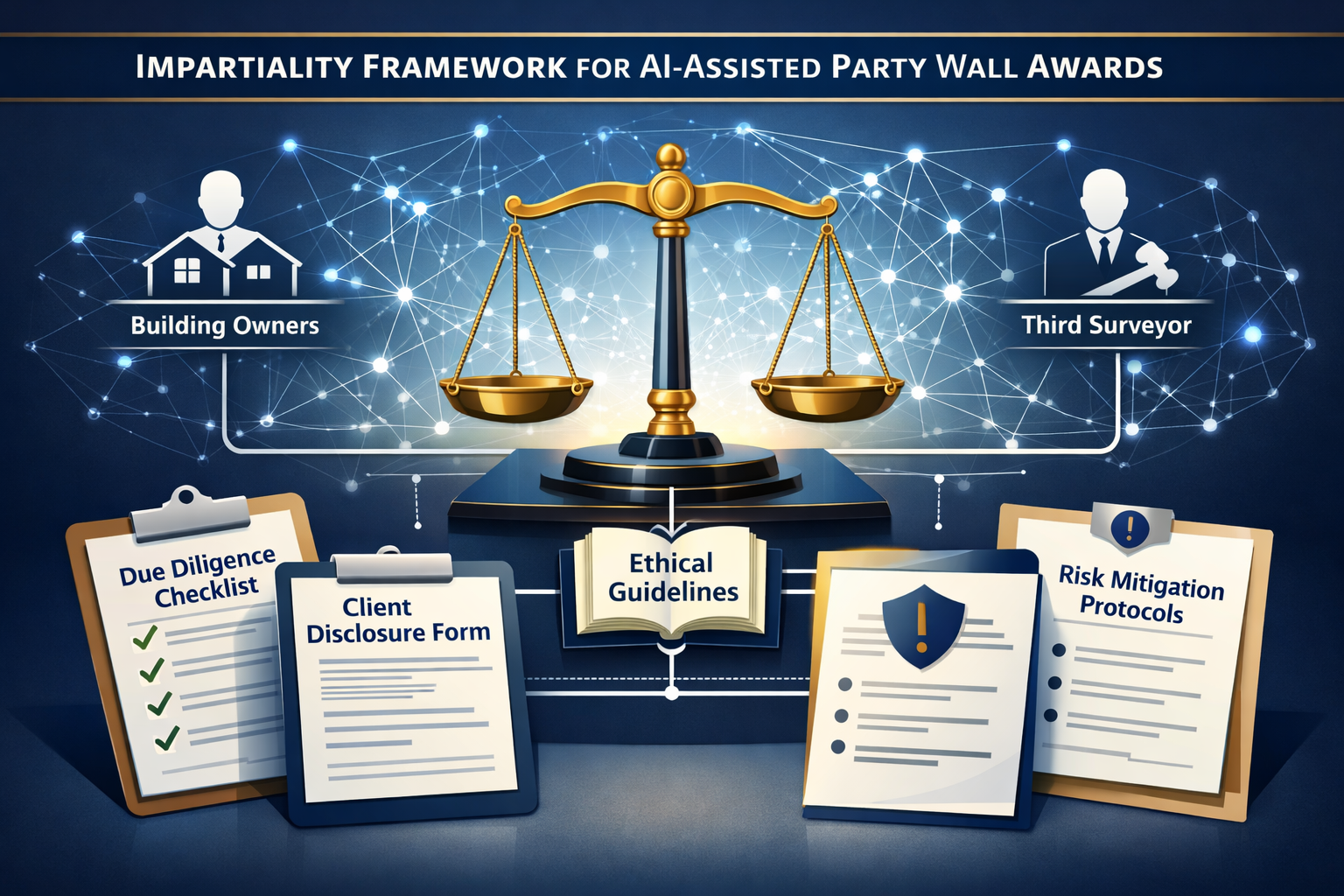
The 2026 standards explicitly address concerns that AI might compromise the impartiality required of party wall surveyors. The framework mandates that AI systems cannot replace professional judgment in assessments.[3][7]
Human Oversight Requirements
Responsible AI in Party Wall Awards: RICS 2026 Standards for Risk Prediction and Impartial Decision-Making requires surveyors to:
- ⚖️ Retain ultimate decision authority: AI provides analysis, but chartered surveyors make final determinations
- 🔍 Verify AI outputs: Cross-check automated assessments against site observations and professional experience
- 📋 Document judgment calls: Record where professional opinion diverged from AI recommendations and why
- 🤝 Explain to stakeholders: Ensure clients understand the role of AI versus human expertise in the award
This approach prevents scenarios where building owners or adjoining owners might challenge awards as "computer-generated" rather than professionally considered.
Addressing Bias in Risk Prediction
AI systems trained on historical party wall data may inherit biases from past practices. The risk register must specifically document inherent bias concerns.[1] Examples include:
- Geographic bias: AI trained primarily on London terraced houses may perform poorly on Manchester semi-detached properties
- Age bias: Systems optimized for Victorian buildings may misassess modern construction techniques
- Severity bias: Training data weighted toward disputed cases may over-predict risks in routine matters
Surveyors must implement mitigation strategies such as:
- Supplementary data collection from diverse property types
- Manual review thresholds triggered by AI confidence scores
- Regular validation against actual outcomes in local practice areas
- Adjustments to AI weightings based on regional building characteristics
Stakeholder Communication Standards
The standard requires firms to ensure clients and stakeholders understand the ways of working and limitations of AI systems used in assessments.[1] For party wall matters, this means:
- Explaining AI's role in schedule of condition guidance documentation
- Disclosing when automated risk scoring influenced award recommendations
- Clarifying that AI does not determine legal rights or obligations
- Providing alternative assessment methods if parties object to AI use
This transparency protects the surveyor's impartiality and reduces the risk of challenges based on perceived technological bias.
Practical Implementation for High-Volume Urban Projects
Urban development projects in 2026 increasingly involve high-volume party wall matters where AI can provide efficiency without compromising quality. The RICS standards enable responsible deployment in these contexts.
Pre-Notice Risk Analysis Applications
AI systems excel at pre-notice boundary risk analysis by:
- Analyzing building records and historical settlement patterns
- Identifying properties within the 3-metre rule requiring excavation notices
- Predicting which boundaries have elevated dispute risk
- Prioritizing surveyor attention toward complex or sensitive matters
For developers planning multiple adjacent projects, AI-powered risk mapping allows proactive engagement with adjoining owners before no party wall notice served situations arise.
Condition Recording Efficiency
The standard applies to AI-powered condition recording in party wall surveys.[3][7] Modern systems can:
- 📸 Automatically catalog and categorize boundary wall photographs
- 🔍 Detect existing cracks, defects, and structural concerns
- 📏 Measure crack widths and propagation angles from images
- 📊 Generate draft schedules of condition for surveyor review
These capabilities significantly reduce time spent on routine documentation, allowing surveyors to focus on professional judgment for complex boundary conditions or shared chimneys.
Workflow Integration Best Practices
Successful AI integration in high-volume party wall practices includes:
- Staged Rollout: Pilot AI systems on straightforward cases before applying to complex disputes
- Parallel Processing: Run AI and traditional methods simultaneously during validation periods
- Feedback Loops: Capture surveyor corrections to AI outputs for system improvement
- Client Education: Develop standard disclosures explaining AI's role in the engagement
- Insurance Coordination: Confirm professional indemnity coverage extends to AI-assisted decisions
Addressing Common Implementation Challenges
Party wall surveyors implementing AI systems under the 2026 standards frequently encounter:
| Challenge | RICS-Compliant Solution |
|---|---|
| Client concerns about AI impartiality | Provide written documentation showing human oversight and verification steps[1] |
| Uncertainty about risk register scope | Include any system influencing award terms, condition assessments, or cost estimates[1] |
| Vendor resistance to transparency | Require contractual disclosure of training data, bias testing, and update protocols |
| Quarterly review resource demands | Designate specific staff roles with protected time for risk register maintenance[1] |
| Legacy system compatibility | Document AI limitations when integrating with existing case management platforms |
Compliance Verification and Regulatory Oversight
RICS enforcement of the AI standards includes audit rights for risk registers, due diligence documentation, and client disclosures. Party wall surveyors should prepare for:
Documentation Retention
Maintain records demonstrating:
- ✅ Quarterly risk register reviews with dated signatures
- ✅ Pre-procurement due diligence for each AI system
- ✅ Client communications explaining AI use and limitations
- ✅ Instances where professional judgment overrode AI recommendations
- ✅ Mitigation actions taken in response to identified risks
These records protect surveyors in professional conduct investigations and provide evidence of standards compliance.
Professional Development Requirements
The 2026 standards assume surveyors possess competence in AI governance. Firms should invest in:
- Training on bias detection and mitigation strategies
- Workshops on risk register development and maintenance
- Case studies analyzing AI failures in surveying contexts
- Continuing professional development (CPD) on emerging AI technologies
This knowledge base enables surveyors to fulfill their obligations under Responsible AI in Party Wall Awards: RICS 2026 Standards for Risk Prediction and Impartial Decision-Making.
Integration with Existing RICS Standards
The AI standard complements existing RICS requirements for building surveying and valuation practice.[6] Party wall surveyors must ensure:
- AI risk registers align with firm-wide risk management frameworks
- Professional indemnity insurance covers AI-assisted decisions
- Quality assurance processes include AI output verification
- Client care standards address AI transparency requirements
Future Developments and Industry Adaptation
The September 2025 publication represents the first edition of the RICS AI standard.[1] Surveyors should anticipate:
Evolving Regulatory Expectations
As AI capabilities advance, RICS will likely:
- 🔄 Update risk categories to address emerging technologies
- 📊 Establish performance benchmarks for common AI applications
- 🎓 Develop formal competency frameworks for AI governance
- 🔍 Increase audit frequency for high-volume AI users
Proactive firms will exceed minimum compliance requirements, positioning themselves as industry leaders in responsible AI adoption.
Industry Best Practices Emerging
Early adopters of Responsible AI in Party Wall Awards: RICS 2026 Standards for Risk Prediction and Impartial Decision-Making are developing:
- Standardized AI disclosure templates for party wall notices
- Collaborative risk registers shared across professional networks
- Peer review protocols for AI-assisted awards
- Case law analysis tracking AI-related party wall disputes
These practices will inform future RICS guidance and establish norms for the profession.
Technology Vendor Responses
AI system providers serving the surveying market are adapting by:
- Publishing detailed training data specifications
- Offering built-in audit trail and documentation features
- Providing RICS-compliant risk assessment templates
- Developing integration with risk register platforms
Surveyors should prioritize vendors demonstrating commitment to the 2026 standards when evaluating new systems.
Conclusion
Responsible AI in Party Wall Awards: RICS 2026 Standards for Risk Prediction and Impartial Decision-Making establishes a comprehensive framework for deploying artificial intelligence in boundary assessments while preserving professional judgment and impartiality. The mandatory requirements—risk registers, quarterly reviews, due diligence documentation, and stakeholder transparency—create accountability without prohibiting innovation.
For party wall surveyors managing high-volume urban projects, these standards enable efficiency gains through AI-powered condition recording and risk prediction while maintaining the trust and fairness essential to party wall awards. Success requires investment in governance infrastructure, vendor evaluation, and ongoing professional development.
Actionable Next Steps
- Conduct an AI inventory: Identify all systems with material impact on party wall service delivery
- Establish your risk register: Document risks, RAG ratings, and mitigation plans before 9 March 2026
- Designate review responsibility: Assign specific staff to quarterly risk register updates
- Review vendor contracts: Ensure third-party AI providers support transparency and audit requirements
- Develop client disclosures: Create standard documentation explaining AI use and limitations
- Invest in training: Build internal competency in AI governance and bias detection
- Monitor industry developments: Track RICS guidance updates and emerging best practices
The 2026 standards represent a watershed moment for surveying practice. Firms that embrace responsible AI implementation will deliver enhanced service quality while maintaining the professional integrity that defines chartered surveying. Those that delay compliance risk regulatory consequences and competitive disadvantage in an increasingly technology-enabled market.
By prioritizing transparency, accountability, and human oversight, party wall surveyors can harness AI's analytical power without compromising the impartiality and professional judgment that remain irreplaceable in boundary dispute resolution and award determination.
References
[1] Responsible Use Of Artificial Intelligence In Surveying Practice September 2025 – https://www.rics.org/content/dam/ricsglobal/documents/standards/Responsible-use-of-artificial-intelligence-in-surveying-practice_September-2025.pdf
[2] Rics Launches Global Standard For Ai In Surveying – http://www.nicholssurveyors.com/news-and-insights/2025/09/18/rics-launches-global-standard-for-ai-in-surveying/
[3] Rics Ai Standards In Building Surveys 2026 Practical Protocols For Level 3 Assessments And Risk Detection – https://nottinghillsurveyors.com/blog/rics-ai-standards-in-building-surveys-2026-practical-protocols-for-level-3-assessments-and-risk-detection
[4] Party Wall Agreement – https://hoa.org.uk/advice/guides-for-homeowners/i-am-improving/party-wall-agreement/
[5] Rics Introduces Mandatory Ai Standard For Surveyors What Insurers And Their Clients Need To Know – https://cms.law/en/gbr/legal-updates/rics-introduces-mandatory-ai-standard-for-surveyors-what-insurers-and-their-clients-need-to-know
[6] Building Surveying Standards – https://www.rics.org/profession-standards/rics-standards-and-guidance/sector-standards/building-surveying-standards
[7] Rics Ai Standards In Building Surveys 2026 Implementing Responsible Use While Maintaining Professional Judgment – https://nottinghillsurveyors.com/blog/rics-ai-standards-in-building-surveys-2026-implementing-responsible-use-while-maintaining-professional-judgment