"

The rental landscape in the UK has transformed overnight. With the Renters' Rights Act 2026 now in force, landlords face stricter property standards, enhanced tenant protections, and significant penalties for non-compliance. The Renters' Rights Act 2026: Building Survey Checklists for Landlords Facing New Rental Regulations represents a fundamental shift in how rental properties must be maintained, inspected, and managed—particularly regarding health hazards like damp and mould under Awaab's Law provisions.
For landlords, the stakes have never been higher. Properties that previously met basic safety requirements now need comprehensive building surveys to identify hidden defects that could trigger legal disputes or enforcement action. Understanding what surveyors look for and implementing systematic inspection protocols has become essential for maintaining compliant, profitable rental portfolios.
Key Takeaways
✅ Section 21 abolition means landlords can no longer use no-fault evictions, making property condition disputes more consequential[2][3][6]
✅ Awaab's Law provisions mandate strict timelines for addressing damp and mould hazards, requiring proactive building surveys to detect issues early
✅ Annual rent increase limits and tribunal challenges make property condition documentation critical for justifying market-rate rents[2][5][6]
✅ Comprehensive building survey checklists help landlords identify structural defects, moisture problems, and health hazards before they escalate into legal issues
✅ Professional RICS surveys provide defensible evidence of property condition and demonstrate compliance with new regulatory standards
Understanding the Renters' Rights Act 2026 and Its Impact on Property Standards
The Renters' Rights Act 2026 fundamentally restructures the private rental sector in England. From 1 March 2026, all assured shorthold tenancies automatically convert to periodic assured tenancies with no fixed end date[2][6]. This seemingly administrative change carries profound implications for property management and maintenance standards.
The End of Section 21 and What It Means for Building Condition
The abolition of Section 21 no-fault evictions represents the most significant change for landlords[2][3][6]. Previously, landlords could regain possession of their properties without providing a reason, giving them leverage in disputes over property condition. Now, landlords must demonstrate valid grounds for eviction, such as:
- Rent arrears (two months or more)
- Property sale requirements
- Landlord or family member occupation needs
- Serious anti-social behaviour
This shift makes property condition disputes far more consequential. If a tenant withholds rent due to unresolved maintenance issues, the landlord cannot simply serve a Section 21 notice. Instead, they must address the underlying problems or pursue potentially lengthy legal proceedings.
Awaab's Law: Strict Timelines for Damp and Mould Remediation
Named after two-year-old Awaab Ishak, who died from prolonged exposure to mould in his home, Awaab's Law introduces mandatory timelines for addressing health hazards in rental properties. While specific implementation dates for private rentals are still being finalized, the principle is clear: landlords must respond to reports of damp and mould within defined timeframes.
Expected requirements include:
| Hazard Severity | Investigation Timeline | Remediation Timeline |
|---|---|---|
| Emergency (severe mould/damp) | 24 hours | 7-14 days |
| Serious (moderate spread) | 7 days | 14-28 days |
| Non-urgent (isolated patches) | 14 days | 28-56 days |
Failure to meet these timelines could result in enforcement action, fines, and potential rent repayment orders. This makes proactive building surveys essential—identifying and addressing moisture problems before tenants report them.
New Rent Control Provisions and Property Value
Landlords can now only increase rent once per year using the amended Section 13 process[2][5][6]. Tenants have the right to challenge increases at tribunal, where property condition becomes a key consideration. A well-maintained property with documented survey evidence stands a better chance of justifying market-rate increases than one with unresolved defects.
Additionally, landlords must not charge more than the advertised rent price and can only request a maximum of one month's rent upfront[6]. These provisions reduce cash flow flexibility, making unexpected repair costs more financially impactful.
Building Survey Checklists for Landlords Facing New Rental Regulations: Essential Inspection Protocols
Comprehensive building surveys have evolved from optional due diligence to regulatory necessity under the Renters' Rights Act 2026. Landlords need systematic inspection protocols that identify potential compliance issues before they become legal liabilities.
Why Standard Safety Certificates Are No Longer Sufficient
While gas safety certificates, electrical installation condition reports (EICRs), and energy performance certificates (EPCs) remain mandatory, they don't address the broader structural and environmental issues now scrutinized under enhanced tenant protections.
The gap between basic compliance and regulatory security includes:
🔍 Moisture and condensation issues not visible during routine inspections
🔍 Structural defects that could worsen over tenancy duration
🔍 Ventilation inadequacies contributing to mould growth
🔍 Insulation failures causing cold bridging and condensation
🔍 Hidden water ingress from roofs, gutters, or underground sources
A professional RICS Building Survey (Level 3) provides the comprehensive assessment needed to identify these issues systematically.
The Three-Tier Survey Approach for Rental Properties
Landlords should implement a three-tier survey strategy aligned with property age, condition, and risk profile:
Tier 1: Annual Landlord Self-Inspection Checklist
For properties in good condition with recent professional surveys, annual self-inspections can identify emerging issues:
- External drainage and guttering functionality
- Window and door seals integrity
- Ventilation system operation
- Visible damp or mould in high-risk areas (bathrooms, kitchens, external walls)
- Heating system performance
- Roof condition (from ground level)
Tier 2: Professional Condition Report (RICS Level 2)
Recommended every 3-5 years for modern properties (post-1990) or after major renovations. This survey provides:
- Traffic light condition ratings for major elements
- Identification of urgent defects requiring immediate attention
- Guidance on maintenance priorities
- Basic moisture meter readings in suspect areas
Tier 3: Comprehensive Building Survey (RICS Level 3)
Essential for older properties (pre-1990), those with known issues, or before purchasing rental investments. This detailed inspection includes:
- Full structural assessment of walls, floors, roofs, and foundations
- Comprehensive damp and moisture investigation
- Thermal imaging to identify heat loss and cold bridging
- Detailed defect analysis with remediation recommendations
- Cost estimates for identified repairs
For properties with specific concerns, specialized surveys such as damp surveys or structural surveys provide targeted investigation.
Critical Inspection Points for Awaab's Law Compliance
Building survey checklists under the Renters' Rights Act 2026 must prioritize health hazard identification, particularly moisture-related issues that lead to mould growth.
External moisture ingress points:
- Roof covering: Missing tiles, damaged flashing, deteriorated felt
- Chimneys: Cracked pots, missing pointing, inadequate weathering
- Gutters and downpipes: Blockages, leaks, inadequate capacity, poor connections
- External walls: Cracked render, damaged brickwork, failed pointing
- Windows and doors: Deteriorated seals, rotten frames, inadequate weather stripping
- Ground levels: Soil or paving above damp-proof course (DPC)
Internal moisture sources:
- Plumbing leaks: Hidden pipe failures, slow drips, condensation on cold pipes
- Bathroom ventilation: Inadequate extraction, blocked vents, non-functional fans
- Kitchen ventilation: Insufficient extraction capacity, poor ducting
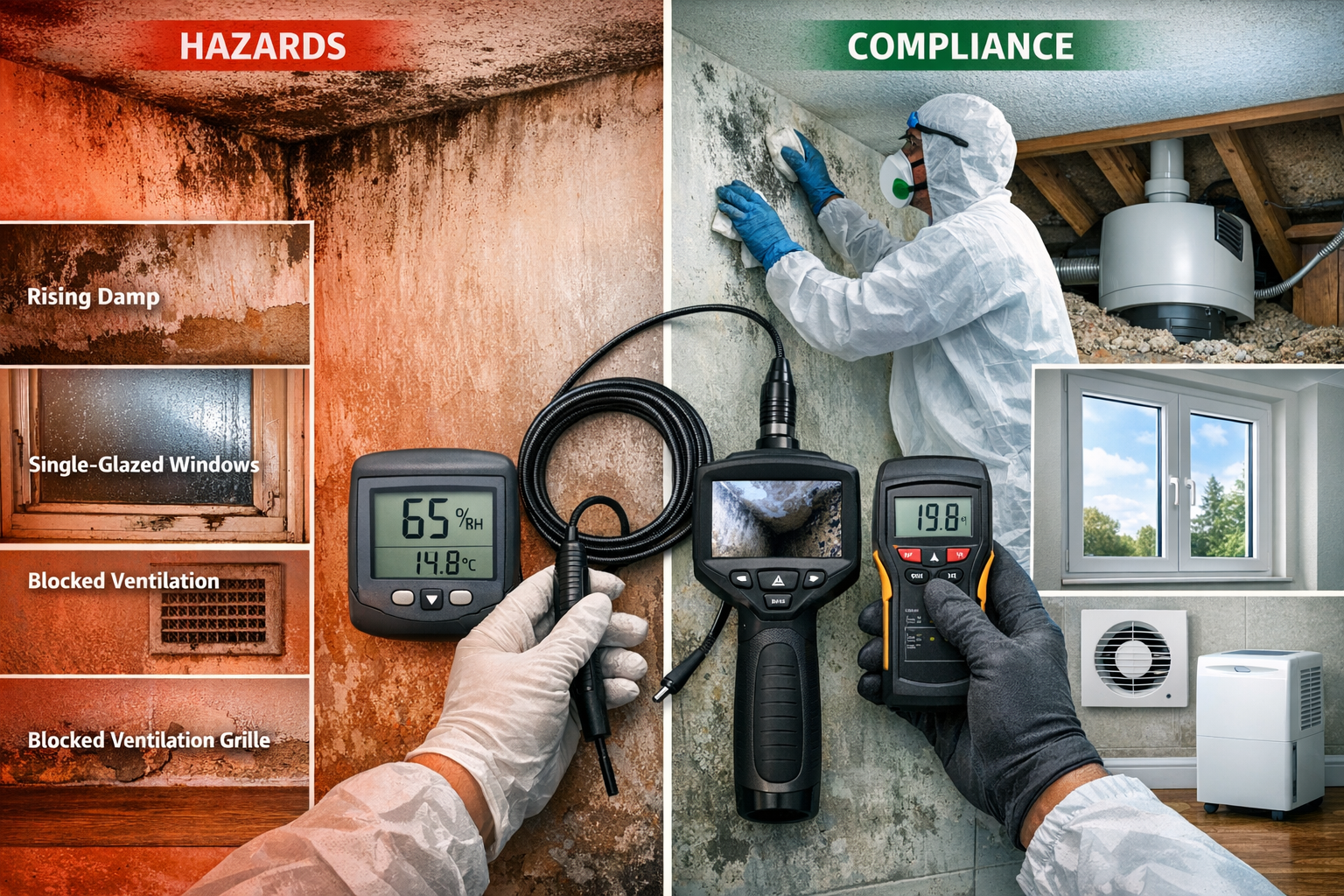
- Condensation: Single-glazed windows, cold surfaces, inadequate heating
- Rising damp: Failed or bridged DPC, missing DPC in older properties
- Penetrating damp: Through solid walls, around window reveals, at wall-floor junctions
Mould risk assessment:
- Existing mould growth locations and extent
- Condensation patterns on windows and cold surfaces
- Musty odours indicating hidden mould
- Tenant lifestyle factors (drying clothes indoors, inadequate heating)
- Ventilation adequacy for property size and occupancy
- Thermal bridging creating cold spots
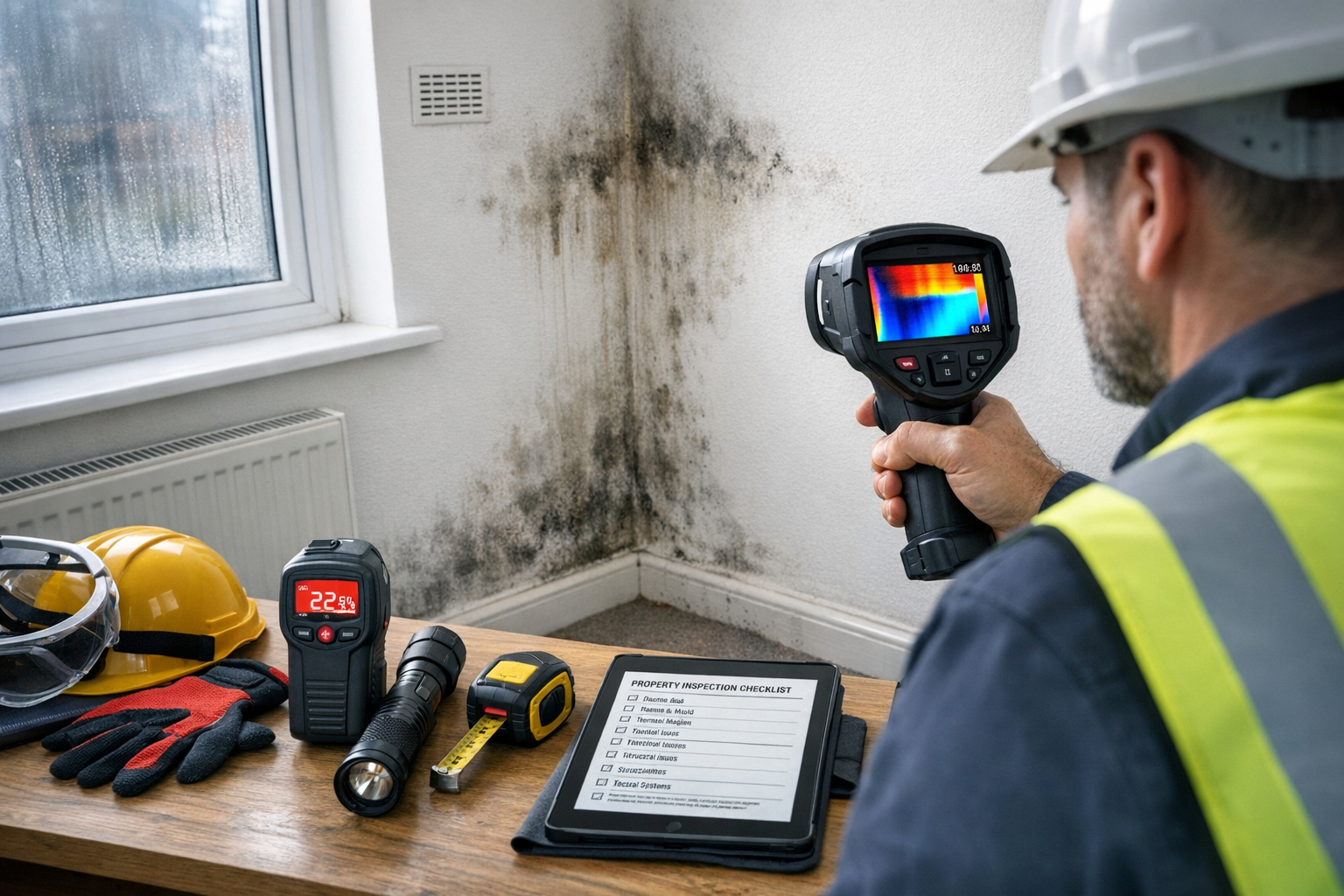
Professional surveyors use specialized equipment including moisture meters, thermal imaging cameras, and borescopes to detect hidden problems. For landlords conducting preliminary assessments, basic moisture meters (available for £20-50) can identify suspect areas requiring professional investigation.
Implementing Renters' Rights Act 2026 Building Survey Checklists: Practical Steps for Landlords
Converting regulatory requirements into actionable property management practices requires systematic implementation of building survey protocols aligned with the Renters' Rights Act 2026.
Pre-Tenancy Survey Protocol
Before advertising a rental property, landlords should complete a comprehensive baseline survey documenting current condition. This creates defensible evidence for deposit disputes and provides a reference point for ongoing maintenance.
Pre-tenancy checklist:
-
Commission professional survey: Engage a RICS-certified surveyor for Level 2 or Level 3 assessment depending on property age and condition
-
Address identified defects: Prioritize health and safety issues, particularly damp and mould risks
-
Document remediation: Photograph repairs and retain contractor invoices as compliance evidence
-
Create tenant information pack: By 31 May 2026, landlords must provide government-produced information sheets explaining new tenancy rules[2][4]
-
Establish maintenance baseline: Record condition of all major elements for comparison during tenancy
-
Install monitoring systems: Consider humidity sensors in high-risk areas to detect condensation issues early
During-Tenancy Inspection Schedule
Regular inspections during tenancy help identify emerging issues before they become serious hazards. Under the Renters' Rights Act 2026, landlords must balance their right to inspect with tenant quiet enjoyment rights.
Recommended inspection frequency:
- Quarterly visual inspections: External condition, gutters, ventilation, heating system
- Six-monthly internal inspections: With 24-hour notice, checking for maintenance issues and tenant-caused damage
- Annual professional assessment: For properties with known vulnerabilities or older buildings
- Post-incident surveys: After severe weather, flooding, or tenant-reported problems
During inspections, prioritize:
✓ Signs of new moisture ingress or damp patches
✓ Mould growth in bathrooms, kitchens, or bedrooms
✓ Ventilation system functionality
✓ Heating system performance
✓ Tenant maintenance of property (excessive condensation from lifestyle factors)
✓ Structural changes or damage requiring attention
Documentation is critical. Photograph all inspections with timestamps, noting both positive findings and concerns. This creates an audit trail demonstrating proactive management.
Emergency Response Protocols for Reported Hazards
When tenants report damp, mould, or structural issues, the Renters' Rights Act 2026 requires prompt action. Landlords should establish clear response protocols:
Immediate response (24-48 hours):
- Acknowledge tenant report in writing
- Arrange inspection visit with 24-hour notice
- Assess severity and immediate health risks
- Implement temporary measures if needed (dehumidifiers, ventilation improvements)
Investigation phase (7-14 days):
- Commission specialist survey if cause unclear (damp survey, drainage survey, or roof survey)
- Identify root cause (structural defect, lifestyle condensation, or combination)
- Obtain contractor quotes for remediation
- Communicate timeline to tenant in writing
Remediation phase (timeline depends on severity):
- Complete repairs within Awaab's Law timelines
- Provide alternative accommodation if works require property vacation
- Document all work with photographs and certificates
- Conduct post-remediation inspection to confirm resolution
Follow-up (ongoing):
- Monitor previously affected areas during subsequent inspections
- Address any recurrence immediately
- Consider preventative improvements (ventilation upgrades, insulation enhancements)
Building Survey Documentation for Legal Protection
Comprehensive documentation protects landlords in disputes and demonstrates compliance with regulatory obligations. Essential records include:
📋 Survey reports: All professional building surveys with dates and surveyor credentials
📋 Remediation records: Invoices, photographs, and completion certificates for all repairs
📋 Inspection logs: Dated notes and photographs from landlord inspections
📋 Tenant communications: Written records of reported issues and landlord responses
📋 Compliance certificates: Gas safety, EICR, EPC, and any specialist assessments
📋 Maintenance schedule: Planned preventative maintenance records
This documentation becomes critical if tenants challenge rent increases at tribunal, claim rent repayment orders for substandard conditions, or pursue legal action for health impacts from property defects.
Cost-Benefit Analysis: Survey Investment vs. Compliance Risk
Professional building surveys represent a significant investment, but the cost-benefit calculation under the Renters' Rights Act 2026 strongly favors proactive assessment:
Survey costs (approximate):
- RICS Level 2 Home Survey: £400-600
- RICS Level 3 Building Survey: £600-1,200
- Specialist damp survey: £300-500
- Thermal imaging assessment: £200-400
Compliance failure costs (potential):
- Rent repayment orders: Up to 12 months' rent refunded
- Tribunal-imposed rent reductions: 10-30% for duration of defects
- Enforcement action fines: £5,000-30,000 depending on severity
- Legal costs defending disputes: £3,000-15,000+
- Remediation costs for emergency repairs: 2-3x planned maintenance costs
- Reputational damage affecting future lettings
A £1,000 comprehensive survey identifying £3,000 of preventative repairs represents exceptional value compared to £20,000+ in potential penalties, emergency remediation, and lost rental income.
Regional Considerations and Survey Access
Landlords operating across different regions should be aware that survey availability and local property characteristics vary significantly. Properties in areas with specific geological or environmental challenges require tailored inspection approaches.
For example, landlords with properties in London face different survey priorities than those in Surrey or Berkshire. Urban properties may have different ventilation challenges compared to rural locations, while older Victorian terraces require different assessment protocols than modern apartments.
Working with local chartered surveyors who understand regional building characteristics ensures more accurate hazard identification and appropriate remediation recommendations.
Conclusion: Proactive Compliance Through Systematic Building Surveys

The Renters' Rights Act 2026: Building Survey Checklists for Landlords Facing New Rental Regulations represents a paradigm shift from reactive property management to proactive compliance. With Section 21 abolished, Awaab's Law timelines enforced, and enhanced tenant protections in place, landlords can no longer afford to address maintenance issues only when they become critical.
Systematic building survey protocols provide the foundation for successful property management under the new regulatory framework. By implementing three-tier inspection strategies, prioritizing moisture and mould risk assessment, and maintaining comprehensive documentation, landlords protect both their tenants and their investments.
Actionable Next Steps
Immediate actions (next 30 days):
- Commission baseline surveys for all rental properties, prioritizing older buildings and those with known issues
- Review current inspection schedules and implement quarterly external assessments
- Establish emergency response protocols for tenant-reported hazards
- Create documentation systems for all surveys, inspections, and remediation work
Medium-term actions (next 3-6 months):
- Address all identified defects from professional surveys, prioritizing health and safety issues
- Install monitoring equipment in high-risk properties (humidity sensors, condensation alarms)
- Develop tenant communication templates for maintenance issues and inspection scheduling
- Build relationships with specialist contractors for rapid response to damp, mould, and structural issues
Long-term strategy (ongoing):
- Schedule regular professional surveys based on property age and condition (every 3-5 years minimum)
- Maintain detailed compliance records demonstrating proactive property management
- Budget for preventative maintenance rather than emergency repairs
- Stay informed about regulatory developments and enforcement trends
The Renters' Rights Act 2026 raises the bar for rental property standards, but landlords who embrace comprehensive building survey protocols will find themselves well-positioned to maintain compliant, profitable portfolios while providing safe, healthy homes for their tenants.
References
[1] Rental Law Changes From 1 March – https://rtb.ie/renting/rental-law-changes-from-1-march/
[2] The Renters Rights Act When Does It All Start – https://fieldcourt.co.uk/the-renters-rights-act-when-does-it-all-start/
[3] Renters Rights Act Changes For Private Renters – https://england.shelter.org.uk/housing_advice/private_renting/renters_rights_act_changes_for_private_renters
[4] The Renters Rights Act 2025 Tenancy Information Requirements For Tenants In 202 – https://connections.nortonrosefulbright.com/post/102mh7u/the-renters-rights-act-2025-tenancy-information-requirements-for-tenants-in-202
[5] Watch – https://www.youtube.com/watch?v=25TQKxq-Jag
[6] Explainer Everything You Need To Know About The New Renters Rights Act – https://mhclgmedia.blog.gov.uk/2025/11/19/explainer-everything-you-need-to-know-about-the-new-renters-rights-act/
[7] Renting Is Changing – https://housinghub.campaign.gov.uk/renting-is-changing/
[8] Renters Rights – https://www.nrla.org.uk/resources/renters-rights