
The UK's high streets are experiencing a remarkable transformation in 2026. Empty office buildings that once housed struggling businesses are being converted into much-needed residential properties. However, this urban revival brings significant challenges—particularly when it comes to party wall surveys and managing agreements between neighbouring property owners. Understanding Party Wall Surveys for UK Office-to-Resi Conversions in 2026: Managing Agreements in High Street Revivals is essential for developers, property owners, and surveyors navigating this complex landscape.
As permitted development rights continue to expand, the conversion of commercial spaces to residential use has accelerated dramatically. Yet many developers underestimate the critical importance of proper party wall procedures when undertaking these projects. Shared walls, foundations, and structural elements require careful assessment and formal agreements to prevent costly disputes and project delays.
Key Takeaways
- 🏢 Party wall procedures are mandatory for most office-to-residential conversions involving shared structures, requiring formal notices and agreements with adjacent property owners
- 📋 Proper documentation protects all parties—schedules of condition, party wall awards, and surveyor appointments prevent disputes and establish clear responsibilities
- ⏱️ Timeline planning is critical—party wall notice periods typically require 2 months minimum, which must be factored into conversion project schedules
- 🔍 Professional surveyors are essential—RICS-qualified party wall surveyors ensure compliance with the Party Wall Act 1996 and manage complex multi-party agreements
- 💷 Costs and responsibilities must be clearly defined—building owners typically bear party wall survey costs, but agreements specify damage liability and ongoing maintenance obligations
Understanding Party Wall Requirements in Office-to-Resi Conversions
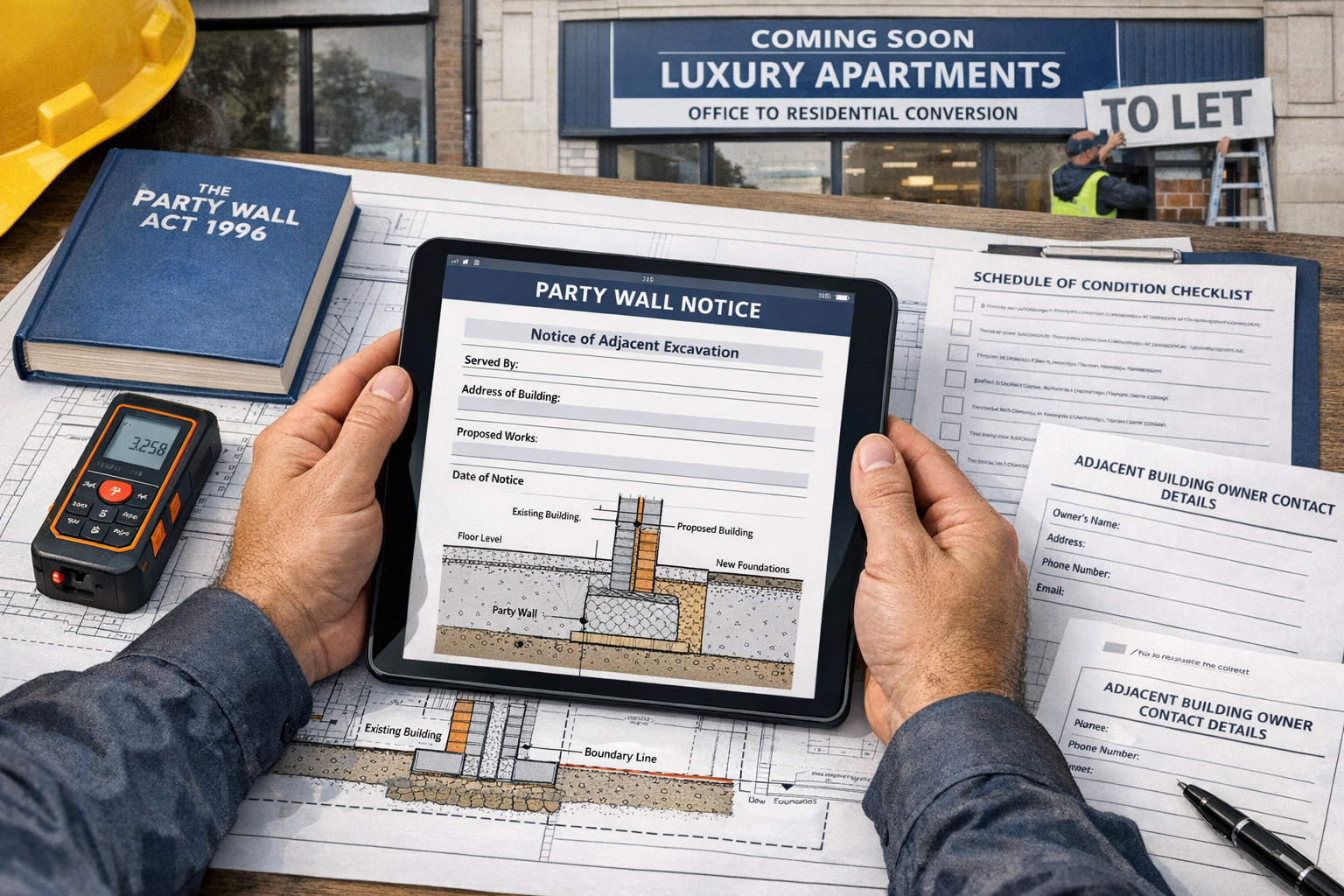
The Party Wall etc. Act 1996 governs all work affecting shared walls, boundaries, and excavations near neighbouring properties in England and Wales. When converting office buildings to residential use, developers frequently encounter party wall scenarios that require formal procedures.
What Triggers Party Wall Requirements?
Office-to-residential conversions typically involve several types of work that activate party wall obligations:
Structural alterations to shared walls between adjacent commercial properties often require strengthening, insulation upgrades, or the creation of new openings. These modifications fall squarely under Section 2 of the Party Wall Act [1].
Foundation work and excavations become necessary when adding additional floors or creating basement conversions. Any excavation within 3-6 metres of a neighbouring building's foundation requires proper excavation notice procedures.
Building on or astride boundary lines occurs frequently in high street conversions where properties share structural elements. New external walls, extensions, or structural reinforcements may require party wall agreements.
Cutting into party walls for services, ventilation systems, or structural modifications demands formal notice and consent from adjoining owners.
The Permitted Development Landscape in 2026
Recent changes to Class MA permitted development rights have simplified planning requirements for office-to-residential conversions, but they haven't eliminated party wall obligations [2]. Developers must understand this crucial distinction:
- ✅ Planning permission may be granted through prior approval
- ⚠️ Party wall procedures remain completely separate legal requirements
- 📝 Both processes must be completed independently
The expansion of permitted development rights has actually increased the volume of party wall work, as more conversions proceed without full planning applications. This makes proper party wall compliance even more critical for avoiding legal complications.
Party Wall Surveys for UK Office-to-Resi Conversions in 2026: The Complete Process
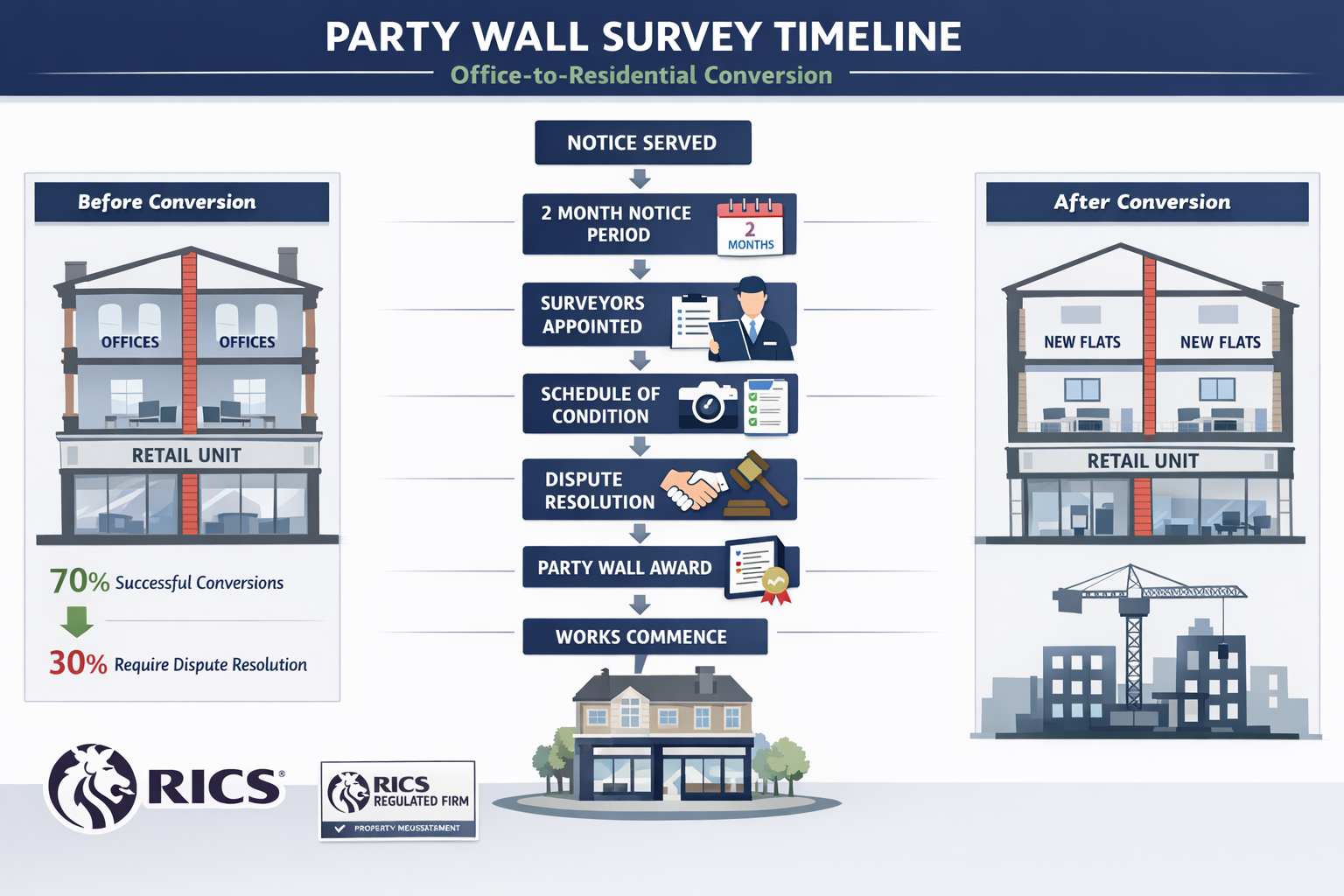
Navigating party wall procedures for office-to-residential conversions requires systematic planning and professional expertise. The process involves multiple stages, each with specific requirements and timelines.
Stage 1: Initial Assessment and Planning
Before serving any notices, developers should conduct a thorough assessment of party wall implications:
Identify all adjoining owners who may be affected by the proposed works. In high street locations, this often includes multiple parties—shops below, offices adjacent, and residential properties above.
Document existing conditions through comprehensive photographic and written records. A professional schedule of condition provides crucial evidence of pre-existing defects and protects against unfounded damage claims.
Engage a qualified party wall surveyor early in the planning process. RICS-qualified professionals understand the technical and legal requirements specific to commercial-to-residential conversions [3].
Review building records to understand shared structural elements, historical modifications, and existing easements or covenants that may affect the conversion.
Stage 2: Serving Party Wall Notices
The Party Wall Act requires specific notices depending on the type of work proposed:
| Notice Type | When Required | Minimum Notice Period |
|---|---|---|
| Party Structure Notice | Work to existing party walls/structures | 2 months |
| Line of Junction Notice | Building on boundary line | 1 month |
| 3-Metre/6-Metre Notice | Excavations near neighbouring buildings | 1 month |
Notice content must be precise and include detailed descriptions of the proposed works, anticipated start dates, and relevant drawings or specifications. Inadequate notices can be rejected, causing significant project delays.
Delivery methods matter—notices should be served by recorded delivery or hand-delivered with proof of receipt. Multiple adjoining owners each require individual notices.
Stage 3: Neighbour Responses and Surveyor Appointments
Once notices are served, adjoining owners have specific response options:
Consent in writing—the simplest outcome, though relatively uncommon in commercial conversions due to complexity and potential risks.
Dissent or non-response—triggers the formal party wall award process. Non-response after 14 days is treated as dissent under the Act [4].
Surveyor appointment—each party appoints a surveyor (or agrees to a single "agreed surveyor"). The building owner typically pays all reasonable surveyor fees, regardless of the outcome.
For office-to-residential conversions involving multiple adjoining owners, coordinating surveyor appointments and managing parallel party wall procedures requires careful project management.
Stage 4: The Party Wall Award
The appointed surveyor(s) prepare a party wall award—a legally binding document that sets out:
- 📋 Detailed scope of permitted works
- 🛡️ Protective measures and working methods
- 📸 Schedule of condition for adjoining properties
- ⏰ Working hours and access arrangements
- 💰 Cost allocation and security deposits
- 🔧 Procedures for addressing damage or disputes
Understanding party wall award guidance helps developers anticipate requirements and budget appropriately. Awards typically take 4-8 weeks to prepare and agree, though complex multi-party situations may take longer.
Managing Complex Party Wall Agreements in High Street Revivals
High street office-to-residential conversions present unique challenges that distinguish them from typical domestic party wall scenarios. The commercial context, multiple stakeholders, and mixed-use environments require sophisticated management approaches.
Multi-Party Coordination Challenges
Unlike suburban residential conversions, high street projects often involve:
Multiple adjoining owners with different interests and concerns. A single conversion might affect retail tenants, commercial landlords, residential leaseholders, and freeholders simultaneously.
Varying property types requiring different technical assessments. The party wall between two office buildings has different characteristics than a wall separating commercial and residential uses.
Complex ownership structures including leasehold arrangements, corporate entities, and absent landlords who may be difficult to locate or engage.
Competing business interests where adjoining commercial tenants worry about disruption, noise, and potential damage affecting their operations.
"High street conversions require party wall surveyors to act as mediators between diverse stakeholders with fundamentally different priorities. Success depends on clear communication and realistic expectations from the outset."
Technical Considerations for Commercial-to-Residential Conversions
Office buildings converted to residential use face specific technical challenges affecting party wall procedures:
Sound insulation requirements are dramatically higher for residential properties than commercial spaces. Upgrading party walls to meet Building Regulations often requires invasive work triggering party wall procedures [5].
Fire safety compliance has intensified following regulatory changes. Compartmentation improvements, fire-stopping, and structural fire protection may require modifications to party walls and shared structures.
Services and utilities must be separated and upgraded. Installing individual heating systems, water supplies, and electrical infrastructure often means cutting into party walls for new service runs.
Structural loading changes occur when office floor plates designed for commercial use are divided into residential units. Additional walls, bathrooms, and kitchens create new load patterns affecting shared structures.
Natural light and ventilation requirements for residential conversions may necessitate new openings in party walls or modifications to shared external walls [3].
Dispute Prevention and Resolution Strategies
Proactive dispute prevention saves time, money, and professional relationships:
Early engagement with adjoining owners before serving formal notices helps identify concerns and potential compromises. Informal discussions can reveal issues that formal procedures might miss.
Clear communication throughout the process prevents misunderstandings. Regular updates, accessible explanations of technical matters, and responsive handling of queries build trust.
Comprehensive schedules of condition provide objective evidence of pre-existing conditions. Professional schedule of condition guidance ensures thorough documentation that withstands scrutiny.
Reasonable working practices minimize disruption to adjoining occupiers. Limiting hours, controlling noise and vibration, and maintaining site cleanliness demonstrate respect for neighbours' interests.
Prompt damage response when issues arise prevents escalation. Immediate assessment, temporary repairs, and transparent communication about permanent remediation maintain goodwill.
When disputes do arise, the Party Wall Act provides resolution mechanisms:
- 🔄 Third surveyor appointment resolves disagreements between appointed surveyors
- ⚖️ Appeals to county court within 14 days of an award (though relatively rare)
- 🤝 Mediation and negotiation often resolve issues without formal proceedings
Understanding what happens without a party wall agreement highlights the risks of non-compliance and the importance of proper procedures.
Surveyor Checklists for Party Wall Compliance in 2026 Conversions
Professional surveyors managing party wall procedures for office-to-residential conversions should follow systematic checklists ensuring comprehensive compliance and risk management.
Pre-Notice Stage Checklist
✅ Conduct site assessment identifying all party walls, shared structures, and boundary conditions
✅ Review title documents establishing ownership, easements, and existing agreements
✅ Identify all adjoining owners including freeholders, leaseholders, and tenants with relevant interests
✅ Prepare detailed work descriptions with drawings, specifications, and methodology statements
✅ Assess excavation requirements and proximity to neighbouring foundations
✅ Commission pre-construction surveys documenting existing conditions of adjoining properties
✅ Develop project timeline incorporating party wall notice periods and response times
✅ Estimate party wall costs including surveyor fees, documentation, and potential security deposits
Notice Serving and Response Checklist
✅ Prepare compliant notices with accurate descriptions, drawings, and statutory information
✅ Serve notices by appropriate methods with proof of delivery to all required parties
✅ Maintain notice register tracking service dates, recipients, and response deadlines
✅ Monitor response periods and follow up on non-responses appropriately
✅ Coordinate surveyor appointments for all consenting and dissenting owners
✅ Establish communication protocols between appointed surveyors and parties
✅ Verify surveyor qualifications ensuring RICS membership and relevant experience
✅ Agree fee structures and payment responsibilities with all parties
Award Preparation and Execution Checklist
✅ Conduct joint inspections of all affected properties with appointed surveyors
✅ Prepare comprehensive schedules of condition with photographs, descriptions, and measurements
✅ Draft detailed work specifications aligned with conversion design and Building Regulations
✅ Define protective measures including temporary supports, monitoring, and access arrangements
✅ Establish working hours and methods balancing project efficiency with neighbour considerations
✅ Specify dispute resolution procedures and escalation mechanisms
✅ Include security deposit provisions where appropriate for high-risk works
✅ Obtain all required signatures and serve awards on all parties
✅ Register awards and maintain accessible copies for contractors and project teams
Construction Phase Monitoring Checklist
✅ Conduct pre-commencement meetings with contractors explaining party wall obligations
✅ Implement monitoring protocols for vibration, noise, and structural movement
✅ Maintain photographic records of work progression and protective measures
✅ Respond promptly to neighbour concerns with site visits and documented assessments
✅ Coordinate access for inspections by adjoining owners' surveyors
✅ Document any variations from agreed works requiring award amendments
✅ Address damage immediately with temporary repairs and permanent remediation plans
✅ Maintain communication logs recording all interactions with adjoining owners and surveyors
Post-Completion Checklist
✅ Conduct final inspections comparing completed works to schedules of condition
✅ Document compliance with party wall award terms and specifications
✅ Address outstanding items including permanent repairs and reinstatement works
✅ Release security deposits following satisfactory completion and settlement periods
✅ Obtain final sign-offs from adjoining owners' surveyors
✅ Archive complete documentation for future reference and potential disputes
✅ Update building records reflecting party wall agreements and modifications
✅ Provide handover documentation to new residential owners explaining party wall arrangements
Cost Considerations and Budget Planning
Understanding the financial implications of party wall procedures helps developers budget accurately for office-to-residential conversions.
Typical Party Wall Survey Costs
Surveyor fees vary based on project complexity, property values, and number of adjoining owners. For high street conversions, expect:
- Single agreed surveyor: £1,500-£3,500 per adjoining owner
- Separate surveyors: £2,000-£5,000+ per party
- Complex multi-party scenarios: £10,000-£25,000+ total
The cost of party wall procedures represents a relatively small proportion of total conversion costs but requires early budget allocation.
Schedule of condition surveys typically cost £500-£1,500 per adjoining property depending on size and complexity.
Security deposits may be required for high-risk works, typically 10-20% of estimated repair costs for potential damage.
Damage remediation costs vary enormously but should be budgeted conservatively. Minor cosmetic repairs might cost £500-£2,000, while structural issues could exceed £50,000.
Who Pays for What?
The Party Wall Act establishes clear cost allocation principles:
Building owners pay for all surveyor fees (including adjoining owners' surveyors), notices, awards, and schedules of condition.
Damage costs fall to the building owner when caused by the works, regardless of party wall compliance.
Betterment costs may be shared when works improve adjoining properties beyond mere repair.
Ongoing maintenance of party structures is typically shared equally unless agreements specify otherwise.
Return on Investment Considerations
While party wall procedures add costs and time to conversion projects, they provide valuable risk mitigation:
- 🛡️ Legal protection against injunctions halting works
- 📉 Reduced dispute costs through formal procedures
- 🤝 Improved neighbour relations supporting long-term property values
- 📋 Clear documentation valuable for future sales and refinancing
Research indicates that office-to-residential conversions can generate significant value, with converted units often achieving 15-25% premiums over comparable new-build apartments in established high street locations [6]. Proper party wall management protects these returns by preventing costly delays and disputes.
Legal Framework and Regulatory Compliance
Understanding the legal context surrounding Party Wall Surveys for UK Office-to-Resi Conversions in 2026: Managing Agreements in High Street Revivals ensures full compliance and risk management.
The Party Wall etc. Act 1996
This legislation governs all party wall matters in England and Wales, establishing:
Statutory notice requirements that cannot be waived or contracted out of, even with neighbour agreement.
Surveyor appointment procedures ensuring independent professional oversight of party wall works.
Award mechanisms creating legally binding agreements between parties.
Dispute resolution processes providing accessible remedies without requiring court proceedings.
Access rights allowing reasonable entry to adjoining properties for inspection and work execution.
The Act applies regardless of planning permission status, meaning permitted development conversions face identical party wall obligations to fully planned projects.
Building Regulations and Party Walls
Office-to-residential conversions must comply with current Building Regulations, which often necessitate party wall works:
Part E (Sound Insulation) requires significant upgrades to party walls between residential units, typically involving additional layers, insulation, or complete reconstruction.
Part B (Fire Safety) demands proper compartmentation and fire-stopping in party walls, especially in multi-storey conversions.
Part L (Conservation of Fuel and Power) may require insulation improvements to external walls shared with adjoining properties.
Part M (Access) considerations might affect party wall works when creating accessible residential units.
Coordinating Building Regulations compliance with party wall procedures requires careful planning and professional coordination.
Planning Considerations
While permitted development rights simplify planning for many conversions, certain scenarios still require full planning permission:
- 🏛️ Listed buildings and conservation areas
- 📏 Conversions exceeding size or height limits
- 🏗️ Projects involving significant external alterations
- 🌳 Developments affecting protected trees or habitats
When full planning permission is required, party wall obligations remain separate but should be coordinated with planning timelines.
Professional Standards and RICS Guidance
The Royal Institution of Chartered Surveyors (RICS) provides professional guidance for party wall surveyors, establishing best practices for:
Conflict of interest management ensuring surveyors act impartially even when appointed by one party.
Fee transparency requiring clear explanations of costs and charging structures.
Professional indemnity insurance protecting clients against surveyor errors or negligence.
Continuing professional development ensuring surveyors maintain current knowledge of legislation and best practices.
Engaging RICS-qualified surveyors provides assurance of professional competence and ethical conduct throughout the party wall process.
Case Studies: Successful High Street Conversions
Examining real-world examples illustrates how effective party wall management contributes to successful office-to-residential conversions.
Case Study 1: Multi-Storey Office Block Conversion, Manchester
A four-storey 1960s office building in Manchester's Northern Quarter was converted to 12 residential apartments in 2025. The project involved:
Party wall challenges:
- Shared walls with three adjoining commercial properties
- Foundation work for new lift installation
- Structural modifications to create residential layouts
- Sound insulation upgrades between units
Solutions implemented:
- Early engagement with all adjoining owners before formal notices
- Single agreed surveyor appointed with consent from all parties
- Comprehensive schedules of condition documenting pre-existing defects
- Phased construction minimizing disruption to operating businesses
- Regular progress updates maintaining neighbour goodwill
Outcomes:
- Zero formal disputes throughout construction
- Party wall procedures completed within 10 weeks
- Total party wall costs: £8,500 (under 1% of conversion budget)
- Project completed on schedule with excellent neighbour relations
Case Study 2: High Street Mixed-Use Conversion, Leeds
A Victorian high street building with ground-floor retail and upper-floor offices was converted to retail plus six apartments. Complications included:
Party wall challenges:
- Historic shared chimney stacks requiring careful assessment
- Asymmetric foundations near adjoining property
- Active retail tenants requiring uninterrupted trading
- Multiple leaseholders with different interests
Solutions implemented:
- Specialist heritage surveyor engaged for chimney assessment
- Extended notice periods allowing thorough neighbour consultation
- Out-of-hours working arrangements for noisy operations
- Enhanced protective measures including temporary supports
Outcomes:
- One minor dispute resolved through third surveyor appointment
- Temporary trading disruption compensated through negotiated agreement
- Successful completion with preserved historic features
- Party wall costs: £15,000 including dispute resolution
These examples demonstrate how professional party wall management, early planning, and clear communication contribute to successful conversions while maintaining positive community relationships.
Future Trends and Emerging Considerations
The landscape of Party Wall Surveys for UK Office-to-Resi Conversions in 2026: Managing Agreements in High Street Revivals continues to evolve with regulatory changes, technological advances, and shifting market dynamics.
Regulatory Evolution
Permitted development expansion is likely to continue, potentially extending to larger buildings and more complex conversions. This will increase the volume and complexity of party wall work in commercial-to-residential projects.
Building safety reforms following the Building Safety Act continue to influence party wall procedures, particularly regarding fire safety and structural integrity in multi-occupancy residential buildings.
Environmental standards are rising, with future conversions likely requiring enhanced thermal performance potentially affecting party wall construction and modification approaches.
Technological Innovations
Digital documentation is transforming party wall procedures:
- 📱 Tablet-based condition surveys with integrated photography and annotation
- 🗂️ Cloud-based document management ensuring accessible records
- 📊 Building Information Modeling (BIM) integration for complex conversions
- 🤖 AI-assisted defect detection and monitoring systems
Remote surveying technologies including drone inspections and 3D scanning are becoming standard tools for assessing party walls and documenting conditions.
Electronic service of notices and digital signatures are streamlining administrative processes while maintaining legal compliance.
Market Dynamics
The office-to-residential conversion market shows strong growth potential through 2026 and beyond:
Urban housing demand continues to exceed supply in most UK cities, making conversions economically attractive [7].
Hybrid working patterns have created persistent office vacancy, providing conversion opportunities in prime high street locations.
Sustainability priorities favor adaptive reuse over demolition and new construction, supporting conversion activity.
Investment returns from well-executed conversions remain competitive, particularly when party wall risks are properly managed.
Understanding these trends helps developers, surveyors, and property owners anticipate future challenges and opportunities in the conversion market.
Conclusion
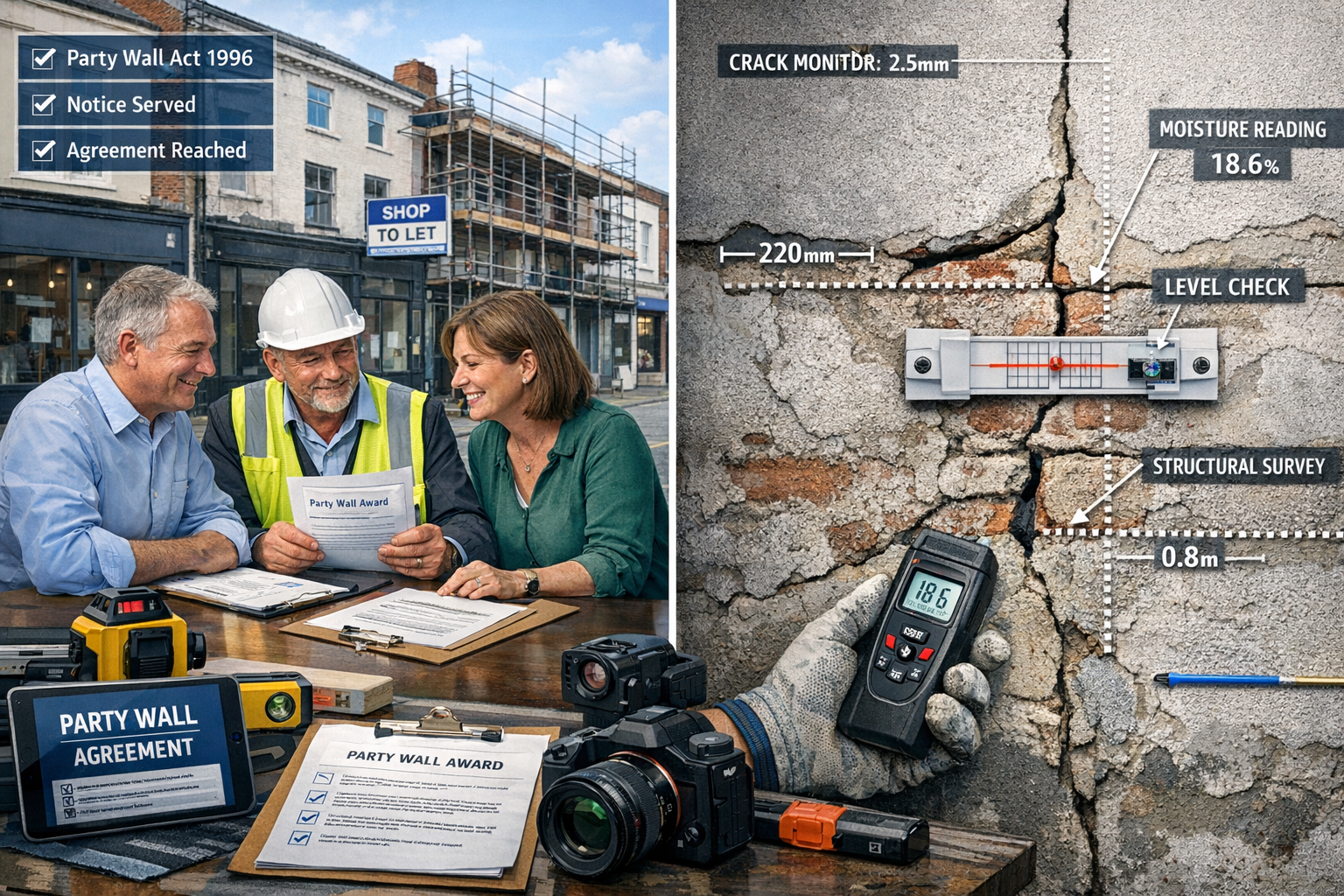
Party Wall Surveys for UK Office-to-Resi Conversions in 2026: Managing Agreements in High Street Revivals represents a critical success factor for developers participating in the urban regeneration transforming Britain's high streets. While permitted development rights have simplified planning procedures, party wall obligations remain unchanged—and arguably more important given the increased volume of conversion activity.
Successful party wall management requires:
✅ Early planning incorporating party wall procedures into project timelines from inception
✅ Professional expertise through engagement of RICS-qualified surveyors experienced in commercial conversions
✅ Comprehensive documentation including detailed schedules of condition and clear work specifications
✅ Proactive communication with all adjoining owners, maintaining transparency and managing expectations
✅ Realistic budgeting accounting for surveyor fees, potential disputes, and damage remediation
✅ Compliance focus ensuring full adherence to the Party Wall Act 1996 and related regulations
The investment in proper party wall procedures pays dividends through reduced disputes, maintained project schedules, and protected property values. As high street revival accelerates through 2026, developers who master party wall management will gain competitive advantages in this dynamic market.
Next Steps for Your Conversion Project
If you're planning an office-to-residential conversion:
- Engage a qualified party wall surveyor early in your planning process to assess requirements and timelines
- Conduct preliminary site assessments identifying all party wall implications before committing to purchase or design
- Budget appropriately for party wall procedures as essential project costs, not optional extras
- Review our party wall FAQ for answers to common questions
- Request a professional quote for comprehensive party wall surveying services tailored to your conversion project
The transformation of UK high streets through office-to-residential conversions offers tremendous opportunities for developers, communities, and urban regeneration. By prioritizing proper party wall procedures and professional surveying services, you can navigate this complex landscape successfully while building positive relationships with neighbours and creating valuable residential properties in thriving urban locations.
References
[1] How To Successfully Convert Offices Into Homes – https://www.garnessjones.co.uk/news/how-to-successfully-convert-offices-into-homes
[2] How To Convert Office Space To Residential – https://propertydata.co.uk/resources/how-to-convert-office-space-to-residential
[3] How To Convert Offices Into Homes Without Planning Permission – https://urbanistarchitecture.co.uk/how-to-convert-offices-into-homes-without-planning-permission/
[4] Office To Residential Conversion What To Know – https://www.jpmorgan.com/insights/real-estate/community-development-banking/office-to-residential-conversion-what-to-know
[5] Converting Commercial To Residential What You Need To Know – https://www.cooperparry.com/news/converting-commercial-to-residential-what-you-need-to-know/
[6] directlinegroup.co.uk – https://www.directlinegroup.co.uk/en/news/brand-news/2024/25112024.html
[7] Converting Vacant Office Space Into Housing – https://www.americanprogress.org/article/converting-vacant-office-space-into-housing/