The northern regions of England are experiencing an unprecedented construction surge in 2026, with housing developments, infrastructure projects, and property renovations transforming neighborhoods at a remarkable pace. As builders break ground on thousands of new homes and homeowners capitalize on rising property values through extensions and conversions, one critical aspect of construction law demands immediate attention: Party Wall Surveys for Northern Construction Boom 2026: Notices, Agreements, and Dispute Prevention. Understanding the Party Wall Act 1996 has never been more essential for property owners, developers, and construction professionals navigating this dynamic market.
The Party Wall Surveys for Northern Construction Boom 2026: Notices, Agreements, and Dispute Prevention framework provides the legal foundation for managing construction work that affects shared walls, boundary structures, and excavations near neighboring properties[1]. With migration patterns shifting northward and construction activity intensifying across Manchester, Leeds, Liverpool, and Newcastle, the volume of party wall matters requiring professional oversight has increased dramatically[3]. This comprehensive guide equips property stakeholders with practical checklists, compliance strategies, and dispute prevention techniques tailored specifically for the northern construction landscape.
Key Takeaways
✅ The Party Wall Act 1996 governs all construction work affecting shared walls, boundary structures, and excavations within three or six meters of neighboring properties, requiring formal notices between 2-12 months before work begins[1]
✅ Northern construction boom conditions demand proactive compliance, with proper party wall surveys, notices, and agreements preventing costly delays and legal disputes in high-demand housing markets[2]
✅ Professional party wall surveyors accredited by RICS, the Chartered Institute of Arbitrators, and the Pyramus and Thisbe Society provide essential oversight for protecting all parties' interests throughout construction projects[1]
✅ Dispute prevention strategies including comprehensive schedules of condition, clear communication protocols, and early neighbor engagement significantly reduce conflict in densely populated northern developments
✅ Non-compliance consequences range from injunctions halting construction to financial penalties and damaged neighbor relations, making proper party wall procedures a critical investment for any building project
Understanding the Party Wall Act Framework in Northern England's 2026 Construction Landscape
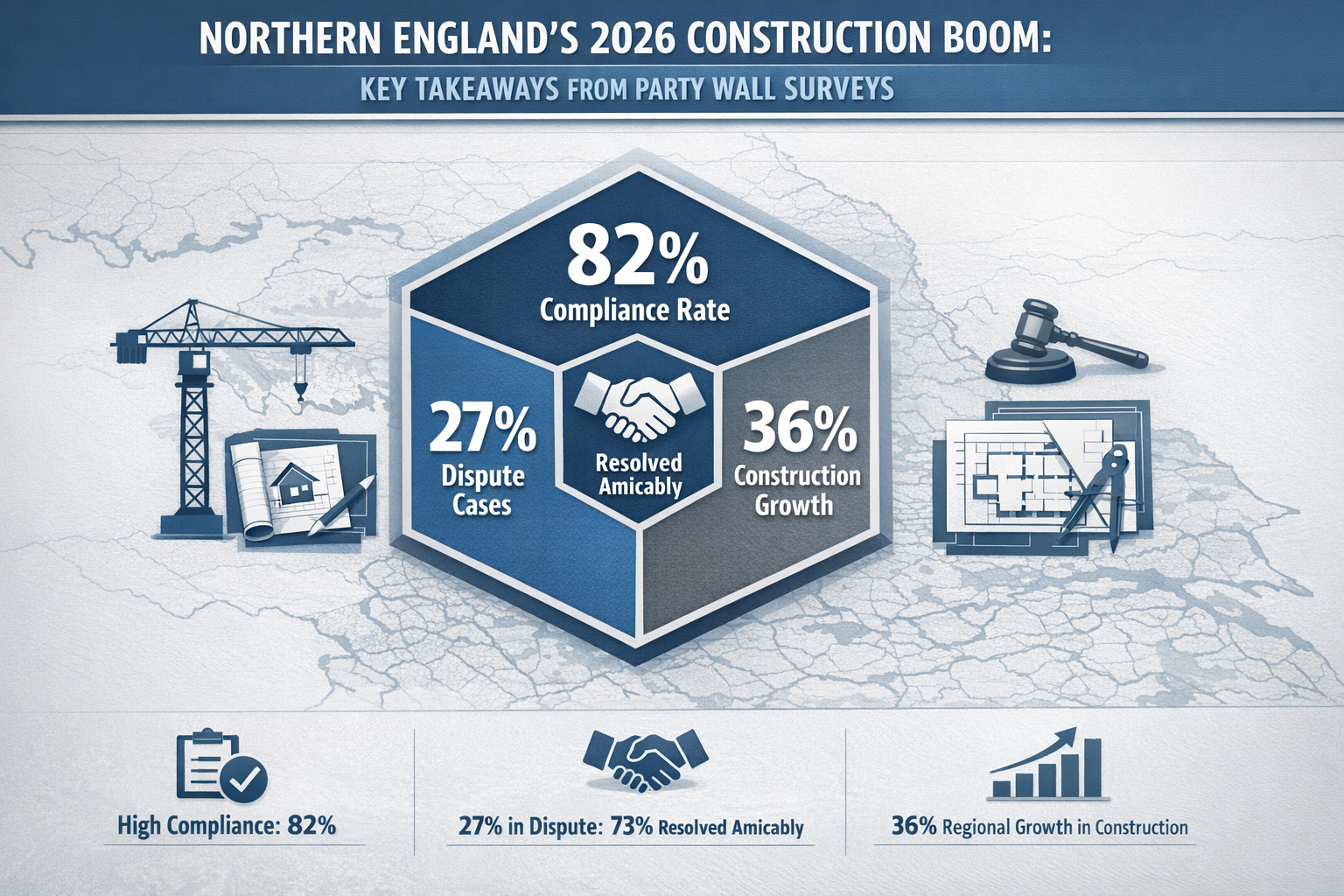
The Party Wall Act 1996 remains the governing legislation for construction work affecting shared structures throughout England and Wales, providing a balanced framework that protects both building owners undertaking construction and adjoining owners whose properties may be affected[1]. As northern regions experience renewed demand forecasts and accelerated development activity in 2026, understanding this legislative framework becomes paramount for successful project delivery.
What Constitutes a Party Wall?
A party wall refers to several distinct structural scenarios that commonly occur in northern England's housing stock:
- Shared walls between semi-detached or terraced properties that stand on the lands of two different owners
- Walls that straddle the boundary line between two properties, even if only one side is built upon
- Boundary walls built entirely on one owner's land but used by both properties (such as garden walls)
- Floors and ceilings in converted flats and maisonettes that separate different ownerships
Northern England's housing landscape features extensive terraced housing stock from the Victorian and Edwardian eras, alongside post-war semi-detached developments and modern townhouse complexes. This architectural heritage means party wall considerations affect a significant proportion of construction projects across the region.
Triggering Events for Party Wall Notices
The Party Wall Act 1996 identifies specific construction activities that trigger the requirement for formal party wall procedures. Understanding these triggering events is essential for Party Wall Surveys for Northern Construction Boom 2026: Notices, Agreements, and Dispute Prevention:
Building on or at the Line of Junction (Section 1)
- Constructing a new wall on the boundary line
- Building a wall astride the boundary line
- Requires notice at least one month before work begins
Work to Existing Party Walls (Section 2)
- Cutting into party walls to insert beams or damp-proof courses
- Raising party walls or adding new floors
- Underpinning party walls or foundations
- Demolishing and rebuilding party walls
- Removing chimney breasts that form part of party walls
- Requires notice at least two months before work begins
Excavation Near Neighboring Buildings (Section 6)
- Excavating within three meters of a neighbor's structure if going deeper than their foundations
- Excavating within six meters of a neighbor's structure if going deeper than a line drawn at 45 degrees from the bottom of their foundations
- Requires notice at least one month before work begins
These provisions are particularly relevant for the northern construction boom's characteristic projects: loft conversions in terraced properties, basement excavations in urban areas, rear extensions on semi-detached homes, and side-return infills on Victorian terraces[1].
If you're facing a situation where no party wall notice has been served, understanding your rights and obligations becomes critical to avoid construction delays.
The Three Types of Party Wall Notices
Proper compliance with Party Wall Surveys for Northern Construction Boom 2026: Notices, Agreements, and Dispute Prevention requires serving the correct notice type:
| Notice Type | Applicable Works | Notice Period | Key Requirements |
|---|---|---|---|
| Party Structure Notice | Work to existing party walls (Section 2) | 2 months | Detailed description of proposed work, plans, and sections |
| Line of Junction Notice | New walls on/at boundary (Section 1) | 1 month | Proposed wall location and construction details |
| Notice of Adjacent Excavation | Excavations within 3m or 6m (Section 6) | 1 month | Excavation depth, proximity, and foundation details |
Each notice must be served in writing to all adjoining owners, providing sufficient detail for them to understand the proposed work's nature and potential impact. For excavation projects, the excavation notice for party wall procedures require particular attention to depth measurements and foundation proximity calculations.
Northern England's Unique Construction Characteristics
The 2026 construction boom in northern England presents specific party wall considerations shaped by regional housing patterns:
🏘️ Dense Terraced Housing: Cities like Manchester, Leeds, and Liverpool feature extensive terraced housing where single projects may require notices to multiple adjoining owners on both sides
🏗️ Victorian and Edwardian Stock: Older properties often have complex foundation arrangements, making excavation notices particularly critical
📈 Rapid Regeneration Areas: Former industrial zones undergoing residential conversion create unique party wall scenarios involving commercial-to-residential boundaries
🌆 Urban Infill Development: Limited land availability drives basement excavations and multi-story extensions that trigger multiple party wall provisions simultaneously
Understanding these regional characteristics helps property owners and developers anticipate party wall requirements early in project planning, preventing delays during the critical construction season.
Comprehensive Compliance Checklist for Party Wall Surveys for Northern Construction Boom 2026
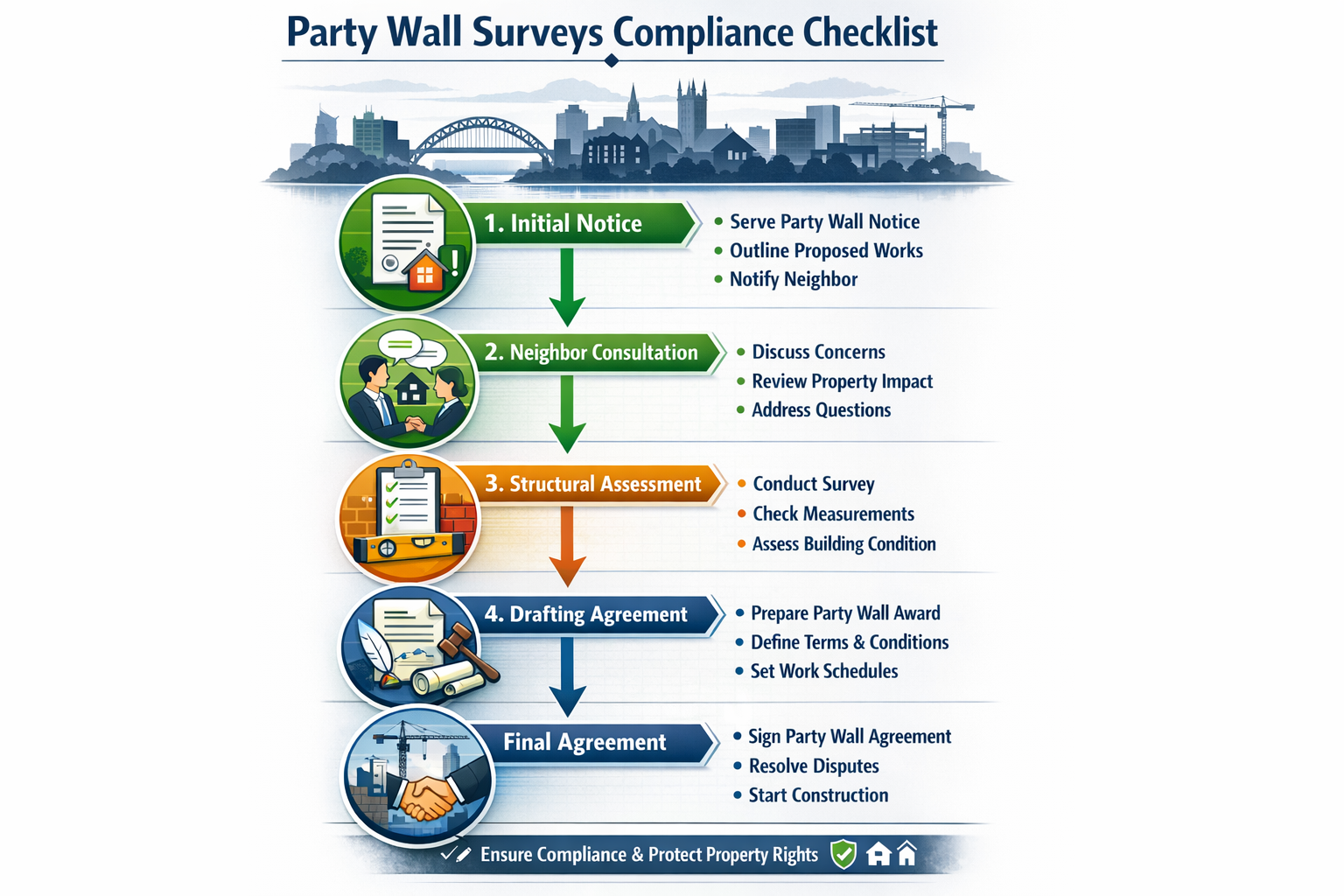
Achieving full compliance with party wall legislation requires systematic planning and professional oversight. This detailed checklist guides building owners through the essential steps for Party Wall Surveys for Northern Construction Boom 2026: Notices, Agreements, and Dispute Prevention.
Phase 1: Pre-Construction Planning (3-6 Months Before Work)
Step 1: Identify Party Wall Implications ✓
- Review architectural plans with party wall provisions in mind
- Determine which structures are party walls, boundary walls, or within excavation zones
- Identify all adjoining owners who require notices
- Consider whether work affects multiple properties (common in terraced housing)
- Consult with architects and structural engineers about party wall impacts
Step 2: Engage Professional Party Wall Surveyor ✓
- Appoint a qualified party wall surveyor with relevant accreditations
- Verify RICS membership and Pyramus and Thisbe Society credentials[1]
- Discuss project timeline and notice requirements
- Obtain fee estimates for surveyor services
- Confirm surveyor's availability for the project duration
Understanding the cost of party wall procedures helps budget appropriately for professional services, which typically represent a small fraction of overall construction costs while providing significant risk mitigation.
Step 3: Conduct Initial Property Assessment ✓
- Commission pre-construction condition surveys of adjoining properties
- Document existing cracks, settlement, or structural issues
- Photograph all relevant areas with dated, timestamped images
- Create detailed schedule of condition reports
- Establish baseline condition to resolve potential future disputes
Step 4: Prepare Comprehensive Notice Documentation ✓
- Draft notices with full project details and technical specifications
- Include architectural drawings, structural calculations, and method statements
- Specify proposed start date (allowing appropriate notice period)
- Detail the nature and extent of work affecting party structures
- Prepare multiple copies for all adjoining owners
Phase 2: Notice Service and Response Period (1-2 Months Before Work)
Step 5: Serve Formal Party Wall Notices ✓
- Deliver notices to all adjoining owners via recorded delivery or hand delivery
- Retain proof of service with dates and delivery confirmation
- Serve notices within the required timeframes (1-2 months depending on work type)
- Include contact information for your appointed surveyor
- Provide clear explanation of adjoining owners' rights and response options
Step 6: Manage Adjoining Owner Responses ✓
- Monitor for consent or dissent within the 14-day response period
- Document all communications with adjoining owners
- If consent received: Proceed with agreed conditions in writing
- If dissent received: Initiate party wall award process
- If no response: Adjoining owner deemed to have dissented after 14 days[1]
Many property owners wonder what happens if you do not have a party wall agreement. The answer is clear: proceeding without proper agreements exposes building owners to injunctions, work stoppages, and potential legal liability.
Step 7: Appoint Party Wall Surveyors ✓
- Building owner appoints their surveyor (already engaged in Step 2)
- Adjoining owner either appoints their own surveyor or agrees to use the same surveyor (Agreed Surveyor)
- If adjoining owner fails to appoint, building owner's surveyor appoints on their behalf
- Appointed surveyors must act impartially despite appointment source
- Surveyors select a Third Surveyor to resolve any disputes between them
Phase 3: Award Preparation and Agreement (2-4 Weeks)
Step 8: Facilitate Surveyor Inspections and Assessments ✓
- Arrange access for surveyors to inspect both properties
- Provide complete construction documentation and specifications
- Respond promptly to surveyor requests for additional information
- Facilitate meetings between surveyors and construction team
- Address any concerns raised during surveyor assessments
Step 9: Review and Finalize Party Wall Award ✓
- Receive draft award from appointed surveyor(s)
- Review all conditions, timelines, and working hour restrictions
- Verify insurance requirements and indemnity provisions
- Confirm schedule of condition accuracy and completeness
- Sign and exchange final award documents with all parties
The party wall award serves as a legally binding document that:
- Grants permission for the proposed work to proceed
- Sets conditions for how work must be carried out
- Establishes monitoring and inspection protocols
- Determines responsibility for costs and potential damage
- Provides dispute resolution mechanisms if issues arise
Step 10: Communicate Award Terms to Construction Team ✓
- Brief contractors on all party wall award conditions
- Highlight restricted working hours and access limitations
- Explain monitoring requirements and surveyor inspection schedules
- Establish protocols for reporting issues or neighbor concerns
- Ensure compliance mechanisms are built into construction management
Phase 4: Construction Phase Management
Step 11: Implement Award Conditions During Construction ✓
- Adhere strictly to working hours specified in the award
- Provide required notice before commencing different work phases
- Facilitate surveyor inspections at specified intervals
- Document compliance with award conditions
- Maintain open communication channels with adjoining owners
Step 12: Monitor and Document Construction Progress ✓
- Conduct regular condition monitoring of adjoining properties
- Photograph any changes or concerns immediately
- Report potential issues to party wall surveyor promptly
- Maintain detailed construction logs and incident reports
- Address neighbor concerns through proper channels
Understanding what constitutes a party wall dispute helps construction teams recognize warning signs early and implement corrective measures before conflicts escalate.
Phase 5: Post-Construction Completion
Step 13: Conduct Final Condition Assessments ✓
- Commission post-construction condition surveys of adjoining properties
- Compare final condition to pre-construction baseline documentation
- Identify any damage or changes attributable to construction work
- Engage surveyors to assess and quantify any necessary remediation
- Obtain final sign-off from party wall surveyors
Step 14: Resolve Any Damage Claims ✓
- Address legitimate damage claims promptly and professionally
- Engage qualified contractors for remediation work
- Document all remediation activities with photographs and reports
- Obtain adjoining owner approval for completed remediation
- Settle financial claims in accordance with award provisions
Step 15: Archive Complete Party Wall Documentation ✓
- Compile all notices, awards, surveys, and correspondence
- Create comprehensive project file for future reference
- Provide copies to property solicitors for conveyancing records
- Retain documentation for statutory limitation periods
- Update property information for future owners
This systematic approach to Party Wall Surveys for Northern Construction Boom 2026: Notices, Agreements, and Dispute Prevention ensures legal compliance while maintaining positive neighbor relations throughout the construction process.
Dispute Prevention Strategies for High-Demand Northern Housing Markets
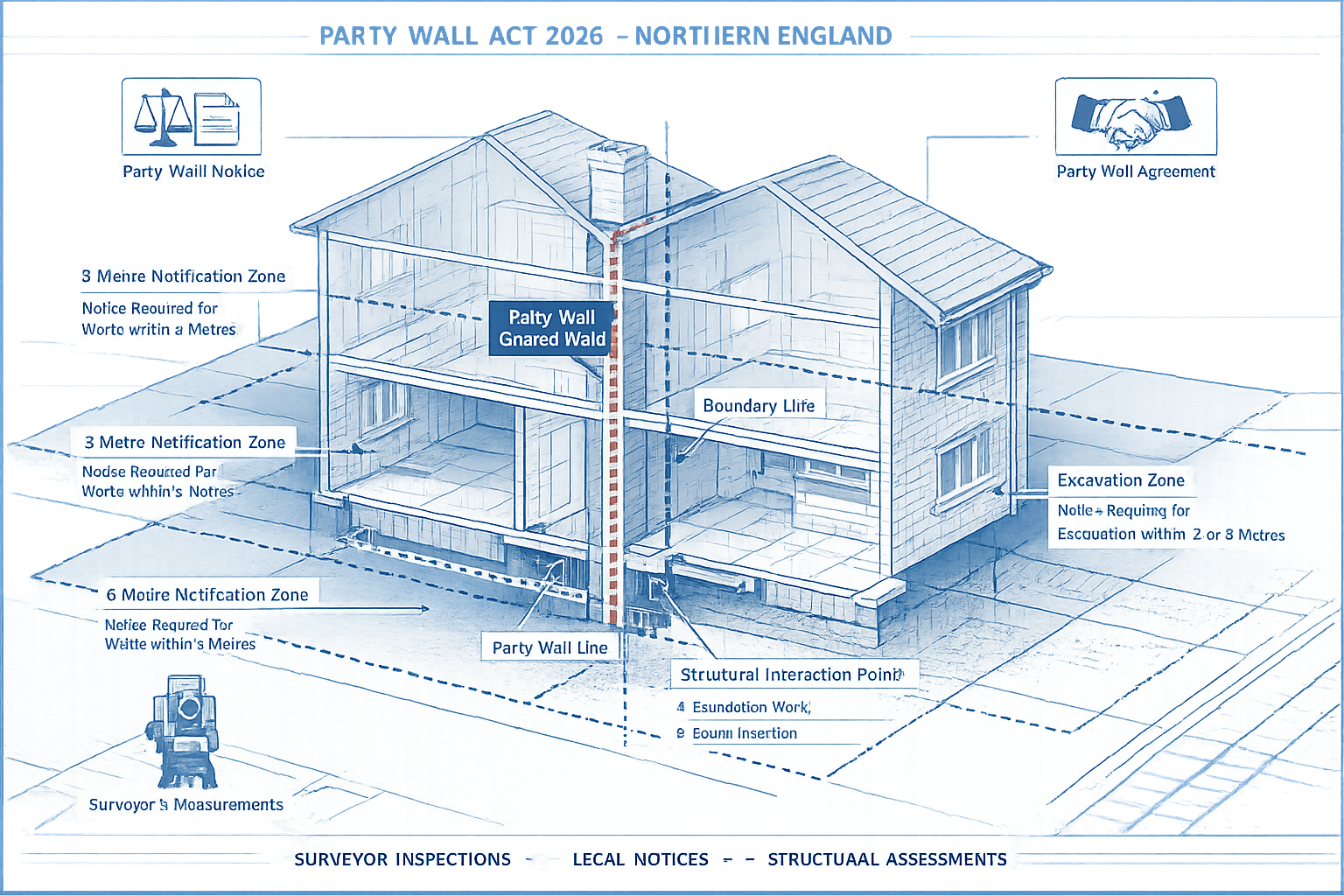
The northern construction boom of 2026 brings increased pressure on party wall procedures, with higher volumes of concurrent projects and compressed timelines creating potential friction points[2]. Implementing proactive dispute prevention strategies protects project schedules, budgets, and community relationships.
Early Neighbor Engagement and Communication
Proactive Communication Protocols 🗣️
Successful party wall management begins long before formal notices are served. Building owners who invest time in early neighbor engagement experience significantly fewer disputes and smoother project delivery:
- Initial informal discussion: Speak with neighbors about planned work before formal notices, explaining the project vision and anticipated timeline
- Visual presentations: Share architectural renderings and plans to help neighbors visualize the finished project
- Address concerns early: Listen to neighbor concerns and modify plans where reasonable to accommodate legitimate issues
- Establish communication channels: Provide direct contact information for the project manager and party wall surveyor
- Regular updates: Keep neighbors informed about project milestones and any schedule changes
This collaborative approach transforms the party wall process from a purely legal requirement into a relationship-building opportunity. In densely populated northern neighborhoods where community cohesion matters, this investment pays dividends throughout the construction period.
Professional Documentation and Record-Keeping
Comprehensive Schedule of Condition 📋
The schedule of condition represents the single most important dispute prevention tool in party wall procedures. This detailed photographic and written record documents the pre-construction state of adjoining properties, providing objective evidence to resolve any damage claims:
Essential Schedule of Condition Elements:
- High-resolution photographs of all rooms, especially those adjacent to party walls
- Detailed written descriptions of existing defects, cracks, and settlement
- Measurements of significant cracks with dated photographic evidence
- Documentation of existing dampness, staining, or structural issues
- External photography showing roof condition, rendering, and boundary structures
- Video walkthroughs providing additional context
- Professional surveyor certification and signature
When disputes arise regarding damage to property in party wall scenarios, comprehensive pre-construction documentation provides clear evidence of whether damage resulted from construction activity or pre-existed the work.
Selecting Qualified Party Wall Surveyors
Professional Accreditation and Experience 🎓
The quality of party wall surveyor services directly impacts dispute prevention success. Property owners should prioritize surveyors with:
Essential Qualifications:
- RICS membership (Royal Institution of Chartered Surveyors) demonstrating professional standards[1]
- Pyramus and Thisbe Society membership indicating party wall specialization[1]
- Chartered Institute of Arbitrators accreditation for dispute resolution expertise[1]
- Local market knowledge of northern England's housing stock and construction practices
- Proven track record with similar project types and property configurations
Experience Considerations:
- Minimum 5+ years party wall surveying experience
- Familiarity with Victorian/Edwardian terraced properties common in northern cities
- Understanding of basement excavation challenges in urban environments
- Experience managing multi-party scenarios in terraced housing
- Professional indemnity insurance coverage
Investing in qualified professional surveyors costs significantly less than resolving disputes through litigation or dealing with construction delays caused by party wall conflicts.
Managing Common Northern Construction Scenarios
Terraced Housing Challenges 🏘️
Northern England's extensive terraced housing stock presents unique party wall management requirements:
Multi-Party Coordination:
- Single mid-terrace property may require notices to neighbors on both sides
- End-terrace properties still typically share one party wall
- Coordinating multiple adjoining owner responses extends timeline
- Disagreement from one neighbor while others consent creates complexity
- Staggered construction phases may require multiple notice periods
Victorian/Edwardian Structural Considerations:
- Older properties often lack modern foundations, increasing excavation sensitivity
- Historical settlement and movement patterns require careful baseline documentation
- Chimney breasts and flues frequently penetrate party walls
- Roof structures may share timbers across party walls
- Dampness and existing defects common, requiring clear pre-construction records
Basement Excavation Projects 🏗️
The popularity of basement conversions in northern urban areas creates specific party wall challenges:
- Excavations frequently trigger Section 6 notices to multiple neighbors
- Foundation depth calculations require professional structural engineering input
- Underpinning party walls may be necessary, triggering Section 2 notices
- Temporary works and shoring systems need careful planning and approval
- Vibration monitoring may be required to protect adjoining structures
- Water table management and drainage considerations affect multiple properties
For projects involving significant excavation, understanding the specific requirements for an excavation notice for party wall ensures compliance with Section 6 provisions.
Addressing Non-Compliance Situations
When Neighbors Proceed Without Agreements ⚠️
The construction boom inevitably leads to situations where property owners or contractors begin work without proper party wall procedures. Understanding response options protects adjoining owners' rights:
If you discover a neighbor is carrying out works without a party wall agreement, immediate action is essential:
- Document the unauthorized work with photographs and dated records
- Engage a party wall surveyor to assess the situation and your rights
- Communicate formally with the building owner in writing
- Request immediate cessation of work until proper procedures are followed
- Consider injunctive relief if work continues despite objections
- Pursue retrospective party wall awards where appropriate
The Party Wall Act provides remedies for non-compliance, but early intervention prevents more serious damage and conflict escalation.
Insurance and Liability Considerations
Protecting All Parties' Interests 🛡️
Comprehensive insurance coverage forms an essential component of dispute prevention:
Building Owner Insurance Requirements:
- Public liability insurance covering party wall work (minimum £5-10 million)
- Professional indemnity insurance for appointed surveyors
- Contractor's all-risks insurance including adjoining property damage
- Structural warranty coverage for new construction elements
- Legal expenses insurance for potential dispute resolution
Adjoining Owner Protections:
- Right to inspect building owner's insurance documentation
- Party wall award provisions requiring proof of adequate coverage
- Indemnity clauses protecting against damage and consequential losses
- Surveyor oversight of insurance adequacy
- Direct claim rights in case of damage
Technology and Monitoring Solutions
Modern Dispute Prevention Tools 💻
The 2026 construction landscape benefits from technological advances that enhance party wall management:
Monitoring Technologies:
- Vibration sensors providing real-time data on construction impact
- Crack monitoring gauges tracking movement in adjoining properties
- Digital photographic documentation with GPS and timestamp metadata
- Drone surveys for roof and external condition assessment
- 3D laser scanning creating precise baseline condition records
Communication Platforms:
- Digital project portals providing neighbors with construction updates
- Mobile apps for reporting concerns and requesting information
- Automated notification systems for upcoming work phases
- Document sharing platforms for awards, schedules, and reports
- Video conferencing for remote surveyor consultations
These technological solutions complement traditional party wall procedures, providing enhanced transparency and objective data to prevent disputes from arising.
Regional Planning Authority Coordination
Navigating Northern England's Regulatory Landscape 🏛️
The construction boom has increased scrutiny from planning authorities and building control departments across northern regions[2]. Coordinating party wall compliance with broader regulatory requirements prevents delays:
Planning Permission Considerations:
- Some planning authorities request evidence of party wall compliance
- Building control may require party wall awards before approving work commencement
- Conservation area restrictions may affect party wall work methods
- Listed building consent interacts with party wall procedures
- Permitted development rights don't override party wall requirements
Building Control Coordination:
- Share party wall awards with building control inspectors
- Coordinate inspection schedules between building control and party wall surveyors
- Ensure structural calculations align with party wall award conditions
- Address any conflicts between building regulations and party wall requirements
- Obtain final certificates from both building control and party wall surveyors
Understanding that party wall compliance runs parallel to, rather than replaces, planning and building control procedures ensures comprehensive regulatory compliance.
Navigating the 2026 Northern Construction Boom: Practical Applications and Case Studies
The unprecedented growth in northern England's construction sector during 2026 creates both opportunities and challenges for party wall management. Real-world applications of Party Wall Surveys for Northern Construction Boom 2026: Notices, Agreements, and Dispute Prevention principles demonstrate how property owners successfully navigate complex scenarios.
Case Study 1: Manchester Terraced Housing Loft Conversion
Project Overview:
A mid-terrace Victorian property in Manchester's Chorlton neighborhood required a loft conversion with dormer extension, affecting party walls on both sides and triggering multiple party wall provisions.
Party Wall Challenges:
- Raising party walls to accommodate increased roof height (Section 2 notice required)
- Inserting steel beams into party walls for structural support (Section 2 notice required)
- Working on shared roof structures spanning party walls
- Coordinating with two sets of adjoining owners with different concerns
- Managing construction access through narrow terraced street
Successful Resolution Strategy:
- Early engagement: Building owner met with both neighbors three months before formal notices, sharing plans and addressing concerns
- Agreed surveyor approach: All three parties agreed to appoint a single surveyor, reducing costs and streamlining the process
- Comprehensive schedule of condition: Detailed photographic surveys documented existing cracks and settlement in both adjoining properties
- Phased construction approach: Work schedule minimized disruption during school holidays when one neighbor's children were home
- Enhanced communication: Weekly update emails kept neighbors informed of progress and upcoming work phases
Outcome:
The project completed on schedule without disputes. Minor cosmetic damage to one adjoining property's ceiling was identified, documented, and remediated within the party wall award framework. Total party wall costs represented less than 2% of the overall project budget while preventing potential delays worth far more.
Case Study 2: Leeds Basement Excavation Project
Project Overview:
A semi-detached Edwardian property in Leeds' Roundhay area required basement excavation extending 2.5 meters below ground level, triggering Section 6 excavation notices to multiple neighbors.
Party Wall Challenges:
- Excavation within 3 meters of three neighboring properties' foundations
- Uncertain foundation depths in 100-year-old neighboring structures
- High water table requiring dewatering management
- Party wall underpinning required on one side
- Neighbor concerns about structural stability and property value impact
Successful Resolution Strategy:
- Trial pit investigation: Structural engineer excavated trial pits to establish neighboring foundation depths before finalizing plans
- Specialist surveyor appointment: Building owner engaged surveyor with extensive basement excavation experience
- Enhanced structural design: Engineer specified underpinning and temporary shoring exceeding minimum requirements to address neighbor concerns
- Vibration monitoring: Real-time sensors installed in all three adjoining properties to track construction impact
- Professional presentations: Structural engineer attended neighbor meetings to explain safety measures and answer technical questions
Outcome:
All three neighbors initially dissented but ultimately agreed to proceed after reviewing enhanced structural measures. Vibration monitoring data demonstrated construction remained within safe parameters throughout excavation. One minor crack appeared in an adjoining property but pre-construction schedule of condition proved it pre-existed the work. The project demonstrated how professional expertise and enhanced communication overcome initial neighbor resistance.
Case Study 3: Liverpool Multi-Unit Development
Project Overview:
A developer converted a former commercial building in Liverpool's Baltic Triangle into six residential units, requiring extensive party wall work affecting multiple existing residential properties on three sides.
Party Wall Challenges:
- New party walls created between individual units within the development
- Excavation for new foundations affecting established neighboring properties
- Boundary wall construction along two property lines
- Coordinating notices to seven separate adjoining owners
- Managing commercial-to-residential transition party wall implications
Successful Resolution Strategy:
- Professional project management: Developer appointed dedicated party wall coordinator to manage all notices and surveyor appointments
- Standardized documentation: Created template notices and information packs for all adjoining owners
- Community presentation: Hosted open house event for neighbors to view plans and meet the development team
- Staggered notice service: Timed notices to align with construction phasing, avoiding unnecessary early notifications
- Professional surveyor panel: Engaged three qualified surveyors to handle the volume of work efficiently
Outcome:
Despite the complexity of multiple adjoining owners, the systematic approach resulted in party wall awards for all affected parties within six weeks. Two disputes arose regarding working hours and access, but the appointed surveyors resolved both through award amendments without construction delays. The developer's investment in professional party wall management protected the project timeline and budget while maintaining community relations essential for future developments in the area.
Emerging Trends in Northern Party Wall Practice
The 2026 construction boom reveals several emerging trends shaping party wall practice across northern England:
Increased Professional Specialization 📊
The volume of party wall work has driven surveyor specialization, with practitioners focusing on specific project types:
- Basement excavation specialists with structural engineering backgrounds
- Victorian/Edwardian property experts understanding historical construction methods
- Multi-unit development coordinators managing complex stakeholder scenarios
- Heritage property specialists navigating listed building constraints
Digital Documentation Standards 💾
Technology adoption has accelerated, with industry best practices now including:
- 3D laser scanning for precise condition documentation
- Blockchain-verified timestamp documentation preventing later disputes about evidence dates
- Cloud-based document sharing platforms providing all parties with real-time access
- Digital signature platforms streamlining award execution
- Automated compliance tracking systems monitoring notice periods and deadlines
Sustainability Considerations 🌱
The push toward energy efficiency affects party wall work, particularly regarding party wall insulation requirements:
- Internal wall insulation affecting party wall thickness and boundary positions
- External wall insulation extending beyond property boundaries
- Cavity wall insulation in party walls requiring neighbor coordination
- Acoustic insulation improvements triggering party wall procedures
- Thermal bridging solutions affecting party wall construction details
Regulatory Integration 📋
Planning authorities across northern England increasingly coordinate party wall compliance with broader development control:
- Pre-application advice now routinely includes party wall considerations
- Building control inspectors requesting party wall award evidence before sign-off
- Conservation officers requiring party wall procedures for heritage properties
- Environmental health departments considering party wall awards in nuisance complaints
- Local authority legal teams providing party wall guidance to planning applicants
Cost-Benefit Analysis of Professional Party Wall Management
Understanding the financial implications of proper party wall procedures helps property owners make informed decisions about professional engagement:
Typical Party Wall Costs (2026 Northern England):
| Service Component | Typical Cost Range | Notes |
|---|---|---|
| Building Owner's Surveyor | £800-£1,500 | Simple projects (single neighbor, straightforward work) |
| Building Owner's Surveyor | £1,500-£3,500 | Complex projects (multiple neighbors, excavation) |
| Adjoining Owner's Surveyor | £600-£1,200 per neighbor | Building owner typically pays both surveyors' fees |
| Schedule of Condition | £300-£800 per property | Detailed photographic and written survey |
| Award Preparation | Included in surveyor fees | Part of standard service |
| Monitoring Visits | £150-£300 per visit | Typically 2-4 visits during construction |
| Dispute Resolution | £1,500-£5,000+ | If Third Surveyor involvement required |
Total typical investment: £2,000-£8,000 for most residential projects
Costs of Non-Compliance:
| Risk Factor | Potential Cost Impact |
|---|---|
| Injunction halting work | £10,000-£50,000+ in delays, legal fees, contractor standby costs |
| Retrospective party wall procedures | 150-200% of standard costs due to urgency and complexity |
| Damage claims without baseline documentation | Unlimited – no evidence to dispute neighbor claims |
| Neighbor litigation | £20,000-£100,000+ in legal costs and settlements |
| Property sale complications | Reduced sale price, collapsed transactions, legal indemnities required |
The cost-benefit analysis clearly favors proactive professional party wall management, with compliance costs representing a small fraction of potential non-compliance consequences.
For property owners concerned about expenses, understanding the full cost of party wall procedures in context of overall project budgets demonstrates the value proposition of professional services.
Regional Variations Across Northern England
While the Party Wall Act 1996 applies uniformly across England and Wales, practical implementation varies across northern regions based on local housing stock and construction patterns:
Greater Manchester 🏙️
- High proportion of terraced Victorian housing requiring multi-party coordination
- Basement conversions increasingly popular in urban core areas
- Strong community networks making early neighbor engagement particularly valuable
- Active local authority building control departments with party wall awareness
Leeds and West Yorkshire 🏘️
- Mix of stone-built terraced properties and modern developments
- Significant heritage property considerations in conservation areas
- Growing student housing market driving HMO conversions with party wall implications
- Professional surveyor networks well-established with local expertise
Liverpool and Merseyside ⚓
- Waterfront regeneration creating commercial-to-residential party wall scenarios
- Historic building stock requiring specialist heritage party wall expertise
- Community-focused development culture emphasizing neighbor consultation
- Local authority planning departments increasingly requesting party wall evidence
Newcastle and North East 🌉
- Tyneside flats creating unique party wall ownership scenarios
- Former industrial areas undergoing residential conversion
- Strong regional construction sector with growing party wall awareness
- Emerging professional surveyor market responding to construction boom
Understanding these regional characteristics helps property owners and developers tailor party wall strategies to local conditions and expectations.
Conclusion: Securing Success in Northern England's Construction Future
The Party Wall Surveys for Northern Construction Boom 2026: Notices, Agreements, and Dispute Prevention framework provides essential guidance for navigating one of the most significant construction periods in northern England's recent history. As thousands of property owners and developers undertake building projects across Manchester, Leeds, Liverpool, Newcastle, and surrounding areas, proper party wall compliance separates successful projects from costly disputes and delays.
Key Success Factors
The evidence from 2026's construction activity demonstrates that successful party wall management rests on several fundamental principles:
Professional Expertise 🎯
Engaging qualified party wall surveyors with RICS accreditation, Pyramus and Thisbe Society membership, and relevant local experience provides the foundation for compliant, dispute-free projects[1]. The modest investment in professional services delivers exceptional value through risk mitigation and project protection.
Proactive Planning 📅
Starting party wall procedures 3-6 months before construction allows adequate time for notice periods, surveyor appointments, award preparation, and dispute resolution if needed. Rushed party wall processes create unnecessary stress and increase dispute likelihood.
Comprehensive Documentation 📸
Detailed schedules of condition with photographic evidence, written descriptions, and professional certification provide objective records that prevent disputes and resolve damage claims fairly. This documentation protects both building owners and adjoining owners' legitimate interests.
Clear Communication 💬
Early neighbor engagement, regular updates, and transparent information sharing transform party wall procedures from purely legal requirements into relationship-building opportunities. In northern England's close-knit communities, this investment in communication pays long-term dividends.
Regulatory Coordination 🏛️
Integrating party wall compliance with planning permission, building control, and other regulatory requirements ensures comprehensive project approval and prevents delays from overlooked procedures[2].
Actionable Next Steps for Property Owners
Whether planning a loft conversion, basement excavation, extension, or new development, property owners should take these immediate actions:
1. Assess Party Wall Implications ✅
Review planned construction work against the Party Wall Act's triggering provisions. Determine whether work affects party walls, boundary structures, or involves excavations near neighboring properties. Identify all adjoining owners requiring notices.
2. Engage Professional Surveyor ✅
Contact qualified party wall surveyors with relevant northern England experience. Request fee quotations and confirm availability for your project timeline. Verify professional accreditations and local market knowledge.
3. Initiate Early Neighbor Dialogue ✅
Speak informally with neighbors about planned work before serving formal notices. Share project vision, address concerns, and establish positive working relationships. This early investment prevents later conflicts.
4. Commission Baseline Condition Surveys ✅
Arrange comprehensive schedules of condition for all adjoining properties before serving party wall notices. Ensure photographic documentation covers all areas, particularly those adjacent to proposed work. Obtain professional surveyor certification of baseline conditions.
5. Prepare and Serve Formal Notices ✅
Work with your appointed surveyor to prepare compliant party wall notices with complete project details. Serve notices within required timeframes (1-2 months depending on work type). Retain proof of service for all notices.
6. Manage Award Process Professionally ✅
Respond promptly to surveyor requests for information and access. Review draft awards carefully and raise any concerns before finalization. Communicate award conditions clearly to your construction team.
7. Maintain Compliance Throughout Construction ✅
Adhere strictly to party wall award conditions regarding working hours, access, and monitoring. Document compliance and address any issues immediately through proper channels. Maintain open communication with neighbors and surveyors.
8. Complete Post-Construction Procedures ✅
Commission final condition surveys comparing post-construction state to baseline documentation. Address any legitimate damage claims promptly and professionally. Obtain final surveyor sign-off and archive complete party wall documentation.
Looking Ahead: The Future of Party Wall Practice
As northern England's construction boom continues through 2026 and beyond, party wall practice will continue evolving to meet market demands. Property owners who embrace professional party wall management position themselves for successful project delivery while maintaining positive community relationships.
The Party Wall Act 1996 provides a balanced, proven framework for managing construction work affecting shared structures. When implemented professionally with proper notices, comprehensive surveys, and clear agreements, party wall procedures protect all parties' legitimate interests while enabling essential construction activity.
For property owners uncertain about their party wall obligations, seeking professional guidance early prevents costly mistakes and project delays. The comprehensive party wall services available from qualified surveyors provide expert support throughout the entire process, from initial assessment through post-construction completion.
The northern construction boom of 2026 represents tremendous opportunity for property owners, developers, and communities. By prioritizing proper party wall compliance through professional surveys, timely notices, comprehensive agreements, and proactive dispute prevention, stakeholders ensure this construction activity delivers lasting value for all involved.
Understanding and implementing Party Wall Surveys for Northern Construction Boom 2026: Notices, Agreements, and Dispute Prevention best practices transforms potential conflicts into collaborative processes, protecting property values, neighbor relationships, and project success across northern England's dynamic construction landscape.
References
[1] 88790 Partywalls London Highlights Essential Party Wall Surveyor Services For Tower Hamlets Property Devel – https://pressadvantage.com/story/88790-partywalls-london-highlights-essential-party-wall-surveyor-services-for-tower-hamlets-property-devel
[2] Party Wall Surveys Amid 2026 Construction Boom Handling Disputes In High Demand Uk Housing Markets – https://nottinghillsurveyors.com/blog/party-wall-surveys-amid-2026-construction-boom-handling-disputes-in-high-demand-uk-housing-markets
[3] Building Surveys For First Time Buyers In Northern Markets Capturing 2026 Migration Demand From Southern Slump – https://nottinghillsurveyors.com/blog/building-surveys-for-first-time-buyers-in-northern-markets-capturing-2026-migration-demand-from-southern-slump