
As the UK accelerates toward its net zero targets in 2026, homeowners face a critical intersection of environmental responsibility and property law. Party Wall Surveys for Heat Pump Installations: Navigating 2026 Net Zero Mandates and Neighbour Agreements has become essential knowledge for anyone planning renewable energy retrofits on shared boundaries. With government incentives driving unprecedented heat pump adoption—over 70,000 Boiler Upgrade Scheme redemptions recorded through November 2025—understanding your legal obligations under the Party Wall Act 1996 protects both your investment and your relationship with neighbours.
The transition to low-carbon heating isn't just encouraged; it's increasingly mandated. The government's Warm Homes Plan aims to reach over 450,000 heat pump installations annually by 2030, compared to just 84,000 in 2024.[2] This dramatic acceleration means thousands of property owners will soon navigate the complex intersection of renewable energy upgrades and party wall legislation.
Key Takeaways
- Party wall notices are legally required for most heat pump installations on shared boundaries, with specific timelines (2 months for building work, 1 month for excavation)
- Government incentives in 2026 include the Boiler Upgrade Scheme with substantial grants, but a £10,000 spending cap applies to private rented sector upgrades[2]
- Professional party wall surveys protect against future disputes by documenting pre-installation conditions and securing formal neighbour agreements
- Air source heat pumps typically trigger Section 2 (work to existing party walls) or Section 6 (excavation near boundaries) notices under the Party Wall Act 1996
- Non-compliance penalties can include forced removal of installations, legal costs, and damaged neighbour relations—far exceeding the cost of proper surveys
Understanding Party Wall Requirements for Heat Pump Installations
The Party Wall Act 1996 governs building work affecting shared walls, boundaries, and excavations near neighbouring properties. When installing heat pumps—particularly air source heat pumps (ASHPs) mounted on external walls or ground source systems requiring excavation—property owners must understand which sections of the Act apply.
Which Party Wall Notices Apply to Heat Pumps? 🏠
Heat pump installations typically trigger one or more of three notice types:
Section 1 Notice: New Walls on Boundary Lines
- Rarely applies to heat pump installations
- Relevant only if constructing new structures on the exact boundary line
- Requires 2 months' notice before work begins
Section 2 Notice: Work to Existing Party Walls
- Most common for ASHP installations mounted on shared or boundary walls
- Covers structural modifications, attachments, or alterations
- Includes installing mounting brackets that penetrate party walls
- Requires 2 months' notice period
Section 6 Notice: Excavation Near Boundaries
- Critical for ground source heat pumps requiring trenching
- Applies when excavating within 3 meters of a neighbour's structure (if going deeper than their foundations)
- Also applies when excavating within 6 meters (if cutting a line at 45 degrees down from their foundation base)
- Requires 1 month's notice
According to research on barriers to air source heat pump adoption, physical property constraints rank among the top concerns for homeowners, with party wall considerations adding legal complexity to installation decisions.[4]
When Party Wall Consent Is Mandatory
Not every heat pump installation requires party wall consent, but most do. Mandatory scenarios include:
✅ Mounting ASHP units on shared external walls between semi-detached or terraced properties
✅ Installing pipework that penetrates party walls
✅ Excavating for ground source systems within prescribed distances
✅ Structural modifications to support heavy equipment
✅ Work affecting shared chimneys or flues (if adapting existing heating infrastructure)
Understanding what happens if you do not have a party wall agreement is crucial—neighbours can obtain injunctions forcing work stoppage or removal of installations, potentially costing thousands in legal fees and wasted equipment.
2026 Government Mandates Driving Heat Pump Adoption
The UK government's commitment to decarbonizing home heating has created a perfect storm of incentives, mandates, and deadlines that make 2026 a pivotal year for heat pump installations.
The Warm Homes Plan and Installation Targets
The Warm Homes Plan represents the most ambitious residential heating transformation in UK history. Key targets include:
- 450,000+ annual heat pump installations by 2030[2]
- 40% increase in installations during 2025 compared to the previous 12 months[2]
- Focus on both private and social housing sectors
- Integration with broader Energy Performance Certificate (EPC) upgrade requirements
For social housing specifically, the Social Housing Decarbonisation Fund has already delivered approximately 120,600 measures across 57,200 households through December 2025, with heat pumps and insulation forming primary intervention strategies.[1]
Financial Incentives and Spending Caps
Boiler Upgrade Scheme (BUS) Performance:
- Over 70,000 redemptions recorded through November 2025[2]
- 108,000 total applications submitted
- Grants covering significant portions of installation costs
- Streamlined application processes in 2026
Private Rented Sector Constraints:
The government has set a £10,000 spending cap per property for landlord-funded upgrades in the private rented sector—lower than the originally proposed £15,000.[2] This creates tension between compliance requirements and financial feasibility.
Average upgrade costs currently sit at approximately £5,400 nationally, rising to £6,100 in higher-cost regions like the East of England.[2] These figures include heat pump installations combined with necessary insulation and electrical upgrades.
EPC Requirements and Retrofit Mandates
Heat pump installations rarely occur in isolation. They're increasingly part of comprehensive retrofit packages addressing Energy Performance Certificate upgrades required under 2026 mandates.[3]
Key EPC-Related Drivers:
- Minimum EPC ratings for rental properties (currently EPC E, moving toward C)
- Improved property valuations with higher EPC ratings
- Reduced energy bills offsetting installation costs
- Enhanced marketability for future sales
The integration of party wall requirements with these broader retrofit mandates means homeowners must coordinate multiple compliance frameworks simultaneously—making professional surveyor guidance increasingly valuable.
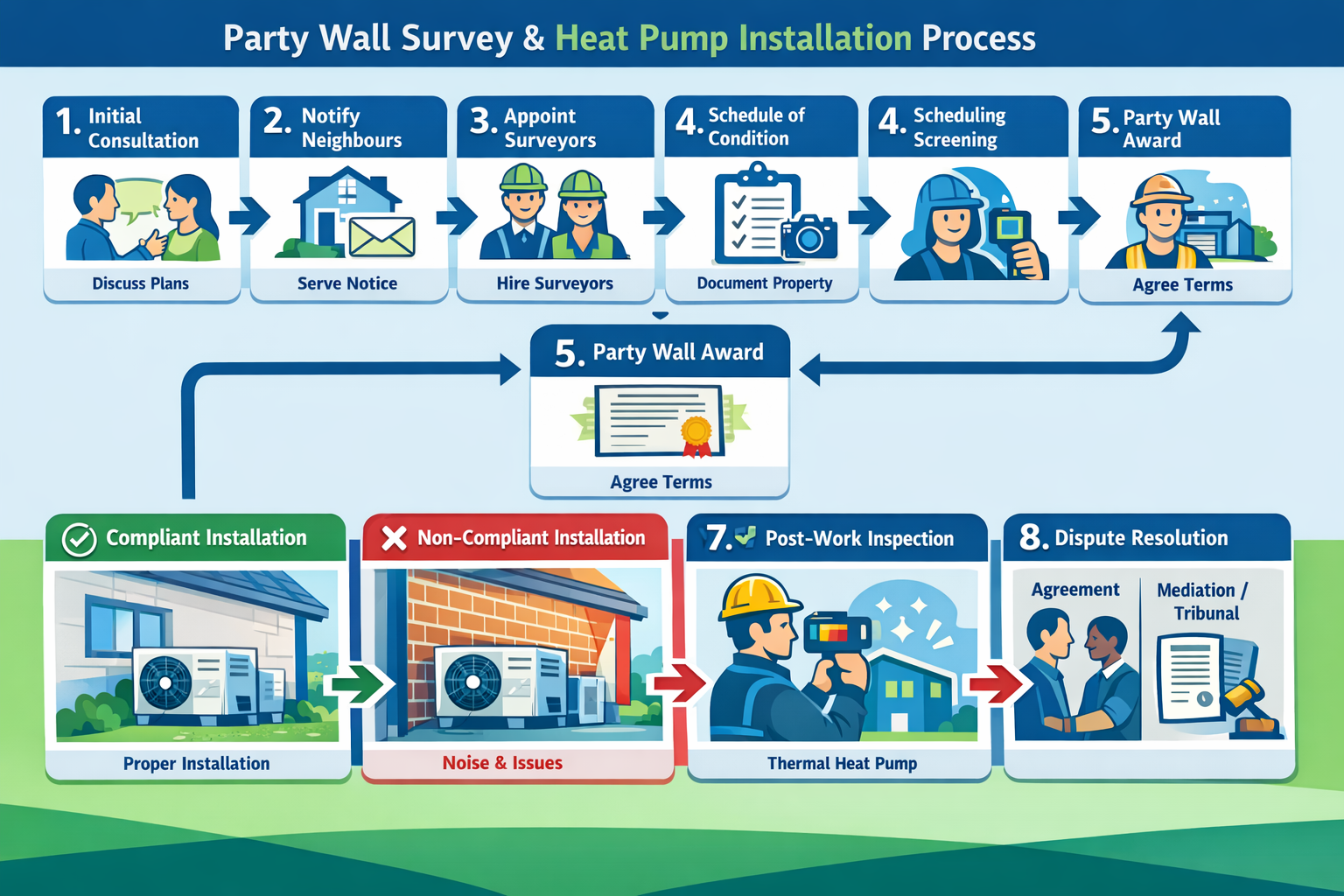
The Party Wall Survey Process for Heat Pump Projects
Navigating Party Wall Surveys for Heat Pump Installations: Navigating 2026 Net Zero Mandates and Neighbour Agreements requires understanding the step-by-step process from initial planning through installation completion.
Step 1: Pre-Installation Assessment and Planning
Before serving any notices, conduct a thorough assessment:
- Determine heat pump type and location (air source vs. ground source)
- Identify affected boundaries and neighbouring properties
- Review property deeds to understand existing easements or restrictions
- Consult with heat pump installers about mounting requirements
- Engage a qualified party wall surveyor for preliminary advice
Professional surveyors can assess whether your planned installation triggers Party Wall Act requirements, potentially saving time and money if alternative positioning avoids shared boundaries.
Step 2: Serving Party Wall Notices
Once you've confirmed party wall procedures apply, formal notices must be served:
Notice Content Requirements:
- Property owner's name and address
- Detailed description of proposed work
- Planned start date (respecting minimum notice periods)
- Technical drawings or specifications
- Surveyor contact information (if already appointed)
Delivery Methods:
- Hand delivery with signed receipt
- Recorded delivery mail
- Email (if neighbour consents to electronic service)
Neighbours have 14 days to respond with either consent or dissent. For detailed guidance on notice procedures, consult our party wall FAQ.
Step 3: Appointing Party Wall Surveyors
If your neighbour dissents (or doesn't respond within 14 days), surveyors must be appointed:
Three Surveyor Scenarios:
| Scenario | Description | Typical Cost Impact |
|---|---|---|
| Agreed Surveyor | Single surveyor represents both parties | Most cost-effective |
| Two Surveyors | Each party appoints their own surveyor | Moderate costs |
| Third Surveyor | Appointed if the two surveyors disagree | Highest costs |
The building owner (person doing the work) pays all reasonable surveyor fees, including the neighbour's surveyor costs. Understanding the cost of party wall procedures helps budget appropriately—typically £700-£1,500 for straightforward heat pump installations, but potentially higher for complex situations.
Step 4: Schedule of Condition Survey
Before any work begins, surveyors prepare a comprehensive schedule of condition documenting the neighbour's property:
📋 Documentation includes:
- Detailed photographs of all potentially affected areas
- Written descriptions of existing conditions
- Crack mapping and structural assessments
- Video recordings for complex installations
- Timestamped evidence
This schedule of condition protects both parties by establishing baseline conditions. If damage occurs during installation, the schedule provides objective evidence for determining responsibility and compensation.
Step 5: Party Wall Award Issuance
Surveyors prepare a Party Wall Award—the legally binding document governing the work:
Award Components:
- Detailed work description and limitations
- Access arrangements and working hours
- Protection measures required during installation
- Schedule of condition reference
- Dispute resolution procedures
- Cost allocation (building owner typically bears all costs)
The award must be served on both parties at least one month before work commences. For comprehensive guidance, review our party wall award guidance.
Step 6: Installation and Monitoring
During heat pump installation:
✓ Adhere strictly to award conditions
✓ Provide reasonable access to surveyors for monitoring visits
✓ Document any deviations and obtain surveyor approval before proceeding
✓ Maintain communication with neighbours about progress and timelines
✓ Address concerns promptly to prevent disputes escalating
Research indicates that neighbour concerns about noise, visual impact, and property disruption represent significant barriers to heat pump adoption.[4] Professional survey processes that address these concerns proactively improve installation success rates.
Step 7: Post-Installation Inspection
After completing the installation:
- Surveyor conducts final inspection comparing against schedule of condition
- Documents any damage or deviations from pre-work state
- Determines responsibility for any issues identified
- Arranges remediation if damage occurred
- Issues completion certificate confirming compliance with award
This final step protects building owners from future claims while ensuring neighbours receive fair treatment if damage occurred.
Common Disputes and How to Avoid Them
Understanding potential conflict points helps property owners navigate Party Wall Surveys for Heat Pump Installations: Navigating 2026 Net Zero Mandates and Neighbour Agreements more smoothly.
Top Dispute Triggers in Heat Pump Installations
1. Noise and Vibration Concerns 🔊
Air source heat pumps generate operational noise that concerns many neighbours. While modern units typically produce 40-60 decibels (similar to a refrigerator), placement near bedroom windows or quiet gardens can trigger objections.
Prevention strategies:
- Position units away from sensitive areas
- Install acoustic barriers or enclosures
- Choose premium low-noise models
- Schedule operating hours appropriately
- Demonstrate compliance with permitted development noise limits
2. Visual Impact and Aesthetics
Large ASHP units on visible external walls can affect property appearance and potentially neighbouring property values.
Mitigation approaches:
- Discreet positioning on less visible walls
- Sympathetic screening with landscaping
- Color-matching to building materials
- Consulting neighbours on placement preferences
3. Structural Damage During Installation
Drilling, excavation, and equipment mounting can cause unintended damage:
- Cracking from vibration
- Water ingress from penetrations
- Foundation disturbance from excavation
- Damage to shared utilities
Comprehensive schedules of condition and professional installation minimize these risks.
4. Access Disputes
Heat pump maintenance requires ongoing access. Awards should specify:
- Routine maintenance access provisions
- Emergency repair procedures
- Reasonable notice periods
- Compensation for access inconvenience
What Constitutes a Party Wall Dispute?
Understanding what is a party wall dispute helps identify when professional intervention becomes necessary:
❌ Formal disputes arise when:
- Neighbours refuse consent without valid reasons
- Work proceeds without proper notices
- Award conditions are violated
- Damage occurs and responsibility is contested
- Access is unreasonably denied
Resolution pathways:
- Direct negotiation between parties
- Surveyor mediation
- Third surveyor appointment
- County court proceedings (last resort)
The party wall dispute resolution process typically resolves issues without court involvement, but professional surveyor guidance proves essential.
Consequences of Proceeding Without Proper Notices
Ignoring party wall requirements creates serious risks. If no party wall notice is served:
⚠️ Potential consequences:
- Injunctions forcing work stoppage mid-installation
- Mandatory removal of completed installations
- Legal costs for both parties (building owner liable)
- Damage claims without schedule of condition protection
- Neighbour relationship breakdown affecting future property enjoyment
- Mortgage complications if lenders discover non-compliance
The costs of retroactive compliance far exceed proactive survey expenses, making professional guidance a sound investment.
Templates and Practical Resources for 2026
To facilitate compliant heat pump installations, property owners and surveyors can utilize standardized templates and checklists.
Party Wall Notice Template for Heat Pump Installations
Sample Section 2 Notice (Work to Existing Party Wall):
PARTY WALL NOTICE
Party Wall etc. Act 1996 – Section 3
From: [Building Owner Name]
[Building Owner Address]
[Contact Details]
To: [Adjoining Owner Name]
[Adjoining Owner Address]
Date: [Date of Service]
NOTICE OF INTENTION TO CARRY OUT WORK
I/We hereby give notice under Section 3 of the Party Wall etc. Act 1996 of my/our intention to carry out work to [party wall/party structure] at the above address.
Description of Proposed Work:
Installation of an air source heat pump system, including:
- Mounting of external ASHP unit (dimensions: [X] x [Y] x [Z]) on [specify wall location]
- Installation of mounting brackets requiring penetration of party wall to depth of [X]mm
- Installation of refrigerant pipework passing through party wall
- Internal modifications for heating system integration
- Associated electrical work
Planned Start Date: [Date – minimum 2 months from notice service]
Attached Documents:
- Technical specifications of heat pump unit
- Installation drawings showing wall penetrations
- Manufacturer's mounting requirements
You have 14 days from receipt of this notice to respond in writing. If you consent, work may proceed on the planned start date. If you dissent or do not respond, the Party Wall Act requires appointment of surveyors to prepare a Party Wall Award.
Building Owner Signature: _________________
Date: _________________
Party Wall Award Checklist for Heat Pump Projects
Surveyors preparing awards should ensure inclusion of:
✅ Technical Specifications
- Heat pump model and specifications
- Mounting method and materials
- Wall penetration details and sealing methods
- Vibration isolation measures
✅ Working Conditions
- Permitted working hours (typically 8am-6pm weekdays)
- Weekend/holiday restrictions
- Noise level limitations
- Dust and debris control measures
✅ Protection Measures
- Protective coverings for adjoining property
- Vibration monitoring protocols
- Water ingress prevention
- Shared structure protection
✅ Access Provisions
- Installation access requirements
- Surveyor inspection access
- Future maintenance access (ongoing)
- Notice periods for access
✅ Financial Provisions
- Fee responsibility (building owner)
- Damage compensation procedures
- Security for expenses (if required)
✅ Dispute Resolution
- Surveyor contact information
- Complaint procedures
- Third surveyor appointment process
- Timeline for resolution
Schedule of Condition Template Elements
Professional schedules of condition for heat pump installations should document:
External Areas:
- All walls within 3 meters of installation
- Existing cracks, staining, or deterioration
- Drainage systems and guttering
- Boundary structures (fences, walls)
- Paving and ground surfaces
Internal Areas (Adjoining Property):
- Rooms sharing party wall
- Ceiling and wall finishes
- Existing cracks or defects
- Decorative condition
- Fixtures and fittings
Photographic Standards:
- High-resolution digital images
- Multiple angles of each area
- Close-ups of existing defects
- Timestamped and GPS-tagged
- Organized by room/area
Measurement Records:
- Crack widths (using crack gauges)
- Level readings for floors
- Plumb measurements for walls
- Baseline vibration readings
Working With Professional Surveyors in 2026
The complexity of Party Wall Surveys for Heat Pump Installations: Navigating 2026 Net Zero Mandates and Neighbour Agreements makes professional surveyor engagement increasingly valuable.
Selecting Qualified Party Wall Surveyors
Look for surveyors with:
🎓 Relevant Qualifications:
- RICS (Royal Institution of Chartered Surveyors) membership
- Specialist party wall accreditation
- Experience with renewable energy installations
- Knowledge of 2026 building regulations and EPC requirements
💼 Practical Experience:
- Track record with heat pump installations
- Familiarity with local authority requirements
- Dispute resolution experience
- Professional indemnity insurance
For comprehensive surveying services beyond party wall matters, consider chartered surveyors who can address multiple aspects of property retrofits.
Cost Considerations and Budgeting
Typical Party Wall Survey Costs for Heat Pump Installations:
| Service Component | Estimated Cost Range |
|---|---|
| Initial consultation | £150-£300 |
| Notice preparation and service | £200-£400 |
| Schedule of condition | £300-£600 |
| Party wall award preparation | £500-£900 |
| Monitoring visits (2-3) | £150-£250 per visit |
| Post-completion inspection | £200-£400 |
| Total (straightforward case) | £700-£1,500 |
Complex installations involving multiple boundaries, ground source systems with extensive excavation, or contentious neighbour relationships can increase costs to £2,000-£3,500.
Remember: building owners pay all reasonable surveyor fees, including costs for the adjoining owner's surveyor if one is appointed.
Coordinating Surveyors with Heat Pump Installers
Successful installations require coordination between multiple professionals:
Best Practice Coordination:
- Engage surveyor before installer to understand party wall requirements
- Share technical specifications between surveyor and installer
- Schedule pre-installation meetings with all parties present
- Align timelines accounting for notice periods and award preparation
- Maintain communication channels throughout installation
- Coordinate inspection visits to minimize disruption
Many heat pump installers in 2026 have developed working relationships with party wall surveyors, streamlining the process for property owners.
Regional Considerations Across the UK
Party wall procedures remain consistent across England and Wales, but regional factors affect heat pump installations:
Property Type Variations:
- London and urban areas: Higher density terraced housing increases party wall complexity
- Semi-rural regions: Detached properties may avoid party wall requirements entirely
- Conservation areas: Additional planning considerations beyond party wall matters
- Listed buildings: Enhanced surveyor expertise required
Cost Variations:
Regional surveyor fees and heat pump installation costs vary significantly, with London and Southeast England commanding premium rates while Northern regions typically see lower costs.
Integration With Broader Property Compliance
Heat pump installations rarely exist in isolation—they're part of comprehensive property improvement strategies addressing multiple regulatory requirements.
EPC Upgrades and Coordinated Retrofits
Smart property owners coordinate heat pump installations with:
- Insulation improvements (wall, loft, floor)
- Window and door upgrades (double/triple glazing)
- Heating controls (smart thermostats, zoning)
- Solar panel integration for renewable electricity
- Ventilation systems (MVHR for airtight properties)
Coordinating party wall surveys to cover multiple improvements reduces overall costs and disruption. For example, party wall insulation work can be documented in the same award as heat pump installation.
Planning Permission vs. Party Wall Requirements
Understanding the distinction prevents confusion:
Planning Permission:
- Granted by local planning authority
- Addresses land use, visual impact, and community planning
- Many heat pumps qualify for permitted development rights
- Separate from party wall procedures
Party Wall Procedures:
- Governed by Party Wall Act 1996
- Addresses neighbour rights and property protection
- Required regardless of planning permission status
- Private agreement between property owners
Both may be required simultaneously for the same installation—they address different legal frameworks.
Building Regulations Compliance
Heat pump installations must comply with Building Regulations Part L (Conservation of Fuel and Power) and Part F (Ventilation):
Key Requirements:
- Proper system sizing and design
- Adequate insulation standards
- Ventilation provisions
- Electrical safety (Part P)
- Structural adequacy for equipment weight
Building Control approval runs parallel to party wall procedures—surveyors can coordinate with Building Control inspectors to streamline compliance.
Future-Proofing Your Heat Pump Installation
Looking beyond 2026, property owners should consider long-term implications of heat pump installations on party wall matters.
Maintenance Access Provisions
Heat pumps require ongoing maintenance:
- Annual servicing of refrigerant systems
- Filter cleaning (quarterly for optimal performance)
- Component replacement (fans, compressors over 10-15 years)
- System upgrades as technology evolves
Party wall awards should explicitly address perpetual maintenance access rights, preventing future disputes when access becomes necessary.
Technology Evolution and Future Modifications
Heat pump technology continues advancing rapidly. Awards should accommodate:
- Equipment replacement with newer models (potentially different dimensions)
- System upgrades (adding thermal storage, smart controls)
- Integration with emerging technologies (vehicle-to-grid, hydrogen hybrid systems)
Flexible award language prevents requiring entirely new party wall procedures for routine upgrades.
Property Sale Considerations
When selling properties with heat pump installations:
✅ Provide buyers with:
- Complete party wall documentation (notices, awards, schedules)
- Proof of compliance with Building Regulations
- Maintenance records and warranties
- EPC showing improved rating
- Evidence of government grant utilization
Comprehensive documentation enhances property value and facilitates smooth transactions.
Conclusion
Party Wall Surveys for Heat Pump Installations: Navigating 2026 Net Zero Mandates and Neighbour Agreements represents a critical knowledge area for property owners participating in the UK's renewable energy transition. With government targets driving heat pump installations from 84,000 in 2024 toward 450,000 annually by 2030, understanding the intersection of environmental mandates and property law has never been more important.[2]
The Party Wall Act 1996 provides a robust framework for protecting both building owners pursuing necessary upgrades and neighbours whose properties might be affected. Professional party wall surveys—while adding upfront costs of £700-£1,500 for typical installations—provide invaluable protection against disputes, legal challenges, and relationship breakdowns that could cost tens of thousands to resolve.
Key Action Steps for Property Owners
- Assess your installation requirements early in the planning process
- Engage qualified party wall surveyors before approaching neighbours
- Serve proper notices with appropriate timelines (2 months for wall work, 1 month for excavation)
- Document existing conditions thoroughly through professional schedules
- Maintain open communication with neighbours throughout the process
- Coordinate with heat pump installers to ensure award compliance
- Retain all documentation for future reference and property sales
Looking Ahead
The convergence of net zero mandates, government incentives, and party wall requirements will continue shaping the UK property landscape throughout 2026 and beyond. The Social Housing Decarbonisation Fund's success in delivering 120,600 measures across 57,200 households demonstrates the scale of transformation underway.[1] Private property owners following similar paths must navigate these legal frameworks competently.
Professional surveyor guidance transforms potentially contentious installations into smooth, compliant projects that benefit both property owners and the broader environment. As heat pump technology becomes standard rather than exceptional, establishing proper party wall procedures today creates precedents that will serve properties for decades.
For comprehensive guidance on party wall matters beyond heat pump installations, explore our complete party wall resources. Whether you're planning your first renewable energy upgrade or managing multiple retrofit projects, professional surveyor support ensures compliance, protects investments, and maintains the neighbour relationships essential to property enjoyment.
The path to net zero runs through millions of individual property decisions. By understanding and properly executing party wall procedures for heat pump installations, property owners contribute to national environmental goals while protecting their legal interests and financial investments.
References
[1] Summary Of The Social Housing Decarbonisation Fund Statistics February 2026 – https://www.gov.uk/government/statistics/social-housing-decarbonisation-fund-statistics-february-2026/summary-of-the-social-housing-decarbonisation-fund-statistics-february-2026
[2] Warm Homes Plan Implications For Real Estate And The Private Rented Sector – https://www.thelandsite.co.uk/articles/warm-homes-plan-implications-for-real-estate-and-the-private-rented-sector
[3] Building Surveys For Energy Performance Certificates In 2026 Navigating Epc Upgrades And Retrofit Mandates For Uk Buyers – https://nottinghillsurveyors.com/blog/building-surveys-for-energy-performance-certificates-in-2026-navigating-epc-upgrades-and-retrofit-mandates-for-uk-buyers
[4] Identifying Barriers To Air Source Heat Pump Adoption – https://www.nesta.org.uk/report/identifying-barriers-to-air-source-heat-pump-adoption/
[5] Party Wall Surveys Amid 2026 Construction Boom Handling Disputes In High Demand Uk Housing Markets – https://nottinghillsurveyors.com/blog/party-wall-surveys-amid-2026-construction-boom-handling-disputes-in-high-demand-uk-housing-markets