The buy-to-let (BTL) market in 2026 continues to show remarkable resilience, with institutional investors demonstrating bullish confidence despite broader market caution. As professional landlords expand their portfolios through strategic property upgrades and conversions, one critical legal safeguard often determines the difference between smooth expansion and costly disputes: party wall surveys. Understanding Party Wall Surveys for Buy-to-Let Investors: Safeguarding 2026 Expansion Plans has become essential for protecting investments, maintaining tenant relationships, and avoiding expensive litigation that can derail even the most carefully planned portfolio growth strategies.
For BTL investors planning loft conversions, basement extensions, or structural improvements to maximize rental yields, navigating the Party Wall etc. Act 1996 isn't merely a legal formality—it's a strategic imperative. With surveyor costs ranging from £90 to £450 per hour[5] and the potential for disputes to escalate into five-figure legal battles, professional investors recognize that proper party wall procedures represent insurance against far greater losses.
Key Takeaways
- 🏘️ Legal compliance is mandatory: Building owners must serve party wall notices at least 2 months before starting notifiable work, with adjoining owners having 14 days to respond[4]
- 💰 Cost-effective protection: Party wall surveyor fees of £90–£450 per hour[5] provide substantial protection against dispute costs that can exceed £50,000
- 📋 Common BTL triggers: Loft conversions, extensions, new foundations, and damp proof course work all require party wall procedures[2]
- 📸 Schedule of condition is crucial: Detailed photographic evidence protects investors from false damage claims during and after construction work[5]
- 🔄 Non-transferable agreements: When selling BTL properties, existing party wall consents typically don't transfer to new owners, requiring fresh procedures[1]
Understanding Party Wall Legislation for Buy-to-Let Properties
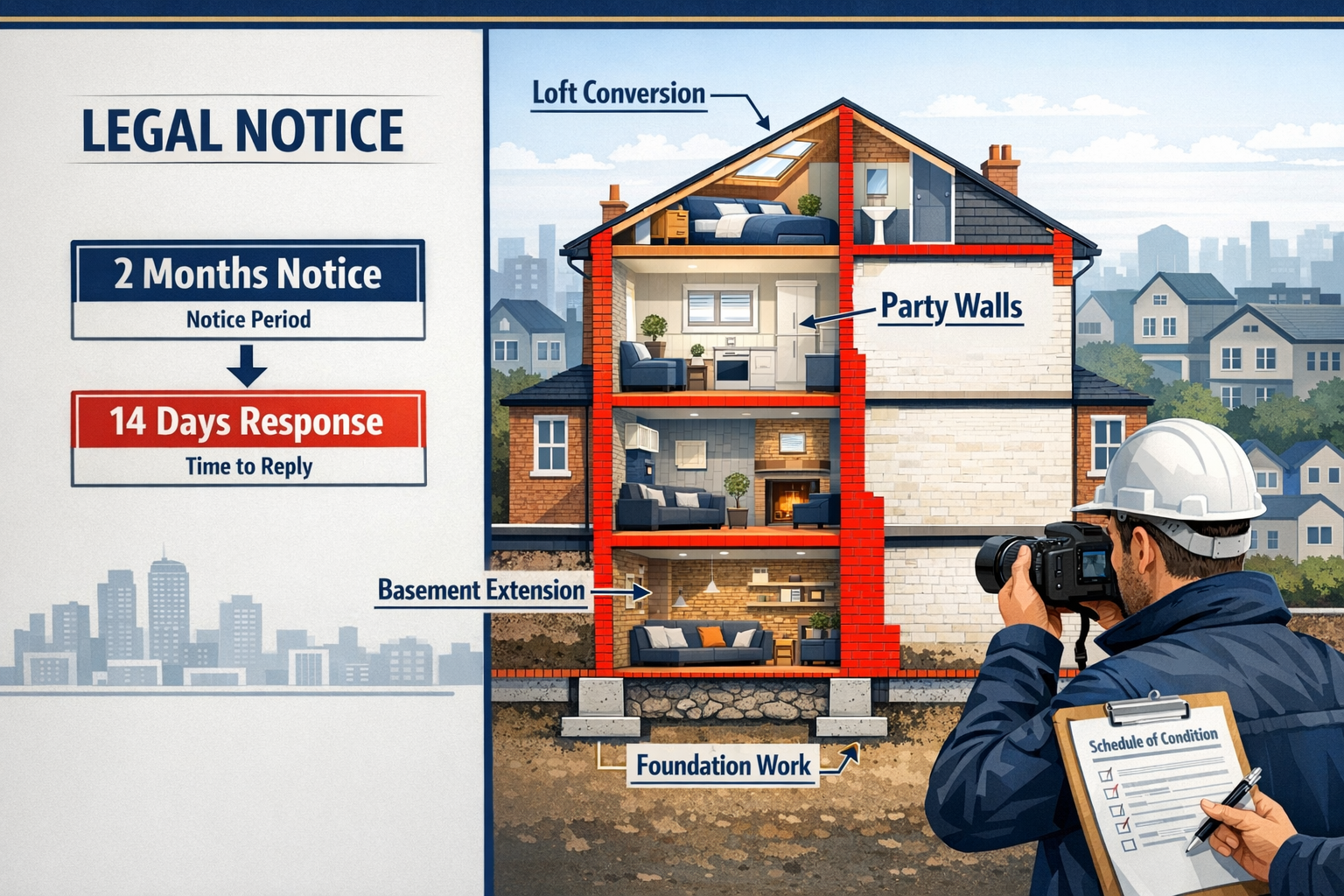
The Party Wall etc. Act 1996 governs construction work on or near shared walls, boundaries, and excavations close to neighboring properties throughout England and Wales. For BTL investors, this legislation creates both obligations and protections that directly impact portfolio expansion strategies.
What Constitutes a Party Wall?
A party wall is any wall or structure that:
- Stands on the boundary between two properties and forms part of a building
- Separates buildings belonging to different owners (such as terraced houses or semi-detached properties)
- Exists within a building divided into separate units (like converted flats)
According to the Act, party structures also include party fence walls (walls standing on boundaries but not part of buildings) and floors or ceilings separating flats in converted properties[4]. Understanding these distinctions helps investors identify when party wall procedures apply to their expansion plans.
Notifiable Works That Trigger Party Wall Procedures
BTL investors planning property improvements must recognize which works require formal party wall notices. Common triggers include[2]:
| Work Type | Party Wall Requirement | Typical BTL Application |
|---|---|---|
| Loft Conversions | Notice required if affecting party walls or excavating near neighbors | Converting unused space to additional bedrooms for higher rental yields |
| Rear/Side Extensions | Notice required for new foundations within 3-6 meters of neighboring structures | Expanding living space to attract family tenants |
| Basement Conversions | Notice required for excavations below neighboring foundations | Creating additional lettable space in high-value areas |
| Damp Proof Course | Notice required when cutting into party walls | Essential maintenance work to protect property value |
| Chimney Removal | Notice required if chimney breast forms part of party wall | Modernization projects for contemporary tenant preferences |
For investors planning loft conversions, the party wall implications extend beyond the shared wall itself—any structural work affecting the party wall's load-bearing capacity triggers notification requirements.
The Two-Month Notice Period: Timeline Planning for BTL Projects
One of the most critical aspects of Party Wall Surveys for Buy-to-Let Investors: Safeguarding 2026 Expansion Plans involves understanding statutory timeframes. Building owners must serve party wall notices at least 2 months before starting notifiable work[4], with adjoining owners having 14 days to respond with either consent or dissent.
This timeline has significant implications for BTL investment strategies:
- Void period planning: Factor in 2+ months before work can commence when calculating rental income loss
- Contractor scheduling: Secure builder availability accounting for potential delays if disputes arise
- Tenant management: Coordinate notice periods with existing tenancy agreements to minimize disruption
- Financing considerations: Ensure bridging loans or development finance accounts for extended pre-construction periods
"Failing to serve proper party wall notices doesn't just risk legal disputes—it can invalidate insurance coverage and create liabilities that persist long after property sales." — Party Wall Surveying Best Practice
Investors who fail to serve party wall notices face potential injunctions halting construction, retrospective dispute resolution costs, and liability for any damage that occurs during unauthorized works.
Party Wall Surveys for Buy-to-Let Investors: Safeguarding 2026 Expansion Plans Through Professional Surveyor Engagement
Engaging qualified party wall surveyors represents a strategic investment rather than a regulatory burden for professional BTL landlords. The surveyor's role extends far beyond simple documentation—they create legally binding frameworks that protect all parties while enabling construction to proceed smoothly.
The Party Wall Award: Your Legal Protection Framework
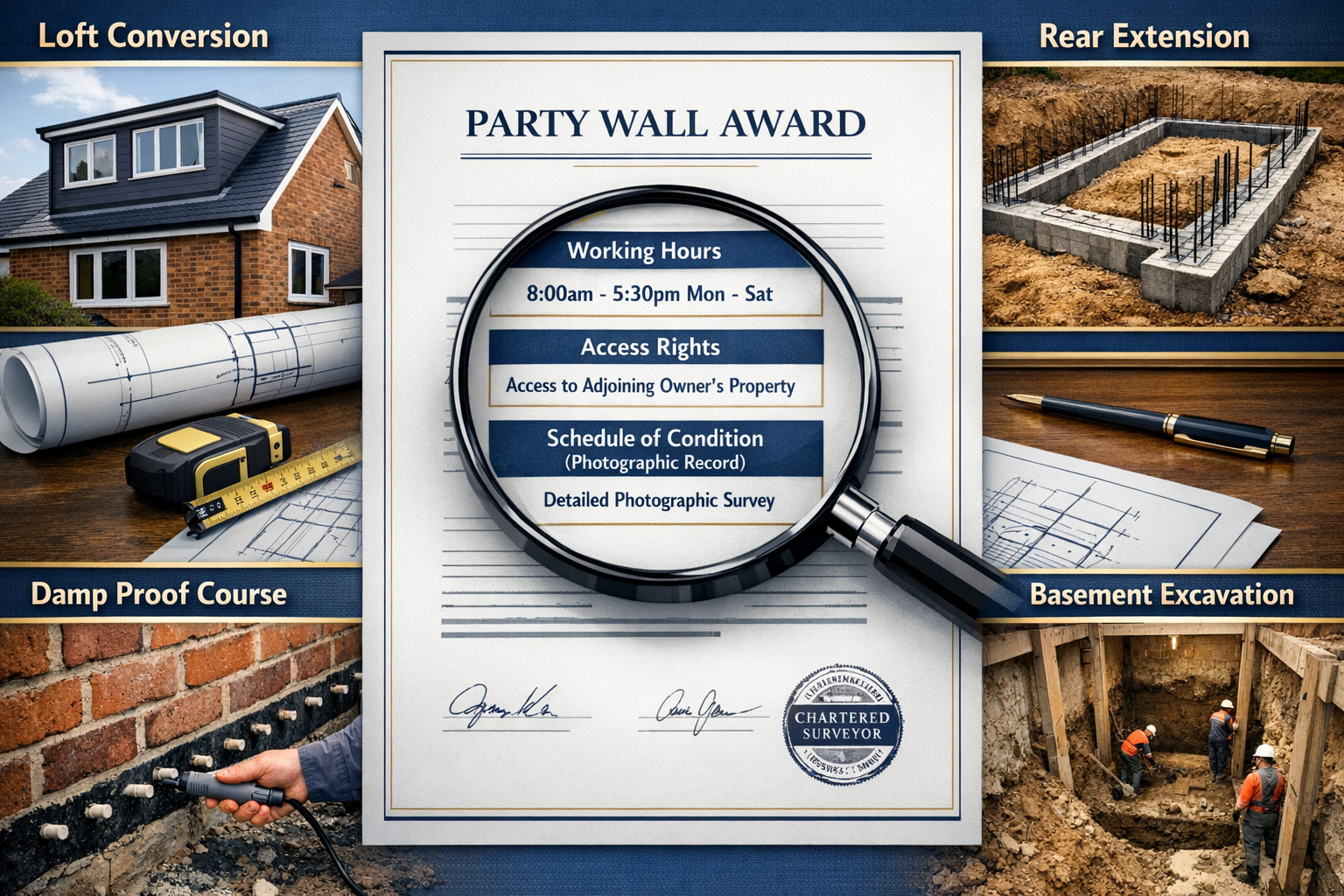
When adjoining owners dissent to proposed works (or fail to respond within 14 days, which legally constitutes dissent), the Party Wall Award becomes the governing document for the project. This surveyor-prepared agreement outlines[5]:
- Specific rights and responsibilities of both building and adjoining owners
- Permitted working hours to minimize disruption to neighboring tenants
- Access arrangements for inspections and emergency interventions
- Construction methodology and protective measures required
- Schedule of condition with detailed photographic evidence of neighboring properties
The schedule of condition deserves particular attention from BTL investors. This comprehensive photographic record, taken before work commences, provides definitive evidence of pre-existing conditions in neighboring properties. Without this documentation, investors face vulnerability to exaggerated or fraudulent damage claims that can cost tens of thousands of pounds to defend or settle.
Surveyor Appointment Options and Cost Implications
The Party Wall Act provides three surveyor appointment scenarios:
- Agreed Surveyor: Both parties appoint a single surveyor (most cost-effective)
- Two Surveyors: Each party appoints their own surveyor (who then appoint a third surveyor if needed)
- Third Surveyor: Appointed by the two party-appointed surveyors to resolve disagreements
Cost considerations for BTL investors[5]:
- Agreed surveyor fees: £800–£1,500 for straightforward cases
- Building owner's surveyor: £1,200–£2,500 for typical residential projects
- Adjoining owner's surveyor: £600–£1,500 (building owner typically pays both surveyors' fees)
- Hourly rates: £90–£450 per hour depending on complexity and location
While the building owner generally bears all surveyor costs, this expense represents exceptional value when compared to dispute resolution costs. Legal proceedings involving party wall disputes routinely exceed £20,000–£50,000 in professional fees alone, not including potential damages, injunction costs, or project delays.
For professional BTL portfolios undertaking multiple projects annually, establishing relationships with experienced chartered surveyors can streamline processes and reduce per-project costs through efficiency and familiarity with your investment strategy.
What Happens When Neighbors Disagree?
Dissent from adjoining owners doesn't prevent work from proceeding—it simply triggers the formal surveyor appointment process. BTL investors should understand that:
- Dissent is common and expected: Many property owners dissent as a precautionary measure to ensure proper protections
- Surveyors act impartially: Even when appointed by one party, surveyors have legal duties to act fairly
- Awards are binding: Once issued, Party Wall Awards have the force of law and can be enforced through county courts
- Disputes can be resolved: The third surveyor mechanism provides resolution when party-appointed surveyors disagree
Understanding what happens without a party wall agreement highlights the risks of informal arrangements. Verbal agreements with neighbors carry no legal weight and provide zero protection if relationships deteriorate or properties change hands.
Strategic Party Wall Management for Professional BTL Portfolios
Institutional BTL investors and professional landlords with expanding portfolios require systematic approaches to party wall compliance that integrate with broader asset management strategies.
Portfolio-Wide Party Wall Risk Assessment
Before committing to property acquisitions or planning improvement programs, sophisticated investors conduct party wall risk assessments that evaluate:
Property characteristics:
- Terraced vs. semi-detached vs. detached configurations
- Age and construction type of neighboring properties
- Historical party wall disputes or structural issues
- Existing party wall awards from previous owners
Neighborhood dynamics:
- Owner-occupier vs. rental property concentration
- Socioeconomic factors affecting dispute likelihood
- Local authority planning trends and development activity
- Professional vs. amateur landlord prevalence
Development potential:
- Loft conversion feasibility given party wall constraints
- Basement development viability and neighbor impact
- Extension opportunities and boundary limitations
- Long-term value enhancement vs. party wall complexity
This assessment informs acquisition decisions, with some investors applying party wall risk discounts of 2-5% to property valuations where complex neighbor situations exist.
Integrating Party Wall Procedures Into Project Management
Professional BTL investors treat party wall compliance as a critical path item in project management workflows:
Pre-acquisition phase:
- Commission building surveys that specifically identify party wall implications
- Review historical planning applications for neighboring properties
- Conduct desktop research on previous party wall awards
- Factor party wall costs and timelines into development appraisals
Planning and design phase:
- Engage party wall surveyors during design development
- Optimize architectural plans to minimize party wall impact where possible
- Prepare comprehensive method statements for notifiable works
- Coordinate party wall notices with planning application timelines
Construction phase:
- Ensure contractors understand party wall award conditions
- Maintain photographic records of all work affecting party walls
- Facilitate surveyor access for inspections
- Address neighbor concerns promptly to prevent escalation
Post-completion phase:
- Retain all party wall documentation with property files
- Update property management systems with party wall history
- Brief property managers on ongoing obligations
- Prepare disclosure documentation for future sales
Party Wall Considerations When Selling BTL Properties
A frequently overlooked aspect of Party Wall Surveys for Buy-to-Let Investors: Safeguarding 2026 Expansion Plans involves the non-transferability of party wall consents. When selling a property with existing party wall agreements, consent from previous adjoining owners typically doesn't transfer to new owners[1].
This creates several implications:
For sellers:
- Disclose all party wall awards and historical disputes
- Provide complete documentation of works carried out
- Address any outstanding party wall obligations before completion
- Consider warranty insurance for undisclosed party wall issues
For buyers:
- Commission legal review of previous party wall awards
- Verify completion of works described in awards
- Assess ongoing obligations or restrictions
- Budget for fresh notices if planning further works
Professional BTL investors maintain comprehensive party wall files for each property containing:
- All notices served and received
- Party wall awards and surveyor correspondence
- Photographic schedules of condition
- Completion certificates and final inspections
- Neighbor communication records
- Insurance documentation
This documentation protects against future claims and demonstrates professional property management to prospective buyers, potentially commanding premium sale prices.
Common Party Wall Pitfalls for BTL Investors and How to Avoid Them
Even experienced property investors encounter party wall challenges that can derail expansion plans. Understanding these pitfalls enables proactive risk management.
Pitfall #1: Assuming Verbal Agreements Provide Protection
The scenario: A landlord discusses planned loft conversion with the neighbor, who verbally agrees. The landlord proceeds without formal notices, assuming the friendly relationship provides adequate protection.
The consequence: Midway through construction, the neighbor sells their property. The new owner, discovering unauthorized party wall work, serves an injunction halting construction and demands retrospective party wall procedures plus compensation for diminished property value during the dispute.
The solution: Always follow formal party wall procedures regardless of neighbor relationships. Verbal agreements carry zero legal weight and provide no protection when properties change hands or relationships deteriorate.
Pitfall #2: Underestimating Timeline Requirements
The scenario: An investor secures a 12-week rental void to complete a major refurbishment including structural work. They serve party wall notices 4 weeks before the planned start date, assuming this provides adequate time.
The consequence: Neighbors dissent (as is their right), triggering surveyor appointment procedures. By the time the Party Wall Award is issued, 10 weeks have elapsed, leaving insufficient time to complete works before the new tenancy begins.
The solution: Factor in minimum 3-4 months from initial notice to construction commencement for projects involving party walls. Build this timeline into tenancy agreements, contractor schedules, and financial projections.
Pitfall #3: Selecting Unqualified or Inexperienced Surveyors
The scenario: To minimize costs, an investor appoints the cheapest available surveyor, who lacks specific party wall expertise or RICS accreditation.
The consequence: The surveyor produces an inadequate Party Wall Award that fails to address critical issues. During construction, disputes arise over matters not covered in the award, requiring expensive legal intervention and project delays.
The solution: Engage experienced, RICS-accredited party wall surveyors with demonstrable track records in similar projects. The modest additional cost provides substantial protection against far greater dispute expenses.
Pitfall #4: Inadequate Schedule of Condition Documentation
The scenario: A surveyor produces a basic schedule of condition with limited photographs and minimal detail. Construction proceeds without incident.
The consequence: Six months after completion, the neighbor claims the works caused cracks in their property and demands £15,000 in repairs. Without comprehensive pre-construction photographic evidence, the investor cannot definitively prove the cracks existed previously.
The solution: Insist on exhaustive schedules of condition with hundreds of detailed photographs covering every aspect of neighboring properties. The additional surveyor time costs £200-£500 but provides protection against claims worth tens of thousands.
Pitfall #5: Failing to Disclose Party Wall History to Buyers
The scenario: When selling a BTL property, the investor fails to disclose previous party wall awards or ongoing disputes, hoping to avoid complicating the sale.
The consequence: The buyer discovers undisclosed party wall issues post-completion and pursues legal action for misrepresentation, seeking damages or contract rescission.
The solution: Maintain comprehensive party wall documentation and provide full disclosure to solicitors during sales. Transparency demonstrates professional management and protects against future claims.
Advanced Party Wall Strategies for 2026 BTL Expansion
As institutional investors and professional landlords scale their portfolios in 2026, sophisticated party wall strategies separate successful expansion from costly setbacks.
Proactive Neighbor Relationship Management
While formal procedures remain essential, strategic relationship building with adjoining owners can significantly smooth party wall processes:
Pre-notice engagement:
- Informal discussions explaining planned works and benefits
- Sharing architectural drawings and method statements
- Addressing concerns before formal notice periods
- Offering goodwill gestures (temporary accommodation during noisy works, property improvements)
Professional communication:
- Written correspondence confirming verbal discussions
- Regular updates throughout construction
- Prompt response to concerns or complaints
- Post-completion follow-up ensuring satisfaction
Long-term relationship building:
- Maintaining contact details for adjoining owners
- Coordinating complementary improvement works
- Sharing party wall surveyor recommendations
- Creating mutual benefit opportunities
"The best party wall agreements are those where formal legal protections exist but never need to be enforced due to excellent neighbor relationships and professional project management."
Portfolio-Scale Party Wall Insurance
For investors managing substantial BTL portfolios with ongoing development programs, specialized party wall insurance products provide additional protection:
Dispute resolution insurance:
- Covers legal costs if party wall disputes escalate
- Typically costs £200-£500 per project
- Provides access to specialist legal teams
- Protects against disproportionate neighbor claims
Professional indemnity enhancement:
- Extended coverage for party wall surveyor errors
- Protection against inadequate Party Wall Awards
- Coverage for schedule of condition deficiencies
- Essential when using less experienced surveyors
Latent defect insurance:
- Protection against undiscovered party wall issues in acquired properties
- Coverage for historical non-compliance
- Essential for portfolios acquired from amateur landlords
- Typically 10-year policies covering structural issues
Technology Integration for Party Wall Management
Forward-thinking BTL investors leverage technology to streamline party wall compliance:
Digital documentation systems:
- Cloud-based party wall file repositories
- Automated notice period tracking and reminders
- Integration with property management software
- Secure sharing with surveyors and legal teams
Photographic evidence platforms:
- 360-degree photography for comprehensive schedules of condition
- Timestamped, tamper-proof digital records
- Comparison tools for pre/post construction analysis
- Mobile access for on-site verification
Neighbor communication tools:
- Dedicated project portals for adjoining owners
- Real-time construction progress updates
- Digital complaint and query management
- Automated notification systems
Coordinating Party Wall Procedures With Other Surveys
Efficient BTL investors coordinate party wall surveys with complementary property assessments to maximize value and minimize disruption:
Pre-acquisition coordination:
- Combine building surveys with party wall risk assessments
- Engage surveyors who can provide multiple services
- Identify party wall implications during due diligence
- Factor findings into purchase negotiations
Development phase integration:
- Coordinate structural surveys with party wall schedules of condition
- Align damp surveys with party wall procedures for DPC work
- Integrate subsidence surveys when excavation work is planned
- Combine party wall awards with structural engineering calculations
Compliance and certification:
- Align party wall completion with building control sign-off
- Coordinate final inspections to minimize surveyor visits
- Integrate party wall documentation with property certification
- Ensure all records support future sales or refinancing
The Financial Impact of Party Wall Compliance on BTL Returns
Understanding the financial implications of party wall procedures enables accurate investment appraisals and realistic return projections.
Direct Cost Analysis
Typical party wall costs for common BTL projects:
Loft conversion (£30,000-£50,000 project value):
- Party wall surveyor fees: £1,200–£2,000
- Adjoining owner's surveyor: £800–£1,500
- Schedule of condition: £400–£600
- Total party wall costs: £2,400–£4,100 (5-8% of project cost)
Rear extension (£40,000-£70,000 project value):
- Party wall surveyor fees: £1,500–£2,500
- Adjoining owner's surveyor: £1,000–£1,800
- Schedule of condition (two neighbors): £600–£900
- Total party wall costs: £3,100–£5,200 (5-7% of project cost)
Basement conversion (£80,000-£150,000 project value):
- Party wall surveyor fees: £2,500–£4,000
- Adjoining owner's surveyors (multiple): £2,000–£3,500
- Comprehensive schedules of condition: £1,000–£1,500
- Total party wall costs: £5,500–£9,000 (4-6% of project cost)
Timeline Impact on Rental Income
The 2-month minimum notice period plus surveyor appointment and award preparation time creates rental income implications:
Standard timeline for dissenting neighbors:
- Notice period: 8 weeks
- Surveyor appointment: 1-2 weeks
- Schedule of condition: 1-2 weeks
- Award preparation: 2-4 weeks
- Total pre-construction period: 12-18 weeks
Financial impact example (£1,500 monthly rental property):
- Extended void period: 3-4 months
- Lost rental income: £4,500–£6,000
- Holding costs (mortgage, insurance, etc.): £2,000–£3,000
- Total timeline cost: £6,500–£9,000
Professional investors factor these costs into development appraisals, typically adding 15-20% contingency to standard project timelines when party wall procedures are required.
Return on Investment: Party Wall Compliance vs. Dispute Costs
The financial case for proper party wall procedures becomes compelling when compared to dispute scenarios:
Compliant approach costs:
- Surveyor fees: £3,000
- Timeline delays: £7,000
- Total cost: £10,000
Non-compliant dispute scenario:
- Legal fees (both parties): £25,000–£50,000
- Court costs and expert witnesses: £10,000–£20,000
- Construction delays (6-12 months): £15,000–£30,000
- Potential damages awarded: £5,000–£50,000
- Reputational damage: Unquantifiable
- Total cost: £55,000–£150,000
The 5:1 to 15:1 cost ratio demonstrates that party wall compliance represents exceptional value as risk mitigation.
Future-Proofing BTL Portfolios: Party Wall Considerations for 2026 and Beyond
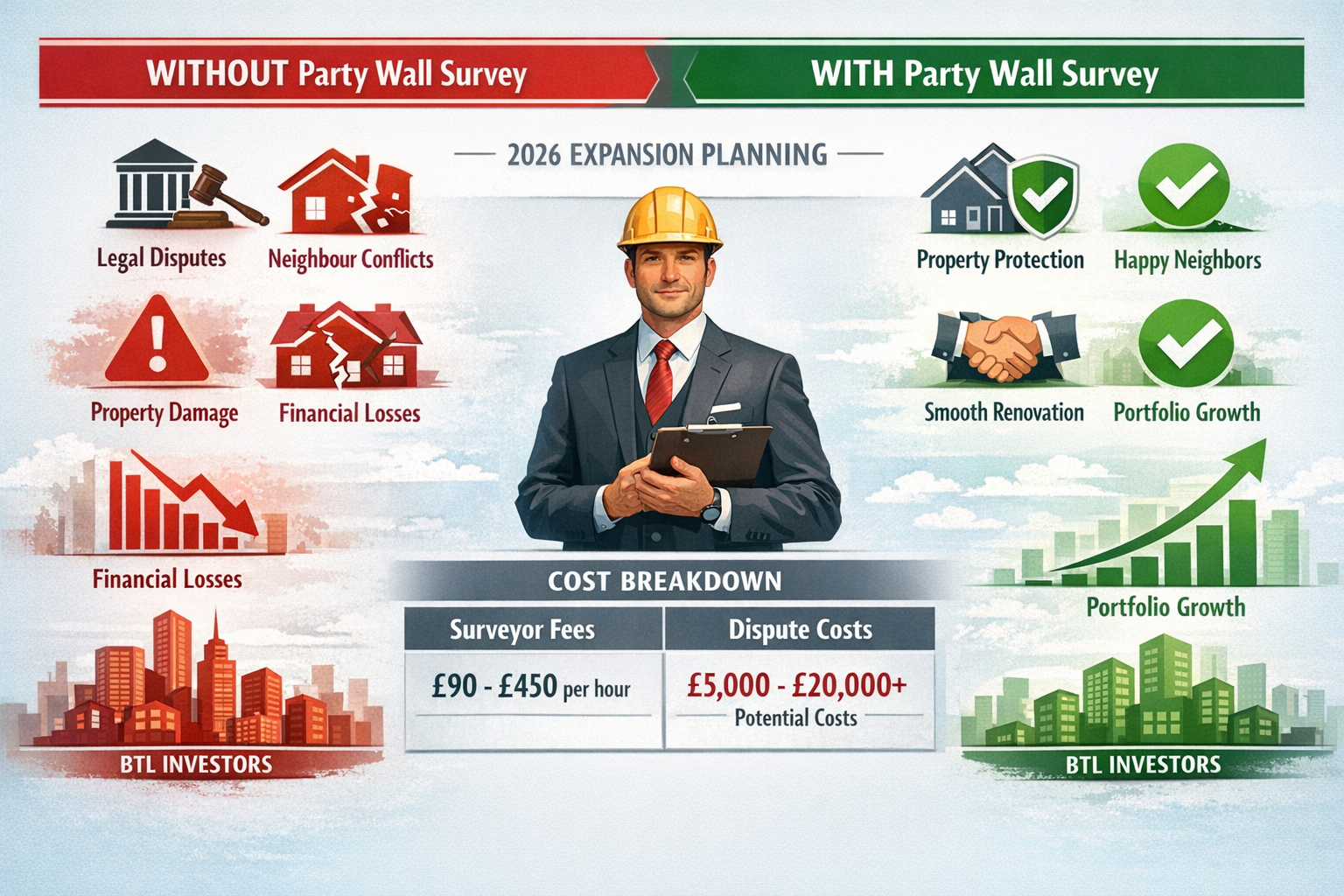
As the BTL market evolves, forward-thinking investors anticipate regulatory changes and market trends affecting party wall procedures.
Potential Regulatory Developments
Industry observers anticipate several possible changes to party wall legislation:
Enhanced tenant protections:
- Stricter noise and disruption limitations during party wall works
- Mandatory tenant notification requirements
- Compensation frameworks for tenant inconvenience
- Extended notice periods for occupied properties
Digital transformation:
- Electronic service of party wall notices
- Online dispute resolution mechanisms
- Digital Party Wall Award repositories
- Blockchain-based proof of compliance
Sustainability integration:
- Party wall procedures for insulation works
- Streamlined processes for energy efficiency improvements
- Coordinated whole-terrace retrofit programs
- Green building standard alignment
Market Trends Affecting Party Wall Strategies
Institutional investment growth:
- Professional landlords with systematic party wall procedures gaining market share
- Amateur landlords exiting due to regulatory complexity
- Increased standardization of party wall processes
- Portfolio-scale efficiency opportunities
Property conversion acceleration:
- HMO conversions requiring extensive party wall works
- Commercial-to-residential conversions with complex party wall implications
- Permitted development rights creating party wall challenges
- Densification strategies increasing party wall frequency
Technology-enabled compliance:
- PropTech solutions for party wall management
- AI-powered risk assessment tools
- Automated documentation and compliance tracking
- Virtual surveying and remote inspections
Building Competitive Advantage Through Party Wall Excellence
Professional BTL investors differentiate themselves through superior party wall management:
Acquisition advantages:
- Faster due diligence and decision-making
- Accurate development appraisals including party wall costs
- Competitive offers based on realistic project timelines
- Reduced risk of post-acquisition surprises
Operational efficiency:
- Streamlined processes reducing per-project costs
- Established surveyor relationships enabling better pricing
- Systematic documentation supporting portfolio refinancing
- Professional reputation facilitating neighbor cooperation
Exit optimization:
- Comprehensive documentation commanding premium prices
- Reduced buyer due diligence concerns
- Demonstrated professional management
- Clean legal history supporting smooth transactions
Conclusion: Protecting Your BTL Expansion Through Professional Party Wall Management
Party Wall Surveys for Buy-to-Let Investors: Safeguarding 2026 Expansion Plans represents far more than regulatory compliance—it's a strategic investment in portfolio protection, operational efficiency, and long-term value creation. As institutional investors demonstrate continued confidence in the BTL sector despite broader market uncertainties, those who master party wall procedures gain significant competitive advantages.
The financial case is unambiguous: £3,000–£10,000 in surveyor fees and timeline costs provides protection against dispute scenarios costing £55,000–£150,000 or more. Beyond pure cost avoidance, professional party wall management enables:
✅ Predictable project timelines supporting accurate financial modeling and tenant management
✅ Legal protection through comprehensive Party Wall Awards and schedules of condition
✅ Neighbor relationship preservation maintaining long-term property enjoyment and value
✅ Portfolio scalability through systematic processes applicable across multiple properties
✅ Professional credibility demonstrating competence to lenders, insurers, and buyers
Actionable Next Steps for BTL Investors
Immediate actions:
- Audit your current portfolio for properties with party wall implications or historical non-compliance
- Establish relationships with experienced, RICS-accredited party wall surveyors in your investment areas
- Review existing projects to ensure all party wall procedures are properly documented and compliant
- Update acquisition criteria to include party wall risk assessment in due diligence processes
Short-term implementation (next 3-6 months):
- Develop standard procedures for party wall compliance across your portfolio
- Create documentation systems for storing and managing party wall records
- Train your team (property managers, contractors, agents) on party wall requirements
- Budget accurately for party wall costs in upcoming development projects
Long-term strategic planning (6-12 months):
- Integrate party wall management into your property management software and workflows
- Build neighbor relationship protocols for proactive communication and dispute prevention
- Consider specialist insurance for portfolio-scale party wall protection
- Monitor regulatory developments affecting party wall procedures in your investment regions
The BTL investors who thrive in 2026 and beyond will be those who recognize that professional party wall management isn't a cost center—it's a competitive advantage. By treating party wall surveys as strategic investments rather than regulatory burdens, you protect your portfolio, enhance returns, and build a foundation for sustainable expansion.
Don't let party wall complications derail your 2026 growth plans. Engage qualified chartered surveyors today to ensure your expansion strategy rests on solid legal and professional foundations. Your future portfolio value depends on the party wall decisions you make today.
References
[1] Buying Property Party Wall Award – https://osborneslaw.com/blog/buying-property-party-wall-award/
[2] Party Wall Agreement – https://hoa.org.uk/advice/guides-for-homeowners/i-am-improving/party-wall-agreement/
[4] Understanding Party Walls – https://www.oakfieldsurveyors.co.uk/party-wall/understanding-party-walls/
[5] Party Wall Surveyor Cost – https://hoa.org.uk/advice/guides-for-homeowners/i-am-improving/party-wall-surveyor-cost/