Basement conversions in England's most densely populated cities have surged by 34% since 2024, with London alone processing over 12,000 basement planning applications annually. This explosive growth in underground living space has placed unprecedented pressure on party wall procedures, prompting the Royal Institution of Chartered Surveyors (RICS) to refine protocols specifically addressing excavation works under the Party Wall etc. Act 1996. Understanding these updated guidelines has become essential for homeowners, developers, and surveyors navigating the complex intersection of structural engineering, legal compliance, and neighbourly relations.
Party Wall Surveys for Basement Conversions in 2026: RICS Protocols Amid Rising Underground Living Demand represents a critical evolution in construction governance. As urban property values continue climbing and horizontal expansion remains limited, digging downward has transformed from luxury upgrade to practical necessity. This comprehensive guide examines the regulatory framework, procedural requirements, and best practices that define compliant basement conversions in today's market.
Key Takeaways
- Statutory compliance is mandatory: All basement excavations within 3 metres of a neighbouring structure require formal Party Wall Act notices, regardless of property age or construction type
- Updated RICS protocols for 2026: New guidance emphasizes enhanced Schedule of Condition documentation and dispute resolution mechanisms specific to underpinning works
- Timeline planning is critical: Statutory notice periods (minimum 2 months for excavation works) must be factored into project schedules before construction commences
- Professional surveyor appointment: Engaging RICS-accredited party wall surveyors significantly reduces dispute risks and ensures legally compliant awards
- Comprehensive documentation protects all parties: Detailed pre-construction condition surveys provide essential evidence for resolving post-construction claims
Understanding the Party Wall Act 1996 and Basement Excavations
The Party Wall etc. Act 1996 provides the legal framework governing construction work that affects shared walls, boundaries, and excavations near neighbouring properties. For basement conversions, Section 6 of the Act specifically addresses excavation works, establishing clear requirements when digging:
- Within 3 metres of a neighbouring building's foundation, where the excavation will go deeper than the neighbour's foundation
- Within 6 metres of a neighbouring building's foundation, where the excavation will cut a line drawn downward at 45 degrees from the bottom of the neighbour's foundation
These provisions recognize the significant structural risks basement excavations pose to adjoining properties. The 3-metre rule establishes a protective zone where neighbouring foundations must be considered, regardless of whether a physical party wall exists.
Why Basement Conversions Require Special Attention
Basement excavations differ fundamentally from other party wall works because they:
Undermine existing foundations 🏗️ – Removing soil beneath or adjacent to neighbouring foundations alters ground support conditions and load distribution patterns.
Create vibration and movement risks – Excavation machinery, underpinning operations, and material removal generate vibrations that can damage historic masonry and plasterwork.
Alter groundwater patterns – Deep excavations can redirect underground water flow, potentially affecting neighbouring basements and causing dampness issues.
Require temporary works – Shoring, propping, and needling operations introduce additional structural considerations during construction phases.
The complexity of these factors has driven RICS to develop specialized guidance addressing basement-specific scenarios, ensuring surveyors apply consistent standards when preparing notices, awards, and condition surveys.
RICS Protocols for Party Wall Surveys in Basement Conversions
The Royal Institution of Chartered Surveyors maintains authoritative guidance for party wall surveyors through its professional standards and practice information. In 2026, RICS protocols emphasize several key principles specifically relevant to basement excavation projects.
Enhanced Schedule of Condition Requirements
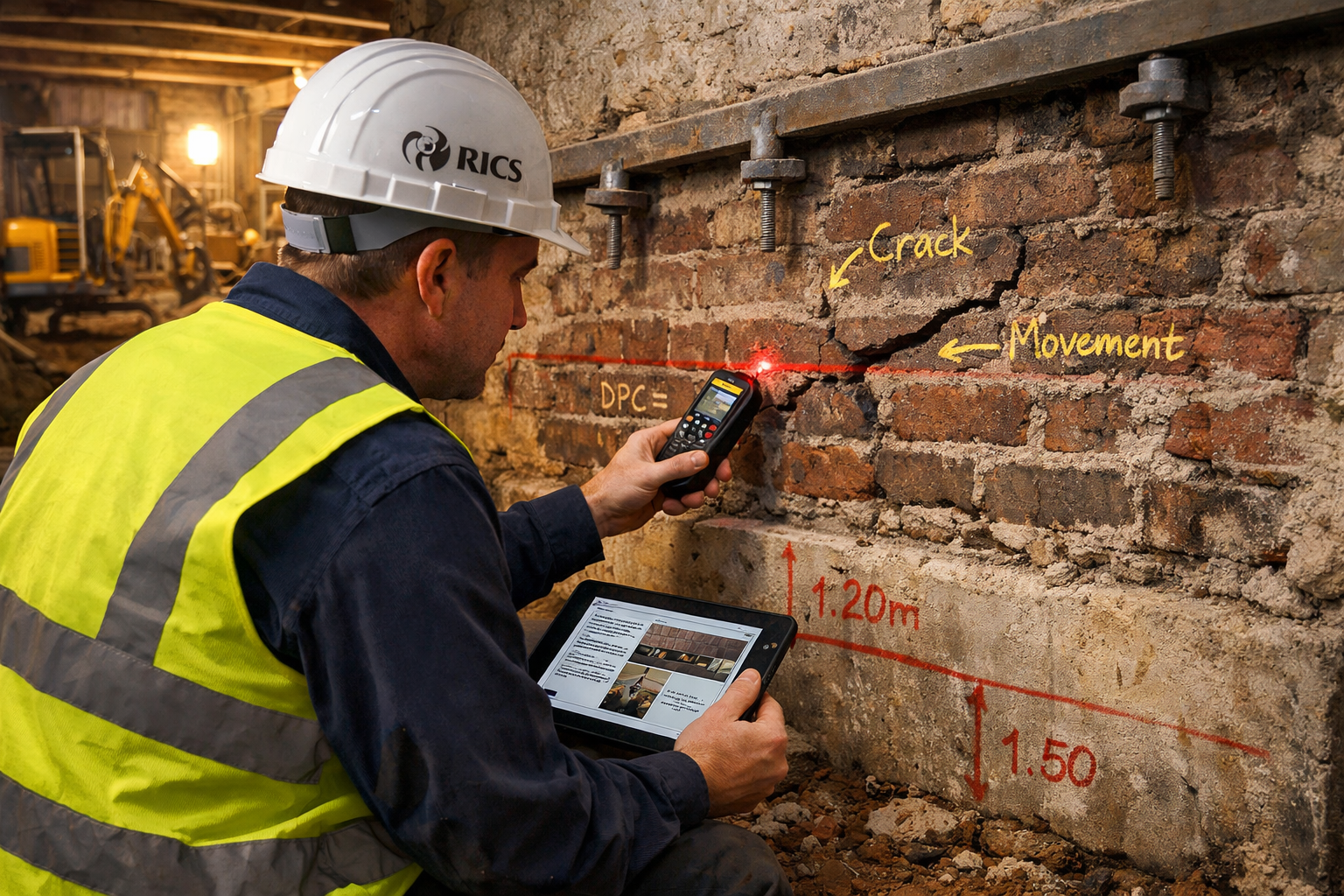
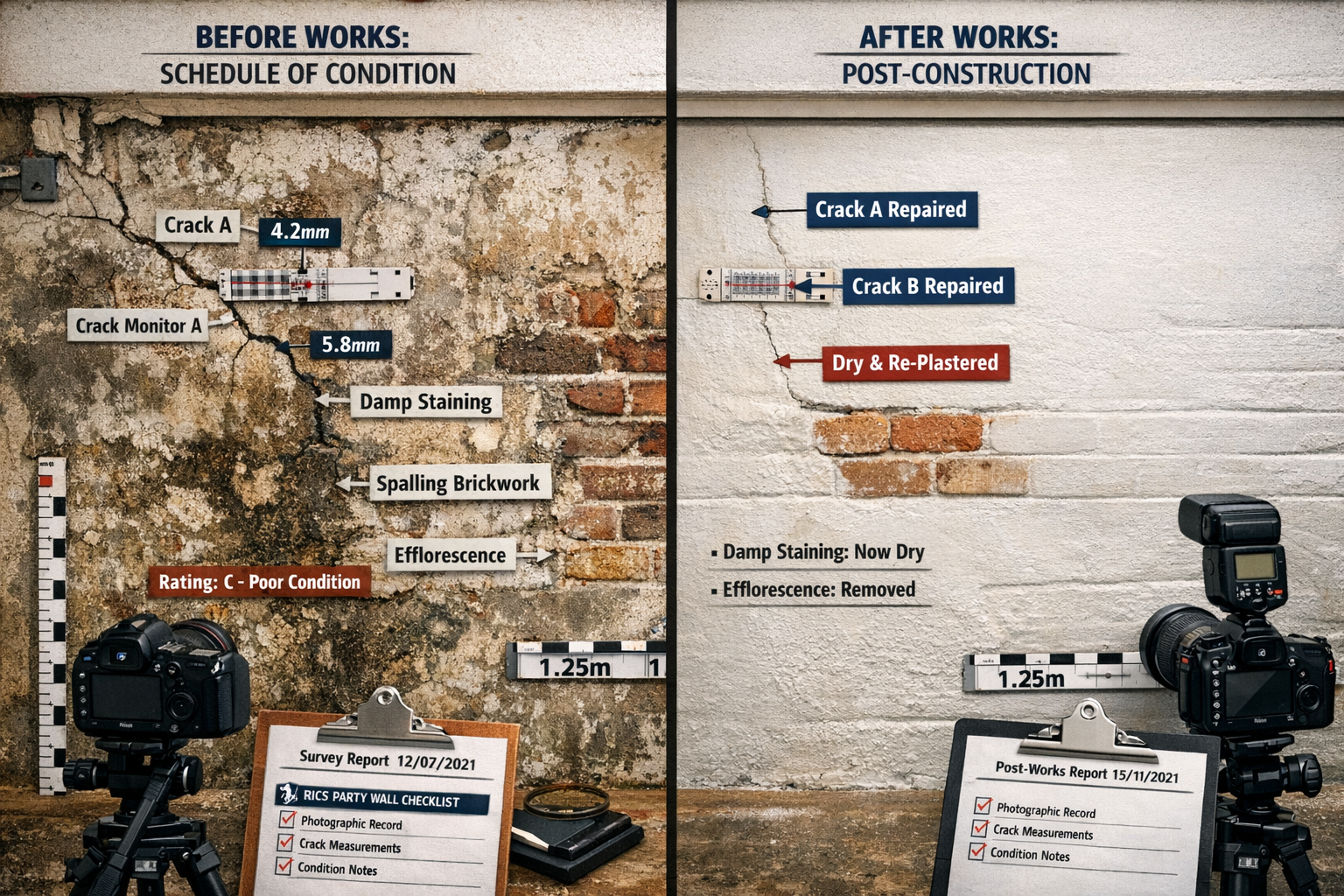
A Schedule of Condition documents the pre-construction state of neighbouring properties, providing baseline evidence against which post-construction conditions can be compared. For basement conversions, RICS guidance now recommends:
Comprehensive photographic documentation 📸 – High-resolution images of all potentially affected areas, including internal finishes, external walls, ceilings, and existing crack patterns.
Detailed written descriptions – Room-by-room narratives describing existing defects, previous repairs, decorative conditions, and structural observations.
Measurement and monitoring points – Establishing specific crack monitoring locations with baseline measurements for ongoing comparison during construction.
Underground and drainage assessment – Documenting existing basement conditions, damp issues, and drainage systems that could be affected by excavation works.
According to recent industry guidance, thorough Schedule of Condition documentation serves as the primary mechanism for preventing post-construction disputes. The more detailed the pre-construction record, the easier it becomes to distinguish new damage from pre-existing conditions [1].
Notice Procedures Specific to Excavation Works
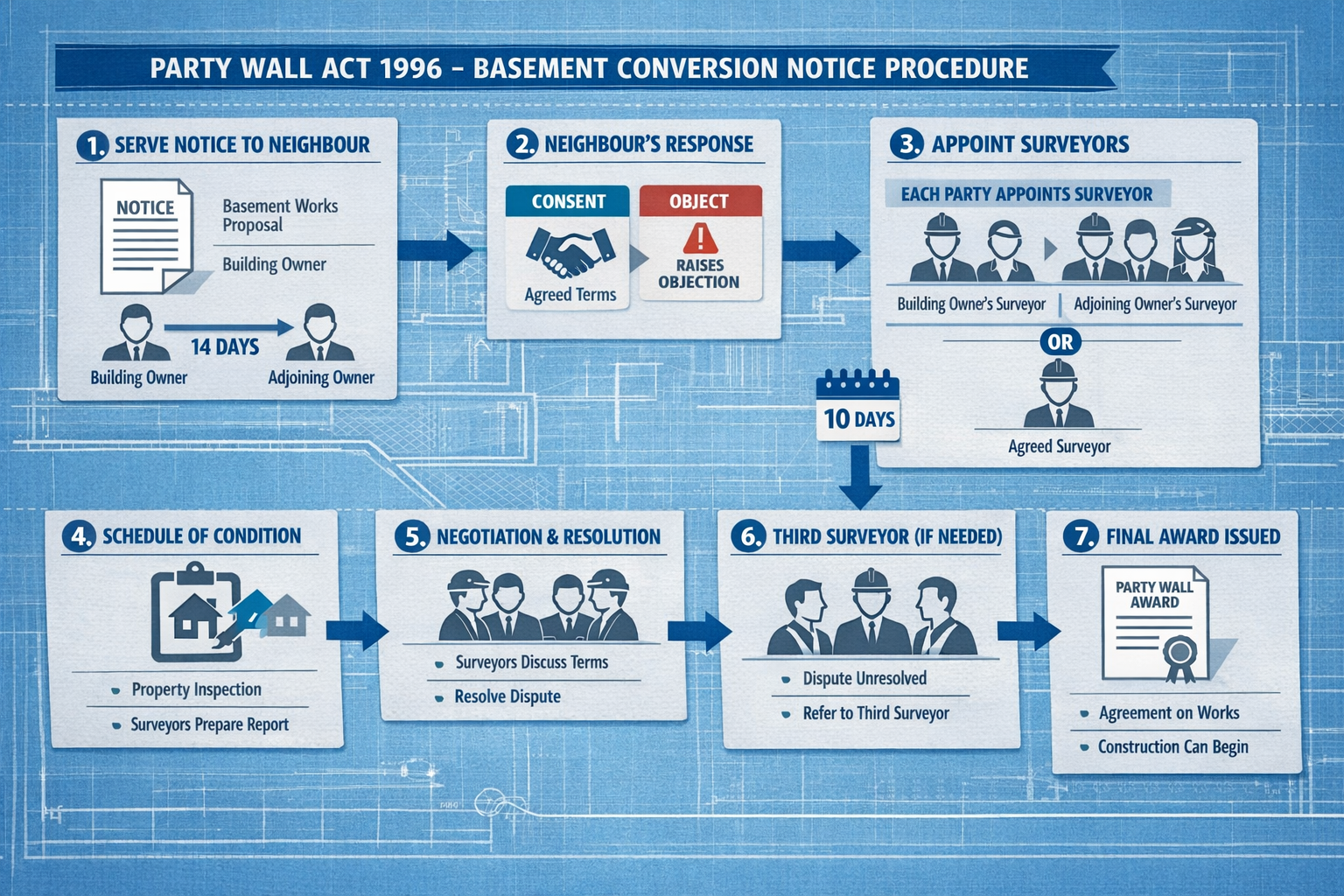
The Party Wall Act establishes strict notice requirements for excavation works. Building owners must serve notice on adjoining owners at least two months before excavation commences. The notice must include:
- Detailed plans showing excavation depth, proximity to neighbouring foundations, and proposed underpinning methods
- Specification of temporary works including shoring and propping arrangements
- Structural engineer's calculations demonstrating foundation stability
- Construction methodology statements outlining vibration control measures
- Proposed timescales for excavation and underpinning phases
Adjoining owners have 14 days to respond to excavation notices. If they consent, work may proceed according to the notice terms. If they dissent or fail to respond, the Party Wall Act's dispute resolution mechanism activates, requiring surveyor appointments.
Understanding what happens without a party wall agreement highlights why proper notice procedures cannot be bypassed—proceeding without compliance exposes building owners to injunctions, enforcement actions, and liability for resulting damage.
The Party Wall Award Process for Basement Projects
When adjoining owners dissent to proposed excavation works or fail to respond to notices, the Act requires appointment of surveyors to prepare a Party Wall Award—a legally binding document setting out how works will proceed and how disputes will be resolved.
Surveyor Appointment Options
The Act provides three surveyor appointment structures:
Agreed Surveyor – Both parties jointly appoint a single impartial surveyor who acts for both building owner and adjoining owner. This approach typically reduces costs but requires mutual confidence in the selected professional.
Two Surveyors – Each party appoints their own surveyor, and these two professionals jointly prepare the award. This structure provides independent representation but increases professional fees.
Third Surveyor – When two appointed surveyors cannot reach agreement on specific matters, they may refer disputes to a pre-appointed third surveyor whose decision becomes binding.
For complex basement conversions involving multiple adjoining properties, the two-surveyor approach often proves most practical, ensuring each party receives independent advice while maintaining professional collaboration.
Essential Components of Basement Excavation Awards
A comprehensive Party Wall Award for basement conversion works should address:
Detailed work descriptions 📋 – Precise specifications of excavation depths, underpinning methods, temporary support systems, and construction sequencing.
Access provisions – Rights for the building owner's contractors to access adjoining property for monitoring, inspection, or emergency intervention if required.
Working hours and restrictions – Limitations on noisy operations, vibration-intensive activities, and construction traffic to minimize disruption.
Condition survey incorporation – Formal adoption of the Schedule of Condition as the baseline for assessing any construction-related damage.
Dispute resolution procedures – Clear mechanisms for addressing disagreements during construction, including third surveyor referral processes.
Cost allocation – Determination of who pays surveyor fees, typically following the principle that building owners bear costs for works they initiate.
The Party Wall Award guidance provided by qualified surveyors ensures awards meet statutory requirements while addressing project-specific circumstances.
Structural Considerations and Engineering Requirements
Basement excavations beneath existing buildings present significant structural engineering challenges requiring careful design and execution. RICS protocols emphasize the critical importance of competent structural engineering input throughout the party wall process.
Underpinning Methods for Party Wall Scenarios
When excavating adjacent to party walls or near neighbouring foundations, underpinning typically becomes necessary to maintain structural stability. Common underpinning approaches include:
Mass concrete underpinning – Traditional method involving sequential excavation of small sections beneath existing foundations, followed by concrete placement. Suitable for shallow excavations with stable ground conditions.
Beam and base underpinning – Reinforced concrete beams spanning between deeper foundation bases, distributing loads more effectively. Preferred for deeper excavations or weaker soil conditions.
Piled underpinning – Mini-piles or micro-piles installed beneath existing foundations, transferring loads to deeper, more competent strata. Essential for very deep basements or problematic ground conditions.
Jet grouting or soil stabilization – Ground improvement techniques that strengthen soil beneath foundations without traditional excavation. Useful in confined spaces or sensitive locations.
The structural engineer's design must account for party wall implications, including load transfer through shared walls, differential settlement risks, and temporary support requirements during construction phases.
Monitoring and Protection Measures
RICS guidance emphasizes proactive monitoring throughout basement excavation projects. Best practice includes:
Pre-construction baseline surveys – Establishing precise measurements of existing crack widths, wall verticality, and structural alignment before works commence.
Ongoing monitoring during construction – Regular inspections and measurements at critical construction stages, particularly during excavation, underpinning, and concrete placement.
Vibration monitoring – Installing accelerometers or seismographs to ensure excavation and piling operations remain within acceptable limits for historic structures.
Settlement monitoring – Precise leveling surveys tracking any foundation movement in adjoining properties throughout the construction period.
Post-construction verification – Final condition survey comparing completed state against baseline documentation to identify any construction-related changes.
These monitoring protocols provide objective evidence of construction impacts, facilitating fair resolution of any damage claims while protecting building owners from spurious allegations.
Common Disputes and Resolution Mechanisms in Basement Conversions
Despite careful planning and professional surveyor involvement, basement conversion projects occasionally generate disputes between building owners and adjoining owners. Understanding common conflict sources helps prevent issues before they escalate.
Typical Sources of Party Wall Disputes
Damage claims ⚖️ – Allegations that excavation works caused cracking, settlement, or other structural damage to neighbouring properties represent the most common dispute category.
Access disagreements – Conflicts over contractor access to adjoining property for monitoring, shoring installation, or emergency interventions.
Noise and disruption complaints – Objections to construction hours, vibration levels, or duration of disruptive activities exceeding expectations set in the award.
Work methodology changes – Disputes arising when building owners modify construction approaches after award preparation without consulting adjoining owners.
Cost allocation arguments – Disagreements over who should bear expenses for additional surveys, monitoring, or remedial works.
Understanding what constitutes a party wall dispute helps parties recognize when formal resolution mechanisms should be invoked rather than attempting informal negotiations that may lack legal standing.
RICS Dispute Resolution Protocols
When disputes arise during basement conversion projects, the Party Wall Act provides structured resolution pathways:
Surveyor mediation – The appointed surveyors (or agreed surveyor) first attempt to resolve disagreements through professional discussion and compromise.
Third surveyor determination – If the two appointed surveyors cannot reach agreement, they refer the specific dispute to the pre-appointed third surveyor whose decision binds both parties.
Award variation – Surveyors may issue supplementary awards or award variations addressing changed circumstances or resolving specific disputes.
County Court appeals – Either party may appeal a Party Wall Award to the County Court within 14 days of service, though this route proves expensive and time-consuming.
RICS guidance emphasizes that early professional intervention by qualified surveyors prevents most disputes from escalating to formal proceedings. The key lies in maintaining clear communication, comprehensive documentation, and adherence to agreed construction methodologies.
Integrating Party Wall Procedures with Planning and Building Control
Basement conversions require multiple regulatory approvals beyond party wall compliance. Successful projects integrate these various requirements into coherent project timelines.
Planning Permission Requirements
Most basement excavations require planning permission, particularly in conservation areas or where external changes occur. Planning considerations include:
- Excavation depth and extent – Local planning authorities increasingly scrutinize basement depths, with some London boroughs limiting excavations to single-story extensions
- Impact on neighbouring amenity – Planning officers assess construction impacts, drainage implications, and long-term effects on adjacent properties
- Heritage considerations – Listed buildings and conservation areas face additional restrictions on basement development
- Sustainability requirements – Modern planning policies require sustainable drainage systems and consideration of groundwater impacts
Party wall procedures run parallel to planning processes but serve different purposes—planning addresses public interest considerations while party wall procedures protect private property rights.
Building Regulations Compliance
Building Control approval ensures basement conversions meet structural safety, fire safety, ventilation, and drainage standards. Key building regulation aspects for basement projects include:
Structural stability – Demonstrating adequate foundation design, underpinning calculations, and load transfer mechanisms through structural surveys and engineering certifications.
Damp proofing and waterproofing – Type C waterproofing systems (cavity drainage membranes) or Type A systems (barrier protection) must meet BS 8102 standards.
Means of escape – Basement habitable rooms require compliant escape routes, often necessitating additional external access points or protected stairways.
Ventilation requirements – Mechanical ventilation systems must provide adequate air changes, particularly for basement bedrooms or living spaces.
While Building Control inspectors verify structural adequacy, they do not replace party wall surveyors in protecting neighbouring property interests. Both regulatory frameworks must be satisfied independently.
Cost Implications and Financial Planning for Party Wall Compliance
Understanding the financial implications of party wall procedures helps building owners budget accurately for basement conversion projects.
Typical Party Wall Survey Costs
Professional fees for party wall services vary based on project complexity, property location, and number of adjoining owners affected:
Agreed surveyor approach – £1,500-£3,500 for straightforward basement conversions affecting one or two neighbours. The single surveyor acts for all parties, reducing duplication.
Two-surveyor approach – £3,000-£7,000+ when each party appoints independent representation. Building owners typically pay both surveyors' fees under the "initiator pays" principle.
Complex multi-party scenarios – £8,000-£15,000+ for basement projects affecting multiple adjoining properties, particularly in terraced developments where excavations impact neighbours on both sides.
Schedule of Condition surveys – £500-£1,500 per affected property for comprehensive photographic and written condition documentation.
These professional fees represent essential insurance against future disputes. The cost of resolving damage claims without proper baseline documentation typically exceeds prevention costs by factors of ten or more [1].
Hidden Costs of Non-Compliance
Proceeding with basement excavations without proper party wall compliance exposes building owners to significant financial risks:
Injunctions halting construction ⛔ – Adjoining owners can obtain court orders stopping non-compliant works, resulting in costly project delays and contractor standby charges.
Liability for damage without limitation – Without agreed awards limiting liability, building owners face unlimited exposure for any damage claims, regardless of causation disputes.
Retrospective compliance costs – Obtaining party wall compliance after works commence typically costs 2-3 times more than following proper procedures initially.
Legal costs – Defending against injunctions or damage claims involves substantial solicitor and barrister fees, often exceeding £20,000 for contested proceedings.
Property devaluation – Unresolved party wall disputes create legal charges against property titles, significantly impacting saleability and market value.
Engaging RICS chartered building surveyors from project inception ensures compliance while minimizing overall costs through efficient procedures and dispute prevention.
Regional Variations and Local Authority Considerations
While the Party Wall Act 1996 applies uniformly across England and Wales, local planning policies and construction practices create regional variations in basement conversion procedures.
London's Unique Basement Landscape
London boroughs have developed particularly stringent basement policies responding to the concentration of underground development:
Borough-specific planning policies – Councils like Kensington & Chelsea, Westminster, and Camden maintain detailed basement SPDs (Supplementary Planning Documents) limiting excavation depths and requiring structural methodology statements.
Basement impact assessments – Many London boroughs require detailed assessments of construction impacts on neighbouring properties, groundwater, and heritage assets.
Construction Management Plans – Mandatory CMPs specify construction hours, traffic management, and neighbour communication protocols.
Party wall scrutiny – London planning officers increasingly verify party wall compliance before issuing planning permission, recognizing the correlation between proper procedures and successful projects.
The concentration of period properties with shallow foundations makes London particularly sensitive to excavation impacts, justifying enhanced procedural requirements.
Regional Construction Practices
Outside London, basement conversions remain less common but follow similar party wall principles:
Manchester and Northern cities – Growing interest in basement conversions in Victorian terraces requires careful attention to party wall procedures, particularly given older construction methods and potential mining legacy issues.
Historic city centers – Bath, York, Oxford, and Cambridge impose additional heritage constraints on basement development, requiring specialized conservation expertise alongside party wall compliance.
Coastal and flood-risk areas – Basement conversions in flood zones face additional drainage and waterproofing requirements that may impact party wall considerations.
Regardless of location, the fundamental Party Wall Act requirements remain constant—proper notice, surveyor appointment when required, and comprehensive condition documentation.
Future Trends in Party Wall Surveys for Basement Conversions
The basement conversion market continues evolving, with several emerging trends shaping party wall practice in 2026 and beyond.
Technology Integration in Party Wall Surveys
Modern surveying technology enhances accuracy and efficiency in party wall procedures:
3D laser scanning – Precise point-cloud surveys capture existing conditions with millimeter accuracy, providing irrefutable baseline documentation for condition surveys.
Digital crack monitoring – Smartphone apps and digital microscopes enable precise crack width measurements and photographic records with embedded metadata.
BIM integration – Building Information Modeling allows party wall surveyors to visualize excavation impacts in three dimensions, improving communication with all parties.
Drone surveys – Aerial imagery documents roof conditions and external wall states more safely and comprehensively than traditional ladder access.
Vibration monitoring apps – Real-time vibration data transmitted to surveyors and adjoining owners provides transparency and early warning of excessive construction impacts.
These technological advances improve documentation quality while reducing survey time and costs, benefiting all parties involved in basement projects.
Regulatory Evolution and Industry Standards
The party wall surveying profession continues developing enhanced standards for basement-specific scenarios:
Updated RICS guidance – Ongoing refinement of professional guidance addresses emerging issues like deep basements, complex underpinning methods, and multi-party scenarios.
Case law development – Court decisions interpreting Party Wall Act provisions for basement scenarios establish precedents guiding future practice.
Professional specialization – Growing recognition that basement excavation work requires specialized expertise beyond general party wall knowledge.
Insurance requirements – Professional indemnity insurers increasingly scrutinize party wall surveyors' basement-specific competence and experience.
As basement conversions become more technically sophisticated, the party wall surveying profession adapts to ensure procedures remain fit for purpose.
Practical Steps for Homeowners Planning Basement Conversions
For property owners considering basement conversions, following a structured approach ensures party wall compliance while minimizing delays and disputes.
Pre-Project Planning Checklist
✅ Engage professionals early – Appoint structural engineers, architects, and party wall surveyors during initial feasibility stages, not after designs are finalized.
✅ Identify all affected neighbours – Map all properties within 6 metres of proposed excavations, including those to sides, rear, and across gardens.
✅ Review existing documentation – Examine property deeds, previous surveys, and planning history for relevant constraints or easements.
✅ Obtain preliminary structural advice – Confirm excavation feasibility, underpinning requirements, and likely construction methodology before committing to designs.
✅ Budget comprehensively – Include party wall fees, monitoring costs, and contingency allowances for unforeseen complications in financial planning.
✅ Establish realistic timescales – Factor statutory notice periods (minimum 2 months for excavations) into project programs before booking contractors.
Neighbour Communication Best Practices
Successful basement projects maintain positive neighbour relations through proactive communication:
Early informal discussions 🤝 – Explain project intentions before serving formal notices, addressing concerns and building goodwill.
Clear information provision – Provide drawings, methodology statements, and construction timescales in accessible formats, not just statutory notices.
Regular updates – Maintain communication throughout construction, advising of milestone completions and any program changes.
Responsive problem-solving – Address neighbour concerns promptly rather than dismissing complaints or deferring to surveyors.
Professional representation – Allow party wall surveyors to handle formal procedures while maintaining personal relationships with neighbours.
While the Party Wall Act provides legal frameworks for proceeding despite neighbour objections, maintaining goodwill significantly reduces stress and dispute risks throughout construction.
Conclusion: Navigating Party Wall Surveys for Basement Conversions in 2026
Party Wall Surveys for Basement Conversions in 2026: RICS Protocols Amid Rising Underground Living Demand reflects the maturation of underground development from niche luxury to mainstream solution for urban space constraints. The regulatory framework established by the Party Wall Act 1996, enhanced by evolving RICS protocols and accumulated case law, provides robust mechanisms for balancing building owners' development rights against adjoining owners' property protection.
Success in basement conversion projects requires:
Early professional engagement – Appointing qualified RICS surveyors, structural engineers, and architects during feasibility stages prevents costly redesigns and procedural errors.
Comprehensive documentation – Detailed Schedules of Condition provide essential protection for all parties, establishing clear baselines against which post-construction conditions can be objectively assessed.
Statutory compliance – Following proper notice procedures, surveyor appointments, and award preparation ensures legal validity while minimizing dispute risks.
Proactive communication – Maintaining transparent dialogue with neighbours throughout planning and construction phases builds goodwill and facilitates problem resolution.
Quality construction practices – Engaging experienced contractors familiar with party wall requirements and sensitive excavation techniques reduces damage risks and construction delays.
The investment in proper party wall procedures—typically representing 2-3% of total basement conversion costs—provides invaluable insurance against disputes that could otherwise derail projects and damage neighbour relations permanently. As urban densification continues driving basement development across UK cities, the party wall framework will remain essential for enabling underground living while protecting the legitimate interests of all affected parties.
For homeowners embarking on basement conversions in 2026, the path forward is clear: engage qualified professionals early, follow statutory procedures meticulously, document conditions comprehensively, and maintain open communication with neighbours. These principles, supported by updated RICS protocols and professional expertise, transform potentially contentious excavation projects into successful additions to urban housing stock.
Next Steps
If you're planning a basement conversion:
- Consult a qualified party wall surveyor – Obtain professional advice on notice requirements, likely procedures, and realistic timescales specific to your project
- Review similar projects – Examine loft conversion party wall procedures to understand parallel regulatory frameworks
- Obtain structural engineering input – Confirm excavation feasibility and underpinning requirements before finalizing designs
- Budget comprehensively – Include party wall fees, monitoring costs, and appropriate contingencies in financial planning
- Communicate with neighbours – Begin informal discussions early, explaining intentions and addressing concerns proactively
The combination of statutory compliance, professional expertise, and neighbourly consideration creates the foundation for successful basement conversions that enhance property value while maintaining community harmony.
References
[1] Schedules Of Condition In Party Wall Works Best Practices To Prevent Post Construction Claims In 2026 – https://nottinghillsurveyors.com/blog/schedules-of-condition-in-party-wall-works-best-practices-to-prevent-post-construction-claims-in-2026