
The United Kingdom stands at the threshold of an unprecedented data centre construction surge in 2026, driven by artificial intelligence infrastructure demands and digital transformation initiatives. As developers race to meet the exponential growth in computing capacity, party wall surveys have emerged as a critical compliance requirement that can make or break project timelines. With construction activity rebounding sharply after the 2025 flatline, understanding Party Wall Surveys for 2026 Data Centre Boom: Compliance Checklists Amid UK Infrastructure Expansion has never been more essential for developers, property owners, and construction professionals navigating this complex regulatory landscape.
The convergence of massive infrastructure investment and stringent building regulations creates unique challenges for data centre projects, particularly those situated in urban areas where shared boundaries are commonplace. Industry forecasts predict that the UK's AI infrastructure will move into full acceleration throughout 2026 [1], placing unprecedented pressure on surveying professionals to deliver compliant, dispute-free party wall agreements. This comprehensive guide provides RICS-aligned protocols and practical checklists to ensure your data centre project navigates party wall requirements successfully.
Key Takeaways
- Data centre construction in the UK is experiencing explosive growth in 2026, with AI-driven infrastructure demands creating urgent timelines that make party wall compliance critical for avoiding costly delays
- The Party Wall etc. Act 1996 mandates specific notification and surveying procedures for all construction work affecting shared boundaries, including excavations within three to six metres of adjoining properties
- RICS-aligned party wall surveys provide structured dispute prevention mechanisms through detailed schedules of condition, formal awards, and professional mediation between building and adjoining owners
- Compliance checklists must address data centre-specific challenges including deep excavations for cooling systems, heavy structural loads, and 24/7 construction schedules that impact neighbouring properties
- Proactive engagement with adjoining owners and early appointment of qualified party wall surveyors can reduce dispute resolution timeframes by 60-70% compared to reactive approaches
Understanding the 2026 UK Data Centre Infrastructure Boom 🏗️

The data centre sector in the United Kingdom is experiencing transformational growth as we progress through 2026. According to industry analysis, the UK's AI infrastructure is moving into full acceleration mode, with massive investments flowing into hyperscale facilities and edge computing networks [1]. This boom represents not just incremental growth but a fundamental reshaping of the nation's digital infrastructure landscape.
Market Drivers Behind Data Centre Expansion
Several converging factors are propelling this unprecedented construction wave:
Artificial Intelligence Workloads: The exponential growth in AI and machine learning applications demands computing infrastructure that can handle intensive processing requirements. Data centres specifically designed for AI workloads require significantly more power density and cooling capacity than traditional facilities [5].
Cloud Migration Acceleration: Businesses across all sectors continue migrating operations to cloud platforms, creating sustained demand for data centre capacity. The UK market has become particularly attractive due to its stable regulatory environment and strategic geographic position.
Digital Sovereignty Concerns: Following Brexit and heightened data protection awareness, UK-based data centres offer compliance advantages for organizations subject to GDPR and domestic data residency requirements [2].
Power Availability Challenges: While demand surges, power grid constraints are creating a competitive race for sites with adequate electrical infrastructure. This scarcity is pushing developers toward urban redevelopment projects where existing power connections can be leveraged [2].
Geographic Concentration and Urban Development Pressures
The 2026 data centre boom is not uniformly distributed across the UK. Development activity concentrates heavily in specific regions:
| Region | Development Activity | Party Wall Implications |
|---|---|---|
| Greater London | Highest density, urban infill sites | Extensive shared boundaries with commercial/residential properties |
| Manchester | Rapid expansion, tech hub growth | Mixed-use areas requiring complex neighbour coordination |
| Slough Trading Estate | Traditional data centre corridor | Industrial adjacencies, less residential impact |
| Edinburgh | Emerging fintech-driven demand | Historic building considerations, conservation areas |
| Birmingham | Regeneration zone opportunities | Brownfield redevelopment, multiple adjoining owners |
This geographic concentration means that many 2026 data centre projects will involve construction on sites with shared boundaries, triggering Party Wall etc. Act 1996 requirements. Unlike greenfield developments in isolated industrial parks, these urban and suburban projects must navigate the complexities of adjoining ownership, making party wall surveys an unavoidable component of project planning.
Construction Timeline Pressures
Data centre developers face intense pressure to compress construction schedules. The competitive advantage goes to operators who can bring capacity online fastest to capture lucrative colocation contracts and hyperscale tenancies. This urgency creates significant tension with party wall procedures, which legally mandate:
- Minimum two-month notice periods before commencing notifiable works
- 14-day response windows for adjoining owners to consent or dissent
- Potential surveyor appointment and award preparation timelines extending 4-8 weeks
For projects targeting aggressive 12-18 month construction schedules, these statutory timeframes represent critical path items that cannot be compressed without legal risk. Understanding Party Wall Surveys for 2026 Data Centre Boom: Compliance Checklists Amid UK Infrastructure Expansion becomes essential for project managers seeking to maintain schedule integrity while ensuring full regulatory compliance.
Party Wall etc. Act 1996: Legal Framework for Data Centre Projects
The Party Wall etc. Act 1996 establishes the statutory framework governing construction work that affects shared boundaries between properties in England and Wales. For data centre developers, this legislation creates mandatory obligations that must be satisfied before breaking ground on projects involving party walls, party structures, or excavations near neighbouring properties.
Core Principles of Party Wall Legislation
The Act balances the rights of building owners to develop their property with the protection of adjoining owners from potential damage or disturbance. It establishes three categories of notifiable work:
Section 1 – New Building on the Line of Junction: Construction of new walls directly on the boundary line between properties requires specific notices and procedures, though this scenario is less common for data centre developments.
Section 2 – Work to Existing Party Walls: This section covers modifications to existing shared walls, including:
- Cutting into party walls for structural connections
- Raising party walls for height increases
- Demolishing and rebuilding party walls
- Underpinning party walls or party structures
- Installing damp-proof courses or protective measures
Section 6 – Excavation Near Neighbouring Buildings: Particularly relevant for data centre projects, this section mandates notices for:
- Excavations within three metres of a neighbouring building where the excavation will go deeper than the neighbour's foundations
- Excavations within six metres of a neighbouring building where the excavation will cut a line drawn downward at 45 degrees from the bottom of the neighbour's foundations
Data centre construction frequently triggers Section 6 requirements due to deep excavations needed for:
- Basement cooling systems and chiller plants
- Underground electrical infrastructure and generator vaults
- Raised floor systems requiring foundation work below neighbouring structures
- Drainage and water management systems
Notification Requirements and Timelines
The Act establishes strict procedural requirements that building owners must follow:
-
Serve Formal Notices: Written notices must be served on all adjoining owners at least two months before commencing work (one month for Section 1 notices). These notices must include specific technical details about the proposed works.
-
Await Response: Adjoining owners have 14 days to respond with either:
- Consent – allowing work to proceed under the Act's protections
- Dissent – triggering the surveyor appointment process
- No response – deemed dissent after 14 days
-
Appoint Surveyors: When dissent occurs (or is deemed), the parties must appoint surveyors:
- Agreed Surveyor – single surveyor acting for both parties (faster, more economical)
- Two Surveyors – each party appoints their own surveyor, who then select a Third Surveyor to resolve disputes
-
Prepare Party Wall Award: The appointed surveyor(s) must prepare a party wall award documenting:
- Description of works to be executed
- Time and manner of executing works
- Schedule of condition for neighbouring properties
- Access arrangements for inspections
- Dispute resolution procedures
Consequences of Non-Compliance
Proceeding without proper party wall procedures exposes building owners to significant risks:
⚠️ Injunctions: Adjoining owners can seek court injunctions to halt construction immediately, causing catastrophic schedule delays for time-sensitive data centre projects.
⚠️ Damages Claims: Building owners become liable for all damage caused to neighbouring properties, without the protections and limitations the Act provides when properly followed.
⚠️ Retrospective Compliance: Courts may require complete cessation of work until proper notices are served and awards prepared, effectively resetting project timelines.
⚠️ Increased Costs: Disputes arising from non-compliance typically cost 3-5 times more to resolve than proactive compliance would have cost initially.
For data centre developers working with investors and tenants expecting firm completion dates, these risks are unacceptable. The question is not whether to comply with party wall requirements, but how to execute compliance efficiently to minimize schedule impact. This is where understanding Party Wall Surveys for 2026 Data Centre Boom: Compliance Checklists Amid UK Infrastructure Expansion becomes a competitive advantage.
RICS Professional Standards for Party Wall Surveyors
The Royal Institution of Chartered Surveyors (RICS) provides professional guidance that supplements the statutory requirements of the Act. RICS-qualified party wall surveyors must adhere to standards including:
- Impartiality and Independence: Even when appointed by one party, surveyors must act impartially in preparing awards
- Professional Competence: Surveyors must demonstrate specific expertise in party wall matters, not just general surveying qualifications
- Transparent Fee Structures: All fees must be clearly communicated and reasonable in relation to the complexity of works
- Detailed Record-Keeping: Comprehensive documentation of all inspections, communications, and decisions
When selecting surveyors for data centre projects, building owners should verify RICS membership and specific party wall experience. The complexity of data centre construction—involving heavy structural loads, vibration from mechanical systems, and deep excavations—demands surveyors with relevant technical knowledge beyond typical residential party wall work.
Understanding what happens if you do not have a party wall agreement is crucial for project risk management, as the consequences extend far beyond simple regulatory non-compliance.
Party Wall Surveys for 2026 Data Centre Boom: Essential Compliance Checklists
Navigating party wall requirements for data centre construction demands systematic planning and meticulous documentation. The following compliance checklists provide RICS-aligned protocols specifically adapted for the unique challenges of Party Wall Surveys for 2026 Data Centre Boom: Compliance Checklists Amid UK Infrastructure Expansion.
Pre-Construction Planning Checklist ✅
6-9 Months Before Construction Start:
- Conduct boundary survey to identify all properties sharing boundaries or within excavation notification zones (3m/6m)
- Obtain Land Registry title documents for all potentially affected adjoining properties to identify legal owners
- Engage RICS-qualified party wall surveyor with data centre project experience
- Prepare preliminary construction methodology detailing excavation depths, foundation types, and structural connections
- Identify sensitive adjoining uses (residential properties, hospitals, data-sensitive facilities) requiring enhanced mitigation
- Budget for party wall costs including surveyor fees, potential awards, and schedule of condition documentation
- Review planning conditions for any party wall-related requirements or neighbour consultation obligations
4-6 Months Before Construction Start:
- Finalize detailed construction drawings showing all works potentially affecting party walls or triggering excavation notices
- Prepare technical specifications for foundation work, including depth, methodology, and vibration control measures
- Draft party wall notices with surveyor assistance, ensuring all statutory information requirements are met
- Identify all adjoining owners including leaseholders, freeholders, and any parties with relevant property interests
- Plan notice service strategy considering multiple properties and potential coordination challenges
- Establish project communication protocols for handling adjoining owner inquiries and concerns
Notice Service and Response Management Checklist 📋
3 Months Before Construction Start (Minimum 2 Months Required):
- Serve formal party wall notices via recorded delivery or personal service with proof of delivery
- Serve excavation notices for all properties within 3m/6m zones, including detailed plans and sections
- Maintain service log documenting exact dates, recipients, and delivery confirmation for all notices
- Prepare explanatory letters in plain language to accompany statutory notices, reducing adjoining owner anxiety
- Offer pre-notice meetings with adjoining owners to explain works and address concerns proactively
- Establish dedicated contact person for adjoining owner questions and communications
14-Day Response Period:
- Monitor responses from all adjoining owners, tracking consents and dissents
- Follow up with non-responders at day 10 to encourage active response rather than deemed dissent
- Document all communications including phone calls, emails, and in-person discussions
- Prepare for surveyor appointments in cases of dissent or deemed dissent
- Coordinate surveyor selection with adjoining owners, proposing agreed surveyor where possible for efficiency
Schedule of Condition Documentation Checklist 📸
The schedule of condition forms the evidential foundation for assessing any damage claims arising from construction work. For data centre projects with significant excavation and structural work, comprehensive condition documentation is essential:
Property Exterior Documentation:
- Photograph all elevations of adjoining properties from multiple angles and distances
- Document existing cracks with measurements, crack width gauges, and detailed descriptions
- Record drainage systems including gullies, downpipes, and surface water management
- Assess foundation visibility where accessible, documenting any signs of movement or distress
- Document boundary treatments including walls, fences, and landscaping features
- Record pavement and hardstanding conditions adjacent to construction zone
Property Interior Documentation (Where Access Granted):
- Photograph all rooms systematically, including walls, ceilings, and floors
- Document existing defects with detailed descriptions and measurements
- Record decorative finishes to establish baseline condition for damage assessment
- Assess structural elements including beams, columns, and load-bearing walls
- Document mechanical systems that could be affected by vibration (boilers, HVAC, sensitive equipment)
- Create detailed written descriptions supplementing photographic evidence
Technical Measurements:
- Establish monitoring points for crack monitoring and movement detection
- Conduct level surveys to document existing settlement or tilt
- Assess vibration sensitivity of adjoining structures and contents
- Document underground services that could be affected by excavation work
- Record water table levels and any existing drainage or dampness issues
Party Wall Award Preparation Checklist 📄
The party wall award represents the formal agreement governing construction work. RICS standards require awards to address:
- Detailed description of notifiable works with reference to construction drawings
- Specific construction methodology including excavation support, underpinning procedures, and vibration limits
- Working hours and days permissible for construction activities
- Access arrangements for ongoing inspections during construction
- Protective measures required to safeguard adjoining properties
- Monitoring protocols including vibration monitoring, crack monitoring, and settlement observations
- Damage resolution procedures establishing how claims will be assessed and remedied
- Fee provisions clarifying surveyor fee responsibility and payment terms
- Dispute resolution mechanisms including Third Surveyor appointment procedures
- Insurance requirements and indemnity provisions
- Completion notification procedures and final inspection arrangements
Construction Phase Compliance Checklist 🚧
Once construction commences, ongoing compliance requires:
Weekly Monitoring:
- Conduct visual inspections of adjoining properties for new cracks or movement
- Review vibration monitoring data against award limits
- Document any incidents or complaints from adjoining owners
- Maintain photographic records of construction progress and protective measures
- Update adjoining owners on construction milestones and upcoming high-impact activities
Monthly Reporting:
- Prepare formal monitoring reports for party wall surveyors
- Compile vibration and movement data with trend analysis
- Schedule surveyor inspections of adjoining properties per award requirements
- Review compliance with award conditions and working hour restrictions
- Address any emerging issues proactively before they escalate to disputes
Critical Activity Notifications:
- Provide advance notice before commencing deep excavations, piling, or other high-impact works
- Arrange surveyor attendance during critical construction phases
- Implement enhanced monitoring during periods of highest risk
- Coordinate with adjoining owners for any temporary access needs or disruption
Dispute Prevention and Resolution Checklist ⚖️
Despite best efforts, disputes may arise. Effective protocols minimize impact:
- Establish clear communication channels for raising concerns before they become formal disputes
- Respond promptly to all adjoining owner communications (target: within 24 hours)
- Document all interactions comprehensively to support dispute resolution
- Engage surveyors early when issues emerge, rather than allowing escalation
- Consider mediation for disputes not requiring formal Third Surveyor determination
- Maintain professional relationships recognizing that data centre operations will continue long after construction
- Budget contingency for potential dispute resolution costs and schedule impacts
Understanding what to do when a neighbour is carrying out works without a party wall agreement provides valuable perspective on the adjoining owner's position, helping building owners anticipate concerns and address them proactively.
Data Centre-Specific Party Wall Challenges and Solutions
Data centre construction presents unique party wall challenges that differ significantly from residential or standard commercial development. Understanding these sector-specific issues enables more effective compliance strategies for Party Wall Surveys for 2026 Data Centre Boom: Compliance Checklists Amid UK Infrastructure Expansion.
Deep Excavations and Foundation Complexity 🔧
Challenge: Data centres require substantial below-ground infrastructure including:
- Basement levels for cooling systems, chiller plants, and thermal storage
- Deep foundations to support concentrated server rack loads (often 2-3x standard commercial loads)
- Underground electrical vaults and generator fuel storage
- Extensive drainage systems for cooling water management
These excavations frequently extend 5-10 metres below ground level, triggering Section 6 excavation notice requirements for properties within the 3m and 6m zones.
Solutions:
- Conduct early geotechnical investigations to determine precise foundation requirements and excavation depths
- Design excavation support systems (sheet piling, secant piling, diaphragm walls) that minimize ground movement and vibration
- Implement comprehensive monitoring including inclinometers, settlement markers, and real-time vibration sensors
- Consider alternative foundation systems such as piled rafts that may reduce excavation depth in sensitive locations
- Engage specialist structural engineering consultants with data centre experience to optimize foundation design
Vibration from Mechanical Systems 📊
Challenge: Operating data centres generate continuous vibration from:
- HVAC systems running 24/7/365
- Generator testing and operation during power events
- Cooling tower fans and pumps
- UPS systems and electrical switchgear
Unlike construction vibration (temporary), operational vibration represents permanent change to the environment affecting adjoining properties indefinitely.
Solutions:
- Specify vibration isolation for all major mechanical equipment using spring isolators, inertia bases, and flexible connections
- Conduct predictive vibration modeling during design phase to identify potential issues before construction
- Establish baseline vibration levels in adjoining properties before construction for comparison with post-completion conditions
- Include operational vibration limits in party wall awards where appropriate
- Design equipment layouts to maximize distance between high-vibration sources and party walls
- Implement vibration monitoring during commissioning to verify isolation effectiveness
24/7 Construction Schedules ⏰
Challenge: Data centre developers often seek extended working hours or continuous construction to compress schedules and meet tenant commitments. This conflicts with typical party wall award restrictions protecting adjoining owners from unreasonable disturbance.
Solutions:
- Negotiate extended hours provisions in party wall awards, offering compensation or mitigation measures
- Implement noise and vibration limits rather than simple time restrictions, allowing quieter work outside standard hours
- Provide advance notice of specific extended-hours activities with detailed justification
- Offer temporary accommodation for adjoining residential occupants during particularly disruptive phases
- Schedule noisiest activities (piling, concrete breaking, heavy deliveries) within standard working hours
- Use quieter construction methods where possible (hydraulic equipment vs. pneumatic, electric vs. diesel)
Power Infrastructure and Service Connections 🔌
Challenge: Data centres require massive electrical infrastructure, often including:
- High-voltage grid connections requiring trenching across multiple properties
- On-site substations with electromagnetic field considerations
- Emergency generator installations with exhaust and noise implications
- Underground cable routes potentially affecting party wall foundations
Solutions:
- Coordinate utility connections early in the party wall process, including all affected route options in notices
- Engage utility companies in party wall discussions to clarify responsibilities and timelines
- Consider alternative routing that minimizes party wall impacts even if slightly more expensive
- Document electromagnetic field levels in schedules of condition for properties near substations
- Include utility work specifications in party wall awards to ensure controlled execution
Cooling Water and Drainage Systems 💧
Challenge: Data centre cooling systems involve:
- Large-volume water circulation requiring substantial drainage infrastructure
- Potential water table impacts from deep excavations
- Risk of water leakage affecting adjoining properties
- Cooling tower discharge and evaporation affecting local environment
Solutions:
- Conduct hydrogeological assessments before excavation to predict water table impacts
- Design robust waterproofing for below-ground structures to prevent water migration
- Include drainage monitoring in party wall awards with specific trigger levels for intervention
- Implement leak detection systems throughout cooling infrastructure
- Specify emergency shutdown procedures in awards to protect adjoining properties from flooding risk
Security and Access Restrictions 🔒
Challenge: Data centre security requirements can conflict with party wall surveyors' rights of access for inspections:
- Strict visitor protocols and background check requirements
- Restricted photography and documentation policies
- Limited access to operational areas once commissioned
- Confidentiality concerns regarding tenant identities and configurations
Solutions:
- Establish surveyor access protocols early in award preparation, clarifying security procedures
- Pre-approve party wall surveyors through security vetting before construction commences
- Designate escort personnel to accompany surveyors during inspections
- Create inspection routes that avoid sensitive areas while still allowing meaningful assessment
- Document security requirements in awards to set clear expectations
- Consider pre-completion final inspections before security systems fully activate
RICS-Aligned Dispute Prevention Strategies
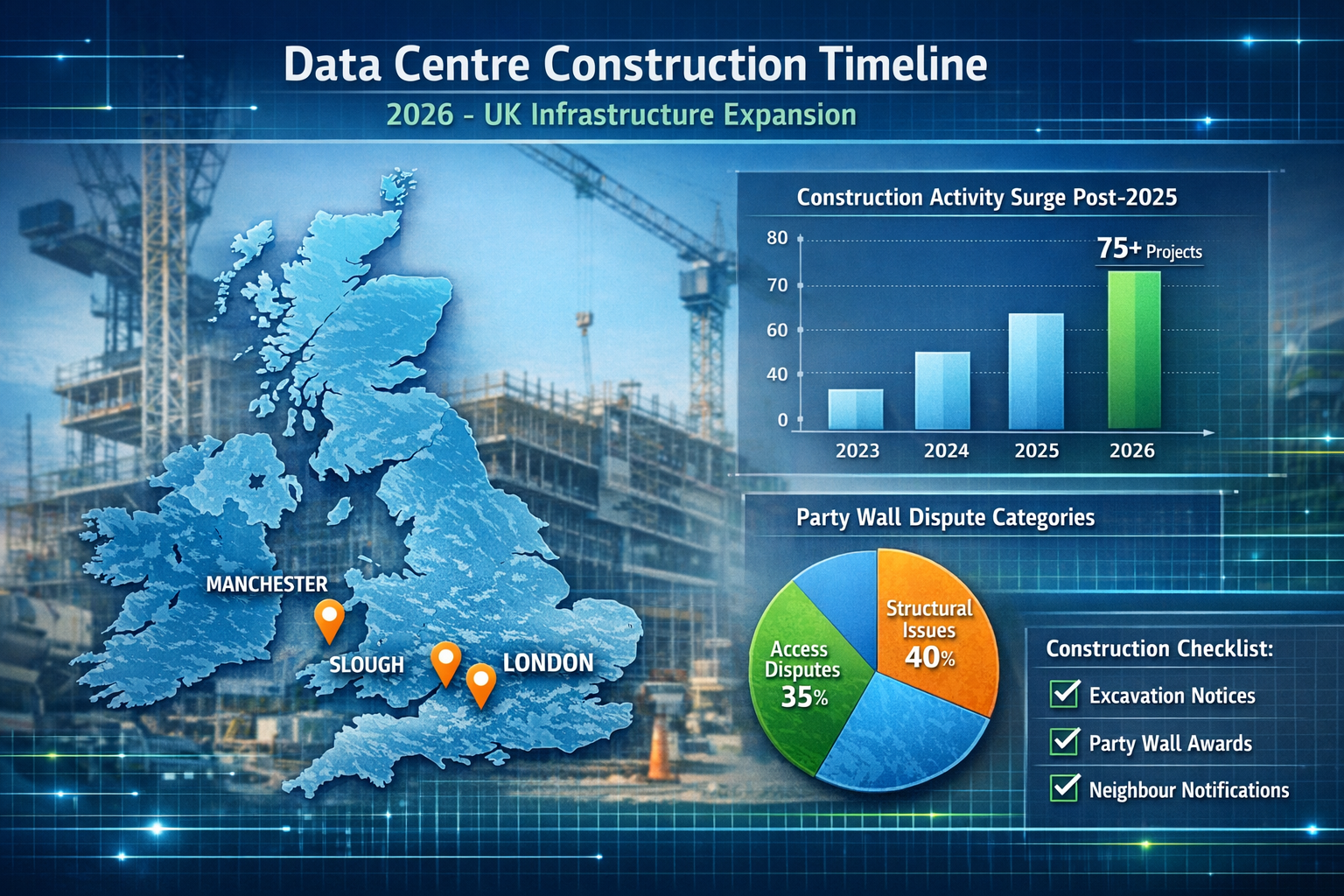
The most effective approach to Party Wall Surveys for 2026 Data Centre Boom: Compliance Checklists Amid UK Infrastructure Expansion focuses on preventing disputes rather than managing them after they arise. RICS professional standards emphasize proactive engagement and transparent communication as the foundation of successful party wall processes.
Early Stakeholder Engagement 🤝
Principle: Engage adjoining owners before formal statutory notices create adversarial dynamics.
Implementation:
-
Pre-Notice Consultation: Contact adjoining owners 3-4 months before serving formal notices to:
- Explain the project in accessible language without legal jargon
- Share visualizations and plans showing how the development will look
- Address concerns and questions in informal, low-pressure setting
- Build personal relationships that facilitate later cooperation
-
Community Liaison Officer: Appoint a dedicated professional to:
- Serve as single point of contact for all adjoining owners
- Respond promptly to questions and concerns
- Organize site visits and information sessions
- Maintain regular communication throughout construction
-
Transparent Information Sharing: Provide:
- Project newsletters with construction progress updates
- Advance notice of disruptive activities (deliveries, noisy work, road closures)
- Direct contact information for raising issues
- Clear explanation of party wall process and adjoining owner rights
Evidence: Industry data suggests that projects implementing comprehensive pre-notice engagement experience 60-70% fewer formal disputes and 40% faster award agreement timelines compared to purely statutory compliance approaches.
Professional Surveyor Selection 👷
Principle: Appointing qualified, experienced surveyors prevents technical disputes and ensures efficient award preparation.
Selection Criteria:
✓ RICS Membership: Verify current RICS accreditation and professional indemnity insurance
✓ Party Wall Specialization: Confirm specific party wall expertise, not just general surveying qualifications
✓ Data Centre Experience: Prioritize surveyors with previous large-scale commercial or industrial project experience
✓ Local Knowledge: Select surveyors familiar with local building stock, ground conditions, and typical construction methods
✓ Availability: Ensure surveyor capacity to respond promptly throughout construction period
✓ Communication Skills: Assess ability to explain technical matters clearly to non-specialist adjoining owners
Agreed Surveyor Advantages: Where possible, propose an agreed surveyor acting for both parties:
- Faster award preparation (single surveyor, no coordination delays)
- Lower costs (one fee instead of two plus Third Surveyor)
- Reduced adversarial dynamics
- Streamlined communication and decision-making
Comprehensive Schedule of Condition Documentation 📋
Principle: Detailed pre-construction condition records eliminate disputes about whether damage is construction-related or pre-existing.
Best Practices:
Photographic Standards:
- Use professional photography equipment with date/time stamping
- Capture multiple angles and distances for each feature
- Include scale references (measuring tapes, crack width gauges)
- Photograph in good lighting conditions
- Create systematic room-by-room documentation
- Number and catalog all images with corresponding written descriptions
Written Descriptions:
- Describe defects precisely with measurements and locations
- Note materials, finishes, and decorative conditions
- Record obvious maintenance issues separately from structural concerns
- Use consistent terminology aligned with RICS standards
- Include surveyor professional opinion on significance of existing defects
Technical Surveys:
- Establish crack monitoring stations at key locations
- Conduct level surveys to document existing settlement
- Assess structural adequacy for anticipated construction impacts
- Identify vulnerable elements requiring special protection
- Document underground services and drainage conditions
Adjoining Owner Involvement:
- Invite adjoining owners to accompany schedule inspections
- Provide copies of schedule documentation for review
- Address any disagreements about condition descriptions before finalizing
- Obtain written acknowledgment of schedule accuracy where possible
Proper schedule preparation, as detailed in guidance on schedule of condition documentation, creates objective evidence that protects both building and adjoining owners from unfounded claims.
Clear Award Provisions and Construction Protocols 📝
Principle: Comprehensive, unambiguous party wall awards prevent disputes by establishing clear expectations and procedures.
Essential Award Components:
Working Hours and Days:
- Specify exact permitted hours (e.g., Monday-Friday 8:00-18:00, Saturday 9:00-13:00)
- Address any extended hours provisions with specific conditions
- Define bank holidays and special restrictions
- Establish notification requirements for exceptional circumstances
Vibration and Noise Limits:
- Set measurable thresholds aligned with British Standards
- Specify monitoring locations and frequency
- Define actions required if limits exceeded
- Clarify responsibility for monitoring costs
Access Arrangements:
- Detail surveyor inspection rights and notification requirements
- Specify emergency access procedures
- Address security and safety protocols
- Clarify liability for access-related damage
Protective Measures:
- Require specific safeguards (hoardings, protective barriers, vibration isolation)
- Set standards for excavation support and temporary works
- Mandate monitoring systems and reporting frequency
- Establish inspection and approval procedures before critical activities
Damage Resolution:
- Define process for reporting potential damage
- Establish investigation and assessment procedures
- Clarify repair standards and approval requirements
- Set timelines for damage remediation
- Address temporary accommodation if repairs require vacation
Proactive Construction Management 🏗️
Principle: Careful construction execution prevents damage that triggers disputes.
Implementation Strategies:
Pre-Construction Briefings:
- Educate site teams on party wall requirements and sensitivities
- Identify adjoining properties and restricted activities
- Establish clear reporting procedures for incidents
- Emphasize importance of working hour compliance
Continuous Monitoring:
- Implement real-time vibration monitoring with automated alerts
- Conduct daily visual inspections of adjoining properties
- Maintain detailed site diaries documenting all relevant activities
- Review monitoring data weekly with party wall surveyor
Incident Response:
- Investigate all damage reports immediately (target: within 4 hours)
- Document findings with photographs and written assessments
- Communicate promptly with affected adjoining owners
- Implement remedial measures or protective actions without delay
- Maintain incident log for surveyor review
Quality Assurance:
- Verify excavation support installation before proceeding to depth
- Inspect temporary works regularly for adequacy
- Monitor groundwater control effectiveness
- Ensure vibration isolation properly installed and functioning
- Conduct pre-start checks before high-risk activities
Case Study: Manchester Data Centre Party Wall Success
A recent 15MW hyperscale data centre development in Manchester demonstrates effective application of Party Wall Surveys for 2026 Data Centre Boom: Compliance Checklists Amid UK Infrastructure Expansion principles.
Project Context
Site: Former industrial property in mixed-use area with:
- 12 adjoining commercial properties (warehouses, offices)
- 3 residential properties within 6m excavation zone
- Shared party walls on two elevations
- Victorian-era neighbouring structures with shallow foundations
Construction Scope:
- 8-metre deep excavation for basement cooling plant
- Piled foundations to 12-metre depth
- Raising existing party wall by 4 metres
- 18-month construction program
- 24/7 construction requirement for schedule compression
Party Wall Strategy Implementation
Pre-Notice Engagement (Month -6):
- Community consultation event with project presentations and Q&A
- Individual meetings with all 15 affected property owners
- Distribution of project information packs with visualizations
- Appointment of community liaison officer with dedicated phone line
Formal Compliance (Month -4 to -2):
- Service of Section 2 notices for party wall raising and modifications
- Service of Section 6 excavation notices for all properties within zones
- Proposal of single agreed surveyor (accepted by 13 of 15 owners)
- Two dissenting owners appointed separate surveyors; Third Surveyor selected
Schedule of Condition (Month -2 to 0):
- Comprehensive photographic surveys of all 15 properties (interior and exterior)
- Crack monitoring stations established at 47 locations
- Vibration baseline surveys conducted
- Detailed written schedules prepared and agreed with all owners
Award Preparation (Month -1 to +1):
- Detailed awards prepared covering all construction methodologies
- Extended working hours negotiated (Monday-Saturday 7:00-20:00) with enhanced vibration limits
- Real-time vibration monitoring mandated with automated alerts
- Weekly inspection regime established
- Compensation provisions agreed for residential properties during noisiest phases
Results and Outcomes
✅ Zero Construction Stoppages: No injunctions or work suspensions despite complex urban setting
✅ Minimal Disputes: Only 2 minor damage claims (cosmetic cracking) resolved within 3 weeks through agreed repair protocols
✅ Schedule Maintained: Party wall compliance achieved without critical path delays
✅ Cost Control: Total party wall costs (surveyor fees, monitoring, minor remediation) came in 15% under budget at £127,000
✅ Stakeholder Satisfaction: Post-construction survey showed 87% of adjoining owners rated communication as "good" or "excellent"
Key Success Factors
The project's success stemmed from:
- Early Investment: Allocating resources to pre-notice engagement created cooperative relationships
- Professional Team: RICS-qualified surveyors with data centre experience prevented technical disputes
- Comprehensive Documentation: Detailed schedules of condition eliminated ambiguity about pre-existing conditions
- Proactive Monitoring: Real-time vibration tracking allowed immediate response to emerging issues
- Clear Communication: Dedicated liaison officer maintained trust throughout construction
This case demonstrates that even complex data centre projects in challenging urban environments can achieve Party Wall Surveys for 2026 Data Centre Boom: Compliance Checklists Amid UK Infrastructure Expansion objectives through systematic application of RICS-aligned protocols.
Technology and Innovation in Party Wall Compliance
The 2026 data centre boom coincides with technological advances that are transforming party wall survey practices, offering opportunities for enhanced compliance and dispute prevention.
Digital Condition Surveys 📱
Traditional Challenges: Paper-based schedules of condition are time-consuming to prepare, difficult to search, and vulnerable to loss or damage.
Digital Solutions:
- Tablet-Based Survey Apps: Purpose-built applications enable surveyors to capture photographs, measurements, and descriptions in structured digital format on-site
- Cloud Storage and Sharing: Instant upload to secure cloud platforms provides immediate access for all parties and prevents document loss
- 360-Degree Photography: Immersive imagery captures complete room conditions, allowing post-survey virtual inspection
- Automated Reporting: Software generates formatted schedules automatically from captured data, reducing preparation time by 60-70%
Benefits for Data Centre Projects:
- Faster schedule preparation supports compressed project timelines
- Enhanced documentation quality reduces disputes about pre-existing conditions
- Remote access enables efficient review by multiple stakeholders
- Integration with construction management systems streamlines workflow
Real-Time Monitoring Systems 📡
Traditional Challenges: Manual vibration and movement monitoring requires periodic site visits, creating gaps in data and delayed response to problems.
Digital Solutions:
- Continuous Vibration Sensors: Wireless sensors provide 24/7 monitoring with automated alerts when thresholds exceeded
- Crack Monitoring Gauges: Digital crack monitors track movement in real-time, identifying trends before visible deterioration occurs
- Settlement Monitoring: Automated level sensors detect ground movement continuously rather than at weekly intervals
- Centralized Dashboards: Web-based platforms aggregate all monitoring data for real-time review by surveyors, contractors, and owners
Benefits for Data Centre Projects:
- Immediate detection of excessive vibration allows instant mitigation
- Continuous data provides evidence of compliance with award limits
- Trend analysis identifies emerging issues before damage occurs
- Automated reporting reduces surveyor site visit requirements
Building Information Modeling (BIM) Integration 🏢
Traditional Challenges: 2D drawings and written descriptions make it difficult to visualize complex party wall relationships and construction impacts.
Digital Solutions:
- 3D Party Wall Models: BIM environments show precise spatial relationships between proposed works and adjoining properties
- Clash Detection: Automated analysis identifies potential conflicts between construction activities and party wall constraints
- Construction Sequencing: 4D BIM (3D + time) demonstrates construction progression and party wall impacts chronologically
- Collaborative Platforms: Cloud-based BIM enables all parties to review and comment on proposed works in shared environment
Benefits for Data Centre Projects:
- Enhanced communication with non-technical adjoining owners through visual models
- Early identification of party wall conflicts during design phase
- More accurate excavation notices with precise depth and proximity data
- Integration with construction planning for optimized sequencing
Drone Surveys for Condition Assessment 🚁
Traditional Challenges: Accessing high-level building elements (roofs, chimneys, upper elevations) for condition surveys requires expensive scaffolding or cherry pickers.
Digital Solutions:
- High-Resolution Aerial Photography: Drones capture detailed images of roofs and upper elevations safely and economically
- Thermal Imaging: Infrared drone cameras identify water penetration, insulation defects, and structural anomalies
- Photogrammetry: Multiple drone images processed into accurate 3D models for precise measurement
- Repeat Surveys: Periodic drone surveys track condition changes throughout construction period
Benefits for Data Centre Projects:
- Comprehensive roof condition documentation without scaffolding costs
- Faster schedule preparation for multi-story adjoining buildings
- Enhanced safety by eliminating high-level access requirements
- Detailed evidence for assessing construction impact on roofs and chimneys
For projects seeking comprehensive property assessment beyond party wall requirements, drone surveys offer valuable complementary data.
Regional Considerations Across the UK
While the Party Wall etc. Act 1996 applies uniformly across England and Wales, regional variations in building stock, ground conditions, and development patterns create location-specific considerations for Party Wall Surveys for 2026 Data Centre Boom: Compliance Checklists Amid UK Infrastructure Expansion.
London and Southeast England 🏙️
Characteristics:
- Dense urban development with extensive shared boundaries
- Victorian and Edwardian building stock with shallow foundations
- High property values increasing dispute stakes
- Complex ownership structures (leasehold, freehold, multiple interests)
- Clay soils prone to movement and subsidence
Party Wall Implications:
- Expect extensive Section 6 excavation notice requirements
- Budget for multiple adjoining owners per boundary
- Anticipate higher surveyor fees reflecting London market rates
- Plan for longer award preparation due to ownership complexity
- Implement enhanced monitoring for clay soil movement
Data Centre Considerations:
- Power grid constraints pushing development to urban infill sites
- Historic building adjacencies requiring specialist conservation input
- Residential proximity creating noise and vibration sensitivity
- Limited construction access complicating logistics
Manchester and Northwest England 🏭
Characteristics:
- Mixed industrial and residential areas from Victorian manufacturing era
- Sandstone and brick construction common in older buildings
- Regeneration zones with brownfield redevelopment opportunities
- More straightforward ownership structures than London
- Generally stable ground conditions (sandstone bedrock)
Party Wall Implications:
- Industrial adjacencies may reduce residential sensitivity concerns
- Sandstone structures require careful assessment for vibration vulnerability
- Regeneration areas may involve derelict adjoining properties with absent owners
- Lower property values may reduce dispute escalation tendency
Data Centre Considerations:
- Established data centre corridor with precedent projects
- Good power infrastructure availability in former industrial areas
- Supportive local planning environment for tech investment
- Access to skilled construction workforce familiar with industrial projects
For projects in the Manchester region, engaging chartered surveyors with local expertise provides valuable knowledge of regional building characteristics and ground conditions.
Scotland: Different Legal Framework ⚖️
Important Distinction: Scotland operates under different legislation – the Party Wall etc. Act 1996 does not apply in Scotland.
Scottish Approach:
- Party wall matters governed by common law and Building (Scotland) Act 2003
- No statutory notice requirements equivalent to English Act
- Disputes resolved through common law principles of nuisance and property rights
- Building standards system addresses structural safety but not party wall procedures
Implications for Scottish Data Centres:
- Greater reliance on voluntary agreements and good neighbour relations
- Professional surveyor involvement recommended but not statutorily mandated
- Court action required for dispute resolution without statutory surveyor process
- Insurance and contractual protections more critical in absence of statutory framework
Data centre developers operating across UK jurisdictions must recognize these fundamental legal differences and adapt compliance strategies accordingly.
Future Outlook: Party Wall Compliance Beyond 2026
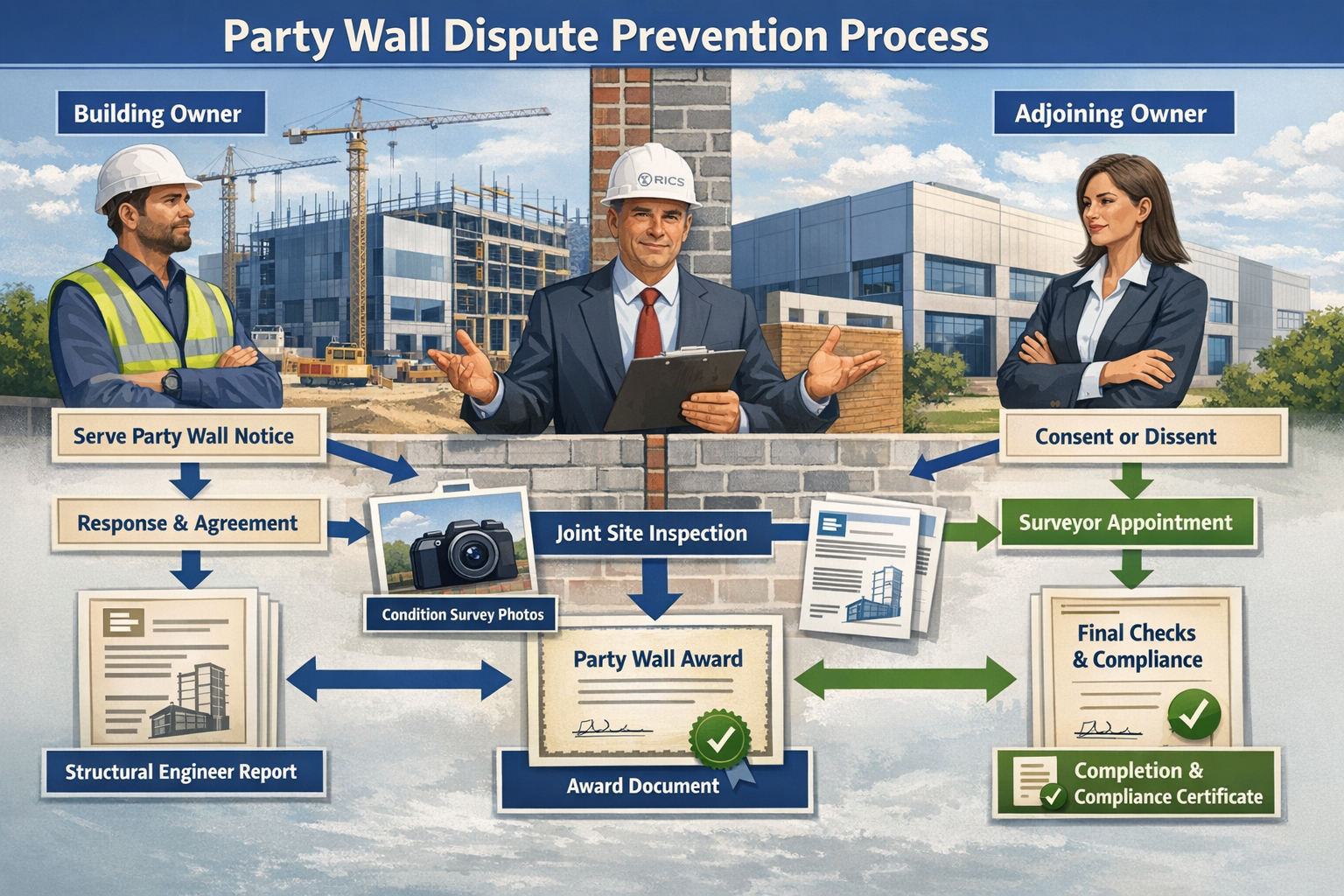
As the UK data centre sector continues evolving beyond 2026, several trends will shape party wall compliance requirements and practices.
Increasing Development Density 📈
Industry forecasts predict sustained data centre growth through 2027-2030 as AI workloads expand and edge computing proliferates [5]. This growth will increasingly occur in urban and suburban locations rather than isolated industrial parks, driven by:
- Power grid constraints limiting greenfield options
- Latency requirements pushing edge facilities into population centers
- Land scarcity in traditional data centre corridors
- Sustainability objectives favoring brownfield redevelopment
Party Wall Implications: Expect rising complexity and frequency of party wall requirements as data centre development intensifies in built-up areas with extensive shared boundaries.
Regulatory Evolution 📜
The UK government's commitment to digital infrastructure may drive regulatory changes affecting party wall processes:
- Streamlined Procedures: Potential reforms to accelerate statutory timelines for critical infrastructure projects
- Enhanced Protections: Possible strengthening of adjoining owner rights in response to construction boom impacts
- Professional Standards: Likely evolution of RICS guidance addressing data centre-specific scenarios
- Technology Integration: Regulatory recognition of digital survey methods and remote monitoring systems
Sustainability and Environmental Considerations 🌱
Data centre environmental impact is receiving increasing scrutiny, with implications for party wall matters:
- Cooling System Innovations: New cooling technologies (liquid cooling, immersion cooling) may create novel party wall considerations
- Renewable Energy Integration: On-site solar, wind, or battery storage may affect party wall relationships
- Circular Economy: Adaptive reuse of existing buildings for data centres creates complex party wall scenarios
- Climate Resilience: Flood protection and climate adaptation measures may require party wall coordination
Professional Development and Specialization 👨🎓
The growing complexity of data centre party wall work is driving professional specialization:
- Data Centre-Specialist Surveyors: Emergence of RICS members focusing specifically on tech infrastructure projects
- Cross-Disciplinary Teams: Integration of party wall surveyors with MEP engineers, structural specialists, and data centre consultants
- Continuous Professional Development: Enhanced training programs addressing data centre-specific party wall challenges
- International Knowledge Sharing: UK professionals learning from data centre markets in Netherlands, Ireland, and Scandinavia
Conclusion: Navigating Party Wall Compliance in the 2026 Data Centre Boom
The unprecedented expansion of UK data centre infrastructure in 2026 creates both opportunities and challenges for developers, property owners, and construction professionals. Successfully navigating Party Wall Surveys for 2026 Data Centre Boom: Compliance Checklists Amid UK Infrastructure Expansion requires systematic application of RICS-aligned protocols, proactive stakeholder engagement, and comprehensive technical planning.
Key principles for success include:
🎯 Early Planning: Integrate party wall considerations into project planning 6-9 months before construction, allowing adequate time for statutory procedures without schedule impact
🎯 Professional Expertise: Engage RICS-qualified party wall surveyors with data centre project experience to navigate technical complexities and prevent disputes
🎯 Comprehensive Documentation: Invest in detailed schedules of condition using modern digital tools to create objective evidence protecting all parties
🎯 Proactive Communication: Build cooperative relationships with adjoining owners through transparent information sharing and responsive engagement
🎯 Technical Excellence: Implement robust monitoring, protective measures, and construction controls to prevent damage and demonstrate compliance
🎯 Dispute Prevention Focus: Prioritize avoiding conflicts through clear awards, reasonable working practices, and prompt incident response rather than relying on dispute resolution mechanisms
The data centre sector's rapid growth means that party wall compliance expertise has become a competitive differentiator. Projects that treat party wall requirements as an opportunity to build stakeholder trust and demonstrate professional excellence will achieve faster approvals, smoother construction, and better long-term operational relationships with neighbouring properties.
Actionable Next Steps
For data centre developers planning 2026 projects:
- Conduct boundary analysis immediately to identify all potential party wall requirements
- Engage RICS party wall surveyor with data centre experience for preliminary consultation
- Integrate party wall timelines into critical path project planning
- Budget adequately for surveyor fees, monitoring systems, and potential mitigation measures
- Initiate pre-notice engagement with adjoining owners 4-6 months before formal notices
For adjoining property owners affected by data centre construction:
- Understand your rights under the Party Wall etc. Act 1996
- Respond promptly to party wall notices within the 14-day statutory period
- Consider appointing your own surveyor or agreeing to a single agreed surveyor
- Document existing conditions independently to supplement formal schedules
- Maintain open communication with building owners and surveyors throughout construction
For party wall surveyors serving the data centre sector:
- Develop data centre-specific expertise through continuous professional development
- Build relationships with data centre developers, contractors, and consultants
- Invest in technology for digital surveys, remote monitoring, and efficient reporting
- Stay current with evolving RICS guidance and industry best practices
- Share knowledge with professional peers to elevate sector-wide standards
The 2026 data centre boom represents a defining moment for UK digital infrastructure. By approaching Party Wall Surveys for 2026 Data Centre Boom: Compliance Checklists Amid UK Infrastructure Expansion with professionalism, technical rigor, and commitment to stakeholder collaboration, the industry can deliver the computing capacity the nation needs while protecting the rights and properties of all affected parties.
For expert guidance on party wall matters specific to your data centre project, consult with qualified professionals who understand both the statutory requirements and the unique technical demands of this critical infrastructure sector. The investment in proper party wall compliance pays dividends through reduced disputes, maintained schedules, and sustainable long-term relationships with the communities hosting these essential facilities.
References
[1] 2026 The Year The Uks Ai Infrastructure Moves Into Full Acceleration – https://datacentreinsight.co.uk/2025/12/29/2026-the-year-the-uks-ai-infrastructure-moves-into-full-acceleration/
[2] Dcr Predicts Uk Data Centres Are Booming But Is The Power Running Out – https://datacentrereview.com/2026/01/dcr-predicts-uk-data-centres-are-booming-but-is-the-power-running-out/
[3] Data Center Statistics – https://programs.com/resources/data-center-statistics/
[4] Planning For Data Centres In 2026 Whats Changed And What Will Matter Most – https://pwaplanning.co.uk/planning-for-data-centres-in-2026-whats-changed-and-what-will-matter-most/
[5] 2026 Data Centre Outlook Top Five Trends – https://www.dcbyte.com/news-blogs/2026-data-centre-outlook-top-five-trends/
[6] Data Center Outlook – https://www.jll.com/en-sea/insights/data-center-outlook
[7] Data Centre Trends 2026 Soben Part Of Accenture – https://www.accenture.com/content/dam/accenture/final/accenture-com/document-4/Data-Centre-Trends-2026-Soben-Part-of-Accenture.pdf