}
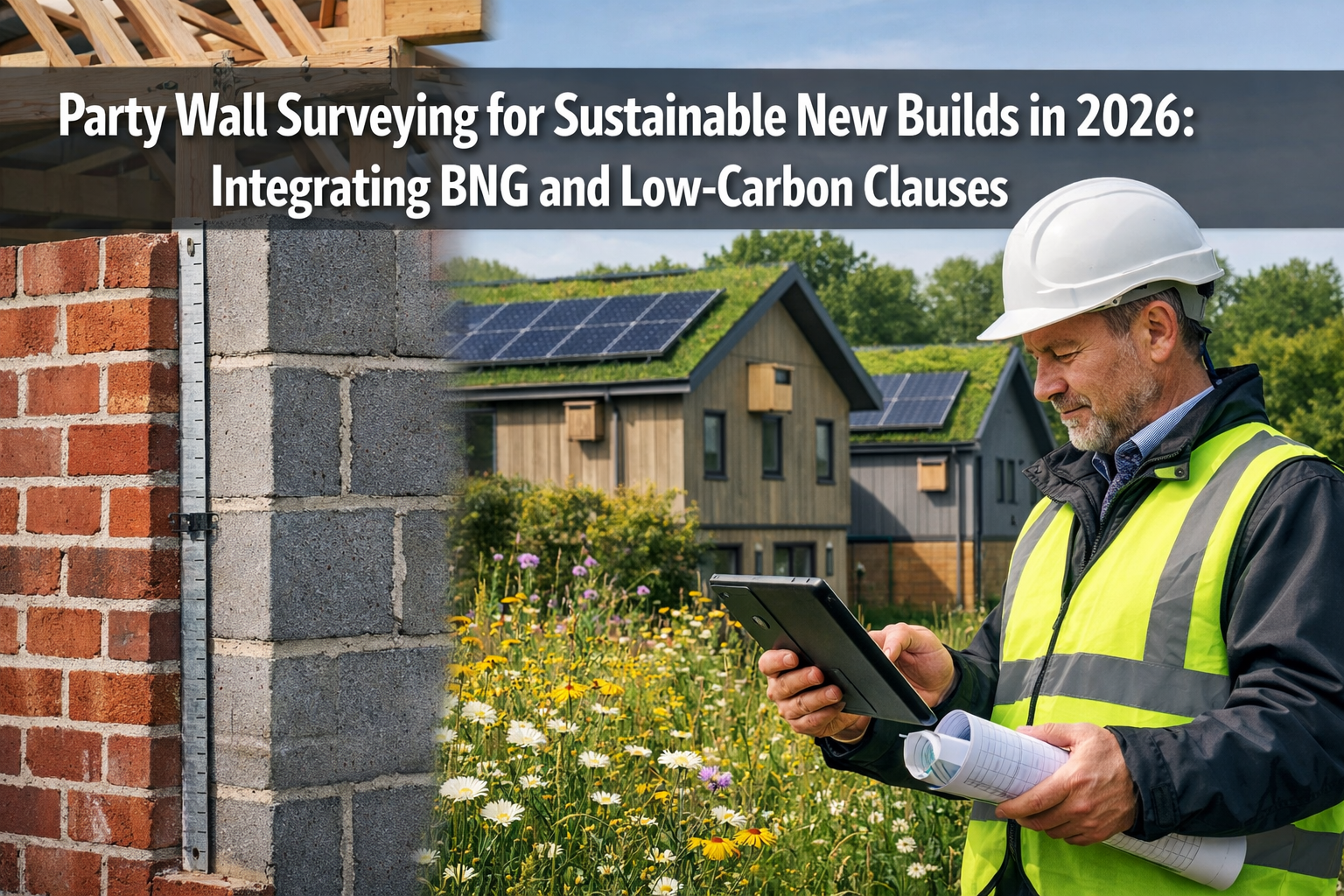
The construction landscape is transforming rapidly, and nowhere is this more evident than in the evolving requirements for Party Wall Surveying for Sustainable New Builds in 2026: Integrating BNG and Low-Carbon Clauses. With the Future Homes Standard now in full effect and biodiversity net gain (BNG) mandates reshaping development protocols, party wall surveyors face unprecedented challenges in adapting traditional agreements to accommodate eco-materials, carbon reduction targets, and habitat enhancement requirements. This comprehensive guide explores how RICS-compliant professionals are revolutionizing party wall processes to meet the demands of sustainable construction while protecting the interests of all parties involved.
Key Takeaways
- 🌱 BNG integration now requires party wall agreements to address biodiversity features on shared boundaries, including swift bricks, bat boxes, and green infrastructure
- 🏗️ Low-carbon clauses must specify embodied carbon limits, sustainable material requirements, and thermal performance standards for party wall construction
- 📋 RICS-compliant templates have evolved to incorporate sustainability schedules, eco-material specifications, and Future Homes Standard compliance verification
- ⚖️ Legal frameworks now mandate consideration of environmental impacts in party wall awards, creating new responsibilities for surveyors
- 🔄 Dispute resolution increasingly involves sustainability experts when disagreements arise over eco-material choices or BNG implementation
Understanding Party Wall Surveying in the Context of Sustainable Development
The Evolution of Party Wall Legislation
The Party Wall etc. Act 1996 has long governed construction work on shared boundaries between properties. However, the legislation was drafted in an era when sustainability considerations were minimal. In 2026, surveyors must interpret these traditional legal requirements through the lens of modern environmental obligations.
Traditional party wall concerns focused primarily on:
- Structural integrity and load-bearing capacity
- Preventing damage to adjoining properties
- Establishing clear rights and responsibilities
- Documenting pre-existing conditions
Modern sustainable considerations now include:
- Embodied carbon in construction materials
- Thermal bridging and energy performance
- Biodiversity enhancement opportunities
- Circular economy principles and material reuse
- Long-term environmental impact assessments
The integration of these new elements requires surveyors to possess expanded knowledge beyond conventional building pathology. Understanding party wall processes now demands familiarity with environmental science, sustainable construction techniques, and evolving regulatory frameworks.
The Future Homes Standard Impact
Since its full implementation, the Future Homes Standard has mandated that new homes produce 75-80% less carbon emissions compared to current building regulations. This dramatic shift affects party wall construction in several critical ways:
Material Selection Constraints 🏗️
- Traditional cement-based mortars may be replaced with lime-based alternatives
- Insulation materials must meet stringent thermal performance and embodied carbon criteria
- Structural elements require lifecycle carbon assessments
- Recycled and bio-based materials take precedence over virgin products
Performance Requirements 📊
- Party walls must achieve enhanced U-values to prevent thermal bridging
- Air tightness standards demand careful detailing at boundary junctions
- Acoustic performance cannot be compromised by sustainable material choices
- Moisture management becomes more complex with breathable eco-materials
Surveyors conducting building surveys on sustainable new builds must verify that party wall specifications align with these heightened performance standards while maintaining compliance with the Party Wall Act.
Party Wall Surveying for Sustainable New Builds in 2026: BNG Integration Strategies
Understanding Biodiversity Net Gain Requirements
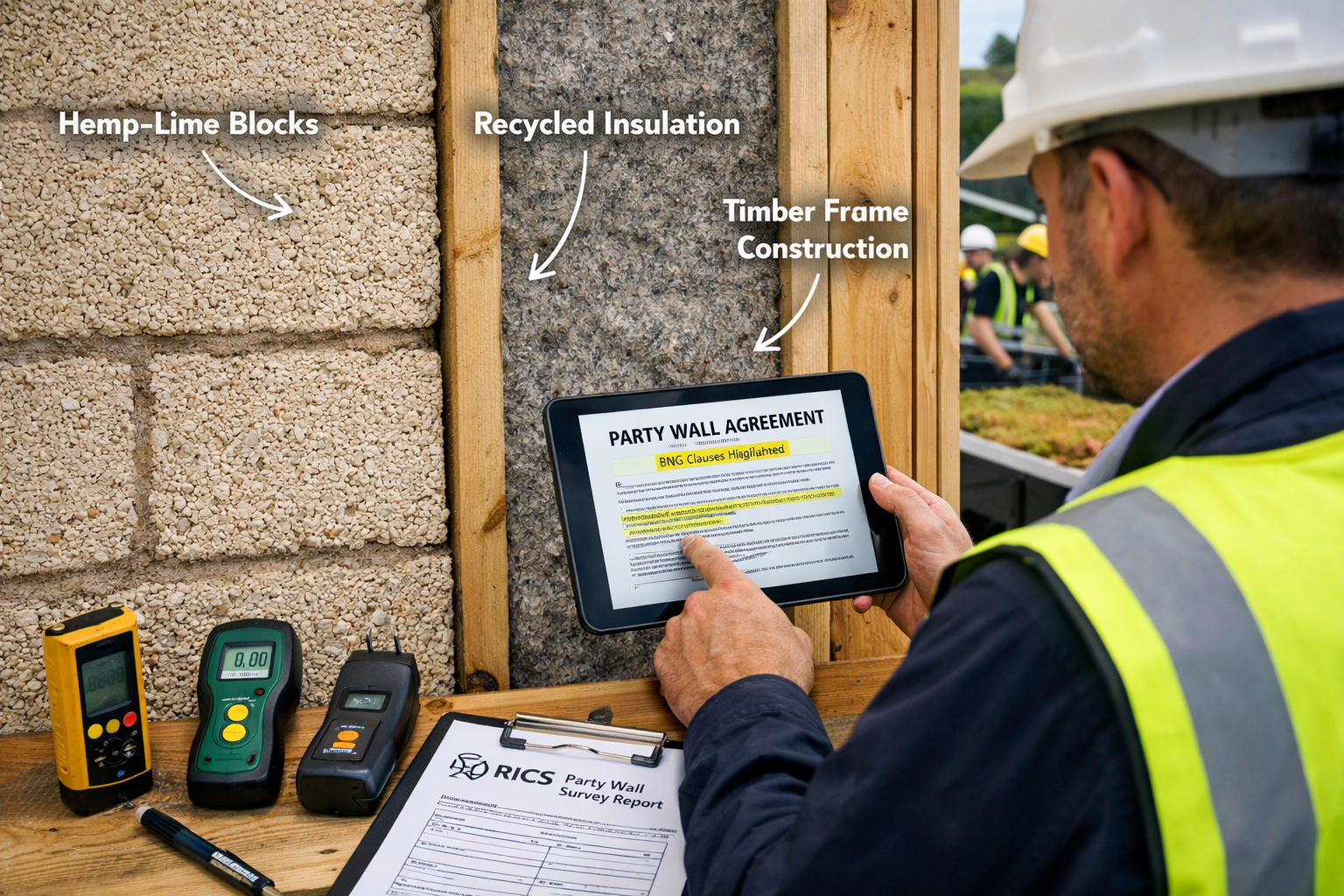
The mandatory 10% biodiversity net gain requirement has fundamentally altered how developers approach site boundaries. Party walls, traditionally viewed purely as structural elements, now represent potential biodiversity corridors and habitat creation opportunities.
Key BNG Considerations for Party Walls:
| BNG Element | Party Wall Application | Surveyor Responsibilities |
|---|---|---|
| Swift bricks | Integrated into shared walls at appropriate heights | Verify installation locations don't compromise structural integrity |
| Bat boxes | Mounted on party wall facades | Ensure access provisions don't breach privacy or create disputes |
| Green walls | Living wall systems on external party wall faces | Assess moisture implications and maintenance access rights |
| Insect hotels | Incorporated into wall design | Document in awards with maintenance schedules |
| Native planting | Boundary vegetation supporting wall ecology | Clarify ownership and maintenance obligations |
Drafting BNG Clauses in Party Wall Agreements
When preparing party wall awards for sustainable new builds, surveyors must now include specific BNG implementation clauses that address:
Habitat Feature Installation 🦇
- Precise locations of biodiversity enhancements on shared boundaries
- Installation methodologies that protect adjoining property
- Quality standards for materials (e.g., untreated timber for bat boxes)
- Timing restrictions to avoid nesting seasons
Maintenance and Access Provisions
- Long-term maintenance responsibilities for biodiversity features
- Access rights for habitat monitoring and upkeep
- Replacement protocols when features reach end of life
- Dispute resolution mechanisms for BNG-related disagreements
Monitoring and Compliance
- Documentation requirements for BNG metric calculations
- Photographic evidence of installed features
- Annual inspection schedules
- Reporting obligations to local planning authorities
Surveyors should reference party wall consent procedures when establishing these new protocols, ensuring all parties understand their environmental obligations alongside traditional structural responsibilities.
Case Study: Terraced Eco-Homes Development
Consider a recent Manchester development of 12 terraced eco-homes with shared party walls. The appointed surveyors faced the challenge of integrating BNG requirements across 11 party wall interfaces while maintaining RICS compliance.
Solutions Implemented:
- Standardized BNG schedule appended to all party wall awards specifying swift brick locations at 5-meter intervals
- Coordinated installation ensuring biodiversity features aligned across all properties for maximum ecological benefit
- Shared maintenance fund established for long-term habitat feature upkeep
- Digital monitoring system using drone surveys to verify BNG implementation without requiring repeated property access
This approach demonstrates how Party Wall Surveying for Sustainable New Builds in 2026: Integrating BNG and Low-Carbon Clauses can be systematically addressed through innovative surveying practices.
Incorporating Low-Carbon Clauses into Party Wall Awards
Embodied Carbon Considerations
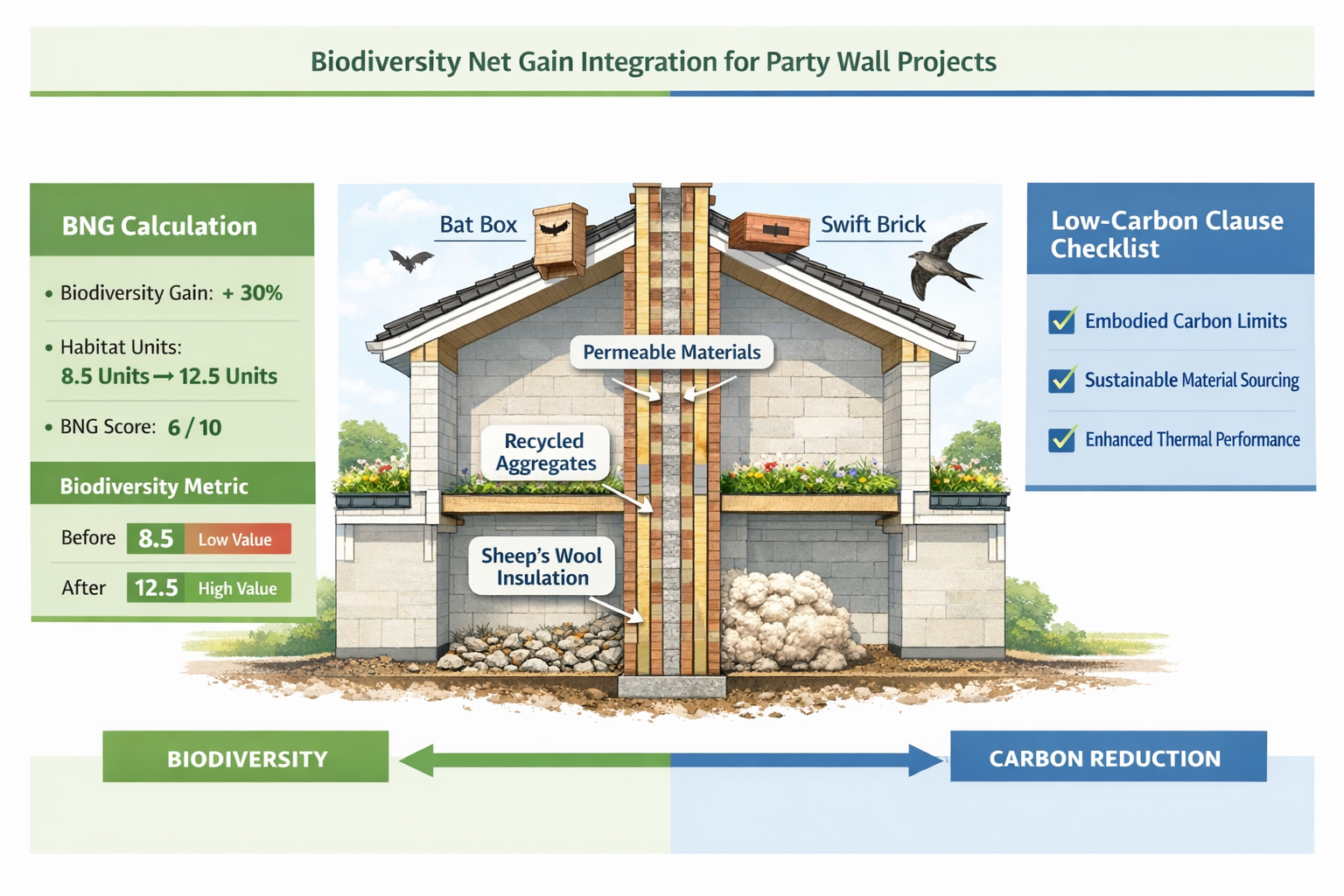
Embodied carbon—the total greenhouse gas emissions from material extraction, manufacturing, transportation, and construction—has become a critical metric in sustainable building. Party wall surveyors must now evaluate and document the carbon footprint of proposed construction methods.
Low-Carbon Material Alternatives for Party Walls:
Traditional vs. Sustainable Options 🌍
- Concrete blocks (high embodied carbon) → Hemp-lime blocks (carbon-negative alternative)
- Cement mortar (cement production = 8% global CO2) → Lime mortar (lower carbon, better breathability)
- Mineral wool insulation → Sheep's wool or recycled textile insulation (renewable, lower impact)
- Standard plasterboard → Clay boards or recycled gypsum products
- New timber → Reclaimed timber or FSC-certified sustainable sources
Drafting Effective Low-Carbon Clauses
When preparing party wall awards, surveyors should include low-carbon specification clauses that establish:
Material Standards 📋
- Maximum embodied carbon thresholds (typically measured in kgCO2e per m² of party wall)
- Mandatory use of Environmental Product Declarations (EPDs) for all primary materials
- Percentage requirements for recycled content
- Restrictions on high-carbon materials unless justified by performance needs
Verification Requirements
- Submission of material carbon calculations before construction commences
- Third-party verification of sustainable material claims
- Photographic evidence of materials used
- Retention of product certifications and EPDs
Example Low-Carbon Clause:
"The Building Owner shall ensure that all materials used in the construction of the party wall achieve an average embodied carbon figure not exceeding 45 kgCO2e/m². All primary structural materials shall be accompanied by independently verified Environmental Product Declarations. Where traditional materials are necessary for structural or conservation reasons, carbon offsetting measures shall be documented and agreed by both parties."
Understanding party wall award guidance helps surveyors frame these environmental requirements within the established legal framework of the Party Wall Act.
Thermal Performance and Energy Efficiency
Low-carbon construction extends beyond material selection to encompass the operational carbon performance of party walls. Surveyors must consider:
Thermal Bridging Prevention 🌡️
- Continuous insulation strategies across party wall junctions
- Thermal modeling to identify cold spots
- Airtightness detailing at wall-floor and wall-roof interfaces
- Specification of thermally broken fixings and connectors
Acoustic Performance Balance
A common challenge in sustainable party wall design involves balancing thermal performance with acoustic requirements. Lightweight eco-materials may offer excellent thermal properties but potentially compromise sound insulation. Surveyors must ensure specifications achieve:
- Minimum 45 dB airborne sound insulation (Building Regulations Part E)
- 62 dB impact sound insulation for separating floors
- Enhanced standards for conversions and sensitive uses
Practical Solution: Hybrid wall construction combining low-carbon structural elements with high-mass acoustic layers, such as recycled rubber sound barriers or clay-based acoustic boards.
RICS Compliance and Professional Standards for Sustainable Party Wall Surveying
Updated RICS Guidance for 2026
The Royal Institution of Chartered Surveyors has progressively updated its professional standards to reflect sustainability imperatives. Party wall surveyors must now demonstrate competence in:
Core Competency Areas ✅
- Environmental impact assessment for construction materials
- Biodiversity net gain calculation and verification
- Carbon accounting methodologies
- Sustainable construction techniques and material science
- Climate change adaptation strategies
Continuing Professional Development (CPD)
RICS now requires party wall surveyors to complete minimum annual CPD hours specifically focused on sustainability topics, including:
- Low-carbon construction materials (minimum 7 hours)
- BNG implementation in built environment (minimum 5 hours)
- Future Homes Standard compliance (minimum 4 hours)
Template Development and Standardization
To maintain consistency and legal robustness, leading surveying practices have developed RICS-compliant sustainable party wall templates that include:
Standard Sustainability Schedules 📄
- Schedule A: Biodiversity Net Gain Implementation Plan
- Schedule B: Low-Carbon Materials Specification
- Schedule C: Thermal Performance Requirements
- Schedule D: Sustainable Construction Methodology
- Schedule E: Environmental Monitoring and Compliance
These schedules attach to traditional party wall awards, ensuring environmental requirements carry the same legal weight as structural provisions. When disputes arise regarding sustainable specifications, surveyors can reference established party wall dispute resolution procedures.
Quality Assurance and Verification
Ensuring compliance with low-carbon and BNG clauses requires robust verification mechanisms:
Pre-Construction Phase 🔍
- Review and approval of detailed material specifications
- Verification of supplier certifications and EPDs
- Confirmation of BNG metric calculations
- Site-specific risk assessments for eco-material performance
During Construction
- Periodic site inspections to verify material compliance
- Photographic documentation of sustainable features installation
- Testing of thermal performance (thermographic surveys)
- Quality control of workmanship with eco-materials
Post-Construction
- Final compliance certification
- Handover of maintenance schedules for BNG features
- As-built documentation including actual carbon performance
- Establishment of monitoring protocols
Navigating Challenges and Disputes in Sustainable Party Wall Projects
Common Conflict Areas
The integration of sustainability requirements into party wall processes has introduced new potential areas of disagreement:
Material Selection Disputes ⚖️
- Adjoining owners questioning the durability of eco-materials
- Concerns about untested sustainable construction methods
- Cost implications of premium low-carbon alternatives
- Aesthetic objections to visible biodiversity features
Performance Concerns
- Doubts about acoustic performance of lightweight sustainable materials
- Moisture management concerns with breathable eco-materials
- Long-term maintenance responsibilities for BNG features
- Insurance implications of non-traditional construction
Resolution Strategies
Effective dispute resolution in sustainable party wall matters requires:
Enhanced Communication 💬
- Early consultation with adjoining owners about sustainability requirements
- Clear explanation of regulatory obligations (Future Homes Standard, BNG mandates)
- Provision of technical evidence supporting eco-material performance
- Visual presentations of proposed biodiversity enhancements
Expert Evidence
When disagreements escalate, appointing specialists with dual expertise in party wall law and sustainable construction proves invaluable. These experts can provide:
- Independent assessment of eco-material suitability
- Comparative analysis of traditional vs. sustainable options
- Risk evaluation and mitigation strategies
- Cost-benefit analysis of low-carbon alternatives
For situations where neighbours carry out works without proper party wall agreements, the complexity increases when sustainable materials are involved, as retrospective assessment requires specialized knowledge.
Insurance and Liability Considerations
The use of innovative sustainable materials and BNG features introduces new insurance considerations:
Key Coverage Areas 🛡️
- Professional indemnity for surveyors recommending untested eco-materials
- Latent defect insurance for non-traditional construction methods
- Public liability for biodiversity features (e.g., bee bricks attracting swarms)
- Performance guarantees for low-carbon material suppliers
Surveyors should ensure party wall awards include clear allocation of insurance responsibilities and require building owners to maintain appropriate coverage throughout construction and beyond.
Practical Implementation: Step-by-Step Guide for Surveyors
Phase 1: Initial Assessment and Planning
When appointed to a sustainable new build party wall matter, surveyors should:
1. Regulatory Review 📋
- Confirm applicable planning conditions related to BNG and carbon reduction
- Review local authority sustainability requirements
- Identify any conservation area or listed building constraints
- Verify Future Homes Standard compliance pathway
2. Baseline Documentation
- Conduct thorough building surveys of adjoining properties
- Document existing biodiversity features on boundaries
- Assess current thermal performance of existing structures
- Photograph all relevant boundary conditions
3. Stakeholder Engagement
- Meet with building owners to explain sustainability obligations
- Consult adjoining owners early regarding eco-material proposals
- Engage with architects and engineers on sustainable design
- Coordinate with ecologists on BNG implementation
Phase 2: Award Preparation
Drafting Comprehensive Sustainable Awards ✍️
The party wall award for sustainable new builds should include:
Section 1: Traditional Provisions
- Standard party wall rights and obligations
- Construction methodology and access arrangements
- Condition schedules and photographic records
- Dispute resolution procedures
Section 2: Sustainability Provisions
- Detailed low-carbon material specifications with embodied carbon limits
- BNG implementation plan with habitat feature locations
- Thermal performance requirements and testing protocols
- Environmental monitoring and compliance verification
Section 3: Special Conditions
- Extended warranty periods for eco-materials (if applicable)
- Maintenance schedules for biodiversity features
- Carbon performance verification requirements
- Adaptive management provisions if sustainable approaches require adjustment
Phase 3: Construction Monitoring
Active Oversight During Build Phase 🏗️
Sustainable party wall projects require enhanced monitoring:
Material Verification Inspections
- Confirm delivered materials match approved specifications
- Review EPDs and certifications on-site
- Document any substitutions and reasons
- Verify proper storage and handling of eco-materials
Installation Quality Control
- Inspect workmanship with sustainable materials
- Verify correct installation of biodiversity features
- Conduct interim thermal performance testing
- Document progress with dated photographs
Adaptive Management
If issues arise with sustainable materials or methods, surveyors must:
- Assess the nature and severity of the problem
- Consult with material manufacturers and specialists
- Propose alternative solutions maintaining sustainability goals
- Obtain agreement from all parties before implementing changes
Phase 4: Completion and Handover
Final Verification and Documentation ✅
Upon completion, surveyors should:
1. Compliance Certification
- Verify all low-carbon clauses have been fulfilled
- Confirm BNG features are properly installed and functional
- Conduct final thermal performance assessment
- Prepare comprehensive completion report
2. Handover Documentation
- Provide maintenance manuals for biodiversity features
- Supply material warranties and EPDs to building owners
- Deliver as-built carbon calculations
- Establish monitoring schedule for BNG features
3. Long-term Provisions
- Set up periodic review mechanisms (typically annual for first 3 years)
- Establish communication protocols for maintenance issues
- Document lessons learned for future projects
- Archive all sustainability documentation
For comprehensive guidance on various surveying approaches, consult resources on comparing different types of survey to understand how sustainability considerations integrate across surveying disciplines.
Future Trends and Emerging Considerations
Technological Integration
The future of Party Wall Surveying for Sustainable New Builds in 2026: Integrating BNG and Low-Carbon Clauses will increasingly leverage technology:
Digital Tools 💻
- BIM (Building Information Modeling) for visualizing sustainable party wall construction
- Carbon calculation software integrated into award preparation
- Drone surveys for non-invasive BNG monitoring
- Thermal imaging for performance verification
- Blockchain for immutable sustainability compliance records
AI and Data Analytics
Machine learning algorithms are beginning to assist surveyors in:
- Predicting long-term performance of eco-materials
- Optimizing biodiversity feature placement
- Identifying potential dispute areas before they escalate
- Benchmarking carbon performance against similar projects
Regulatory Evolution
Anticipated regulatory developments include:
Enhanced Standards 📈
- Potential increase in BNG requirements beyond 10%
- Stricter embodied carbon limits as net-zero targets approach
- Mandatory whole-life carbon assessments for all new builds
- Integration of circular economy principles into building regulations
Extended Liability Periods
Given the innovative nature of many sustainable materials, expect:
- Longer defect liability periods for eco-material performance
- Enhanced professional indemnity requirements for surveyors
- Mandatory performance monitoring for first 5-10 years
- Stricter enforcement of sustainability compliance
Market Dynamics
The sustainable construction market is rapidly maturing:
Material Innovation 🔬
- Mycelium-based insulation materials
- Carbon-negative concrete alternatives
- Self-healing bio-based materials
- Smart materials with integrated monitoring capabilities
Economic Factors
- Decreasing cost premiums for sustainable materials as production scales
- Green financing incentives for low-carbon construction
- Property value premiums for verified sustainable builds
- Insurance discounts for buildings with enhanced environmental performance
Frequently Asked Questions
Q: Are sustainable materials more expensive for party wall construction?
A: Initially, some eco-materials carry premium costs, but prices are declining rapidly. Whole-life cost analysis often shows savings through enhanced performance and durability. Many developers find that the property value premium for certified sustainable builds offsets any material cost increases.
Q: What happens if a biodiversity feature on a party wall fails?
A: Party wall awards should clearly allocate maintenance responsibilities. Typically, the building owner who installed the feature bears responsibility for its upkeep. Regular monitoring (documented in the award) helps identify issues early. Replacement protocols should be pre-agreed to avoid disputes.
Q: Can adjoining owners refuse sustainable materials in party wall construction?
A: Adjoining owners cannot unreasonably refuse materials that meet regulatory requirements and perform equivalently to traditional options. However, legitimate concerns about performance, durability, or aesthetics must be addressed. This is where expert surveyor guidance and evidence-based recommendations prove essential.
Q: How do I verify embodied carbon claims from material suppliers?
A: Require independently verified Environmental Product Declarations (EPDs) conforming to EN 15804 standards. Cross-reference claims against databases like the ICE (Inventory of Carbon & Energy) database. Consider engaging a carbon consultant for complex projects or high-value developments.
Q: What if sustainable construction methods cause damage to an adjoining property?
A: Standard party wall protections apply regardless of materials used. The building owner remains liable for damage caused during works. This underscores the importance of thorough condition surveys, appropriate insurance, and careful contractor selection experienced with eco-materials.
For more detailed information on party wall processes, visit our comprehensive party wall FAQ resource.
Conclusion
Party Wall Surveying for Sustainable New Builds in 2026: Integrating BNG and Low-Carbon Clauses represents a fundamental evolution in surveying practice, requiring professionals to master environmental science alongside traditional building pathology. The convergence of the Future Homes Standard, mandatory biodiversity net gain, and accelerating climate commitments has transformed party wall awards from straightforward structural documents into comprehensive sustainability frameworks.
Successful surveyors in this new landscape must:
✅ Develop comprehensive expertise in low-carbon materials, BNG implementation, and environmental regulations
✅ Adopt enhanced templates incorporating sustainability schedules as standard practice
✅ Implement robust verification processes ensuring environmental compliance
✅ Facilitate collaborative approaches that bring all stakeholders along the sustainability journey
✅ Embrace technological tools that streamline sustainable surveying processes
Actionable Next Steps
For Party Wall Surveyors:
- Invest in CPD focused on sustainable construction and environmental assessment
- Update templates to include standardized sustainability schedules
- Build networks with ecologists, carbon consultants, and sustainable material specialists
- Document case studies of successful sustainable party wall projects for knowledge sharing
For Building Owners and Developers:
- Engage surveyors early with proven sustainability expertise
- Budget appropriately for enhanced surveying requirements and material specifications
- Communicate proactively with adjoining owners about environmental benefits
- Maintain comprehensive records of sustainability compliance for future property transactions
For Adjoining Owners:
- Educate yourself about sustainable construction benefits and regulatory requirements
- Ask informed questions about eco-material performance and longevity
- Seek independent advice if concerns arise about proposed sustainable methods
- Consider the broader context of environmental responsibility in construction decisions
The integration of sustainability into party wall surveying is not merely a regulatory compliance exercise—it represents a critical contribution to the built environment's transformation toward net-zero carbon emissions and enhanced biodiversity. As the industry continues to innovate and regulatory frameworks evolve, surveyors who embrace these changes will lead the profession into a more sustainable future.
By adopting the strategies, templates, and approaches outlined in this guide, party wall surveyors can confidently navigate the complexities of sustainable new build projects, protecting client interests while advancing environmental objectives. The future of party wall surveying is undeniably green, and the professionals who adapt most effectively will find themselves at the forefront of the construction industry's most important transition.
For expert assistance with sustainable party wall matters or to discuss your specific project requirements, consult with RICS-accredited professionals experienced in integrating environmental considerations into traditional surveying practice. The complexity of modern sustainable construction demands expertise that spans both established legal frameworks and emerging environmental imperatives.