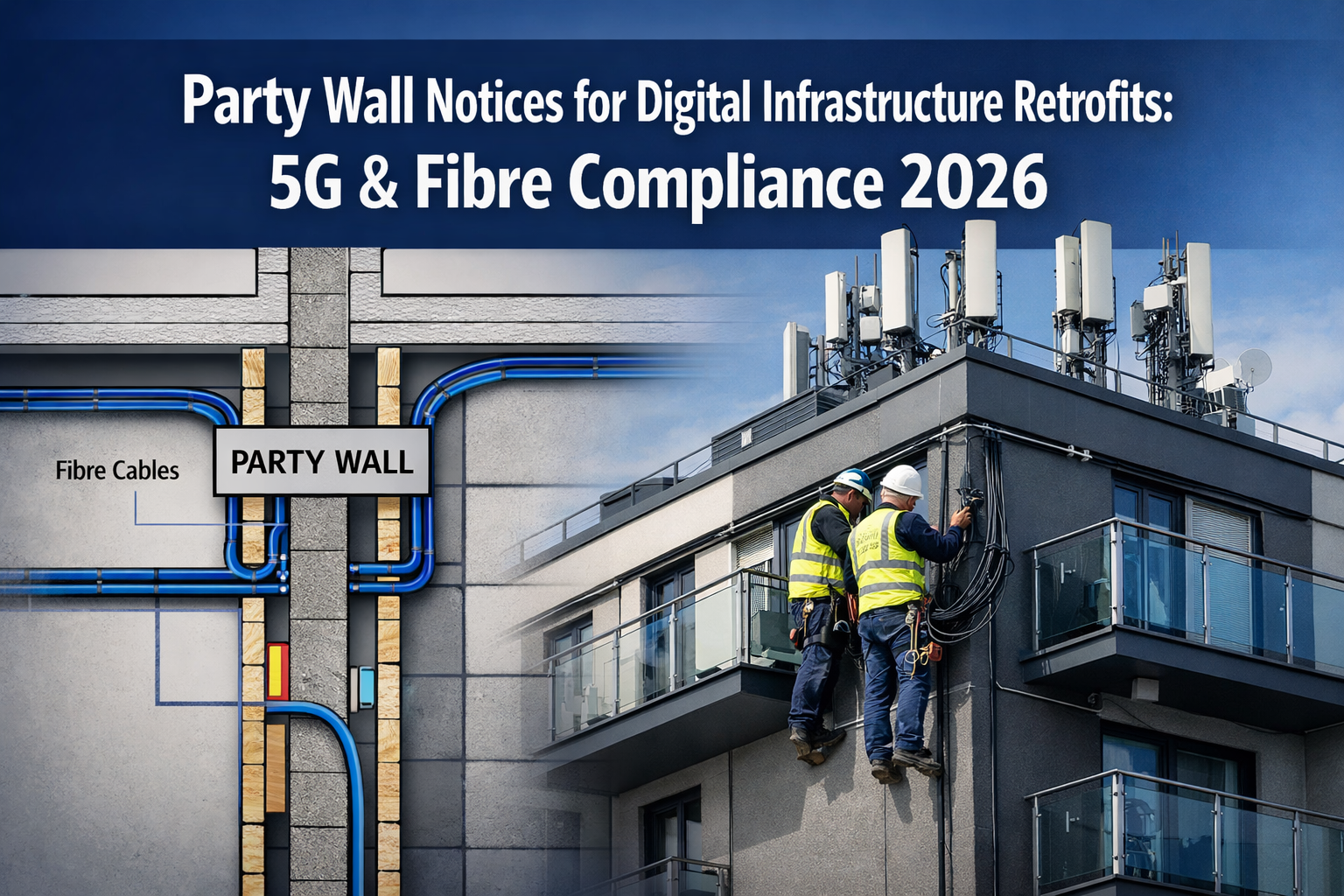
Telecommunications infrastructure projects now account for over 40% of all party wall disputes in multi-occupancy buildings, a dramatic surge driven by the rapid deployment of 5G networks and gigabit-capable fibre connections[1]. As digital infrastructure becomes as essential as electricity and water, building owners, telecommunications providers, and surveyors face a complex web of compliance requirements that intersect party wall legislation, building regulations, and telecommunications standards.
Understanding Party Wall Notices for Digital Infrastructure Retrofits: Surveying 5G and Fibre Compliance in 2026 Multi-Occupancy Buildings has become critical for property professionals navigating this evolving landscape. The convergence of increased data center energy demands, environmental scrutiny, and regulatory reform creates unprecedented challenges for retrofitting connectivity infrastructure into existing structures[1][2].
Key Takeaways
- Party wall notices are mandatory for most 5G and fibre installations that involve drilling, fixing equipment to, or running cables through shared walls in multi-occupancy buildings
- Compliance requires coordination between Party Wall Act procedures, building control approval, and telecommunications regulatory standards from bodies like Ofcom
- Schedule of condition surveys protect all parties by documenting the state of party walls before and after digital infrastructure installation work
- Multi-occupancy buildings present unique challenges including multiple adjoining owners, common areas, and complex service routing through shared structures
- Professional party wall surveyors with telecommunications infrastructure experience can prevent costly disputes and project delays
Understanding Party Wall Requirements for Digital Infrastructure Projects
The Party Wall Act 1996 governs work on shared walls, boundaries, and excavations near neighbouring properties in England and Wales. When telecommunications companies or building owners retrofit 5G equipment or fibre optic cables, they frequently trigger party wall obligations that many stakeholders overlook until disputes arise.
What Constitutes Notifiable Works?
Digital infrastructure retrofits typically involve several activities that require party wall notices:
Drilling and Fixing Operations 🔧
- Installing cable trunking or conduits through party walls
- Fixing antenna mounting brackets to shared roof structures
- Creating penetrations for fibre entry points
- Securing equipment cabinets to party walls
Structural Alterations
- Cutting chases for cable routing
- Installing support frameworks for heavy telecommunications equipment
- Modifying shared chimney stacks for antenna installation
- Reinforcing walls to bear additional equipment weight
Service Routing Through Boundaries
- Running fibre optic cables through party wall cavities
- Installing risers in shared service shafts
- Routing cables across boundary lines between properties
- Creating new service entry points at property boundaries
According to established party wall procedures, building owners must serve notices on all adjoining owners at least two months before commencing work on party walls or one month for excavation works near boundaries. Failure to serve proper notices can result in injunctions, work stoppages, and liability for damages—risks that have increased as neighbours carrying out works without party wall agreements become more common in the telecommunications sector.
The Three-Metre Rule and Digital Infrastructure
Telecommunications equipment installations often involve foundation work for ground-based cabinets, equipment rooms, or antenna support structures. The 3-metre rule becomes relevant when excavating within three metres of a neighbouring building if the work extends below the neighbour's foundation level, or within six metres if the excavation will cut into a 45-degree plane from the bottom of their foundations.
Common scenarios requiring notice:
| Work Type | Distance from Boundary | Notice Required? |
|---|---|---|
| Fibre cabinet foundation (0.5m deep) | 2m from neighbour | Yes (within 3m) |
| Equipment room excavation (2m deep) | 4m from neighbour | Yes (within 6m, below foundation plane) |
| Surface-mounted cabinet | 1m from boundary | No (no excavation) |
| Underground cable trench (0.3m deep) | 2.5m from neighbour | Possibly (depends on foundation depth) |
Party Wall Notices for Digital Infrastructure Retrofits: Surveying 5G and Fibre Compliance Requirements in 2026
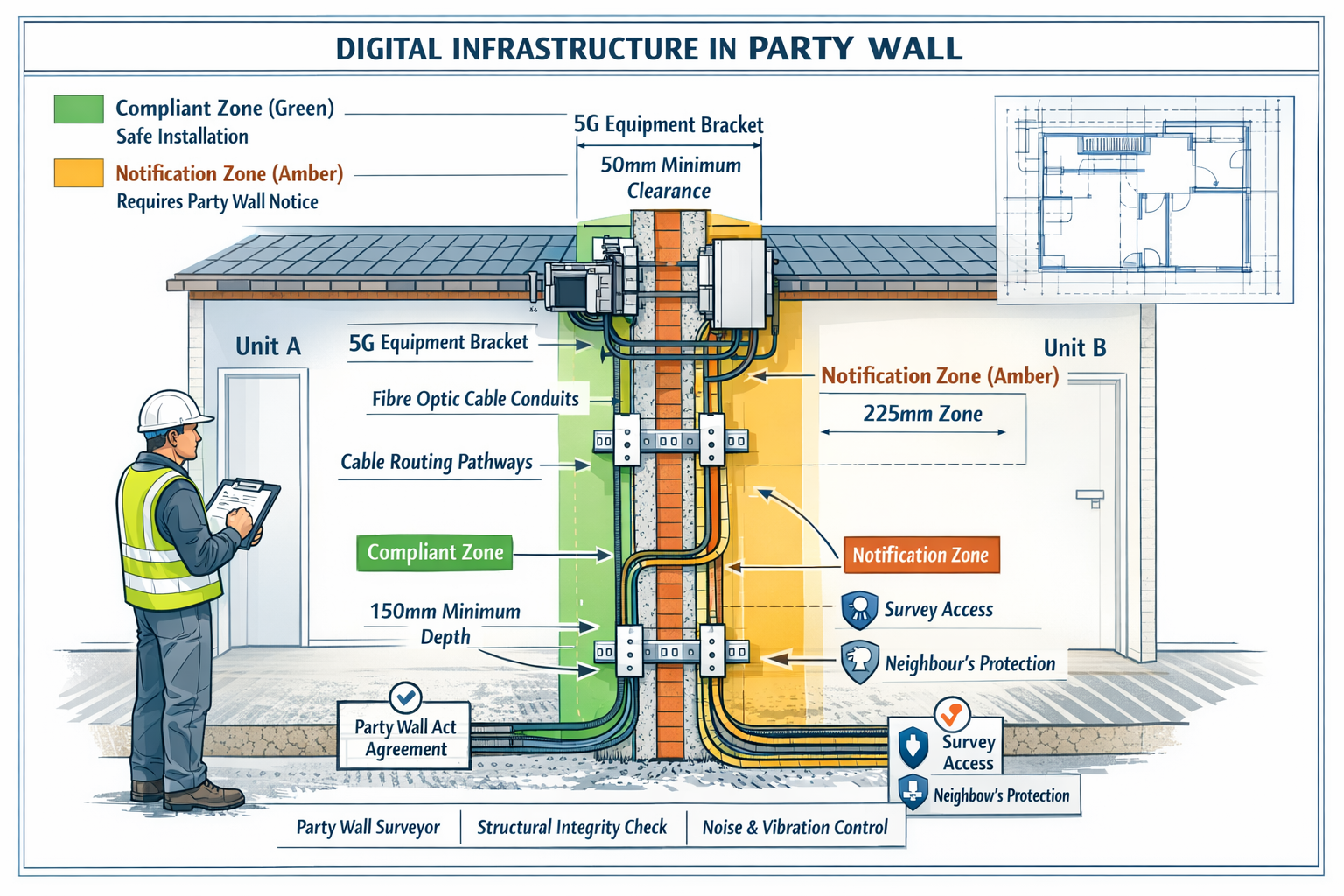
The regulatory landscape for Party Wall Notices for Digital Infrastructure Retrofits: Surveying 5G and Fibre Compliance in 2026 Multi-Occupancy Buildings extends beyond traditional party wall legislation. Telecommunications infrastructure must satisfy multiple compliance frameworks simultaneously.
Building Control and Planning Considerations
Digital infrastructure retrofits typically require Building Regulations approval for:
- Structural safety: Ensuring party walls can support additional equipment loads
- Fire safety: Maintaining fire resistance ratings when creating penetrations
- Electrical safety: Proper installation of power supplies and earthing systems
- Ventilation: Managing heat output from telecommunications equipment
Permitted development rights often cover external antenna installations, but internal works affecting party walls usually require building control notification regardless of planning status. Commercial property surveying professionals emphasize the importance of coordinating party wall procedures with building control applications to avoid sequential delays.
Telecommunications-Specific Compliance Standards
Ofcom Regulations (UK Context)
The Electronic Communications Code provides telecommunications operators with certain rights to install infrastructure, but these do not override party wall obligations. Operators must still:
- Serve proper party wall notices before commencing boundary works
- Obtain party wall consent from adjoining owners or proceed through the dispute resolution process
- Comply with building regulations and structural safety requirements
- Minimize disruption and restore affected areas to their previous condition
5G-Specific Considerations
5G installations present unique challenges:
- Higher equipment density: More antennas and cabinets per building
- Increased power requirements: Heavier electrical infrastructure
- Heat generation: Greater cooling and ventilation demands
- Structural loads: Heavier equipment requiring reinforced mounting points
The proliferation of data centers and telecommunications infrastructure has triggered increased environmental litigation and permitting scrutiny[2], making thorough compliance documentation essential for project success.
Multi-Occupancy Building Complexities
Party Wall Notices for Digital Infrastructure Retrofits: Surveying 5G and Fibre Compliance in 2026 Multi-Occupancy Buildings becomes particularly complex when dealing with:
Multiple Adjoining Owners 👥
- Apartment blocks may have dozens of adjoining owners requiring individual notices
- Leasehold structures require notices to both leaseholders and freeholders
- Common areas involve management companies and resident associations
- Mixed-use buildings combine residential and commercial stakeholders
Shared Service Infrastructure
Multi-occupancy buildings often feature:
- Common service risers running through multiple party walls
- Shared roof spaces with complex ownership arrangements
- Communal plant rooms affecting multiple properties
- Interconnected cavity systems spanning numerous units
Each property sharing a wall with the proposed works requires proper notification, making the administrative burden substantial. Professional party wall surveyors experienced in telecommunications projects can streamline this process and ensure comprehensive coverage.
Surveying Best Practices for Digital Infrastructure Party Wall Projects
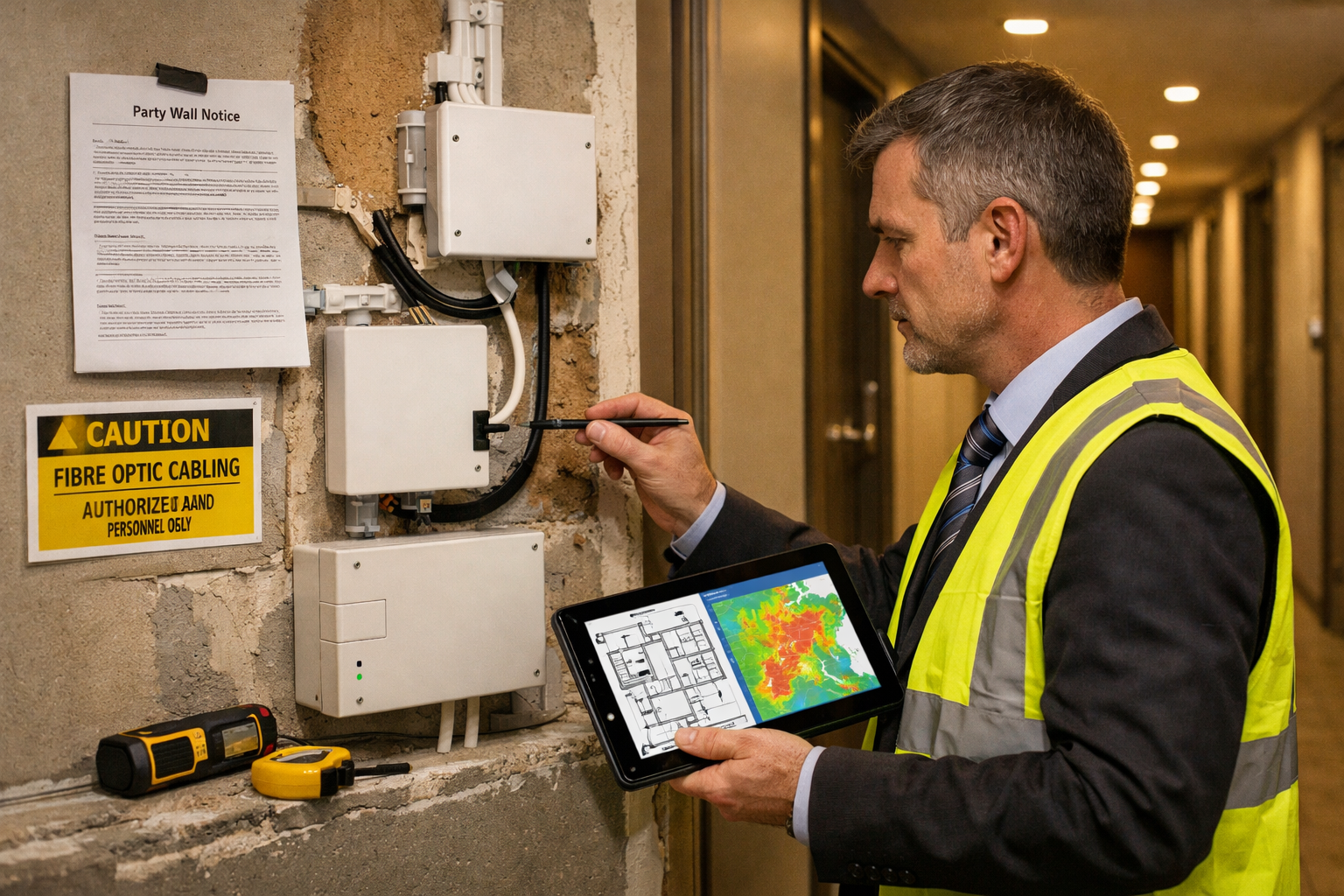
Effective surveying practices protect all parties and facilitate smooth project delivery for Party Wall Notices for Digital Infrastructure Retrofits: Surveying 5G and Fibre Compliance in 2026 Multi-Occupancy Buildings.
Pre-Installation Assessment and Documentation
Schedule of Condition Surveys
A comprehensive schedule of condition forms the foundation of party wall protection for digital infrastructure projects. This detailed photographic and written record documents:
- Existing condition of all party walls affected by the works
- Pre-existing cracks, defects, or damage
- Decorative finishes and fixtures that may be affected
- Access routes through common areas
- Condition of neighbouring properties' interiors where relevant
Professional surveyors typically conduct schedule of condition surveys for both the building owner's property and all adjoining owners' properties. This bilateral documentation prevents disputes about whether damage resulted from the telecommunications installation or pre-existed the works.
Technical Specifications Review 📋
Surveyors should review and verify:
- Equipment specifications: Weight, dimensions, power requirements, heat output
- Installation methodology: Drilling techniques, fixings, cable routing
- Structural calculations: Load-bearing capacity, reinforcement requirements
- Fire safety measures: Fire-stopping materials, cavity barriers, compartmentation
- Access requirements: Scaffolding, temporary works, disruption schedules
The Party Wall Award Process
When adjoining owners consent to the works, a simple written agreement may suffice. However, when owners dissent or fail to respond within 14 days, the matter becomes a party wall dispute requiring formal resolution through a party wall award.
The Award Process:
-
Surveyor Appointment: Each party appoints a surveyor, or both agree to a single "Agreed Surveyor"
-
Site Inspection: Surveyors inspect the proposed works and affected properties
-
Award Preparation: Surveyors prepare a detailed award document specifying:
- Description of works permitted
- Hours and methods of working
- Protection measures required
- Access arrangements
- Dispute resolution procedures
-
Award Service: The award is served on all parties and becomes binding
For digital infrastructure projects, awards should specifically address:
- Cable routing specifications: Exact paths, depths, and fixing methods
- Equipment mounting details: Load calculations and structural reinforcement
- Testing and commissioning: Radio frequency testing, signal verification
- Maintenance access: Future access rights for repairs and upgrades
- Decommissioning obligations: Removal requirements if equipment becomes obsolete
Common Pitfalls and How to Avoid Them
Inadequate Notice Periods ⏰
Telecommunications projects often operate on tight deployment schedules driven by network rollout targets. However, rushing party wall procedures creates significant risks. Building owners must serve notices with adequate lead time:
- Two months for party wall works
- One month for excavation works
- Additional time for surveyor appointments if disputes arise
- Buffer time for unexpected complications or additional consents
Starting party wall procedures early—ideally during the planning and design phase—prevents critical path delays.
Incomplete Identification of Adjoining Owners
Multi-occupancy buildings present identification challenges. Surveyors must:
- Obtain up-to-date land registry information
- Review leasehold structures and management arrangements
- Identify all properties sharing walls with the installation route
- Confirm current occupants and legal owners
- Serve notices on both leaseholders and freeholders where applicable
Missing even one adjoining owner can invalidate the entire process and expose the building owner to party wall disputes.
Underestimating Structural Impact
5G and fibre installations may appear minimally invasive, but they can affect structural integrity:
- Excessive drilling weakens party walls
- Heavy equipment loads exceed original design parameters
- Cable penetrations compromise fire compartmentation
- Vibration from installation damages neighbouring properties
Professional structural engineering input ensures installations remain safe and compliant.
Neglecting Fire Safety Requirements
Creating penetrations through party walls for cable routing can compromise fire resistance ratings. Proper fire-stopping measures must:
- Restore the wall's original fire resistance rating
- Use approved fire-stopping materials and methods
- Maintain compartmentation between units
- Comply with Building Regulations Approved Document B
Failure to properly fire-stop cable penetrations creates serious safety hazards and regulatory violations.
Working with Telecommunications Operators
Building owners and managing agents must understand that telecommunications operators, while possessing certain statutory rights, remain subject to party wall requirements. Effective collaboration involves:
Clear Contractual Arrangements 📄
- Define responsibility for party wall procedures (typically the operator as "building owner" under the Act)
- Specify liability for damages and dispute costs
- Establish restoration standards for affected areas
- Include indemnities for party wall claims
Coordination with Building Management
In multi-occupancy buildings:
- Notify residents' associations and management companies early
- Schedule works to minimize disruption
- Coordinate with other building works or maintenance
- Establish clear communication channels for concerns
Documentation and Compliance Records
Maintain comprehensive records including:
- All party wall notices and responses
- Surveyor correspondence and awards
- Building control approvals and completion certificates
- Schedule of condition reports and photographic evidence
- As-built drawings showing final installation details
These records prove invaluable if disputes arise months or years after installation, particularly when no party wall notice was served initially and retrospective issues emerge.
Emerging Trends and Future Considerations
The intersection of digital infrastructure deployment and party wall compliance continues to evolve rapidly in 2026.
Regulatory Reform and Streamlining
Lawmakers are increasingly focused on data center permitting reform to accelerate critical infrastructure deployment[1]. Potential changes may include:
- Fast-track procedures for telecommunications infrastructure in existing buildings
- Standardized templates for digital infrastructure party wall awards
- Deemed consent provisions for certain low-impact installations
- Coordinated approval processes combining party wall, building control, and telecommunications consents
However, until such reforms materialize, full compliance with existing party wall procedures remains mandatory.
Environmental and Energy Considerations
Digital infrastructure's environmental footprint faces growing scrutiny. Data centers and telecommunications equipment consume significant energy, triggering environmental litigation in some jurisdictions[2]. Party wall surveyors must increasingly consider:
- Energy efficiency of installed equipment
- Heat management and its impact on neighbouring properties
- Noise from cooling systems affecting residential occupants
- Visual impact of external equipment on building aesthetics
Technology-Enabled Surveying
Professional surveyors increasingly employ technology to improve Party Wall Notices for Digital Infrastructure Retrofits: Surveying 5G and Fibre Compliance in 2026 Multi-Occupancy Buildings:
- 3D laser scanning for precise condition documentation
- Thermal imaging to identify heat transfer issues
- Digital collaboration platforms for multi-party communication
- BIM integration for complex multi-occupancy buildings
- Drone surveys for roof-mounted equipment assessment
These tools enhance accuracy, reduce site visit requirements, and provide superior documentation for dispute resolution.
AI and Data Center Expansion
The explosive growth of AI applications drives unprecedented data center expansion, with associated financing and litigation risks[4]. This trend cascades down to building-level infrastructure, as:
- Edge computing facilities proliferate in urban multi-occupancy buildings
- Increased bandwidth demands require more extensive fibre installations
- Higher power densities necessitate substantial electrical infrastructure upgrades
- Cooling requirements impact building services and party wall works
Surveyors must adapt their expertise to these evolving technical requirements while maintaining rigorous party wall compliance.
Practical Checklist for Building Owners and Surveyors
When planning digital infrastructure retrofits in multi-occupancy buildings, use this comprehensive checklist:
Pre-Project Planning Phase ✅
- Identify all party walls affected by proposed cable routes and equipment locations
- Obtain detailed technical specifications from telecommunications provider
- Commission structural assessment of mounting points and cable routes
- Review building control requirements and initiate applications
- Identify all adjoining owners (leaseholders, freeholders, management companies)
- Engage experienced party wall surveyor with telecommunications infrastructure knowledge
- Review insurance coverage for party wall works and potential disputes
- Establish project timeline with adequate party wall notice periods
Notice and Consent Phase
- Prepare detailed party wall notices with technical drawings and specifications
- Serve notices on all adjoining owners with required lead times
- Track responses and consent status for each adjoining owner
- Appoint surveyors promptly if disputes arise
- Conduct pre-works schedule of condition surveys for all affected properties
- Prepare party wall awards addressing all technical and access requirements
- Obtain building control approval before commencing works
- Confirm telecommunications regulatory compliance (Ofcom, FCC, or equivalent)
Installation Phase
- Provide advance notice to residents before works commence
- Ensure contractors understand party wall award requirements and limitations
- Monitor works for compliance with approved specifications
- Document installation progress with photographs and records
- Address any concerns from adjoining owners promptly
- Conduct interim inspections if works extend over long periods
- Implement proper fire-stopping and structural protection measures
- Maintain site cleanliness and minimize disruption
Post-Installation Phase
- Conduct post-works schedule of condition surveys
- Compare pre- and post-condition to identify any damage
- Arrange repairs for any damage caused by the works
- Obtain building control completion certificate
- Provide as-built drawings to building owner and management company
- Document final installation configuration for future reference
- Establish maintenance access arrangements and protocols
- Archive all party wall documentation for future reference
Conclusion
Party Wall Notices for Digital Infrastructure Retrofits: Surveying 5G and Fibre Compliance in 2026 Multi-Occupancy Buildings represents a critical intersection of traditional property law, modern telecommunications regulation, and evolving building standards. As digital connectivity becomes essential infrastructure comparable to electricity and water, the volume and complexity of party wall matters involving telecommunications installations will only increase.
Success requires early planning, comprehensive compliance procedures, and professional expertise spanning party wall legislation, structural engineering, building control, and telecommunications standards. Building owners who invest in proper party wall procedures protect themselves from disputes, delays, and liability while facilitating the digital infrastructure upgrades that modern occupants demand.
For multi-occupancy buildings, the complexity multiplies with each additional adjoining owner, making professional surveying support not merely advisable but essential. The relatively modest cost of engaging experienced party wall surveyors pales in comparison to the potential costs of disputes, injunctions, or project delays.
Actionable Next Steps
If you're planning digital infrastructure retrofits in a multi-occupancy building:
- Engage a qualified party wall surveyor with telecommunications infrastructure experience at the earliest planning stage
- Commission a schedule of condition survey before any works commence
- Identify all adjoining owners comprehensively, including leaseholders, freeholders, and management entities
- Coordinate party wall procedures with building control applications and telecommunications regulatory requirements
- Build adequate time into project schedules for proper notice periods and potential dispute resolution
- Document everything thoroughly, from initial notices through final completion
- Get a professional quote from qualified surveyors to understand the full scope and cost of compliance
The digital infrastructure demands of 2026 and beyond require property professionals to master this specialized intersection of disciplines. Those who do will successfully navigate the regulatory landscape, protect their interests, and deliver the connectivity infrastructure that modern buildings require.
References
[1] Lawmakers from Both Parties Back Data Center Permitting Reform – https://www.nextgov.com/artificial-intelligence/2026/02/lawmakers-both-parties-back-data-center-permitting-reform/411700/
[2] Publications Data Centers Energy Digital Gateway Project Skyway – https://www.mankogold.com/publications-Data-Centers-Energy-Digital-Gateway-Project-Skyway.html
[3] I2coalition Internet Infrastructure Policy Report March 2026 – https://i2coalition.com/i2coalition-internet-infrastructure-policy-report-march-2026/
[4] Client Alert AI Data Center Financing And Litigation Risks – https://www.quinnemanuel.com/media/4dzkfccz/client-alert-ai-data-center-financing-and-litigation-risks.pdf
[5] Clarity Act Title IV The Expensive Plumbing Digital Firms Must Build Now – https://www.disruptionbanking.com/2026/04/02/clarity-act-title-iv-the-expensive-plumbing-digital-firms-must-build-now/