
The artificial intelligence revolution is reshaping Britain's digital infrastructure landscape at an unprecedented pace. As data centres race to expand capacity to meet surging AI computational demands, property boundaries are becoming critical legal and technical battlegrounds. Party Wall Agreements for UK Data Centre Expansions 2026: Surveyor Protocols in the AI Boom represents a convergence of traditional property law, cutting-edge technology infrastructure, and specialist surveying expertise that is defining how the UK builds its digital future.
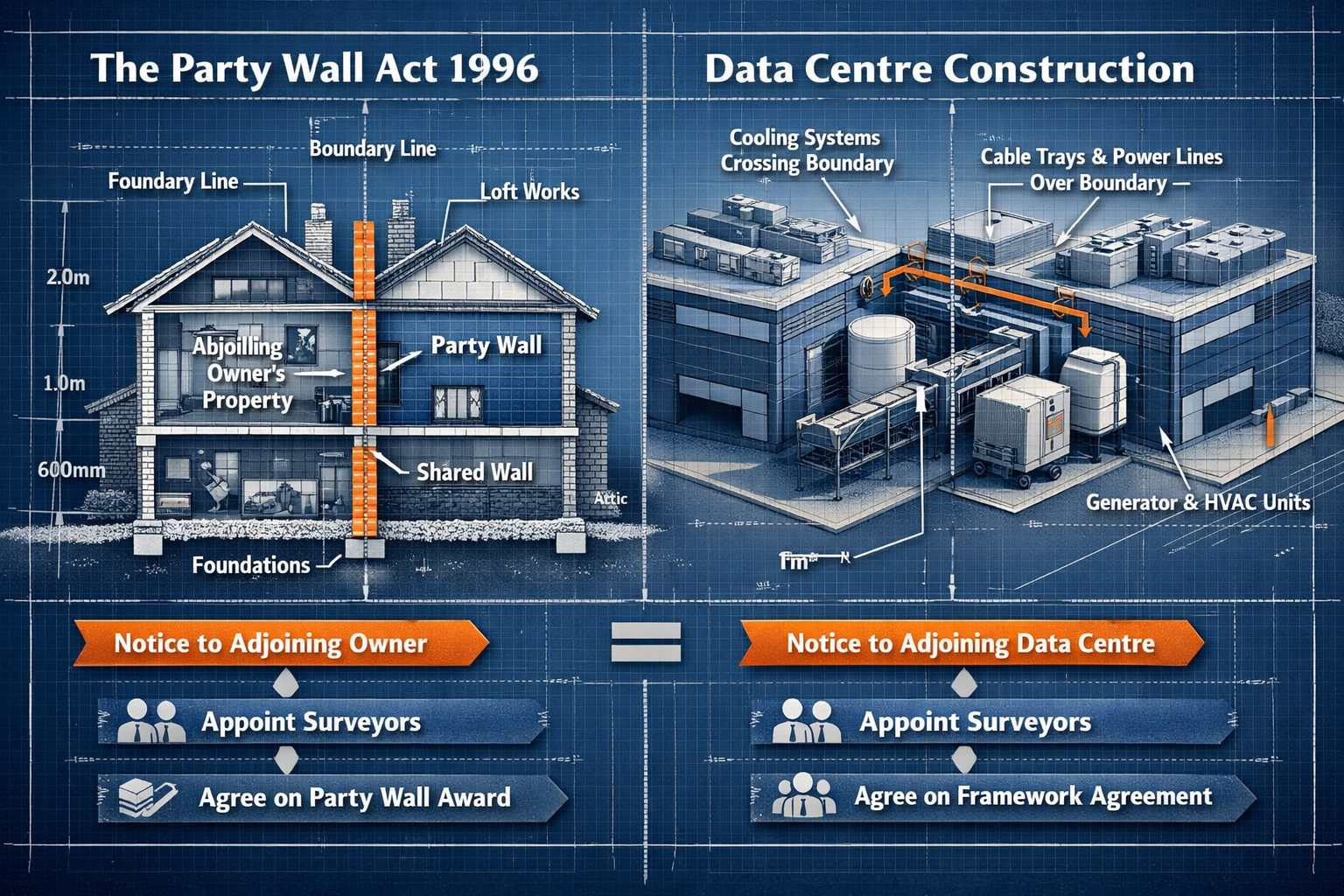
The UK government's National Data Strategy predicts data usage will double by 2026, driven largely by artificial intelligence and cloud computing adoption [1]. This explosive growth is forcing data centre operators to expand facilities rapidly, often requiring construction work that impacts shared boundaries and neighbouring properties. Understanding the intersection of party wall legislation and data centre development has never been more critical for developers, surveyors, and neighbouring property owners.
Key Takeaways
- 🏗️ AI-driven demand is accelerating UK data centre expansions, with data usage predicted to double by 2026, creating unprecedented party wall challenges
- 📋 Surveyor protocols must adapt to unique data centre requirements including deep excavations, vibration-sensitive equipment, and 24/7 operational continuity
- ⚖️ Party Wall Act 1996 compliance is mandatory for most data centre expansion works, requiring specialist knowledge of both construction law and digital infrastructure
- 🌍 Regional diversification beyond London is creating party wall scenarios in new locations across the UK
- 💼 Professional expertise from RICS-qualified surveyors experienced in both party wall matters and data centre construction is essential for successful project delivery
Understanding Party Wall Agreements for UK Data Centre Expansions 2026
The Legal Framework and Data Centre Applications
The Party Wall etc. Act 1996 governs construction work on or near boundaries between properties in England and Wales. For data centre expansions in 2026, this legislation takes on heightened significance due to the scale, complexity, and technical sensitivity of these projects.
Data centre developments typically trigger party wall requirements through:
- Excavation works for underground cooling systems, power infrastructure, and foundation reinforcement
- Structural alterations to existing buildings sharing boundaries with neighbouring properties
- New construction of server halls, cooling towers, and backup generator facilities
- Foundation works for heavy equipment requiring deep pile foundations
The excavation notice for party wall procedures become particularly critical when data centres require deep foundations to support massive cooling and power infrastructure. Unlike residential developments, data centre excavations often extend significantly deeper and closer to boundary lines.
Why Data Centre Expansions Present Unique Challenges
Data centres differ fundamentally from traditional commercial or residential developments in ways that complicate party wall procedures:
Operational Continuity Requirements: Existing data centres cannot tolerate downtime. Any party wall work must account for maintaining 24/7 operations, which affects scheduling, vibration control, and access arrangements.
Vibration Sensitivity: Server equipment and storage systems are highly sensitive to vibration. Party wall works involving piling, excavation, or structural alterations require sophisticated monitoring and mitigation strategies beyond standard construction practices.
Power and Cooling Infrastructure: Modern AI-focused data centres require massive power delivery systems and cooling capacity. The industry is shifting focus from cooling high-density AI racks to addressing power delivery challenges, with large GPU clusters creating power volatility that jumps from 20-40% idle load to 140-160% in cycles [3]. This infrastructure often crosses property boundaries through underground services.
Security Considerations: Data centres maintain strict security protocols. Party wall surveyors and neighbouring property owners requiring access must navigate enhanced security clearance procedures.
Surveyor Protocols for Party Wall Agreements in Data Centre Projects
Appointment of Specialist Surveyors
The complexity of Party Wall Agreements for UK Data Centre Expansions 2026: Surveyor Protocols in the AI Boom demands surveyors with dual expertise: comprehensive knowledge of the Party Wall Act 1996 and understanding of data centre construction requirements.
When selecting a party wall surveyor for data centre projects, consider:
| Qualification | Why It Matters for Data Centres |
|---|---|
| RICS Chartered Status | Ensures professional standards and insurance coverage for high-value projects |
| Data Centre Experience | Understanding of power, cooling, and operational requirements |
| Structural Engineering Knowledge | Ability to assess impact on foundations supporting heavy equipment |
| Vibration Assessment Skills | Critical for protecting sensitive server infrastructure |
| Commercial Project Background | Experience with large-scale developments and complex stakeholder management |
Our party wall services provide specialist expertise tailored to commercial and industrial developments, including data centre facilities.
The Schedule of Condition Process
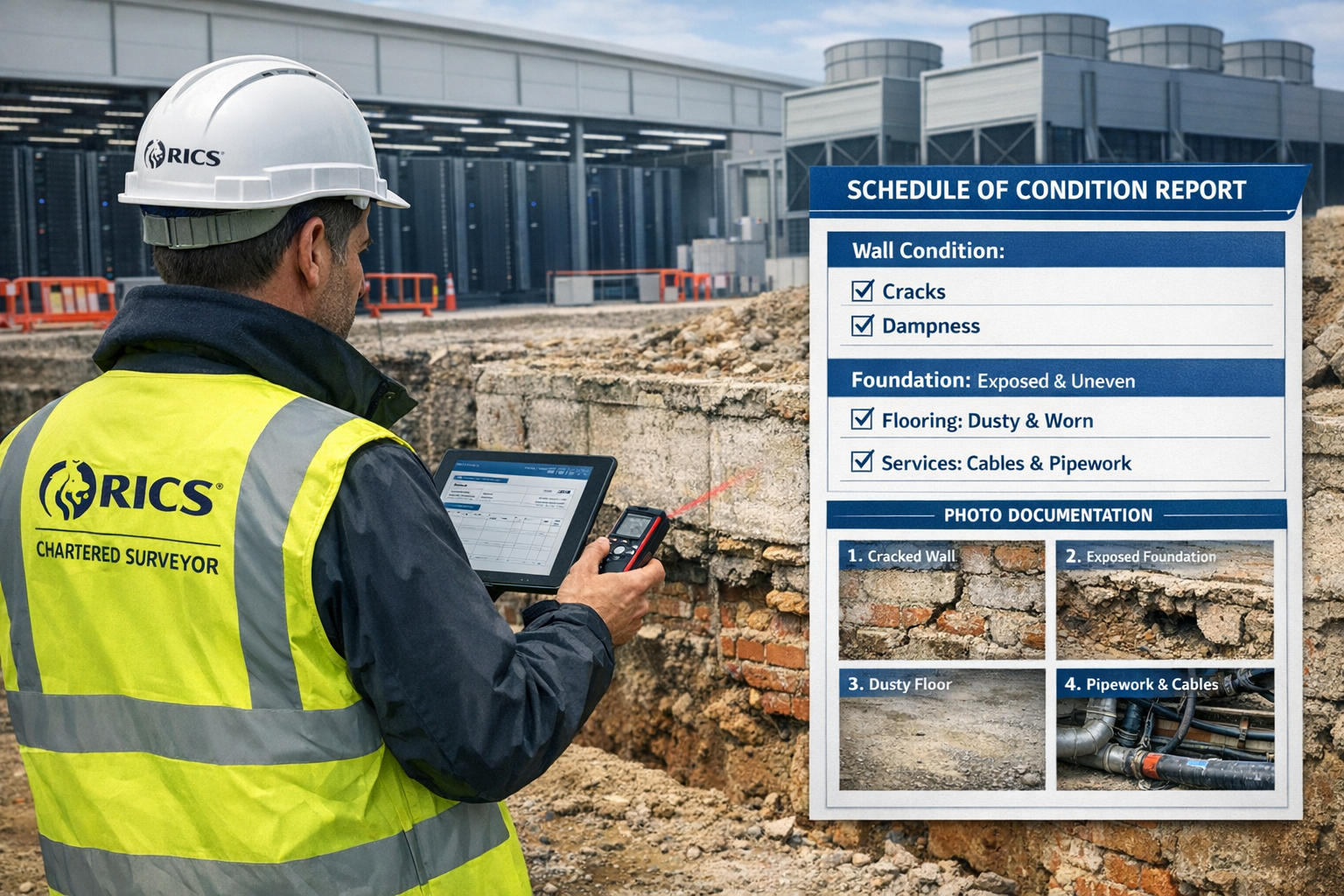
A comprehensive schedule of condition is absolutely essential for data centre party wall agreements. This detailed record documents the existing state of neighbouring properties before construction begins.
For data centre projects, schedules of condition should include:
- Photographic evidence of all structural elements, internal finishes, and external facades
- Vibration baseline measurements using specialized equipment to establish pre-construction levels
- Crack monitoring with precise measurements and photographic records
- Service infrastructure documentation including underground utilities and connections
- Equipment condition assessment for any sensitive machinery in neighbouring properties
The schedule protects both the building owner (data centre developer) and the adjoining owner by creating an objective record against which post-construction conditions can be compared.
Notice Procedures and Timelines
Data centre developers must serve appropriate notices under the Party Wall Act:
Line of Junction Notice (Section 1): For new walls built on the boundary line
Party Structure Notice (Section 2): For work to existing party walls or structures
Adjacent Excavation Notice (Section 6): For excavations within 3-6 meters of neighbouring buildings
⚠️ Critical Timeline Consideration: Notices must be served at least two months before work commences (one month for Section 6 notices). Given the rapid pace of data centre development driven by AI demand, early notice service is crucial to avoid project delays.
If no party wall notice is served, neighbouring owners can seek injunctions to halt construction, causing significant delays and financial losses on time-sensitive data centre projects.
The Party Wall Award
When agreement cannot be reached, or when surveyors are appointed, a Party Wall Award becomes necessary. This legally binding document sets out:
- Detailed description of proposed works
- Timing and access arrangements
- Protective measures and monitoring requirements
- Dispute resolution procedures
- Cost allocation
For comprehensive guidance, review our party wall award guidance which explains the award process in detail.
Data centre awards typically include specialized provisions:
✅ Vibration limits with continuous monitoring requirements
✅ Access protocols respecting security requirements
✅ Emergency contact procedures for 24/7 operations
✅ Equipment protection measures for sensitive infrastructure
✅ Service continuity guarantees ensuring no operational interruption
Regional Diversification and the AI Boom Impact
Beyond London: The 2026 Data Centre Map
While London has historically dominated UK data centre development, 2026 marks a significant shift toward regional diversification across the UK [2]. This geographic spread creates party wall scenarios in locations previously unfamiliar with large-scale data infrastructure projects.
Key Regional Growth Areas:
- Manchester and the North West: Emerging as a major hub with competitive power costs and connectivity
- Scotland: Benefiting from renewable energy availability and cooling climate advantages
- Midlands: Strategic central location attracting hyperscale developments
- South Wales: Growing cluster driven by connectivity and available land
This regional expansion means party wall surveyors across the UK must rapidly develop expertise in data centre construction requirements. Local surveyors in these regions should familiarize themselves with the unique demands of these projects.
AI-Specific Infrastructure Requirements
The AI boom is fundamentally changing data centre design, with direct implications for party wall agreements:
Power Density Increases: AI workloads, particularly large language models and machine learning training, require substantially higher power density than traditional data centre applications. This necessitates upgraded electrical infrastructure that may impact neighbouring properties.
Cooling System Evolution: Advanced cooling technologies including liquid cooling, immersion cooling, and hybrid systems require different infrastructure than traditional air-cooled facilities. These systems often involve deeper excavations and more complex underground piping networks.
Rapid Technological Change: The pace of AI development creates obsolescence risks, leading employers to instruct scope changes during projects [1]. Party wall agreements must accommodate potential modifications while protecting neighbouring owners.
Supply Chain Pressures and Timeline Management
Specialized components and equipment required for data centre construction are limiting supplier choice, with demand far outstripping supply, creating delays and imbalances in negotiating positions [1]. These supply chain challenges affect party wall timelines:
- Extended construction periods increase the duration of potential disruption to neighbours
- Phased procurement models where data centre construction is structured across multiple contracts [1] may require multiple party wall notices and awards
- Equipment delivery uncertainties make precise scheduling of party wall works more challenging
Surveyors must build flexibility into party wall awards while maintaining adequate protections for adjoining owners.
Common Party Wall Disputes in Data Centre Developments

Vibration and Structural Damage Claims
The most common dispute in data centre party wall matters involves vibration damage claims. The combination of deep excavations, heavy equipment installation, and ongoing operational vibration creates multiple risk points.
Prevention Strategies:
- Establish baseline vibration measurements before work commences
- Install continuous vibration monitoring equipment
- Set clear threshold limits in the party wall award
- Implement immediate notification protocols when limits are approached
- Use low-vibration construction techniques (e.g., continuous flight auger piling instead of impact piling)
If a neighbour is carrying out works without a party wall agreement, immediate action is necessary to protect property rights and prevent damage.
Access and Security Conflicts
Data centre security protocols can conflict with party wall access requirements. Neighbouring owners and their surveyors have legal rights to access for inspection purposes, but data centre operators have legitimate security concerns.
Resolution Approaches:
- Pre-approve specific individuals for site access
- Implement escort protocols for all visits
- Schedule inspections during agreed timeframes
- Use remote monitoring technology where appropriate
- Document all access in detailed logs
Service Disruption Issues
Excavation and construction work can inadvertently damage underground services affecting neighbouring properties. For data centres, the reverse is also true—neighbouring property services may impact data centre operations.
Risk Mitigation:
- Comprehensive utility surveys before work begins
- Service protection measures during excavation
- Emergency response protocols for service damage
- Temporary service provision arrangements if disruption occurs
Best Practices for Data Centre Party Wall Agreements in 2026
Early Engagement and Communication
The UK remains one of the top three data centre markets globally, with planning applications continuing to increase [1]. This competitive environment creates pressure to move quickly, but rushing party wall procedures creates significant risks.
Recommended Timeline:
- 6+ months before construction: Initial neighbour consultation and relationship building
- 4-5 months before: Formal party wall notices served
- 2-4 months before: Surveyor appointments and schedule of condition completed
- 1-2 months before: Party wall award finalized
- Construction phase: Regular communication and monitoring
Leveraging Technology
Modern surveying technology enhances party wall procedures for data centre projects:
- 3D laser scanning for precise condition documentation
- Continuous vibration monitoring with automated alerts
- Crack monitoring sensors providing real-time data
- Drone surveys for external condition assessment
- Digital collaboration platforms for document sharing and communication
Insurance and Indemnity Considerations
Data centre developments involve substantial financial stakes. Party wall awards should address:
- Professional indemnity insurance requirements for all appointed surveyors
- Contractor insurance covering party wall damage
- Indemnity clauses protecting neighbouring owners
- Security deposits for high-risk works
For questions about party wall procedures, our party wall FAQ provides answers to common concerns.
The Role of RICS Standards and Professional Guidance
The Royal Institution of Chartered Surveyors (RICS) provides essential professional standards for party wall surveyors. When dealing with Party Wall Agreements for UK Data Centre Expansions 2026: Surveyor Protocols in the AI Boom, RICS guidance ensures consistent, professional approaches.
Key RICS Resources:
- Party Wall Legislation and Procedure Guidance Note: Comprehensive framework for party wall work
- Conflicts of Interest Guidance: Critical for maintaining impartiality in appointments
- Schedule of Condition Guidance: Standards for documentation quality
- Fees and Costs Guidance: Framework for reasonable surveyor fees
RICS-qualified surveyors bring professional accountability, continuing education requirements, and ethical standards that protect all parties in complex data centre developments.
Planning Considerations and National Infrastructure Status
Favourable changes to the National Planning Policy Framework and the designation of data centres as nationally significant infrastructure are helping to ease the planning process [1]. This elevated status recognizes the critical importance of data infrastructure to the UK economy.
However, planning permission does not override party wall requirements. Even with streamlined planning processes, developers must still comply fully with the Party Wall Act 1996.
The interaction between planning and party wall procedures requires careful coordination:
- Planning conditions may impose restrictions affecting party wall works
- Party wall awards may require modifications to approved plans
- Neighbouring objections in planning may signal party wall disputes
- Environmental impact assessments may inform party wall protection measures
Skills Shortage and Professional Development Needs
The UK data centre industry faces "ever-growing pressure" from skills shortages, with the industry unable to keep pace with growth driven by AI investment without expanding the talent pool [3]. This shortage extends to specialist party wall surveyors with data centre expertise.
Professional Development Priorities:
- Cross-training between traditional party wall practice and data centre construction
- Technical education on power and cooling infrastructure
- Vibration assessment and monitoring certification
- Security clearance processes and protocols
- Understanding of AI workload requirements and implications
Surveyors seeking to specialize in this growing field should pursue additional qualifications in structural engineering, commercial construction, and technology infrastructure.
What Happens If You Don't Have a Party Wall Agreement?
The consequences of proceeding without proper party wall agreements can be severe for data centre developments. Understanding what happens if you do not have a party wall agreement is crucial for developers.
Potential Consequences:
- ⛔ Injunctions halting construction immediately
- 💰 Financial penalties and compensation to affected neighbours
- ⏱️ Project delays while agreements are retrospectively obtained
- 📉 Reputation damage affecting future development opportunities
- ⚖️ Legal costs for dispute resolution
For time-sensitive AI infrastructure projects where delays translate to lost competitive advantage, the cost of non-compliance far exceeds the investment in proper party wall procedures.
Future Trends: Party Wall Agreements Beyond 2026
Modular and Prefabricated Data Centre Construction
The industry is increasingly adopting modular construction approaches to accelerate deployment. These methods may reduce certain party wall impacts (less on-site fabrication) while creating new considerations (heavier crane lifts, different access requirements).
Edge Computing and Distributed Facilities
The growth of edge computing is creating smaller, distributed data facilities in urban locations. These developments may involve more complex party wall scenarios with multiple adjacent properties and mixed-use buildings.
Sustainability and Environmental Considerations
Data centre energy consumption and environmental impact are under increasing scrutiny. Party wall agreements may need to address:
- Renewable energy infrastructure crossing boundaries
- Heat recovery systems serving neighbouring properties
- Noise from cooling equipment and backup generators
- Water usage for cooling systems
Regulatory Evolution
As data centres gain recognition as critical national infrastructure, regulatory frameworks may evolve. Potential changes could include:
- Streamlined party wall procedures for designated strategic facilities
- Enhanced protections for neighbouring properties
- Mandatory vibration and noise standards
- Integration with environmental permitting processes
Conclusion
Party Wall Agreements for UK Data Centre Expansions 2026: Surveyor Protocols in the AI Boom represents a critical intersection of property law, construction expertise, and digital infrastructure development. As artificial intelligence drives unprecedented demand for computational capacity, the UK's data centre sector is experiencing explosive growth that shows no signs of slowing.
The successful delivery of these essential facilities depends on professional, compliant party wall procedures that protect all stakeholders while enabling vital infrastructure development. RICS-qualified surveyors with specialist knowledge of both party wall legislation and data centre construction requirements are essential partners in this process.
Actionable Next Steps
For Data Centre Developers:
- Engage party wall surveyors with data centre experience early in project planning
- Budget adequately for comprehensive party wall procedures
- Build party wall timelines into critical path planning
- Establish neighbour relations before formal notices
For Neighbouring Property Owners:
- Respond promptly to party wall notices
- Appoint experienced surveyors to protect your interests
- Document existing property conditions thoroughly
- Maintain open communication with developers
For Surveyors:
- Develop specialist knowledge of data centre construction
- Invest in modern surveying technology for condition documentation
- Build networks with data centre industry professionals
- Stay current on AI infrastructure trends and requirements
The AI revolution is reshaping Britain's digital landscape, and party wall agreements are the legal foundation ensuring this transformation proceeds fairly, safely, and successfully. Professional expertise, early engagement, and rigorous compliance with the Party Wall Act 1996 will determine which projects succeed and which face costly delays and disputes.