
The transformation of Britain's urban landscape is accelerating at an unprecedented pace in 2026. With expanded permitted development (PD) rights fueling a surge in office-to-residential conversions, surveyors face mounting pressure to navigate complex party wall legislation efficiently. As developers rush to capitalize on relaxed planning regulations, the critical question emerges: how can chartered surveyors manage the delicate balance between rapid conversion timelines and the statutory requirements of Party Wall Agreements for Office-to-Residential Conversions: Surveyor Essentials in 2026 Permitted Development Surge? The answer lies in understanding precise notification procedures, mastering condition surveys, and deploying standardized templates that prevent costly neighbor disputes in high-volume urban projects.
Key Takeaways
- Permitted development expansion in 2026 has created a conversion boom, with office-to-residential projects requiring meticulous party wall compliance to avoid legal disputes and project delays
- Three distinct notice types under the Party Wall Act 1996 apply to conversions, each with specific timeframes and requirements that surveyors must navigate precisely
- Schedule of condition surveys are essential protective measures for both building owners and adjoining owners, documenting pre-work property status to resolve future damage claims
- RICS guidance and standardized templates streamline the award process in high-volume projects, ensuring consistent quality while managing neighbor relations effectively
- Early engagement and proactive communication with adjoining owners reduces dispute rates and accelerates project timelines in dense urban environments
Understanding the 2026 Permitted Development Surge
The landscape of urban development has shifted dramatically in 2026. Government initiatives to address housing shortages have expanded permitted development rights, making it significantly easier to convert commercial office spaces into residential units without full planning permission. This regulatory change has unleashed a wave of conversion projects across major cities.
Why Office-to-Residential Conversions Are Booming
Several factors drive the current surge:
- Remote work legacy: Persistent hybrid working patterns have left substantial office vacancy rates in city centers
- Housing demand: Acute residential property shortages make conversion economically attractive
- Streamlined approvals: Class MA and Class ZA permitted development rights reduce planning barriers
- Economic incentives: Lower conversion costs compared to new builds improve developer margins
- Sustainability goals: Adaptive reuse aligns with 2026 environmental targets and circular economy principles
The scale of this transformation is remarkable. Industry estimates suggest that over 15,000 office-to-residential conversion projects are currently in various stages across England and Wales in 2026, with concentrations in London, Manchester, Birmingham, and Leeds.
The Party Wall Challenge in Conversion Projects
Unlike detached new builds, office conversions typically occur within terraced blocks or semi-detached commercial properties where shared walls are the norm. These party walls create legal obligations under the Party Wall etc. Act 1996 that cannot be bypassed, even under permitted development routes.
Common party wall scenarios in office conversions include:
- 🏢 Structural alterations: Removing internal walls, adding steel beams, or creating new floor openings
- 🔨 Building up: Adding additional residential floors to existing office structures
- 🏗️ Foundation work: Underpinning or excavation near neighboring properties
- 🚪 Services installation: Cutting into party walls for plumbing, electrical, and HVAC systems
- 🪟 Facade modifications: Creating new windows, balconies, or external access points
Each of these activities triggers specific notice requirements. Understanding what happens if you do not have a party wall agreement becomes crucial, as proceeding without proper notices can result in injunctions, costly legal proceedings, and significant project delays.
Party Wall Act Requirements for Office-to-Residential Conversions
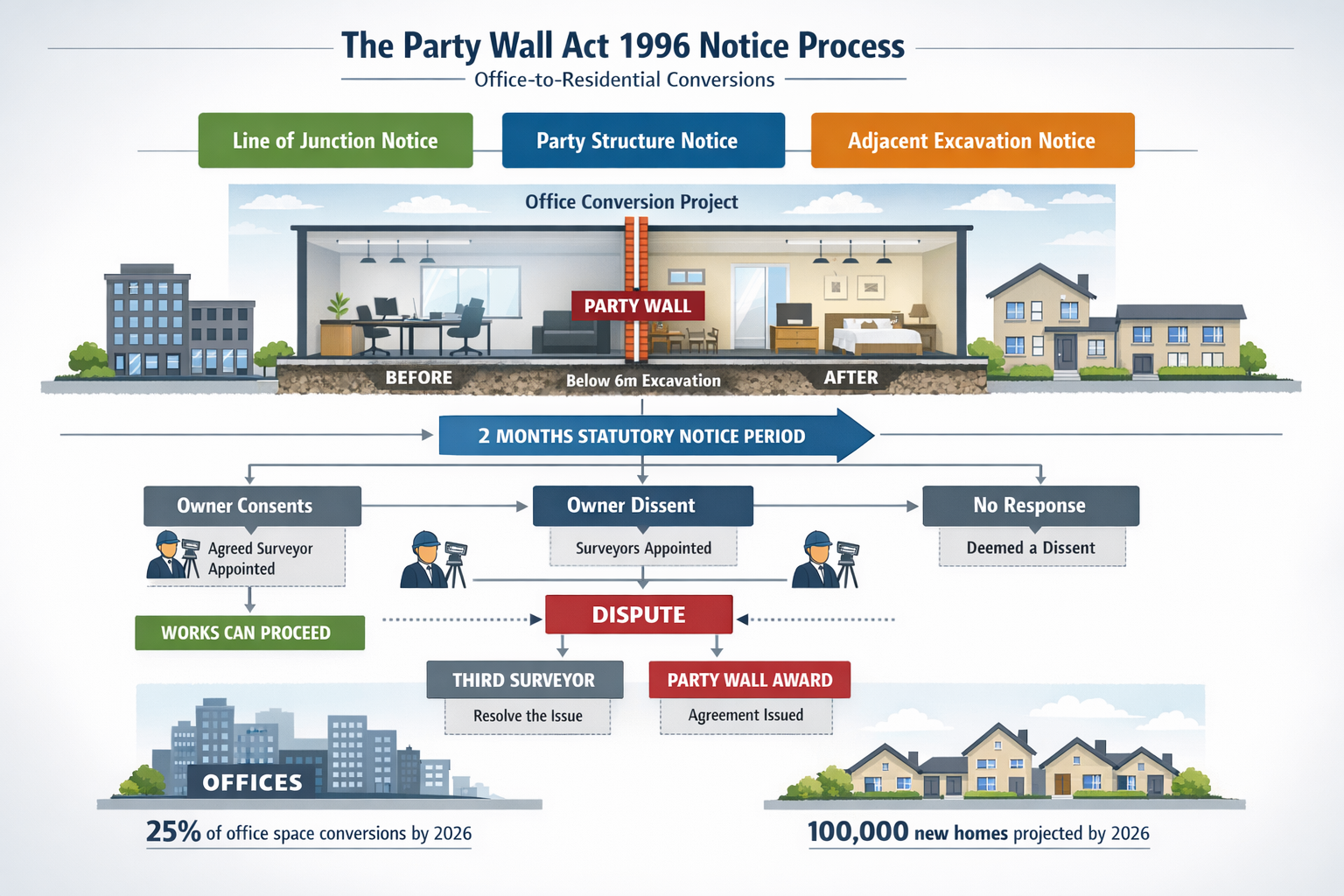
The Party Wall etc. Act 1996 establishes clear statutory procedures that apply regardless of whether a project proceeds under permitted development or full planning permission. For surveyors managing Party Wall Agreements for Office-to-Residential Conversions: Surveyor Essentials in 2026 Permitted Development Surge, mastering these requirements is fundamental.
Three Types of Party Wall Notices
The Act defines three distinct notice categories, each applicable to different conversion scenarios:
| Notice Type | Application in Conversions | Notice Period | Key Requirements |
|---|---|---|---|
| Line of Junction Notice | Building new party walls or party fence walls between properties | 1 month | Describe proposed wall construction, position, and foundation details |
| Party Structure Notice | Work directly affecting existing party walls, floors, or structures | 2 months | Detailed description of work, drawings, and structural specifications |
| Adjacent Excavation Notice | Excavation within 3 or 6 meters of neighboring buildings | 1 month | Depth and position of excavation, foundation protection measures |
For typical office-to-residential conversions, the Party Structure Notice is most frequently required. This applies when developers:
- Cut into party walls for new residential layouts
- Install damp-proof courses across party structures
- Add or remove load-bearing elements
- Raise party walls for additional floors
- Underpin party wall foundations
The 3-metre rule for excavation becomes particularly relevant when basement conversions or foundation strengthening forms part of the residential adaptation.
Critical Timelines and Service Requirements
Timing is everything in party wall procedures. Building owners must serve notices:
- ✅ At least 2 months before starting work affecting party structures
- ✅ At least 1 month before excavation or building new walls
- ✅ In writing with sufficient detail for adjoining owners to understand the work
Adjoining owners then have 14 days to respond in writing. Silence after this period constitutes dissent, automatically triggering the dispute resolution process and surveyor appointment.
Common timing mistakes that delay conversion projects include:
- Serving notices too late, after contractors are already mobilized
- Providing insufficient technical detail, requiring re-notification
- Failing to identify all adjoining owners in multi-occupancy buildings
- Not accounting for weekends and bank holidays in statutory periods
For projects where no party wall notice has been served, adjoining owners can seek injunctions to halt work, creating expensive delays in conversion timelines.
The Role of Party Wall Surveyors in Conversions
When adjoining owners dissent (or fail to respond), the Act requires appointment of surveyors to produce a Party Wall Award. This legal document sets out:
- 📋 Detailed description of permitted works
- 📋 Time and manner of execution
- 📋 Access arrangements for inspections
- 📋 Schedule of condition for neighboring properties
- 📋 Dispute resolution procedures
- 📋 Cost allocation and payment terms
In 2026's high-volume conversion environment, three surveyor appointment models exist:
Agreed Surveyor: A single surveyor acts for both parties (fastest, most economical)
Two Surveyors: Each party appoints their own surveyor who jointly prepare the award
Third Surveyor: Appointed to resolve disagreements between the two party-appointed surveyors
For efficient project delivery, experienced conversion developers typically propose an agreed surveyor arrangement, reducing costs of party wall procedures and accelerating award timelines.
Surveyor Essentials: Conducting Effective Conversion Assessments
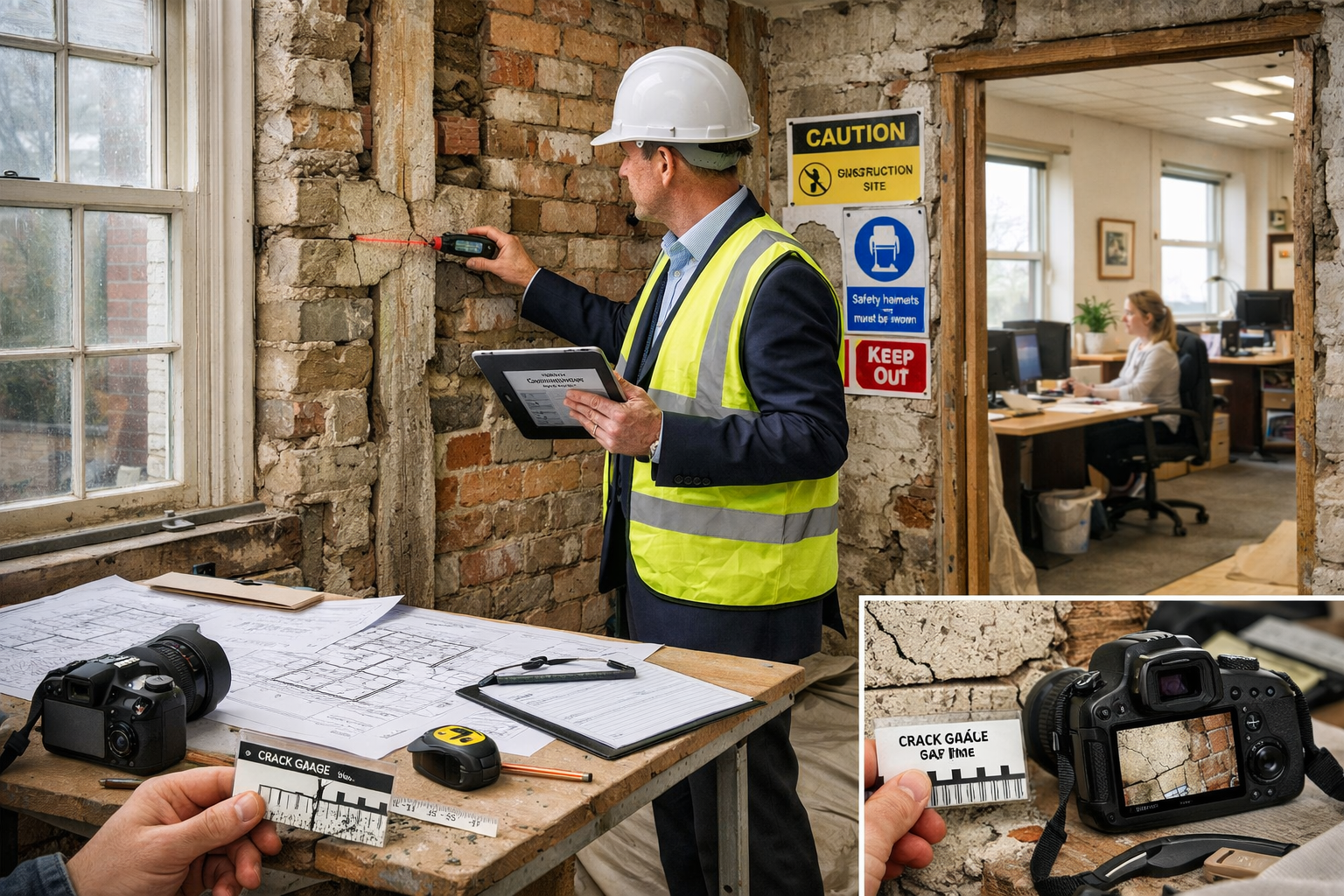
Professional surveyors managing Party Wall Agreements for Office-to-Residential Conversions: Surveyor Essentials in 2026 Permitted Development Surge must balance thoroughness with efficiency. The volume of conversion work in 2026 demands systematic approaches without compromising quality.
Pre-Work Schedule of Condition Surveys
The schedule of condition represents the surveyor's most powerful tool for protecting all parties. This detailed photographic and written record documents the exact state of adjoining properties before conversion work begins.
Essential elements include:
External inspection:
- Facade condition, noting existing cracks, settlement, or defects
- Roof condition, chimney stacks, and rainwater goods
- Boundary walls, fences, and shared structures
- Ground levels and drainage systems
Internal inspection:
- Room-by-room condition assessment
- Crack mapping with measurements and photographs
- Ceiling and wall finishes condition
- Floor levels and structural movement indicators
- Services condition where visible
Documentation standards:
- High-resolution digital photographs with date stamps
- Detailed written descriptions using standardized terminology
- Measured crack widths using calibrated gauges
- Floor plans showing inspection locations
- Professional presentation suitable for legal proceedings
A comprehensive schedule of condition typically takes 2-4 hours for a standard terraced property but provides invaluable protection. When disputes arise about damage to property during party wall work, this baseline evidence becomes crucial for determining causation and liability.
Structural Assessment for Conversion Works
Office-to-residential conversions often involve significant structural modifications that surveyors must evaluate:
Load redistribution analysis: Converting open-plan offices to multiple residential units typically requires new internal walls, creating different load patterns on party structures.
Floor strengthening requirements: Residential building regulations often demand higher floor loading capacities than commercial offices, potentially requiring party wall reinforcement.
Sound insulation compliance: The transition from commercial to residential use triggers stringent acoustic performance standards, often necessitating party wall upgrades.
Fire separation standards: Residential fire safety requirements may exceed those for commercial offices, requiring party wall fire resistance improvements.
Surveyors must coordinate with structural engineers to ensure proposed works:
- ✓ Maintain party wall structural integrity
- ✓ Comply with Building Regulations Part A (Structure)
- ✓ Meet acoustic standards in Approved Document E
- ✓ Achieve fire resistance requirements in Approved Document B
- ✓ Protect adjoining owner properties from damage
Similar principles apply as with loft conversions and party walls, where vertical extensions require careful assessment of existing structure capacity.
Managing Neighbor Relations and Disputes
The human element often determines project success or failure. Effective surveyors in 2026 combine technical expertise with strong communication skills.
Proactive engagement strategies:
- 🤝 Early informal discussions before formal notices
- 🤝 Clear, jargon-free explanations of proposed work
- 🤝 Realistic timeframes and working hours commitments
- 🤝 Designated contact person for concerns
- 🤝 Regular progress updates throughout the project
Common dispute triggers in conversion projects include:
- Noise and vibration: Extended working hours disturbing residential neighbors
- Access concerns: Scaffolding, site compounds, or delivery vehicles blocking access
- Dust and debris: Construction impacts on adjacent occupied premises
- Structural anxiety: Fears about building stability and property damage
- Property value concerns: Worries about conversion impacts on neighboring property values
Addressing these concerns transparently in the Party Wall Award prevents escalation. Surveyors should specify:
- Permitted working hours (typically 8am-6pm weekdays, limited weekend work)
- Noise and vibration monitoring protocols
- Dust suppression and site cleanliness measures
- Scaffolding and access arrangements with advance notice
- Insurance coverage details and claims procedures
When disputes do arise despite preventive measures, the Third Surveyor mechanism provides statutory resolution without court proceedings, maintaining project momentum.
RICS Guidance and Best Practice Templates for 2026
The Royal Institution of Chartered Surveyors (RICS) provides authoritative guidance that has evolved to address the unique challenges of high-volume conversion work in 2026.
Standardized Award Templates
To manage the surge in conversion projects efficiently, leading practices have developed standardized Party Wall Award templates that incorporate RICS best practice while allowing customization for specific projects.
Key template sections include:
Preamble and definitions: Standard legal framework establishing surveyor appointments, property descriptions, and terminology
Description of works: Customizable section detailing specific conversion activities affecting party walls
Working methods and timing: Standardized clauses for working hours, access, noise control, and project duration
Schedule of condition: Template format for consistent condition documentation
Special conditions: Project-specific requirements for complex conversions
Cost provisions: Standard clauses for fee payment, dispute costs, and damage compensation
Signature and service: Formal execution requirements and service confirmation
These templates reduce award preparation time from several weeks to just days, critical when managing multiple conversion projects simultaneously.
Quality Assurance and Professional Standards
RICS members conducting party wall work in 2026 must adhere to:
Professional competence: Demonstrable knowledge of the Party Wall Act, building pathology, and construction methods
Independence and impartiality: Acting fairly between building and adjoining owners, avoiding conflicts of interest
Insurance coverage: Adequate professional indemnity insurance for party wall surveying activities
Record keeping: Maintaining comprehensive files including notices, correspondence, awards, and condition records
Continuing professional development: Regular training on legislative updates, case law, and best practice evolution
For complex conversion projects, engaging surveyors with specific experience in commercial-to-residential work proves invaluable. Their familiarity with common structural modifications, regulatory requirements, and neighbor concerns accelerates the process while reducing dispute risks.
Technology and Digital Tools in 2026
Modern party wall practice increasingly leverages technology:
Digital condition surveys: Tablet-based applications with integrated photography, measurement tools, and cloud storage enable real-time documentation and instant sharing with all parties.
3D scanning: Laser scanning technology creates precise digital models of existing conditions, particularly valuable for complex party structures or heritage buildings.
Project management platforms: Cloud-based systems track multiple conversion projects, notice deadlines, and award milestones, ensuring nothing falls through gaps.
Electronic service: Digital notice service and electronic signatures accelerate statutory timelines while maintaining legal compliance.
Monitoring systems: Automated vibration and movement monitoring provides objective evidence of construction impacts, protecting both developers and neighbors.
These tools don't replace professional judgment but enhance efficiency and evidence quality in high-volume environments.
Practical Workflow for Conversion Project Surveyors
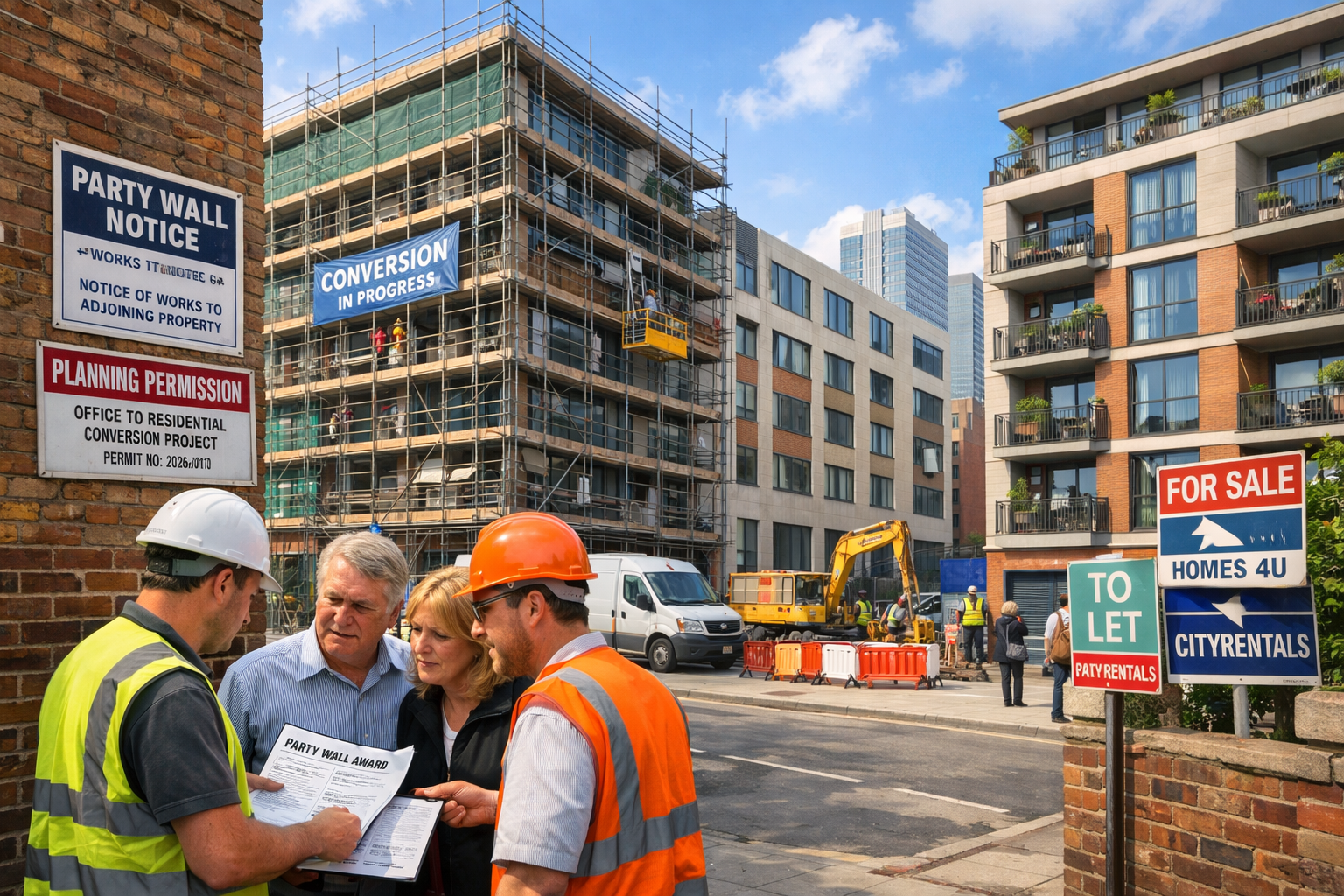
Implementing Party Wall Agreements for Office-to-Residential Conversions: Surveyor Essentials in 2026 Permitted Development Surge requires a systematic approach from initial instruction through project completion.
Phase 1: Initial Assessment and Notice Preparation (Weeks 1-2)
Step 1: Receive developer instruction and review conversion plans
- Identify all party wall elements affected by proposed works
- Determine which notice types are required
- Identify all adjoining owners requiring notification
Step 2: Site inspection and preliminary assessment
- Inspect party walls and structures from building owner's property
- Photograph existing conditions
- Assess structural implications of proposed works
- Identify potential concerns or complications
Step 3: Notice preparation and service
- Draft appropriate notices with sufficient technical detail
- Prepare explanatory letters for adjoining owners
- Serve notices by hand delivery or recorded delivery
- Document service with proof of delivery
Step 4: Adjoining owner engagement
- Follow up with phone calls or emails to ensure receipt
- Offer to answer questions about proposed works
- Encourage agreed surveyor appointment for efficiency
- Respond promptly to concerns or requests for clarification
Phase 2: Award Preparation (Weeks 3-6)
Step 5: Surveyor appointments
- Confirm agreed surveyor or separate surveyor appointments
- Issue formal letters of appointment
- Establish fee arrangements with both parties
- Set timeline expectations for award preparation
Step 6: Detailed condition surveys
- Conduct comprehensive schedule of condition for all adjoining properties
- Photograph every room, external elevation, and shared structure
- Measure and document all existing defects
- Prepare professional condition report with photographic appendix
Step 7: Award drafting
- Prepare detailed description of permitted works
- Specify working methods, hours, and access arrangements
- Include schedule of condition as appendix
- Set out cost allocation and payment terms
- Address specific concerns raised by adjoining owners
Step 8: Award service and acknowledgment
- Serve award on both building and adjoining owners
- Obtain signed acknowledgments of receipt
- Confirm understanding of award terms
- Issue formal notice that works may commence
Phase 3: Construction Monitoring (Project Duration)
Step 9: Pre-commencement meeting
- Meet with contractor to review award requirements
- Confirm working hours and access arrangements
- Establish communication protocols for issues
- Verify insurance documentation
Step 10: Periodic inspections
- Conduct regular site visits during critical work phases
- Monitor compliance with award conditions
- Inspect adjoining properties for any damage or movement
- Document progress with photographs and notes
Step 11: Damage assessment and resolution
- Investigate any damage claims promptly
- Compare current condition to schedule of condition baseline
- Determine causation using professional judgment
- Facilitate repairs or compensation as appropriate
Phase 4: Project Completion (Final Weeks)
Step 12: Final inspections
- Conduct comprehensive final inspection of adjoining properties
- Compare against original schedule of condition
- Identify any damage attributable to conversion works
- Photograph final condition for records
Step 13: Outstanding matters resolution
- Address any remaining damage claims or concerns
- Ensure all repair works are completed satisfactorily
- Confirm adjoining owner satisfaction in writing
- Close out any financial matters
Step 14: File closure and archiving
- Prepare final file summary
- Archive all documentation for statutory retention period
- Issue final accounts to building owner
- Provide completion confirmation to all parties
This systematic workflow ensures nothing is overlooked while maintaining project momentum through the conversion process.
Cost Management and Fee Structures
Understanding the financial aspects of party wall procedures helps developers budget accurately for conversion projects in 2026's competitive market.
Typical Fee Ranges for Conversion Projects
Party wall costs vary based on project complexity, property size, and number of adjoining owners:
Agreed surveyor fees: £800-£2,500 per adjoining owner for standard conversions
Individual surveyor fees: £1,200-£3,500 per surveyor for more complex projects
Schedule of condition surveys: £300-£800 per property depending on size
Third surveyor fees: £1,500-£5,000 for dispute resolution (rare with good practice)
For a typical office conversion affecting three adjoining properties, total party wall costs might range from £3,000-£8,000, representing a small fraction of overall conversion costs but essential for legal compliance.
The cost of party wall procedures is normally borne by the building owner under the Act, though this can be negotiated in commercial arrangements.
Cost-Benefit Analysis for Developers
While party wall compliance represents an upfront cost, the benefits far outweigh expenses:
Risk mitigation: Proper procedures prevent injunctions that could halt projects costing hundreds of thousands in delays
Relationship management: Professional surveyor involvement reduces neighbor disputes that damage developer reputation
Legal protection: Awards provide clear legal framework protecting against future claims
Insurance compliance: Many development insurance policies require party wall compliance
Resale value: Proper documentation adds value and reduces complications for future property transactions
Developers who attempt to bypass party wall requirements to save costs invariably face greater expenses through disputes, legal proceedings, and project delays.
Common Pitfalls and How to Avoid Them
Even experienced surveyors can encounter challenges in the high-pressure environment of 2026's conversion surge. Awareness of common pitfalls enables proactive prevention.
Inadequate Notice Detail
Pitfall: Serving notices with insufficient technical information about proposed works
Consequence: Adjoining owners cannot properly assess impacts, leading to dissent and delays
Solution: Include detailed drawings, structural calculations, and clear work descriptions in all notices. When in doubt, provide more information rather than less.
Missed Adjoining Owners
Pitfall: Failing to identify all parties with party wall interests, particularly in complex commercial buildings with multiple occupiers or freeholders
Consequence: Invalid notices, potential injunctions, and requirement to restart entire process
Solution: Conduct thorough Land Registry searches, inspect lease documents, and physically verify occupancy before serving notices. Consider all vertical and horizontal neighbors.
Rushed Condition Surveys
Pitfall: Conducting superficial schedules of condition to save time or reduce costs
Consequence: Insufficient baseline evidence to resolve damage disputes, leading to costly disagreements
Solution: Allocate adequate time for thorough condition documentation. Use standardized checklists and comprehensive photographic protocols. Remember that schedule of condition guidance emphasizes quality over speed.
Poor Communication
Pitfall: Using technical jargon, failing to respond promptly to concerns, or adopting adversarial tone with adjoining owners
Consequence: Escalating disputes, formal objections, and damaged relationships that complicate project delivery
Solution: Communicate clearly, promptly, and professionally. Explain technical matters in accessible language. Build rapport and trust through transparency and responsiveness.
Inadequate Monitoring
Pitfall: Failing to conduct regular inspections during construction, missing damage as it occurs
Consequence: Difficulty determining causation, disputes about responsibility, and increased liability exposure
Solution: Schedule inspections at critical work stages (commencement, structural modifications, completion). Document conditions photographically at each visit. Address concerns immediately rather than allowing them to accumulate.
Future Trends and Regulatory Developments
As 2026 progresses, several trends are shaping the party wall landscape for office-to-residential conversions.
Potential Legislative Updates
Industry discussions suggest possible Party Wall Act amendments to address modern development patterns:
- Electronic service provisions: Formal recognition of digital notice service and electronic signatures
- Dispute resolution streamlining: Alternative dispute resolution mechanisms to reduce Third Surveyor timelines
- Heritage building provisions: Special procedures for listed buildings and conservation areas
- Climate adaptation clauses: Standard provisions for sustainability measures in conversion works
While no legislative changes are imminent, surveyors should monitor Parliamentary activity and RICS guidance updates.
Technology Integration
The digitalization of party wall practice will continue accelerating:
- AI-assisted condition surveys: Machine learning algorithms identifying and categorizing defects from photographs
- Blockchain documentation: Immutable records of notices, awards, and condition surveys
- Virtual inspections: Remote condition assessment using high-resolution video and 3D scanning
- Automated compliance checking: Software verification of notice content against statutory requirements
These technologies will enhance efficiency without replacing professional judgment and personal interaction.
Sustainability and Party Wall Work
The 2026 focus on building decarbonization creates new party wall considerations:
- Retrofit installations: External wall insulation and other energy efficiency measures affecting party structures
- Renewable energy systems: Solar panels, heat pumps, and battery storage requiring structural modifications
- Circular economy adaptations: Reuse of existing materials and structures in conversion projects
- Climate resilience: Flood protection, overheating prevention, and adaptation measures
Surveyors must develop expertise in assessing these sustainability interventions within the party wall framework.
Conclusion
The Party Wall Agreements for Office-to-Residential Conversions: Surveyor Essentials in 2026 Permitted Development Surge represents both challenge and opportunity for chartered surveyors. As permitted development rights drive unprecedented conversion volumes, professional expertise in party wall procedures becomes increasingly valuable.
Success requires mastering the statutory framework of the Party Wall etc. Act 1996, conducting thorough condition surveys, preparing comprehensive awards, and managing neighbor relations with skill and diplomacy. The surveyors who thrive in this environment combine technical competence with efficient systems, leveraging standardized templates and digital tools while maintaining the personal touch that prevents disputes.
For building owners and developers, engaging experienced party wall surveyors early in the conversion planning process proves essential. The modest costs of proper compliance pale against the risks of injunctions, neighbor disputes, and project delays that can derail even the most promising conversion projects.
Actionable Next Steps
For developers planning office-to-residential conversions:
- Engage a qualified party wall surveyor during feasibility stage, before finalizing conversion designs
- Budget appropriately for party wall costs (typically £3,000-£8,000 for standard projects)
- Build party wall timelines into project programs (minimum 2-3 months before construction start)
- Communicate proactively with neighbors before formal notices to build goodwill
- Ensure contractors understand award requirements and compliance obligations
For adjoining owners receiving party wall notices:
- Respond within 14 days to maintain control over surveyor appointment
- Consider appointing your own surveyor for complex projects or if you have concerns
- Request schedule of condition to protect your property interests
- Engage constructively with building owners and surveyors
- Document any concerns in writing for inclusion in the award
For surveyors managing conversion projects:
- Develop standardized templates and workflows for efficiency
- Invest in digital tools for condition surveys and project management
- Maintain CPD on conversion-specific structural and regulatory matters
- Build networks with structural engineers, planning consultants, and conversion specialists
- Focus on communication skills alongside technical expertise
The office-to-residential conversion surge of 2026 will reshape Britain's urban landscape for decades to come. With proper party wall management, this transformation can proceed smoothly, protecting property owners while delivering the housing that communities desperately need. Professional surveyors stand at the center of this process, ensuring that legal compliance and neighborly relations support rather than hinder urban regeneration.