The UK's accelerating transition to electric vehicles is creating an unexpected surge in party wall notices across terraced housing estates and semi-detached properties nationwide. As the government increases EV charger grants to £500 per socket from April 2026[1] and homeowners rush to install charging infrastructure, surveyors find themselves navigating complex scenarios where Party Wall Agreements for 2026 UK EV Charging Retrofits: Surveyor Best Practices Under Net Zero Push have become essential knowledge. This convergence of net zero ambitions and century-old property law demands a fresh understanding of how the Party Wall etc. Act 1996 applies to modern electrical installations.
Key Takeaways
- 🔌 EV charging retrofits often trigger Party Wall Act requirements when electrical conduits pass through or are fixed to shared walls, requiring formal notices and agreements
- 📋 Enhanced grant funding of £500 per socket from April 2026 increases installation volumes, making surveyor expertise in party wall compliance more critical than ever[1]
- ⚖️ Proper party wall procedures protect both building and adjoining owners from disputes, structural damage claims, and installation delays that can derail net zero retrofit projects
- 🏘️ Terraced and semi-detached properties face unique challenges requiring surveyors to balance technical EV infrastructure needs with neighbour relations and legal compliance
- ✅ Pre-installation schedules of condition and clear party wall awards provide essential documentation that prevents costly disputes and ensures smooth EV charging installations
Understanding the Party Wall Act Framework for EV Charging Installations
The Party Wall etc. Act 1996 governs building work on or near shared walls, boundaries, and excavations in England and Wales. While originally designed for traditional construction activities, the legislation applies equally to modern infrastructure retrofits, including electric vehicle charging points.
When Do EV Chargers Trigger Party Wall Requirements?
Not every EV charging installation requires a party wall agreement, but several common scenarios demand compliance:
Installations Requiring Party Wall Notices:
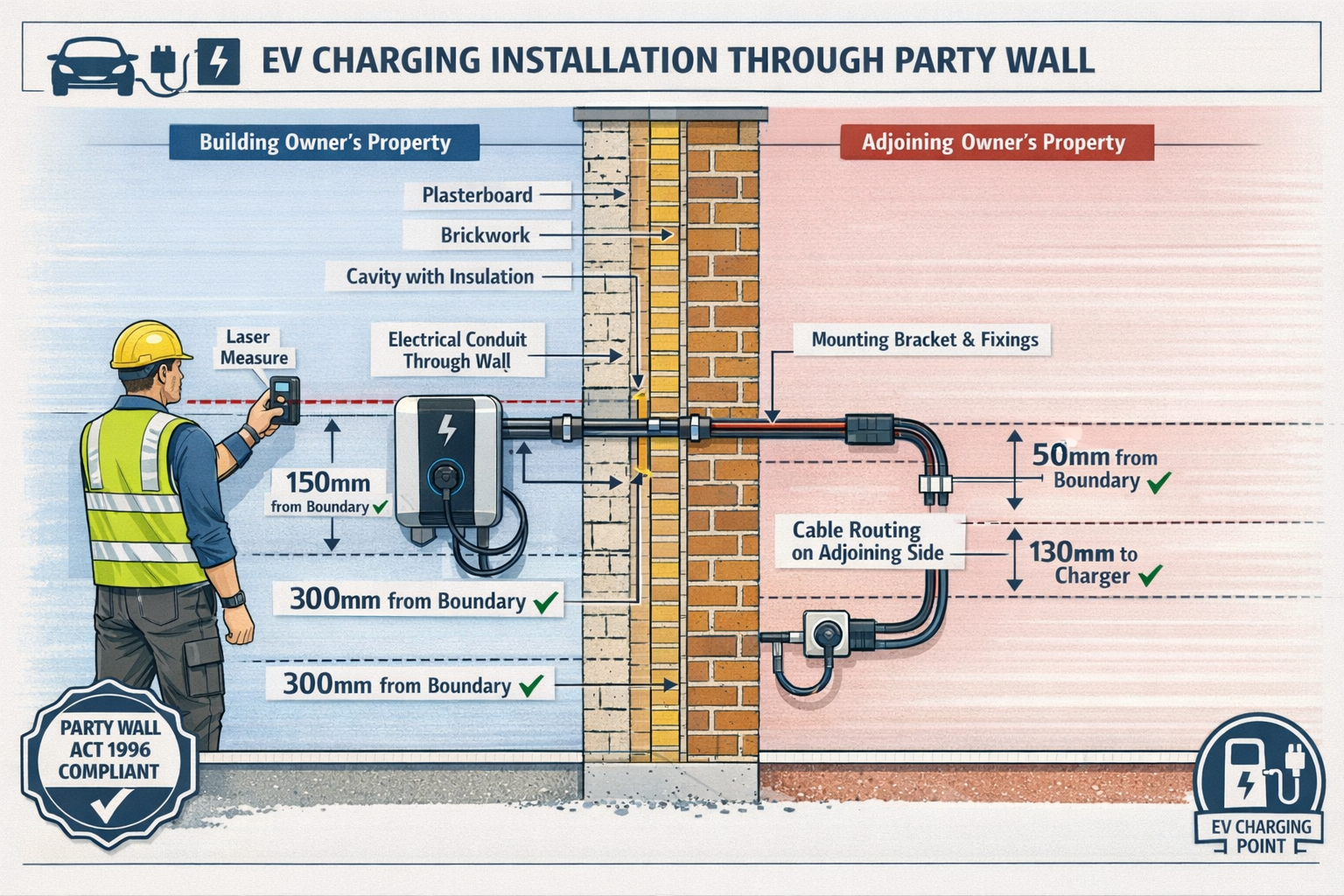
- Fixing charging units or electrical conduits to party walls (external or internal faces)
- Drilling through party walls to route electrical cables
- Installing ground-mounted posts or bollards within three metres of adjoining property boundaries with excavations exceeding one metre depth
- Structural modifications to party walls for cable management systems
- Any work affecting the structural integrity or weatherproofing of shared walls
Installations Typically Exempt:
- Standalone charging posts entirely within the building owner's property boundary
- Internal electrical work not affecting party structures
- Surface-mounted conduits on non-party walls
- Charging points on detached properties with no shared boundaries
The critical distinction lies in whether the installation physically affects or is attached to a party wall structure. Even seemingly minor fixings can constitute notifiable works under the Act.
The Three-Month Notice Timeline for 2026 Retrofits
Timing becomes crucial when coordinating Party Wall Agreements for 2026 UK EV Charging Retrofits: Surveyor Best Practices Under Net Zero Push with government grant deadlines and installation schedules. The Act mandates specific notice periods:
| Notice Type | Minimum Period | Application to EV Charging |
|---|---|---|
| Party Structure Notice | 2 months | Work directly on/to party wall (drilling, fixing) |
| Line of Junction Notice | 1 month | New walls/structures at boundary line |
| Excavation Notice | 1 month | Foundation work within 3 metres of adjoining building |
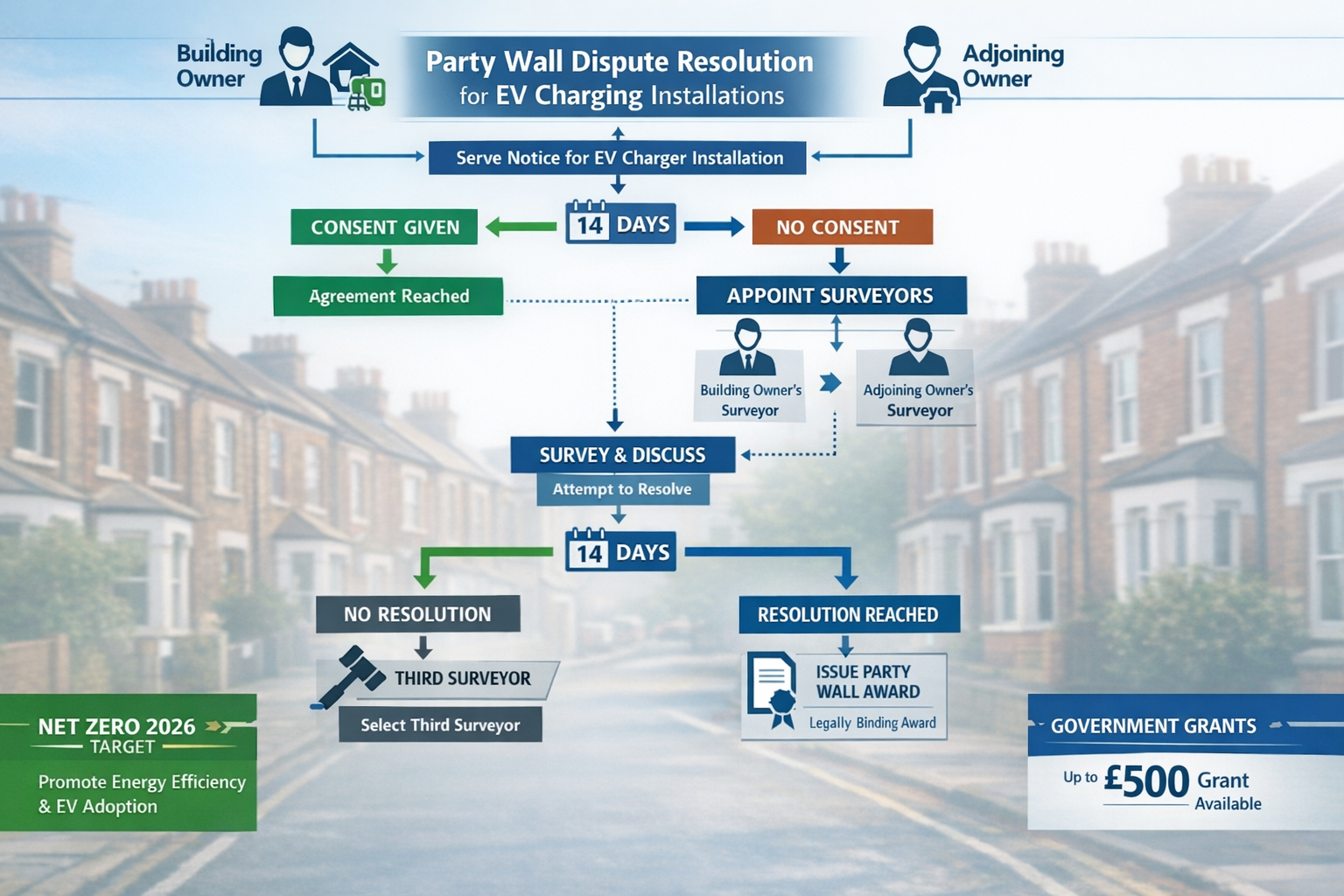
Building owners must serve notices before commencing any work. The adjoining owner then has 14 days to consent or dissent. If they dissent or fail to respond, the party wall dispute resolution process begins, requiring appointment of surveyors.
For homeowners eager to access the enhanced £500 grant available from April 2026[1], this timeline means planning installations at least three to four months ahead to accommodate potential surveyor appointments, awards, and any negotiated conditions.
Surveyor Best Practices for EV Charging Retrofit Assessments
Professional surveyors play a pivotal role in ensuring Party Wall Agreements for 2026 UK EV Charging Retrofits: Surveyor Best Practices Under Net Zero Push proceed smoothly, protecting all parties while facilitating essential net zero infrastructure.
Pre-Installation Site Assessment Protocol
A comprehensive initial assessment forms the foundation of successful party wall management for EV charging projects:
Essential Assessment Components:
-
Boundary and Ownership Verification
- Review Land Registry documents to confirm exact property boundaries
- Identify all party walls, party fence walls, and boundary structures
- Map proposed charging point locations against party wall positions
-
Structural Evaluation
- Assess party wall construction type (brick, block, cavity, solid)
- Identify existing services within or near party walls
- Evaluate structural capacity for additional fixings or penetrations
- Document any pre-existing defects or damage
-
Installation Method Review
- Examine electrical contractor's proposed routing and fixing methods
- Assess drilling requirements, depths, and positions
- Evaluate alternative installation approaches that might reduce party wall impact
- Consider weatherproofing and fire-stopping requirements
-
Neighbour Impact Analysis
- Identify potential noise, vibration, or access issues during installation
- Assess visual impact on adjoining property
- Evaluate any temporary works requirements (scaffolding, access)
This thorough assessment enables surveyors to provide accurate advice on whether party wall procedures apply and what specific provisions the eventual award should contain.
Schedule of Condition: Documentation Standards
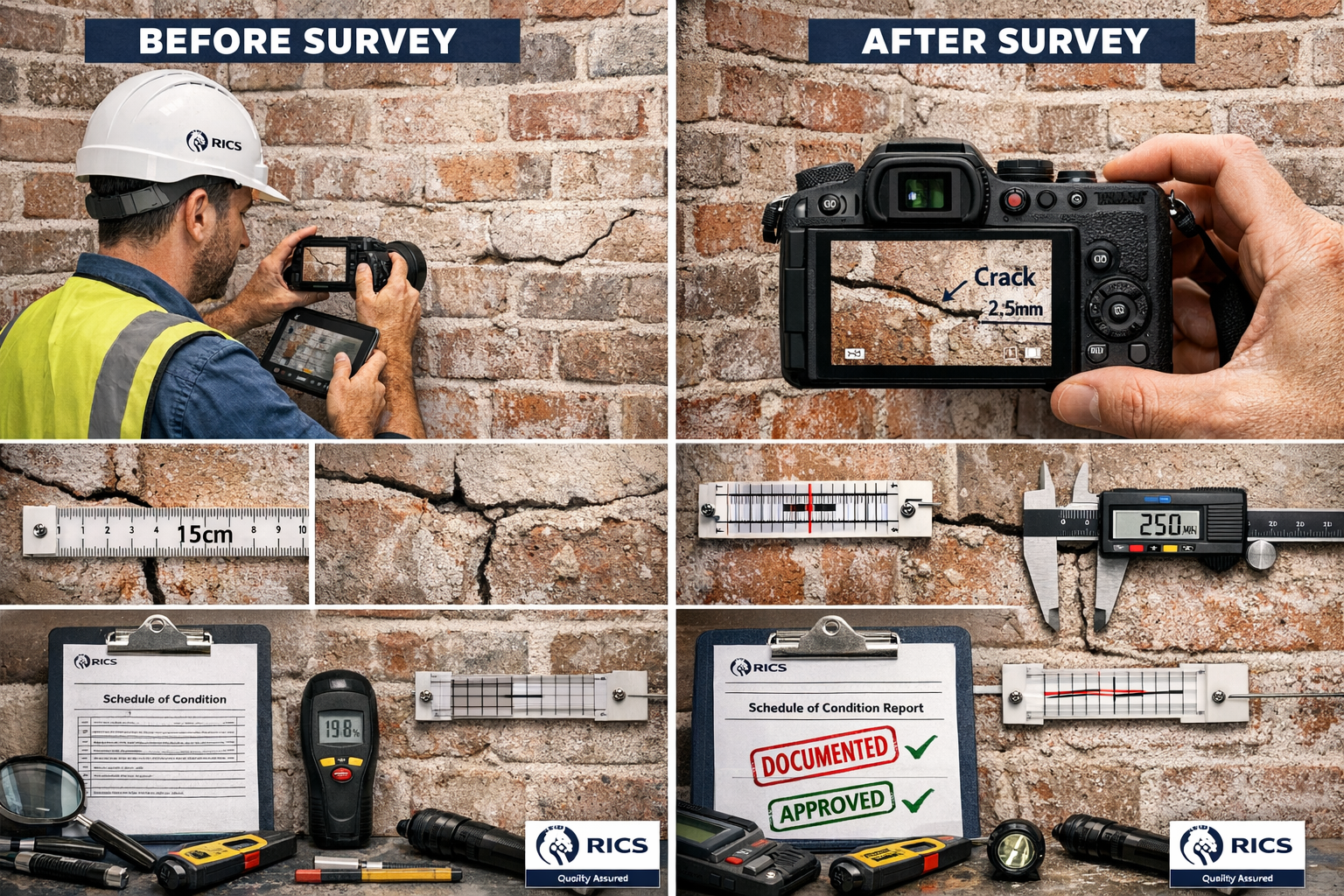
Creating a comprehensive schedule of condition before EV charging installation work commences provides essential baseline evidence. This document becomes crucial if disputes arise about installation-related damage.
Best Practice Documentation Requirements:
📸 Photographic Evidence
- High-resolution images of all party wall surfaces (both sides where accessible)
- Close-up shots of existing cracks, defects, or damage
- Wide-angle context shots showing overall condition
- Dated and georeferenced images with metadata preserved
📐 Measured Surveys
- Precise crack width measurements using crack monitoring gauges
- Level readings to establish any existing movement or settlement
- Moisture readings in areas where drilling will occur
- Structural deflection measurements where relevant
📝 Written Descriptions
- Detailed narrative descriptions of existing conditions
- Material specifications and construction methods observed
- Notation of any existing electrical installations or services
- Record of decorative finishes that might be affected
The schedule of condition guidance emphasizes that documentation should be sufficiently detailed that any subsequent damage can be clearly distinguished from pre-existing conditions.
Drafting Effective Party Wall Awards for EV Infrastructure
The party wall award represents the formal agreement governing the EV charging installation work. For Party Wall Agreements for 2026 UK EV Charging Retrofits: Surveyor Best Practices Under Net Zero Push, awards should address specific technical and practical considerations:
Essential Award Provisions:
Technical Specifications Section:
- Precise description of drilling locations, depths, and diameters
- Specification of fixing types and load capacities
- Requirements for fire-stopping materials and methods
- Weatherproofing and sealing specifications
- Cable routing and conduit specifications
Working Hours and Methods:
- Permitted working hours (typically avoiding early mornings, evenings, weekends)
- Noise limitation requirements
- Vibration monitoring thresholds if applicable
- Dust suppression and site cleanliness standards
Access and Notification:
- Requirements for advance notice before work commences
- Access provisions if work requires entry to adjoining property
- Emergency contact procedures
- Progress update requirements
Protection and Reinstatement:
- Requirements to protect adjoining owner's property during works
- Specifications for making good any damage
- Decorative finish matching requirements
- Timeline for completion of reinstatement works
Insurance and Liability:
- Confirmation of building owner's insurance coverage
- Liability provisions for damage to adjoining property
- Security for expenses provisions where appropriate
Well-drafted party wall award guidance ensures all parties understand their rights and obligations, significantly reducing the likelihood of disputes during or after installation.
Navigating Common Challenges in 2026 EV Charging Retrofits
The unique characteristics of EV charging installations create specific challenges that surveyors must address when managing Party Wall Agreements for 2026 UK EV Charging Retrofits: Surveyor Best Practices Under Net Zero Push.
Electrical Conduit Routing Through Party Walls
One of the most common scenarios involves routing electrical cables through party walls to reach external charging points. This seemingly straightforward work raises multiple party wall considerations:
Technical Challenges:
- Cavity wall penetrations: Maintaining cavity barriers and fire-stopping while creating cable routes
- Service conflicts: Avoiding existing gas, water, or electrical services within party walls
- Structural integrity: Ensuring drilling doesn't compromise wall strength, particularly in older properties
- Weatherproofing: Preventing water ingress through new penetrations
Surveyor Solutions:
- Specify precise drilling locations that avoid structural elements and existing services
- Require use of detection equipment before drilling commences
- Mandate appropriate fire-stopping materials compliant with Building Regulations
- Include detailed weatherproofing specifications in the award
- Consider requiring CCTV inspection of cavities before and after work
Managing Neighbour Objections and Consent Issues
The 2026 net zero push means more homeowners are installing EV chargers, but not all neighbours welcome the infrastructure. When party wall consent becomes contentious, surveyors must balance technical requirements with relationship management.
Common Objection Themes:
- Visual impact concerns (particularly for heritage or conservation areas)
- Noise from charging equipment or installation work
- Property value impact fears
- General resistance to change or new technology
- Previous neighbour relationship issues
Professional Response Strategies:
✅ Education and Communication
- Explain that the Party Wall Act doesn't give neighbours veto power over reasonable works
- Provide information about planning permission exemptions introduced in England from June 2025[2]
- Share details about modern charging equipment noise levels (typically minimal)
- Offer to arrange pre-installation meetings to address concerns
✅ Award Conditions to Address Concerns
- Include specific working hours that minimize disruption
- Specify high-quality installation standards and finishes
- Provide for enhanced notice periods before work commences
- Include provisions for regular progress updates
✅ Alternative Installation Methods
- Explore routing options that minimize party wall impact
- Consider wireless charging solutions where appropriate
- Investigate shared charging infrastructure possibilities
When neighbours carry out works without a party wall agreement, the situation becomes more complex, but the same principles of professional communication and technical expertise apply.
Coordinating with Grant Deadlines and Installation Timelines
The enhanced grant scheme offering £500 per socket from April 2026[1] creates urgency for homeowners, but party wall procedures cannot be rushed without risking non-compliance.
Timeline Coordination Best Practices:
Month 1: Initial Assessment and Notice
- Complete site assessment and determine party wall requirements
- Prepare and serve appropriate notices on adjoining owners
- Begin grant application process in parallel
Month 2: Surveyor Appointment and Award Preparation
- If adjoining owner dissents, appoint surveyors (or agreed surveyor)
- Conduct detailed surveys and prepare schedule of condition
- Draft party wall award with technical specifications
Month 3: Award Finalization and Pre-Installation
- Finalize and serve party wall award
- Ensure all conditions precedent are satisfied
- Coordinate with electrical contractor on award compliance
Month 4: Installation and Completion
- Commence installation works in accordance with award
- Monitor compliance with award conditions
- Complete reinstatement and final documentation
This four-month timeline allows for the two-month notice period plus adequate time for surveyor appointments and award preparation, while still enabling homeowners to access grant funding efficiently.
Regulatory Landscape: 2026 Updates and Compliance Requirements
Understanding how Party Wall Agreements for 2026 UK EV Charging Retrofits: Surveyor Best Practices Under Net Zero Push intersect with broader regulatory changes helps surveyors provide comprehensive advice.
Planning Permission Exemptions and Building Regulations
Recent regulatory changes have simplified some aspects of EV charger installation while maintaining important safeguards:
Planning Permission Updates:
From June 2025, new permitted development rights in England exempt most driveway EV chargers from planning permission requirements, provided they meet specific criteria[2]. However, these planning exemptions do not override Party Wall Act obligations.
Key Distinction:
- ✅ Planning permission: May be exempt under permitted development
- ⚠️ Party wall procedures: Still required if work affects party structures
- ✅ Building Regulations: Must be satisfied for electrical installation safety
Surveyors must ensure building owners understand that planning permission exemptions don't eliminate party wall requirements. The two regulatory frameworks operate independently.
Grant Scheme Implications for Surveyor Practice
The government's updated Electric Vehicle Chargepoint Grant Scheme, with increased funding to £500 per socket from April 2026[3], affects surveyor practice in several ways:
Grant-Related Considerations:
💷 Cost Allocation
- Grant funding covers equipment and installation costs
- Party wall surveyor fees remain the building owner's responsibility
- Awards should clarify that grant funding doesn't affect cost-sharing under the Act
📋 Installation Standards
- Grant-funded installations must meet specific technical standards
- Party wall awards should reference these standards
- Surveyors should verify installer credentials and compliance
⏰ Timeline Pressures
- Grant deadlines may create pressure to expedite party wall procedures
- Surveyors must resist pressure to compromise proper process
- Clear communication about realistic timelines prevents conflicts
The workplace charging scheme also continues with updated provisions[3], creating additional scenarios where commercial properties may require party wall agreements for EV infrastructure.
RICS Guidance and Professional Standards
The Royal Institution of Chartered Surveyors (RICS) provides professional guidance that informs best practice for party wall surveyors handling EV charging installations:
Core Professional Obligations:
- Impartiality: Acting fairly between building and adjoining owners
- Competence: Maintaining knowledge of relevant technical standards and regulations
- Communication: Providing clear, timely information to all parties
- Documentation: Maintaining comprehensive records of all decisions and communications
For complex installations, engaging chartered surveyors with specific party wall expertise ensures compliance with both legal requirements and professional standards.
Case Studies: Lessons from 2026 EV Charging Retrofits
Examining real-world scenarios illustrates how Party Wall Agreements for 2026 UK EV Charging Retrofits: Surveyor Best Practices Under Net Zero Push apply in practice.
Case Study 1: Victorian Terrace Shared Wall Installation
Scenario: Homeowner in a Victorian terraced property sought to install an EV charging point on the front elevation, requiring electrical conduit to be fixed to the external face of the party wall.
Challenges:
- Solid brick party wall construction with no cavity
- Listed building constraints in conservation area
- Adjoining owner initially concerned about visual impact
Surveyor Approach:
- Conducted detailed heritage impact assessment
- Specified color-matched conduit and minimal fixings
- Included provision for professional painting to match existing finish
- Arranged pre-installation meeting between both owners and installer
Outcome: Award agreed with enhanced visual impact provisions. Installation completed successfully with adjoining owner satisfied with appearance. Total timeline from notice to completion: 14 weeks.
Case Study 2: Semi-Detached Property Boundary Dispute
Scenario: Building owner planned ground-mounted charging post near property boundary, with excavation for electrical supply potentially falling within the three-metre rule.
Challenges:
- Unclear boundary location due to missing fence
- Excavation depth of 1.2 metres for electrical supply
- Adjoining owner concerned about foundation impact
Surveyor Approach:
- Commissioned Land Registry boundary determination
- Specified excavation monitoring and shoring requirements
- Required structural engineer's assessment of foundation proximity
- Included vibration monitoring provisions in award
Outcome: Excavation repositioned slightly to minimize foundation proximity. Award included enhanced monitoring provisions. Work completed without incident or damage.
Case Study 3: Apartment Block Shared Infrastructure
Scenario: Multiple flat owners in a converted building sought to install EV charging points, requiring shared electrical infrastructure through party walls.
Challenges:
- Multiple party wall relationships between flat owners
- Complex electrical routing through multiple party structures
- Coordination of multiple installations and notices
Surveyor Approach:
- Coordinated single agreed surveyor appointment for all parties
- Developed comprehensive award covering all installations
- Specified phased installation approach to minimize disruption
- Created shared schedule of condition for common areas
Outcome: Coordinated approach reduced costs and timeline. All installations completed within single award framework. Demonstrates efficiency of professional coordination for complex scenarios.
Risk Management and Dispute Avoidance Strategies
Effective risk management prevents disputes and ensures smooth completion of EV charging installations under party wall agreements.
Pre-Emptive Communication Protocols
Building Owner Responsibilities:
- Serve notices well in advance of desired installation dates
- Provide clear, accessible explanations of proposed work
- Share installer credentials and technical specifications
- Offer to arrange pre-installation meetings
Surveyor Facilitation:
- Encourage direct communication between owners where relationships are good
- Provide neutral, technical explanations of work requirements
- Manage expectations about timelines and processes
- Document all communications comprehensively
Insurance and Liability Considerations
Essential Insurance Coverage:
- Building owner should maintain adequate buildings insurance
- Electrical contractors must carry professional indemnity and public liability insurance
- Party wall awards should reference insurance requirements
- Consider requiring proof of insurance before work commences
Liability Allocation:
- Awards should clearly specify building owner's liability for damage
- Include provisions for security for expenses where significant risk exists
- Specify dispute resolution procedures if damage claims arise
Monitoring and Compliance During Installation
Active Surveyor Oversight:
- Schedule site visits at key installation stages
- Verify compliance with award specifications
- Document any variations from agreed methods
- Address issues immediately before they escalate
Post-Installation Documentation:
- Conduct final inspection comparing to schedule of condition
- Document any damage and required reinstatement
- Verify completion of making good provisions
- Issue formal completion confirmation
Future Trends: EV Infrastructure and Party Wall Evolution
As the UK progresses toward net zero targets, the intersection of EV charging infrastructure and party wall law will continue evolving.
Anticipated Regulatory Developments
Potential Changes:
- Simplified party wall procedures for standardized EV installations
- Integration of party wall requirements into EV grant application processes
- Enhanced guidance from professional bodies on EV-specific scenarios
- Possible legislative updates to address modern infrastructure needs
Surveyor Preparation:
- Maintain current knowledge of regulatory developments
- Engage with professional body consultations
- Develop specialized EV infrastructure expertise
- Build relationships with electrical contractors and installers
Emerging Technologies and Installation Methods
Innovation Impact:
- Wireless charging technologies may reduce party wall impacts
- Shared community charging infrastructure may create new party wall scenarios
- Solar panel integration with EV charging creates additional complexity
- Battery storage systems may require separate party wall consideration
Surveyors who develop expertise in Party Wall Agreements for 2026 UK EV Charging Retrofits: Surveyor Best Practices Under Net Zero Push position themselves as essential advisors in the ongoing energy transition.
Conclusion
The convergence of ambitious net zero targets, enhanced government grants of £500 per socket from April 2026, and the practical realities of UK housing stock creates unprecedented demand for professional surveyor expertise in party wall matters related to EV charging infrastructure. Party Wall Agreements for 2026 UK EV Charging Retrofits: Surveyor Best Practices Under Net Zero Push require a sophisticated understanding of both traditional party wall law and modern electrical infrastructure requirements.
Key Action Steps for Surveyors:
- Develop Technical Competence: Understand EV charging installation methods, electrical routing requirements, and modern construction techniques
- Master Timeline Coordination: Balance statutory notice periods with grant deadlines and homeowner expectations
- Prioritize Documentation: Create comprehensive schedules of condition and detailed awards that address EV-specific considerations
- Facilitate Communication: Act as neutral professionals who help neighbors understand technical requirements while protecting their interests
- Stay Current: Monitor regulatory changes, professional guidance updates, and emerging installation technologies
For Building Owners:
- Begin party wall procedures at least three to four months before desired installation dates
- Engage qualified party wall surveyors early in the planning process
- Ensure electrical contractors understand party wall compliance requirements
- Maintain open communication with neighbors throughout the process
For Adjoining Owners:
- Respond promptly to party wall notices to avoid deemed dissent
- Seek professional advice if uncertain about your rights and obligations
- Focus on reasonable protections rather than obstruction
- Understand that the Act balances property rights with reasonable development
The successful integration of EV charging infrastructure into the UK's existing housing stock depends on professional surveyors who can navigate the complex intersection of property law, technical requirements, and neighbor relations. By following established best practices while adapting to the unique characteristics of EV installations, surveyors ensure that the journey to net zero proceeds smoothly, one charging point at a time.
As 2026 brings enhanced grant funding and accelerating EV adoption, the demand for expert party wall guidance will only intensify. Surveyors who position themselves as specialists in this emerging field will find themselves essential partners in the UK's energy transition, protecting property rights while facilitating essential infrastructure development.
References
[1] Ev Charger Installation Grant United Kingdom 2026 – https://wallbox.com/en_uk/blog/ev-charger-installation-grant-united-kingdom-2026
[2] New Driveway Rules Ev Charger Planning Permission England 2026 – https://westminsterpimliconews.co.uk/new-driveway-rules-ev-charger-planning-permission-england-2026/
[3] Changes To Electric Vehicle Chargepoint Grant Schemes From 1 April 2026 – https://www.gov.uk/guidance/changes-to-electric-vehicle-chargepoint-grant-schemes-from-1-april-2026
[4] Party Wall Surveyors Association – https://www.pwsa.org.uk/