Party Wall Agreed Surveyor: Your Complete Guide to Shared Property Expertise in 2025
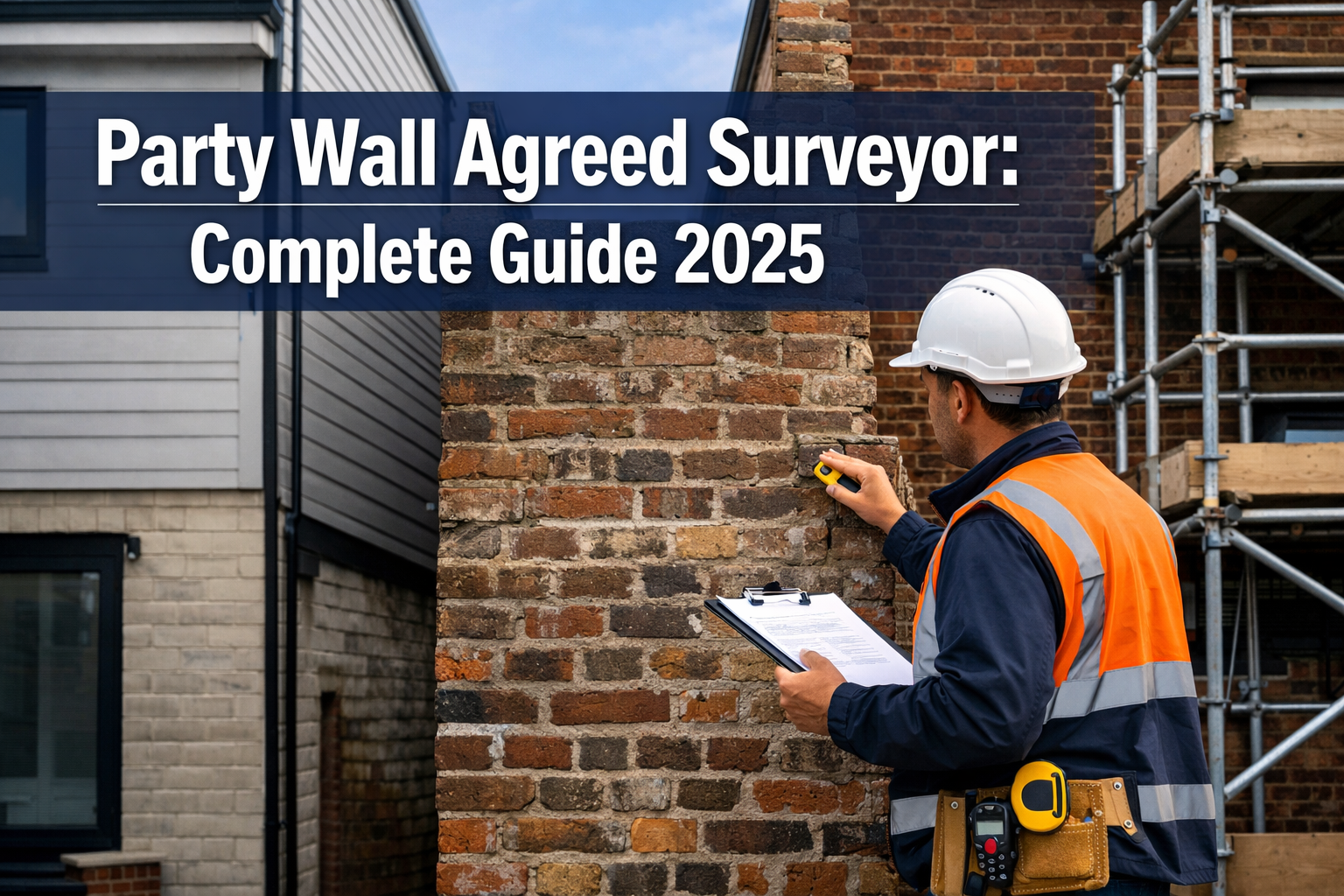
When building work threatens to disrupt the delicate balance between neighbouring properties, a single decision can mean the difference between a smooth construction process and years of costly legal battles. Enter the party wall agreed surveyor—a professional who can transform potential conflict into collaborative resolution. Whether you’re planning an extension, excavation, or structural alteration near a shared boundary, understanding the role of a party wall agreed surveyor could save you thousands of pounds and countless sleepless nights.
Key Takeaways
- 🏗️ A party wall agreed surveyor is a single impartial professional appointed by both property owners to oversee party wall matters, offering a cost-effective alternative to appointing separate surveyors
- ⚖️ Agreed surveyors must maintain complete impartiality and act fairly for both the building owner and adjoining owner throughout the entire process
- 💰 Appointing one agreed surveyor typically reduces costs by 30-50% compared to using two separate surveyors, with fees normally paid by the building owner
- 📋 The agreed surveyor prepares a legally binding party wall award that protects both parties’ interests and establishes clear procedures for the building work
- ✅ Choosing an RICS-qualified surveyor with specific party wall experience ensures professional standards and proper legal compliance under the Party Wall etc. Act 1996
What Is a Party Wall Agreed Surveyor?
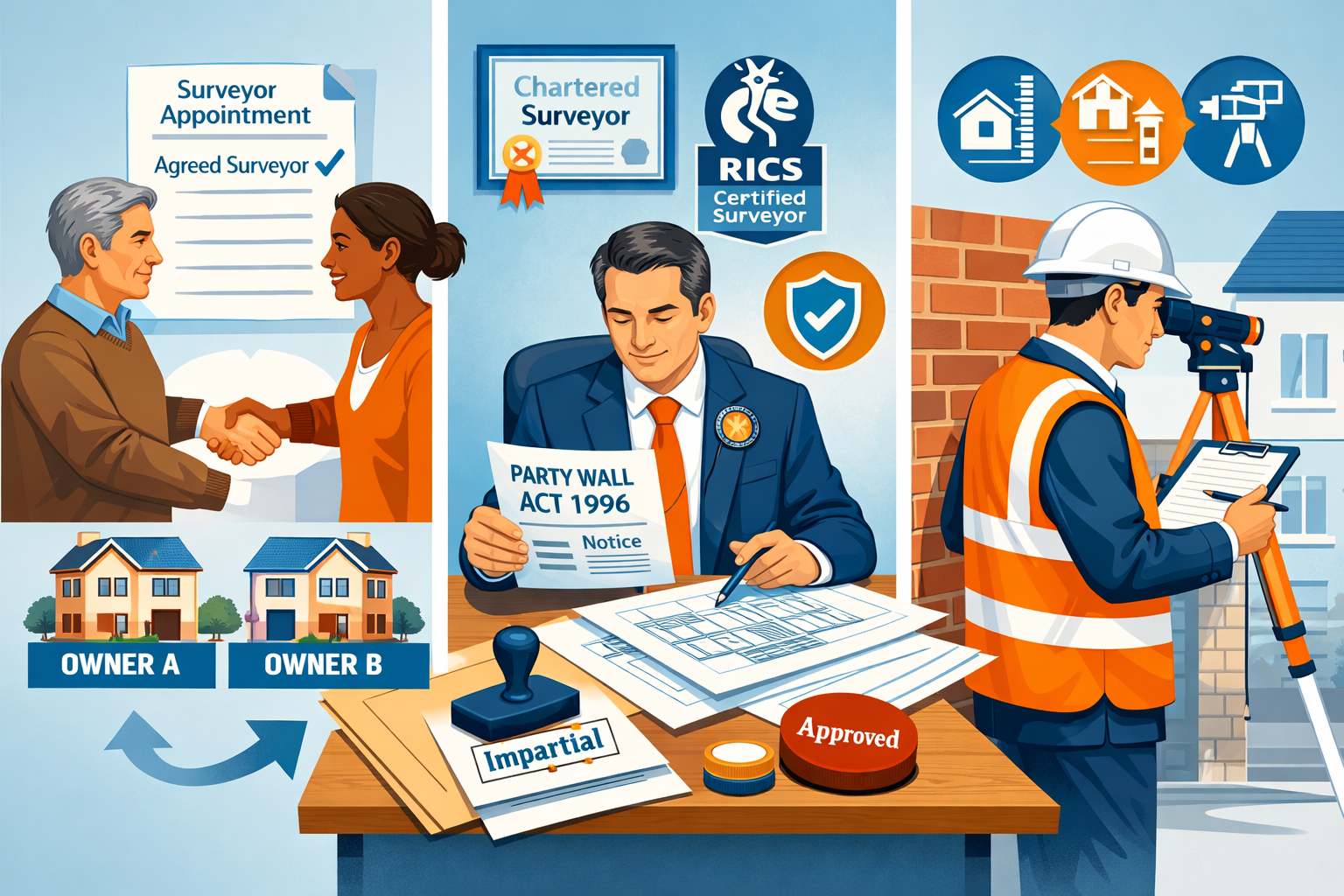
A party wall agreed surveyor is a qualified professional appointed jointly by both the building owner (the person carrying out construction work) and the adjoining owner (the neighbour) to administer matters arising under the Party Wall etc. Act 1996. Unlike scenarios where each party appoints their own surveyor, an agreed surveyor serves both parties simultaneously, acting with complete impartiality throughout the process.
The agreed surveyor’s primary responsibility is to prepare a party wall award—a legal document that sets out the rights and responsibilities of both parties, describes the proposed work, establishes the condition of adjoining properties before work commences, and outlines how any disputes will be resolved.
The Legal Framework
The Party Wall etc. Act 1996 governs building work that affects party walls (walls shared between properties), boundary walls, and excavations near neighbouring buildings in England and Wales. When a property owner plans such work, they must serve notice on their neighbours. If the neighbour consents to the work and both parties agree, they can jointly appoint a single surveyor rather than each appointing their own.
This streamlined approach offers several advantages:
- Cost efficiency: One surveyor means one set of fees instead of two
- Faster resolution: Decision-making is quicker with a single point of authority
- Reduced complexity: Communication flows more smoothly through one professional
- Collaborative atmosphere: Joint appointment encourages cooperation rather than adversarial positions
Professional chartered surveyors with party wall expertise typically serve in this capacity, bringing technical knowledge and legal understanding to protect both parties’ interests.
Why Choose a Party Wall Agreed Surveyor?
The decision to appoint an agreed surveyor versus separate surveyors represents a strategic choice that impacts costs, timelines, and the overall relationship between neighbours. Understanding the benefits helps property owners make informed decisions.
Financial Advantages
Cost savings represent the most immediate benefit of appointing a party wall agreed surveyor. When each party appoints their own surveyor, the building owner typically bears the reasonable costs of both professionals—their own surveyor and the adjoining owner’s surveyor. This can result in fees ranging from £1,500 to £3,000 or more for straightforward projects.
With an agreed surveyor, costs typically fall within the £700 to £1,500 range for similar work, representing savings of 30-50%. These fees cover:
- Initial consultation and advice
- Site inspections and condition surveys
- Preparation of the party wall award
- Ongoing monitoring during construction
- Resolution of any disputes that arise
Time Efficiency
Projects move forward more quickly with a single decision-maker. When two surveyors are involved, they must coordinate schedules, exchange correspondence, and reach consensus on various matters. This process can add weeks or even months to the timeline before work can commence.
An agreed surveyor can:
- ✅ Complete initial assessments within 7-10 days
- ✅ Draft and issue awards within 2-3 weeks
- ✅ Make immediate decisions on site issues
- ✅ Expedite the entire party wall process
Maintaining Neighbourly Relations
Perhaps the most undervalued benefit is the preservation of good neighbourly relations. Appointing separate surveyors can create an adversarial dynamic, with each professional advocating for their client’s position. This “us versus them” mentality can damage relationships that must continue long after construction ends.
A party wall agreed surveyor fosters collaboration by:
- Demonstrating mutual trust between neighbours
- Encouraging direct communication
- Focusing on fair solutions rather than competitive positions
- Reducing the formality and tension of the process
For those seeking professional guidance on property matters, experienced surveyors and valuers can provide comprehensive support throughout the party wall process.
The Role and Responsibilities of an Agreed Surveyor
Understanding what a party wall agreed surveyor actually does helps property owners set realistic expectations and appreciate the value these professionals provide.
Impartiality and Duty of Care
The cornerstone of the agreed surveyor’s role is absolute impartiality. Unlike a surveyor appointed by one party who acts primarily in that client’s interest, an agreed surveyor owes equal duties to both the building owner and the adjoining owner. This dual responsibility is enshrined in the Party Wall etc. Act 1996 and professional codes of conduct.
An agreed surveyor must:
- Listen equally to both parties’ concerns
- Consider fairly the interests of both properties
- Make balanced decisions based on technical merit and legal requirements
- Communicate transparently with all parties
- Avoid favouritism or bias toward either party
“The agreed surveyor stands in a unique position of trust, balancing technical expertise with diplomatic skill to ensure fair outcomes for all parties involved in party wall matters.”
Key Responsibilities
The agreed surveyor’s duties span the entire lifecycle of the building project:
1. Initial Assessment and Consultation
Before formal appointment, the surveyor typically meets with both parties to:
- Explain the party wall process and legal requirements
- Review the proposed building work and plans
- Assess the scope of work required under the Act
- Provide fee estimates and timeline expectations
- Confirm willingness to act impartially
2. Condition Survey
A comprehensive condition survey of the adjoining owner’s property forms the foundation of party wall protection. The agreed surveyor:
- Photographs all relevant areas of the neighbouring property
- Documents existing cracks, defects, and structural conditions
- Creates a detailed written record with measurements
- Establishes a baseline for comparison after construction
- Identifies any pre-existing issues that aren’t the building owner’s responsibility
This survey protects both parties—the building owner from false claims of damage, and the adjoining owner by ensuring any genuine damage is properly documented and remedied.
3. Preparation of the Party Wall Award
The party wall award is the central legal document that governs the building work. The agreed surveyor drafts this comprehensive document, which typically includes:
| Award Component | Description |
|---|---|
| Description of Works | Detailed explanation of the proposed building work affecting the party wall or boundary |
| Rights Granted | Specific permissions given to the building owner to carry out the work |
| Protective Measures | Requirements for protecting the adjoining property during construction |
| Working Hours | Permitted times for noisy or disruptive work |
| Access Rights | Arrangements for the building owner to access the neighbour’s property if necessary |
| Condition Schedule | Reference to the pre-work condition survey |
| Dispute Resolution | Procedures for addressing disagreements during the work |
| Cost Provisions | Clarification of who pays for what expenses |
4. Monitoring and Inspection
Throughout the construction phase, the agreed surveyor:
- Conducts periodic site inspections to ensure compliance with the award
- Addresses concerns raised by either party
- Verifies that protective measures are properly implemented
- Documents the progress of work
- Makes decisions on variations or unforeseen issues
5. Post-Completion Assessment
After work concludes, the surveyor:
- Performs a final inspection of the adjoining property
- Compares the current condition with the pre-work survey
- Identifies any damage attributable to the building work
- Specifies necessary remedial works
- Ensures the building owner fulfills all obligations under the award
For property owners requiring various assessment types beyond party wall matters, professional surveyors offer comprehensive services tailored to specific needs.
How to Appoint a Party Wall Agreed Surveyor
The appointment process follows specific legal procedures under the Party Wall etc. Act 1996. Understanding these steps ensures compliance and smooth progression.
Step 1: Serving Notice
Before any surveyor appointment, the building owner must serve proper notice on the adjoining owner. This notice must:
- Be in writing (specific forms are recommended)
- Describe the proposed work in sufficient detail
- Indicate when the work will start
- Be served at least two months in advance for new construction on the boundary line
- Be served at least one month in advance for other party wall work
The notice gives the adjoining owner three options:
- Consent to the work (ending the party wall process)
- Dissent or fail to respond within 14 days (triggering the surveyor appointment process)
- Consent with conditions (which may or may not be acceptable to the building owner)
Step 2: Mutual Agreement on Surveyor Selection
If the adjoining owner dissents or doesn’t respond, both parties can agree to appoint a single party wall agreed surveyor. This agreement should be:
- In writing: Clear documentation prevents future disputes
- Explicit: Both parties should formally confirm their consent to the appointment
- Informed: Both parties should understand the surveyor’s qualifications and fee structure
The building owner typically initiates this conversation, often saying something like: “Rather than each of us appointing our own surveyor, would you be willing to jointly appoint [surveyor name] as our agreed surveyor? This will save us both time and money.”
Step 3: Formal Appointment
Once both parties agree, the formal appointment involves:
- Both parties signing an appointment letter or agreement
- The surveyor confirming acceptance of the appointment in writing
- Agreement on fee arrangements (typically paid by the building owner)
- Establishment of communication protocols
Step 4: Surveyor Acceptance and Commencement
The appointed surveyor then:
- Confirms acceptance of the role in writing to both parties
- Provides a fee estimate and payment terms
- Schedules the initial condition survey
- Sets a timeline for preparing the party wall award
- Begins the technical assessment of the proposed work
Selecting the Right Surveyor
Not all surveyors possess equal expertise in party wall matters. When selecting a party wall agreed surveyor, consider:
Qualifications and Accreditation
- ✅ RICS (Royal Institution of Chartered Surveyors) membership
- ✅ Specialist party wall qualifications or training
- ✅ Professional indemnity insurance
- ✅ Membership in the Faculty of Party Wall Surveyors
Experience and Track Record
- 🔍 Years of party wall practice
- 🔍 Number of awards prepared
- 🔍 Experience with similar types of building work
- 🔍 Local knowledge of construction practices and building types
Reputation and References
- 💬 Reviews from previous clients
- 💬 Recommendations from both building owners and adjoining owners
- 💬 Standing in the professional community
- 💬 Dispute resolution success rate
Communication and Approach
- 📞 Responsiveness to inquiries
- 📞 Clarity of explanations
- 📞 Professional but approachable manner
- 📞 Demonstrated impartiality
Working with RICS-certified experts ensures adherence to professional standards and ethical guidelines throughout the party wall process.
Common Scenarios Requiring a Party Wall Agreed Surveyor
Understanding when a party wall agreed surveyor becomes necessary helps property owners plan appropriately and comply with legal requirements.
Building Work on Party Walls
Party walls are walls that stand on the boundary between two properties and are used by both properties. Common scenarios include:
Loft Conversions
When converting a loft in a semi-detached or terraced property, work often affects the party wall. This might involve:
- Cutting into the party wall to install steel beams
- Raising the party wall to create additional headroom
- Inserting joists into the party wall
- Adding insulation that affects the wall structure
Extensions
Rear or side extensions frequently require party wall procedures when:
- The new structure abuts or connects to the party wall
- Foundations are dug near the boundary
- The extension increases the load on the party wall
- Weatherproofing requires alterations to the party wall
Internal Alterations
Even work entirely within your property may require party wall procedures:
- Removing chimney breasts that pass through the party wall
- Installing new doorways through party walls (in converted properties)
- Underpinning that affects the party wall’s foundation
- Installing damp-proof courses in party walls
Excavations Near Boundaries
The Party Wall etc. Act 1996 covers excavations within certain distances of neighbouring buildings:
| Excavation Depth | Distance from Neighbour’s Building | Notice Required? |
|---|---|---|
| Deeper than neighbour’s foundation | Within 3 metres | ✅ Yes |
| Deeper than neighbour’s foundation | 3-6 metres | ✅ Yes (if within 45-degree line) |
| Shallower than neighbour’s foundation | Any distance | ❌ No |
Common excavation scenarios include:
- Basement conversions: Digging below existing floor levels
- Foundation work: New extensions with deep foundations
- Drainage installations: Trenches for pipes and sewers
- Swimming pools: Excavations for below-ground pools
Boundary Structures
Work on walls that sit entirely on one property’s land but are used by both properties (boundary walls) requires party wall procedures when:
- Raising the height of a boundary wall
- Demolishing and rebuilding a boundary wall
- Cutting into a boundary wall
- Repairing or underpinning a boundary wall
Special Considerations for Different Property Types
Terraced Houses: Party wall issues are most common in terraced properties, where walls are shared on both sides. Work affecting one party wall may trigger notices to multiple neighbours.
Semi-Detached Properties: Typically involve one shared wall, but excavations may affect neighbours on other sides.
Flats and Maisonettes: Party wall matters become more complex in multi-unit buildings, potentially involving multiple adjoining owners including those above and below.
Commercial Properties: The same legal requirements apply, though the scale and complexity of work often increases.
For property owners dealing with complex valuation needs alongside party wall matters, services like matrimonial valuations or probate valuations may also be required.
Costs and Fees: What to Expect When Hiring a Party Wall Agreed Surveyor
Understanding the financial aspects of appointing a party wall agreed surveyor helps property owners budget appropriately and avoid surprises.
Typical Fee Structures
Party wall surveyors generally charge fees in one of three ways:
1. Fixed Fee Basis
For straightforward projects with predictable scope, many surveyors offer fixed fees covering:
- Initial consultation
- Condition survey
- Preparation of the party wall award
- One or two site inspections during work
- Final inspection
Typical ranges for fixed fees:
- Simple projects (single-storey extension, minor works): £700-£1,200
- Medium complexity (two-storey extension, loft conversion): £1,200-£2,000
- Complex projects (basement excavation, major structural work): £2,000-£3,500
2. Hourly Rate
For projects where the scope is uncertain, hourly rates apply:
- Junior surveyors: £80-£120 per hour
- Senior surveyors: £120-£200 per hour
- Partner-level surveyors: £200-£300 per hour
3. Hybrid Approach
Many surveyors combine approaches:
- Fixed fee for the award preparation
- Hourly rate for site inspections and dispute resolution
- Additional charges for unforeseen complications
What’s Included in the Fee?
A comprehensive party wall agreed surveyor service typically includes:
✅ Pre-appointment consultation – Initial discussion about the project and process
✅ Formal appointment documentation – Letters confirming the appointment
✅ Review of building plans – Technical assessment of proposed work
✅ Condition survey – Detailed photographic and written record of adjoining property
✅ Award preparation – Drafting the legally binding party wall award
✅ Award service – Distributing the award to both parties
✅ Routine site inspections – Monitoring compliance during construction (typically 2-3 visits)
✅ Final inspection – Post-completion assessment
✅ Correspondence – Reasonable communication with both parties
Additional Costs to Consider
Beyond the surveyor’s professional fees, building owners should budget for:
Adjoining Owner’s Surveyor Fees (if separate surveyors are appointed instead)
- The building owner pays reasonable fees for both surveyors
- Total costs typically double compared to an agreed surveyor
Third Surveyor Fees
- If the two surveyors disagree, they may appoint a third surveyor
- The building owner typically pays these additional fees
- Costs range from £500-£2,000+ depending on complexity
Remedial Works
- Costs to repair any damage caused by the building work
- Can range from minor cosmetic repairs (£200-£500) to significant structural repairs (£2,000+)
Legal Fees
- If disputes escalate to court proceedings (rare)
- Can easily exceed £10,000
Who Pays the Surveyor’s Fees?
Under the Party Wall etc. Act 1996, the building owner (the person carrying out the work) typically bears all reasonable costs associated with the party wall process, including:
- Their own surveyor’s fees
- The adjoining owner’s surveyor’s fees (if separate surveyors are appointed)
- The agreed surveyor’s fees (if jointly appointed)
- Any third surveyor’s fees
This cost allocation applies regardless of whether the adjoining owner consented to the work. The principle is that the person initiating the building work should bear the administrative and professional costs of ensuring proper procedures are followed.
Cost Comparison: Agreed Surveyor vs. Separate Surveyors
| Scenario | Agreed Surveyor | Separate Surveyors | Savings |
|---|---|---|---|
| Simple extension | £900 | £1,800 (£900 × 2) | £900 (50%) |
| Medium project | £1,500 | £3,000 (£1,500 × 2) | £1,500 (50%) |
| Complex basement | £2,500 | £5,000 (£2,500 × 2) | £2,500 (50%) |
These savings assume both surveyors would charge similar fees. In practice, savings may be even greater if the adjoining owner appoints a more expensive specialist.
Getting Value for Money
To ensure good value when appointing a party wall agreed surveyor:
- Request detailed fee proposals – Ask for itemized breakdowns
- Compare multiple quotes – Get proposals from 2-3 qualified surveyors
- Clarify what’s included – Understand exactly what services the fee covers
- Ask about potential additional costs – Identify circumstances that might trigger extra charges
- Check qualifications – Ensure the surveyor has appropriate expertise
- Read reviews – Look for feedback from previous clients
For those seeking cost guidance on various property services, understanding valuation costs can provide helpful context for budgeting professional fees.
The Party Wall Award: What It Contains and Why It Matters
The party wall award represents the culmination of the agreed surveyor’s work and serves as the legal framework governing the building project. Understanding its components helps property owners appreciate its importance.
Essential Components of a Party Wall Award
A comprehensive party wall award typically includes the following sections:
1. Preamble and Parties
- Names and addresses of the building owner and adjoining owner
- Property addresses
- Date of the award
- Name and qualifications of the agreed surveyor
- Reference to the Party Wall etc. Act 1996
2. Description of the Proposed Works
Detailed explanation of the building work, including:
- Nature of the construction (extension, loft conversion, excavation, etc.)
- Specific work affecting the party wall or boundary
- Reference to architectural drawings and specifications
- Construction methodology where relevant
- Timeline for the work
3. Rights Granted to the Building Owner
Specific permissions under the Act, such as:
- Right to cut into the party wall
- Right to raise or underpin the party wall
- Right to demolish and rebuild
- Right to access the adjoining owner’s property (if necessary)
- Right to carry out excavations within specified distances
4. Conditions and Protective Measures
Requirements to protect the adjoining property:
- Structural protection: Temporary supports, shoring, or propping
- Dust and debris control: Sheeting, barriers, or protective coverings
- Vibration limits: Restrictions on heavy machinery or pile-driving
- Working hours: Permitted times for noisy work (typically 8am-6pm weekdays, 8am-1pm Saturdays, no Sundays or bank holidays)
- Noise mitigation: Requirements for acoustic barriers or quiet equipment
- Site management: Keeping the site tidy and secure
5. Schedule of Condition
- Reference to the pre-work condition survey
- Photographs and descriptions of the adjoining property’s current state
- Documentation of existing cracks, defects, or damage
- Baseline for assessing any damage caused by the building work
6. Access Provisions
If the building owner needs to access the adjoining property:
- Specific purposes for which access is permitted
- Notice period required before access
- Hours during which access may occur
- Obligations to minimize disruption
- Requirements to make good any damage caused by access
7. Dispute Resolution Procedures
- Process for raising concerns during the work
- Role of the agreed surveyor in resolving disputes
- Timeline for surveyor responses to issues
- Provisions for appointing a third surveyor if necessary
8. Costs and Expenses
- Confirmation that the building owner pays the surveyor’s fees
- Responsibility for remedial works if damage occurs
- Provisions for security for expenses (if required)
- Payment timelines
9. Special Conditions
Any project-specific requirements, such as:
- Monitoring of specific structural elements
- Additional inspections at critical stages
- Notification requirements before certain work commences
- Insurance requirements
Legal Status and Enforceability
The party wall award is a legally binding document with the same force as a court order. This means:
- ✅ Both parties must comply with its terms
- ✅ Failure to comply can result in injunctions or damages
- ✅ The award can be enforced through court proceedings if necessary
- ✅ The award supersedes any informal agreements between the parties
Appeals and Challenges
Either party has the right to appeal a party wall award to the County Court within 14 days of receiving it. Grounds for appeal are limited to:
- The surveyor exceeded their authority under the Act
- The award is unreasonable or unfair
- Procedural errors occurred in preparing the award
- The surveyor demonstrated bias or failed to act impartially
Appeals are relatively rare, as most agreed surveyors produce balanced, technically sound awards that protect both parties fairly.
Variations and Amendments
If circumstances change during construction, the agreed surveyor can:
- Issue supplementary awards addressing new issues
- Amend the original award with both parties’ consent
- Make determinations on matters not originally anticipated
- Resolve disputes about the interpretation of award provisions
Practical Importance
The party wall award serves several critical functions:
For the Building Owner:
- Provides legal authority to proceed with work affecting the party wall
- Protects against claims of trespass or damage (if award terms are followed)
- Establishes clear parameters for the construction work
- Minimizes risk of injunctions stopping the work
For the Adjoining Owner:
- Documents the pre-work condition of their property
- Establishes protective measures to minimize damage
- Creates a framework for compensation if damage occurs
- Provides recourse if the building owner acts unreasonably
For Both Parties:
- Reduces uncertainty and potential for disputes
- Provides an impartial expert’s assessment of appropriate procedures
- Creates a clear record for future reference
- Facilitates good neighbourly relations by establishing fair expectations
For property owners navigating complex property transactions alongside building work, understanding related services like conveyancing can provide a more complete picture of professional support available.
Resolving Disputes: The Agreed Surveyor’s Mediation Role
Even with the best planning and most detailed party wall awards, disagreements sometimes arise during construction. The party wall agreed surveyor plays a crucial role in resolving these disputes efficiently and fairly.
Common Types of Disputes
Disputes during party wall projects typically fall into several categories:
1. Damage Claims
The most frequent disputes involve allegations of damage:
- Cracks appearing in walls or ceilings
- Doors or windows sticking
- Plaster damage or cosmetic issues
- Structural movement or subsidence
- Drainage problems
The agreed surveyor’s role is to:
- Investigate the damage promptly
- Compare current condition with the pre-work survey
- Determine whether the damage is attributable to the building work
- Specify appropriate remedial measures
- Ensure the building owner fulfills repair obligations
2. Non-Compliance with the Award
Disputes arise when the building owner fails to follow award provisions:
- Working outside permitted hours
- Failing to implement protective measures
- Causing excessive noise, dust, or vibration
- Not providing required notice before certain work stages
- Accessing the adjoining property without permission
The agreed surveyor can:
- Issue formal notices requiring compliance
- Stop work until protective measures are implemented
- Amend the award to address unforeseen circumstances
- Recommend legal action in cases of serious non-compliance
3. Scope of Work Disputes
Disagreements about what work is actually being done:
- Building owner undertaking work not described in the notice or award
- Adjoining owner claiming work exceeds what was agreed
- Changes to the construction methodology
- Additional work discovered to be necessary
The agreed surveyor must:
- Assess whether the work falls within the scope of the original notice
- Determine if a new notice is required
- Issue supplementary awards if appropriate
- Clarify ambiguities in the original award
4. Access Disputes
Conflicts over the building owner’s need to access the adjoining property:
- Adjoining owner refusing reasonable access
- Building owner seeking access beyond what the award permits
- Disputes about timing or duration of access
- Concerns about damage during access
The surveyor balances both parties’ rights:
- Determining whether access is genuinely necessary
- Specifying reasonable terms and conditions
- Ensuring minimal disruption to the adjoining owner
- Protecting the adjoining owner’s property during access
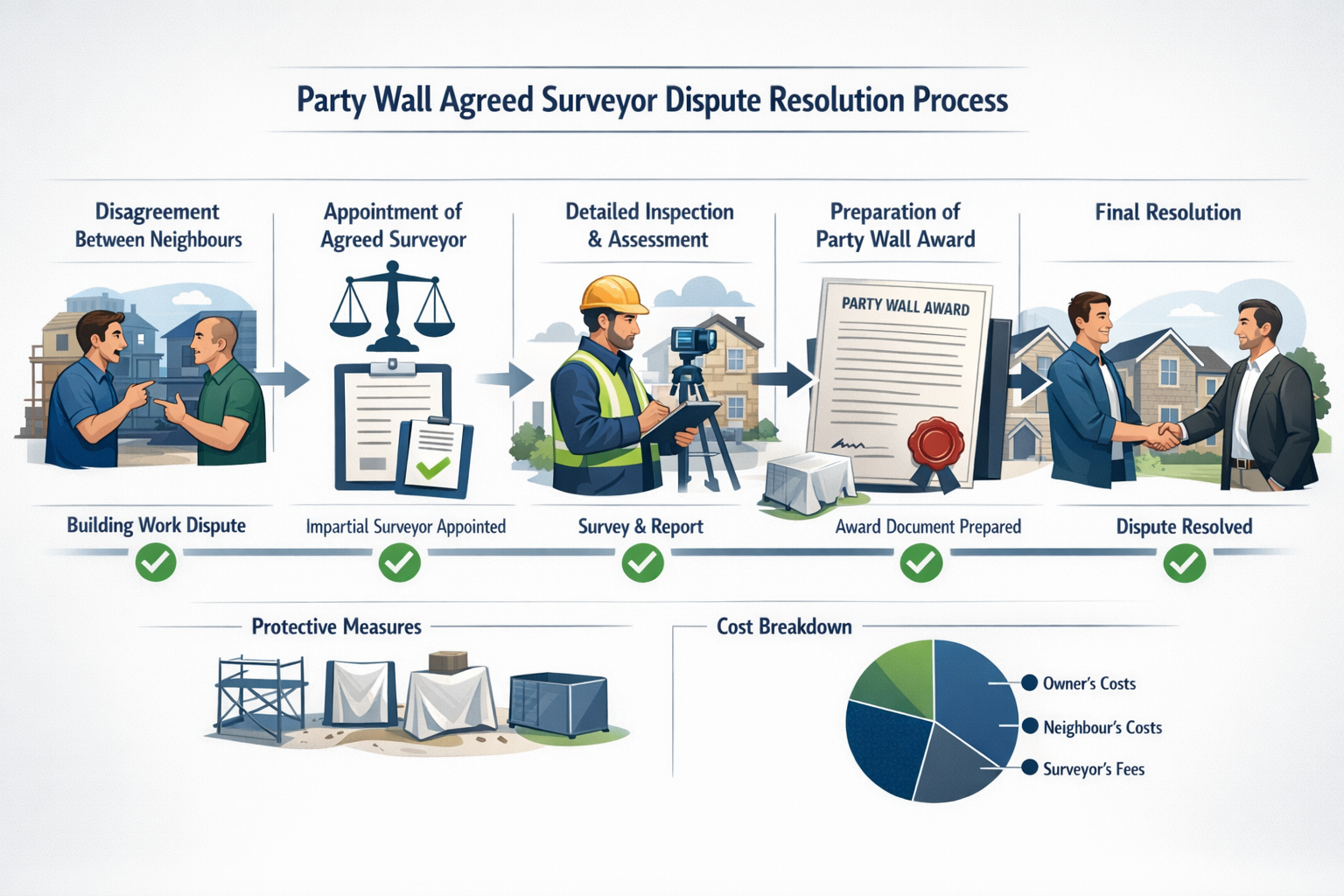
The Dispute Resolution Process
When a dispute arises, the agreed surveyor typically follows this process:
Step 1: Notification
Either party contacts the surveyor to report the issue, providing:
- Description of the problem
- Photographic evidence if relevant
- Details of when the issue arose
- Any correspondence with the other party
Step 2: Investigation
The surveyor:
- Reviews the complaint and supporting evidence
- Conducts a site inspection if necessary
- Examines relevant provisions of the award
- Consults technical references or specialists if needed
- Considers both parties’ perspectives
Step 3: Determination
The surveyor makes a decision:
- Issues a written determination explaining the decision
- Specifies any actions required by either party
- Sets deadlines for compliance
- Clarifies any ambiguities in the award
Step 4: Implementation
The parties comply with the surveyor’s determination:
- Building owner implements required remedial measures
- Adjoining owner provides reasonable cooperation
- Both parties follow any revised procedures
Step 5: Follow-up
The surveyor monitors compliance:
- Conducts follow-up inspections
- Verifies that remedial work is satisfactory
- Addresses any further concerns
- Documents the resolution for the record
Maintaining Impartiality During Disputes
The agreed surveyor’s impartiality is tested most during dispute resolution. Professional surveyors maintain neutrality by:
- Listening equally to both parties’ concerns without prejudgment
- Basing decisions on evidence rather than personalities or pressure
- Applying technical expertise objectively to assess claims
- Communicating transparently with both parties about the decision-making process
- Documenting thoroughly to create a clear record of the dispute and resolution
“An effective party wall agreed surveyor acts as both technical expert and diplomatic mediator, resolving disputes through professional judgment rather than advocacy for either party.”
When Disputes Escalate
If either party disagrees with the agreed surveyor’s determination, they have several options:
Request Reconsideration
- Provide additional evidence or information
- Ask the surveyor to review the decision
- Clarify any misunderstandings
Appeal to County Court
- File an appeal within 14 days of the determination
- Present evidence and arguments to a judge
- Seek a court order modifying or overturning the surveyor’s decision
Appoint a Third Surveyor
- In some cases, a third surveyor may be appointed to review the dispute
- The third surveyor’s decision is typically final
- Both parties usually share the third surveyor’s costs
Preventing Disputes Through Good Practice
The best dispute resolution is dispute prevention. Effective agreed surveyors minimize conflicts by:
- Preparing comprehensive awards that anticipate potential issues
- Conducting thorough condition surveys that document pre-existing conditions clearly
- Communicating proactively with both parties throughout the project
- Inspecting regularly to catch problems early
- Responding promptly to concerns before they escalate
- Educating both parties about their rights and responsibilities
- Maintaining detailed records of all decisions and communications
For property owners dealing with complex situations involving multiple professional services, understanding the breadth of assessment types available can help coordinate comprehensive property management strategies.
Choosing Between an Agreed Surveyor and Separate Surveyors
While this guide focuses on party wall agreed surveyors, understanding when separate surveyors might be more appropriate helps property owners make informed decisions.
When an Agreed Surveyor Is Ideal
A party wall agreed surveyor works best in these situations:
✅ Neighbourly relations are good – Both parties trust each other and want to minimize costs and complexity
✅ The project is straightforward – Standard extensions, loft conversions, or minor party wall work without unusual complications
✅ Both parties are reasonable – Neither party has extreme demands or unrealistic expectations
✅ Cost is a significant concern – The building owner wants to minimize professional fees
✅ Speed is important – The project timeline benefits from streamlined decision-making
✅ No significant pre-existing disputes – There are no ongoing conflicts between the neighbours
When Separate Surveyors May Be Better
Separate surveyors (each party appointing their own) might be preferable when:
❌ Relations are already strained – Existing conflicts make joint appointment difficult
❌ The project is highly complex – Major structural work, deep excavations, or unusual construction methods require specialized advocacy
❌ Significant property value is at stake – High-value properties where even minor damage could be costly
❌ One party has special concerns – The adjoining owner has specific vulnerabilities (elderly occupants, valuable finishes, sensitive equipment)
❌ Previous disputes occurred – Past conflicts suggest the need for independent representation
❌ Legal complexity exists – Unusual ownership structures, multiple adjoining owners, or commercial properties
The Middle Ground: Starting with an Agreed Surveyor
Many property owners begin with an agreed surveyor and retain the option to appoint separate surveyors if issues arise. This approach:
- Minimizes initial costs
- Demonstrates good faith and willingness to cooperate
- Allows both parties to assess the surveyor’s impartiality
- Preserves the right to appoint separate surveyors later if necessary
Making the Decision
When deciding whether to propose an agreed surveyor, building owners should consider:
Your Relationship with Your Neighbour
- How well do you know them?
- Have you had previous disputes?
- Do they seem reasonable and cooperative?
- Have they expressed concerns about your project?
The Nature of Your Project
- How extensive is the work?
- What risks does it pose to the adjoining property?
- Are there unusual technical challenges?
- How long will construction take?
Your Neighbour’s Circumstances
- Do they have special vulnerabilities (elderly, disabled, young children)?
- Is their property particularly valuable or sensitively finished?
- Do they run a business from home that could be disrupted?
- Are they knowledgeable about construction and party wall matters?
Your Budget and Timeline
- How important are cost savings?
- Can you afford potential delays?
- Do you have contingency funds for disputes?
- Is your construction timeline flexible?
Approaching the Conversation
If you decide to propose an agreed surveyor, approach the conversation thoughtfully:
Do:
- ✅ Explain the benefits (cost savings, faster process, collaborative approach)
- ✅ Suggest a qualified, experienced surveyor with good credentials
- ✅ Offer to share the surveyor’s information and qualifications
- ✅ Emphasize that the surveyor must act impartially
- ✅ Respect their right to appoint their own surveyor if they prefer
Don’t:
- ❌ Pressure them into agreeing
- ❌ Suggest that appointing separate surveyors is unreasonable
- ❌ Imply that you’re doing them a favour
- ❌ Minimize legitimate concerns about the building work
- ❌ Present it as a take-it-or-leave-it proposition
If Your Neighbour Prefers Separate Surveyors
If the adjoining owner wants to appoint their own surveyor, respect their decision. This doesn’t necessarily indicate hostility—they may simply feel more comfortable with independent representation. The process will cost more and take longer, but it still provides a structured framework for managing the party wall matters professionally.
Remember that even with separate surveyors, the goal remains the same: ensuring that building work proceeds safely and fairly with proper protection for both properties.
Frequently Asked Questions About Party Wall Agreed Surveyors
Can I appoint my own builder or architect as the agreed surveyor?
No. The agreed surveyor must be independent and have no financial or personal interest in the building project. Appointing someone already involved in your project would compromise the impartiality required under the Party Wall etc. Act 1996. The surveyor should be a qualified professional with specific party wall expertise and no connection to either party beyond the surveyor appointment.
What happens if I disagree with the agreed surveyor’s decision?
You have the right to appeal the surveyor’s award or determination to the County Court within 14 days of receiving it. However, appeals are only successful if you can demonstrate that the surveyor exceeded their authority, acted unreasonably, or failed to follow proper procedures. Before appealing, consider requesting clarification from the surveyor, as many apparent disagreements stem from misunderstandings that can be resolved through communication.
How long does the party wall process take with an agreed surveyor?
For straightforward projects, the process typically takes 4-8 weeks from appointment to award:
- Week 1-2: Initial consultation and condition survey
- Week 2-4: Award preparation and review
- Week 4-6: Award finalization and service to both parties
- Week 6-8: 14-day appeal period
Complex projects or those requiring multiple site visits may take longer. Using an agreed surveyor rather than separate surveyors typically reduces the overall timeline by 2-4 weeks.
Do I need a party wall agreed surveyor for internal renovations?
It depends on the nature of the work. Internal renovations require party wall procedures if they affect a party wall, such as:
- Removing a chimney breast that passes through the party wall
- Cutting into the party wall to install beams or joists
- Underpinning that affects the party wall’s foundation
- Installing new openings through party walls
Purely cosmetic internal work (painting, flooring, kitchen installation) that doesn’t affect the structure of the party wall doesn’t require party wall procedures.
Can the agreed surveyor charge different fees to each party?
No. The agreed surveyor charges a single fee for their services, which is typically paid entirely by the building owner under the “costs follow the work” principle. The surveyor cannot charge the building owner one fee and the adjoining owner a different fee, as this would create a conflict of interest and compromise impartiality.
What qualifications should a party wall agreed surveyor have?
Look for:
- RICS membership (Royal Institution of Chartered Surveyors)
- Specific party wall training or membership in the Faculty of Party Wall Surveyors
- Professional indemnity insurance of at least £1 million
- Several years of party wall experience, ideally with dozens of awards prepared
- Local knowledge of construction practices and property types in your area
Can I change from an agreed surveyor to separate surveyors?
Yes, either party can appoint their own surveyor at any point before the award is finalized, even if an agreed surveyor was initially appointed. However, once the award is issued, you cannot simply change surveyors—you would need to appeal the award or wait for a new matter to arise that requires a fresh appointment.
What if my neighbour won’t agree to an agreed surveyor?
If your neighbour prefers to appoint their own surveyor, you cannot force them to accept an agreed surveyor. The Party Wall etc. Act 1996 gives each party the right to appoint their own surveyor. In this case, you’ll proceed with two surveyors who will work together to prepare the award. You’ll pay the reasonable fees of both surveyors, but you’ll still receive proper protection under the Act.
Conclusion: Making the Right Choice for Your Party Wall Matters
Navigating party wall procedures represents one of the most delicate aspects of property development, requiring a careful balance between legal compliance, technical expertise, and neighbourly diplomacy. The party wall agreed surveyor offers a streamlined, cost-effective solution that benefits both building owners and adjoining owners when circumstances permit.
By appointing a single impartial professional, property owners can:
💰 Reduce costs by 30-50% compared to appointing separate surveyors
⏱️ Accelerate timelines through streamlined decision-making
🤝 Preserve relationships by demonstrating trust and cooperation
⚖️ Ensure fairness through professional impartiality and technical expertise
📋 Achieve compliance with the Party Wall etc. Act 1996
The key to success lies in selecting a qualified, experienced surveyor who demonstrates genuine impartiality and technical competence. Look for RICS-qualified professionals with specific party wall expertise, strong communication skills, and a track record of preparing balanced awards that protect all parties fairly.
Your Next Steps
If you’re planning building work that may affect a party wall or boundary:
- Review your plans to identify work that requires party wall procedures
- Serve proper notice on your neighbours at least 1-2 months before starting work
- Discuss the agreed surveyor option with your neighbour if they dissent or don’t respond
- Research qualified surveyors with appropriate credentials and experience
- Request fee proposals from 2-3 surveyors to compare qualifications and costs
- Make the appointment formally in writing with both parties’ consent
- Cooperate fully with the surveyor throughout the process
- Follow the award carefully during construction to avoid disputes
Remember that party wall procedures exist to protect both your interests and your neighbour’s interests. While the process may seem bureaucratic, it provides a proven framework for managing building work fairly and minimizing conflicts.
Professional Support
For expert guidance on party wall matters and comprehensive surveying services, Manchester Surveyors offers professional support throughout the North West and beyond. With RICS-qualified surveyors experienced in party wall procedures, building surveys, and various valuation services, the team provides the expertise needed to navigate complex property matters with confidence.
Whether you’re planning a simple extension or a complex development project, professional surveying support ensures compliance, protects your investment, and facilitates positive outcomes for all parties involved. Don’t leave party wall matters to chance—engage qualified professionals who can guide you through the process efficiently and effectively.
The right party wall agreed surveyor transforms a potentially contentious legal requirement into a smooth, professional process that protects everyone’s interests while allowing your building project to proceed on schedule and within budget. Make the choice that sets your project up for success from the very beginning.