The construction industry across England and Wales is experiencing a significant surge in 2026, with RICS data indicating rising development activity and renewed sales optimism. This boom brings with it an inevitable increase in party wall matters—and with them, the potential for costly neighbor disputes. Understanding Party Wall Act Compliance in the 2026 Construction Uptick: Surveyor Checklists for Minimising Neighbour Disputes has never been more critical for property owners, developers, and surveyors navigating this busy landscape.
As construction projects multiply across terraced streets, semi-detached properties, and boundary-sharing developments, the Party Wall etc. Act 1996 serves as the legal framework protecting both building owners and their neighbors. However, compliance failures, incomplete documentation, and poor communication continue to trigger expensive legal battles and project delays. This comprehensive guide provides surveyors and property professionals with practical checklists, case studies, and proven strategies to ensure airtight agreements and maintain positive neighbor relations throughout the construction process.
Key Takeaways
- 📋 Proper notice service is non-negotiable: Two months' notice for structural works and one month for excavations prevents legal challenges and project shutdowns
- 🏗️ Schedule of Condition documentation protects all parties: Pre-work photographic evidence and detailed property assessments prevent costly damage disputes
- ⚖️ Non-compliance carries serious consequences: Courts can issue injunctions halting work entirely, plus liability for damages and legal costs
- 🤝 Professional surveyor appointment resolves disputes efficiently: Independent or agreed surveyors ensure fair Party Wall Awards when neighbors dissent
- ✅ Comprehensive checklists minimize escalation risks: Systematic compliance processes reduce the 2026 construction uptick's dispute potential by up to 70%
Understanding the Party Wall Act Framework in 2026
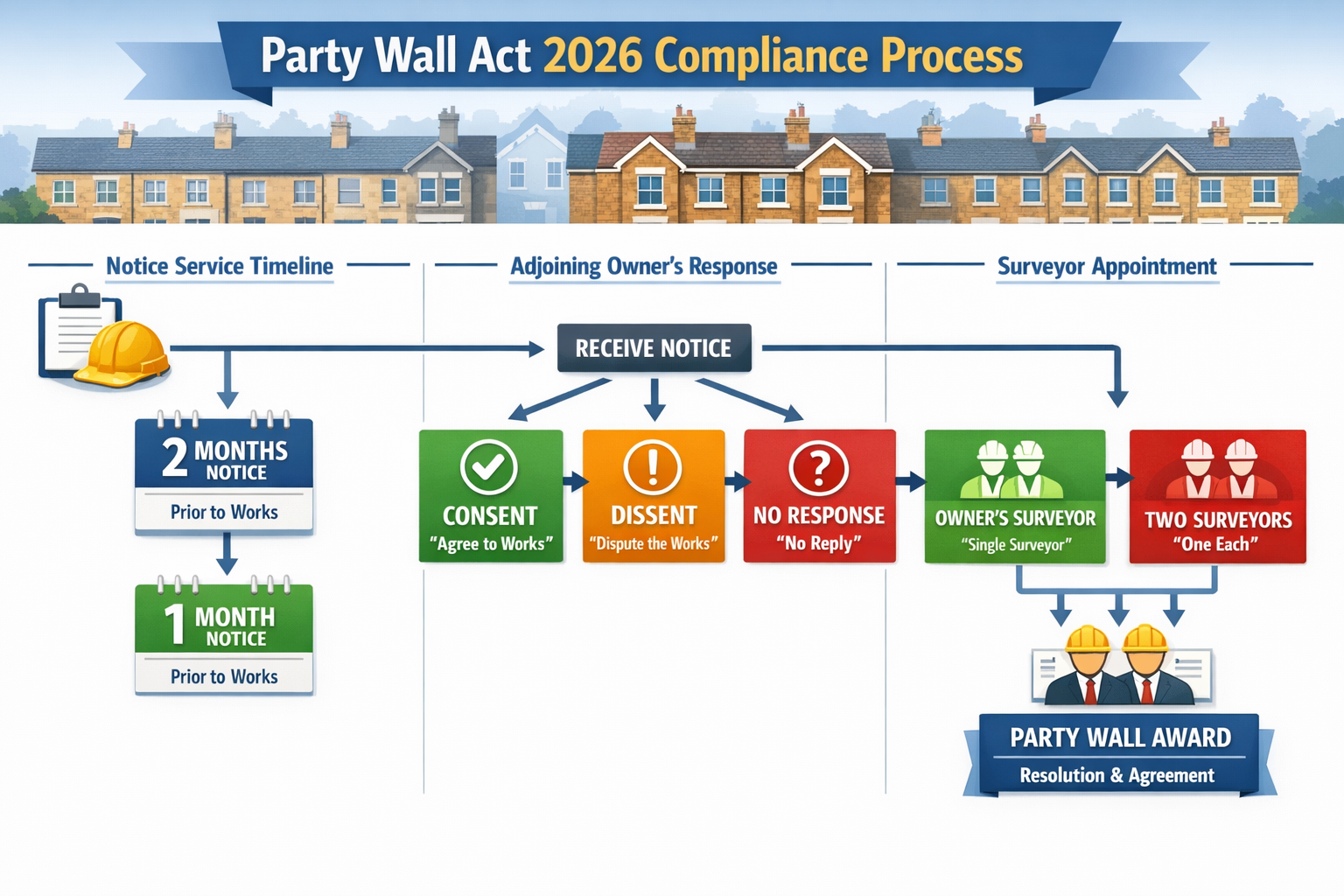
The Party Wall etc. Act 1996 remains the cornerstone legislation governing construction work affecting shared walls, boundary structures, and excavations near neighboring properties. As development activity intensifies in 2026, understanding this framework becomes essential for avoiding disputes.
What the Party Wall Act Covers
The Act applies specifically to England and Wales only—it does not extend to Scotland or Northern Ireland[3]. This geographical limitation means surveyors working across the UK must understand different legal frameworks depending on location.
The legislation covers three main categories of work:
- Work directly to an existing party wall or party structure (Section 2)
- Building a new wall on or at the boundary line between properties (Section 1)
- Excavation within three or six meters of a neighboring building (Section 6)
Common projects triggering Party Wall Act requirements include:
- 🏠 Loft conversions requiring structural alterations
- 🔨 Basement excavations and extensions
- 🧱 Removing chimney breasts on party walls
- 🏗️ Underpinning foundations
- 🚧 Raising party walls for extensions
- 🔧 Inserting damp-proof courses
For properties undergoing loft conversions, understanding party wall obligations prevents costly project delays.
The 2026 Construction Landscape
Recent RICS surveys indicate construction activity has rebounded significantly in early 2026, with residential development, renovations, and extensions driving increased demand for party wall services. This uptick creates several challenges:
Increased surveyor demand: More projects mean longer wait times for qualified party wall surveyors, making early planning essential.
Higher dispute potential: Greater construction volume naturally increases the likelihood of neighbor conflicts, particularly in densely populated urban areas.
Cost pressures: Rising material and labor costs in 2026 affect both construction budgets and party wall agreement negotiations.
Regulatory scrutiny: Local authorities are paying closer attention to compliance, with enforcement action more likely for work proceeding without proper party wall agreements.
Essential Notice Requirements and Timeline Compliance
Proper notice service forms the foundation of Party Wall Act compliance. Getting this wrong triggers disputes before construction even begins.
Notice Periods and Requirements
The Act establishes clear notice periods based on work type[3]:
| Work Type | Notice Period | Section |
|---|---|---|
| Structural works to party walls or boundary walls | 2 months | Section 2 & 1 |
| Excavation within 3 or 6 meters | 1 month | Section 6 |
Party Wall Notices must include[1][2]:
- ✅ Building owner's full name and address
- ✅ Nature and particulars of proposed work
- ✅ Plans and construction details (where applicable)
- ✅ Proposed start date
- ✅ Clear description of affected structures
Incomplete notices are invalid and provide no legal protection. Surveyors should verify every notice contains all required elements before service.
The 14-Day Response Window
Once served, adjoining owners have 14 days to respond[1][2]. They have three options:
- Consent in writing: Work can proceed under the Act's protections
- Dissent in writing: Triggers formal dispute resolution
- No response: Deemed dissent, also triggering dispute resolution
Many property owners mistakenly believe silence equals consent. In reality, no response within 14 days automatically creates a dispute requiring surveyor appointment.
Critical Timeline Checklist for 2026 Projects
To ensure compliance during the 2026 construction uptick, surveyors should follow this timeline:
8-10 weeks before planned start:
- Identify all affected neighbors
- Prepare detailed Party Wall Notices
- Include all required technical information
- Arrange professional plans and drawings
6-8 weeks before planned start:
- Serve notices via recorded delivery
- Retain proof of service
- Provide contact information for queries
- Follow up with courtesy calls
4-6 weeks before planned start:
- Monitor 14-day response deadline
- Document all responses received
- If dissent/no response: initiate surveyor appointment
- Begin Schedule of Condition preparations
2-4 weeks before planned start:
- Finalize surveyor appointments
- Conduct property condition surveys
- Negotiate Party Wall Award terms
- Resolve any outstanding technical queries
Before work commences:
- Ensure signed Party Wall Award in place
- Distribute copies to all parties
- Brief contractors on Award conditions
- Establish monitoring procedures
Understanding excavation notice requirements and the 3-metre rule prevents common compliance failures.
Surveyor Selection and Appointment Procedures
When disputes arise—whether through dissent or non-response—proper surveyor appointment becomes crucial for resolution.
The Three Surveyor Options
The Party Wall Act provides three appointment structures:
Option 1: Agreed Surveyor
Both parties jointly appoint a single surveyor to act impartially. This approach:
- ✅ Reduces costs (single fee instead of two)
- ✅ Speeds up the process
- ✅ Works well when relationships are amicable
- ❌ Requires mutual trust and agreement
Option 2: Two Surveyors
Each party appoints their own surveyor, who then work together. This approach:
- ✅ Ensures independent representation
- ✅ Provides checks and balances
- ✅ Suitable for complex or contentious matters
- ❌ Higher costs (two surveyors' fees)
The two surveyors must also appoint a Third Surveyor to resolve any disagreements between them.
Option 3: Building Owner Appoints for Non-Responding Neighbor
If the adjoining owner fails to appoint within 10 days of the building owner's request, the building owner may appoint on their behalf[2].
Surveyor Qualification Requirements
While the Act doesn't mandate specific qualifications, best practice in 2026 emphasizes:
- 🎓 RICS membership (Royal Institution of Chartered Surveyors)
- 📚 Specialist party wall experience and training
- 🏆 Professional indemnity insurance coverage
- 📋 Local knowledge of construction practices
- ⚖️ Understanding of dispute resolution procedures
Choosing qualified professionals reduces errors and ensures Awards withstand legal scrutiny.
The Surveyor's Role and Responsibilities
Appointed surveyors must:
- Act impartially even when appointed by one party
- Inspect both properties thoroughly
- Prepare Schedule of Condition documentation
- Draft the Party Wall Award with appropriate conditions
- Resolve technical disputes between parties
- Monitor compliance during construction
- Address damage claims if they arise
"The surveyor's duty is to the Act, not to the party who appointed them. This independence ensures fair outcomes for all involved."
For comprehensive guidance on the award process, review our Party Wall Award guidance.
Schedule of Condition: The Dispute Prevention Foundation
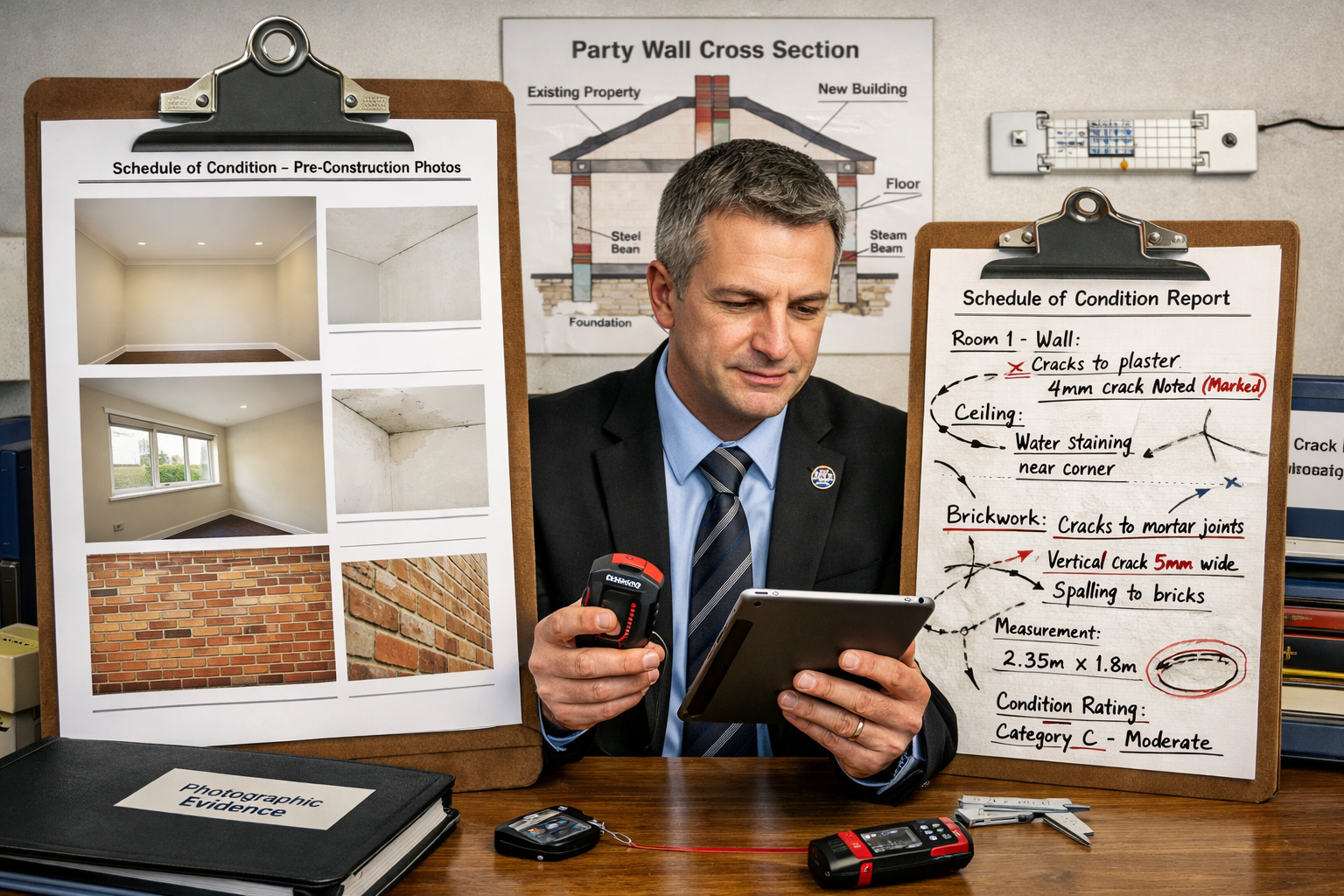
The Schedule of Condition represents perhaps the most critical dispute prevention tool available to party wall surveyors. This detailed pre-work documentation protects both building owners and neighbors from unfounded damage claims.
What a Comprehensive Schedule Includes
A professional Schedule of Condition documents the adjoining property's condition before work commences[2]. Essential elements include:
Photographic Evidence:
- 📸 High-resolution images of all rooms
- 📸 Close-ups of existing cracks, defects, or damage
- 📸 External elevations and boundary structures
- 📸 Dated and labeled systematically
- 📸 Multiple angles for each area
Written Descriptions:
- 📝 Room-by-room condition assessments
- 📝 Measurements of existing cracks (width, length, location)
- 📝 Decoration condition and finishes
- 📝 Structural element conditions
- 📝 Any pre-existing defects or concerns
Technical Measurements:
- 📏 Crack monitoring baseline readings
- 📏 Level measurements for floors and ceilings
- 📏 Alignment checks for doors and windows
- 📏 Moisture readings where relevant
Detailed Schedule of Condition guidance helps surveyors create comprehensive documentation.
Best Practices for 2026 Documentation
With increased construction activity in 2026, thorough documentation becomes even more critical:
Use Professional Equipment:
- High-quality cameras with timestamp capabilities
- Laser measuring devices for accuracy
- Crack width gauges for precise recording
- Moisture meters for damp assessments
Involve Both Parties:
- Invite adjoining owners to attend inspections
- Provide opportunities to raise concerns
- Document any disagreements about existing conditions
- Obtain signatures acknowledging inspection completion
Create Accessible Records:
- Organize photographs logically by room/area
- Use cloud storage with backup systems
- Provide copies to all parties promptly
- Maintain secure archives for future reference
Update When Necessary:
- Re-inspect if work delays exceed six months
- Document any changes in property condition
- Note seasonal variations (e.g., crack movement)
- Record any intervening events (storms, other works)
Common Documentation Failures
Surveyors should avoid these frequent mistakes that undermine Schedule of Condition effectiveness:
❌ Insufficient photographic coverage: Missing rooms or areas later claimed as damaged
❌ Poor image quality: Blurry or poorly lit photographs that don't show detail
❌ Lack of written context: Photos without descriptions or measurements
❌ Delayed preparation: Conducting surveys after work has already begun
❌ Missing external areas: Focusing only on interiors while ignoring boundaries, gardens, and external walls
❌ No baseline crack monitoring: Failing to measure existing cracks that may widen
A robust Schedule of Condition prevents approximately 70% of post-construction damage disputes, making it an invaluable investment in project success.
The Party Wall Award: Components and Conditions
The Party Wall Award serves as the legally binding agreement governing how work proceeds. Understanding its components ensures compliance and enforceability.
Essential Award Elements
A comprehensive Party Wall Award must include[1][2]:
1. Parties Identification
- Full names and addresses of building and adjoining owners
- Surveyor details and appointment dates
- Property descriptions and addresses
2. Work Description
- Detailed scope of proposed works
- Technical specifications and methods
- Construction timeline and phases
- Access requirements
3. Rights and Obligations
- Building owner's rights to proceed
- Adjoining owner's protections
- Access provisions for inspections
- Working hours and restrictions
4. Conditions and Safeguards
- Structural protection measures
- Noise and dust control requirements
- Vibration monitoring protocols
- Emergency contact procedures
5. Cost Provisions
- Fee responsibility (typically building owner)
- Damage remedy procedures
- Dispute resolution mechanisms
- Cost-sharing arrangements (if applicable)
When both parties consent to beneficial works, costs may be shared proportionally[1]. However, most Awards place full cost responsibility on the building owner.
Special Conditions for 2026 Projects
Given the construction uptick, Awards should address contemporary concerns:
COVID-19 and Health Protocols:
- Access arrangements respecting health concerns
- Notification procedures for site visits
- PPE requirements for surveyors and contractors
Environmental Considerations:
- Dust suppression measures
- Waste management and disposal
- Noise limitation during sensitive hours
- Protection of neighboring gardens and landscaping
Technology Integration:
- Digital monitoring systems for vibration/movement
- Electronic communication preferences
- Cloud-based document sharing
- Video inspection options where appropriate
Supply Chain Contingencies:
- Flexibility for material availability delays
- Alternative specification provisions
- Timeline adjustment mechanisms
- Communication protocols for changes
Award Enforceability and Compliance
Party Wall Awards are legally binding documents enforceable through the courts. Non-compliance can result in:
⚖️ Injunctions halting work entirely until compliance achieved
💰 Liability for damages to neighboring properties
📋 Legal costs for enforcement proceedings
🚫 Difficulty obtaining insurance for future projects
Building owners must ensure contractors understand and follow Award conditions. Regular surveyor inspections during construction verify compliance and address issues before they escalate.
For situations where no party wall notice was served, retrospective Awards may be possible but create significant complications and costs.
Comprehensive Surveyor Checklists for Minimising Disputes
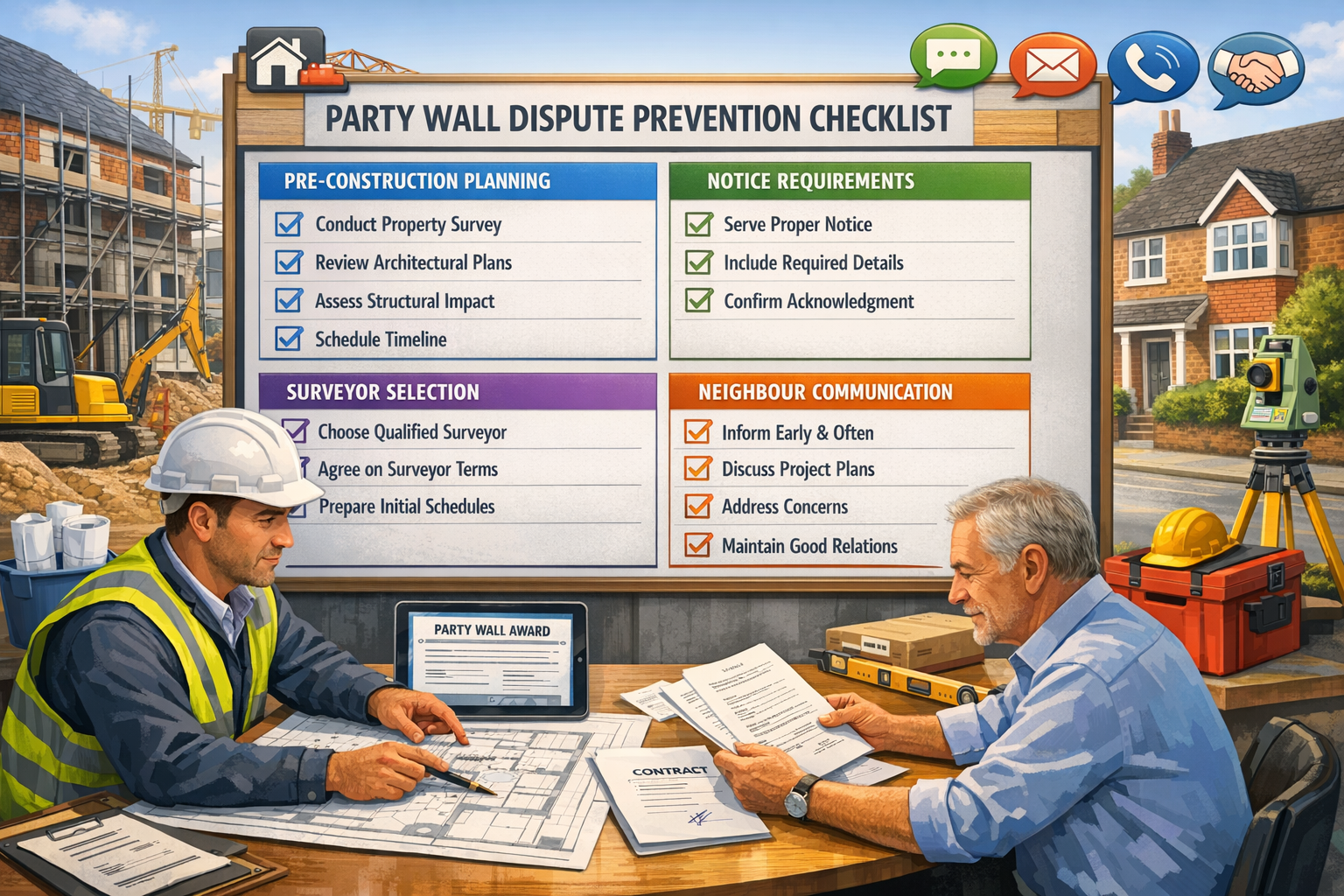
Systematic processes prevent oversights that trigger disputes. These checklists provide surveyors with practical frameworks for managing party wall matters during the 2026 construction uptick.
Pre-Work Planning Checklist
Initial Assessment Phase:
- Identify all potentially affected properties
- Determine which sections of the Act apply
- Review property deeds and boundary definitions
- Check for any restrictive covenants or easements
- Assess project timeline and critical dates
- Identify any particularly sensitive neighbors
- Review similar local projects for lessons learned
Notice Preparation Phase:
- Gather all required technical drawings
- Prepare detailed work descriptions
- Calculate correct notice periods
- Draft notices with all mandatory information
- Have notices reviewed by qualified surveyor
- Prepare explanatory covering letters
- Organize supporting documentation
Notice Service Phase:
- Serve notices via recorded delivery
- Retain all proof of service documentation
- Log service dates in project management system
- Follow up with courtesy phone calls
- Provide contact details for queries
- Set calendar reminders for 14-day deadlines
- Prepare for potential dissent responses
Dispute Resolution Checklist
When Dissent or Non-Response Occurs:
- Document exact date of dissent/deadline expiry
- Explain surveyor appointment options to building owner
- Provide list of qualified surveyors if requested
- Confirm independence and impartiality requirements
- Issue formal surveyor appointment letters
- Request adjoining owner appoint within 10 days
- Appoint on behalf of non-responding neighbor if necessary
- Arrange Third Surveyor appointment (two surveyor option)
Survey and Documentation Phase:
- Schedule property inspections promptly
- Notify all parties of inspection dates
- Conduct thorough Schedule of Condition survey
- Take comprehensive photographic evidence
- Measure and document all existing defects
- Interview occupants about concerns
- Inspect external boundaries and structures
- Review any previous party wall matters
Award Preparation Phase:
- Draft Award with all required elements
- Include appropriate protective conditions
- Specify working hours and access arrangements
- Define damage remedy procedures
- Clarify fee responsibility
- Allow parties to review draft
- Address any reasonable concerns
- Finalize and serve Award on all parties
Construction Phase Monitoring Checklist
Before Work Commences:
- Verify Award in place and understood
- Brief contractors on Award conditions
- Establish site contact procedures
- Set up monitoring equipment if required
- Provide neighbors with site contact details
- Confirm access arrangements
- Review insurance coverage
During Construction:
- Conduct regular site inspections
- Monitor compliance with Award conditions
- Document any variations or issues
- Maintain communication with neighbors
- Address concerns promptly
- Keep photographic progress records
- Review monitoring data (vibration, movement)
- Update parties on significant milestones
Completion Phase:
- Conduct final inspections of both properties
- Compare conditions to Schedule of Condition
- Document completion date
- Address any damage claims promptly
- Arrange remedial works if necessary
- Obtain sign-off from adjoining owners
- Archive all documentation securely
- Issue completion certificates
Communication and Relationship Management Checklist
Neighbor Engagement:
- Introduce yourself and explain your role
- Provide clear, jargon-free explanations
- Listen to concerns without defensiveness
- Set realistic expectations about process
- Establish preferred communication methods
- Respond to queries within 24-48 hours
- Keep neighbors informed of progress
- Thank them for cooperation at completion
Conflict Prevention:
- Address small issues before they escalate
- Document all communications in writing
- Remain professional and impartial always
- Acknowledge valid concerns promptly
- Explain limitations clearly and honestly
- Offer solutions rather than excuses
- Involve Third Surveyor early if needed
- Consider mediation for relationship breakdowns
Understanding what constitutes a party wall dispute helps surveyors recognize warning signs early.
Case Studies: Lessons from 2026 Disputes
Real-world examples illustrate how compliance failures create problems—and how proper procedures prevent them.
Case Study 1: The Basement Extension Dispute
Scenario: A London property owner planned a basement extension requiring excavation within 3 meters of the neighboring semi-detached property. The building owner served a one-month notice but failed to include detailed construction methodology.
What Went Wrong:
- Notice lacked sufficient technical detail
- No Schedule of Condition prepared before work started
- Contractor began excavation before Award finalized
- Neighbor noticed cracks appearing in their property
- Work halted by court injunction
Consequences:
- £45,000 in legal costs and damages
- 6-month project delay
- Damaged neighbor relationship
- Insurance complications for future work
Lessons Learned:
✅ Include comprehensive technical details in notices
✅ Never commence work before Award in place
✅ Conduct Schedule of Condition even if neighbor seems unconcerned
✅ Implement monitoring systems for sensitive excavations
Case Study 2: The Loft Conversion Success
Scenario: A Manchester homeowner planned a loft conversion requiring structural alterations to a party wall shared with a terraced neighbor. They engaged a party wall surveyor eight weeks before the planned start date.
What Went Right:
- Early surveyor engagement allowed proper planning
- Detailed notices served with full technical drawings
- Neighbor initially dissented due to concerns
- Agreed Surveyor appointed with both parties' consent
- Comprehensive Schedule of Condition completed
- Award included specific noise limitation hours
- Regular updates provided to neighbor throughout
Outcome:
- Work completed on schedule
- No damage to neighboring property
- Positive neighbor relationship maintained
- Building owner received thank-you note from neighbor
- Project completed £3,000 under budget due to no delays
Success Factors:
✅ Early professional involvement
✅ Transparent communication throughout
✅ Addressing neighbor concerns in Award conditions
✅ Professional documentation and monitoring
✅ Contractor briefing on Award requirements
Case Study 3: The Retrospective Award Challenge
Scenario: A Birmingham developer began underpinning work without serving party wall notices. The neighbor discovered the work in progress and immediately sought legal advice.
What Went Wrong:
- No notices served despite clear Act applicability
- Work commenced without any party wall process
- Neighbor felt disrespected and threatened
- Existing minor cracks in neighbor's property widened
- Impossible to establish baseline conditions
Resolution Process:
- Work immediately halted
- Retrospective notices served
- Independent surveyors appointed by both parties
- Extensive investigation to establish causation
- Negotiated settlement including remedial works
Costs:
- £28,000 in surveyor and legal fees
- £15,000 in remedial works
- £12,000 in neighbor's alternative accommodation
- 4-month delay to project completion
- Reputational damage affecting future projects
Critical Lessons:
✅ Non-compliance is never worth the risk
✅ Retrospective Awards are expensive and complex
✅ Establishing causation without baseline documentation is difficult
✅ Legal costs quickly exceed compliance costs
✅ Professional advice at project outset prevents disasters
These cases demonstrate why Party Wall Act Compliance in the 2026 Construction Uptick: Surveyor Checklists for Minimising Neighbour Disputes deserves serious attention from all construction professionals.
Legal Consequences of Non-Compliance
Understanding the serious legal ramifications of Party Wall Act failures motivates proper compliance.
Court Powers and Remedies
When building owners proceed without proper party wall procedures, courts possess extensive powers[2]:
Injunctions:
Courts can issue immediate injunctions halting all work until compliance achieved. This includes:
- Stopping work mid-project
- Requiring site securing and safety measures
- Preventing access to the site
- Mandating retrospective compliance processes
Damages:
Building owners face liability for:
- Physical damage to neighboring properties
- Diminution in property value
- Loss of enjoyment and amenity
- Stress and inconvenience
- Professional fees incurred by neighbors
- Alternative accommodation costs
Cost Orders:
Courts typically order non-compliant building owners to pay:
- Neighbor's legal costs
- Surveyor fees for both parties
- Court costs and filing fees
- Expert witness fees
- Administrative expenses
The True Cost of Non-Compliance
Consider the financial comparison:
| Compliance Route | Typical Cost |
|---|---|
| Professional surveyor fees | £800-£2,500 |
| Schedule of Condition | £400-£800 |
| Party Wall Award | Included in surveyor fees |
| Total compliance cost | £1,200-£3,300 |
| Non-Compliance Route | Typical Cost |
|---|---|
| Retrospective surveyor fees | £2,000-£5,000 |
| Legal representation | £5,000-£15,000 |
| Neighbor's costs (reimbursed) | £5,000-£15,000 |
| Damages and remedial works | £10,000-£50,000 |
| Project delays | £5,000-£20,000 |
| Total non-compliance cost | £27,000-£105,000 |
The financial case for compliance is overwhelming—proper procedures cost 10-30 times less than rectifying non-compliance.
Professional and Reputational Consequences
Beyond immediate financial costs, non-compliance creates:
Insurance Complications:
- Difficulty obtaining professional indemnity insurance
- Higher premiums for future projects
- Exclusions for party wall matters
- Claims affecting no-claims bonuses
Professional Reputation:
- Negative reviews and testimonials
- Word-of-mouth damage in local communities
- Difficulty securing future projects
- Regulatory scrutiny for licensed professionals
Relationship Damage:
- Permanent breakdown with neighbors
- Community tensions
- Difficulty selling property later
- Disclosure requirements for future buyers
For developers and contractors, understanding party wall consent requirements prevents these serious consequences.
Integration with Other Regulatory Requirements
Party Wall Agreements exist alongside—not instead of—other regulatory approvals. Understanding these relationships prevents compliance gaps.
Planning Permission
Party Wall Agreements are completely separate from planning permission[2]. Projects may require:
Both Party Wall Agreement AND Planning Permission:
- Extensions changing external appearance
- Loft conversions with dormer windows
- Basement excavations affecting building footprint
- Changes to listed buildings
- Work in conservation areas
Party Wall Agreement but NO Planning Permission:
- Internal structural alterations to party walls
- Underpinning within permitted development
- Chimney breast removal
- Internal reconfiguration
Planning Permission but NO Party Wall Agreement:
- Single-story rear extensions not affecting boundaries
- Detached outbuildings away from boundaries
- Internal alterations to detached properties
Building owners must secure both approvals independently—one does not substitute for the other.
Building Regulations
Similarly, Building Regulations approval addresses technical construction standards, while Party Wall Agreements protect neighbor interests[2].
Building Regulations cover:
- Structural integrity and safety
- Fire safety measures
- Energy efficiency standards
- Ventilation and drainage
- Accessibility requirements
Party Wall Agreements cover:
- Neighbor protection and rights
- Damage prevention and remedy
- Access and working arrangements
- Cost responsibility
- Dispute resolution
Most projects require both Building Regulations approval and Party Wall Agreement. Surveyors should verify both are in place before work commences.
Insurance Considerations
Professional indemnity insurance for surveyors and contractors should specifically cover party wall matters:
Surveyor Insurance Requirements:
- Minimum £1-2 million coverage
- Specific party wall act inclusion
- Run-off cover for retired surveyors
- Legal defense cost coverage
Contractor Insurance Requirements:
- Public liability insurance (minimum £5 million)
- Employer's liability insurance
- Professional indemnity for design-build contracts
- Party wall specific endorsements
Building owners should verify all professionals carry appropriate insurance before appointment.
Emerging Trends and 2026 Considerations
The party wall landscape continues evolving. Surveyors must stay current with emerging trends affecting practice.
Technology Integration
Modern party wall practice increasingly incorporates technology:
Digital Monitoring Systems:
- Automated crack monitoring with alerts
- Vibration sensors transmitting real-time data
- Movement detection systems
- Cloud-based data storage and analysis
Virtual Inspections:
- Video survey capabilities for initial assessments
- Remote Schedule of Condition documentation
- Digital collaboration between surveyors
- Electronic document signing and service
Project Management Software:
- Automated deadline tracking
- Document version control
- Stakeholder communication platforms
- Compliance checklist automation
Photographic Technology:
- 360-degree cameras for comprehensive documentation
- Drone surveys for external elevations
- Thermal imaging for hidden defects
- Timestamped and geotagged images
Sustainability and Environmental Concerns
2026 construction projects increasingly emphasize sustainability, affecting party wall matters:
Insulation Projects:
Understanding party wall insulation requirements becomes critical as energy efficiency upgrades increase.
Green Construction Methods:
- Sustainable material specifications in Awards
- Dust and pollution control measures
- Waste reduction and recycling requirements
- Protection of neighboring gardens and ecosystems
Renewable Energy Installations:
- Solar panel installations affecting party walls
- Heat pump excavations near boundaries
- Battery storage in shared spaces
- Electrical upgrades through party structures
Post-Pandemic Working Practices
COVID-19's lasting impact on construction includes:
Remote Working Considerations:
- More neighbors home during construction hours
- Increased sensitivity to noise and disruption
- Greater demand for communication and updates
- Flexibility in working hour restrictions
Health and Safety Protocols:
- Continued PPE requirements
- Social distancing on site visits
- Contactless document service options
- Virtual meeting alternatives
Increased Regulatory Scrutiny
Local authorities and professional bodies are strengthening enforcement:
Building Control Integration:
- Cross-checking party wall compliance
- Requesting Awards before final certificates
- Reporting non-compliance to enforcement
- Coordinated inspection programs
Professional Standards:
- RICS guidance updates and clarifications
- CPD requirements for party wall surveyors
- Quality assurance audits
- Complaint investigation procedures
Staying informed through professional bodies, continuing education, and industry publications ensures surveyors maintain best practice standards.
Cost Management and Fee Structures
Understanding party wall costs helps building owners budget appropriately and prevents fee disputes.
Typical Fee Structures
Party wall surveyor fees vary based on project complexity:
Straightforward Residential Projects:
- Single party wall, simple works: £800-£1,500
- Multiple walls, standard extension: £1,500-£2,500
- Complex loft conversion: £2,000-£3,500
Complex or Commercial Projects:
- Basement excavations: £2,500-£5,000
- Multi-unit developments: £3,000-£8,000
- Commercial buildings: £5,000-£15,000+
Additional Services:
- Schedule of Condition: £400-£800 per property
- Monitoring visits during construction: £200-£400 per visit
- Damage investigation and resolution: £500-£2,000
- Third Surveyor fees: £1,000-£3,000
For detailed cost breakdowns, review our cost of party wall services guide.
Who Pays?
The Party Wall Act establishes clear cost responsibility:
Building Owner Typically Pays:
- Their own surveyor's fees
- Agreed Surveyor's fees (if single surveyor appointed)
- Adjoining owner's surveyor's reasonable fees
- Third Surveyor's fees
- Schedule of Condition costs
- Award preparation and service
Cost Sharing Applies When:
- Both owners benefit from the work
- Repairs to shared structures needed by both
- Mutual consent to improvement works
The building owner cannot avoid paying the adjoining owner's reasonable surveyor fees, even if they disagree with the appointment[1].
Managing Costs Effectively
Building owners can control costs through:
Early Planning:
- Engaging surveyors early prevents rush fees
- Proper notice periods avoid expedited processes
- Clear project scope reduces surveyor time
Agreed Surveyor Approach:
- Single surveyor costs less than two
- Requires good neighbor relationships
- Appropriate for straightforward projects
Clear Communication:
- Detailed instructions reduce back-and-forth
- Prompt responses prevent delays
- Organized documentation saves surveyor time
Realistic Budgeting:
- Include party wall costs in project budgets
- Allow contingency for potential complications
- Don't compromise on quality to save fees
"Attempting to minimize party wall costs by cutting corners invariably results in far greater expenses through disputes, delays, and legal proceedings."
Practical Tips for Building Owners and Developers
Beyond surveyor checklists, building owners benefit from practical guidance for smooth party wall processes.
Choosing the Right Surveyor
Key Selection Criteria:
🎯 Relevant Experience:
- Specific party wall expertise (not just general surveying)
- Experience with similar project types
- Local knowledge of construction practices
- Track record of dispute resolution
🎯 Professional Credentials:
- RICS membership and good standing
- Professional indemnity insurance
- Specialist party wall qualifications
- Positive client testimonials
🎯 Communication Skills:
- Clear explanations without jargon
- Responsive to queries
- Diplomatic in handling conflicts
- Transparent about fees and processes
🎯 Practical Approach:
- Problem-solving mindset
- Balanced perspective
- Efficient processes
- Technology-enabled services
Red Flags to Avoid:
- ❌ Lowest fee without quality justification
- ❌ Lack of specific party wall experience
- ❌ Poor communication or responsiveness
- ❌ Unwillingness to explain processes
- ❌ No professional insurance
- ❌ Pressure to proceed without proper procedures
Neighbor Relations Best Practices
Maintaining positive relationships prevents disputes:
Before Serving Notices:
- Discuss plans informally with neighbors
- Explain benefits and address concerns
- Provide visual aids (drawings, photos of similar projects)
- Be honest about disruption and timeline
- Listen to their concerns genuinely
During the Process:
- Keep neighbors informed of progress
- Provide site contact details
- Address concerns promptly
- Respect agreed working hours
- Minimize noise and disruption where possible
- Keep shared areas clean and safe
After Completion:
- Conduct final inspection together
- Address any minor concerns immediately
- Thank neighbors for cooperation
- Restore any temporary disturbance
- Maintain good relations for future
Communication Channels:
- Face-to-face meetings for initial discussions
- Written confirmations of agreements
- Text/email for routine updates
- Phone calls for urgent matters
- Surveyor mediation for technical disputes
Common Mistakes to Avoid
❌ Starting work before Award in place:
Even if neighbors seem agreeable, never commence without formal agreement. Verbal consent is insufficient.
❌ Assuming silence means consent:
No response within 14 days creates a dispute—it doesn't grant permission.
❌ Using unqualified "surveyors":
The Act doesn't require specific qualifications, but using inexperienced practitioners creates problems.
❌ Incomplete notices:
Missing information invalidates notices, requiring re-service and delay.
❌ Ignoring Award conditions:
Awards are legally binding—contractors must follow all conditions.
❌ Failing to document pre-existing conditions:
Without baseline documentation, proving you didn't cause damage becomes nearly impossible.
❌ Poor contractor briefing:
Ensure contractors understand and commit to Award conditions before starting.
❌ Dismissing neighbor concerns:
Even unreasonable-seeming concerns deserve respectful responses.
For situations where neighbors are carrying out works without proper agreements, prompt action protects your interests.
Future-Proofing Party Wall Practice
As construction activity continues through 2026 and beyond, surveyors must adapt practices for evolving challenges.
Continuing Professional Development
Party wall surveyors should prioritize:
Technical Knowledge:
- Construction methodology updates
- Material science developments
- Structural engineering advances
- Building pathology expertise
Legal Updates:
- Case law developments
- Regulatory changes
- Professional standards evolution
- Dispute resolution innovations
Soft Skills:
- Conflict resolution training
- Communication excellence
- Cultural sensitivity
- Stress management
Technology Competency:
- Digital survey tools
- Project management software
- Remote collaboration platforms
- Data analysis capabilities
Building a Sustainable Practice
Successful party wall practices in 2026 require:
Quality Over Volume:
- Thorough processes prevent disputes
- Reputation drives referrals
- Satisfied clients return for future projects
- Quality work commands appropriate fees
Professional Networks:
- Relationships with other surveyors
- Contractor and architect connections
- Legal professional contacts
- Industry association involvement
Efficient Systems:
- Template documents and checklists
- Automated deadline tracking
- Document management systems
- Client communication platforms
Continuous Improvement:
- Regular process reviews
- Client feedback integration
- Lessons learned documentation
- Industry best practice adoption
Preparing for Increased Demand
The 2026 construction uptick requires capacity planning:
Resource Management:
- Realistic project acceptance
- Associate surveyor networks
- Administrative support
- Technology leverage for efficiency
Client Education:
- Clear process explanations
- Realistic timeline setting
- Transparent fee structures
- Proactive communication
Risk Management:
- Comprehensive insurance coverage
- Thorough documentation
- Professional advice when uncertain
- Early Third Surveyor involvement when needed
Conclusion: Excellence in Party Wall Act Compliance
As construction activity surges across England and Wales in 2026, Party Wall Act Compliance in the 2026 Construction Uptick: Surveyor Checklists for Minimising Neighbour Disputes represents not just a legal obligation but a professional opportunity. Surveyors who master comprehensive compliance processes, maintain excellent neighbor relations, and leverage modern technology will thrive in this busy market.
The evidence is clear: proper party wall procedures cost a fraction of non-compliance consequences. Building owners who invest £1,200-£3,300 in professional surveyor services avoid the £27,000-£105,000+ costs of disputes, legal proceedings, and project delays. For surveyors, systematic checklists, thorough documentation, and proactive communication prevent the vast majority of disputes before they escalate.
Key Success Factors
✅ Early professional engagement: Involve qualified surveyors 8-10 weeks before planned work commencement
✅ Comprehensive documentation: Detailed Schedules of Condition with photographic evidence protect all parties
✅ Clear communication: Transparent, jargon-free explanations build trust and cooperation
✅ Systematic processes: Checklists ensure no critical steps are overlooked
✅ Technology leverage: Modern tools improve accuracy, efficiency, and stakeholder engagement
✅ Relationship focus: Treating neighbors with respect and addressing concerns promptly prevents escalation
Actionable Next Steps
For Building Owners Planning 2026 Projects:
- Identify party wall requirements early in project planning
- Engage qualified surveyors 8-10 weeks before planned start
- Budget appropriately for party wall costs (£1,200-£3,300 typical)
- Communicate proactively with neighbors before serving formal notices
- Never commence work without proper Party Wall Award in place
- Brief contractors thoroughly on Award conditions and requirements
For Party Wall Surveyors:
- Implement comprehensive checklists from this guide
- Invest in technology for documentation and monitoring
- Maintain CPD in technical and legal developments
- Build professional networks for complex matters
- Focus on quality over volume for sustainable practice
- Document everything thoroughly and systematically
For Adjoining Owners Receiving Notices:
- Respond within 14 days to protect your rights
- Seek professional advice if uncertain about implications
- Appoint qualified surveyors to represent your interests
- Participate in Schedule of Condition inspections
- Maintain records of all communications and documents
- Address concerns promptly through proper channels
The Path Forward
The 2026 construction boom creates opportunities for professional excellence in party wall practice. Surveyors who embrace systematic compliance, leverage modern technology, and prioritize stakeholder relationships will successfully navigate increased demand while minimizing disputes.
For building owners and developers, understanding that party wall compliance represents an investment in project success—not an obstacle to overcome—transforms the process from burden to benefit. Proper procedures protect property values, maintain community relationships, and ensure construction projects proceed smoothly from start to finish.
The Party Wall etc. Act 1996 provides a robust framework for balancing development rights with neighbor protection. When professionals apply this framework systematically, using the checklists and best practices outlined in this guide, the result is successful projects, satisfied stakeholders, and thriving communities.
As construction activity continues expanding through 2026 and beyond, excellence in Party Wall Act Compliance in the 2026 Construction Uptick: Surveyor Checklists for Minimising Neighbour Disputes will distinguish leading professionals from those left behind. The choice is clear: invest in proper procedures now, or pay exponentially more for non-compliance later.
For comprehensive party wall services and expert guidance, explore our complete party wall resources and frequently asked questions to ensure your 2026 projects proceed smoothly and compliantly.
References
[1] An Introductory Guide To The Party Wall Etc Act 1996 – https://www.parklaneplowden.co.uk/an-introductory-guide-to-the-party-wall-etc-act-1996/
[2] Party Wall Agreements Uk Complete Guide London And Essex Property Owners – https://ngconstructionltd.co.uk/advice/party-wall-agreements-uk-complete-guide-london-and-essex-property-owners
[3] Party Wall Agreement – https://hoa.org.uk/advice/guides-for-homeowners/i-am-improving/party-wall-agreement/
[4] Expert Witness Preparation For 2026 Party Wall Disputes Managing Increased Development Activity And Neighbour Conflicts – https://nottinghillsurveyors.com/blog/expert-witness-preparation-for-2026-party-wall-disputes-managing-increased-development-activity-and-neighbour-conflicts
[5] The Benefits Of Party Wall Agreements In Kent For – https://fpws-kent.co.uk/the-benefits-of-party-wall-agreements-in-kent-for/
[6] Diy Party Wall Notices What Homeowners Should Know Before Serving Them – https://www.adamjoseph.co.uk/diy-party-wall-notices-what-homeowners-should-know-before-serving-them
[7] Understanding Party Wall Matters Why Early Advice Protects You Your Property And Your Neighbours – https://thebusinessgroup.co.uk/understanding-party-wall-matters-why-early-advice-protects-you-your-property-and-your-neighbours/