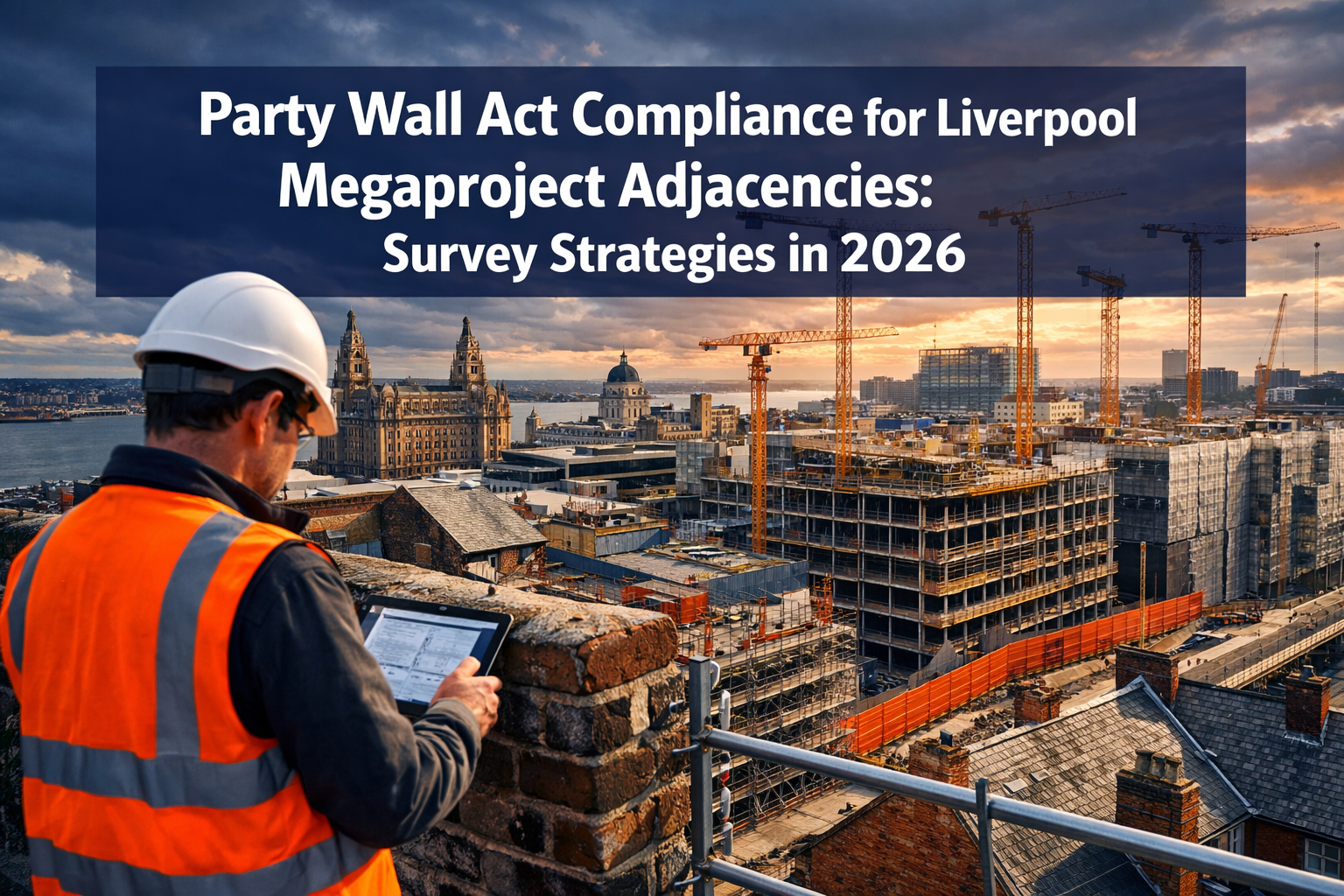
Liverpool's skyline is transforming at an unprecedented pace. As the city experiences a renaissance of infrastructure development in 2026, property owners and surveyors face a critical challenge: ensuring Party Wall Act compliance while massive construction projects reshape entire neighborhoods. When a £2 billion regeneration scheme meets centuries-old Victorian terraces, the stakes for proper party wall management couldn't be higher.
The complexity of Party Wall Act Compliance for Liverpool Megaproject Adjacencies: Survey Strategies in 2026 Infrastructure Growth has become a defining issue for chartered surveyors operating in dense urban environments. With Liverpool's regeneration expected to take major steps forward this year [1], the intersection of historic property boundaries and modern megaproject construction demands sophisticated survey strategies and meticulous legal compliance.
This comprehensive guide explores the essential frameworks, practical checklists, and dispute resolution tactics that surveyors need to navigate party wall challenges in Liverpool's rapidly evolving urban landscape.
Key Takeaways
✅ Liverpool's 2026 infrastructure boom requires enhanced party wall survey protocols to protect adjacent properties during megaproject construction
✅ Comprehensive schedule of condition surveys before construction begins are essential for documenting pre-existing property conditions and preventing disputes
✅ Early notice procedures under the Party Wall Act (minimum 2 months for most works) must be integrated into megaproject timelines to avoid costly delays
✅ Technology-enhanced survey methods including laser scanning and drone surveys provide superior documentation for complex urban adjacencies
✅ Proactive dispute resolution strategies can prevent escalation and maintain project momentum in dense residential areas
Understanding Liverpool's 2026 Infrastructure Landscape
Liverpool's regeneration trajectory has accelerated dramatically, with the Liverpool City Region Combined Authority confirming major development initiatives that will reshape the urban fabric [4]. The scale of these megaprojects—ranging from mixed-use developments to transport infrastructure—creates unprecedented adjacency challenges where new construction interfaces with existing properties.
The Megaproject Context
The city's regeneration plans include:
- Large-scale residential developments with hundreds of units constructed adjacent to established neighborhoods
- Commercial district expansions requiring deep excavations near historic buildings
- Transport infrastructure upgrades affecting property foundations along construction corridors
- Industrial construction initiatives utilizing modern methods adjacent to traditional structures [6]
Each of these projects triggers Party Wall Act requirements when work affects shared boundaries, walls, or involves excavation within specified distances of neighboring properties.
Adjacency Complexity in Dense Urban Settings
Liverpool's urban density presents unique challenges for Party Wall Act compliance:
🏘️ Victorian terraces with shared walls requiring careful assessment before adjacent development
🏗️ Mixed-age building stock where modern construction techniques meet historic masonry
📏 Narrow plot boundaries limiting construction access and increasing vibration risks
⚖️ Multiple adjoining owners requiring coordinated notice procedures and agreements
Understanding these contextual factors is essential for developing effective survey strategies that protect all parties' interests.
Party Wall Act Compliance for Liverpool Megaproject Adjacencies: Core Legal Framework
The Party Wall Act 1996 provides the statutory framework governing work on party walls, boundary walls, and excavations near neighboring properties. For Liverpool's megaprojects in 2026, compliance isn't optional—it's a legal requirement that protects property owners and enables construction to proceed lawfully.
When the Party Wall Act Applies
The Act covers three main types of work:
1. Work Directly to Party Walls (Section 2)
- Building a new wall on the boundary line
- Cutting into or removing parts of a party wall
- Demolishing and rebuilding a party wall
- Underpinning a party wall
2. Work to Party Structures (Section 2)
- Inserting damp-proof courses
- Raising party walls
- Installing beams or other structural elements
- Protecting walls with weatherproofing
3. Excavation Near Neighboring Buildings (Section 6)
- Digging within 3 meters of a neighboring structure and going deeper than its foundations
- Digging within 6 meters and cutting a line drawn at 45 degrees from the bottom of the neighbor's foundations
For guidance on excavation distances, review our detailed explanation of the 3-metre rule and excavation notice requirements.
Notice Requirements and Timelines
Critical compliance deadlines:
| Notice Type | Minimum Notice Period | Content Requirements |
|---|---|---|
| Party Wall Notice (Section 2) | 2 months | Description of proposed works, plans, commencement date |
| Party Structure Notice (Section 2) | 2 months | Detailed specifications, structural drawings |
| Excavation Notice (Section 6) | 1 month | Depth and location of excavation, foundation details |
⚠️ Important: Megaproject developers must integrate these notice periods into construction schedules. Failure to serve proper notices can result in injunctions halting work entirely.
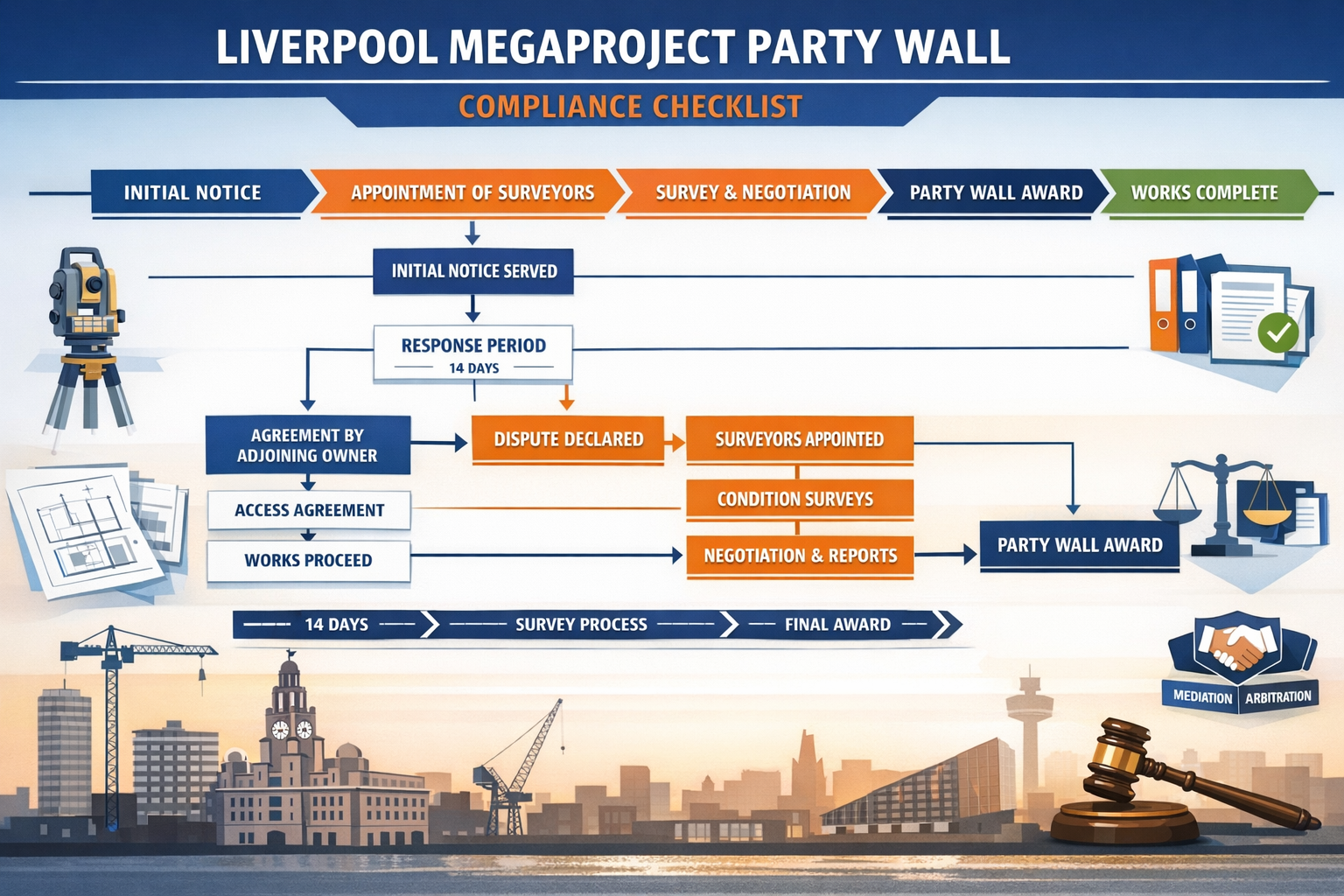
Adjoining owners have 14 days to respond to notices. If they dissent or fail to respond, the party wall award process begins with the appointment of surveyors.
Survey Strategies in 2026 Infrastructure Growth: Pre-Construction Assessment
Effective Party Wall Act compliance begins long before the first excavator arrives on site. For Liverpool megaprojects, comprehensive pre-construction surveys provide the foundation for protecting adjacent properties and preventing disputes.
Schedule of Condition Surveys: The Essential First Step
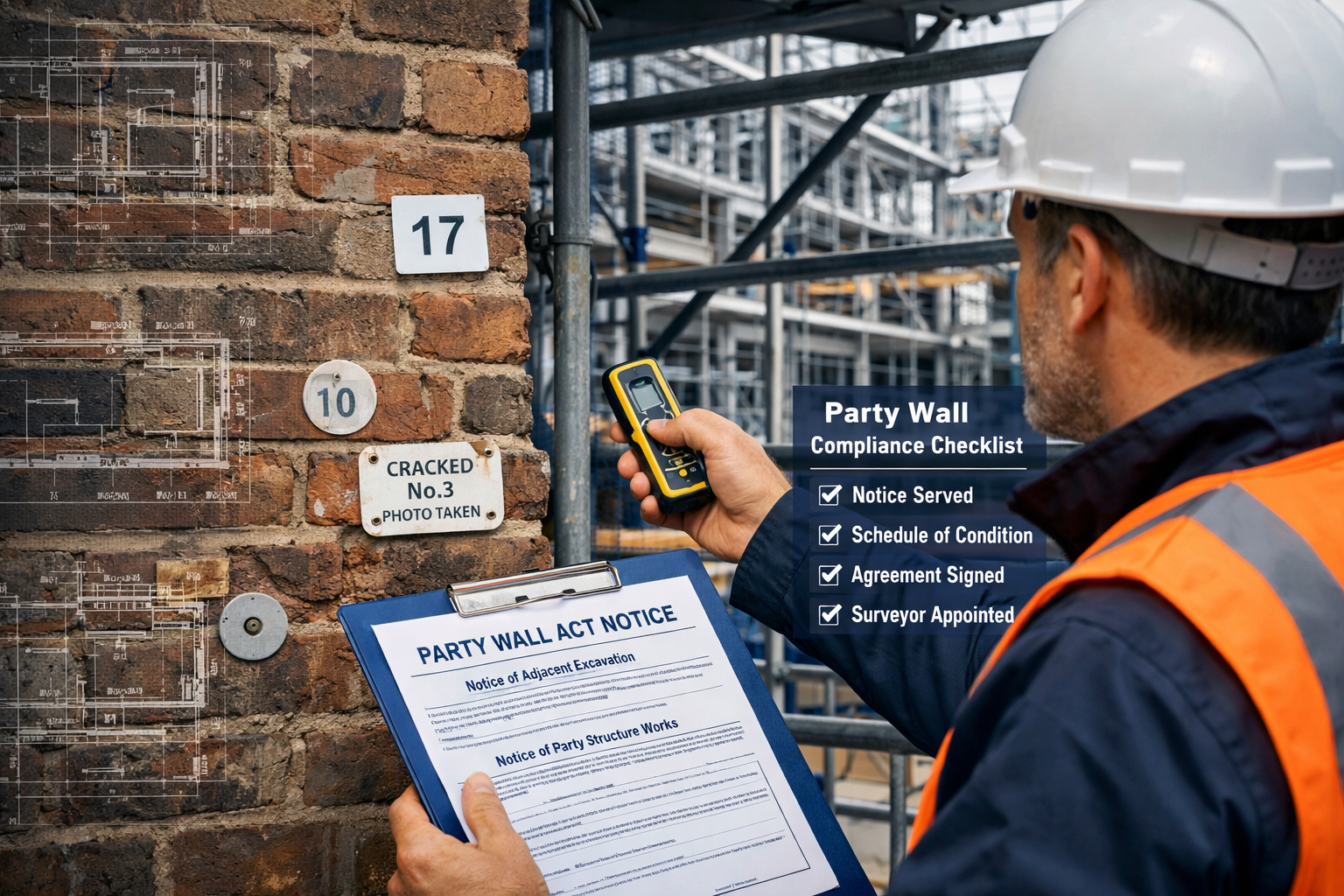
A schedule of condition survey documents the existing state of adjoining properties before construction commences. This photographic and written record becomes crucial evidence if disputes arise about construction-related damage.
Best practices for schedule of condition surveys in 2026:
📸 Comprehensive photographic documentation using high-resolution digital cameras with metadata
- External elevations from multiple angles
- Internal rooms, particularly those closest to construction
- Existing cracks, settlement, or defects with measurement references
- Ceiling, wall, and floor conditions
📝 Detailed written descriptions noting:
- Construction type and age of the property
- Existing defects with dimensions and locations
- Structural condition assessment
- Decorative condition and finishes
🔍 Enhanced technology integration:
- Laser scanning for precise 3D modeling of existing conditions
- Drone surveys for roof and upper-level documentation
- Thermal imaging to identify hidden defects
- Vibration monitoring baseline readings
For comprehensive guidance, consult our schedule of condition guidance which outlines industry best practices.
Structural Assessment and Risk Evaluation
Beyond documenting existing conditions, surveyors must evaluate structural risks posed by adjacent megaproject construction:
Foundation analysis:
- Determining existing foundation depth and type
- Assessing soil conditions and load-bearing capacity
- Identifying vulnerability to settlement or heave
- Evaluating groundwater considerations
Vibration risk assessment:
- Proximity to piling, excavation, or demolition activities
- Building age and construction method sensitivity
- Establishing acceptable vibration thresholds
- Planning monitoring protocols
Access requirements:
- Determining if construction requires access to adjoining property
- Planning scaffolding or crane oversail arrangements
- Coordinating with occupants for survey access
Professional structural surveys provide the technical foundation for these assessments.
Multi-Property Coordination Strategies
Liverpool megaprojects often affect dozens of adjoining properties simultaneously. Efficient coordination requires:
✅ Centralized notice management system tracking all served notices and responses
✅ Standardized survey protocols ensuring consistency across multiple properties
✅ Phased survey scheduling aligned with construction sequencing
✅ Clear communication channels with all affected property owners
✅ Coordinated surveyor appointments when multiple properties share party walls
Expert Insight: "For large-scale developments affecting 20+ properties, appointing a single agreed surveyor to act for all adjoining owners can streamline the process significantly, provided all parties consent and the surveyor maintains impartiality."
Party Wall Act Compliance for Liverpool Megaproject Adjacencies: Managing Construction Phase Challenges
Once construction begins, ongoing compliance and monitoring become critical. The dynamic nature of megaproject construction requires adaptive survey strategies that respond to evolving conditions.
Continuous Monitoring Protocols
Vibration monitoring:
- Installing seismographs at sensitive locations
- Establishing trigger levels for construction activities
- Real-time alerts when thresholds are approached
- Regular reporting to adjoining owners and surveyors
Settlement monitoring:
- Installing crack monitoring stations on existing defects
- Periodic level surveys to detect foundation movement
- Photographic comparison against baseline conditions
- Immediate investigation of new defects
Access management:
- Coordinating scheduled inspections with occupants
- Documenting all site visits with photographic records
- Maintaining inspection logs and findings
- Ensuring construction personnel understand access rights and limitations
Responding to Emerging Issues
Despite careful planning, construction activities can cause unexpected impacts. Rapid response protocols are essential:
🚨 Immediate response triggers:
- New cracking or widening of existing cracks
- Visible structural movement or distortion
- Water ingress or drainage problems
- Excessive vibration or noise complaints
Response procedure:
- Immediate site inspection by appointed surveyor
- Documentation of observed conditions with photography
- Comparison against baseline schedule of condition
- Causation assessment determining if construction-related
- Remedial action plan if damage is attributable to works
- Communication with all parties and updating party wall award if necessary
Understanding damage to property in party wall scenarios helps surveyors distinguish between construction-related impacts and pre-existing conditions.
Award Amendments and Supplementary Agreements
Megaproject complexity often requires modifications to original party wall awards:
Common amendment scenarios:
- Changes to construction methodology affecting party walls
- Extended construction timelines requiring updated access arrangements
- Discovery of unforeseen conditions during excavation
- Additional works not covered in original notices
Amendments must follow proper procedures with surveyor agreement and formal documentation to maintain legal compliance.
Dispute Resolution Tactics for Dense Urban Settings
Even with meticulous planning, disputes can arise during megaproject construction. Effective resolution strategies prevent costly delays and maintain project momentum.
Early Intervention Strategies
Proactive communication:
- Regular updates to adjoining owners about construction progress
- Pre-emptive meetings before particularly disruptive activities
- Open-door policy for concerns and questions
- Transparent sharing of monitoring data
Mediation before escalation:
- Informal discussions between surveyors to resolve minor disagreements
- Site meetings with all parties to address concerns directly
- Technical solutions to mitigate impacts (e.g., modified construction methods)
- Goodwill gestures such as temporary accommodation during noisy works
Understanding what constitutes a party wall dispute helps parties recognize when formal resolution mechanisms are necessary.
Formal Dispute Resolution Under the Act
When informal resolution fails, the Party Wall Act provides structured mechanisms:
Third surveyor appointment:
- Appointed by the two party-appointed surveyors when they cannot agree
- Makes binding determinations on disputed matters
- Costs typically shared between parties or allocated based on reasonableness
Award challenges:
- Appeals to County Court within 14 days of award service
- Limited grounds: procedural irregularity, surveyor bias, or manifest error
- High threshold for overturning surveyor decisions
Cost disputes:
- Most common source of formal disputes in megaprojects
- Surveyors must justify fee allocations based on work complexity
- Detailed cost breakdowns and time records essential
Review our guidance on party wall costs to understand typical fee structures.
Liverpool-Specific Considerations
Liverpool's regeneration context creates unique dispute dynamics:
🏛️ Heritage considerations: Work affecting listed buildings or conservation areas requires additional sensitivity
👥 Community relations: Large-scale developments affecting entire neighborhoods require community engagement beyond statutory requirements
⚖️ Local authority coordination: Planning conditions may impose additional requirements beyond Party Wall Act minimums
💼 Commercial pressures: Megaproject timelines and financing create pressure for rapid resolution
Successful surveyors balance legal compliance with pragmatic problem-solving that keeps projects moving forward.
Technology and Innovation in 2026 Survey Practice
The surveying profession has embraced technological advancement, and 2026 brings sophisticated tools that enhance Party Wall Act compliance for complex megaprojects.
Digital Documentation Systems
Cloud-based case management:
- Centralized storage of all notices, awards, and correspondence
- Automated deadline tracking and reminder systems
- Secure sharing with clients and fellow surveyors
- Audit trails for regulatory compliance
Mobile survey applications:
- On-site data capture with integrated photography
- GPS-tagged documentation for precise location records
- Real-time synchronization with office systems
- Offline functionality for areas with poor connectivity
Advanced Survey Technologies
3D laser scanning:
- Millimeter-accurate capture of existing conditions
- Point cloud data enabling precise before/after comparisons
- Virtual site visits reducing disruption to occupants
- Integration with Building Information Modeling (BIM) for megaprojects
Drone surveys:
- Safe inspection of roofs and upper levels without scaffolding access
- Comprehensive aerial photography of site context
- Thermal imaging for roof condition assessment
- Regular progress monitoring of construction activities
Explore our drone survey capabilities for modern documentation approaches.
Automated monitoring systems:
- Continuous vibration and settlement monitoring with IoT sensors
- Automated alerts when predetermined thresholds are exceeded
- Cloud-based data visualization for all stakeholders
- Historical trend analysis for predictive risk management
Building Information Modeling (BIM) Integration
Liverpool's major infrastructure projects increasingly utilize BIM, creating opportunities for enhanced party wall management:
- Clash detection identifying potential party wall conflicts during design phase
- 4D sequencing planning construction activities to minimize adjacency impacts
- Coordinated surveys integrating party wall data with overall project models
- Stakeholder visualization helping property owners understand proposed works
Compliance Checklists for Surveyors
Practical checklists ensure systematic compliance throughout the party wall process.
Pre-Construction Checklist
✅ Initial Assessment Phase
- Identify all properties potentially affected by works
- Determine which Party Wall Act sections apply
- Review planning permissions and building regulations approvals
- Assess construction methodology and adjacency risks
- Establish project timeline including notice periods
✅ Notice Preparation Phase
- Prepare detailed descriptions of proposed works
- Obtain necessary plans and technical drawings
- Identify all adjoining owners from Land Registry records
- Draft appropriate notices (Section 2 or Section 6)
- Serve notices with appropriate lead time (1-2 months)
✅ Survey Preparation Phase
- Schedule schedule of condition surveys with all adjoining owners
- Conduct comprehensive photographic documentation
- Prepare detailed written condition reports
- Establish baseline monitoring readings
- Distribute schedule of condition to all parties
For detailed requirements, consult our party wall FAQ covering common questions.
Construction Phase Checklist
✅ Ongoing Monitoring
- Conduct regular site inspections at agreed intervals
- Review vibration and settlement monitoring data
- Document any emerging defects or concerns
- Maintain communication with adjoining owners
- Update party wall award if scope changes
✅ Issue Response
- Investigate complaints or concerns within 24-48 hours
- Document findings with photography and written reports
- Determine causation (construction-related vs. pre-existing)
- Implement remedial measures if damage attributable to works
- Update all parties on findings and actions
✅ Completion Phase
- Conduct final schedule of condition survey
- Compare against baseline documentation
- Identify any construction-related damage requiring remedy
- Coordinate repair works with property owners
- Obtain sign-off from adjoining owners
- Close out party wall awards formally
Cost Management Checklist
Understanding and managing costs is crucial for all parties:
✅ Fee Transparency
- Provide detailed fee estimates at appointment
- Explain basis for fee calculations (hourly rates, fixed fees)
- Clarify which party bears costs under the Act
- Issue interim invoices with detailed time records
- Justify fees if challenged by paying party
✅ Construction Cost Allocation
- Determine liability for any damage remediation
- Assess reasonableness of proposed repair methods
- Obtain competitive quotations for remedial works
- Ensure repairs restore properties to original condition
- Document cost allocation in party wall award
Professional Standards and Best Practices
Chartered surveyors operating in Liverpool's megaproject environment must maintain the highest professional standards.
RICS Practice Standards
The Royal Institution of Chartered Surveyors (RICS) provides authoritative guidance:
Key standards for party wall surveyors:
- Competence to undertake party wall work
- Independence and impartiality when acting as agreed surveyor
- Clear terms of engagement and fee transparency
- Professional indemnity insurance requirements
- Continuing professional development in party wall practice
Ethical obligations:
- Avoiding conflicts of interest
- Maintaining confidentiality
- Acting with integrity in all dealings
- Providing objective advice based on technical assessment
- Documenting decisions and reasoning thoroughly
Continuing Professional Development
The evolving landscape of 2026 infrastructure projects requires ongoing learning:
📚 Technical knowledge updates:
- Modern construction methods and their party wall implications
- Emerging technologies for survey and monitoring
- Case law developments affecting party wall practice
- Building pathology and defect diagnosis
🏗️ Project-specific learning:
- Understanding megaproject construction sequencing
- Coordinating with multiple construction disciplines
- Managing large-scale multi-property scenarios
- Navigating complex stakeholder relationships
Quality Assurance Protocols
Firms providing party wall services for Liverpool megaprojects should implement:
- Peer review processes for complex awards and technical assessments
- Template libraries ensuring consistency and completeness
- Client feedback mechanisms to continuously improve service delivery
- Regular training for all surveyors on Party Wall Act updates
- Professional indemnity insurance with adequate coverage limits
Liverpool City Region Specific Considerations
While the Party Wall Act applies uniformly across England and Wales, Liverpool's unique regeneration context creates specific considerations.
Coordination with Planning and Building Control
Liverpool City Council's ambitious regeneration plans [1] mean party wall work often intersects with:
Planning conditions:
- Construction management plans addressing neighbor impacts
- Heritage statements for works affecting conservation areas
- Section 106 agreements potentially including neighbor protection measures
Building regulations:
- Structural calculations for party wall works
- Fire safety requirements for party structures
- Sound insulation standards for new party walls
Surveyors must ensure party wall awards align with these broader regulatory requirements.
Mayoral Development Corporation Framework
The Liverpool City Region Combined Authority has established frameworks for major development [4], creating:
- Streamlined approval processes for strategic sites
- Enhanced coordination between developers and local authorities
- Community engagement requirements beyond statutory minimums
- Quality standards for construction in regeneration areas
Party wall surveyors should understand how their work fits within these broader governance structures.
Community Relations in Regeneration Areas
Liverpool's regeneration affects established communities, requiring sensitivity beyond legal compliance:
💬 Enhanced communication:
- Community meetings explaining party wall processes
- Plain-language explanations of technical matters
- Accessible complaint and feedback mechanisms
- Regular progress updates to affected residents
🤝 Goodwill measures:
- Temporary accommodation during particularly disruptive works
- Compensation for inconvenience beyond statutory requirements
- Enhanced property protection measures
- Post-construction property improvements
These measures, while not legally required, can prevent disputes and maintain community support for regeneration projects.
Case Study Insights: Lessons from 2026 Projects
While specific project details remain confidential, general lessons from Liverpool's 2026 megaprojects illustrate effective compliance strategies.
Multi-Story Residential Development Adjacent to Victorian Terraces
Challenge: 200-unit development requiring deep excavations within 3 meters of occupied Victorian terraced houses with shallow foundations.
Strategy:
- Early engagement with all 47 affected properties six months before construction
- Comprehensive baseline surveys including laser scanning and vibration testing
- Phased construction approach minimizing simultaneous impacts
- Real-time monitoring with automated alerts to surveyors and residents
- Weekly drop-in sessions for residents to raise concerns
Outcome: Despite 18-month construction period, only two minor disputes arose, both resolved through mediation without formal third surveyor involvement.
Key lesson: Over-communication and proactive monitoring prevent escalation.
Transport Infrastructure with Multiple Property Types
Challenge: New transit corridor affecting mix of residential, commercial, and industrial properties with varied construction ages and types.
Strategy:
- Categorization of properties by structural vulnerability
- Risk-based monitoring intensity (high-risk properties monitored continuously, lower-risk properties monthly)
- Single agreed surveyor appointed for residential properties, separate surveyors for commercial interests
- Technology platform providing all stakeholders real-time access to monitoring data
Outcome: Efficient management of 130+ affected properties with transparent data sharing building trust.
Key lesson: Technology platforms enable scalable transparency for large-scale projects.
Future-Proofing Party Wall Practice
As Liverpool's regeneration continues beyond 2026, surveyors must anticipate evolving challenges.
Emerging Construction Methods
Liverpool's pilot of industrialized construction initiatives [6] introduces new party wall considerations:
Modular construction:
- Rapid assembly reducing construction duration but potentially increasing crane oversail issues
- Precision manufacturing requiring accurate boundary surveys
- Different vibration profiles compared to traditional construction
Modern Methods of Construction (MMC):
- Prefabricated party wall elements requiring careful integration with existing structures
- Reduced wet trades potentially minimizing water damage risks
- New materials requiring updated condition assessment protocols
Climate Resilience and Sustainability
2026's infrastructure projects increasingly incorporate sustainability measures affecting party walls:
- Enhanced insulation of party walls requiring careful installation to avoid damage
- Renewable energy installations potentially affecting party structures
- Sustainable drainage systems changing groundwater conditions near foundations
- Retrofit measures in existing buildings adjacent to new development
Surveyors must understand these technologies and their party wall implications. Our guidance on party wall insulation addresses some of these considerations.
Regulatory Evolution
The Party Wall Act 1996 remains unchanged, but practice evolves through:
- Case law developments clarifying ambiguous provisions
- Professional guidance updates from RICS and other bodies
- Technology standards for digital surveys and monitoring
- Insurance requirements adapting to new construction risks
Successful surveyors maintain awareness of these developments through professional networks and continuing education.
Conclusion
Party Wall Act Compliance for Liverpool Megaproject Adjacencies: Survey Strategies in 2026 Infrastructure Growth represents a critical intersection of law, technology, and professional practice. As Liverpool's ambitious regeneration transforms the city, chartered surveyors play an essential role protecting property owners while enabling development to proceed.
The key principles for success are clear:
🎯 Early engagement with comprehensive baseline surveys before construction begins
📋 Systematic compliance with notice requirements and statutory procedures
🔍 Continuous monitoring using modern technology to detect issues before they escalate
💬 Proactive communication with all stakeholders maintaining trust and transparency
⚖️ Professional integrity balancing the interests of building owners and adjoining owners
The complexity of megaproject adjacencies demands expertise, diligence, and adaptability. Surveyors who master these elements will not only ensure legal compliance but also contribute to Liverpool's successful transformation while protecting the city's existing building stock and the people who live and work in it.
Next Steps for Property Owners and Developers
If you're planning construction work in Liverpool:
- Engage a qualified party wall surveyor early in your project planning—ideally during design phase
- Budget appropriately for party wall compliance including survey fees, monitoring costs, and potential remediation
- Build notice periods into your project timeline to avoid delays
- Communicate proactively with neighbors before formal notices are required
- Invest in comprehensive baseline surveys to protect against unfounded damage claims
If you're an adjoining owner affected by nearby development:
- Respond promptly to party wall notices within the 14-day period
- Appoint a qualified surveyor to represent your interests (at the building owner's expense)
- Insist on thorough schedule of condition surveys before work commences
- Keep records of any concerns or impacts during construction
- Understand your rights under the Party Wall Act including access for surveys and protection from damage
For surveyors developing expertise in this area:
- Pursue specialized training in party wall practice and megaproject management
- Invest in technology including laser scanning, drone surveys, and monitoring systems
- Build relationships with construction teams, developers, and fellow surveyors
- Stay current with case law, RICS guidance, and industry best practices
- Develop templates and protocols for efficient management of multi-property scenarios
Liverpool's 2026 infrastructure growth presents both challenges and opportunities. With proper survey strategies and rigorous Party Wall Act compliance, the city's regeneration can proceed successfully while protecting the interests of all property owners. The professional surveyors who navigate these complex adjacencies with skill and integrity will be instrumental in shaping Liverpool's built environment for generations to come.
For expert assistance with party wall matters in Liverpool and throughout the UK, consult qualified chartered surveyors with experience in large-scale infrastructure projects and urban regeneration contexts.
References
[1] Liverpools Regeneration To Take Major Step Forward In 2026 – https://www.buyassociationgroup.com/en-us/news/liverpools-regeneration-to-take-major-step-forward-in-2026/
[2] Watch – https://www.youtube.com/watch?v=FIXy_FJSDj8
[3] State Nation 2026 – https://knowledgehub.ice.org.uk/insight/state-nation-2026/
[4] Confirmed Next Steps Mayoral Development Corporation – https://www.publicsectorexecutive.com/articles/confirmed-next-steps-mayoral-development-corporation
[5] Housing%20and%20regeneration%20update – https://liverpoolcityregion-ca.moderngov.co.uk/documents/s82684/Housing%20and%20Regeneration%20update.pdf
[6] Liverpool To Pilot Industrialised Construction Initiative – https://www.digitalconstruction-now.com/article/310979/liverpool-to-pilot-industrialised-construction-initiative