
The Northern England property market stands at a pivotal moment in 2026, with construction activity surging and prices climbing at unprecedented rates. For property buyers, investors, and developers operating in Manchester, Leeds, Liverpool, and Newcastle, understanding the critical role of building surveys has never been more important. As the UK construction market reaches a projected USD 325.33 billion in 2026[1], Northern England's recovering housing sector presents both remarkable opportunities and significant risks that demand professional scrutiny.
Northern England Building Surveys: Capitalising on 2026 Price Surge and Construction Recovery represents more than just a market trend—it's a strategic imperative for anyone looking to navigate this dynamic landscape successfully. With building costs forecast to increase by 15% over the next five years and tender prices expected to rise by 17%[6], the financial stakes of overlooking property defects have escalated dramatically. Professional building surveys now serve as essential risk management tools in a market where even minor structural issues can translate into substantial financial exposure.
Key Takeaways
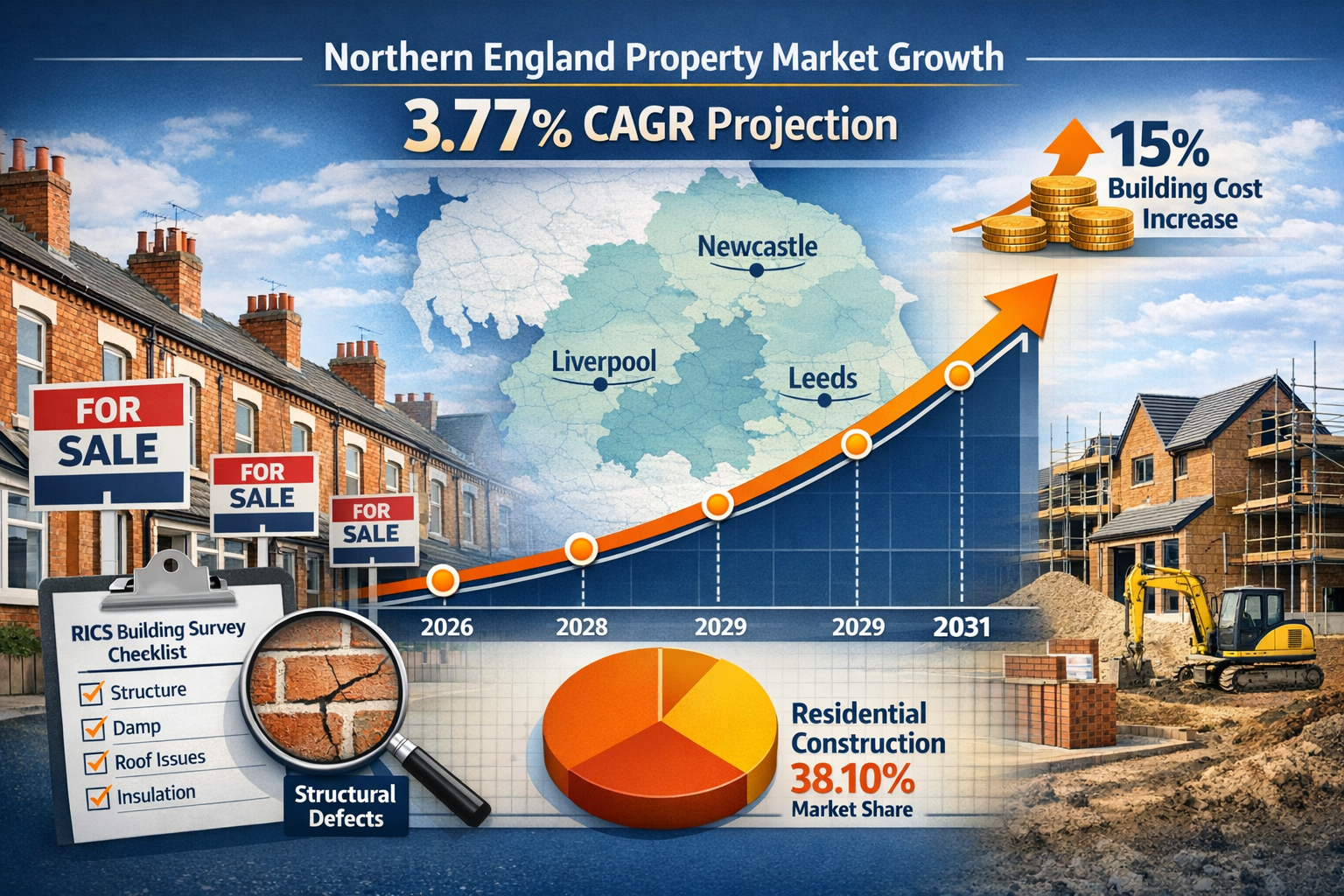
✅ Market Growth Trajectory: The UK construction market is expanding at a 3.77% CAGR, with England accounting for 79.55% of activity and residential construction leading at 38.10% market share in 2026[1]
✅ Cost Escalation Reality: Building costs are projected to increase 15% while tender prices will rise 17% over the next five years, making early defect identification financially critical[6]
✅ Northern England Opportunity: High-demand Northern markets present investment opportunities, but Victorian and Edwardian housing stock requires thorough RICS building surveys to identify hidden defects
✅ Risk Mitigation Strategy: Professional building surveys protect buyers from purchasing properties with undisclosed structural issues, subsidence, or damp problems common in Northern England's older housing stock
✅ Strategic Timing Advantage: Conducting comprehensive surveys during the 2026 price surge enables informed negotiation, accurate budgeting, and confident investment decisions in recovering construction markets
Understanding the 2026 Northern England Construction Landscape
Market Fundamentals Driving Regional Growth
Northern England's construction sector has emerged from recent economic challenges with renewed vigour, supported by substantial infrastructure investment and housing demand. The region's major urban centres—Manchester, Leeds, Liverpool, Sheffield, and Newcastle—are experiencing coordinated development activity that's reshaping the built environment.
The residential construction sector dominates the current landscape, holding 38.10% market share in 2026[1]. This residential focus reflects multiple converging factors:
- Housing shortage pressures in major Northern cities
- Government-backed mixed-tenure delivery programmes encouraging development
- Urban regeneration initiatives transforming former industrial areas
- Quality upgrade demands from buyers seeking modern amenities
- Population growth in Northern economic hubs
New construction activity represents 55.10% of the market in 2026[1], indicating that fresh development—rather than renovation—currently leads the sector. This new-build dominance creates particular challenges for building survey professionals, as recently completed properties may harbour construction defects that only become apparent through systematic inspection.
Regional Economic Drivers and Construction Activity
England's 79.55% share of UK construction activity[1] concentrates heavily in strategic corridors, with Northern England benefiting from targeted investment in transport infrastructure, commercial developments, and residential schemes. The Northern Powerhouse initiative continues to channel resources toward improving connectivity and economic competitiveness across the region.
However, this construction boom operates against a backdrop of escalating costs. The 15% projected increase in building costs over five years[6] affects everything from materials procurement to labour expenses. For property buyers, this cost trajectory means that defects identified during a building survey will become progressively more expensive to remedy as time passes.
| Market Indicator | 2026 Projection | Impact on Building Surveys |
|---|---|---|
| UK Construction Market Size | USD 325.33 billion[1] | Increased transaction volume requiring survey services |
| Building Cost Increase (5-year) | 15%[6] | Higher remediation costs for identified defects |
| Tender Price Increase (5-year) | 17%[6] | Greater financial risk from undetected issues |
| Residential Market Share | 38.10%[1] | Primary focus for homebuyer surveys |
| New Construction Share | 55.10%[1] | Emphasis on snagging and new-build defect surveys |
Northern England's Unique Property Characteristics
The Northern England housing stock presents distinctive challenges that make professional building surveys particularly valuable. Unlike newer developments in the South East, Northern cities feature extensive Victorian and Edwardian terraced housing, converted industrial buildings, and post-war social housing alongside modern developments.
Common defect patterns in Northern England properties include:
🏚️ Subsidence and structural movement due to mining activity, clay soils, and foundation settlement
💧 Penetrating damp and condensation from solid wall construction lacking cavity insulation
🧱 Pointing deterioration accelerated by Northern England's wet climate
🏭 Conversion quality issues in former mills and warehouses repurposed as residential space
⚡ Outdated electrical and heating systems in older properties requiring comprehensive upgrades
These regional characteristics make RICS chartered building surveyors with local knowledge invaluable. Understanding how Northern England's climate, geology, and construction history affect property condition enables surveyors to identify risks that generic inspections might overlook.
Northern England Building Surveys: Capitalising on 2026 Price Surge and Construction Recovery Through Strategic Defect Identification
The Critical Role of Building Surveys in Rising Markets
As property prices surge across Northern England in 2026, the temptation to expedite purchases and skip comprehensive surveys intensifies. However, this approach represents false economy in a market where building costs are increasing 15% and tender prices rising 17%[6]. The financial consequences of purchasing a property with undisclosed defects have never been more severe.
Professional building surveys serve multiple strategic functions in the current market environment:
Risk Quantification: Surveys transform unknown property conditions into documented, quantifiable risks that can be factored into purchase decisions and financing arrangements.
Negotiation Leverage: Identified defects provide concrete evidence for price renegotiation, potentially saving buyers tens of thousands of pounds even after accounting for survey costs.
Budget Accuracy: Understanding the full scope of required remediation work enables realistic budgeting for post-purchase improvements, preventing financial surprises.
Insurance Protection: Comprehensive survey documentation supports insurance claims and provides evidence of property condition at purchase.
Investment Confidence: Thorough defect identification allows investors to make informed decisions about property potential and renovation feasibility.
Types of Building Surveys for Northern England Properties
Different property types and transaction scenarios require tailored survey approaches. Understanding which survey level matches specific circumstances optimises both cost-effectiveness and risk management.
RICS Level 2 Homebuyer Survey
The RICS Home Survey (formerly Homebuyer Report) suits conventional properties in reasonable condition where buyers need professional assessment without exhaustive investigation. This survey level provides:
- Traffic light condition ratings for major property elements
- Identification of urgent defects requiring immediate attention
- Advice on necessary repairs and maintenance priorities
- Market valuation (when requested)
- Insurance reinstatement cost assessment
For standard Northern England terraced houses, semi-detached properties, and modern apartments without obvious issues, the Level 2 survey offers balanced coverage at moderate cost.
RICS Level 3 Building Survey
The comprehensive RICS Building Survey (formerly Full Structural Survey) represents the gold standard for property assessment. This detailed investigation suits:
- Properties built before 1900 (common across Northern England)
- Unusual construction types including converted industrial buildings
- Properties requiring renovation or significant alteration
- Properties with known defects requiring detailed assessment
- High-value transactions where comprehensive due diligence justifies investment
The Level 3 survey includes invasive investigation where appropriate, detailed analysis of construction methods, and comprehensive reporting on all accessible property elements. For Victorian and Edwardian properties dominating Northern England's housing stock, this survey level provides essential protection.
Specialist Defect Surveys
Specific concerns identified during initial inspections or property viewings may warrant targeted investigation through specific defect surveys. Common specialist surveys in Northern England include:
Subsidence Surveys: Essential for properties showing cracking patterns, particularly in areas with mining history or clay soils. Northern England's industrial heritage means subsidence risk remains elevated in many locations.
Roof Surveys: Detailed assessment of roof condition, particularly valuable for slate roofs common on Victorian terraces where replacement costs can exceed £15,000.
Damp and Timber Surveys: Investigating moisture ingress and timber decay in solid-wall properties lacking damp-proof courses—a frequent issue in pre-1920s Northern England housing.
Structural Movement Assessment: Evaluating whether observed cracking represents historic settlement or ongoing structural issues requiring intervention.
Common Defects in Northern England Properties and Survey Detection
Understanding prevalent defect patterns helps property buyers appreciate the value professional surveys deliver. Northern England's distinctive housing stock exhibits recurring issues that experienced surveyors routinely identify:
Subsidence and Structural Movement
Mining subsidence affects extensive areas across Yorkshire, Lancashire, and the North East. While most historic mining-related movement has stabilised, subsidence surveys remain crucial for properties in affected zones. Surveyors assess:
- Crack width, pattern, and orientation
- Evidence of ongoing movement versus historic settlement
- Foundation adequacy and soil conditions
- Proximity to mining records and geological fault lines
- Previous underpinning or structural repairs
The 17% projected increase in tender prices[6] means subsidence remediation will become progressively more expensive. Early identification through building surveys enables buyers to factor realistic repair costs into purchase decisions or negotiate price reductions reflecting the defect severity.
Damp Penetration and Condensation
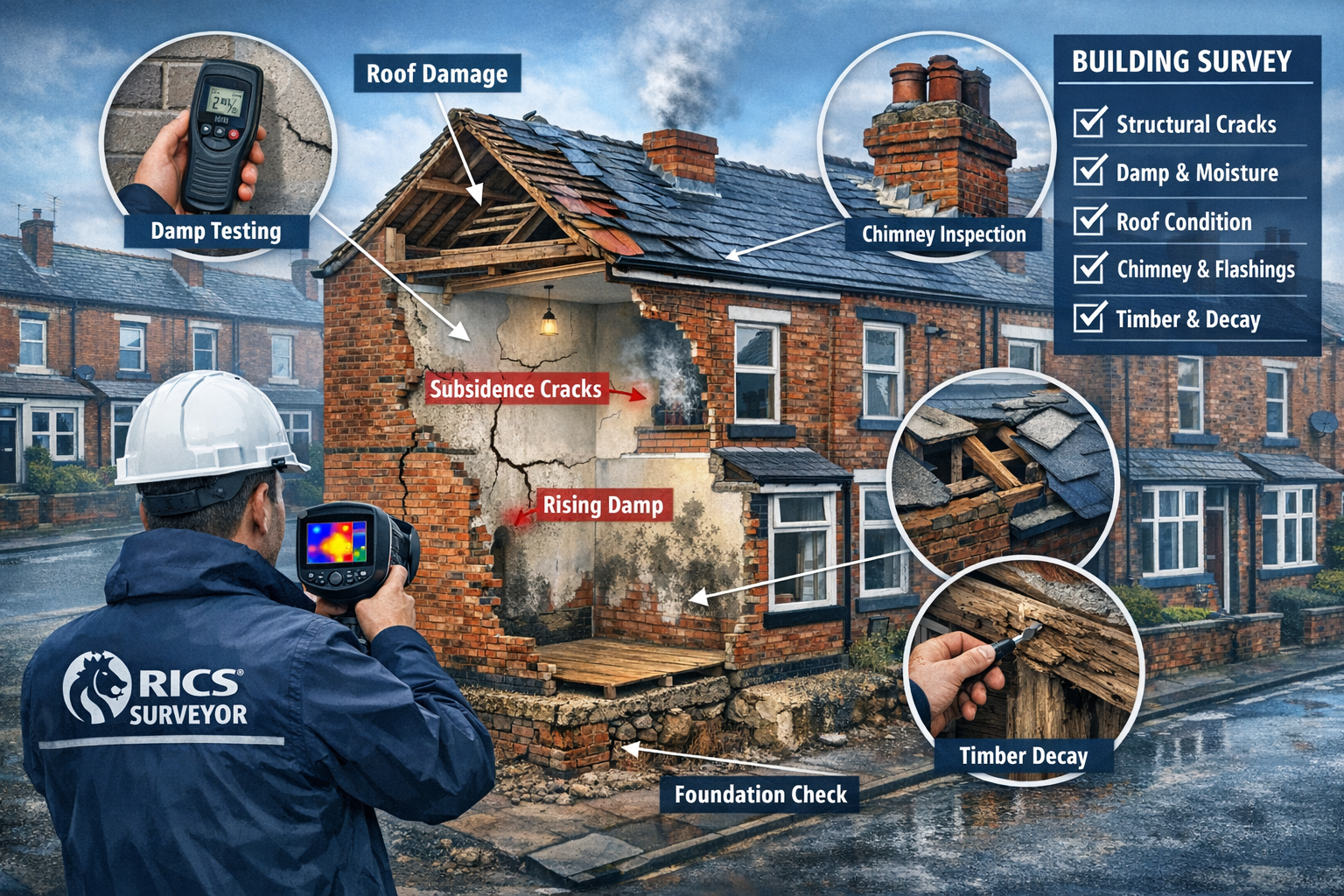
Northern England's high rainfall and humidity create ideal conditions for damp problems. Solid-wall construction in Victorian terraces lacks the cavity protection found in modern buildings, making penetrating damp common. Building surveys identify:
💧 Penetrating damp from defective pointing, damaged render, or failed flashings
💧 Rising damp in properties lacking or having failed damp-proof courses
💧 Condensation issues from inadequate ventilation and thermal bridging
💧 Concealed leaks from plumbing or roofing defects
Moisture meters, thermal imaging, and visual inspection combine to locate damp sources accurately. With building costs rising 15%[6], addressing damp problems early prevents progressive deterioration that multiplies remediation expenses.
Roof Deterioration
Traditional Welsh slate roofs on Northern England terraces typically last 80-100 years, meaning properties built in the 1920s-1940s now require replacement. Roof surveys assess:
- Slate condition, nail fatigue, and delamination
- Valley gutter integrity and flashing condition
- Chimney stack stability and pointing
- Roof timber condition and structural adequacy
- Insulation levels and ventilation provision
Roof replacement represents one of the most significant maintenance expenses property owners face. Comprehensive survey assessment enables accurate budgeting and prevents post-purchase financial shocks.
Conversion Quality Issues
Northern England's industrial heritage means many residential properties occupy converted mills, warehouses, and commercial buildings. These conversions vary dramatically in quality, with building surveys revealing:
- Inadequate structural alterations and beam sizing
- Deficient fire separation between units
- Poor acoustic insulation in apartment conversions
- Incomplete removal of hazardous materials
- Non-compliant building regulation work
Commercial property surveying expertise proves valuable when assessing converted industrial buildings, as surveyors must understand both original construction methods and conversion adequacy.
Capitalising on Northern England Building Surveys During the 2026 Recovery
Strategic Survey Timing in Competitive Markets
The 2026 construction recovery has intensified competition for desirable Northern England properties. Multiple-offer scenarios tempt buyers to waive survey conditions or accept abbreviated inspection timelines. However, this approach introduces substantial risk precisely when building costs are escalating 15% and tender prices rising 17%[6].
Strategic survey timing balances competitive positioning with due diligence requirements:
Pre-Offer Surveys: In highly competitive markets, commissioning surveys before submitting offers demonstrates seriousness while enabling informed bid pricing. This approach works best for properties remaining on market for several weeks.
Subject-to-Survey Offers: Traditional offers conditional on satisfactory survey results remain standard practice. Buyers should negotiate realistic survey periods (10-14 days) allowing comprehensive investigation without unnecessary delay.
New-Build Snagging: Properties purchased off-plan or recently completed require snagging surveys before final completion. The 55.10% new construction market share[1] means snagging expertise has become increasingly valuable.
Leveraging Survey Findings for Price Negotiation
Professional building surveys frequently identify defects requiring remediation costing £10,000-£50,000 or more. In the current market, where residential construction holds 38.10% market share[1] and demand remains strong, vendors may resist price reductions. However, documented defects provide objective negotiation leverage.
Effective negotiation strategies include:
📊 Quantified Remediation Costs: Obtaining contractor quotations for identified repairs transforms survey findings into concrete financial figures
📊 Retention Arrangements: Agreeing purchase price reductions held in escrow until buyers complete specified repairs
📊 Vendor Remediation: Negotiating for sellers to complete critical repairs before completion
📊 Warranty Protection: Requiring vendors to provide insurance-backed warranties for recent work of questionable quality
The key principle involves converting survey findings into financial terms that reflect current construction costs. With the 15% building cost increase trajectory[6], even modest defects represent substantial financial exposure.
Investment Decision-Making in High-Growth Markets
Northern England's construction recovery creates opportunities for property investors, but success requires accurate assessment of acquisition costs, remediation expenses, and value-creation potential. Building surveys provide the foundational data enabling sound investment analysis.
Investment-focused surveys should address:
Structural Adequacy for Intended Use: Whether existing construction supports planned modifications, extensions, or conversions.
Planning and Regulatory Compliance: Identifying unauthorised alterations, building regulation non-compliance, or planning contraventions that could affect value or future development.
Maintenance Liability Assessment: Quantifying deferred maintenance and projecting future capital expenditure requirements.
Value Enhancement Opportunities: Identifying cost-effective improvements that maximise return on investment.
Comparable Property Analysis: Understanding how identified defects affect value relative to similar properties in better condition.
For investors targeting Northern England's recovering markets, survey pricing represents minor expense compared to the financial protection and strategic insight comprehensive assessment delivers.
Understanding Survey Limitations and Complementary Assessments
While building surveys provide comprehensive property assessment, buyers should understand inherent limitations:
⚠️ Non-Invasive Investigation: Standard surveys assess visible and accessible elements without destructive testing
⚠️ Point-in-Time Assessment: Surveys document conditions on inspection date, not future performance
⚠️ Specialist Referral: Complex issues may require specialist investigation beyond general surveying scope
⚠️ Concealed Defects: Elements hidden behind finishes, within structures, or underground remain unassessable
These limitations don't diminish survey value but highlight circumstances requiring complementary assessments. Common supplementary investigations include:
Drainage Surveys: CCTV drainage inspection identifying defects in underground drainage systems—particularly valuable for Victorian properties with original clay drains.
Electrical Testing: Comprehensive electrical installation condition reports assessing safety and compliance.
Asbestos Surveys: Identifying asbestos-containing materials in properties built before 2000, especially relevant in converted industrial buildings.
Structural Engineering Assessment: Detailed structural analysis when surveyors identify significant movement, alterations, or load-bearing concerns requiring specialist evaluation.
The 3.77% CAGR growth in UK construction[1] creates sustained demand for these specialist services as transaction volumes increase.
The RICS Advantage in Northern England Markets
Selecting RICS chartered building surveyors provides essential quality assurance in markets where survey competence directly affects financial outcomes. RICS membership requires:
✅ Rigorous qualification standards including university education and professional assessment
✅ Continuing professional development maintaining current knowledge
✅ Professional indemnity insurance protecting clients financially
✅ Ethical standards enforcement through RICS disciplinary procedures
✅ Standardised reporting formats ensuring comprehensive coverage
In Northern England's distinctive property market, RICS surveyors' local knowledge proves particularly valuable. Understanding regional construction methods, common defect patterns, geological conditions, and climatic factors enables accurate risk assessment that generic inspections cannot match.
Cost-Benefit Analysis of Building Surveys in 2026
Property buyers frequently question whether survey costs justify the investment, particularly when purchasing apparently well-maintained properties. However, financial analysis demonstrates overwhelming value:
Survey Investment: £400-£1,500 depending on property value and survey level
Average Defect Identification Value: £8,000-£25,000 in negotiated price reductions
Risk Mitigation Value: Protection against catastrophic defects costing £50,000+
Budget Accuracy Value: Preventing post-purchase financial surprises and enabling realistic renovation planning
With building costs increasing 15% and tender prices rising 17%[6], the cost-benefit equation favours comprehensive surveying more strongly than ever. A £1,000 survey investment that identifies £20,000 in remediation needs delivers 20:1 return through negotiated price reduction or informed withdrawal from problematic purchases.
For investors and developers operating in Northern England's 38.10% residential market share[1], building surveys represent essential due diligence rather than optional expense.
Regional Variations Across Northern England's Property Markets
Manchester and Greater Manchester
Manchester's position as Northern England's economic powerhouse drives sustained construction activity and property price growth. The city's extensive Victorian terraced housing in areas like Didsbury, Chorlton, and Levenshulme requires careful survey assessment, while modern apartment developments in the city centre present different challenges.
Common Manchester-specific survey considerations include:
- Terraced property party wall condition and shared structural elements
- Conversion quality in former industrial buildings around Ancoats and Northern Quarter
- New-build apartment quality in high-rise developments
- Flood risk assessment for properties near waterways
- Ground conditions affecting foundations in former industrial areas
Manchester's construction boom, supported by the 55.10% new construction market share[1], creates demand for both traditional building surveys and specialist new-build snagging inspections.
Leeds and West Yorkshire
Leeds combines Georgian and Victorian architecture in areas like Headingley and Chapel Allerton with modern developments around the waterfront and city centre. West Yorkshire's industrial heritage means many residential properties occupy converted textile mills and warehouses.
Survey priorities for Leeds properties include:
- Stone construction assessment in properties using Yorkshire stone
- Conversion structural adequacy in former industrial buildings
- Roof condition on stone-built properties where replacement costs prove particularly high
- Subsidence risk in areas with mining history
- Damp issues in solid-wall stone construction
The region's participation in England's 79.55% construction activity share[1] reflects ongoing development that creates opportunities for investors willing to conduct thorough due diligence.
Liverpool and Merseyside
Liverpool's distinctive architectural character includes extensive Georgian terraces, Victorian villas, and post-war social housing alongside modern regeneration schemes. The city's maritime climate creates particular challenges for property maintenance.
Liverpool-specific survey considerations include:
- Salt weathering on coastal properties affecting masonry and render
- Victorian terrace structural condition in areas like Aigburth and Sefton Park
- Regeneration area property quality where rapid development may compromise construction standards
- Basement condition in Georgian properties with below-ground rooms
- Modern apartment building quality in waterfront developments
Newcastle and the North East
Newcastle and the wider North East region feature distinctive Tyneside flats, Victorian terraces, and extensive post-war housing. The region's industrial heritage creates specific survey requirements.
North East survey priorities include:
- Tyneside flat party floor/ceiling condition and sound insulation
- Mining subsidence assessment given extensive coalfield history
- Cavity wall tie failure in 1920s-1950s housing
- Render condition on properties with pebbledash or cement render finishes
- Exposed location weathering affecting coastal and elevated properties
The North East's construction activity, while smaller than Manchester or Leeds, benefits from the residential sector's 38.10% market share[1] and targeted regeneration investment.
Future-Proofing Property Investments Through Comprehensive Surveys

Climate Resilience and Energy Efficiency Assessment
The 2026 property market increasingly values energy efficiency and climate resilience. Building surveys now routinely assess properties against these emerging priorities:
🌡️ Thermal performance and insulation adequacy
🌡️ Heating system efficiency and renewable energy potential
🌡️ Flood risk and surface water management
🌡️ Ventilation adequacy and air quality
🌡️ Climate adaptation potential for extreme weather events
Northern England's older housing stock typically performs poorly on energy efficiency metrics. Surveys identifying cost-effective improvement opportunities enable buyers to factor enhancement costs into purchase decisions while understanding long-term value creation potential.
The 15% building cost increase[6] affects energy efficiency improvements alongside general construction work. Early assessment enables strategic planning and phased implementation aligned with available budgets.
Regulatory Compliance and Building Standards
Building surveys assess compliance with current regulations, identifying unauthorised alterations, building regulation contraventions, and planning violations. In Northern England's markets, where property modification is common, compliance assessment proves particularly valuable.
Key regulatory considerations include:
- Building regulation approval for extensions, conversions, and structural alterations
- Planning permission for changes affecting external appearance or use
- Listed building consent for works to designated heritage assets
- Fire safety compliance in apartment buildings and houses in multiple occupation
- Electrical safety standards for rental properties
Non-compliance creates financial liability through enforcement action, remediation costs, and value impairment. Comprehensive surveys identifying regulatory issues enable informed risk assessment and negotiation.
Long-Term Maintenance Planning
Building surveys provide the foundation for strategic maintenance planning, enabling property owners to anticipate and budget for future capital expenditure. This forward-looking approach proves particularly valuable given the 17% tender price increase trajectory[6].
Survey-based maintenance planning addresses:
📅 Immediate priorities requiring attention within 12 months
📅 Medium-term requirements anticipated within 2-5 years
📅 Long-term considerations affecting 5-10 year planning
📅 Lifecycle replacement for building elements approaching service life limits
For investors operating in Northern England's recovering construction market, maintenance planning enables accurate cash flow projection and prevents unexpected capital calls that undermine investment returns.
Conclusion: Strategic Action in Northern England's 2026 Property Market
Northern England Building Surveys: Capitalising on 2026 Price Surge and Construction Recovery demands strategic thinking and professional expertise. The region's construction sector, participating in the USD 325.33 billion UK market[1] growing at 3.77% CAGR, presents genuine opportunities for informed buyers and investors. However, success requires rigorous due diligence through comprehensive building surveys that identify risks before they become financial liabilities.
The confluence of 15% building cost increases and 17% tender price escalation[6] over the coming five years means defect remediation will become progressively more expensive. Properties purchased in 2026 without thorough survey assessment may harbour defects costing tens of thousands of pounds to address at future inflated prices. Conversely, buyers who invest in professional RICS building surveys gain negotiation leverage, budget accuracy, and investment confidence that translate directly into financial advantage.
Actionable Next Steps for Property Buyers and Investors
1. Prioritise Survey Investment: Allocate budget for comprehensive building surveys as essential transaction costs rather than optional extras. The cost-benefit ratio overwhelmingly favours professional assessment.
2. Select RICS Chartered Surveyors: Engage RICS chartered building surveyors with demonstrated Northern England experience and local market knowledge.
3. Match Survey Level to Property Type: Commission Level 3 surveys for pre-1900 properties, unusual construction types, and buildings requiring renovation. Use Level 2 surveys for conventional properties in reasonable condition.
4. Address Specialist Concerns: Supplement building surveys with targeted investigations (subsidence surveys, roof surveys, drainage CCTV) when specific risks warrant detailed assessment.
5. Quantify Remediation Costs: Obtain contractor quotations for identified defects to support price negotiation with objective financial data.
6. Plan Long-Term Maintenance: Use survey findings to develop strategic maintenance plans that anticipate future capital expenditure and prevent deterioration.
7. Understand Market Context: Recognise that Northern England's 38.10% residential market share[1] and 55.10% new construction focus[1] create specific opportunities and challenges requiring tailored survey approaches.
8. Act Decisively: The 2026 construction recovery creates competitive markets where informed buyers with comprehensive survey data gain decisive advantages over those relying on superficial assessment.
The Northern England property market's 2026 trajectory offers substantial opportunities for buyers and investors who approach transactions with professional rigour. Building surveys transform property acquisition from speculation into informed investment, providing the knowledge foundation for confident decision-making in dynamic markets. As construction costs escalate and tender prices rise, the financial protection and strategic insight comprehensive surveys deliver becomes increasingly valuable.
For property stakeholders operating across Manchester, Leeds, Liverpool, Newcastle, and the wider Northern England region, professional building surveys represent not merely prudent risk management but strategic competitive advantage in markets where knowledge directly translates into financial outcomes.
References
[1] United Kingdom Construction Market – https://www.mordorintelligence.com/industry-reports/united-kingdom-construction-market
[2] Uk Residential Building Construction Industry 17305 – https://www.datainsightsmarket.com/reports/uk-residential-building-construction-industry-17305
[3] Northeast Lmi Final – https://www.citb.co.uk/media/jisj33b3/northeast-lmi-final.pdf
[4] The Glenigan Forecast 2025 2026 November 2024 66455 Digital – https://www.glenigan.com/wp-content/uploads/The-Glenigan-Forecast-2025-2026_November_2024_66455_Digital.pdf
[5] Uk Construction Perspective – https://www.jll.com/en-uk/insights/uk-construction-perspective
[6] Bcis Construction Industry Forecast – https://www.bcis.co.uk/news/bcis-construction-industry-forecast/