The institutional buy-to-let sector is experiencing unprecedented growth in 2026, with professional landlords and corporate investment firms acquiring residential portfolios at record volumes. This surge has transformed the landscape of property surveying, demanding rigorous inspection protocols that go far beyond standard residential assessments. Level 3 Building Surveys for Institutional Buy-to-Let: Identifying Defects in 2026's Professional Landlord Boom represents a critical evolution in property due diligence, where comprehensive defect identification can mean the difference between profitable portfolio expansion and costly investment mistakes.
Unlike individual homebuyers, institutional investors require detailed intelligence about structural integrity, compliance risks, and long-term maintenance liabilities. The stakes are higher, the properties are often more complex, and the financial implications of undetected defects can cascade across entire portfolios. As professional landlords compete for quality stock in 2026's competitive market, the Level 3 Building Survey has emerged as the gold standard for informed acquisition decisions.
Key Takeaways
✅ Level 3 Building Surveys provide the most comprehensive inspection available, essential for institutional investors acquiring older, complex, or potentially problematic buy-to-let properties
🏢 Institutional buy-to-let portfolios in 2026 demand survey protocols that extend beyond residential standards, focusing on structural risks, compliance issues, and portfolio-wide value impacts
💰 Survey costs for institutional investors typically range from £630 to £1,500+, representing a minimal investment compared to the financial risks of undetected defects
🔍 Defect identification in 2026's professional landlord boom requires specialist expertise in Victorian conversions, HMO compliance, fire safety regulations, and building performance standards
📊 Risk-focused assessment frameworks enable institutional landlords to make data-driven acquisition decisions, prioritize remedial works, and accurately forecast maintenance capital expenditure
Understanding Level 3 Building Surveys in the Institutional Context
What Makes Level 3 Surveys Essential for Professional Landlords
Level 3 Building Surveys represent the most detailed and comprehensive inspection service available through RICS-qualified surveyors. Designed specifically for properties over 50 years old, buildings with unusual construction, listed properties, or those in poor condition, these surveys deliver exhaustive analysis of a property's structural condition and defect profile [1].
For institutional investors in 2026's competitive buy-to-let market, this level of scrutiny is non-negotiable. The survey identifies "identifiable risk and causes of potential or hidden defects in areas not inspected" and outlines the scope of remedial work along with consequences of non-repair [1]. This comprehensive approach aligns perfectly with institutional investment requirements for:
- Portfolio risk management across multiple properties
- Accurate capital expenditure forecasting for budgeting and financial modeling
- Compliance verification with evolving rental sector regulations
- Informed negotiation leverage based on documented defects
- Long-term asset performance planning spanning 10-20 year investment horizons
When comparing different types of survey, the Level 3 option stands apart in depth and detail. A full Level 3 structural survey can take up to a day to complete [1], with surveyors examining every accessible element of the building fabric, from foundations to roof spaces.
The 2026 Professional Landlord Landscape
The institutional buy-to-let sector in 2026 has evolved dramatically from the traditional amateur landlord model. Corporate landlords, real estate investment trusts (REITs), and pension fund-backed property companies now dominate acquisition activity in key urban markets. This professionalization demands "survey protocols that extend far beyond standard residential assessments," employing risk-focused assessment frameworks [2].
Key characteristics of 2026's institutional buy-to-let market:
| Factor | Impact on Survey Requirements |
|---|---|
| 🏗️ Victorian conversion prevalence | Requires specialist structural knowledge of period construction methods |
| 📜 Stricter regulatory environment | Demands compliance verification for fire safety, energy performance, HMO standards |
| 💼 Portfolio acquisition strategies | Necessitates standardized reporting formats for comparative analysis |
| ⚡ Sustainability requirements | Requires assessment of retrofit potential and building performance |
| 🔐 Institutional lending criteria | Demands comprehensive defect documentation for financing approval |
Professional landlords in 2026 cannot afford the reactive maintenance approach that characterizes amateur buy-to-let operations. Instead, they require predictive intelligence about building performance, enabling proactive capital planning and risk mitigation strategies.
Survey Scope and Methodology
A properly executed RICS commercial building survey for institutional buy-to-let purposes examines:
Structural Elements:
- Foundation condition and settlement indicators
- Load-bearing wall integrity and structural movement
- Floor construction and deflection issues
- Roof structure, covering condition, and water ingress risks
- Chimney stacks and parapet stability
Building Fabric:
- External wall condition, pointing, and render
- Window and door frames, glazing, and weatherproofing
- Internal wall finishes and evidence of dampness
- Floor finishes and substrate condition
- Ceiling condition and evidence of leaks
Building Services:
- Electrical installation age, condition, and compliance
- Heating system efficiency and safety
- Plumbing condition and water supply adequacy
- Drainage systems and foul water disposal
- Ventilation provision and condensation risks
Compliance and Safety:
- Fire safety provisions for HMO or multi-occupancy use
- Accessibility and building regulation compliance
- Asbestos presence in pre-2000 buildings
- Energy performance and EPC rating potential
The surveyor's expertise in identifying specific defects becomes particularly valuable when institutional investors need to understand not just what is wrong, but why it occurred and what remediation will cost.
Critical Defects Institutional Investors Must Identify in 2026
Structural Defects That Impact Portfolio Value
Structural issues represent the most significant financial risk in buy-to-let acquisitions. Unlike cosmetic defects that can be addressed through routine maintenance, structural problems can fundamentally undermine property value and rental viability.
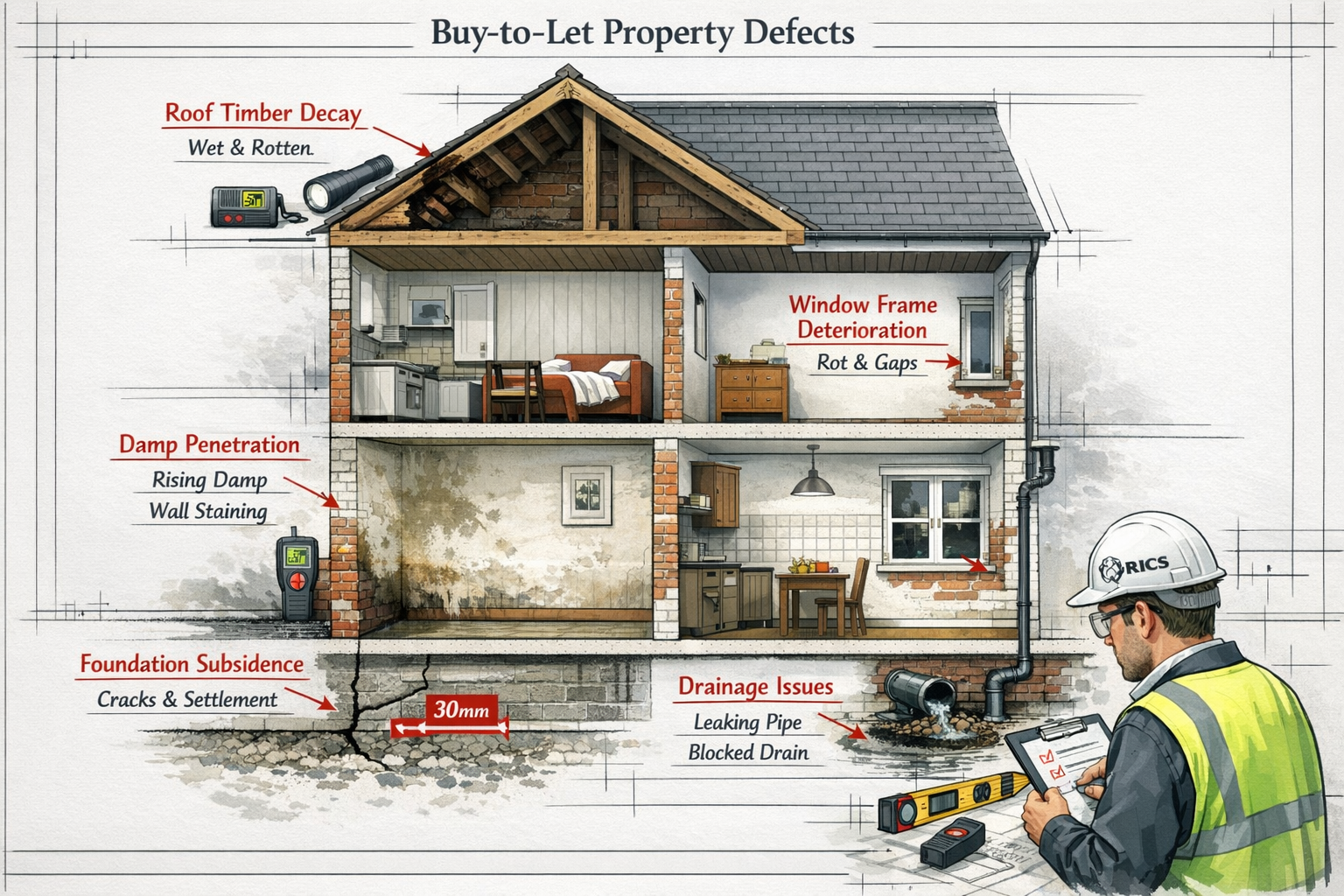
Foundation and Subsidence Issues:
Foundation movement and subsidence remain among the most costly defects to remediate. In 2026's market, institutional investors must identify:
- Differential settlement in Victorian terraces built on clay soils
- Mining subsidence in former industrial areas
- Tree root damage from mature vegetation near buildings
- Drainage-related settlement from leaking underground services
- Inadequate foundations in older properties lacking modern standards
Signs include progressive cracking in walls (particularly diagonal cracks wider than 3mm), sticking doors and windows, and visible floor slope. Professional surveyors use crack monitoring, level surveys, and specialist investigation techniques to differentiate between historic settlement and active movement.
Load-Bearing Wall Defects:
Many buy-to-let properties, particularly Victorian conversions, have been subject to previous alterations that may compromise structural integrity:
- Removed or inadequately supported load-bearing walls
- Lintels with insufficient bearing length over openings
- Structural cracks indicating overloading
- Lateral movement in party walls
- Bulging or bowing in external walls
These defects often emerge during conversion to HMO or multi-unit occupation, where layout changes have been undertaken without proper structural surveys or building control approval.
Roof Structure Deterioration:
Roof defects combine immediate water ingress risks with long-term structural concerns:
- Timber decay in rafters, purlins, and ridge boards
- Inadequate roof spread restraint in older buildings
- Failed or inadequate roof coverings
- Defective flashings and valley gutters
- Structural movement affecting roof geometry
For institutional landlords managing portfolios, roof replacement represents a major capital expenditure item. Accurate assessment of remaining roof life enables strategic planning of replacement programs across multiple properties.
Dampness, Water Ingress, and Building Performance
Water-related defects represent the most common and potentially pervasive issues in buy-to-let properties. In 2026's regulatory environment, these defects carry additional significance due to energy efficiency requirements and health and safety obligations.
Rising Damp and DPC Failures:
Despite being overdiagnosed in some contexts, genuine rising damp remains problematic in:
- Pre-1875 properties built without damp-proof courses
- Buildings with failed or bridged DPC systems
- Properties with raised external ground levels
- Solid wall constructions with inadequate moisture barriers
Institutional investors must distinguish between rising damp, penetrating damp, and condensation—each requiring different remediation approaches and cost implications.
Penetrating Dampness:
External water ingress sources include:
- Defective rainwater goods (gutters, downpipes, hoppers)
- Failed pointing and render
- Cracked or porous masonry
- Window and door frame defects
- Roof covering failures and flashing defects
The cumulative effect of multiple minor defects can create significant internal damage, affecting tenant comfort, decoration condition, and potentially creating health hazards through mold growth.
Condensation and Ventilation:
Modern energy efficiency standards often conflict with traditional building performance in older buy-to-let stock:
- Inadequate ventilation in sealed buildings
- Thermal bridging at junctions and penetrations
- Single-glazed windows creating cold surfaces
- Insufficient heating provision
- Occupant behavior in multi-occupancy settings
For HMO properties particularly, condensation management requires careful assessment of ventilation provision, heating adequacy, and thermal performance.
Compliance and Regulatory Defects
The 2026 regulatory landscape for buy-to-let properties has become increasingly complex, with institutional investors facing significant penalties for non-compliance.
Fire Safety Requirements:
Following legislative changes in recent years, fire safety has become a primary concern:
- Inadequate fire separation between units
- Missing or defective fire doors
- Insufficient escape routes in HMOs
- Lack of fire detection and alarm systems
- Combustible cladding or external wall concerns
A comprehensive specific defect report focusing on fire safety compliance is often required alongside the main Level 3 survey for HMO or multi-unit acquisitions.
Energy Performance Standards:
Minimum EPC requirements for rental properties continue to tighten:
- Properties below EPC rating C face future rental restrictions
- Poor insulation in solid wall constructions
- Inefficient heating systems
- Single glazing and thermal bridging
- Inadequate loft and floor insulation
Institutional investors must assess both current compliance and the cost of achieving future regulatory standards.
Electrical Safety Compliance:
Five-yearly electrical installation condition reports are now mandatory:
- Outdated wiring systems requiring replacement
- Inadequate earthing and bonding
- Consumer unit upgrades needed
- Insufficient socket provision for modern use
- Dangerous DIY alterations
Building Regulation and Planning Compliance:
Previous alterations may lack proper approvals:
- Unauthorized conversions to HMO use
- Building work without building control sign-off
- Planning permission issues for changes of use
- Unauthorized extensions or structural alterations
These compliance defects can affect property value, insurability, and rental viability—making them critical elements of institutional due diligence.
The Level 3 Survey Process for Institutional Buy-to-Let Acquisitions
Pre-Survey Preparation and Briefing
Successful institutional surveys begin with comprehensive briefing between the investor and the surveyor. Unlike standard residential surveys, institutional buy-to-let assessments require:
Clear Investment Objectives:
- Intended use (single let, HMO, multi-unit)
- Hold period and exit strategy
- Target tenant demographic
- Portfolio integration requirements
Specific Risk Concerns:
- Known issues from marketing materials
- Previous survey findings if available
- Particular compliance requirements
- Budget constraints for remedial works
Reporting Requirements:
- Standardized format for portfolio comparison
- Cost estimation detail required
- Prioritization of defects by urgency
- Integration with investment appraisal models
Professional surveyors working with institutional clients in 2026 typically provide customized reporting templates that align with the investor's decision-making frameworks.
On-Site Inspection Methodology
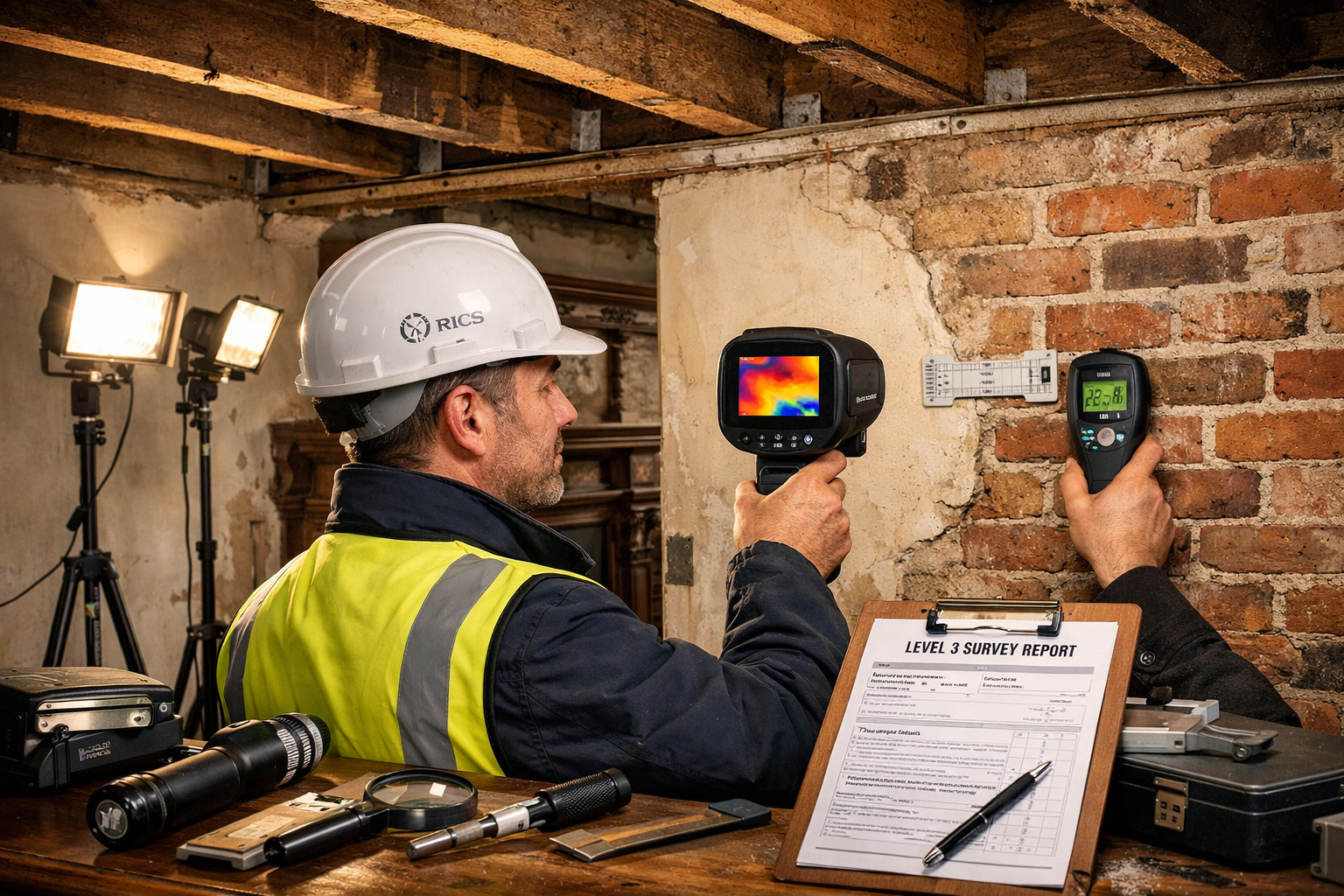
The physical inspection represents the core of the Level 3 survey process. For buy-to-let properties, surveyors employ systematic methodologies:
External Inspection:
- Detailed examination of all elevations
- Roof inspection using binoculars, drones, or ladder access
- Rainwater goods and external services
- Boundary walls, outbuildings, and site features
- Drainage inspection chambers and manholes
Internal Inspection:
- Room-by-room systematic examination
- Floor void inspection where accessible
- Roof space examination
- Damp meter readings at multiple locations
- Photography of all significant defects
Services Assessment:
- Visual inspection of accessible services
- Identification of upgrade requirements
- Safety and compliance observations
- Recommendations for specialist testing
The inspection for a typical three-story Victorian terrace conversion might take 4-6 hours, with larger or more complex properties requiring extended time.
Specialist Investigations and Testing
Level 3 surveys often identify issues requiring specialist investigation:
Structural Engineer Referrals:
- Significant cracking or movement
- Structural alterations requiring assessment
- Foundation concerns
- Complex structural defects
Damp and Timber Specialists:
- Invasive moisture investigation
- Timber decay assessment
- Remedial treatment specifications
Electrical and Mechanical Consultants:
- Full electrical installation condition reports
- Heating system efficiency testing
- Drainage CCTV surveys
Environmental Specialists:
- Asbestos surveys for pre-2000 buildings
- Contaminated land assessments
- Japanese knotweed and invasive species
Institutional investors typically budget for these additional investigations as part of their due diligence process, with costs factored into acquisition models.
Report Delivery and Defect Categorization
The Level 3 survey report for institutional buy-to-let purposes typically includes:
Executive Summary:
- Property overview and construction type
- Summary of significant defects
- Overall condition rating
- Estimated total remedial costs
- Key recommendations
Detailed Findings:
- Element-by-element condition assessment
- Photographic evidence of defects
- Technical explanations of causes
- Repair methodology recommendations
- Cost estimates for remediation
Defect Prioritization:
| Category | Definition | Action Timeframe | Typical Examples |
|---|---|---|---|
| Category 1 – Urgent | Serious defects requiring immediate attention | 0-6 months | Active structural movement, major water ingress, safety hazards |
| Category 2 – Significant | Important defects affecting value/use | 6-24 months | Roof covering nearing end of life, heating system replacement, compliance upgrades |
| Category 3 – Moderate | Defects requiring attention during hold period | 2-5 years | Window replacement, external redecoration, minor repairs |
| Category 4 – Minor | Routine maintenance items | 5+ years | General wear and tear, cosmetic issues |
This categorization enables institutional investors to:
- Negotiate purchase price based on Category 1 and 2 defects
- Plan capital expenditure across the investment period
- Assess portfolio risk by aggregating defect categories
- Prioritize remedial works across multiple properties
Understanding which survey you need depends on property type and investment strategy, but for institutional buy-to-let, the Level 3 option provides the comprehensive intelligence required for informed decision-making.
Cost-Benefit Analysis: Survey Investment vs. Defect Risk
Survey Costs in the 2026 Market
Level 3 Building Surveys represent a significant but essential investment for institutional buy-to-let acquisitions. In 2026, typical costs range from £562 to £945 with an average of £629 for standard residential properties [3]. However, for institutional investors dealing with larger, more complex, or portfolio acquisitions, costs typically range from £630 to £1,500+ depending on property size, age, complexity, and location [1].
Cost Variables Include:
💷 Property size – Larger properties require more inspection time
🏛️ Age and complexity – Victorian conversions and listed buildings demand specialist expertise
📍 Location – Regional variations in surveyor fees
🔍 Access requirements – Scaffolding or specialist access equipment
📊 Reporting detail – Customized institutional reporting formats
⚡ Urgency – Expedited reports command premium fees
For a typical institutional acquisition of a £300,000 Victorian terrace conversion, a comprehensive Level 3 survey costing £800-£1,200 represents just 0.27-0.40% of the purchase price—a minimal investment compared to the financial exposure from undetected defects.
Financial Impact of Undetected Defects
The true value of Level 3 surveys becomes apparent when considering the cost of defects discovered post-acquisition:
Major Structural Repairs:
- Foundation underpinning: £10,000-£50,000+
- Roof structure replacement: £15,000-£40,000
- External wall rebuilding: £20,000-£60,000
- Structural alterations remediation: £5,000-£30,000
Building Performance Issues:
- Rising damp treatment: £3,000-£8,000
- Penetrating damp remediation: £2,000-£15,000
- Condensation and ventilation upgrades: £1,500-£5,000
Compliance Upgrades:
- Fire safety improvements (HMO): £8,000-£25,000
- Electrical rewiring: £4,000-£8,000
- EPC improvement works: £5,000-£20,000
- Building regulation retrospective compliance: £3,000-£15,000+
A single undetected Category 1 defect can easily cost 10-50 times the survey fee to remediate. For institutional investors managing portfolios, the cumulative impact of survey-preventable defects can significantly undermine investment returns.
Portfolio-Level Risk Management
Institutional landlords in 2026 approach survey investment strategically across their portfolios:
Standardized Survey Protocols:
- Consistent reporting formats enable comparative analysis
- Standardized cost estimation supports accurate budgeting
- Uniform defect categorization facilitates portfolio risk assessment
Acquisition Decision Frameworks:
- Survey findings integrated into investment appraisal models
- Defect costs factored into purchase price negotiations
- Risk-adjusted returns calculated incorporating remedial expenditure
Capital Expenditure Planning:
- Survey data aggregated to forecast portfolio-wide maintenance needs
- Defect categories mapped to maintenance budgets
- Lifecycle replacement programs informed by condition data
Asset Performance Monitoring:
- Baseline condition data from acquisition surveys
- Monitoring surveys track deterioration rates
- Proactive maintenance triggered by condition thresholds
This systematic approach transforms survey costs from acquisition expenses into strategic intelligence investments that enhance portfolio performance and risk management.
Negotiation Leverage and Value Protection
Level 3 surveys provide institutional investors with powerful negotiation tools:
Price Reduction Justification:
When surveys identify significant defects, documented evidence supports price renegotiation. A comprehensive report detailing £30,000 of Category 1 and 2 defects provides objective justification for equivalent purchase price reduction or seller-funded remediation.
Conditional Exchange Terms:
Survey findings enable sophisticated conditional exchange arrangements:
- Seller remediation of specific defects before completion
- Retention of funds pending defect resolution
- Warranty provisions for latent defects
- Indemnities for compliance issues
Lender Requirements:
Institutional financing often requires comprehensive survey evidence:
- Lenders may insist on Level 3 surveys for older properties
- Survey findings inform loan-to-value ratios
- Defect remediation may be completion conditions
- Regular condition surveys required for portfolio lending
The survey investment thus serves multiple purposes beyond defect identification—it becomes a critical tool in transaction structuring and financing arrangements.
Selecting the Right Surveyor for Institutional Buy-to-Let
RICS Qualification and Specialist Expertise
Not all surveyors possess the expertise required for institutional buy-to-let assessments in 2026. Investors should prioritize:
RICS Chartered Status:
RICS chartered building surveyors provide assurance of:
- Professional qualification and ongoing CPD
- Professional indemnity insurance
- Adherence to RICS standards and ethics
- Regulatory oversight and complaints procedures
Sector-Specific Experience:
Institutional buy-to-let demands surveyors with:
- Experience in Victorian and period property construction
- Knowledge of HMO and multi-unit conversion issues
- Understanding of buy-to-let regulatory requirements
- Familiarity with institutional reporting needs
- Track record with professional landlord clients
Local Market Knowledge:
Surveyors with local expertise offer advantages:
- Understanding of regional construction methods
- Awareness of area-specific defect patterns (mining subsidence, clay soils, etc.)
- Knowledge of local authority requirements
- Relationships with specialist contractors for cost estimates
Customized Reporting for Institutional Needs
Standard residential survey reports often require adaptation for institutional use:
Standardized Formats:
Portfolio investors benefit from consistent reporting structures that enable:
- Direct comparison between properties
- Aggregation of defect data
- Integration with investment appraisal software
- Efficient review processes
Enhanced Cost Information:
Institutional reports should include:
- Detailed cost breakdowns for remedial works
- Alternative remediation approaches with cost comparisons
- Lifecycle cost projections
- Prioritized work programs with phasing options
Risk Assessment Integration:
Advanced institutional reporting incorporates:
- Risk ratings for identified defects
- Probability and impact assessments
- Portfolio-level risk aggregation
- Compliance risk evaluation
Digital Delivery:
Modern institutional surveyors provide:
- Digital report formats with searchable content
- Photographic libraries with tagged defects
- Integration with property management systems
- Electronic data extraction for analysis
Building Long-Term Surveyor Relationships
Successful institutional landlords in 2026 cultivate ongoing relationships with trusted surveyors:
Portfolio-Wide Engagement:
Rather than one-off instructions, institutional investors benefit from:
- Framework agreements for multiple properties
- Preferential fee arrangements for volume work
- Consistent surveyor teams familiar with portfolio strategy
- Streamlined instruction and reporting processes
Ongoing Condition Monitoring:
Beyond acquisition surveys, institutional relationships encompass:
- Periodic condition surveys of existing portfolio
- Schedule of condition reporting for lease events
- Defect investigation for emerging issues
- Expert witness services for disputes
Strategic Advisory Services:
Experienced surveyors become strategic partners providing:
- Market intelligence on property condition trends
- Regulatory compliance updates
- Refurbishment and improvement advice
- Portfolio optimization recommendations
This evolution from transactional service provider to strategic advisor maximizes the value of survey investment across the investment lifecycle.
Conclusion: Elevating Due Diligence Standards in 2026's Professional Landlord Sector
The institutional buy-to-let boom of 2026 has fundamentally transformed property acquisition due diligence. Level 3 Building Surveys for Institutional Buy-to-Let: Identifying Defects in 2026's Professional Landlord Boom represents not merely a regulatory compliance exercise, but a strategic intelligence-gathering process that underpins successful portfolio investment.
As professional landlords compete for quality stock in increasingly competitive markets, the comprehensive defect identification provided by Level 3 surveys delivers multiple layers of value:
🎯 Risk mitigation through early identification of structural, compliance, and performance defects
💰 Financial protection via informed negotiation and accurate capital expenditure forecasting
📊 Portfolio optimization through standardized condition data and strategic maintenance planning
⚖️ Regulatory compliance by identifying and addressing safety and performance standards
🔄 Long-term value preservation through proactive asset management informed by baseline condition data
The relatively modest investment in comprehensive surveys—typically 0.3-0.5% of acquisition cost—pales in comparison to the financial exposure from undetected defects, which can easily reach tens of thousands of pounds per property. For institutional investors managing portfolios worth millions, systematic survey protocols represent essential risk management infrastructure.
Actionable Next Steps for Institutional Investors
For Investors Planning Acquisitions:
- Engage RICS-qualified surveyors with proven institutional buy-to-let experience early in the acquisition process
- Develop standardized survey briefs that align with your investment criteria and reporting needs
- Budget appropriately for comprehensive Level 3 surveys and likely specialist investigations
- Integrate survey findings into investment appraisal models and negotiation strategies
- Plan remedial works based on defect categorization and priority rankings
For Portfolio Managers:
- Establish framework agreements with trusted surveyor firms for consistent service delivery
- Aggregate survey data across portfolios to identify systemic issues and maintenance patterns
- Implement condition monitoring programs to track asset performance over time
- Use survey intelligence to optimize capital expenditure allocation and timing
- Maintain baseline condition records for future reference and performance tracking
For Professional Landlords Entering the Market:
- Recognize that Level 3 surveys are non-negotiable for older, complex, or converted properties
- Understand the difference between mortgage valuations and surveys—they serve entirely different purposes
- Build relationships with qualified surveyors who understand buy-to-let sector requirements
- Factor survey costs and findings into your acquisition financial models from the outset
- Use survey evidence to negotiate effectively and protect your investment
The professional landlord sector of 2026 demands professional standards of due diligence. Level 3 Building Surveys provide the comprehensive intelligence required to make informed acquisition decisions, manage portfolio risk, and achieve sustainable investment returns in an increasingly regulated and competitive market.
By elevating survey standards and integrating comprehensive defect identification into acquisition protocols, institutional investors position themselves for long-term success in the evolving buy-to-let landscape. The question is no longer whether to commission Level 3 surveys, but how to maximize their strategic value across the investment lifecycle.
References
[1] What Sort Of Survey Should I Have – https://hoa.org.uk/advice/guides-for-homeowners/i-am-buying/what-sort-of-survey-should-i-have/
[2] Surveying The 2026 Buy To Let Boom Building Survey Protocols For Institutional Landlord Investments – https://nottinghillsurveyors.com/blog/surveying-the-2026-buy-to-let-boom-building-survey-protocols-for-institutional-landlord-investments
[3] Level 3 Survey Cost – https://www.comparemymove.com/guides/surveying/level-3-survey-cost