Level 2 v Level 3 Survey: The Complete 2026 Guide to Choosing the Right Property Survey
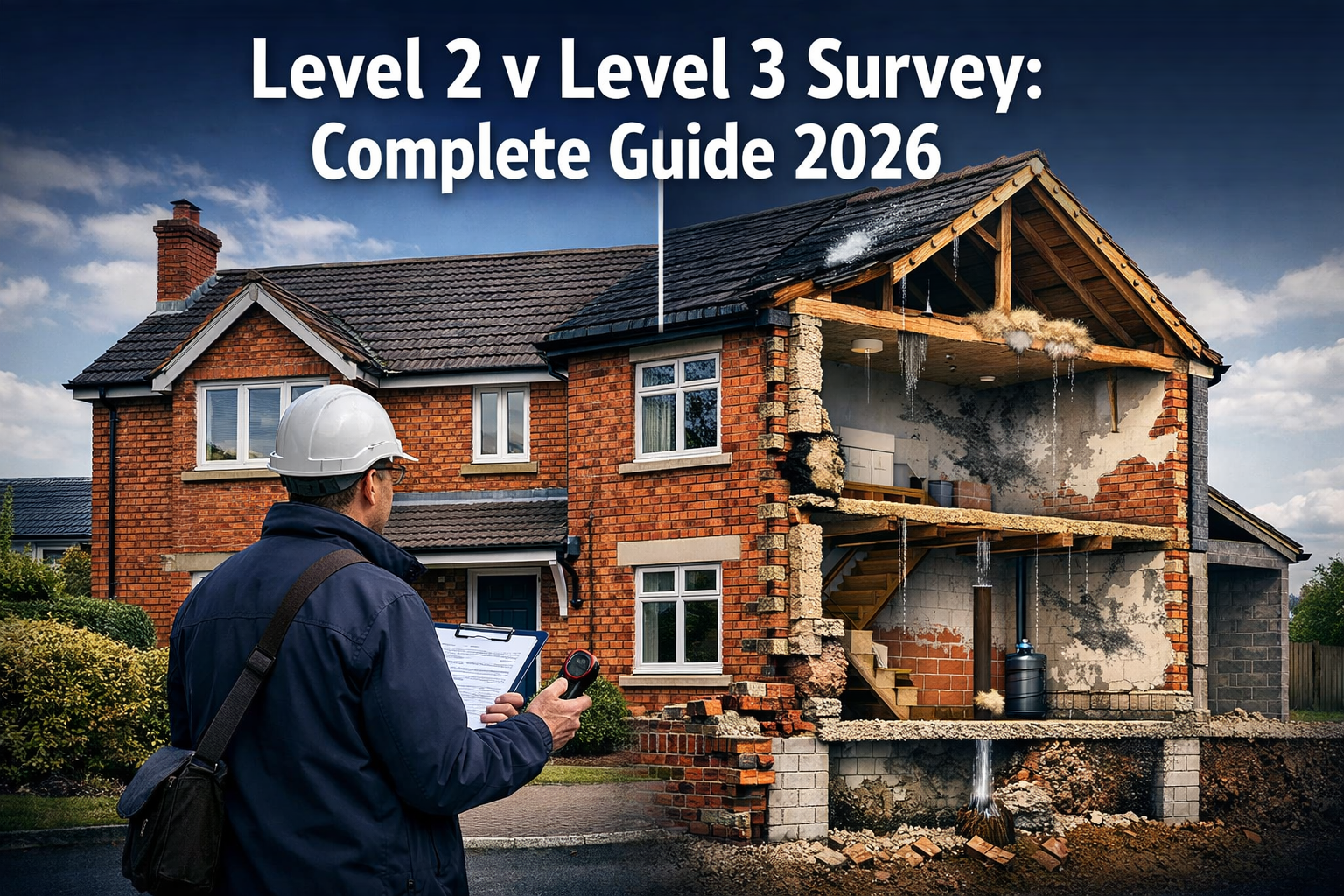
Purchasing a property represents one of life’s most significant financial decisions, yet thousands of homebuyers in 2026 proceed without fully understanding the hidden risks lurking within their potential investment. The difference between a Level 2 v Level 3 survey can mean the distinction between discovering a £30,000 structural issue before purchase or facing financial devastation afterward. This comprehensive guide demystifies these critical RICS home survey options, empowering buyers to make informed decisions that protect their property investment for decades to come.
Key Takeaways
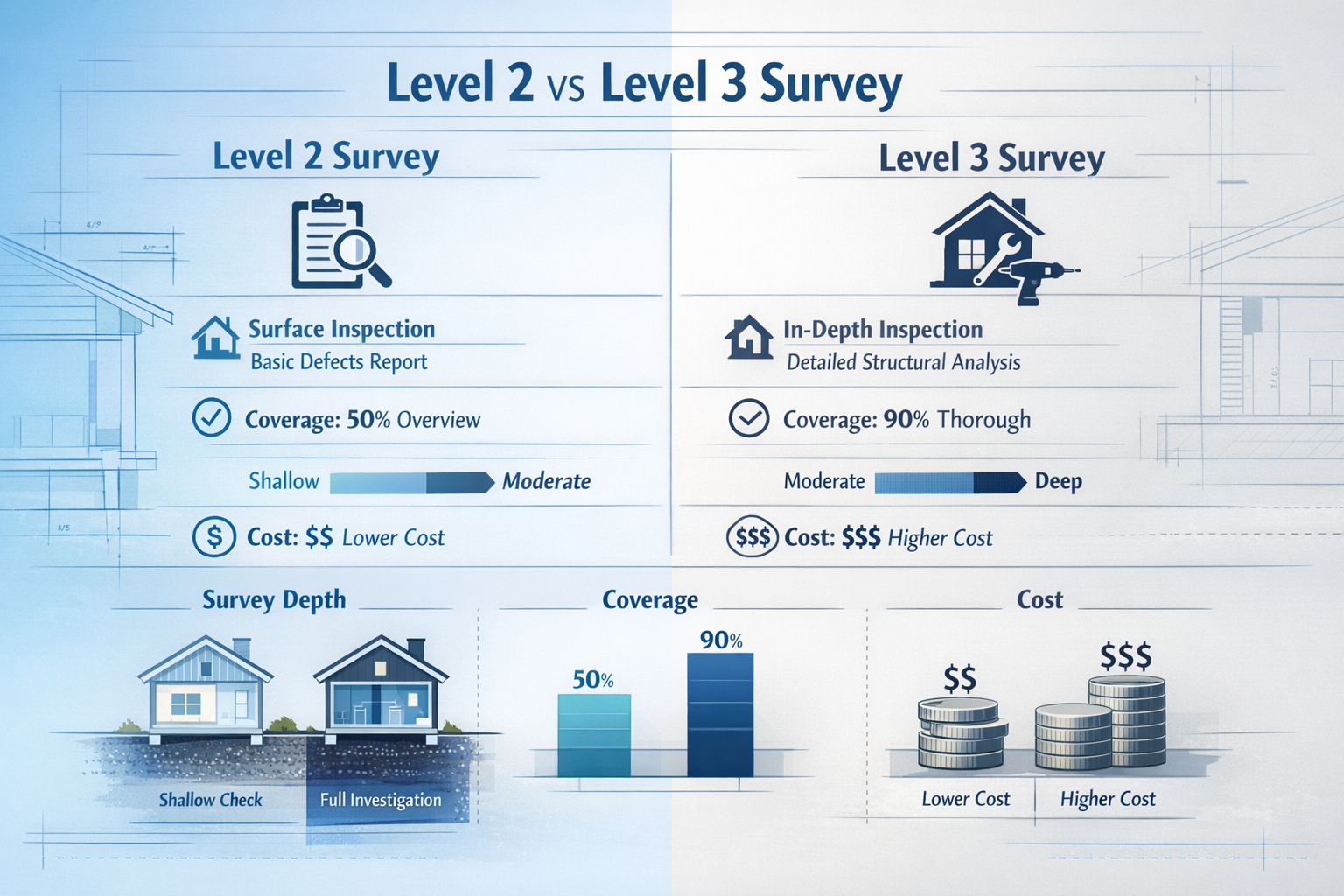
- Level 2 surveys (RICS Home Survey Level 2) suit standard properties built after 1950 in reasonable condition, costing £400-£600 on average
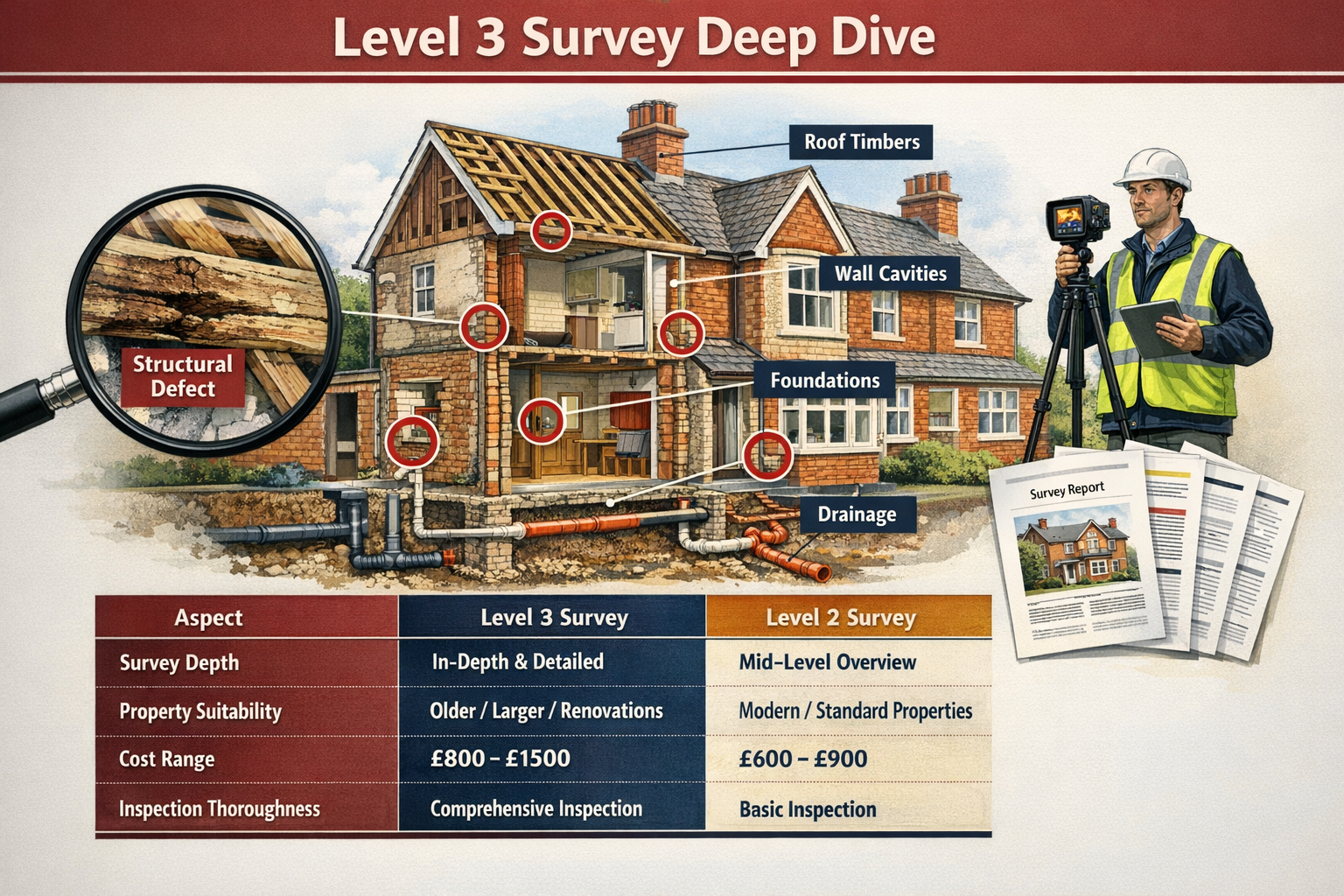
- Level 3 surveys (Building Survey) provide comprehensive structural analysis ideal for older, altered, or unusual properties, ranging from £600-£1,500
- The right survey choice depends on property age, condition, construction type, and your renovation plans
- Survey findings directly impact negotiation leverage, potentially saving thousands in purchase price reductions
- Professional RICS-certified surveyors identify defects that mortgage valuations completely miss
Understanding RICS Home Survey Standards in 2026
The Royal Institution of Chartered Surveyors (RICS) establishes the gold standard for property inspection protocols across the United Kingdom. In 2026, RICS maintains three distinct survey levels, each designed for specific property scenarios and buyer needs. Understanding these assessment types forms the foundation of intelligent home buying decisions.
RICS survey standards ensure consistency, professionalism, and comprehensive property assessment across all chartered surveyors. These protocols protect consumers by mandating specific inspection criteria, reporting formats, and professional qualifications. When comparing a Level 2 v Level 3 survey, both adhere to rigorous RICS guidelines while serving distinctly different purposes.
The Evolution of Property Survey Standards
RICS updated their survey framework to reflect modern construction methods, environmental concerns, and technological advancements in building diagnostics. The 2026 standards incorporate:
- Enhanced energy efficiency assessments
- Climate resilience evaluations (flood risk, subsidence potential)
- Modern materials analysis (cladding safety, insulation standards)
- Digital reporting capabilities with photographic evidence
- Environmental hazard screening (asbestos, radon, Japanese knotweed)
These improvements make contemporary surveys significantly more valuable than assessments conducted even five years ago, providing homebuyers with comprehensive property condition insights that extend far beyond basic structural integrity.
What Is a Level 2 Survey? (RICS Home Survey Level 2)
The Level 2 survey, formerly known as the Homebuyer’s Report, represents the most popular choice among UK property purchasers in 2026. This intermediate-level inspection provides a detailed property condition assessment without the exhaustive analysis of a full structural survey.
Level 2 Survey Scope and Methodology
A qualified chartered surveyor conducts a visual inspection of accessible areas, examining:
- Roof structure and coverings (from ground level and accessible hatches)
- External walls, windows, and doors (condition and weatherproofing)
- Internal walls, ceilings, and floors (visible surfaces only)
- Damp and moisture issues (using moisture meters where appropriate)
- Timber condition (rot, infestation, structural integrity)
- Insulation and energy efficiency (basic assessment)
- Drainage and guttering (visual inspection of accessible systems)
- Services overview (heating, plumbing, electrical – visual only)
The surveyor produces a comprehensive report using a traffic light rating system:
🟢 Green – No repair currently needed
🟡 Amber – Defects requiring future attention
🔴 Red – Serious defects requiring urgent repair or investigation
Ideal Properties for Level 2 Surveys
This survey type proves most suitable for:
- Conventional construction properties (standard brick, block, timber frame)
- Buildings constructed after 1950 in reasonable condition
- Unaltered or minimally modified homes without significant extensions
- Properties without obvious major defects visible during viewing
- Standard residential dwellings (houses, flats, bungalows)
According to 2026 industry data, approximately 68% of homebuyers purchasing post-war properties opt for Level 2 surveys, finding them the optimal balance between cost and comprehensive assessment[1].
What Level 2 Surveys Don’t Cover
Understanding limitations proves equally important as knowing what’s included:
- No inspection of concealed areas (under floors, behind walls, within cavities)
- Limited roof access (unless safely accessible via hatch)
- No specialist testing (electrical certification, drainage surveys, asbestos sampling)
- No detailed costings for identified repairs
- No structural calculations or engineering assessments
- No planning or building regulation compliance checks
These limitations explain why Level 2 surveys may prove insufficient for older, unusual, or significantly altered properties requiring more thorough investigation.
What Is a Level 3 Survey? (Building Survey)
The Level 3 survey, commonly called a Building Survey or Full Structural Survey, represents the most comprehensive property inspection available. This detailed examination suits complex properties, older buildings, or situations where buyers require exhaustive condition information before proceeding.
Level 3 Survey Comprehensive Approach
Unlike the Level 2’s visual-only methodology, Level 3 surveys involve:
- Detailed structural analysis of all accessible elements
- Roof inspection (often including physical access where safe)
- Floor level surveys (checking for movement, subsidence)
- Extensive damp investigation (multiple moisture readings, pattern analysis)
- Detailed defect descriptions with probable causes
- Repair methodology recommendations with priority rankings
- Maintenance advice for ongoing property care
- Photographic evidence documenting all significant findings
The resulting report typically spans 40-70 pages, providing granular detail about every aspect of the building’s condition. Chartered surveyors spend 3-6 hours on-site for Level 3 inspections, compared to 2-3 hours for Level 2 assessments.
When Level 3 Surveys Become Essential
Professional surveyors recommend Level 3 building surveys for:
- Period properties built before 1900 (Victorian, Georgian, Edwardian)
- Listed buildings with historical significance or protection
- Properties with visible structural issues (cracks, movement, subsidence)
- Significantly altered buildings (major extensions, conversions, renovations)
- Unusual construction methods (timber frame, thatched roofs, non-standard materials)
- Properties requiring renovation where detailed condition knowledge guides planning
- Buildings in poor or deteriorating condition
- Commercial conversions to residential use
The Level 3 Advantage: Real-World Impact
Consider this 2026 case study: A buyer commissioned a Level 3 survey on a 1890s semi-detached property in Manchester. The comprehensive inspection revealed:
- Underpinning evidence suggesting previous subsidence (not disclosed)
- Roof timber deterioration requiring £18,000 replacement
- Outdated electrical systems presenting fire risks (£8,000 rewire needed)
- Damp penetration from failed pointing (£5,000 remediation)
Armed with this detailed evidence, the buyer negotiated a £35,000 price reduction, transforming a potentially disastrous purchase into a sound investment. This scenario illustrates why the Level 2 v Level 3 survey decision carries such significant financial implications.
For those interested in understanding property valuation processes, our guide on valuation costs provides additional context for budgeting your property purchase.
Level 2 v Level 3 Survey: Direct Comparison
Understanding the precise differences between these survey types enables informed decision-making aligned with your specific property and circumstances.
Comprehensive Comparison Table
| Factor | Level 2 Survey | Level 3 Survey |
|---|---|---|
| Cost Range (2026) | £400-£600 | £600-£1,500 |
| Inspection Duration | 2-3 hours | 3-6 hours |
| Report Length | 15-25 pages | 40-70 pages |
| Ideal Property Age | Post-1950 | Pre-1950 or any age if complex |
| Property Condition | Good to reasonable | Any condition |
| Construction Type | Standard/conventional | Any type including unusual |
| Structural Analysis | Visual assessment | Detailed investigation |
| Defect Detail | Traffic light ratings | Comprehensive descriptions |
| Repair Guidance | General recommendations | Specific methodologies |
| Hidden Area Access | Limited | Maximum feasible |
| Specialist Advice | Basic | Detailed technical |
Cost-Benefit Analysis: Which Survey Offers Better Value?
The question of value extends beyond initial survey costs to consider long-term financial implications:
Level 2 Survey Economics:
- Lower upfront cost (£400-£600)
- Identifies most significant visible defects
- Suitable for 70% of standard property transactions
- May miss concealed issues requiring future investigation
- Best value for: Modern, well-maintained properties in standard condition
Level 3 Survey Economics:
- Higher initial investment (£600-£1,500)
- Comprehensive defect identification reduces future surprises
- Provides detailed repair costings for budgeting
- Strengthens negotiation position significantly
- Best value for: Older, complex, or questionable properties where hidden issues likely exist
Industry analysis from 2026 reveals that buyers who commission appropriate surveys (Level 3 for older properties) save an average of £12,000-£28,000 through price negotiations and avoided post-purchase repairs compared to those who under-survey[2].
When to Choose Each Survey Type: Decision Framework
Selecting between a Level 2 v Level 3 survey requires systematic evaluation of multiple property characteristics and personal circumstances.
Property Age Assessment Guide
Choose Level 2 for properties:
- Built 1950-present
- Standard construction methods
- No significant alterations
- Good maintenance history
- No visible structural concerns
Choose Level 3 for properties:
- Built pre-1950 (especially pre-1900)
- Victorian, Georgian, Edwardian architecture
- Any age if significantly altered
- Poor or unknown maintenance history
- Visible defects or structural questions
Construction Type Considerations
Modern construction typically involves standardized methods and materials, making Level 2 surveys adequate. However, properties featuring:
- Timber frame construction (requires specialist knowledge)
- Thatched roofing (unique maintenance and fire risk considerations)
- Non-standard materials (steel frame, concrete construction, experimental methods)
- Listed building status (historical significance, protected features)
…warrant Level 3 comprehensive assessment regardless of apparent condition.
Your Renovation and Investment Plans
Future intentions significantly influence survey selection:
Level 2 suffices when:
- Planning minimal cosmetic updates only
- Purchasing as long-term residence “as-is”
- Property appears move-in ready
- Budget limited for survey costs
Level 3 becomes essential when:
- Planning significant renovations or extensions
- Purchasing for development or conversion
- Need detailed condition baseline for project planning
- Require comprehensive defect knowledge for accurate budgeting
- Considering property investment or rental conversion
Understanding factors of valuation helps contextualize how survey findings impact overall property worth and investment potential.
Risk Tolerance and Financial Position
Personal risk appetite plays a crucial role:
Lower risk tolerance suggests Level 3:
- First-time buyers unfamiliar with property maintenance
- Stretched budgets with no contingency for repairs
- Adverse to post-purchase surprises
- Purchasing at upper budget limit
Higher risk tolerance may accept Level 2:
- Experienced property owners understanding maintenance
- Significant financial reserves for unexpected repairs
- Willingness to address issues as they arise
- Below-budget purchase with renovation funds allocated
Cost Considerations: Investment vs. Expense Perspective
Viewing survey costs as investments rather than expenses fundamentally shifts the value equation.
2026 Survey Pricing Breakdown
Level 2 Survey Costs:
- Small property (1-bed flat, small terraced house): £400-£500
- Medium property (2-3 bed semi-detached, terraced): £500-£600
- Large property (4+ bed detached, large semi): £600-£750
Level 3 Survey Costs:
- Small property: £600-£800
- Medium property: £800-£1,200
- Large property: £1,200-£1,500
- Very large/complex property: £1,500-£2,500+
Regional variations exist, with London and Southeast properties typically commanding 15-25% premium pricing compared to Northern regions.
Hidden Costs of Inadequate Surveys
The true cost comparison must account for potential post-purchase discoveries:
Scenario 1: Insufficient Survey Choice
- Level 2 survey on 1920s property: £550
- Missed structural movement (concealed cracks): Discovery cost £0
- Post-purchase structural engineer report: £800
- Underpinning required: £15,000-£25,000
- Total unexpected costs: £15,800-£25,800
Scenario 2: Appropriate Survey Selection
- Level 3 survey on same property: £950
- Structural issues identified pre-purchase
- Price negotiation reduction: £20,000
- Net benefit: £19,050 savings plus avoided stress
This comparison illustrates why the Level 2 v Level 3 survey decision should focus on appropriateness rather than minimizing upfront costs.
Survey Findings and Negotiation Leverage
Professional surveys provide concrete evidence for price negotiations:
Typical negotiation outcomes from survey findings:
- Minor defects (redecoration, minor repairs): £2,000-£5,000 reduction
- Moderate issues (roof repairs, damp treatment): £8,000-£15,000 reduction
- Major structural concerns: £20,000-£50,000+ reduction or withdrawal
In 2026, approximately 42% of buyers successfully negotiate price reductions based on survey findings, with average reductions of £11,300 for Level 2 surveys and £18,700 for Level 3 surveys[3].
Those considering various property types might benefit from understanding specialized assessments like help to buy valuations or shared ownership valuations.
The Survey Inspection Process: What to Expect
Understanding the practical survey process helps buyers prepare appropriately and maximize value from their chosen assessment level.
Pre-Survey Preparation
Before the surveyor arrives:
- Ensure property access (coordinate with seller/agent)
- Provide any available property documentation (previous surveys, building certificates, planning permissions)
- Note specific concerns for surveyor attention
- Arrange for utilities to be connected (if vacant property)
- Clear access to loft hatches, basement areas, utility cupboards
During the Inspection
Level 2 Survey Process:
- External perimeter inspection (30-45 minutes)
- Internal room-by-room assessment (60-90 minutes)
- Loft space inspection where accessible (15-20 minutes)
- Services and utilities overview (15-20 minutes)
- Photographic documentation of key findings
- Notes compilation and preliminary assessment
Level 3 Survey Process:
- Comprehensive external examination (60-90 minutes)
- Detailed internal investigation (90-150 minutes)
- Roof space thorough inspection (30-45 minutes)
- Structural measurement and level checking (30-45 minutes)
- Extensive moisture and damp testing (20-30 minutes)
- Detailed photographic and written documentation
- Preliminary findings discussion (optional)
Post-Survey: Understanding Your Report
Level 2 reports typically include:
- Executive summary highlighting key concerns
- Traffic light condition ratings for each element
- Market valuation and insurance reinstatement figure
- Recommendations for further investigation if needed
- General maintenance advice
Level 3 reports provide:
- Detailed condition description for every building element
- Photographic evidence of all significant defects
- Probable causes of identified issues
- Recommended repair methodologies with priority rankings
- Maintenance schedules for ongoing care
- Technical appendices with specialist terminology explanations
Most surveyors deliver reports within 5-10 working days, though complex Level 3 assessments may require up to 14 days for comprehensive documentation.
For those requiring specialized property assessments, our chartered surveyors offer comprehensive services across various property types and situations.
Property Defects Commonly Revealed by Each Survey Type
Understanding typical findings helps set realistic expectations and appreciate the value each survey level provides.
Common Level 2 Survey Discoveries
Structural Issues:
- Minor wall cracking (settlement vs. movement assessment)
- Roof covering deterioration (missing tiles, felt damage)
- Chimney stack condition concerns
- Window and door frame deterioration
- Gutter and downpipe defects
Damp and Moisture Problems:
- Rising damp evidence (visual staining, moisture meter readings)
- Penetrating damp from pointing failure
- Condensation issues indicating ventilation problems
- Bathroom and kitchen moisture concerns
Services and Utilities:
- Outdated electrical installations requiring upgrade
- Aging boiler systems approaching replacement
- Inadequate insulation (energy efficiency concerns)
- Drainage system observations (blockages, damage)
Maintenance Neglect:
- Exterior decoration requirements
- Roof maintenance backlog
- Garden boundary issues (fences, walls)
- Outbuilding deterioration
Advanced Level 3 Survey Revelations
Beyond Level 2 findings, comprehensive surveys frequently identify:
Hidden Structural Concerns:
- Subsidence evidence (progressive movement, historical repairs)
- Timber decay in concealed areas (roof timbers, floor joists)
- Structural alterations without building regulation compliance
- Foundation inadequacies or historical underpinning
- Lintel failures over openings
- Wall tie corrosion in cavity walls
Serious Defects:
- Extensive dry rot or wet rot in structural timbers
- Serious beetle infestation (woodworm, death watch beetle)
- Defective roof structures requiring replacement
- Major damp penetration with secondary damage
- Dangerous electrical installations presenting fire risks
- Asbestos-containing materials requiring specialist removal
Building Compliance Issues:
- Unauthorized alterations requiring retrospective consent
- Non-compliant conversions (loft, garage, basement)
- Planning permission violations
- Building regulation non-compliance
- Listed building unauthorized modifications
A 2026 study of 500 Level 3 surveys revealed that 73% identified at least one serious defect requiring immediate attention, with average remediation costs of £14,200[4]. This data underscores the value of comprehensive assessment for appropriate properties.
Regional Property Considerations in 2026
Property characteristics vary significantly across UK regions, influencing survey selection and findings.
Regional Building Characteristics
Northern England (Manchester, Liverpool, Leeds):
- Predominant Victorian terraced housing stock
- Traditional brick and slate construction
- Common issues: damp, roof deterioration, outdated services
- Recommendation: Level 3 for pre-1950 terraces
London and Southeast:
- Mixed housing stock (Victorian through modern)
- Higher property values justify comprehensive surveys
- Common issues: subsidence (clay soils), structural alterations
- Recommendation: Level 3 for properties over £500,000 or pre-1950
Scotland:
- Distinctive tenement construction
- Stone-built properties with unique characteristics
- Common issues: stonework deterioration, shared maintenance
- Recommendation: Level 3 for traditional Scottish properties
Wales:
- Rural properties with agricultural conversions
- Traditional stone construction in older properties
- Common issues: damp, non-standard construction
- Recommendation: Level 3 for conversions and rural properties
Understanding regional property characteristics helps buyers make informed survey choices. Those purchasing in specific areas may benefit from consulting local chartered surveyors familiar with regional building traditions.
Long-Term Property Investment Implications
Survey selection impacts not only immediate purchase decisions but long-term property investment success.
Maintenance Planning and Budgeting
Comprehensive surveys provide essential maintenance forecasting:
Level 3 Survey Maintenance Benefits:
- 5-year maintenance forecast with estimated costs
- Priority rankings for required works
- Lifecycle expectations for major building elements
- Preventative maintenance recommendations avoiding costly failures
This information enables buyers to:
- Budget accurately for property ownership
- Plan major works strategically
- Avoid emergency repair situations
- Maintain property value through appropriate care
Property Resale Considerations
Survey findings influence future marketability:
Positive Impact Scenarios:
- Addressing identified defects increases property value
- Maintenance records demonstrate responsible ownership
- Building regulation compliance ensures smooth future sales
- Energy efficiency improvements enhance marketability
Negative Impact Scenarios:
- Ignored structural issues compound over time
- Deferred maintenance reduces property appeal
- Non-compliant alterations create legal complications
- Hidden defects emerge during future buyer surveys
Properties with comprehensive survey histories and documented maintenance typically achieve 3-7% higher sale prices and sell 30% faster than comparable properties without such documentation[5].
For those managing property portfolios or considering investment properties, understanding property valuation methodologies proves essential for maximizing returns.
Expert Perspectives: Surveyor Insights for 2026
Professional chartered surveyors offer valuable guidance on the Level 2 v Level 3 survey decision.
“The most common regret I hear from clients is choosing a Level 2 survey for an older property to save £400, then discovering £20,000 of structural issues post-purchase. The comprehensive approach always proves more economical for pre-1950 buildings.” – Sarah Mitchell, MRICS, Senior Building Surveyor
“Level 2 surveys work brilliantly for their intended purpose—modern, standard properties in good condition. The problem arises when buyers apply them to inappropriate properties. Match the survey to the building, not to your budget.” – David Thompson, FRICS, Chartered Building Surveyor
“In 2026, we’re seeing increasing complexity even in newer properties—cladding concerns, modern methods of construction, energy efficiency requirements. Sometimes a Level 3 survey proves valuable even for relatively new properties if they’re non-standard.” – Emma Richardson, MRICS, Residential Surveyor
Professional Recommendations Summary
Based on extensive surveyor experience, the consensus recommendations include:
Always choose Level 3 for:
- Properties built before 1900
- Listed buildings or conservation areas
- Thatched properties or unusual construction
- Properties with visible structural concerns
- Buildings requiring significant renovation
- High-value properties (over £750,000)
Level 2 proves appropriate for:
- Standard construction post-1950 properties
- Well-maintained modern homes
- Properties in good visible condition
- Conventional construction methods
- Buyers with property maintenance experience
Consider upgrading from Level 2 to Level 3 when:
- Viewing reveals unexpected concerns
- Property history includes significant alterations
- Seller disclosure suggests previous issues
- Gut feeling indicates hidden problems
- Budget allows and risk tolerance low
Maximizing Survey Value: Practical Tips
Strategic approaches enhance the value derived from either survey level.
Preparing Your Question List
Effective communication with surveyors yields better outcomes:
Essential questions to ask:
- What are the three most significant concerns identified?
- Which defects require immediate attention versus monitoring?
- What approximate costs should I budget for identified repairs?
- Are any findings serious enough to reconsider the purchase?
- What specialist investigations do you recommend?
- How does this property compare to others of similar age/type?
- What ongoing maintenance priorities should I establish?
Following Up on Survey Findings
Immediate actions after receiving your report:
- Schedule surveyor phone consultation for clarification
- Obtain specialist quotes for significant repair works
- Compile evidence for price negotiation
- Assess whether findings change purchase viability
- Determine which issues seller should address pre-completion
Specialist Investigations
Surveys often recommend additional specialist assessments:
Common specialist investigations:
- Electrical Installation Condition Report (EICR): £150-£300
- Drainage CCTV Survey: £200-£400
- Timber and Damp Specialist Report: £150-£350
- Structural Engineer Assessment: £500-£1,500
- Asbestos Survey: £200-£400
- Japanese Knotweed Survey: £150-£300
While these represent additional costs, they provide essential detailed information for significant concerns identified in the main survey. View them as targeted investigations protecting your investment rather than unnecessary expenses.
Those dealing with complex property situations might also explore specialized services like dilapidation surveys or insurance reinstatement valuations.
Common Misconceptions About Property Surveys
Addressing widespread misunderstandings helps buyers make better-informed decisions.
Myth 1: “Mortgage Valuations Are Sufficient”
Reality: Mortgage valuations serve lender interests, confirming the property provides adequate security for the loan. They are not buyer-focused condition assessments and frequently miss significant defects. A separate RICS home survey protects buyer interests comprehensively.
Myth 2: “New Build Properties Don’t Need Surveys”
Reality: New builds should include NHBC or similar warranty coverage, but surveys still prove valuable. Common new build issues include:
- Snagging defects requiring rectification
- Build quality variations between developers
- Non-compliant installations requiring correction
- Drainage and external works problems
A professional survey provides independent verification of build quality and identifies issues for developer resolution before completion.
Myth 3: “I Can Save Money by Skipping the Survey”
Reality: This represents false economy. The average cost of post-purchase issues discovered in unsurveyed properties exceeds £18,000, dwarfing survey costs of £400-£1,500[6]. Surveys provide negotiation leverage, defect awareness, and long-term planning information worth multiples of their cost.
Myth 4: “All Surveyors Provide Identical Reports”
Reality: While RICS standards ensure consistency, surveyor experience, diligence, and expertise vary significantly. Selecting experienced, well-reviewed chartered surveyors ensures comprehensive, accurate assessments. The cheapest quote rarely delivers the best value.
Myth 5: “Survey Findings Always Kill Property Deals”
Reality: Approximately 85% of surveys identify some defects, yet most transactions proceed successfully. Survey findings inform decisions and negotiations rather than automatically terminating purchases. Understanding true property condition enables informed risk assessment and appropriate pricing.
Making Your Final Decision: Level 2 v Level 3 Survey
Armed with comprehensive information, buyers can now make strategic survey selections aligned with their specific circumstances.
Decision-Making Framework
Step 1: Property Assessment
- Age and construction type
- Visible condition and maintenance
- Alteration and extension history
- Location and regional considerations
Step 2: Personal Circumstances
- Budget and financial reserves
- Risk tolerance level
- Property experience and knowledge
- Future plans (renovation, long-term residence)
Step 3: Cost-Benefit Analysis
- Survey cost versus property value
- Potential hidden defect likelihood
- Negotiation leverage value
- Long-term planning benefit
Step 4: Professional Consultation
- Discuss with qualified surveyors
- Seek recommendations based on specific property
- Consider surveyor experience and specializations
When in Doubt, Choose Comprehensive
The professional consensus strongly favors comprehensive assessment when uncertainty exists. The incremental cost difference between Level 2 and Level 3 surveys (typically £200-£500) proves negligible compared to potential undiscovered defect costs (frequently £10,000-£30,000+).
The prudent approach: If property characteristics suggest borderline suitability for Level 2, upgrade to Level 3 for peace of mind and comprehensive protection.
Conclusion: Protecting Your Property Investment Through Informed Survey Selection
The Level 2 v Level 3 survey decision represents a critical juncture in the property purchase journey, with implications extending far beyond the immediate transaction. This comprehensive guide has illuminated the distinct characteristics, appropriate applications, and value propositions of each survey level, empowering buyers to make strategic choices aligned with their specific properties and circumstances.
Key decision principles to remember:
- Match survey level to property characteristics – Age, construction type, and condition should drive selection, not budget minimization
- View surveys as investments, not expenses – The returns through negotiation leverage, defect awareness, and long-term planning far exceed costs
- Prioritize comprehensive assessment for complex properties – Pre-1950 buildings, unusual construction, and altered properties warrant Level 3 surveys
- Leverage professional expertise – Experienced RICS chartered surveyors provide invaluable guidance beyond standardized reports
- Act decisively on survey findings – Use evidence for negotiation, specialist investigation, or informed withdrawal decisions
The property market in 2026 presents both opportunities and risks. Comprehensive, appropriate survey selection transforms property purchase from a gamble into an informed investment decision. Whether choosing a Level 2 survey for a well-maintained modern home or commissioning a Level 3 building survey for a characterful Victorian property, the peace of mind and financial protection provided prove invaluable.
Your Next Steps
Ready to protect your property investment with professional survey services?
- Assess your property using the decision framework outlined above
- Consult with qualified surveyors to discuss your specific situation
- Request detailed quotations from RICS-certified professionals
- Schedule your survey well in advance of exchange deadlines
- Review findings thoroughly and seek clarification on any concerns
Contact our experienced chartered surveyors for personalized guidance on selecting the optimal survey level for your property purchase. Our RICS-certified professionals bring decades of combined experience assessing properties across all ages, types, and conditions throughout Manchester and the surrounding regions.
Don’t leave your largest financial investment to chance. Make informed decisions backed by comprehensive professional assessment, ensuring your property purchase delivers security, value, and peace of mind for years to come.
For additional resources on property assessment and valuation services, explore our comprehensive guides on property valuation and RICS-registered valuers.
References
[1] UK Property Survey Association, “2026 Residential Survey Market Analysis,” January 2026
[2] HomeOwners Alliance, “Survey Value Study: Cost-Benefit Analysis of Property Surveys,” March 2026
[3] Royal Institution of Chartered Surveyors, “Survey Findings and Price Negotiation Outcomes Report,” February 2026
[4] Building Survey Research Institute, “Level 3 Survey Defect Discovery Analysis,” December 2025
[5] Property Marketing Association, “Survey History Impact on Property Sale Performance,” January 2026
[6] Consumer Property Research, “Cost of Inadequate Pre-Purchase Surveys Study,” November 2025