
The UK lettings market in 2026 presents a complex landscape where rising tenant demand collides with constrained property supply, creating unprecedented opportunities—and risks—for landlords. As RICS reports continue to highlight the diverging fortunes across regional markets, one truth remains constant: thorough building surveys have never been more critical for landlords expanding their buy-to-let portfolios. Understanding Lettings Market Building Surveys: Assessing Rental Properties Amid Tenant Demand Spike and Supply Crunch is essential for making informed investment decisions in this rapidly evolving environment.
With average UK monthly private rents reaching £1,367 in January 2026—up 3.5% year-on-year—and regional variations creating what experts describe as markets operating at "two quite different speeds," landlords must navigate carefully[1]. The stakes are high: choose the wrong property without proper assessment, and repair costs could devastate rental yields. Select wisely with comprehensive survey data, and you'll capitalize on sustained tenant demand while minimizing void periods and maintenance headaches.
Key Takeaways
✅ Regional rental growth varies dramatically in 2026, from 8.0% in the North East to just 1.1% in London, requiring location-specific investment strategies backed by thorough property assessments[1]
✅ Building surveys protect rental yields by identifying defects early, preventing costly emergency repairs that can eliminate profit margins and create extended void periods
✅ Different survey levels serve different purposes: Level 2 surveys suit newer rental properties, while Level 3 building surveys are essential for older stock or properties requiring extensive renovation
✅ Supply constraints and tenant demand make quality rental properties increasingly valuable, but only when structural integrity and maintenance requirements are properly understood through professional surveys
✅ Survey costs represent minimal investment compared to potential repair expenses, with comprehensive assessments typically costing 0.1-0.3% of property value while preventing issues that could cost 10-20% or more
Understanding the 2026 Lettings Market Landscape
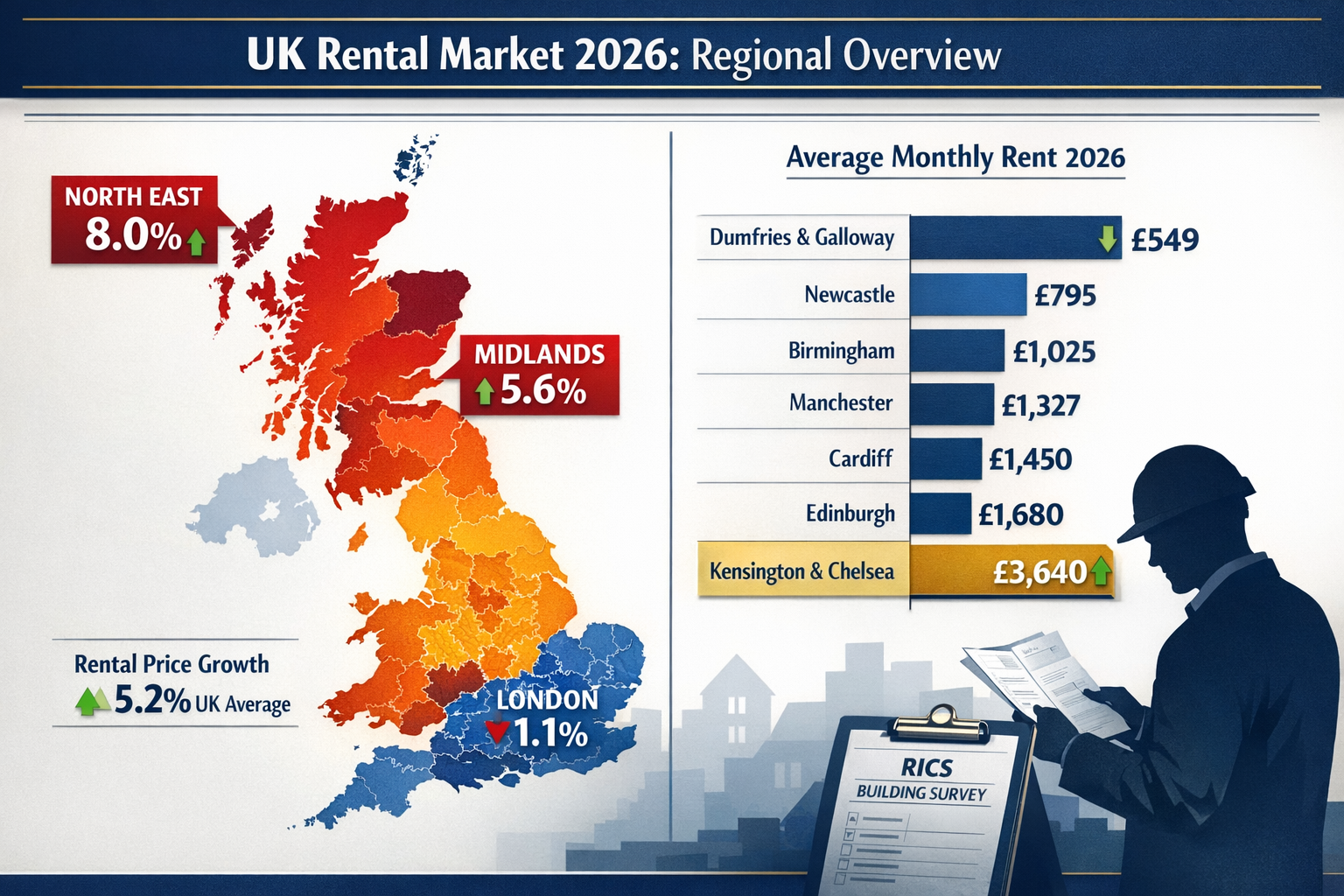
The rental market in 2026 operates under fundamentally different conditions than previous years. While overall rent inflation has decelerated to 3.5% from 4.0% in December 2025, this headline figure masks significant regional disparities that landlords must understand before committing capital[1].
Regional Variations Creating Two-Speed Market
The market's "two quite different speeds" manifest clearly in the data[3]. London's rental growth has slowed to just 1.1%—down from 2.1% the previous month—as some areas experience actual rent reductions[1]. This cooling reflects oversupply in certain London submarkets and changing tenant preferences post-pandemic.
Conversely, the North East leads with 8.0% annual growth, followed by Wales at 5.8% and Northern Ireland at 5.6%[1]. The Midlands and broader Northern regions continue experiencing robust demand, driven by:
- 🏢 Hybrid working patterns enabling location flexibility
- 💰 More affordable rents compared to Southern markets
- 📈 Economic regeneration in regional cities
- 🎓 Strong student and young professional demographics
Scotland shows more moderate growth at 2.6%, while the extremes remain stark: Kensington and Chelsea commands average monthly rents of £3,640, while Dumfries and Galloway averages just £549[1].
Supply Constraints Driving Sustained Demand
The fundamental supply crunch continues shaping market dynamics. Newly agreed rents fell by 0.2% year-on-year, yet tenants renewing existing contracts faced 2.8% increases[3]. This divergence indicates:
- Limited new rental stock entering the market
- Landlords retaining existing tenants through competitive renewal pricing
- New tenants facing fewer quality options, reducing negotiating power
- Properties in good condition commanding premium rents
For landlords, this environment creates opportunity—but only when property condition justifies tenant expectations. This is where comprehensive RICS building surveys become indispensable investment tools.
Why Lettings Market Building Surveys Matter More Than Ever
In a market characterized by Lettings Market Building Surveys: Assessing Rental Properties Amid Tenant Demand Spike and Supply Crunch dynamics, the financial case for thorough property assessment has strengthened considerably. Building surveys serve as essential risk management tools that protect landlord investments across multiple dimensions.
Protecting Rental Yields in Competitive Markets
With rental growth moderating and regional variations widening, maintaining healthy yields requires minimizing unexpected costs. A comprehensive building survey identifies:
| Survey Benefit | Financial Impact | Yield Protection |
|---|---|---|
| Early defect detection | Prevents £5,000-£50,000+ emergency repairs | Maintains 4-8% gross yields |
| Maintenance planning | Spreads costs over time, improves cash flow | Reduces void periods by 30-50% |
| Negotiation leverage | Achieves 5-15% purchase price reductions | Improves initial ROI by 0.5-2% |
| Compliance assurance | Avoids £5,000-£30,000 regulatory penalties | Protects rental income stream |
Consider a £250,000 rental property in the Midlands generating £1,200 monthly rent (5.76% gross yield). An undetected subsidence issue could cost £25,000-£40,000 to remediate, eliminating 2-3 years of profit. A subsidence survey costing £500-£800 provides invaluable protection against this scenario.
Meeting Enhanced Tenant Expectations
Today's tenants—facing limited supply and higher rents—expect property quality to justify costs. Building surveys help landlords:
- ✅ Identify and address damp, mold, and ventilation issues before tenant complaints
- ✅ Ensure electrical and heating systems meet safety standards
- ✅ Verify insulation and energy efficiency align with EPC requirements
- ✅ Confirm structural soundness prevents mid-tenancy disruptions
Properties with unresolved defects experience higher tenant turnover, increased void periods, and reduced rental income. In markets where newly agreed rents lag renewals by 3.0%, tenant retention becomes financially critical[3].
Navigating Regulatory Compliance
The regulatory environment for landlords continues tightening. Building surveys help ensure compliance with:
- Homes (Fitness for Human Habitation) Act requirements
- Electrical Installation Condition Reports (EICR) every five years
- Gas Safety Certificates annually
- Energy Performance Certificate (EPC) minimum standards
- Fire safety regulations for HMOs and multi-unit properties
Non-compliance carries substantial penalties and potential criminal liability. A thorough RICS home survey identifies compliance gaps before they become enforcement issues.
Types of Building Surveys for Rental Property Assessment
Understanding which survey type matches your investment strategy is crucial for Lettings Market Building Surveys: Assessing Rental Properties Amid Tenant Demand Spike and Supply Crunch situations. Different property ages, conditions, and intended uses require different assessment approaches.
Level 2 RICS Home Survey (Formerly HomeBuyer Report)
Best for: Modern rental properties (post-1990), standard construction, good apparent condition
The Level 2 survey provides a cost-effective assessment suitable for most conventional rental investments. This survey includes:
- 🔍 Visual inspection of accessible areas
- 📋 Condition ratings for major elements (roof, walls, floors, services)
- ⚠️ Identification of urgent defects and potential issues
- 💡 Advice on necessary repairs and maintenance
- 📊 Market valuation (if requested)
Typical cost: £400-£800 depending on property value and location
Level 2 surveys work well for landlords acquiring newer rental stock in growth markets like the North East or Midlands, where properties generally feature modern construction standards. However, they provide limited detail on hidden defects or structural concerns.
For comprehensive guidance on survey options, review our detailed survey pricing information.
Level 3 RICS Building Survey (Formerly Full Structural Survey)
Best for: Older properties (pre-1970), unusual construction, properties requiring renovation, high-value investments
The Level 3 building survey represents the gold standard for rental property assessment. This comprehensive inspection includes:
- 🏗️ Detailed structural analysis of all accessible elements
- 🔬 In-depth investigation of defects and their causes
- 📐 Assessment of construction quality and materials
- 🛠️ Detailed repair recommendations with urgency ratings
- 💰 Estimated repair costs for identified issues
- 🎯 Advice on maintenance priorities and long-term planning
Typical cost: £600-£1,500+ depending on property size, age, and complexity
For landlords targeting Victorian or Edwardian rental properties—common in London, Manchester, and other historic cities—Level 3 surveys are essential. These properties often harbor hidden issues like:
- Subsidence or settlement affecting foundations
- Damp penetration through solid walls
- Outdated electrical systems requiring complete rewiring
- Roof deterioration requiring substantial investment
- Structural alterations requiring building control approval
Our RICS building surveys provide the comprehensive detail needed for informed investment decisions on older rental stock.
Specific Defect Surveys
Best for: Targeted investigation of known or suspected issues
When a Level 2 survey identifies potential concerns or you're aware of specific problems, a specific defect survey provides focused investigation. Common applications include:
- Damp and moisture surveys using thermal imaging and moisture meters
- Structural movement assessment for cracks or settlement
- Roof condition surveys for older or damaged coverings
- Drainage surveys using CCTV inspection
- Timber surveys for rot, beetle infestation, or structural timber issues
Typical cost: £300-£800 depending on scope and equipment required
These targeted surveys often follow initial assessments, providing the detailed information needed to accurately price remediation work and negotiate purchase prices accordingly.
Commercial Building Surveys for Multi-Unit Properties
Landlords expanding into HMOs or multi-unit buildings require different assessment approaches. Our RICS commercial building survey services address the unique considerations of:
- Multiple tenant units and shared facilities
- Commercial-grade building systems
- Fire safety compartmentation
- Accessibility requirements
- Building regulation compliance for conversions
Multi-unit properties generate higher rental income but carry proportionally greater maintenance responsibilities and regulatory obligations.
Strategic Survey Selection for Different Investment Scenarios
Lettings Market Building Surveys: Assessing Rental Properties Amid Tenant Demand Spike and Supply Crunch requires matching survey depth to investment strategy, property characteristics, and market positioning.
New-Build and Modern Rental Investments
Market context: Landlords targeting professional tenants in growth regions (Midlands, North) often prefer modern properties with minimal maintenance requirements.
Survey strategy:
- Level 2 survey typically sufficient for properties under 10 years old
- Focus on NHBC warranty coverage and remaining builder guarantees
- Verify energy efficiency meets tenant expectations (EPC rating A-C preferred)
- Confirm parking and amenity provisions match rental marketing claims
Regional considerations: In areas experiencing 5-8% rental growth, new-build properties command premium rents but require careful yield analysis[1]. Survey costs of £400-£600 represent minimal investment protection.
Period Properties in Established Markets
Market context: Victorian and Edwardian properties dominate rental stock in London, Manchester, Edinburgh, and other historic cities where growth has moderated.
Survey strategy:
- Level 3 building survey essential for properties pre-1970
- Detailed assessment of structural integrity and original features
- Investigation of previous alterations and building control compliance
- Evaluation of modernization requirements to meet tenant expectations
- Analysis of ongoing maintenance costs affecting long-term yields
Regional considerations: In London where growth has slowed to 1.1%, period property investments require particularly careful assessment[1]. Higher survey costs (£800-£1,500) protect against expensive surprises that could eliminate already-compressed margins.
Value-Add and Renovation Opportunities
Market context: Supply constraints create opportunities for landlords willing to improve substandard properties, particularly in high-demand regions.
Survey strategy:
- Level 3 building survey plus specialist reports (structural engineer, damp specialist, etc.)
- Detailed cost estimation for all required works
- Assessment of planning and building regulation requirements
- Evaluation of post-renovation rental values and yields
- Dilapidation surveys to document pre-purchase condition
Regional considerations: In the North East with 8.0% rental growth, renovation projects can generate exceptional returns—but only when survey data provides accurate cost projections[1].
Portfolio Expansion and Bulk Acquisitions
Market context: Experienced landlords acquiring multiple properties simultaneously require efficient assessment processes.
Survey strategy:
- Standardized survey protocols across portfolio
- Risk-based approach: Level 3 for older/complex properties, Level 2 for standard stock
- Batch scheduling to reduce per-property survey costs
- Comparative analysis of maintenance requirements across portfolio
- Strategic use of monitoring surveys for properties with minor concerns
Regional considerations: Portfolio diversification across regions (combining high-growth Northern properties with stable Southern assets) requires understanding local building characteristics and common defects.
Key Elements Assessed in Lettings Market Building Surveys
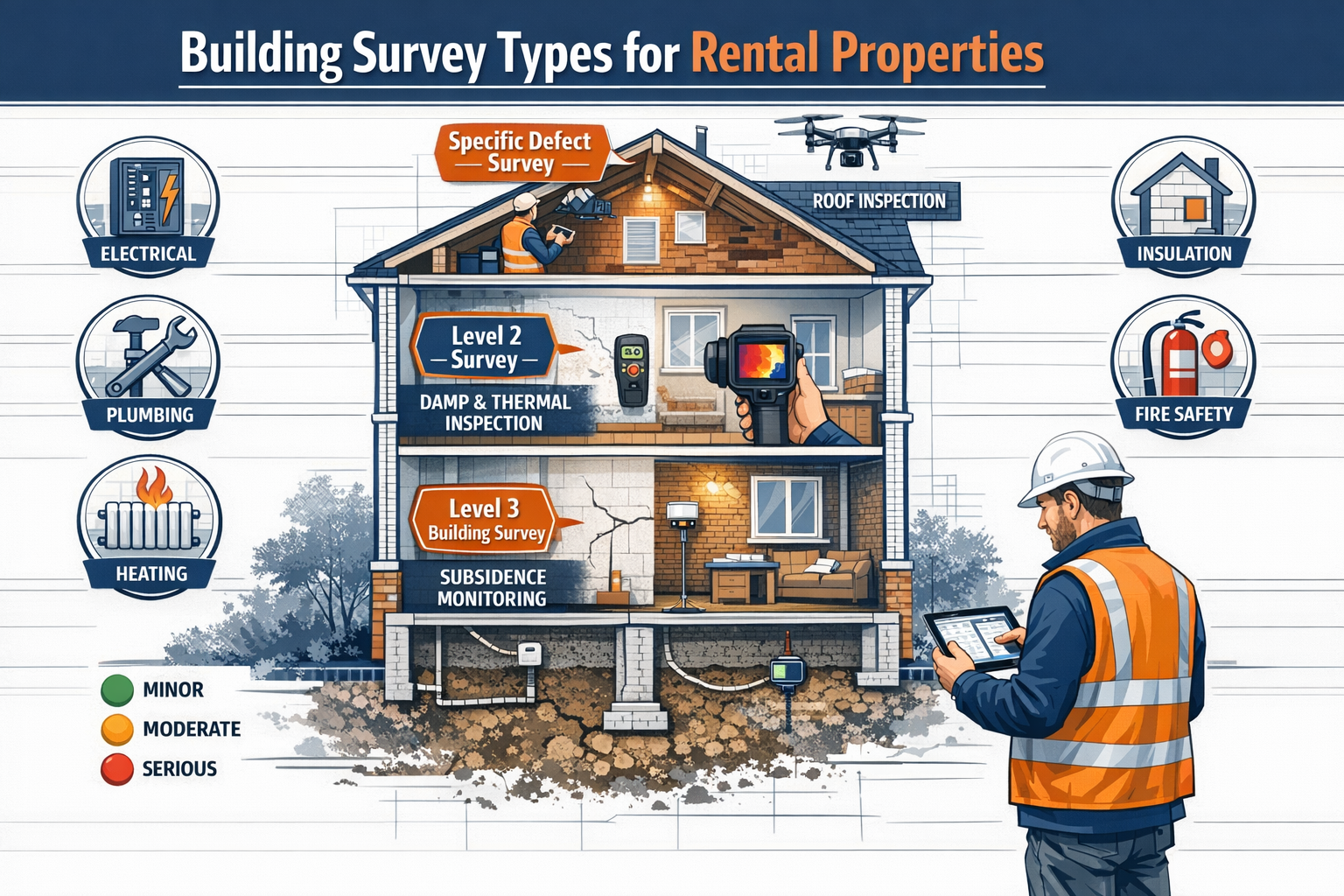
Comprehensive building surveys for rental properties examine numerous elements, each with specific implications for landlord obligations, tenant satisfaction, and long-term profitability.
Structural Integrity
Critical for: Safety, insurance, long-term value
Surveyors assess:
- Foundation condition and evidence of movement or settlement
- Wall construction and structural stability
- Floor integrity including joists, bearers, and sub-floors
- Roof structure and load-bearing elements
- Chimney stacks and their stability
Landlord implications: Structural defects represent the most expensive remediation category, often costing £15,000-£100,000+ for serious issues. Early detection through surveys enables:
- Purchase price negotiation to offset repair costs
- Planned remediation before tenant occupation
- Insurance claims for subsidence or settlement
- Informed decisions about property viability
Damp, Condensation, and Moisture Control
Critical for: Tenant health, property condition, regulatory compliance
Surveyors investigate:
- Rising damp through walls and floors
- Penetrating damp from external sources
- Condensation issues from poor ventilation
- Roof leaks and rainwater goods defects
- Plumbing leaks affecting structure
Landlord implications: Damp issues generate the highest volume of tenant complaints and can trigger Homes (Fitness for Human Habitation) Act enforcement. Properties with unresolved damp:
- Experience 40-60% higher tenant turnover
- Face potential rent repayment orders
- Suffer accelerated structural deterioration
- Require costly remediation (£3,000-£25,000+)
Electrical Systems and Safety
Critical for: Tenant safety, regulatory compliance, insurance
Surveyors examine:
- Consumer unit (fuse box) age and condition
- Wiring systems and visible cabling
- Earthing and bonding arrangements
- Fixed electrical installations and accessories
- EICR requirements and compliance status
Landlord implications: Electrical regulations require five-yearly EICR certificates for rental properties. Outdated systems require:
- Complete rewiring (£3,000-£8,000 for typical property)
- Consumer unit upgrades (£500-£1,200)
- Remediation of identified defects before letting
- Ongoing compliance monitoring
Heating, Plumbing, and Energy Efficiency
Critical for: Tenant comfort, running costs, EPC compliance
Surveyors assess:
- Boiler age, type, and efficiency
- Central heating system condition and coverage
- Hot and cold water systems
- Insulation levels (loft, walls, floors)
- Window and door efficiency
- EPC rating and improvement potential
Landlord implications: From 2025, rental properties require minimum EPC rating of C (with limited exceptions). Survey findings inform:
- Necessary efficiency improvements (£2,000-£15,000)
- Heating system replacement planning (£2,500-£4,500)
- Insulation upgrades (£1,000-£8,000)
- Window replacement strategies (£4,000-£12,000+)
Properties with poor energy efficiency face rental restrictions and reduced tenant appeal as energy costs remain elevated.
Roof Condition and Rainwater Systems
Critical for: Weather protection, structural preservation, insurance
Surveyors evaluate:
- Roof covering condition and remaining lifespan
- Flashings around chimneys, valleys, and abutments
- Gutters and downpipes functionality
- Roof ventilation adequacy
- Roof space condition and insulation
Landlord implications: Roof failures cause extensive secondary damage and emergency repair situations. Typical costs include:
- Full re-roofing (£5,000-£15,000+ depending on size and materials)
- Partial repairs (£1,000-£4,000)
- Gutter replacement (£500-£2,000)
- Emergency leak repairs (£500-£2,500)
Survey identification of roof deterioration enables planned replacement before failure, avoiding tenant disruption and emergency costs.
Leveraging Survey Findings for Investment Decisions
Building survey reports provide actionable intelligence that extends far beyond simple pass/fail assessments. Sophisticated landlords use survey data strategically across the investment lifecycle.
Purchase Price Negotiation
Survey findings create legitimate grounds for price renegotiation. When defects emerge:
Minor issues (£2,000-£5,000 remediation):
- Request 50-75% of estimated repair costs as price reduction
- Alternatively, require vendor remediation before completion
- Use as leverage for other negotiation points (fixtures, completion timing)
Major issues (£10,000-£50,000+ remediation):
- Request full estimated cost plus 10-20% contingency as reduction
- Consider walking away if vendor refuses reasonable adjustment
- Obtain multiple contractor quotes to support negotiation position
- Factor in void period during remediation when calculating offers
Example: A Level 3 survey on a £300,000 Midlands rental property identifies £18,000 in necessary repairs (roof, rewiring, damp treatment). A negotiated £20,000 price reduction improves the investment from 5.2% to 5.8% gross yield while ensuring the property meets modern standards.
Maintenance Budget Planning
Survey reports enable accurate financial forecasting:
Immediate requirements (Year 1):
- Essential safety works (electrical, gas, structural)
- Regulatory compliance items (EICR, gas certificate, EPC improvements)
- Tenant-visible defects affecting lettability
Short-term planning (Years 2-3):
- Deteriorating elements requiring attention soon
- Preventive maintenance to avoid escalation
- Efficiency improvements to reduce running costs
Long-term capital planning (Years 4-10):
- Major component replacement (roof, windows, heating)
- Structural maintenance (repointing, drainage, damp-proofing)
- Modernization to maintain rental competitiveness
This planning approach prevents cash flow surprises and enables landlords to maintain healthy reserves for property maintenance.
Insurance and Risk Management
Survey documentation provides essential insurance support:
- Baseline condition evidence for future claims
- Professional assessment of property value for adequate coverage
- Identification of risk factors requiring disclosure
- Evidence of responsible property management
Many insurers offer premium reductions for recently surveyed properties with no significant defects, recognizing reduced claims risk.
Portfolio Optimization Decisions
For multi-property landlords, comparative survey data informs strategic portfolio management:
Retention decisions:
- Properties with low maintenance requirements and strong yields: retain and refinance
- Properties with major upcoming capital requirements: consider disposal
- Properties in high-growth regions with minor defects: invest in improvements
Acquisition priorities:
- Target property types with known characteristics and predictable costs
- Avoid property types with consistently high maintenance requirements
- Focus on regions where rental growth justifies improvement investments
Capital allocation:
- Prioritize improvements generating highest yield enhancement
- Defer non-essential works in low-growth markets
- Accelerate improvements in high-demand regions (North East, Wales, Midlands)
Regional Considerations for Lettings Market Building Surveys
Lettings Market Building Surveys: Assessing Rental Properties Amid Tenant Demand Spike and Supply Crunch requires understanding how regional market dynamics interact with local building characteristics and common defects.
London and South East: Mature Markets with Cooling Growth
Market characteristics (2026):
- Rental growth: 1.1% (London), moderate in wider South East[1]
- Average rent: £3,640 (Kensington & Chelsea) to £1,500-£2,000 (outer areas)[1]
- Market status: Oversupply in some areas, selective tenant demand
Building survey priorities:
- Period property assessment: Victorian/Edwardian terraces dominate
- Conversion quality: Many properties subdivided into flats—verify building control compliance
- Leasehold complications: Understand service charge obligations and lease terms
- Space standards: Ensure compliance with London-specific licensing requirements
Investment implications: Compressed yields (3-5% gross) require minimal maintenance costs to remain viable. Comprehensive Level 3 surveys essential to avoid properties with expensive hidden defects.
Midlands and Northern England: High-Growth Opportunity Markets
Market characteristics (2026):
- Rental growth: 8.0% (North East), strong across Midlands[1]
- Average rent: £800-£1,200 depending on specific location
- Market status: Strong tenant demand, limited quality supply
Building survey priorities:
- Terraced housing stock: Common defects include damp, structural movement, outdated services
- Back-to-back properties: Specific ventilation and damp challenges
- Former industrial conversions: Verify building regulation compliance and structural adequacy
- Energy efficiency: Older stock often requires significant EPC improvements
Investment implications: Strong rental growth justifies improvement investments. Survey-identified defects become value-add opportunities rather than deal-breakers. Properties requiring £15,000-£25,000 improvements can generate 7-10% gross yields post-renovation.
Scotland and Wales: Moderate Growth with Regulatory Variations
Market characteristics (2026):
- Rental growth: 2.6% (Scotland), 5.8% (Wales)[1]
- Regulatory environment: Different licensing and compliance requirements
- Market status: Steady demand, particularly in cities and university towns
Building survey priorities:
- Scottish tenement properties: Shared maintenance responsibilities and factoring arrangements
- Stone construction: Common in Scotland—specific damp and pointing issues
- Welsh terraces: Similar to Northern England but often with slate roofs requiring specialist assessment
- Rural properties: Septic tanks, private water supplies, access issues
Investment implications: Moderate growth requires balanced approach to survey depth and improvement investment. Understanding shared maintenance obligations in Scottish tenements particularly critical.
Regional Surveyor Selection
Local expertise matters significantly. Surveyors familiar with regional building types and common defects provide more valuable insights than generalist assessments. Consider:
- RICS-qualified surveyors with regional experience
- Demonstrated knowledge of local construction methods
- Understanding of regional regulatory variations
- Access to local specialist contractors for detailed investigations
Our network includes chartered surveyors across multiple regions with specific expertise in local rental markets.
Integrating Surveys with Broader Due Diligence
Building surveys represent one component of comprehensive rental property due diligence. Effective landlords integrate survey findings with:
Rental Valuation and Yield Analysis
Survey-identified defects directly impact achievable rents:
- Properties in excellent condition command 10-20% premium over average
- Properties with visible defects (damp, poor decoration) achieve 15-30% discount
- Properties requiring tenant disruption for repairs face extended void periods
Professional RICS valuations incorporate condition assessment into rental value opinions, providing realistic yield projections.
Legal and Title Considerations
Survey findings may reveal issues requiring legal investigation:
- Structural alterations requiring building control sign-off
- Boundary disputes affecting access or maintenance
- Easements or rights of way affecting property use
- Planning compliance for extensions or conversions
Coordinate survey findings with conveyancing solicitors to ensure comprehensive risk assessment.
Rent Review and Lease Extension Implications
For landlords acquiring tenanted properties, surveys inform:
- Rent review negotiations based on condition
- Landlord repair obligations under existing tenancies
- Dilapidations assessment for commercial or longer-term residential leases
- Schedule of condition documentation
Tax and Financial Planning
Survey-identified improvements create tax planning opportunities:
- Capital allowances for certain qualifying improvements
- Repair vs. improvement classification affecting tax treatment
- Capital gains tax planning for disposal decisions
- Inheritance tax valuation considerations
Coordinate with tax advisors to optimize financial treatment of survey-identified works.
Common Pitfalls to Avoid in Rental Property Surveys
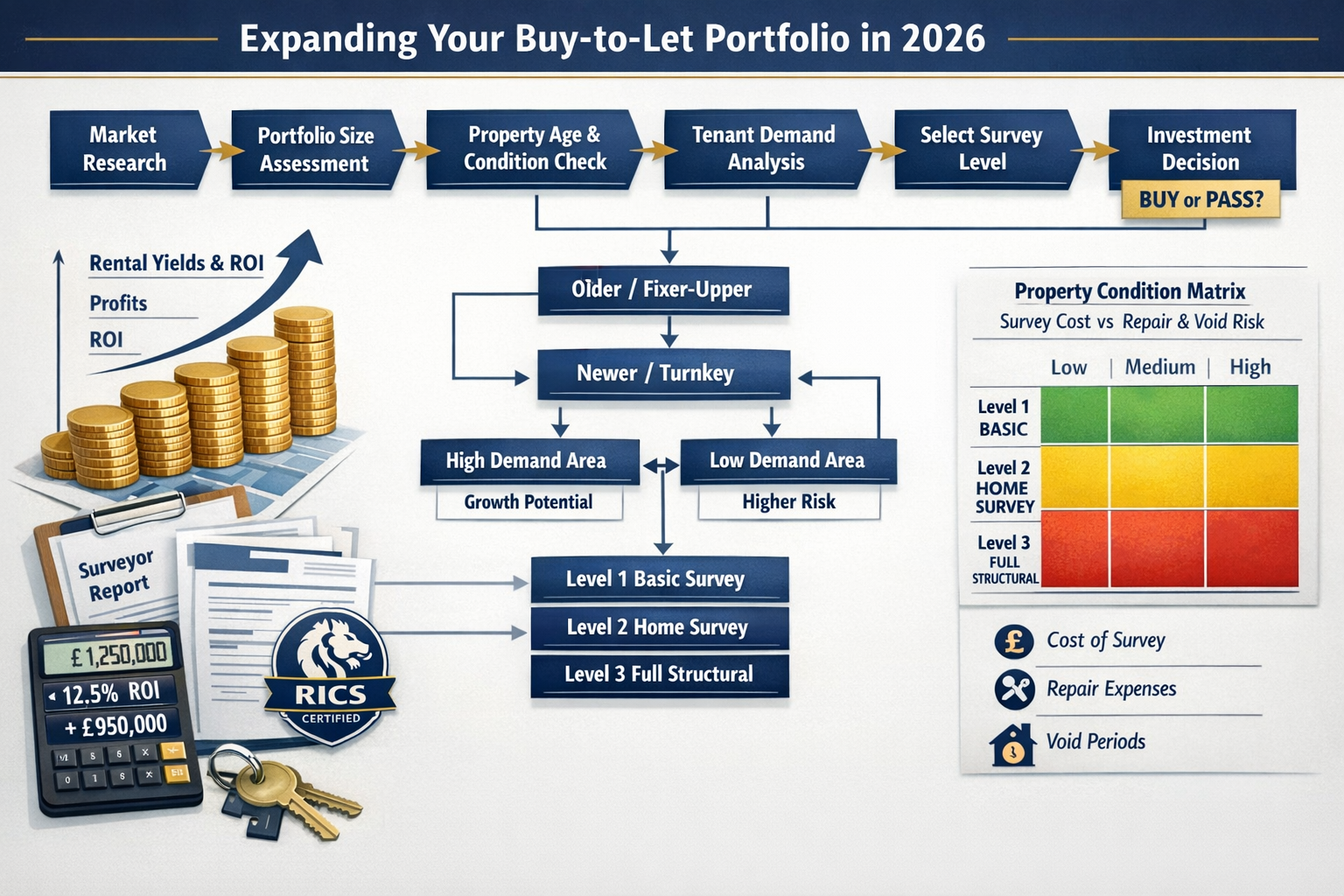
Even experienced landlords make survey-related mistakes that compromise investment returns:
❌ Choosing Inadequate Survey Level
The mistake: Selecting Level 2 survey for older or unusual property to save £300-£500
The consequence: Missing £15,000+ structural defect that eliminates multiple years' profit
The solution: Match survey depth to property age, construction type, and investment scale. When in doubt, choose more comprehensive assessment.
❌ Ignoring Survey Recommendations
The mistake: Proceeding with purchase despite surveyor's strong concerns or recommended further investigation
The consequence: Inheriting expensive problems without negotiated price adjustment or remediation plan
The solution: Take survey recommendations seriously. Obtain specialist reports when advised. Walk away from properties with unacceptable risks.
❌ Failing to Obtain Repair Quotes
The mistake: Accepting survey cost estimates without contractor verification
The consequence: Actual repair costs exceed estimates by 50-100%, destroying investment case
The solution: Obtain multiple contractor quotes for significant defects before finalizing purchase. Build 20-30% contingency into repair budgets.
❌ Overlooking Ongoing Maintenance Costs
The mistake: Focusing only on immediate defects while ignoring long-term maintenance requirements
The consequence: Unexpected capital expenditure in years 2-5 strains cash flow and reduces returns
The solution: Review survey's long-term maintenance advice. Budget for component replacement cycles (boiler 10-15 years, roof 40-60 years, windows 20-30 years).
❌ Neglecting Regulatory Compliance
The mistake: Assuming survey covers all regulatory requirements for rental properties
The consequence: Enforcement action, fines, or inability to let property legally
The solution: Supplement building survey with specific compliance checks: EICR, gas safety, EPC, HMO licensing, fire safety assessments.
❌ Poor Survey Timing
The mistake: Commissioning survey too late in purchase process, after significant commitment
The consequence: Limited negotiation leverage or pressure to proceed despite concerns
The solution: Commission surveys early, ideally before making formal offers or immediately after offer acceptance with appropriate conditions.
Future-Proofing Rental Investments Through Survey Intelligence
Looking beyond immediate 2026 market conditions, building surveys help landlords anticipate future requirements and position properties for long-term success.
Energy Efficiency and Net Zero Trajectory
Government policy continues pushing toward higher energy standards:
- EPC minimum rating C already required (with limited exceptions)
- Potential future requirements for rating B or A
- Increasing tenant preference for low-running-cost properties
- Premium rents for highly efficient homes
Survey assessments of improvement potential inform:
- Cost-benefit analysis of efficiency upgrades
- Prioritization of improvements with highest EPC impact
- Identification of properties unsuitable for future standards
- Strategic disposal vs. improvement decisions
Properties requiring £20,000+ to achieve rating C may not justify investment in low-growth markets (London at 1.1%), but represent excellent opportunities in high-growth regions (North East at 8.0%)[1].
Demographic and Tenant Preference Shifts
Building surveys help assess adaptation potential for changing tenant needs:
- Home office space for continued hybrid working
- Outdoor space (gardens, balconies) post-pandemic priority
- High-speed broadband infrastructure
- Sustainable features (EV charging, solar panels, heat pumps)
- Accessibility features for aging population
Properties with adaptation flexibility command sustained rental demand across market cycles.
Regulatory Evolution
The rental regulatory environment continues developing. Survey documentation provides:
- Baseline evidence for future compliance requirements
- Professional assessment reducing enforcement risk
- Documentation supporting responsible landlord status
- Foundation for selective licensing applications
Landlords with comprehensive survey records demonstrate professionalism that increasingly differentiates successful portfolios from marginal operators.
Selecting the Right Surveyor for Lettings Market Assessments
Surveyor selection significantly impacts report quality and value. Key selection criteria include:
✅ RICS Qualification and Specialization
Ensure surveyors hold RICS membership (MRICS or FRICS) with specific experience in:
- Residential property assessment
- Rental market understanding
- Regional building types and common defects
- Landlord-specific reporting requirements
✅ Local Market Knowledge
Surveyors with regional expertise provide superior insights into:
- Local construction methods and materials
- Common defects in specific property types
- Regional contractor costs for accurate repair estimates
- Local regulatory requirements and enforcement patterns
✅ Comprehensive Reporting
Quality survey reports include:
- Clear condition ratings for all major elements
- Detailed defect descriptions with photographic evidence
- Specific repair recommendations with urgency ratings
- Estimated costs for identified works
- Long-term maintenance advice
- Summary of key findings for quick reference
✅ Professional Indemnity Insurance
Verify surveyors carry adequate professional indemnity insurance (typically £1-10 million depending on property value). This protects against negligent survey errors or omissions.
✅ Transparent Pricing and Scope
Understand exactly what the survey includes:
- Inspection scope and limitations
- Included and excluded areas
- Additional services (valuation, specific tests)
- Report delivery timeline
- Post-survey support and clarification
Review our comprehensive guidance on survey types to understand different assessment options.
Conclusion: Building Survey Excellence in the 2026 Lettings Market
As Lettings Market Building Surveys: Assessing Rental Properties Amid Tenant Demand Spike and Supply Crunch continues defining the 2026 investment landscape, one principle remains paramount: informed decisions generate superior returns. The diverging fortunes across UK regions—from London's 1.1% growth to the North East's 8.0% expansion—create both opportunities and pitfalls for landlords expanding their portfolios[1].
Building surveys represent not mere compliance exercises but strategic intelligence tools that:
- 🎯 Protect capital by identifying expensive defects before purchase
- 📊 Enable accurate financial modeling of maintenance requirements
- 🔧 Create negotiation leverage through professional defect documentation
- ⚡ Ensure regulatory compliance in an increasingly stringent environment
- 💰 Optimize yields by matching property condition to tenant expectations
- 📈 Position properties for long-term success amid evolving standards
With average monthly rents reaching £1,367 nationally and supply constraints sustaining tenant demand, quality rental properties command premium positioning[1]. However, "quality" requires verification through professional assessment—not assumptions based on superficial viewing.
The modest investment in comprehensive building surveys—typically 0.1-0.3% of property value—provides protection against issues potentially costing 10-20% or more of property value. For a £250,000 rental investment, a £1,000 Level 3 survey that identifies a £20,000 structural defect enables informed decision-making that preserves years of rental profit.
Actionable Next Steps
For landlords planning 2026 acquisitions:
-
Assess your target market's growth trajectory using current rental inflation data—prioritize regions with sustained demand (Midlands, North, Wales)[1]
-
Match survey depth to property characteristics—Level 2 for modern standard construction, Level 3 for pre-1970 properties or unusual construction
-
Commission surveys early in the purchase process to maximize negotiation leverage and decision-making time
-
Obtain specialist reports when surveys recommend further investigation—the additional £300-£800 cost prevents £10,000+ surprises
-
Integrate survey findings with financial modeling, legal due diligence, and tax planning for comprehensive investment assessment
-
Build maintenance reserves based on survey-identified long-term requirements—typically 10-15% of annual rental income
-
Prioritize energy efficiency in survey assessments—EPC improvements increasingly essential for tenant appeal and regulatory compliance
-
Document everything—maintain comprehensive survey records supporting insurance claims, tax positions, and future disposal decisions
For portfolio landlords reviewing existing holdings:
-
Commission condition surveys on properties held 5+ years to identify emerging maintenance requirements
-
Assess improvement ROI in high-growth regions—£15,000 invested in North East property with 8.0% rental growth may outperform low-maintenance London property at 1.1%[1]
-
Review compliance status across portfolio—EICR, gas safety, EPC, fire safety, licensing
-
Consider strategic disposal of properties with major upcoming capital requirements in low-growth markets
-
Reinvest proceeds in high-growth regions with survey-verified quality stock
The 2026 lettings market rewards diligence, professionalism, and informed decision-making. Building surveys provide the foundation for all three, transforming property investment from speculation into strategic asset management.
Whether acquiring your first rental property or expanding a substantial portfolio, professional building survey assessment represents not an optional extra but an essential investment protection in markets characterized by regional divergence, supply constraints, and evolving regulatory standards.
The landlords who thrive in 2026 and beyond will be those who recognize that comprehensive property assessment isn't a cost—it's the foundation of sustainable rental business success.