The real estate landscape in 2026 is more dynamic than ever before. Property surveyors who rely solely on traditional inspection methodologies risk falling behind competitors who understand how to read the broader market signals shaping client decisions. Integrating Market Signals into Survey Workflows: How Surveyors Can Anticipate Real Estate Trends and Client Needs represents the evolution from reactive service provision to proactive advisory partnerships that deliver exceptional value.
Imagine a surveyor who can predict which property features will matter most to buyers before stepping foot on site, or who understands regional migration patterns well enough to advise clients on investment timing. This isn't speculation—it's strategic integration of employment trends, interest rates, housing supply metrics, and demographic shifts into everyday surveying practice.
The surveyors who thrive in 2026 and beyond will be those who transform external market intelligence into actionable recommendations that protect and enhance client investments. This comprehensive guide reveals exactly how to make that transformation.
Key Takeaways
- Market signals provide predictive power: Monitoring employment trends, interest rates, housing inventory, and migration patterns enables surveyors to anticipate client needs before they arise
- Regional variations demand localized intelligence: With Southeast and Northeast markets outperforming other regions, surveyors must customize recommendations based on geographic market conditions[1]
- Demographic shifts reshape service offerings: Growing segments like single female homebuyers and aging baby boomers require specialized survey insights aligned with their unique priorities[2][5]
- Technology integration is essential: Digital tools that aggregate market data into survey workflows create competitive advantages and enhanced client value
- Proactive advisory services command premium fees: Surveyors who translate market signals into strategic recommendations position themselves as indispensable partners rather than transactional service providers
Understanding the Market Signals That Matter Most to Surveyors
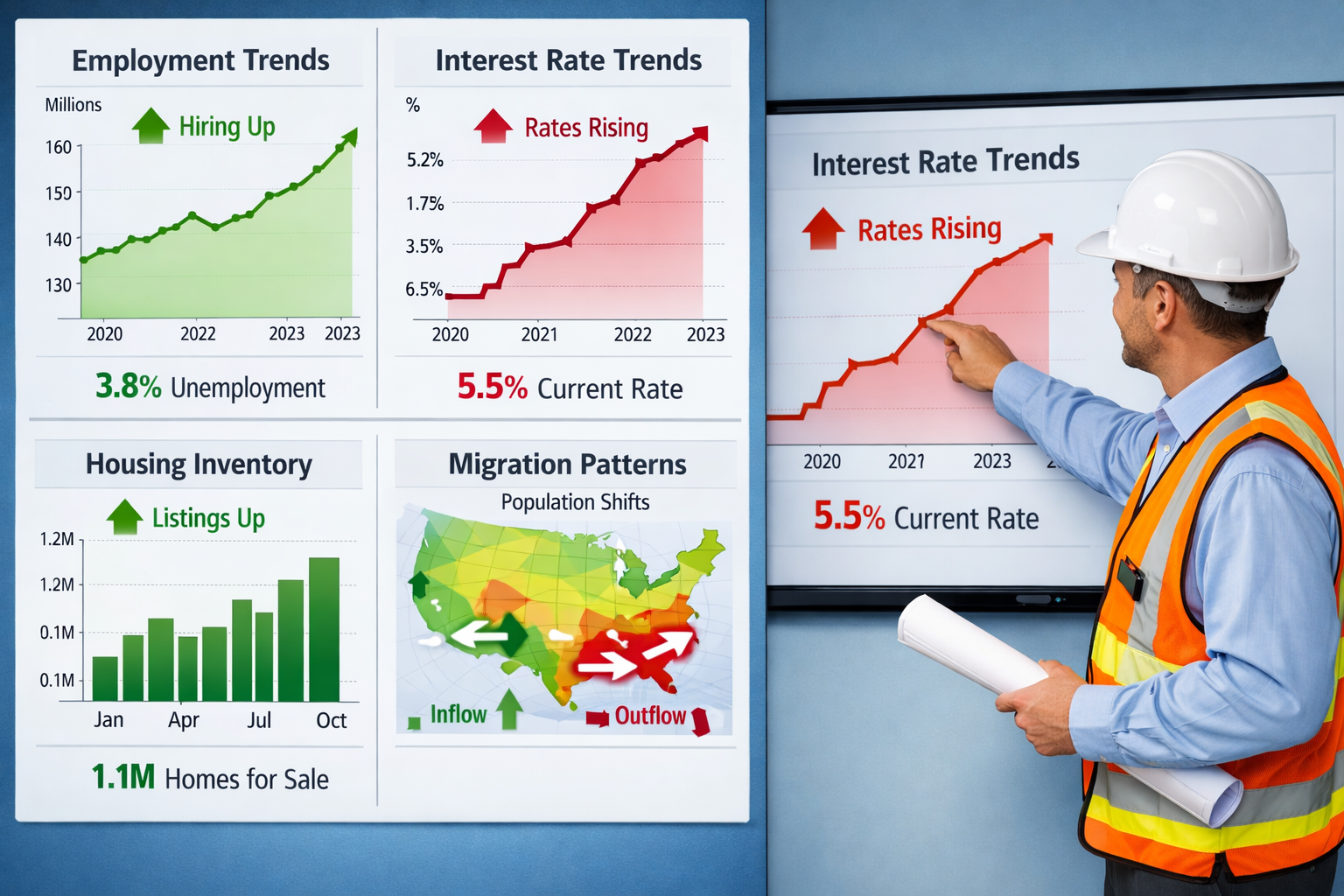
Employment Trends and Local Economic Health 📊
Employment data serves as a leading indicator for housing demand and property values. When surveyors monitor regional job growth, unemployment rates, and industry diversification, they gain insight into future market stability that directly impacts property valuations and investment viability.
Key employment metrics to track include:
- Monthly non-farm payroll changes in the survey area
- Unemployment rate trends over 12-24 month periods
- Major employer announcements (expansions, relocations, closures)
- Industry sector diversification and concentration risks
- Average wage growth and income trends
For example, when a major technology employer announces a new campus in a region, savvy surveyors can anticipate increased demand for mid-to-upper tier residential properties and advise clients accordingly during property inspections. This forward-looking perspective transforms a standard survey into strategic investment guidance.
Interest Rate Movements and Financing Accessibility
Interest rates directly influence buyer purchasing power and property affordability. In 2026, with housing market recovery projecting 4.26 million existing home sales—a 4.3% increase from 2025—understanding rate trajectories helps surveyors contextualize current market conditions for clients[4].
Critical interest rate considerations:
| Rate Environment | Impact on Surveys | Surveyor Response |
|---|---|---|
| Rising rates | Reduced buyer pool, longer marketing times | Emphasize value-for-money features, flag deferred maintenance more critically |
| Falling rates | Increased competition, faster transactions | Highlight investment potential, competitive positioning factors |
| Stable rates | Predictable market conditions | Focus on fundamental property qualities and long-term value |
When conducting RICS valuations, integrating rate environment context helps clients understand not just current value but future marketability under various economic scenarios.
Housing Supply Dynamics and Inventory Levels
The balance between housing supply and demand fundamentally shapes market conditions. Surveyors who track local inventory levels, new construction permits, and absorption rates can provide clients with crucial context about competitive positioning and pricing strategies.
Supply indicators to monitor:
- Months of inventory available in relevant price segments
- New construction permits and completion timelines
- Conversion projects (commercial to residential)
- Demolition and redevelopment activity
- Seasonal inventory fluctuations
In markets with limited inventory, surveyors might emphasize property uniqueness and competitive advantages during building surveys, while in oversupplied markets, they should focus more critically on condition issues that could hinder competitive positioning.
Migration Patterns and Demographic Shifts 🏘️
Understanding who is moving where—and why—provides powerful context for property surveys. The 2026 market features significant regional disparities, with Southeast, South Central, and Northeast markets outperforming Midwest and West regions[1]. This geographic variation demands location-specific survey approaches.
Demographic trends reshaping 2026 markets:
- Single female homebuyers representing a growing market segment with specific property preferences[2]
- Senior housing demand reaching historic inflection points as baby boomers turn 80[5]
- First-time buyer dynamics influenced by affordability constraints and changing preferences
- Remote work migration continuing to influence suburban and secondary market demand
When surveyors understand these demographic shifts, they can tailor observations and recommendations to align with the most likely buyer profiles for each property. For instance, properties suitable for aging-in-place might warrant special attention to accessibility features, single-level living potential, and proximity to healthcare facilities.
Integrating Market Signals into Survey Workflows: Practical Implementation Strategies
Building Your Market Intelligence Dashboard
The foundation of Integrating Market Signals into Survey Workflows: How Surveyors Can Anticipate Real Estate Trends and Client Needs begins with establishing systematic data collection processes. Modern surveyors need centralized dashboards that aggregate relevant market intelligence alongside traditional survey data.
Essential dashboard components:
- Economic indicators module – Employment data, GDP growth, consumer confidence indices
- Real estate metrics tracker – Median prices, days on market, inventory levels, absorption rates
- Demographic analytics – Population growth, age distribution, household formation trends
- Regulatory monitoring – Zoning changes, building code updates, environmental regulations
- Competitive intelligence – Comparable property listings, recent sales, market positioning
Many surveyors leverage tools like Excel with automated data feeds, specialized real estate analytics platforms, or custom CRM integrations that pull market data alongside client information. The key is consistency—reviewing and updating market intelligence weekly ensures recommendations remain current and relevant.
Translating Data into Client-Facing Insights
Raw market data holds little value until translated into actionable recommendations within survey reports. This translation process differentiates exceptional surveyors from those providing commodity services.
Practical translation framework:
Market Signal → Survey Implication → Client Recommendation
Example 1: Rising Interest Rates
- Signal: Mortgage rates increased 0.5% over past quarter
- Implication: Buyer purchasing power reduced, longer marketing periods likely
- Recommendation: "Given current rate environment, addressing the £8,000 roof repair before listing could prevent price negotiations that exceed repair costs and accelerate sale timeline."
Example 2: Regional Employment Growth
- Signal: Local tech sector added 2,000 jobs in past six months
- Implication: Increased demand for move-in ready properties near employment centers
- Recommendation: "The property's proximity to the new tech campus and excellent condition position it favorably for the expanding professional buyer pool, supporting the upper end of the valuation range."
When conducting different types of surveys, this contextual framework helps clients understand not just what conditions exist, but what those conditions mean for their specific objectives.
Customizing Survey Scope Based on Market Conditions
Market signals should influence not just survey commentary but the survey scope itself. Integrating Market Signals into Survey Workflows: How Surveyors Can Anticipate Real Estate Trends and Client Needs means adapting investigation depth and focus areas to align with current market priorities.
Market-responsive scope adjustments:
- In competitive seller's markets: Emphasize features that differentiate the property, investigate value-adding improvement potential, assess competitive positioning factors
- In buyer's markets: Increase scrutiny of condition issues, provide detailed cost estimates for repairs, evaluate price-to-value relationships more critically
- In transitioning markets: Offer scenario analysis showing property performance under different market conditions, highlight flexibility and adaptation potential
For example, when energy-efficient home features become mainstream buyer preferences—as observed in 2026 trends[4]—surveyors should proactively assess insulation quality, HVAC efficiency, window performance, and renewable energy potential even when not explicitly requested. This anticipatory approach demonstrates market awareness that clients value highly.
Timing Recommendations with Market Cycles
Strategic timing advice represents one of the highest-value services surveyors can provide when market intelligence is properly integrated. Understanding seasonal patterns, economic cycles, and local market momentum helps surveyors guide clients toward optimal decision timing.
Timing considerations by transaction type:
| Transaction Type | Market Signal Focus | Timing Guidance |
|---|---|---|
| Purchase | Inventory trends, price momentum, rate forecasts | "Current 3.2 months inventory suggests moderate buyer leverage; waiting 60-90 days may provide additional options" |
| Sale | Seasonal patterns, competing listings, buyer demographics | "Spring market typically sees 23% more qualified buyers in this segment; addressing defects now positions for March listing" |
| Refinance | Rate trends, property value trajectory | "Recent comparable sales support current valuation; rate environment favors action within next 45 days" |
| Investment | Employment trends, demographic shifts, development pipeline | "Planned infrastructure improvements suggest 8-12% appreciation potential over 24 months" |
This timing intelligence, integrated into RICS home surveys, transforms surveys from static snapshots into dynamic strategic tools.
Advanced Applications: Anticipating Client Needs Before They Articulate Them
Proactive Service Offerings Based on Market Trends 💡
The most sophisticated application of Integrating Market Signals into Survey Workflows: How Surveyors Can Anticipate Real Estate Trends and Client Needs involves anticipating requirements before clients recognize them themselves. This proactive approach builds loyalty and generates additional revenue through value-added services.
Market signal-driven service development:
Trend: Senior Housing Demand Surge[5]
- Anticipated Need: Aging-in-place assessments
- Proactive Service: Accessibility audits, modification feasibility studies, universal design evaluations
- Client Approach: "Given demographic trends, we're now offering specialized aging-in-place assessments that evaluate modification potential and estimate adaptation costs—would this add value to your survey?"
Trend: Energy Efficiency Preferences[4]
- Anticipated Need: Sustainability performance metrics
- Proactive Service: Energy efficiency ratings, renewable energy potential assessments, carbon footprint evaluations
- Client Approach: "With 68% of buyers now prioritizing energy efficiency, we can include thermal imaging and efficiency scoring in your survey to support competitive positioning."
Trend: Regional Market Disparities[1]
- Anticipated Need: Comparative market positioning analysis
- Proactive Service: Regional performance benchmarking, investment timing analysis
- Client Approach: "Southeast markets are outperforming by 12% this year—our enhanced regional analysis can help you understand this property's position within broader trends."
These proactive offerings demonstrate market sophistication that commands premium fees and strengthens client relationships.
Building Client Advisory Relationships
When surveyors consistently deliver market-informed insights, they transition from transactional service providers to trusted advisors. This relationship evolution creates recurring revenue opportunities and referral generation.
Advisory relationship building blocks:
- Regular market updates: Quarterly newsletters sharing regional trends and their implications for property owners
- Portfolio reviews: Annual assessments of client property holdings with market-contextualized recommendations
- Strategic planning sessions: Consultative meetings discussing market conditions and optimal timing for planned transactions
- Educational content: Webinars, guides, and resources helping clients understand market dynamics
- Priority access: First notification of market shifts that create opportunities or risks for specific clients
For clients with multiple properties or ongoing development projects, chartered building surveyors who provide this advisory layer become indispensable partners rather than occasional service providers.
Case Study: Regional Market Intelligence in Action
Consider a surveyor operating across multiple regions who monitors the 2026 trend of Southeast and Northeast market outperformance versus Midwest and West underperformance[1]. This intelligence enables differentiated service approaches:
Southeast Client (Strong Market)
- Survey emphasis: Competitive differentiation, premium feature highlighting, investment potential
- Recommendation tone: Confident, growth-oriented, emphasizing opportunity
- Additional services: Highest-and-best-use analysis, development potential assessment
- Timing guidance: "Current momentum supports listing within 30 days to capture peak seasonal demand"
Midwest Client (Challenged Market)
- Survey emphasis: Value optimization, cost-effective improvements, realistic positioning
- Recommendation tone: Pragmatic, value-focused, emphasizing smart decision-making
- Additional services: Cost-benefit analysis for improvements, competitive pricing research
- Timing guidance: "Market headwinds suggest holding until Q2 when inventory typically tightens, or pricing 5-7% below comparable to ensure prompt sale"
This regional customization, informed by market intelligence, delivers precisely calibrated advice that clients recognize as sophisticated and valuable.
Leveraging Technology for Market Signal Integration
Modern technology platforms enable surveyors to integrate market signals more efficiently and comprehensively than manual methods allow. Strategic technology adoption amplifies the impact of market intelligence integration.
Technology solutions for market-aware surveying:
- Real estate data platforms: CoStar, Zillow Research, local MLS analytics providing inventory, pricing, and trend data
- Economic data feeds: Federal Reserve Economic Data (FRED), Bureau of Labor Statistics APIs delivering employment and economic indicators
- GIS and mapping tools: Demographic overlays, development pipeline visualization, migration pattern analysis
- Survey report automation: Templates with dynamic market commentary insertion based on current conditions
- CRM integration: Client property tracking with automated market change alerts
When conducting specialized surveys like structural surveys or specific defect reports, these technology tools enable rapid contextualization without extending project timelines.
Overcoming Implementation Challenges and Common Pitfalls

Balancing Market Commentary with Professional Objectivity ⚖️
Surveyors must navigate the tension between providing market-informed insights and maintaining professional objectivity. Integrating Market Signals into Survey Workflows: How Surveyors Can Anticipate Real Estate Trends and Client Needs requires clear boundaries between factual observation and speculative prediction.
Best practices for maintaining objectivity:
- Clearly label market commentary: Use distinct sections or formatting to differentiate market context from property-specific findings
- Cite data sources: Reference specific market reports, economic indicators, or statistical sources supporting observations
- Avoid guarantees: Frame market insights as "current trends suggest" rather than "will definitely result in"
- Acknowledge uncertainty: Include appropriate caveats about market volatility and unpredictability
- Stay within competence: Defer to financial advisors, tax professionals, or legal counsel for matters outside surveying expertise
For example, when providing RICS valuations, market context enhances the report but shouldn't replace rigorous comparable analysis and professional valuation methodology.
Managing Data Overload and Analysis Paralysis
The abundance of available market data can overwhelm surveyors attempting to integrate intelligence into workflows. Effective implementation requires filtering signal from noise.
Data management strategies:
- Define core metrics: Identify 8-12 key indicators most relevant to your service area and client base
- Establish review rhythms: Weekly quick scans, monthly deep dives, quarterly trend analysis
- Create alert thresholds: Set triggers for significant changes requiring immediate attention
- Use visualization tools: Charts and graphs that make patterns immediately apparent
- Delegate monitoring: Assign team members specific data domains to track and summarize
The goal isn't comprehensive market expertise but rather focused intelligence on factors directly impacting client decisions and property values in your specific service areas.
Avoiding Scope Creep and Fee Erosion
Providing enhanced market-informed insights shouldn't mean working for free. Surveyors must structure services and fees to appropriately compensate for the additional value delivered.
Fee structure approaches:
- Tiered service packages: Basic survey, market-enhanced survey, comprehensive advisory survey with increasing scope and pricing
- Add-on modules: Market positioning analysis, timing recommendations, investment potential assessment as optional upgrades
- Subscription models: Annual retainer for ongoing market intelligence and advisory access
- Value-based pricing: Fees reflecting potential client benefit rather than time invested
- Educational positioning: Marketing materials explaining the value of market integration to justify premium pricing
When clients understand that market-informed recommendations could save thousands in avoided mistakes or capture additional value, they readily pay premium fees for enhanced services.
Maintaining Current Knowledge in Dynamic Markets
Market conditions evolve continuously, requiring ongoing education and intelligence gathering. Surveyors must establish sustainable learning systems that keep knowledge current without consuming excessive time.
Continuing education strategies:
- Professional association resources: RICS publications, webinars, and market reports
- Industry newsletters: Curated digests from real estate research firms and economic analysts
- Peer networks: Regional surveyor groups sharing local market intelligence
- Client conversations: Systematic documentation of client-reported market observations
- Competitor monitoring: Reviewing how leading firms incorporate market intelligence
- Academic research: University real estate centers and housing research institutes
Dedicating 2-3 hours weekly to market intelligence review ensures knowledge remains current while maintaining manageable time investment.
Future-Proofing Your Survey Practice Through Market Intelligence
Adapting to Emerging Market Trends Beyond 2026 🔮
While current market signals provide immediate value, forward-thinking surveyors also monitor emerging trends that will shape future client needs. Several developments warrant attention for long-term practice positioning.
Emerging trends to track:
- Climate resilience requirements: Increasing focus on flood risk, wildfire exposure, extreme weather adaptation
- Smart home integration: Technology infrastructure becoming standard buyer expectation
- Flexible space design: Continued remote work influence on space utilization preferences
- Wellness features: Health-focused design elements gaining prominence in buyer priorities
- Sustainable materials: Growing emphasis on environmental impact of building materials and systems
Surveyors who develop expertise in these emerging areas position themselves as forward-looking advisors capable of guiding clients through evolving market landscapes.
Building Competitive Differentiation Through Market Expertise
As more surveyors recognize the value of market signal integration, competitive advantage will flow to those who execute most effectively. Differentiation strategies include:
Specialization approaches:
- Geographic micro-expertise: Becoming the definitive authority on specific neighborhoods or regions
- Demographic focus: Specializing in serving specific buyer segments (seniors, first-time buyers, investors)
- Property type specialization: Deep market knowledge for specific property categories
- Trend leadership: Early adoption and expertise in emerging market factors
For instance, a surveyor developing specialized knowledge in senior housing needs—particularly relevant given baby boomers turning 80[5]—could dominate that growing market segment through targeted expertise.
Measuring ROI on Market Intelligence Integration
Quantifying the return on time and resources invested in market signal integration helps justify continued investment and refinement of approaches.
ROI measurement metrics:
| Metric | Measurement Approach | Target Improvement |
|---|---|---|
| Client retention rate | Repeat client percentage year-over-year | 15-25% increase |
| Average project value | Mean fee per survey engagement | 20-35% increase |
| Referral generation | New clients from existing client referrals | 30-50% increase |
| Service mix | Percentage of enhanced vs. basic surveys | 40-60% enhanced |
| Client satisfaction | Survey scores on value delivered | 4.5+ out of 5.0 |
Tracking these metrics demonstrates the tangible business impact of Integrating Market Signals into Survey Workflows: How Surveyors Can Anticipate Real Estate Trends and Client Needs, supporting continued investment in market intelligence capabilities.
Creating Scalable Systems for Growing Practices
As survey practices grow, market intelligence integration must scale without proportional time investment increases. Systematization enables growth while maintaining quality.
Scalability strategies:
- Template libraries: Pre-written market commentary modules customizable for specific conditions
- Team specialization: Dedicated market research roles supporting multiple surveyors
- Technology automation: Automated data gathering, analysis, and report integration
- Knowledge management systems: Centralized repositories of market insights accessible to all team members
- Quality assurance protocols: Review processes ensuring consistent market intelligence application
These systems enable practices to deliver market-informed surveys across dozens or hundreds of projects monthly while maintaining consistency and quality.
Practical Tools and Resources for Implementation
Essential Market Data Sources 📚
Building effective market intelligence requires reliable, current data sources. The following resources provide surveyors with the foundation for informed analysis:
Economic and employment data:
- Bureau of Labor Statistics (local employment statistics)
- Federal Reserve Economic Data (FRED)
- Regional economic development agencies
- Chamber of Commerce business reports
Real estate market data:
- Multiple Listing Service (MLS) analytics
- Zillow Research and market reports[4]
- Local real estate board statistics
- Property transaction databases
Demographic information:
- Census Bureau data and projections
- Migration pattern studies
- Household formation forecasts
- Age distribution trends
Industry research:
- PwC Emerging Trends in Real Estate[1][6]
- National Association of Realtors research[2]
- Urban Land Institute reports[5]
- CBRE market outlook publications[3]
Regular review of these sources, combined with local market observation, creates comprehensive market intelligence supporting enhanced survey services.
Sample Market Commentary Templates
Standardized templates accelerate the integration of market intelligence into survey reports while maintaining consistency. Below are example frameworks:
Template 1: Market Context Section
Current Market Conditions
The [location] real estate market currently exhibits [characterization based on data]. Key indicators include:
- Inventory levels: [X] months of supply (vs. [Y] historical average)
- Median days on market: [X] days ([increase/decrease] from prior year)
- Price trends: [X]% [increase/decrease] year-over-year
- Buyer demand: [characterization based on showing activity, offers, etc.]
Implications for This Property
Given these conditions, this property's [strengths] position it [favorably/competitively/challengingly] within the current market. [Specific recommendations based on conditions].
Template 2: Timing Recommendation
Market Timing Considerations
Based on current market trajectory and seasonal patterns, [action] timing considerations include:
- [Factor 1 and implication]
- [Factor 2 and implication]
- [Factor 3 and implication]
Recommendation: [Specific timing guidance with rationale]
These templates provide structure while allowing customization for specific properties and client situations.
Checklist for Market-Informed Survey Delivery
Use this checklist to ensure comprehensive market intelligence integration:
Pre-Survey Phase:
- Review current market data for property location
- Identify relevant demographic trends for property type
- Check recent comparable sales and active listings
- Note any significant economic developments in area
- Understand client's specific objectives and timeline
During Survey:
- Observe property features relative to current buyer preferences
- Assess competitive positioning factors
- Evaluate improvement potential aligned with market demand
- Document market-relevant strengths and weaknesses
- Consider timing implications of identified issues
Report Preparation:
- Include market context section with current conditions
- Integrate market implications into findings
- Provide specific recommendations based on market intelligence
- Include timing guidance where appropriate
- Cite data sources supporting market observations
- Clearly differentiate market commentary from property findings
Client Delivery:
- Explain market context and its relevance
- Connect market trends to specific recommendations
- Discuss timing considerations
- Provide additional resources for client education
- Offer follow-up consultation on market-related questions
This systematic approach ensures consistent integration of market intelligence across all survey engagements.
Conclusion: Transforming Survey Practice Through Market Intelligence

Integrating Market Signals into Survey Workflows: How Surveyors Can Anticipate Real Estate Trends and Client Needs represents more than a competitive advantage—it's becoming a professional necessity in 2026's dynamic real estate environment. Surveyors who monitor employment trends, interest rates, housing supply, and migration patterns transform from technical inspectors into strategic advisors capable of guiding clients through complex market conditions.
The implementation journey begins with establishing systematic market intelligence gathering processes, then progressively integrating insights into survey scopes, reports, and client recommendations. As proficiency develops, surveyors can advance to proactive service offerings that anticipate client needs before they're articulated, building advisory relationships that generate recurring revenue and referrals.
Key success factors include:
✅ Systematic data collection focusing on core metrics most relevant to your service area and client base
✅ Clear communication frameworks that distinguish market context from property-specific findings while maintaining professional objectivity
✅ Technology leverage enabling efficient intelligence gathering and integration without excessive time investment
✅ Appropriate fee structures that compensate for the enhanced value delivered through market-informed insights
✅ Continuous learning maintaining current knowledge as market conditions evolve
The surveyors who excel in this integrated approach will find themselves positioned as indispensable partners in client decision-making, commanding premium fees while building sustainable competitive advantages. Those who continue treating surveys as isolated technical exercises risk commoditization and fee pressure as clients increasingly recognize the superior value delivered by market-aware professionals.
Next Steps: Implementing Market Intelligence in Your Practice
Week 1-2: Foundation Building
- Identify 8-12 core market metrics relevant to your service area
- Establish data sources and create a simple tracking dashboard
- Review past survey reports identifying opportunities for market context integration
Week 3-4: Template Development
- Create market commentary templates for common scenarios
- Develop client-facing explanations of market intelligence value
- Update service descriptions and fee structures to reflect enhanced offerings
Month 2: Pilot Implementation
- Integrate market intelligence into 5-10 survey reports
- Gather client feedback on value delivered
- Refine approaches based on initial results
Month 3+: Scaling and Optimization
- Systematize market intelligence integration across all projects
- Develop specialized expertise in emerging trends
- Build advisory relationship offerings for high-value clients
- Measure ROI and adjust approaches based on results
The real estate market's complexity and dynamism will only increase in coming years. Surveyors who master the integration of market signals into their workflows position themselves not just to survive but to thrive, delivering exceptional value that clients recognize and reward. The time to begin this transformation is now—your clients' success and your practice's future depend on it.
For surveyors ready to elevate their practice through market intelligence integration, the opportunity is clear: become the advisor clients turn to not just for property condition assessment, but for strategic guidance through complex market landscapes. This evolution from technician to trusted advisor represents the future of professional surveying.
References
[1] Markets To Watch – https://www.pwc.com/us/en/industries/financial-services/asset-wealth-management/real-estate/emerging-trends-in-real-estate-pwc-uli/markets-to-watch.html
[2] 2026 Real Estate Outlook What Leading Housing Economists Are Watching – https://www.nar.realtor/magazine/real-estate-news/2026-real-estate-outlook-what-leading-housing-economists-are-watching
[3] Us Real Estate Market Outlook 2026 – https://www.cbre.com/insights/books/us-real-estate-market-outlook-2026
[4] 2026 Housing Predictions 35800 – https://www.zillow.com/research/2026-housing-predictions-35800/
[5] Emerging Trends In Real Estate United States And Canada 2026 – https://knowledge.uli.org/en/reports/emerging-trends/2026/emerging-trends-in-real-estate-united-states-and-canada-2026
[6] Emerging Trends In Real Estate Pwc Uli – https://www.pwc.com/us/en/industries/financial-services/asset-wealth-management/real-estate/emerging-trends-in-real-estate-pwc-uli.html