The tragic events at Grenfell Tower in 2017 fundamentally changed how the property industry approaches fire safety in multi-occupancy buildings. Nearly nine years later, the regulatory landscape continues to evolve, with 2026 marking a critical juncture for building surveyors, property owners, and prospective buyers navigating increasingly complex compliance requirements. Fire Safety Upgrades in Building Surveys: 2026 RICS Guidance Post-Grenfell for Multi-Occupancy Properties represents not just a regulatory checkbox, but a comprehensive framework designed to protect lives and property values in an era of heightened awareness and accountability.
As buyer demand for transparent fire safety information reaches unprecedented levels, understanding the latest RICS guidance has become essential for anyone involved in multi-occupancy residential property transactions. This comprehensive guide explores the updated building survey checklists, mandatory assessment protocols, and practical compliance strategies that define the current landscape.
Key Takeaways
🔥 Mandatory Fire Risk Assessments: All multi-occupancy properties now require formal fire risk appraisals (FRAs) covering external wall systems, with specific requirements for buildings 11 metres or higher[3][7].
📋 EWS1 Form Requirements: External Wall System assessments remain critical for multi-storey, multi-occupied residential buildings, with validity periods up to five years unless substantial works occur[7].
🏢 Enhanced Building Survey Protocols: RICS chartered surveyors must now incorporate comprehensive fire safety evaluations into RICS building surveys, including cladding assessments, compartmentation checks, and escape route evaluations.
⚖️ Regulatory Framework Evolution: The Fire Safety Act 2021 and Fire Safety (England) Regulations 2022 create additional duties for responsible persons in multi-occupied residential buildings[3][7].
💼 Professional Accountability: Building surveyors face increased professional responsibility for identifying fire safety deficiencies, with industry standards like PAS 9980 and BS 5839-1:2017 providing technical guidance[5].
Understanding the Post-Grenfell Regulatory Framework
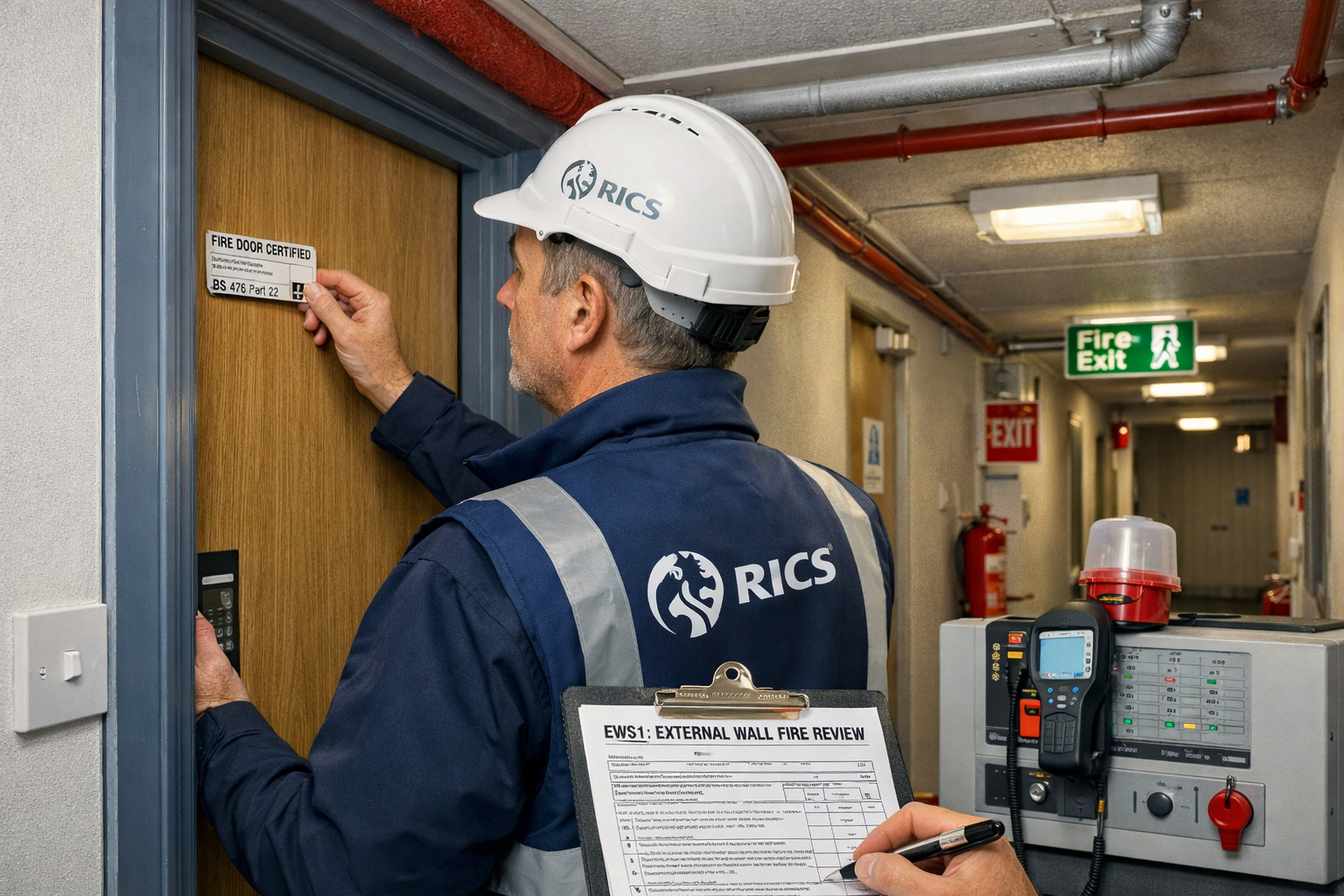
The regulatory environment surrounding fire safety in multi-occupancy properties has undergone transformative change since 2017. The Fire Safety Act 2021 expanded the scope of fire safety legislation to explicitly include external wall systems, balconies, and flat entrance doors—areas previously subject to interpretation or oversight[3].
The Fire Safety (England) Regulations 2022
These regulations place specific duties on responsible persons in multi-occupied residential buildings. The responsible person—typically the building owner, landlord, or managing agent—must ensure comprehensive fire risk assessments are conducted and regularly updated[4].
The regulations mandate that FRAs must cover:
- Fire doors and their certification
- Corridors and common areas
- Stairs and lift systems
- Main entrances and access points
- External walls including cladding and balconies
- Flat entrance doors in residential blocks[4]
For properties requiring a RICS Building Surveys Level 3 inspection, chartered surveyors must now evaluate compliance with these regulatory requirements as part of their comprehensive assessment.
Building Height Thresholds and Risk Classification
A critical aspect of the 2026 regulatory framework involves building height thresholds. Buildings of 11 metres or more (approximately five storeys or higher) face enhanced fire safety requirements[10]. This threshold determines whether properties require:
- Mandatory EWS1 external wall assessments
- Enhanced fire risk appraisal protocols
- Additional compartmentation standards
- Stricter material specifications for cladding systems
The redefinition of higher-risk buildings and introduction of mandatory fire safety strategies represent significant changes in building surveying practice in 2026[9].
Fire Safety Upgrades in Building Surveys: Essential Assessment Components
When conducting building surveys on multi-occupancy properties in 2026, chartered surveyors must integrate comprehensive fire safety evaluations throughout their inspection process. This represents a substantial evolution from traditional survey methodologies.
External Wall System (EWS1) Assessments
The EWS1 form remains a cornerstone requirement for multi-storey, multi-occupied residential buildings. This standardized assessment evaluates the fire performance of external wall systems and provides critical information for mortgage lenders, insurers, and prospective buyers[7].
Key EWS1 Requirements:
| Assessment Element | Requirement | Validity Period |
|---|---|---|
| Physical Inspection | Mandatory on-site examination | N/A |
| Photo Documentation | Comprehensive visual evidence required | N/A |
| Material Testing | Fire performance verification of cladding | N/A |
| Professional Certification | Qualified fire engineer or building surveyor | Up to 5 years |
| Reassessment Triggers | Substantial works affecting original conclusions | As needed |
Importantly, assessments must include physical evidence of fire performance for materials used in cladding systems. Paperwork from original developers cannot serve as the sole evidence base[3]. This requirement often necessitates intrusive investigation and material sampling during RICS commercial building surveys.
Formal Fire Risk Appraisals (FRAs)
All multi-occupancy properties require a formal FRA, with a designated responsible person appointed to oversee compliance[4]. Building surveyors must verify that current FRAs exist and meet regulatory standards.
FRA Coverage Requirements for Residential Blocks:
✅ Fire Detection Systems: Compliance with BS 5839-1:2017 standards for fire detection and alarm systems[5]
✅ Emergency Lighting: Adequate coverage and functionality testing protocols
✅ Fire Compartmentation: Effective separation between units and common areas
✅ Escape Routes: Clear, unobstructed egress paths with appropriate signage
✅ Fire Doors: Properly certified, maintained, and functional fire-rated doors
✅ External Wall Systems: Assessment per PAS 9980 guidance for external wall fire risk[5]
For properties undergoing specific defect reports, fire safety deficiencies often constitute critical findings requiring immediate remediation.
Cladding Material Assessment
The composition and configuration of external cladding systems represent perhaps the most scrutinized aspect of post-Grenfell fire safety assessments. Surveyors must evaluate:
Cladding System Components:
- Face Material: Aluminum composite material (ACM), high-pressure laminate (HPL), or other facade systems
- Core Material: Polyethylene (PE), fire-retardant (FR), or mineral-filled cores
- Insulation Layer: Combustibility classification and fire performance
- Cavity Barriers: Presence, condition, and compliance with current standards
- Fire Stops: Effectiveness of horizontal and vertical fire breaks
RICS obtained figures showing a significant number of deaths and injuries each year from fires in residential properties, which prompted development of their public-facing fire safety guidance[1]. This underscores the critical importance of thorough cladding assessments in contemporary building surveys.
Fire Safety Upgrades in Building Surveys: 2026 RICS Guidance Implementation
The Royal Institution of Chartered Surveyors has published comprehensive guidance addressing the evolving fire safety landscape. This guidance serves multiple stakeholder groups including homeowners, tenants, landlords, and professional surveyors[1].
RICS Public Fire Safety Guide
RICS has developed a clear fire safety guide written by Chartered Building Surveyors and a multi-discipline advisory group. This guidance addresses homeowners, tenants, and landlords regardless of property type[1]. The guide provides:
- Clear responsibility delineation between landlords and tenants
- Practical compliance checklists for different property types
- Accessible explanations of technical requirements
- Actionable recommendations for addressing deficiencies
The guidance emphasizes that fire safety is not solely a regulatory compliance issue but a fundamental aspect of property stewardship and occupant protection[2].
Landlord-Tenant Responsibility Clarification
A critical component of the 2026 RICS guidance involves clarifying specific responsibilities between property owners and occupants. The RICS guidance differentiates:
Landlord Obligations for Rented/Shared Accommodation:
- Appliance safety: Ensuring electrical and gas appliances meet safety standards
- Furniture compliance: Fire-resistant furniture in common areas and furnished lettings
- Alarm systems: Installation and maintenance of appropriate fire detection systems
- Common area safety: Fire doors, emergency lighting, and escape routes in shared spaces
- Regular inspections: Periodic fire safety assessments and equipment testing[1][4]
Owner-Occupied Property Requirements:
- Fire detection installation: Appropriate alarm systems for property configuration
- Accessibility considerations: Escape routes suitable for all occupants
- Personal responsibility: Maintaining installed safety equipment
- Awareness: Understanding evacuation procedures and assembly points[1][2]
For properties requiring RICS Homebuyer Surveys Level 2, surveyors should highlight these responsibility boundaries to prospective purchasers.
Professional Standards for Building Surveyors
Chartered surveyors conducting building surveys in 2026 must demonstrate competence in fire safety assessment. This includes:
Required Knowledge Areas:
📚 Regulatory Framework: Understanding of Fire Safety Act 2021, Fire Safety (England) Regulations 2022, and Building Regulations Approved Document B
📚 Technical Standards: Familiarity with PAS 9980, BS 5839-1:2017, and other relevant British Standards
📚 Material Science: Knowledge of cladding systems, combustibility classifications, and fire performance characteristics
📚 Risk Assessment Methodology: Competence in evaluating fire safety risks and prioritizing remediation actions
📚 Reporting Standards: Ability to communicate findings clearly to clients with varying technical backgrounds
When conducting surveys on multi-occupancy properties, chartered surveyors must integrate these competencies throughout their inspection and reporting process.
Legacy Building Challenges and Remediation Strategies
Older premises face particular compliance complexity when assessed against contemporary fire safety standards. Buildings constructed before current regulations were implemented often exhibit multiple deficiencies requiring systematic remediation[5].
Common Legacy Building Deficiencies
Detection and Alarm Systems:
Older multi-occupancy buildings frequently lack adequate fire detection coverage. Common issues include:
- Insufficient detector density for building configuration
- Outdated alarm technology not meeting BS 5839-1:2017 standards
- Lack of integration between detection and suppression systems
- Inadequate audibility in all occupied areas
- Missing or non-functional manual call points
Emergency Lighting and Signage:
Legacy buildings often demonstrate:
- Inadequate emergency lighting coverage along escape routes
- Non-compliant or outdated luminaire specifications
- Insufficient battery backup duration
- Missing or unclear fire safety signage
- Poorly marked assembly points and escape routes[5]
Fire Compartmentation:
Perhaps the most challenging legacy issue involves ineffective fire compartmentation. This includes:
- Unsealed penetrations through fire-rated walls and floors
- Deteriorated fire-stopping materials
- Missing cavity barriers in external wall systems
- Compromised fire doors with damaged seals or closers
- Inadequate separation between residential units
"The complexity of bringing older buildings into compliance with 2026 fire safety standards often requires phased remediation strategies balancing occupant safety, cost considerations, and practical implementation timelines."
Remediation Prioritization Framework
When building surveys identify multiple fire safety deficiencies, surveyors should recommend prioritized remediation strategies:
Priority Level 1 (Immediate Action Required):
- Life-critical deficiencies posing imminent risk
- Non-compliant cladding systems with high combustibility
- Blocked or compromised escape routes
- Non-functional fire detection systems
- Missing or ineffective fire doors in critical locations
Priority Level 2 (Short-Term Remediation):
- Inadequate emergency lighting coverage
- Partial compartmentation failures
- Outdated but functional alarm systems
- Minor fire door deficiencies
- Signage and wayfinding improvements
Priority Level 3 (Medium-Term Upgrades):
- System modernization and integration
- Enhanced detection coverage beyond minimum standards
- Accessibility improvements for vulnerable occupants
- Aesthetic improvements to fire safety infrastructure
This framework helps property owners and responsible persons allocate resources effectively while ensuring the most critical risks receive immediate attention.
Buyer Demand and Market Impact of Fire Safety Compliance
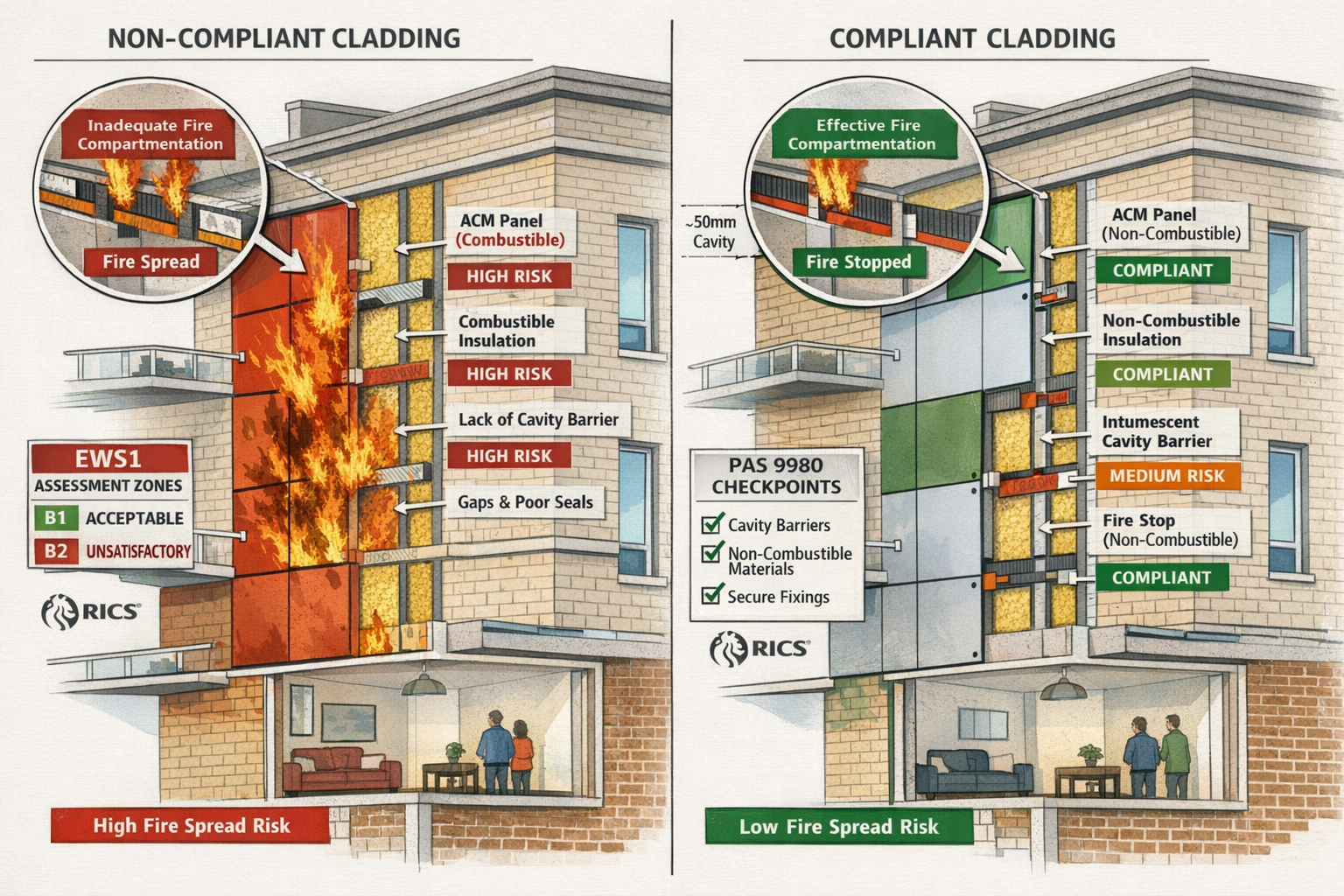
The heightened awareness of fire safety issues has fundamentally altered buyer behavior in the multi-occupancy property market. Prospective purchasers increasingly demand comprehensive fire safety information before committing to transactions.
The EWS1 Requirement and Mortgage Lending
Mortgage lenders now routinely require EWS1 assessments for buildings meeting height and construction criteria. Properties lacking current EWS1 certification often face:
- Mortgage offer delays while assessments are commissioned
- Valuation reductions reflecting remediation costs or uncertainty
- Lending restrictions with some lenders declining applications entirely
- Insurance complications with higher premiums or coverage limitations
The validity period for EWS1 assessments extends up to five years unless substantial works affect the original conclusions[7]. However, lenders may request updated assessments more frequently, particularly for buildings undergoing remediation.
Valuation Considerations for Properties with Cladding Issues
RICS has published specific guidance on the valuation of properties in multi-storey, multi-occupancy residential buildings with cladding[6]. This guidance addresses the complex interplay between fire safety compliance and property value.
Valuation Impact Factors:
💷 Remediation Cost Estimates: Direct costs for cladding replacement or enhancement
💷 Interim Safety Measures: Costs for waking watches, enhanced alarm systems, or temporary measures
💷 Service Charge Implications: Long-term increases to cover enhanced fire safety measures
💷 Marketability Constraints: Reduced buyer pool due to lending restrictions
💷 Legal Liability Exposure: Potential claims against current or previous owners
💷 Regulatory Uncertainty: Future compliance requirements affecting long-term value
When commissioning RICS valuations, property owners should ensure valuers have specific competence in fire safety valuation considerations.
Buyer Due Diligence Expectations in 2026
Sophisticated buyers now expect comprehensive fire safety documentation as part of standard due diligence. This includes:
Essential Documentation:
📄 Current Fire Risk Assessment (dated within 12 months)
📄 EWS1 form (if applicable to building height/construction)
📄 Fire door certification and maintenance records
📄 Alarm system testing and maintenance logs
📄 Building insurance confirmation with fire cover details
📄 Service charge accounts showing fire safety expenditure
📄 Remediation plans for identified deficiencies
📄 Building Safety Fund or other grant applications (if applicable)
Sellers unable to provide this documentation face significant market disadvantages, with buyers either withdrawing or negotiating substantial price reductions to reflect uncertainty and potential future costs.
Practical Implementation: Building Survey Checklists for 2026
Chartered surveyors conducting building surveys on multi-occupancy properties should utilize comprehensive checklists ensuring all fire safety aspects receive appropriate attention.
External Inspection Checklist
Cladding and External Wall Systems:
✓ Overall cladding system type and configuration
✓ Face material composition (ACM, HPL, render, etc.)
✓ Visible condition and attachment integrity
✓ Evidence of cavity barriers at floor levels
✓ Balcony construction and separation
✓ Window spandrel panel construction
✓ External insulation system type
✓ Previous remediation works evidence
✓ EWS1 form availability and currency
External Access and Egress:
✓ Fire service access routes and hardstanding
✓ Dry riser/wet riser locations and condition
✓ External staircase condition (if present)
✓ Assembly point designation and signage
✓ Vehicle access restrictions or barriers
Internal Common Areas Checklist
Fire Detection and Alarm Systems:
✓ System type and compliance with BS 5839-1:2017
✓ Detector coverage in common areas
✓ Manual call point locations
✓ Alarm sounders audibility
✓ Control panel location and condition
✓ Testing and maintenance records
✓ Integration with suppression systems
Escape Routes and Compartmentation:
✓ Stairwell construction and fire rating
✓ Corridor width and clear passage
✓ Fire door locations, certification, and condition
✓ Self-closing mechanisms functionality
✓ Intumescent strips and smoke seals
✓ Vision panels where required
✓ Floor/ceiling penetration sealing
✓ Service duct fire-stopping
✓ Refuse chute construction and maintenance
Emergency Lighting and Signage:
✓ Emergency luminaire coverage
✓ Maintained vs. non-maintained system type
✓ Battery backup duration
✓ Testing regime compliance
✓ Fire action notices positioning
✓ Escape route signage clarity
✓ Floor plan displays showing escape routes
✓ Assembly point designation
Individual Unit Assessment
When survey scope permits access to individual units:
Flat Entrance Doors:
✓ Fire rating certification (typically FD30S minimum)
✓ Door condition and fit within frame
✓ Self-closing device functionality
✓ Intumescent strips and smoke seals
✓ Letter box fire-rated flap
✓ Viewer or spy-hole installation
✓ Lock and latch security
Internal Fire Safety Features:
✓ Smoke alarm installation and type
✓ Heat detector in kitchen areas
✓ Carbon monoxide detector (if gas appliances)
✓ Fire blanket provision
✓ Extinguisher availability (if appropriate)
✓ Internal compartmentation (if maisonette/duplex)
These comprehensive checklists ensure building surveyors capture all relevant fire safety information during their inspections, providing clients with the detailed intelligence necessary for informed decision-making.
Emerging Trends and Future Developments
The fire safety regulatory landscape continues to evolve, with several emerging trends likely to shape building survey practice beyond 2026.
Building Safety Act Implementation
The Building Safety Act introduces the Building Safety Regulator with enhanced powers over higher-risk buildings. This creates additional compliance layers including:
- Building Control approval for fire safety alterations
- Competence requirements for professionals involved in design and construction
- Golden thread information requirements tracking building safety throughout lifecycle
- Mandatory occurrence reporting for fire safety incidents
- Resident engagement requirements for building safety matters
These requirements will increasingly feature in building survey reports as surveyors assess compliance with evolving regulatory frameworks.
Technology Integration in Fire Safety Assessment
Technological advances are transforming fire safety assessment methodologies:
Drone Surveys:
Drone surveys enable detailed external wall inspection without expensive scaffolding or access equipment. High-resolution imagery and thermal imaging capabilities allow surveyors to identify:
- Cladding system defects and detachment
- Thermal bridging indicating missing cavity barriers
- Water ingress affecting fire performance
- Detailed material composition analysis
Building Information Modeling (BIM):
BIM integration provides comprehensive building data supporting fire safety assessment:
- Three-dimensional visualization of compartmentation
- Material specifications and fire ratings
- Escape route modeling and analysis
- Maintenance scheduling for fire safety equipment
Smart Building Systems:
Connected fire safety systems provide real-time monitoring and data analytics:
- Continuous detector functionality verification
- Automated testing protocols
- Predictive maintenance scheduling
- Integration with building management systems
Mandatory Fire Safety Strategies
The redefinition of higher-risk buildings and introduction of mandatory fire safety strategies represent significant changes in building surveying practice in 2026[9]. These strategies require comprehensive documentation of:
- Fire safety design principles
- Evacuation strategies (stay-put, simultaneous evacuation, or phased)
- Fire service facilities and intervention capabilities
- Resident communication protocols
- Maintenance and testing schedules
Building surveyors must verify that appropriate fire safety strategies exist and remain valid for current building configuration and use.
Professional Development and Competence Requirements
The complexity of fire safety assessment in 2026 necessitates ongoing professional development for chartered surveyors. RICS and other professional bodies emphasize competence requirements across multiple domains.
Continuing Professional Development (CPD)
Surveyors specializing in multi-occupancy property assessment should pursue CPD covering:
Technical Knowledge:
- Material science and combustibility testing
- Fire engineering principles
- Regulatory framework updates
- Industry standards evolution (PAS, BS, etc.)
Practical Skills:
- EWS1 assessment methodology
- Fire risk appraisal techniques
- Remediation strategy development
- Client communication for complex findings
Professional Standards:
- RICS Red Book valuation guidance for affected properties
- Professional indemnity insurance considerations
- Duty of care and liability management
- Expert witness requirements for dispute resolution
Collaboration with Fire Safety Specialists
Complex fire safety assessments often require multidisciplinary collaboration. Building surveyors should develop relationships with:
- Fire engineers for detailed fire strategy assessment
- Cladding specialists for material testing and analysis
- Building control professionals for regulatory interpretation
- Legal advisors for liability and compliance guidance
- Insurance specialists for risk transfer strategies
This collaborative approach ensures clients receive comprehensive advice addressing all aspects of fire safety compliance and risk management.
Case Studies: Fire Safety Upgrades in Practice
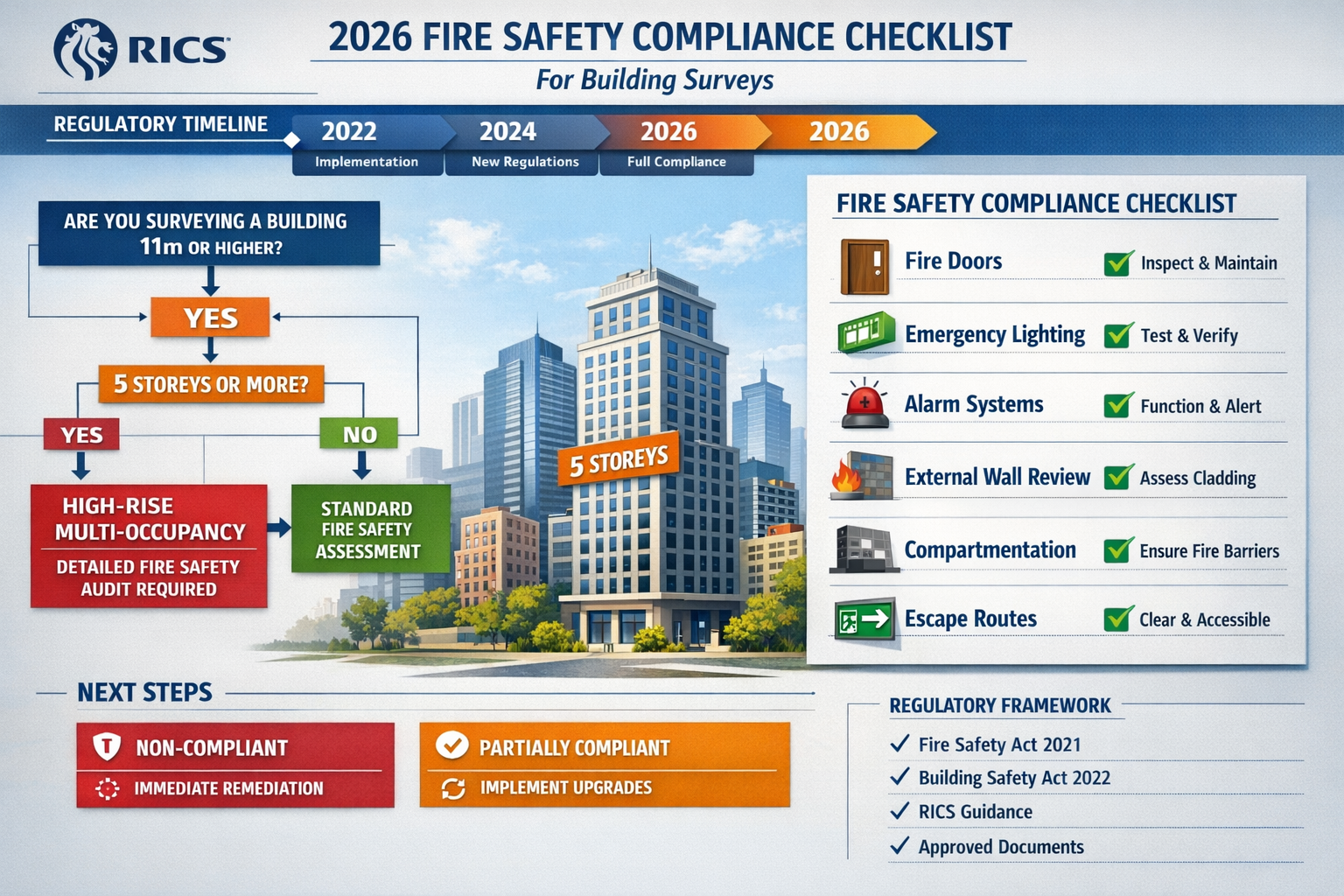
Examining real-world scenarios illustrates the practical application of Fire Safety Upgrades in Building Surveys: 2026 RICS Guidance Post-Grenfell for Multi-Occupancy Properties.
Case Study 1: 1970s Tower Block Remediation
Building Profile:
- 15-storey residential tower
- 120 flats
- Original ACM cladding with PE core
- Single stairwell escape route
Survey Findings:
- High-risk cladding requiring complete replacement
- Inadequate compartmentation with multiple unsealed penetrations
- Non-compliant fire doors throughout
- Outdated alarm system
- Insufficient emergency lighting
Remediation Strategy:
- Complete cladding replacement with A2-rated materials (£8.5M)
- Compartmentation upgrade program (£450K)
- Fire door replacement schedule (£380K)
- Alarm system upgrade to BS 5839-1:2017 (£120K)
- Emergency lighting enhancement (£65K)
- Interim waking watch pending completion (£15K/month)
Valuation Impact:
Individual flat values decreased 35-40% pending remediation completion, with gradual recovery as works progressed.
Case Study 2: Modern Build with Minor Deficiencies
Building Profile:
- 8-storey residential block (completed 2015)
- 64 flats
- Brick and render facade
- Compliant alarm and detection systems
Survey Findings:
- Render system requiring fire performance verification
- Minor fire door maintenance issues
- Some compartmentation penetrations inadequately sealed
- Emergency lighting functional but approaching replacement cycle
Remediation Strategy:
- EWS1 assessment confirming acceptable risk rating (£3,500)
- Fire door maintenance program (£8,000)
- Compartmentation sealing works (£12,000)
- Emergency lighting upgrade (£18,000)
Valuation Impact:
Minimal impact (less than 5%) with clear remediation plan and modest costs.
These case studies demonstrate the spectrum of fire safety issues encountered in contemporary building surveys and the varying implications for property values and marketability.
Conclusion: Navigating Fire Safety Compliance in 2026
Fire Safety Upgrades in Building Surveys: 2026 RICS Guidance Post-Grenfell for Multi-Occupancy Properties represents a fundamental evolution in how the property industry approaches building safety. The regulatory framework continues to develop, buyer expectations have permanently shifted, and professional standards demand comprehensive fire safety assessment as integral to building survey practice.
For property owners, prospective buyers, and building professionals, understanding these requirements is no longer optional—it's essential for protecting lives, preserving property values, and ensuring regulatory compliance.
Actionable Next Steps
For Property Owners and Landlords:
- Commission Current Fire Risk Assessments: Ensure FRAs are current (within 12 months) and cover all required areas including external walls
- Obtain EWS1 Certification: If your building is 11 metres or higher, secure current EWS1 assessment from qualified professional
- Address Priority Deficiencies: Implement remediation for life-critical issues immediately
- Maintain Comprehensive Records: Document all fire safety equipment testing, maintenance, and upgrades
- Engage Professional Surveyors: Commission RICS building surveys from chartered professionals with fire safety competence
For Prospective Buyers:
- Request Fire Safety Documentation: Obtain all relevant certificates, assessments, and records before exchange
- Commission Independent Surveys: Don't rely solely on seller-provided information—obtain independent building surveys from qualified professionals
- Understand Responsibility Allocation: Clarify whether you or the building owner/management company bears responsibility for specific fire safety elements
- Factor Remediation Costs: Budget for potential fire safety upgrades when calculating affordability
- Verify Insurance Availability: Confirm building insurance covers fire risks adequately
For Building Surveyors:
- Enhance Technical Competence: Pursue CPD in fire safety assessment, cladding systems, and regulatory frameworks
- Develop Specialist Networks: Build relationships with fire engineers and cladding specialists for complex assessments
- Implement Comprehensive Checklists: Utilize systematic inspection protocols covering all fire safety elements
- Communicate Clearly: Present findings in accessible language while maintaining technical accuracy
- Stay Current: Monitor regulatory developments and industry guidance updates continuously
The post-Grenfell regulatory environment demands vigilance, competence, and commitment from all stakeholders. By understanding and implementing the guidance outlined in this comprehensive review, property professionals can navigate this complex landscape while prioritizing the fundamental objective: ensuring the safety of building occupants.
The evolution of fire safety standards represents progress toward a safer built environment. While the compliance journey may be challenging, particularly for legacy buildings, the ultimate goal—preventing future tragedies—justifies the investment, effort, and professional dedication required.
References
[1] Public Guide – https://www.rics.org/news-insights/public-guide
[2] Clear And Impartial Fire Safety Guide From Rics – https://ringley.co.uk/blogs/clear-and-impartial-fire-safety-guide-from-rics
[3] Cladding External Wall System Ews Faqs – https://www.rics.org/news-insights/current-topics-campaigns/fire-safety/cladding-external-wall-system-ews-faqs
[4] Fire Safety Landlords Rented Shared Accommodation – https://www.rics.org/consumer-guides/fire-safety-landlords-rented-shared-accommodation
[5] Facilities Security Challenges 2026 – https://www.ipsfs.co.uk/blog/security/facilities-security-challenges-2026/
[6] Valuation Of Properties In Multi Storey Multi Occupancy Residential Buildings With Cladding – https://www.rics.org/profession-standards/rics-standards-and-guidance/sector-standards/valuation-standards/valuation-of-properties-in-multi-storey-multi-occupancy-residential-buildings-with-cladding
[7] Ews1 Fire Safety Forms Future – https://ww3.rics.org/uk/en/journals/built-environment-journal/ews1-fire-safety-forms-future.html
[9] Things About Building Surveying You Need To Know In 2026 – https://mcessex.co.uk/2026/01/23/things-about-building-surveying-you-need-to-know-in-2026/
[10] Fire Safety Requirements – https://www.nationwide-intermediary.co.uk/lending-criteria/fire-safety-requirements