The aftermath of the Grenfell Tower tragedy continues to reshape how the UK approaches fire safety in high-rise buildings. As enforcement of the Building Safety Act intensifies in 2026, surveyors face unprecedented scrutiny when validating remediation works through Gateway 2 and Gateway 3 checkpoints. Building owners, developers, and construction professionals must now navigate a complex regulatory landscape where non-compliance carries criminal penalties and costly construction halts.
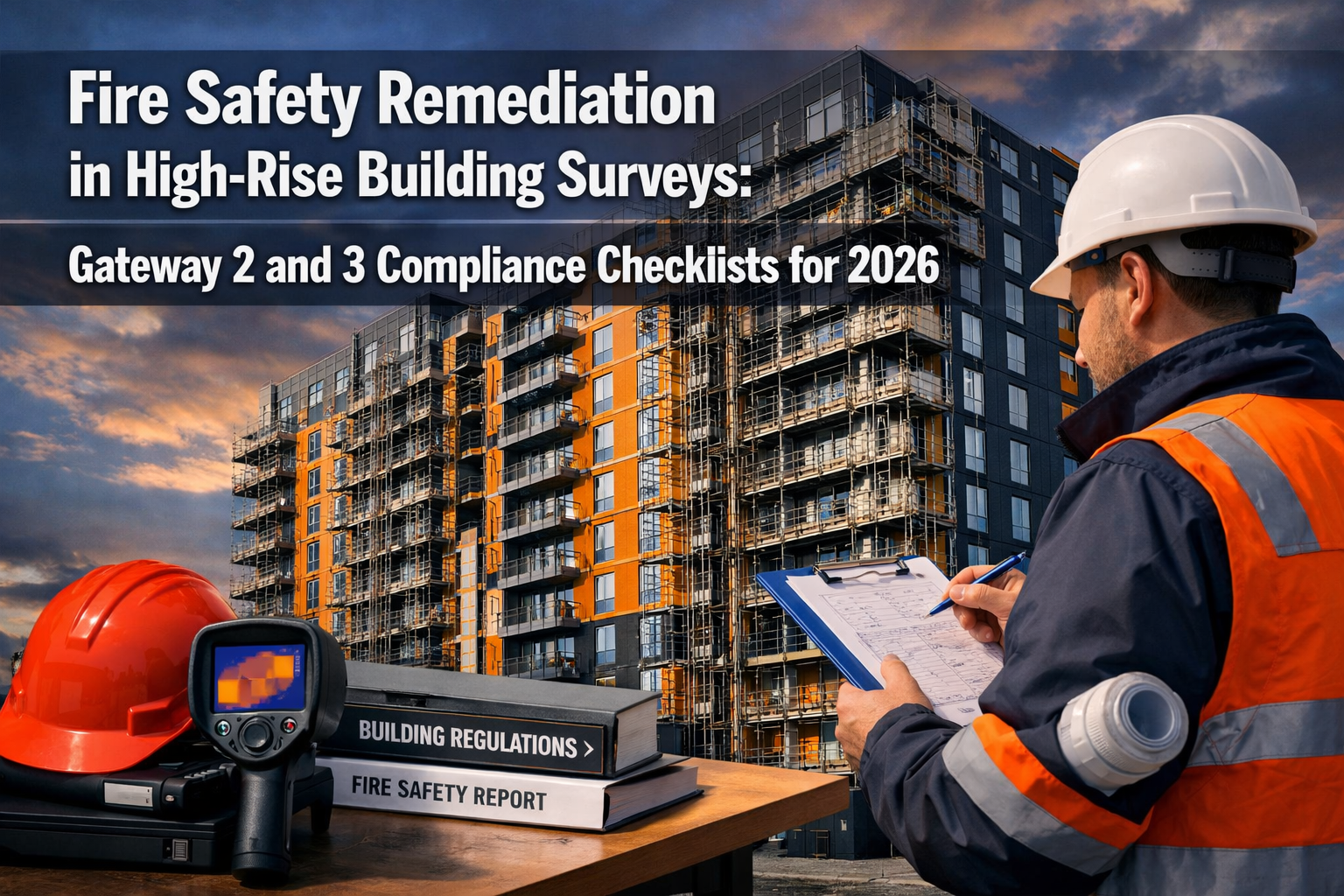
Understanding Fire Safety Remediation in High-Rise Building Surveys: Gateway 2 and 3 Compliance Checklists for 2026 has become essential for anyone involved in high-rise construction or remediation projects. This comprehensive guide provides RICS-aligned checklists, post-Grenfell case studies, and practical frameworks for ensuring your building projects meet the Building Safety Regulator's stringent requirements.
Key Takeaways
- 🏢 Gateway 2 requires mandatory fire safety assessments before any construction work begins on buildings 18 meters or taller, with detailed technical submissions covering fire compartmentation and safety systems[1]
- 📋 Gateway 3 approval is legally required before occupancy, with criminal penalties for buildings occupied without completion certificates[3]
- 📱 Golden Thread documentation must be maintained digitally throughout the building's entire lifecycle, creating a permanent record of all safety decisions[2]
- ⚠️ Non-compliance risks include enforcement action, construction delays, refusal of permission to build or occupy, and potential prosecution[1]
- 🔍 Remediation works on existing high-rises trigger both Gateway 2 and 3 requirements when works constitute significant modifications[5]
Understanding the Building Safety Act Gateway System for Fire Safety Remediation in High-Rise Building Surveys
The Building Safety Act introduced a three-gateway system specifically designed to prevent another Grenfell-style disaster. For surveyors conducting building surveys on high-rise structures, understanding these gateways is no longer optional—it's a professional necessity.
What Qualifies as a Higher-Risk Building?
Higher-risk buildings subject to Gateway 2 and 3 requirements include structures that meet specific criteria[2]:
- Height: At least 18 meters tall
- Storeys: Seven or more floors
- Occupancy type: Residential accommodation including:
- Student housing
- Care homes
- Hospitals
- Apartment buildings
- Mixed-use developments with residential components
The Three Gateway Checkpoints
| Gateway | Stage | Key Requirements | Approval Authority |
|---|---|---|---|
| Gateway 1 | Planning Permission | Initial safety considerations | Local Planning Authority |
| Gateway 2 | Pre-Construction | Full technical design, fire safety assessments | Building Safety Regulator |
| Gateway 3 | Pre-Occupancy | Completion certificate, Golden Thread handover | Building Safety Regulator |
For surveyors, Gateway 2 and Gateway 3 represent critical intervention points where professional expertise directly impacts project viability and public safety.
Fire Safety Remediation in High-Rise Building Surveys: Gateway 2 Compliance Checklist for 2026
Gateway 2 represents the most technically demanding checkpoint for fire safety remediation projects. Before any construction work begins, developers must submit comprehensive documentation demonstrating how their building design complies with Building Regulations[1].
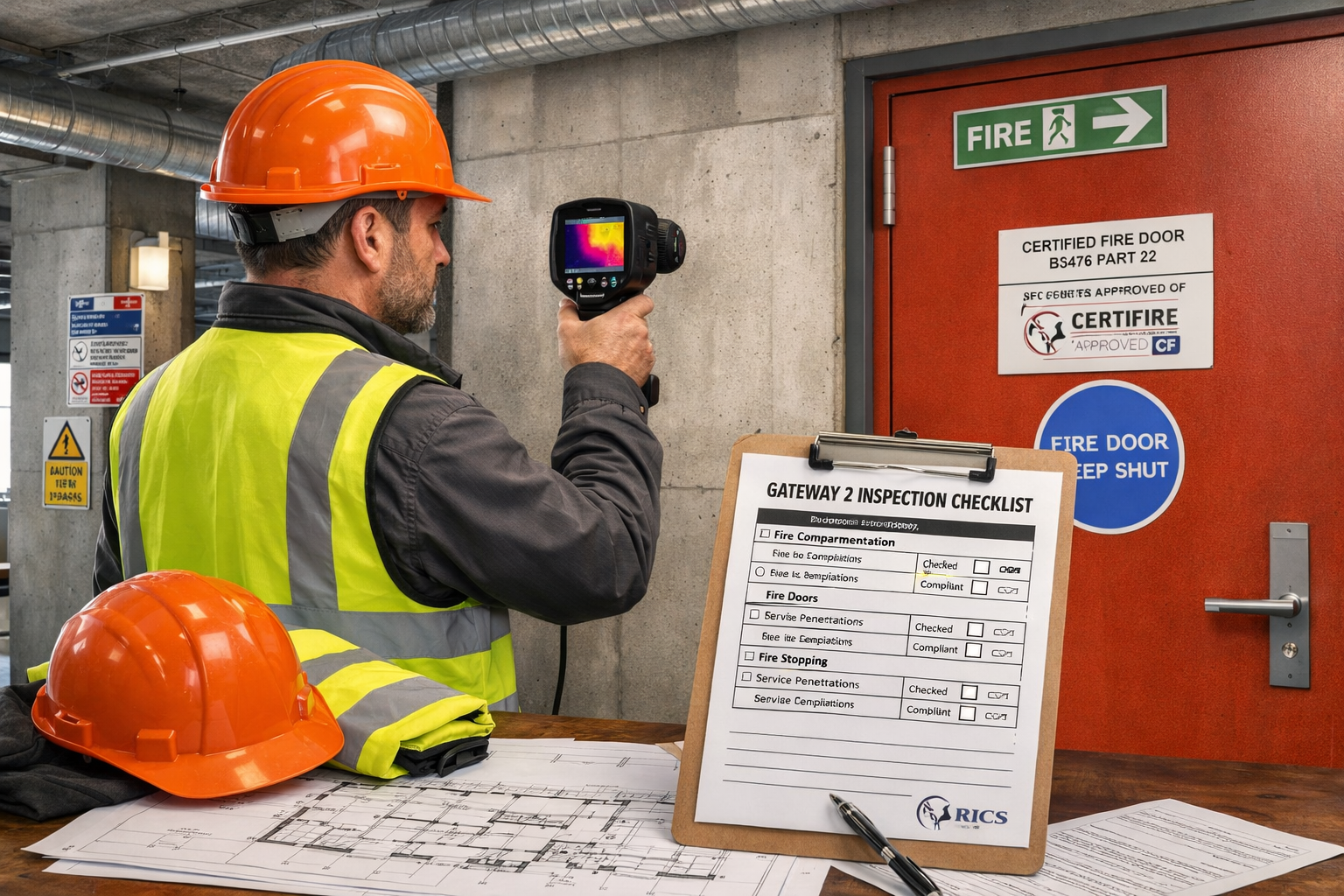
Mandatory Fire Safety Assessments for Gateway 2
The Building Safety Regulator requires both narrative explanations and supporting evidence for all fire safety measures[3]. When conducting RICS building surveys for Gateway 2 submissions, surveyors must verify:
🔥 Fire Compartmentation Requirements
- Fire-resistant walls and floors: Verification of fire resistance ratings (typically 60-120 minutes)
- Cavity barriers: Proper installation in concealed spaces
- Service penetrations: Fire-stopping around pipes, cables, and ducts
- Compartment boundaries: Clear definition and maintenance of fire compartments
- Structural fire protection: Protection of load-bearing elements
🚪 Fire Door Systems
- Certification: Valid third-party certification for all fire door sets
- Installation quality: Proper fitting with appropriate gaps and seals
- Hardware: Certified hinges, locks, and closing devices
- Signage: Clear identification of fire doors
- Maintenance records: Evidence of regular inspection and maintenance
🏗️ External Wall Systems (EWS1 Updates)
Following the post-Grenfell scrutiny, external wall systems require particularly detailed assessment:
- Cladding materials: Full specification of materials and fire performance
- Cavity barriers: Proper installation at each floor level
- Insulation materials: Fire classification and compatibility with cladding
- Fixing systems: Structural adequacy and fire performance
- Testing evidence: Fire test reports for complete system assemblies
"Gateway 2 requires developers to submit detailed fire safety and structural integrity assessments as part of full technical design submissions before any construction work begins."[1]
Technical Documentation Requirements
For remediation projects, Gateway 2 submissions must include[1]:
- Detailed and dimensioned substation layouts
- Diagrams of high-voltage and low-voltage networks
- Cable route and riser layouts
- Fire strategy report prepared by competent fire engineer
- Structural engineer's certification of fire protection measures
- Product certification for all fire safety materials
- Installation methodology statements
Design Coordination for Fire Safety Systems
For the finishes and interiors sector, Gateway 2 implications extend to multiple building elements[4]:
- Fire compartmentation coordination: Ensuring fit-out works maintain compartment integrity
- Door set specifications: Compliance with fire resistance requirements
- Signage systems: Emergency exit and fire safety signage
- Life safety systems: Integration with building-wide fire detection and alarm systems
- Smoke control systems: Coordination with mechanical ventilation
When conducting Level 3 building surveys, surveyors should pay particular attention to these coordination points, as failures here often lead to Gateway 2 refusals.
Common Gateway 2 Defects Identified in Surveys
Based on 2026 enforcement data, the most frequently identified defects include:
- ❌ Inadequate fire-stopping around service penetrations
- ❌ Missing cavity barriers in external wall systems
- ❌ Non-compliant fire doors lacking proper certification
- ❌ Incomplete compartmentation due to design changes
- ❌ Insufficient documentation of product specifications
- ❌ Poor coordination between trades affecting fire safety
Gateway 3 Compliance Checklist: Completion Certificate Requirements for Fire Safety Remediation in High-Rise Building Surveys
Gateway 3 represents the final checkpoint before a building can legally be occupied. Under the Building Safety Act, it is a criminal offence for a higher-risk building to be occupied before Gateway 3 approval is granted[3].

Pre-Occupancy Fire Safety Verification
Surveyors conducting pre-occupancy inspections must verify that all fire safety systems are fully operational and compliant:
🔍 Physical Inspection Requirements
Active Fire Protection Systems:
- Fire detection and alarm systems fully commissioned
- Sprinkler systems tested and certified
- Smoke control systems operational
- Emergency lighting functional
- Fire-fighting lifts operational (where required)
Passive Fire Protection:
- All fire doors installed and operational
- Fire compartmentation complete with no breaches
- Fire-stopping completed at all penetrations
- External wall systems fully installed per approved design
- Escape routes clear and compliant
📱 Golden Thread Documentation Handover
The Golden Thread concept requires well-organised digital records of all safety decisions and building data, maintained for as long as the building stands[2]. Gateway 3 requires the Principal Contractor to hand over comprehensive documentation including:
- As-built drawings: Reflecting all changes from approved design
- Product specifications: Complete details of all fire safety materials
- Installation records: Evidence of proper installation procedures
- Test certificates: For all fire safety systems and components
- Maintenance manuals: For ongoing building management
- Safety case report: Comprehensive fire safety strategy
- Change log: Record of all design changes and their safety implications
Completion Certificate Application Process
The Gateway 3 application must demonstrate:
- ✅ Full compliance with approved Gateway 2 design
- ✅ Proper documentation of any approved changes
- ✅ Commissioning evidence for all fire safety systems
- ✅ Competent person certification for specialist installations
- ✅ Building control final inspection sign-off
- ✅ Golden Thread information package ready for handover
Enforcement Action for Non-Compliance
The Building Safety Regulator may take enforcement action if a building is occupied without a completion certificate[3]. Potential consequences include:
- Criminal prosecution of building owners and developers
- Prohibition notices preventing occupancy
- Unlimited fines for serious breaches
- Personal liability for directors and officers
- Reputational damage affecting future projects
When conducting structural surveys for Gateway 3 compliance, surveyors must be thorough in identifying any outstanding defects that could prevent certificate issuance.
Post-Grenfell Case Studies: Lessons for Fire Safety Remediation in High-Rise Building Surveys
The Grenfell Tower fire fundamentally changed how the UK approaches high-rise fire safety. Examining post-Grenfell remediation projects provides valuable lessons for surveyors navigating Gateway 2 and 3 compliance in 2026.
Case Study 1: Large-Scale Cladding Remediation Project
Building Profile:
- 22-storey residential tower
- ACM cladding requiring complete removal
- 180 residential units
- Gateway 2 and 3 compliance required for remediation works[5]
Survey Findings:
- Original external wall system failed fire safety standards
- Cavity barriers missing at multiple floor levels
- Insulation materials non-compliant with current standards
- Balcony fire-stopping inadequate
Remediation Approach:
- Complete cladding system replacement
- Installation of compliant cavity barriers at each floor
- Upgrade to non-combustible insulation materials
- Enhanced fire-stopping at all penetrations
- Installation of sprinkler system throughout building
Gateway Compliance Challenges:
- Gateway 2: Required extensive fire engineering analysis to demonstrate compliance of new system
- Gateway 3: Phased occupancy strategy required to maintain resident accommodation during works
- Golden Thread: Retrospective documentation of original building required significant investigation
Lessons for Surveyors:
- Early engagement with Building Safety Regulator reduces delays
- Comprehensive specific defect reports essential for planning remediation scope
- Phasing strategy must be incorporated into Gateway submissions
- Resident communication plan required for occupied buildings
Case Study 2: Student Accommodation Fire Safety Upgrade
Building Profile:
- 15-storey purpose-built student accommodation
- Non-compliant external wall system
- Significant internal compartmentation defects
- Remediation works triggering Gateway requirements[5]
Survey Findings:
- HPL cladding panels requiring replacement
- Fire doors throughout building lacking certification
- Service penetrations inadequately fire-stopped
- Smoke control system deficiencies
Remediation Scope:
- External wall system replacement
- Complete fire door replacement programme (300+ doors)
- Fire-stopping works throughout building
- Smoke control system upgrade
- Installation of enhanced fire detection system
Gateway Compliance Process:
- Gateway 2: Submitted with detailed fire strategy addressing both external and internal fire safety measures
- Documentation: Extensive product certification required for all fire safety components
- Gateway 3: Staged completion certificates for phased remediation programme
- Golden Thread: Digital building information model created to maintain ongoing safety records
Key Takeaways:
- Internal fire safety defects often as significant as external wall issues
- Certification requirements for fire doors frequently overlooked in original construction
- Chartered surveyors must assess both external and internal fire safety measures comprehensively
- Digital documentation systems essential for Golden Thread compliance
Case Study 3: Mixed-Use Development Gateway 2 Refusal
Building Profile:
- 25-storey mixed-use tower
- Residential units above commercial podium
- New construction project
- Gateway 2 application refused, requiring redesign
Initial Design Issues:
- Inadequate fire separation between commercial and residential areas
- External wall system lacked sufficient fire test evidence
- Evacuation strategy unclear for simultaneous evacuation scenario
- Structural fire protection inadequate for proposed design
Refusal Reasons:
- Insufficient evidence of fire compartmentation effectiveness
- External wall system fire performance not adequately demonstrated
- Evacuation strategy not compliant with current guidance
- Structural fire engineering calculations incomplete
Redesign Requirements:
- Enhanced fire separation between uses
- Alternative external wall system with comprehensive test evidence
- Revised evacuation strategy with additional protected stairways
- Structural fire protection upgrade
Impact:
- 6-month construction delay
- £2.3 million additional costs
- Reputational damage with Building Safety Regulator
- Increased insurance premiums
Lessons Learned:
- Pre-application engagement with Building Safety Regulator crucial
- Early involvement of fire engineer prevents costly redesigns
- Comprehensive fire test evidence must support all system selections
- Mixed-use buildings face heightened scrutiny at Gateway 2
Streamlined Gateway Approvals Process in 2026
Recognizing the delays affecting high-rise construction, a new streamlined gateway approvals process aims to speed up the review of applications[6]. For surveyors and developers, understanding these improvements helps optimize submission strategies.
Fast-Track Approval Criteria
Applications may qualify for expedited review if they:
- Use pre-approved fire safety systems and materials
- Demonstrate early engagement with Building Safety Regulator
- Submit complete documentation packages without deficiencies
- Employ registered Building Safety Competent Persons
- Utilize standardized design approaches with proven compliance history
Common Reasons for Gateway Application Delays
Based on 2026 Building Safety Regulator data, the most common delay factors include:
- Incomplete documentation (42% of applications)
- Inadequate fire test evidence (31% of applications)
- Unclear design intent in narrative submissions (28% of applications)
- Missing product certifications (24% of applications)
- Insufficient structural fire engineering (19% of applications)
Best Practices for Efficient Gateway Submissions
Pre-Submission Strategies:
- Engage Building Safety Regulator for pre-application advice
- Conduct thorough RICS building surveys to identify all potential issues
- Compile complete documentation packages before submission
- Use competent fire safety professionals for all assessments
- Implement quality assurance review before submission
Documentation Organization:
- Create clear document hierarchy with executive summary
- Cross-reference between narrative and supporting evidence
- Use standardized naming conventions for all documents
- Provide comprehensive index of all submissions
- Include clear contact information for follow-up queries
Technical Excellence:
- Ensure fire engineering calculations are comprehensive and clear
- Provide complete fire test evidence for all systems
- Document design coordination between disciplines
- Address potential concerns proactively in submissions
- Include risk assessments for any novel design approaches
Practical Compliance Checklists for Surveyors
To assist surveyors conducting fire safety assessments for Gateway 2 and 3 compliance, these practical checklists provide systematic frameworks for thorough inspections.
Gateway 2 Pre-Construction Survey Checklist
External Wall Systems:
- Cladding material specification and fire classification verified
- Cavity barrier locations marked on drawings and physically verified
- Insulation material fire performance documented
- Complete external wall system fire test evidence obtained
- Fixing system adequacy confirmed by structural engineer
- Window and door interface detailing reviewed for fire performance
- Balcony fire separation measures verified
Fire Compartmentation:
- Compartment boundaries clearly defined on drawings
- Fire resistance ratings specified for all compartment elements
- Service penetration locations identified and fire-stopping specified
- Cavity barriers specified in all concealed spaces
- Structural fire protection specified for load-bearing elements
- Compartmentation maintained at junctions between elements
Fire Door Systems:
- Fire door schedule complete with locations and specifications
- Third-party certification confirmed for all door sets
- Door hardware specifications verified as compatible
- Installation methodology reviewed and approved
- Inspection and testing regime specified
- Signage requirements identified
Active Fire Protection:
- Fire detection and alarm system design reviewed
- Sprinkler system design verified (where required)
- Smoke control system design assessed
- Emergency lighting design confirmed
- Fire-fighting lift provisions verified (where required)
- Dry riser or wet riser systems specified appropriately
Documentation:
- Fire strategy report complete and approved
- Structural fire engineering report obtained
- Product certifications compiled for all fire safety materials
- Installation methodology statements prepared
- Design coordination matrix completed
- Risk assessments documented for any deviations from standards
Gateway 3 Pre-Occupancy Survey Checklist
Physical Verification:
- All fire doors installed, adjusted, and operational
- Fire compartmentation complete with no breaches observed
- Fire-stopping completed at all service penetrations
- External wall system fully installed per approved design
- Cavity barriers installed and verified at all required locations
- Escape routes clear, marked, and compliant with approved design
Active Systems Commissioning:
- Fire detection and alarm system commissioned and tested
- Sprinkler system hydraulically tested and certified
- Smoke control system commissioned and operational
- Emergency lighting tested and functional
- Fire-fighting lift commissioned (where applicable)
- Dry/wet riser systems tested and certified
Documentation Verification:
- As-built drawings reflect actual construction
- Product specifications match installed materials
- Installation records complete for all fire safety elements
- Test certificates obtained for all systems and components
- Maintenance manuals compiled for building management
- Safety case report finalized
- Change log complete and reconciled with as-built condition
Golden Thread Preparation:
- Digital information management system established
- All safety-critical information uploaded and organized
- Document version control implemented
- Access permissions configured appropriately
- Training provided to building management team
- Ongoing maintenance and update procedures established
Regulatory Compliance:
- Building control final inspection completed
- All competent person certifications obtained
- Regulatory compliance statement prepared
- Outstanding defects list compiled (if any)
- Remediation plan for any minor outstanding items
- Completion certificate application package assembled
Working with Building Safety Regulator: Engagement Strategies
Successful navigation of Gateway 2 and 3 requires effective engagement with the Building Safety Regulator. Understanding their expectations and processes improves approval likelihood and reduces delays.
Pre-Application Advice Service
The Building Safety Regulator offers pre-application advice for complex projects. Surveyors should recommend clients utilize this service when:
- Novel design approaches are proposed
- Building involves unusual occupancy types
- Significant remediation works are planned
- Previous gateway applications have been refused
- Project timeline is particularly constrained
Communication Best Practices
During Gateway 2:
- Respond promptly to all regulator queries
- Provide comprehensive answers with supporting evidence
- Maintain professional tone in all communications
- Document all interactions for project records
- Escalate unresolved issues through appropriate channels
During Gateway 3:
- Notify regulator of any changes from approved Gateway 2 design
- Provide advance notice of completion timelines
- Facilitate site inspections efficiently
- Address any defects identified promptly
- Maintain open communication regarding occupancy plans
Common Regulator Concerns
Understanding typical Building Safety Regulator concerns helps surveyors anticipate issues:
- Inadequate fire test evidence for external wall systems
- Unclear design coordination between disciplines
- Insufficient competence of design team members
- Incomplete change management processes
- Inadequate resident engagement for occupied buildings
- Poor quality control during construction phase
Future Developments in Fire Safety Regulation
As 2026 progresses, several regulatory developments will further impact fire safety remediation in high-rise building surveys.
Proposed Regulatory Changes
- Enhanced competence requirements for fire safety professionals
- Stricter product certification standards for building materials
- Expanded scope of buildings subject to gateway regime
- Increased penalties for non-compliance
- Mandatory registration of high-rise buildings
Technology Integration
Digital tools are transforming fire safety compliance:
- Building Information Modeling (BIM) for Golden Thread documentation
- Digital inspection tools for systematic defect identification
- Thermal imaging for fire compartmentation verification
- Drone surveys for external wall system assessment
- Digital certification platforms for product verification
Surveyors should invest in these technologies to maintain competitive advantage and improve inspection quality. Consider exploring drone surveys for comprehensive external wall assessments.
Industry Best Practice Evolution
Professional bodies including RICS continue developing guidance for fire safety assessments. Surveyors should:
- Maintain continuing professional development in fire safety
- Participate in industry working groups
- Stay current with evolving technical standards
- Share lessons learned from gateway applications
- Contribute to development of best practice guidance
Conclusion
Fire Safety Remediation in High-Rise Building Surveys: Gateway 2 and 3 Compliance Checklists for 2026 represents a critical competency for surveyors operating in the post-Grenfell regulatory environment. The Building Safety Act's gateway regime has fundamentally transformed how high-rise buildings are designed, constructed, and remediated, with non-compliance carrying serious legal and financial consequences.
Surveyors must approach Gateway 2 and 3 assessments with comprehensive technical knowledge, systematic inspection methodologies, and thorough documentation practices. The checklists and case studies provided in this guide offer practical frameworks for ensuring compliance, but successful navigation of the gateway regime ultimately depends on:
- Early engagement with Building Safety Regulator
- Comprehensive technical assessments covering all fire safety systems
- Meticulous documentation supporting all compliance claims
- Effective coordination between all design and construction disciplines
- Rigorous quality control throughout the project lifecycle
Actionable Next Steps
For building owners and developers planning high-rise projects or remediation works:
- Engage qualified surveyors early in project planning to identify potential compliance issues
- Conduct comprehensive building surveys before commencing design work
- Utilize pre-application advice from Building Safety Regulator for complex projects
- Implement robust quality assurance processes for all fire safety elements
- Establish Golden Thread systems from project inception
- Budget adequately for compliance costs and potential delays
For surveyors conducting high-rise assessments:
- Maintain current knowledge of Building Safety Act requirements through CPD
- Develop systematic inspection methodologies using the checklists provided
- Invest in appropriate technology for comprehensive assessments
- Build relationships with Building Safety Regulator and fire safety professionals
- Document thoroughly all findings and recommendations
- Consider specialization in fire safety assessments for high-rise buildings
The stakes for fire safety compliance have never been higher. By following the guidance in this comprehensive article, surveyors can ensure their assessments meet the rigorous standards required for Gateway 2 and 3 approval, protecting both public safety and their clients' interests.
For expert assistance with high-rise building surveys and fire safety assessments, get a quote from experienced chartered surveyors who understand the complexities of the Building Safety Act gateway regime.
References
[1] Gateway 2 What Developers And Mes Need To Know For High Rise Buildings – https://bdcmagazine.com/2025/09/gateway-2-what-developers-and-mes-need-to-know-for-high-rise-buildings/
[2] Constructions New Checkpoints What You Need To Know About The Building Safety Act Gateways – https://www.projectsimpel.com/constructions-new-checkpoints-what-you-need-to-know-about-the-building-safety-act-gateways/
[3] Gateways – https://www.thebesa.com/building-safety-act/gateways/
[4] Gateway Two Progress Building Safety Updates And What They Mean For Fit Out Contractors – https://www.thefis.org/2026/01/15/gateway-two-progress-building-safety-updates-and-what-they-mean-for-fit-out-contractors/
[5] Party Wall Surveys For High Rise Remediation Works Navigating Building Safety Act Requirements In 2026 – https://nottinghillsurveyors.com/blog/party-wall-surveys-for-high-rise-remediation-works-navigating-building-safety-act-requirements-in-2026/
[6] What Can The Latest Building Safety Regulator Figures For Gateway 2 Applications Tell Architects – https://www.riba.org/work/insights-and-resources/professional-features/building-safety-act-professional-features/what-can-the-latest-building-safety-regulator-figures-for-gateway-2-applications-tell-architects/