The property market in 2026 continues to grapple with the lasting impact of the Grenfell Tower tragedy. As residential transactions increase and market recovery gains momentum, fire safety building surveys have become non-negotiable components of property due diligence. The ongoing regulatory scrutiny surrounding Fire Safety Building Surveys Post-Grenfell: 2026 Updates for Cladding and EWS1 Compliance demands that property owners, buyers, and lenders understand the latest standards, remediation requirements, and valuation implications. With nearly half of identified high-risk buildings still awaiting complete remediation and new regulations taking effect this year, comprehensive fire risk assessments are more critical than ever for protecting investments and ensuring occupant safety.
Key Takeaways
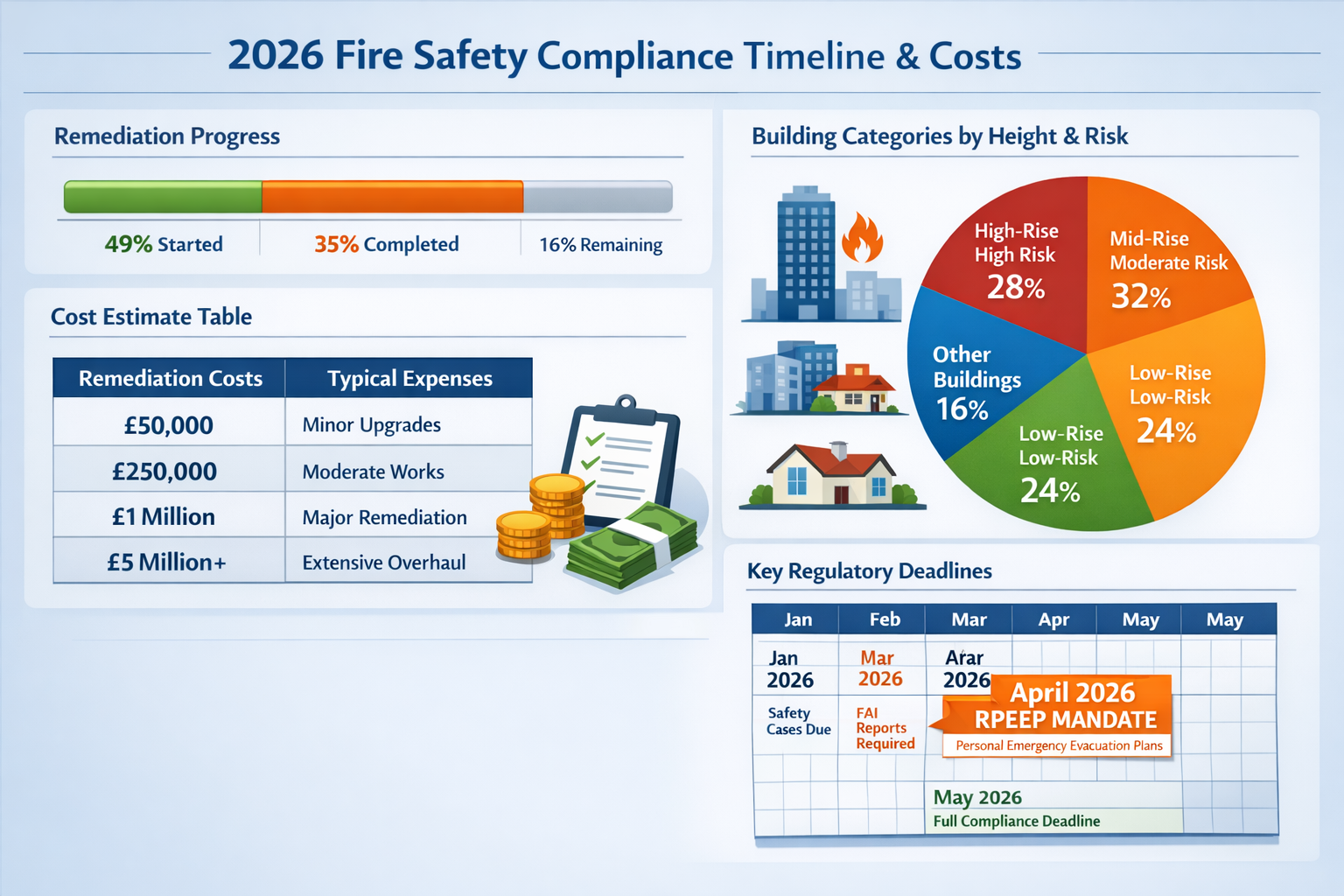
- 🏢 As of 2026, only 35% of identified high-risk buildings have completed cladding remediation, with 2,705 buildings (49%) having started or completed work on unsafe cladding systems[4]
- 📋 Residential Personal Emergency Evacuation Plans (RPEEPs) become legally mandatory from April 6, 2026, requiring building owners to implement comprehensive evacuation strategies[3][4]
- ⏱️ Gateway 2 application delays averaged 33 weeks in 2025, prompting government consultation on streamlining approval processes for lower-risk building modifications[1]
- 💰 Remediation costs significantly impact property valuations, with comprehensive fire safety surveys now essential for accurate RICS valuations and mortgage lending decisions
- 🔍 Updated Approved Document B guidance expected in 2026 will provide clearer fire safety standards following expert panel recommendations from July 2025[5]
Understanding Fire Safety Building Surveys Post-Grenfell: The 2026 Regulatory Landscape
The regulatory environment governing building fire safety has undergone dramatic transformation since the Grenfell Tower fire in 2017. In 2026, property professionals face a complex web of requirements that extend far beyond traditional building surveys. The Fire Safety Building Surveys Post-Grenfell: 2026 Updates for Cladding and EWS1 Compliance framework represents the culmination of years of legislative development, inquiry findings, and industry adaptation.
The Building Safety Act and Gateway System
The Building Safety Act introduced a Gateway approval process designed to ensure rigorous oversight of higher-risk buildings throughout their lifecycle. However, implementation challenges have emerged. Gateway 2 applications experienced significant delays in 2025, with processing times averaging 33 weeks[1]. This bottleneck has prompted government action, with early 2026 consultations planned to streamline approvals for certain building modifications that pose limited fire safety risks, such as bathroom pod installations[1].
For property owners and developers, these delays have real financial consequences. Projects stall, costs escalate, and property transactions face uncertainty. When commissioning a structural survey, it's essential to understand whether Gateway approvals will be required and factor potential delays into project timelines.
Key Regulatory Milestones in 2026
Several critical regulatory developments are shaping fire safety requirements this year:
| Regulatory Change | Effective Date | Impact |
|---|---|---|
| Residential Personal Emergency Evacuation Plans (RPEEPs) | April 6, 2026 | Mandatory implementation for all qualifying residential buildings[3][4] |
| Government's First Annual Grenfell Phase 2 Report | February 2026 | Updated guidance on building safety requirements[1] |
| Approved Document B Updates | Expected 2026 | Revised fire safety standards following expert panel review[5] |
| Gateway Proportionality Consultation | Early 2026 | Potential streamlining of approval processes for lower-risk modifications[1] |
The government's first annual report responding to the Grenfell Phase 2 inquiry findings was due in February 2026, providing updated guidance that will influence how commercial building surveys address fire safety concerns[1].
The Scope of Buildings Requiring Assessment
Not all buildings face the same level of scrutiny. The regulatory framework primarily focuses on:
- Residential buildings 11 metres and above (approximately 3-4 stories)
- Buildings with 7 or more stories, regardless of height
- Higher-risk buildings as defined under the Building Safety Act
- Buildings with external wall systems containing combustible materials
As of October 2025, the Department for Levelling Up, Housing and Communities is monitoring 5,570 residential buildings 11 metres and over with unsafe cladding, representing an estimated 65-97% of all buildings expected to require remediation[4]. This substantial number underscores the widespread nature of fire safety concerns across the UK housing stock.
Cladding Systems and External Wall Fire Review (EWS1) Requirements
The External Wall Fire Review (EWS1) form has become one of the most significant documents in residential property transactions since its introduction. Understanding cladding types, assessment requirements, and EWS1 implications is essential for anyone involved in Fire Safety Building Surveys Post-Grenfell: 2026 Updates for Cladding and EWS1 Compliance.
Types of Cladding Systems Under Scrutiny
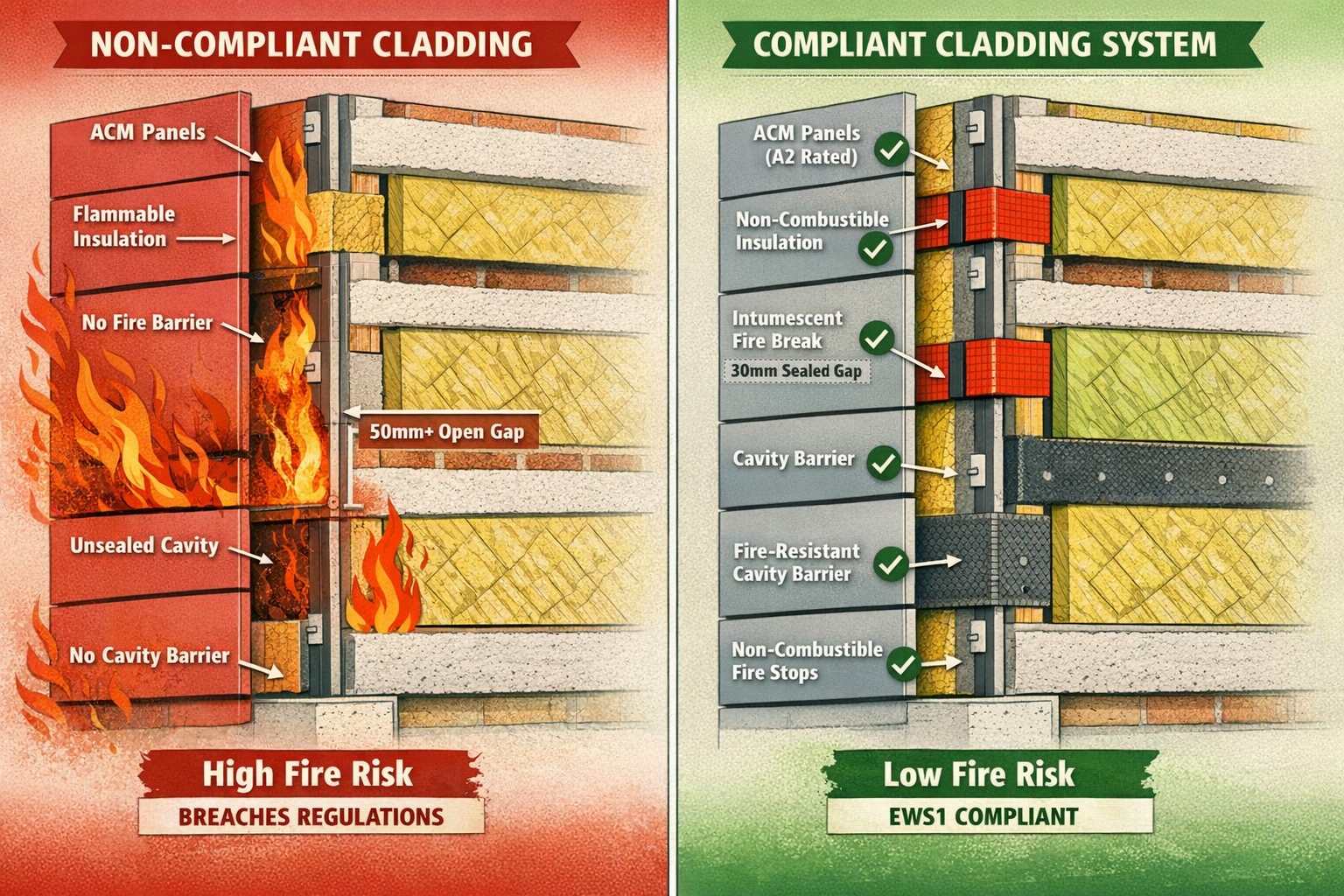
Not all cladding presents equal risk. Fire safety assessments categorize external wall systems based on their combustibility and fire performance:
High-Risk Cladding Materials:
- Aluminium Composite Material (ACM) with polyethylene core (the type used on Grenfell Tower)
- High-Pressure Laminate (HPL) panels with combustible cores
- Certain timber cladding systems without adequate fire resistance
- Expanded polystyrene (EPS) insulation in specific configurations
Lower-Risk Systems:
- ACM with fire-retardant mineral cores
- Brick and masonry cladding
- Render systems on non-combustible substrates
- Metal cladding with appropriate fire barriers
Compliant Modern Systems:
- A2-rated non-combustible materials meeting current Building Regulations
- Systems with comprehensive cavity barriers and fire breaks
- Properly designed ventilated rainscreen systems with fire-stopping
When conducting a comprehensive building survey comparison, understanding these distinctions helps property professionals assess which level of investigation is appropriate.
The EWS1 Form: What It Is and When It's Required
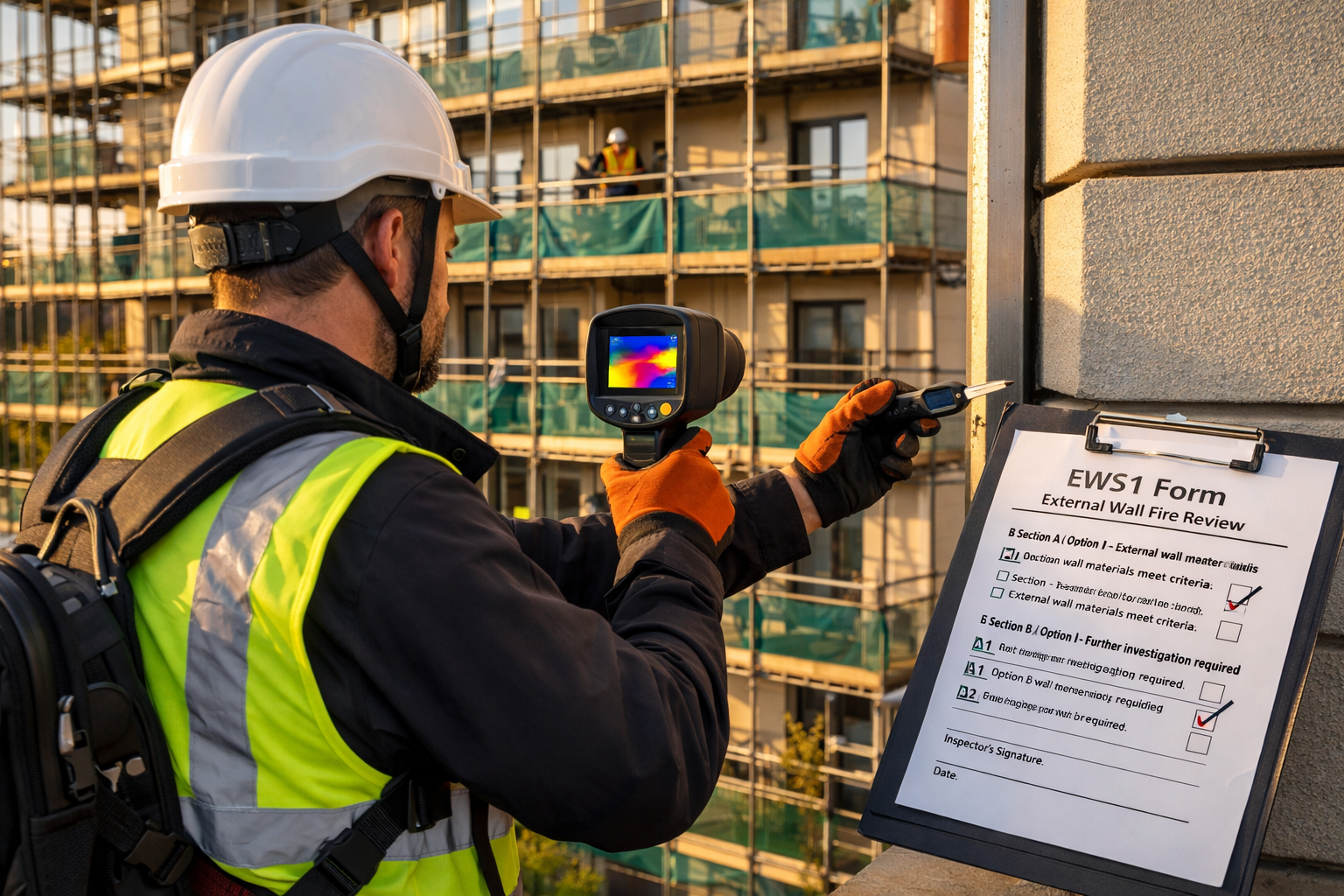
The EWS1 form is a standardized document completed by a qualified fire engineer or building surveyor to confirm whether a building's external wall system requires remediation. The form has three possible outcomes:
- ✅ Form A (Pass): External walls meet required standards; no remediation needed
- ⚠️ Form B1 (Remediation Required): External walls require remediation work
- ⚠️ Form B2 (Interim Measures): Interim fire safety measures implemented while awaiting full remediation
When is an EWS1 required?
While not legally mandatory for all buildings, lenders typically require EWS1 forms for:
- Buildings 18 metres (6 stories) and above with any external wall system
- Buildings 11-18 metres with combustible materials in the external wall
- Buildings where the lender's valuer identifies fire safety concerns
The Royal Institution of Chartered Surveyors (RICS) guidance has evolved, and many lenders now take a more proportionate approach. However, the absence of an EWS1 form can still render properties unmortgageable, creating significant valuation and saleability issues.
The Remediation Progress Reality
Despite years of focus on cladding remediation, progress remains slower than many stakeholders hoped. As of the latest government data:
- 2,705 buildings (49%) have started or completed remediation work
- 1,946 buildings (35%) have fully completed remediation
- 2,865 buildings (51%) have not yet started remediation work[4]
These figures reveal that more than half of identified high-risk buildings still await remediation commencement. For property buyers, this creates a challenging landscape where thorough structural surveys must assess not only current fire safety status but also potential future remediation liabilities.
Cost Implications of Cladding Remediation
Remediation costs vary dramatically based on building height, cladding type, and complexity:
| Building Height | Typical Remediation Cost Range |
|---|---|
| 11-18 metres | £50,000 – £500,000 |
| 18-30 metres | £500,000 – £2 million |
| 30+ metres | £2 million – £5+ million |
These substantial costs have profound implications for:
- Leaseholders facing service charge demands
- Freeholders and managing agents coordinating works
- Property valuations and reinstatement cost assessments
- Insurance premiums and building coverage
Government funding schemes, including the Building Safety Fund and the Cladding Safety Scheme, provide financial support for qualifying buildings. However, eligibility criteria, application processes, and funding gaps mean many building owners still face significant out-of-pocket expenses.
Conducting Comprehensive Fire Safety Building Surveys in 2026
The practical execution of Fire Safety Building Surveys Post-Grenfell: 2026 Updates for Cladding and EWS1 Compliance requires specialized knowledge, appropriate qualifications, and systematic methodology. As regulatory requirements evolve and enforcement intensifies, the quality and thoroughness of fire safety assessments have never been more important.
Who Can Conduct Fire Safety Building Surveys?
Not all surveyors possess the expertise required for comprehensive fire safety assessments. Qualified professionals include:
Chartered Building Surveyors with fire safety specialization:
- RICS-registered professionals with relevant continuing professional development
- Experience in external wall system assessment
- Understanding of Building Regulations Part B (Fire Safety)
Fire Safety Engineers:
- Chartered engineers with fire engineering qualifications
- Competence in fire risk assessment and building performance
- Ability to model fire behavior and evacuation scenarios
Approved Inspectors and Building Control:
- Registered building control professionals
- Authority to assess compliance with Building Regulations
- Experience with Gateway approval processes
When selecting a surveyor for fire safety assessment, verify their qualifications, professional indemnity insurance, and specific experience with cladding systems. The complexity of modern fire safety regulations means that general building surveyors without specialized training may miss critical issues.
The Fire Safety Survey Process
A comprehensive fire safety building survey follows a structured methodology:
1. Desktop Review and Documentation Assessment
- Review building plans, specifications, and construction records
- Examine previous EWS1 forms or fire risk assessments
- Check building control approval history and Gateway submissions
- Verify compliance certificates and product warranties
2. External Inspection
- Visual assessment of cladding systems and external wall construction
- Identification of materials and construction methods
- Assessment of cavity barriers, fire breaks, and compartmentation
- Evaluation of balconies, windows, and penetrations
3. Internal Inspection
- Review of common areas, stairwells, and escape routes
- Assessment of fire doors, emergency lighting, and signage
- Examination of compartmentation and fire-stopping
- Evaluation of fire alarm and detection systems
4. Intrusive Investigation (When Required)
- Opening-up works to expose concealed construction
- Material sampling for laboratory testing
- Thermal imaging to identify construction anomalies
- Cavity inspection using borescopes or similar equipment
5. Risk Assessment and Reporting
- Fire risk evaluation using recognized methodologies
- Identification of deficiencies and non-compliances
- Prioritization of remedial actions
- Cost estimation for required works
This systematic approach ensures that all aspects of fire safety receive appropriate attention, similar to the thoroughness required in asbestos surveys where hidden hazards demand careful investigation.
Integration with Other Survey Types
Fire safety considerations now permeate all types of property surveys:
Pre-Purchase Surveys: Buyers commissioning Level 2 or Level 3 surveys for flats in buildings over 11 metres should specifically request fire safety assessment as part of the survey scope.
Valuation Surveys: RICS valuations must consider fire safety status, with significant value adjustments for buildings requiring remediation or lacking EWS1 certification.
Commercial Property Surveys: Commercial building surveys for mixed-use developments must address residential fire safety requirements where applicable.
Dilapidations Assessments: Dilapidation surveys may need to consider whether fire safety improvements constitute landlord or tenant obligations.
New Requirements: Residential Personal Emergency Evacuation Plans (RPEEPs)
From April 6, 2026, Residential Personal Emergency Evacuation Plans become legally mandatory[3][4]. This significant regulatory change requires:
Building Owners and Responsible Persons to:
- Identify residents who may need assistance during evacuation
- Develop personalized evacuation strategies for vulnerable residents
- Document and regularly review evacuation procedures
- Coordinate with emergency services and building management
RPEEPs must consider:
- 🦽 Mobility impairments and wheelchair users
- 👁️ Visual or hearing impairments
- 🧠 Cognitive conditions affecting evacuation capability
- 👶 Families with young children or infants
- 🏥 Temporary conditions (injury, pregnancy, illness)
This requirement represents a shift from generic evacuation strategies to personalized, resident-specific planning. Building surveys must now assess whether adequate provisions exist for implementing and maintaining RPEEPs, including:
- Suitable refuge areas or evacuation equipment
- Communication systems for alerting vulnerable residents
- Record-keeping systems for RPEEP documentation
- Staff training and emergency response procedures
Valuation Implications and Financial Considerations
The financial impact of fire safety issues extends far beyond remediation costs. Understanding how Fire Safety Building Surveys Post-Grenfell: 2026 Updates for Cladding and EWS1 Compliance affect property values, mortgageability, and investment decisions is crucial for all stakeholders in the property market.
Impact on Property Values
Fire safety concerns create significant valuation challenges:
Properties with Confirmed Fire Safety Issues:
- Value reductions of 20-70% are common for properties in buildings with serious cladding defects
- Some properties become effectively unsaleable until remediation completes
- Leasehold properties face additional devaluation from anticipated service charge liabilities
Properties Lacking EWS1 Certification:
- Even where no defects exist, absence of EWS1 forms creates valuation uncertainty
- Lenders may refuse mortgages, limiting the buyer pool to cash purchasers
- Cash buyers typically demand substantial discounts to compensate for risk and illiquidity
Properties with Completed Remediation:
- Values typically recover to near pre-crisis levels
- Premium may exist for buildings with comprehensive fire safety upgrades
- Enhanced saleability and broader mortgage availability
When obtaining RICS reinstatement valuations, it's essential that valuers consider fire safety compliance, as rebuilding costs must reflect current regulatory standards.
Mortgage Lending and EWS1 Requirements
The mortgage lending landscape has evolved significantly:
2024-2026 Lending Trends:
- Most major lenders require EWS1 forms for buildings over 18 metres
- Many lenders extend requirements to 11-18 metre buildings with cladding concerns
- Some lenders have relaxed requirements for lower-rise buildings without obvious risks
- Proportionate approach increasingly adopted based on individual building assessment
Lender Risk Assessment Factors:
- Building height and number of stories
- Presence and type of external cladding
- Availability of EWS1 or alternative fire safety certification
- Evidence of ongoing remediation work and funding
- Building insurance availability and cost
The relationship between fire safety and mortgageability means that understanding whether a mortgage valuation is the same as a survey becomes even more important—basic mortgage valuations may not identify fire safety issues that could later affect property value or saleability.
Service Charge and Remediation Funding
For leasehold properties, fire safety remediation creates complex financial obligations:
Funding Sources:
- Government grants (Building Safety Fund, Cladding Safety Scheme)
- Developer contributions (voluntary or through legal action)
- Freeholder funding (particularly for portfolio landlords)
- Leaseholder service charges (subject to legal protections and caps)
Leaseholder Protections:
The Building Safety Act introduced important protections:
- £15,000 cap on remediation costs for qualifying leaseholders
- £50,000 lifetime cap for higher-value property owners
- Developer liability for buildings they developed in previous 30 years
- Freeholder liability for building owners meeting certain criteria
However, these protections don't cover all scenarios, and leaseholders may still face:
- Costs for non-cladding fire safety works
- Interim safety measure expenses (waking watches, alarm systems)
- Increased insurance premiums
- Professional fees and survey costs
Insurance Considerations
Building insurance has become increasingly challenging for properties with fire safety concerns:
Insurance Market Trends:
- Premium increases of 200-500% for buildings with identified cladding issues
- Some insurers refuse coverage for high-risk buildings
- Waking watch requirements as insurance conditions (£100,000+ annually)
- Enhanced coverage requirements for buildings undergoing remediation
Insurance Assessment Factors:
- External wall system type and fire performance
- Presence of sprinklers, alarms, and detection systems
- Building height and occupancy density
- Fire risk assessment findings and EWS1 status
- Interim safety measures in place
When commissioning reinstatement valuations, ensure the valuer understands current fire safety requirements, as rebuilding to modern standards may cost significantly more than the original construction.
Practical Guidance for Property Owners, Buyers, and Professionals
Navigating Fire Safety Building Surveys Post-Grenfell: 2026 Updates for Cladding and EWS1 Compliance requires practical strategies tailored to different stakeholder perspectives. Whether you're buying, selling, managing, or professionally assessing properties, understanding your obligations and options is essential.
For Property Buyers
Before Making an Offer:
✅ Request fire safety documentation including:
- EWS1 forms (if applicable)
- Recent fire risk assessments
- Building insurance certificates
- Details of any ongoing remediation work
✅ Commission appropriate surveys:
- Specify fire safety assessment in survey instructions
- Consider specialist fire engineer reports for higher-risk buildings
- Request specific cladding material identification
✅ Investigate service charge implications:
- Review service charge accounts for fire safety expenditure
- Request estimates for planned remediation works
- Verify eligibility for government funding or developer contributions
✅ Confirm mortgage availability:
- Discuss fire safety status with mortgage broker early
- Obtain agreement in principle before proceeding
- Understand lender-specific EWS1 requirements
Red Flags to Watch For:
- 🚩 Seller reluctance to provide fire safety documentation
- 🚩 Ongoing waking watch arrangements (indicating unresolved fire risks)
- 🚩 Significant service charge arrears (suggesting leaseholder funding disputes)
- 🚩 Buildings with ACM cladding still awaiting remediation
- 🚩 Insurance renewals pending or coverage gaps
For Property Sellers
Preparing for Sale:
📋 Gather documentation proactively:
- Obtain EWS1 form if not already available
- Compile fire safety certificates and assessments
- Document remediation work completed or planned
- Prepare service charge account summaries
📋 Be transparent about fire safety status:
- Disclose known issues in property particulars
- Provide realistic timescales for remediation completion
- Share information about funding arrangements
- Communicate insurance status and costs
📋 Consider timing strategically:
- Properties mid-remediation may achieve better prices after completion
- Market conditions and lender policy changes affect saleability
- Government funding deadlines may influence optimal sale timing
📋 Price realistically:
- Obtain professional RICS valuations that factor in fire safety status
- Understand that cash buyers will expect significant discounts if mortgages unavailable
- Consider whether remediation completion before sale maximizes value
For Building Owners and Managing Agents
Compliance Obligations:
🏢 Conduct regular fire risk assessments:
- Legal requirement under Regulatory Reform (Fire Safety) Order 2005
- Update assessments when building alterations occur
- Review and update following regulatory changes
🏢 Implement RPEEP requirements (mandatory from April 6, 2026):
- Identify residents requiring personalized evacuation plans
- Develop and document individual RPEEPs
- Establish review and update procedures
- Train staff on RPEEP implementation
🏢 Maintain comprehensive records:
- Fire safety certificates and test records
- Remediation work documentation and warranties
- Gateway approval correspondence
- Resident communication regarding fire safety
🏢 Engage qualified professionals:
- Appoint competent fire risk assessors
- Retain specialist fire engineers for complex assessments
- Work with experienced structural engineers for remediation design
- Ensure contractors hold appropriate accreditations
Remediation Project Management:
For buildings requiring remediation:
- Secure funding through available government schemes and developer contributions
- Appoint professional team including fire engineers, surveyors, and project managers
- Navigate Gateway approvals allowing for extended timescales
- Communicate with residents providing regular updates and managing expectations
- Coordinate interim measures such as enhanced fire detection or waking watches
- Document comprehensively to demonstrate compliance and support future sales
For Property Professionals and Surveyors
Professional Competence Requirements:
📊 Maintain current knowledge:
- Attend CPD training on fire safety regulations
- Stay updated on Building Safety Act implementation
- Understand EWS1 form completion requirements
- Monitor government guidance updates
📊 Scope surveys appropriately:
- Clearly define whether fire safety assessment is included
- Identify when specialist fire engineer input is required
- Recommend additional investigations when concerns arise
- Document limitations of inspection scope
📊 Report findings clearly:
- Use standardized terminology and risk classifications
- Provide cost estimates for remediation works
- Explain implications for value, mortgageability, and insurance
- Offer practical recommendations prioritized by urgency
📊 Understand liability boundaries:
- Maintain appropriate professional indemnity insurance
- Work within competence limits
- Recommend specialist input when required
- Document advice and recommendations thoroughly
When conducting surveys that may involve expert witness reports or litigation support, particularly rigorous documentation and evidence gathering becomes essential.
Looking Ahead: Future Developments and Regulatory Evolution
The regulatory landscape governing Fire Safety Building Surveys Post-Grenfell: 2026 Updates for Cladding and EWS1 Compliance continues to evolve. Understanding anticipated changes helps stakeholders prepare for future requirements and adjust strategies accordingly.
Expected Regulatory Changes in 2026
Approved Document B Updates:
The Building Regulations guidance review overseen by an expert panel appointed in July 2025 is expected to yield recommendations for updates to Approved Document B (Fire Safety) in 2026[5]. Anticipated changes include:
- Clarified guidance on external wall construction and materials
- Enhanced requirements for compartmentation and fire-stopping
- Updated evacuation strategy requirements
- Improved coordination between different regulatory frameworks
Gateway Process Streamlining:
Following consultation in early 2026, the government plans to streamline the Building Safety Act Gateway approval process for certain types of building work[1]. Expected changes include:
- Proportionate approvals for modifications posing limited fire safety risks
- Faster processing for routine works like bathroom installations
- Clearer categorization of which works require full Gateway approval
- Reduced administrative burden while maintaining safety standards
These changes respond to industry feedback about the 33-week Gateway 2 delays experienced in 2025[1], which have created significant project bottlenecks.
Industry Best Practices Emerging in 2026
Digital Fire Safety Passports:
Several building owners are implementing digital building passports that consolidate:
- Fire risk assessments and EWS1 forms
- Remediation work certificates and warranties
- Maintenance records for fire safety equipment
- RPEEP documentation and resident information
- Gateway approval correspondence
These digital systems improve transparency, facilitate property transactions, and support ongoing compliance management.
Enhanced Resident Communication:
Leading building managers are adopting proactive communication strategies:
- Regular fire safety updates through resident portals
- Clear explanation of remediation timescales and funding
- Transparent service charge reporting for fire safety expenditure
- Resident engagement in evacuation planning and drills
Integrated Risk Management:
Forward-thinking building owners are moving beyond compliance to holistic risk management:
- Regular fire safety audits beyond minimum requirements
- Investment in enhanced detection and suppression systems
- Comprehensive staff training programs
- Scenario planning for emergency situations
The Path to Market Normalization
While fire safety concerns will remain a permanent feature of the property landscape, several factors suggest gradual market normalization:
Remediation Progress:
- As the 49% of buildings that have started remediation complete their works[4], the pool of problematic properties will shrink
- Government funding schemes continue to support remediation acceleration
- Industry expertise and capacity for remediation work is expanding
Lender Adaptation:
- Mortgage lenders are developing more proportionate assessment approaches
- Standardized EWS1 requirements are reducing uncertainty
- Alternative lending products are emerging for properties mid-remediation
Valuation Stabilization:
- As remediation completes, property values are recovering
- Market participants are developing better understanding of fire safety implications
- Price discovery is improving as transaction volumes increase
Regulatory Clarity:
- Ongoing guidance updates are reducing ambiguity
- Industry best practices are becoming established
- Professional competence standards are improving
Conclusion
The landscape of Fire Safety Building Surveys Post-Grenfell: 2026 Updates for Cladding and EWS1 Compliance represents one of the most significant regulatory transformations in UK property history. As 2026 progresses, the implementation of mandatory Residential Personal Emergency Evacuation Plans from April 6th, the anticipated updates to Approved Document B, and ongoing remediation efforts continue to reshape how property professionals approach fire safety assessment.
Key points to remember:
- Only 35% of identified high-risk buildings have completed remediation[4], meaning fire safety concerns will remain prominent in property transactions for years to come
- Comprehensive fire safety surveys are now essential components of due diligence, not optional extras
- Valuation impacts can be severe, with properties lacking EWS1 certification or requiring remediation experiencing significant value reductions
- Professional competence in fire safety assessment has never been more important, with specialized knowledge required beyond traditional surveying skills
- Regulatory evolution continues, with 2026 bringing important updates to guidance, Gateway processes, and resident protection requirements
Actionable Next Steps
For Property Buyers:
- Commission comprehensive structural surveys that specifically address fire safety
- Request all available fire safety documentation before making offers
- Verify mortgage availability early in the transaction process
- Budget for potential remediation contributions or service charge increases
For Property Owners:
- Obtain EWS1 certification if applicable to your building
- Prepare for RPEEP implementation requirements from April 6, 2026
- Engage qualified professionals for fire risk assessments
- Explore government funding eligibility for remediation works
For Building Managers:
- Conduct comprehensive fire safety audits using current 2026 standards
- Develop resident communication strategies for fire safety matters
- Implement digital systems for fire safety documentation management
- Establish relationships with qualified fire safety professionals
For Property Professionals:
- Invest in CPD training on current fire safety regulations
- Develop networks with specialist fire engineers for complex assessments
- Update survey templates and reporting formats to address fire safety systematically
- Maintain awareness of regulatory changes through professional bodies
The post-Grenfell regulatory environment has fundamentally changed how the property industry approaches fire safety. While challenges remain—particularly the slow pace of remediation and ongoing valuation uncertainty—the direction of travel is clear: comprehensive, professional fire safety assessment is now a permanent and essential feature of property due diligence.
By understanding the requirements, engaging qualified professionals, and maintaining rigorous standards, property owners, buyers, and professionals can navigate this complex landscape while protecting both financial investments and, most importantly, the safety of building occupants.
For expert guidance on fire safety building surveys and comprehensive property assessments, consider consulting with qualified chartered surveyors who possess the specialized knowledge required in this evolving regulatory environment.
References
[1] England Gateway Regime Delays And Solutions – https://www.brownejacobson.com/insights/2026-horizon-scanning-in-construction/england-gateway-regime-delays-and-solutions
[2] Grenfell Inquiry Phase 2 What The Third Progress Report Tells Us – https://gowlingwlg.com/en/insights-resources/articles/2026/grenfell-inquiry-phase-2—what-the-third-progress-report-tells-us
[3] New Fire Safety Regulations Coming April 2026 Are You Prepared – https://totalsafeuk.com/blog/uncategorised/new-fire-safety-regulations-coming-april-2026-are-you-prepared/
[4] Progress Report Summary Update – https://www.gov.uk/government/publications/grenfell-tower-inquiry-government-progress-report/progress-report-summary-update
[5] Key Takeaways From The Third Grenfell 6581976 – https://www.jdsupra.com/legalnews/key-takeaways-from-the-third-grenfell-6581976/