The UK property market in 2026 presents a fascinating paradox: while national prices stabilize, regional price divergences are widening at unprecedented rates. Expert witnesses tasked with property valuations now face a complex challenge—how to accurately assess value in markets moving in opposite directions. The North West England region shows robust growth, while traditional Southern powerhouses experience stagnation. Understanding Expert Witness Valuations in Regional Price Divergences: Strategies for North West England vs Southern Stagnation has become essential for legal professionals, surveyors, and property stakeholders navigating disputes in this fragmented market.
The RICS January 2026 survey documented these widening regional gaps, creating specific challenges for expert witnesses in valuation disputes. When a Manchester property appreciates while a comparable London asset flatlines, traditional valuation methodologies require careful recalibration. This article explores proven strategies for delivering credible, defensible valuations in divergent regional markets.
Key Takeaways
- Regional divergence requires specialized expertise: North West England's growth trajectory demands different valuation approaches than Southern stagnation zones
- CPR Part 35 compliance is non-negotiable: Expert witness reports must meet strict legal standards while accounting for regional market variations
- Comparable evidence selection becomes critical: Choosing appropriate comparables across diverging markets requires sophisticated methodology and clear justification
- 2026 regulatory changes impact valuations: New rental regulations and buy-to-let considerations affect dispute resolution strategies differently across regions
- Documentation and transparency protect credibility: Detailed methodology disclosure helps expert witnesses withstand cross-examination in regional price dispute cases
Understanding Regional Price Divergences in 2026
The UK property landscape has shifted dramatically. Gone are the days when London's performance predicted national trends. In 2026, regional variations define the market, with the North West England region emerging as a growth leader while Southern markets experience prolonged stagnation.
The North West England Growth Story
Several factors drive the North West's outperformance:
- 🏢 Commercial investment: Manchester and Liverpool attract significant business relocations
- 🚄 Infrastructure improvements: Transport connectivity enhancements boost regional appeal
- 💼 Affordability advantage: Lower entry prices attract first-time buyers and investors
- 🎓 Educational institutions: Universities drive rental demand and graduate retention
- 🏗️ Development pipeline: New construction meets growing population needs
The region benefits from a virtuous cycle: economic growth attracts residents, increasing housing demand, which stimulates further development and investment. Expert witness services must account for these growth dynamics when preparing valuations for North West properties.
Southern Market Stagnation
Conversely, Southern markets face headwinds:
- 📉 Affordability crisis: Prices reached unsustainable levels relative to local incomes
- 🏛️ Policy pressures: Regulatory changes disproportionately impact high-value markets
- 🏃 Population migration: Remote work enables movement to more affordable regions
- 💰 Investor caution: Buy-to-let returns diminish under increased regulation
- 📊 Market maturity: Limited growth potential in already-expensive areas
This stagnation doesn't necessarily mean price crashes, but rather extended periods of flat or minimal growth. Understanding these divergent trajectories is fundamental to Expert Witness Valuations in Regional Price Divergences: Strategies for North West England vs Southern Stagnation.
Expert Witness Valuation Strategies for Divergent Markets

Valuation disputes arising from regional divergences require expert witnesses to employ sophisticated strategies that acknowledge market realities while maintaining professional standards. The approach differs significantly between growth and stagnation markets.
Core Principles for Regional Valuation Disputes
1. Market-Specific Methodology Selection
Expert witnesses must justify their chosen valuation approach based on regional characteristics. In the North West's growth environment, forward-looking indicators carry more weight. For Southern stagnation markets, historical analysis and income-based approaches may prove more reliable.
Consider these methodology adaptations:
| Valuation Approach | North West Application | Southern Application |
|---|---|---|
| Comparable Sales | Recent transactions weighted heavily | Extended timeframe needed |
| Income Capitalization | Growth potential factored | Conservative yield assumptions |
| Cost Approach | New construction costs relevant | Depreciation emphasized |
| Residual Method | Development potential premium | Land value constraints |
2. Comparable Evidence Selection Criteria
Selecting appropriate comparables becomes particularly challenging when regional markets diverge. Understanding factors of valuation helps expert witnesses justify their comparable selection.
Best practices include:
- ✅ Geographic proximity: Prioritize same-region comparables over cross-regional examples
- ✅ Temporal relevance: Recent transactions matter more in volatile markets
- ✅ Property characteristics: Match size, condition, and features closely
- ✅ Transaction circumstances: Exclude distressed sales or unusual conditions
- ✅ Market segment alignment: Residential, commercial, or mixed-use consistency
3. Adjustment Transparency
When Expert Witness Valuations in Regional Price Divergences: Strategies for North West England vs Southern Stagnation require adjustments to comparable evidence, transparency becomes paramount. Every adjustment must be:
- Clearly documented with supporting rationale
- Quantified with specific percentage or monetary amounts
- Supported by market data where possible
- Consistently applied across all comparables
- Defensible under cross-examination
CPR Part 35 Compliance in Regional Disputes
Civil Procedure Rules Part 35 governs expert witness conduct in England and Wales. Compliance isn't optional—it's the foundation of credible testimony. Expert witness reports must meet specific requirements regardless of regional market conditions.
Essential CPR Part 35 Requirements:
- Duty to the court: Expert witnesses serve the court, not the instructing party
- Statement of truth: Reports must include signed declarations of truthfulness
- Range of opinion: Where uncertainty exists, present a reasonable range
- Material facts: Include all relevant facts, even those undermining your position
- Qualifications disclosure: Detail relevant expertise and experience
- Instructions summary: Summarize what you were asked to do
- Information basis: Identify sources and assumptions underlying your opinion
In regional divergence cases, CPR Part 35 compliance requires additional considerations. Expert witnesses must explicitly address how regional market conditions influenced their valuation methodology and conclusions.
Advanced Strategies for North West England Valuations
When valuing properties in the North West's growth market, expert witnesses should employ these specialized strategies:
Growth Trajectory Analysis
Don't simply extrapolate recent growth indefinitely. Instead:
- Analyze historical growth cycles in the region
- Compare current growth rates to sustainable long-term averages
- Consider infrastructure and economic development timelines
- Assess supply pipeline constraints or expansions
- Evaluate demographic trends and migration patterns
Development Potential Premium
North West properties may carry development or redevelopment potential premiums that wouldn't apply in stagnant Southern markets. RICS valuation surveyors must carefully assess:
- Planning policy and local development frameworks
- Comparable development land values
- Feasibility of alternative uses
- Market absorption rates for new development
Rental Yield Considerations
The North West often offers superior rental yields compared to Southern markets. When disputes involve investment properties, expert witnesses should:
- Compare regional yield benchmarks
- Analyze tenant demand indicators
- Consider regulatory impacts on rental income
- Assess void period expectations
- Evaluate management cost differentials
Specialized Approaches for Southern Stagnation Markets
Southern market valuations require different emphasis and caution:
Extended Comparable Timeframes
In stagnant markets, recent comparables may be scarce. Expert witnesses might need to:
- Extend the comparable search period to 12-18 months
- Apply time adjustments conservatively
- Weight quality of comparable over recency when necessary
- Document market stability to justify older comparables
Downward Adjustment Justification
When evidence suggests value declines, expert witnesses must present this sensitively but honestly:
- Use multiple data sources to support negative adjustments
- Distinguish between temporary market fluctuations and structural decline
- Consider whether stagnation reflects price correction or genuine depreciation
- Present findings objectively without advocacy
Income Approach Emphasis
For investment properties in stagnant Southern markets, income-based valuations often provide more reliable indicators than sales comparables. This approach requires:
- Realistic rental income projections
- Conservative capitalization rates reflecting market uncertainty
- Thorough expense analysis including regulatory compliance costs
- Sensitivity analysis showing value ranges under different scenarios
Regional Market Intelligence and Evidence Gathering
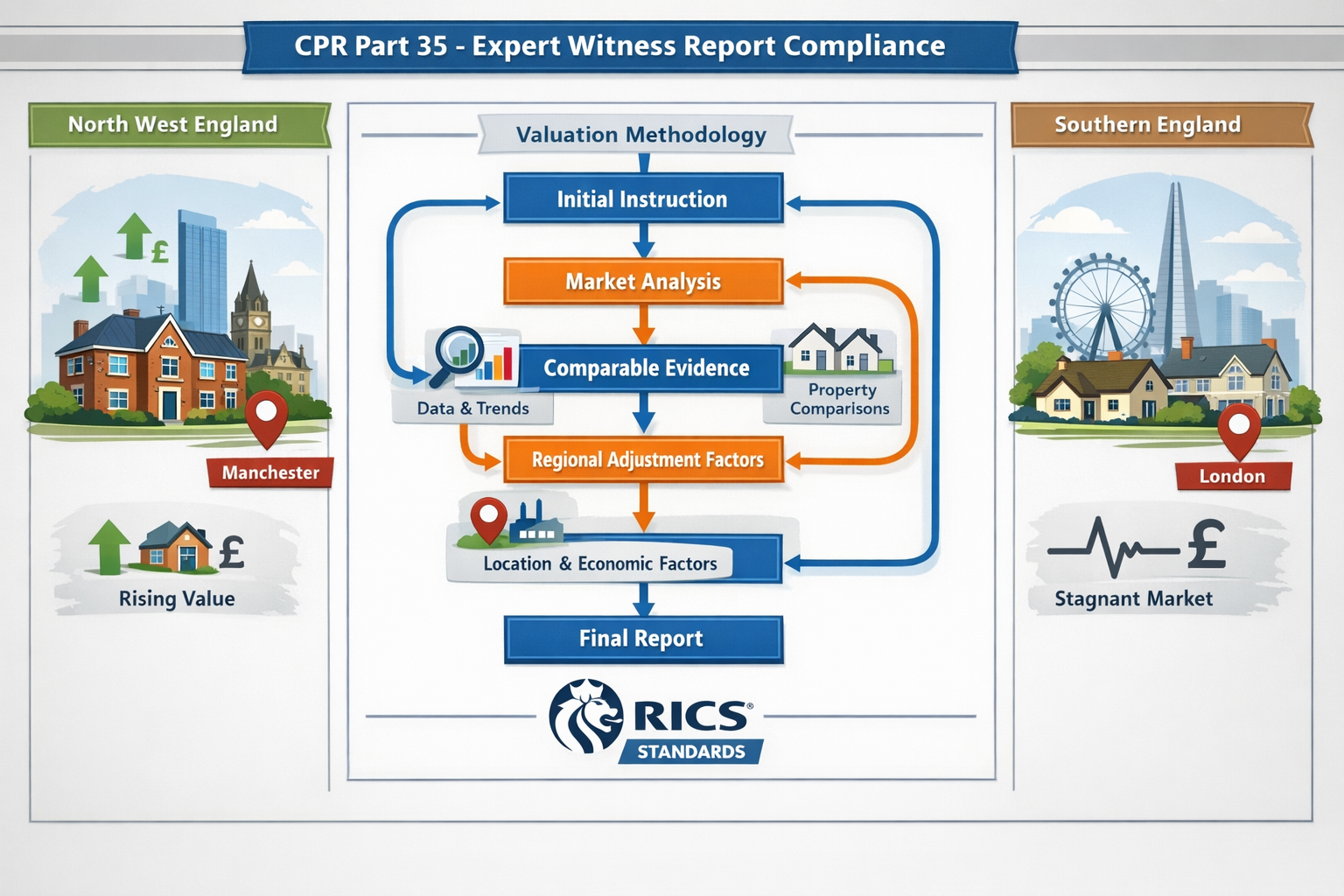
Expert witness credibility depends heavily on the quality and relevance of market intelligence. In 2026's divergent regional markets, gathering appropriate evidence requires systematic approaches tailored to each region's characteristics.
Data Sources for North West England
Building a comprehensive evidence base for North West valuations involves:
Primary Market Data:
- Land Registry price paid data for recent transactions
- Local estate agent market reports and asking price trends
- Rental listing platforms for income evidence
- New development pricing and absorption rates
- Commercial property databases for mixed-use valuations
Secondary Intelligence:
- Regional economic indicators (employment, GDP growth)
- Infrastructure project timelines and impact studies
- Population migration statistics
- University enrollment and graduate retention data
- Local authority planning approval rates
Professional Networks:
- Local RICS member insights and market sentiment
- Relationships with active North West estate agents
- Developer and investor perspectives on market direction
- Legal professionals handling regional transactions
Evidence Strategies for Southern Markets
Southern market evidence gathering requires different emphasis:
Historical Context:
- Longer-term price trend analysis (5-10 years)
- Previous market cycle comparisons
- Peak pricing periods and subsequent adjustments
- Recovery timeline analysis from past corrections
Regulatory Impact Assessment:
- Buy-to-let taxation changes and their effects
- Second home surcharges and market response
- Planning policy changes affecting supply
- Energy efficiency requirements and retrofit costs
Market Sentiment Indicators:
- Time-on-market statistics showing demand weakness
- Price reduction frequency and magnitude
- Auction results and clearance rates
- Mortgage approval trends and lending criteria changes
Expert Witness Valuations in Regional Price Divergences: Documentation Standards
Regardless of region, expert witnesses must maintain rigorous documentation standards. Best practices include:
- Comparable evidence files: Maintain detailed records for each comparable, including property details, transaction circumstances, and source documentation
- Adjustment calculations: Create spreadsheets showing all adjustments with formulas and supporting rationale
- Market data compilation: Organize regional statistics, reports, and intelligence in accessible formats
- Instruction records: Document all communications with instructing parties and clarification requests
- Methodology notes: Maintain contemporaneous notes explaining analytical decisions and approach selection
This documentation serves multiple purposes: it supports report preparation, facilitates peer review, provides cross-examination preparation materials, and demonstrates professional diligence.
Navigating 2026 Regulatory Considerations
The regulatory landscape in 2026 adds complexity to Expert Witness Valuations in Regional Price Divergences: Strategies for North West England vs Southern Stagnation. New rules affect different regions with varying intensity.
Buy-to-Let Regulatory Shifts
Recent regulatory changes disproportionately impact investment property valuations:
Rental Regulation Impacts:
- Rent control measures in some Southern jurisdictions
- Enhanced tenant protection legislation
- Mandatory property condition standards
- Licensing scheme expansions in multiple areas
Expert witnesses must assess how these regulations affect:
- Achievable rental income projections
- Compliance cost implications for property values
- Investor demand and capitalization rate adjustments
- Comparable selection when regulatory environments differ
Help to Buy valuations and other government scheme properties may require additional regulatory consideration.
Energy Efficiency Requirements
2026's enhanced energy performance standards create valuation challenges:
- Properties failing to meet minimum EPC ratings face rental restrictions
- Retrofit costs can significantly impact net property values
- Regional variation in property stock age affects compliance costs
- North West's newer housing stock may have advantages over older Southern properties
Expert witnesses should:
- Assess subject property EPC ratings and improvement requirements
- Quantify retrofit costs for compliance
- Consider impact on marketability and rental potential
- Apply appropriate adjustments when comparing properties with different energy profiles
Planning and Development Policy Variations
Regional planning policies create divergent development potential:
North West Characteristics:
- Generally more permissive development frameworks
- Active local authority growth strategies
- Streamlined approval processes in growth areas
- Infrastructure investment supporting development
Southern Characteristics:
- Restrictive planning in many high-value areas
- Green belt and conservation constraints
- Community opposition to development
- Limited development land availability
These policy differences significantly affect property valuations, particularly for sites with potential alternative uses or development opportunities. Valuation for probate and estate planning purposes must consider these regional variations.
Practical Application: Case Study Approaches
Understanding how Expert Witness Valuations in Regional Price Divergences: Strategies for North West England vs Southern Stagnation work in practice helps clarify the strategies discussed.
Scenario 1: Family Law Dispute – Manchester Property
Situation: Divorcing couple disputes the value of their Manchester investment property. One party claims rapid regional growth justifies a high valuation; the other argues for conservative assessment.
Expert Witness Strategy:
- Gather comparable sales from past 6 months within 1-mile radius
- Analyze rental income against regional yield benchmarks
- Apply modest growth adjustment reflecting sustainable trends, not peak rates
- Present valuation range acknowledging market momentum but avoiding speculation
- Document all assumptions and adjustment rationale clearly
Key Considerations:
- Balance growth recognition with professional conservatism
- Provide sensitivity analysis showing value under different growth scenarios
- Emphasize duty to court over partisan advocacy
- Use Red Book valuation standards for credibility
Scenario 2: Negligence Claim – Southern Property
Situation: Buyer claims surveyor undervalued defects in a Southern property, leading to overpayment. Market has stagnated since purchase, complicating loss calculation.
Expert Witness Strategy:
- Establish property value at purchase date using contemporaneous comparables
- Quantify defect repair costs with supporting contractor quotes
- Assess market value impact of defects beyond repair costs
- Separate market movement from defect-related value loss
- Present clear timeline showing valuation at key dates
Key Considerations:
- Distinguish between market-driven value changes and defect impacts
- Address causation clearly—what loss stems from alleged negligence versus market conditions
- Consider whether defects would have affected buyer's decision or negotiated price
- Maintain objectivity when one party may be sympathetic
Scenario 3: Commercial Lease Dispute – Regional Comparison
Situation: Rent review dispute where landlord argues London-based comparable rents should apply; tenant argues local North West market rates are appropriate.
Expert Witness Strategy:
- Establish lease terms and review clause requirements
- Analyze local market rental evidence comprehensively
- Address London comparables, explaining why regional differences make them inappropriate
- Quantify regional rental differentials with supporting data
- Apply lease-specific assumptions as required by review clause
Key Considerations:
- Lease terms may dictate valuation approach regardless of market realities
- Regional rental evidence must be robust and well-documented
- Expert must explain regional market differences clearly for non-specialist audiences
- Valuation costs and fee structures should reflect complexity
Building Credibility: Qualifications and Professional Development
Expert witness credibility in regional valuation disputes depends significantly on demonstrated expertise and ongoing professional development.
Essential Qualifications
Minimum credentials for expert witnesses handling regional valuation disputes include:
✅ RICS Chartered Status: Membership in the Royal Institution of Chartered Surveyors demonstrates professional competence and adherence to ethical standards
✅ Relevant Experience: Demonstrated track record of valuations in the specific regions under consideration
✅ Expert Witness Training: Formal qualifications such as the Advanced Professional Award in Expert Witness Evidence (APAEWE) show understanding of legal requirements
✅ Regional Market Knowledge: Proven experience conducting valuations in both North West and Southern markets when handling comparative disputes
✅ Continuing Professional Development: Evidence of ongoing education in valuation methodology, market trends, and regulatory changes
Specialized Regional Expertise
For Expert Witness Valuations in Regional Price Divergences: Strategies for North West England vs Southern Stagnation, additional specialized knowledge proves valuable:
- Local market cycles: Understanding historical performance patterns in specific regions
- Economic drivers: Knowledge of regional employment, industry sectors, and economic development
- Infrastructure impacts: Awareness of transport, education, and amenity developments affecting values
- Regulatory environment: Familiarity with local planning policies and development frameworks
- Market participants: Relationships with active buyers, sellers, agents, and developers in each region
Expert witnesses should maintain active practice in relevant regions rather than relying solely on desk-based research. Regular market engagement through property inspections, professional networking, and transaction involvement maintains current knowledge.
Professional Standards and Ethics
RICS professional standards govern expert witness conduct. Key principles include:
- Objectivity: Provide unbiased opinions regardless of which party instructs you
- Competence: Only accept instructions within your area of expertise
- Transparency: Disclose all relevant facts, assumptions, and limitations
- Independence: Avoid conflicts of interest and maintain professional distance
- Integrity: Uphold ethical standards even when inconvenient or unprofitable
These standards become particularly important when regional market divergences create pressure to advocate for particular positions. The expert witness's duty to the court supersedes any obligation to the instructing party.
Technology and Data Analytics in Regional Valuations
Modern expert witnesses increasingly leverage technology and data analytics to enhance their regional valuation work.
Data Visualization Tools
Presenting complex regional divergence data effectively requires sophisticated visualization:
- Heat maps: Show geographic price variation patterns across regions
- Trend charts: Illustrate diverging price movements over time
- Comparative dashboards: Display multiple market metrics side-by-side
- Interactive presentations: Allow court to explore data relationships
These tools help judges, lawyers, and other non-specialists understand complex market dynamics underlying Expert Witness Valuations in Regional Price Divergences: Strategies for North West England vs Southern Stagnation.
Automated Valuation Models (AVMs)
While AVMs cannot replace expert judgment, they provide useful supporting evidence:
Appropriate AVM Applications:
- Initial value range estimation
- Comparable property identification
- Market trend confirmation
- Outlier detection in comparable analysis
AVM Limitations:
- Cannot account for unique property characteristics
- May lag in rapidly changing markets
- Limited effectiveness in low-transaction areas
- Require expert interpretation and adjustment
Expert witnesses should understand AVM methodology, use them appropriately as supporting tools, and be prepared to explain their limitations under cross-examination.
Market Intelligence Platforms
Subscription services and databases enhance evidence gathering:
- Land Registry data access and analysis tools
- Commercial property databases (CoStar, EGi)
- Rental market platforms (Rightmove, Zoopla)
- Economic data services (ONS, regional development agencies)
- Professional networks and market sentiment surveys
Effective use of these platforms requires understanding their data sources, update frequencies, and potential biases or limitations.
Preparing for Cross-Examination
Even the most thorough Expert Witness Valuations in Regional Price Divergences: Strategies for North West England vs Southern Stagnation face scrutiny during cross-examination. Preparation is essential.
Anticipated Challenges in Regional Divergence Cases
Opposing counsel typically challenge:
Methodology Selection:
- "Why did you choose this approach rather than an alternative?"
- "Isn't your methodology biased toward supporting your instructing party's position?"
- "Have you applied this methodology consistently in other cases?"
Comparable Selection:
- "Why did you exclude [specific comparable] from your analysis?"
- "Aren't these comparables too different from the subject property?"
- "Have you cherry-picked comparables that support your conclusion?"
Regional Assumptions:
- "How do you know the North West growth will continue?"
- "Isn't your growth projection overly optimistic?"
- "Haven't you underestimated the Southern market's resilience?"
Adjustment Justification:
- "Can you prove this adjustment percentage is accurate?"
- "Why is this adjustment different from your previous cases?"
- "Aren't your adjustments arbitrary?"
Defensive Strategies
Effective cross-examination defense requires:
- Know your report thoroughly: Review all details, calculations, and sources before testimony
- Maintain composure: Answer questions calmly and professionally, even under pressure
- Listen carefully: Ensure you understand each question before answering
- Answer only what's asked: Don't volunteer additional information that wasn't requested
- Admit limitations: Acknowledge uncertainty where it exists rather than overreaching
- Reference your report: Direct questioners to specific sections supporting your answers
- Explain methodology: Be prepared to educate the court on technical concepts
- Stay objective: Avoid appearing as an advocate for the instructing party
Remember that your credibility depends on honesty and objectivity. Admitting when something is uncertain or when alternative approaches could be reasonable often strengthens rather than weakens your position.
Future Outlook: Regional Divergences Beyond 2026
While this article focuses on 2026 conditions, expert witnesses must consider longer-term trends affecting Expert Witness Valuations in Regional Price Divergences: Strategies for North West England vs Southern Stagnation.
Factors That May Narrow Regional Gaps
Several developments could reduce North-South divergences:
- Southern market recovery: Affordability improvements may reignite demand
- North West supply increases: New construction may moderate growth rates
- Policy interventions: Government initiatives targeting regional imbalances
- Economic shifts: Changes in employment patterns or industry distribution
- Infrastructure completion: Major projects reaching completion and normalizing
Factors That May Widen Divergences
Conversely, gaps could expand further due to:
- Climate change impacts: Coastal and flood-risk areas face increasing challenges
- Remote work permanence: Continued migration from expensive to affordable regions
- Investment concentration: Capital flowing toward growth regions accelerates divergence
- Regulatory divergence: Different regional policy approaches creating varied investment climates
- Infrastructure investment: Continued North West improvements while Southern infrastructure ages
Expert witnesses must avoid assuming current trends will continue indefinitely while remaining grounded in observable market realities rather than speculation.
Conclusion
Expert Witness Valuations in Regional Price Divergences: Strategies for North West England vs Southern Stagnation require sophisticated approaches that acknowledge market realities while maintaining professional standards and legal compliance. The widening gap between the North West's robust growth and Southern market stagnation creates unique challenges for valuation professionals.
Key Success Factors:
📊 Rigorous methodology: Select and apply valuation approaches appropriate to each region's specific market characteristics
🔍 Comprehensive evidence: Gather robust comparable and market data reflecting regional conditions accurately
📋 CPR Part 35 compliance: Maintain strict adherence to legal requirements governing expert witness conduct
🎯 Objectivity: Provide unbiased opinions serving the court rather than advocating for instructing parties
📚 Ongoing education: Stay current with regional market trends, regulatory changes, and professional standards
The strategies outlined in this article—from comparable selection and adjustment transparency to regulatory consideration and cross-examination preparation—provide a framework for delivering credible, defensible valuations in divergent regional markets.
Next Steps for Property Professionals
Whether you're a solicitor instructing an expert witness, a surveyor developing expertise in this area, or a property stakeholder involved in a valuation dispute, consider these actions:
- Engage qualified experts early: Select expert witnesses with demonstrated regional expertise before disputes escalate
- Invest in market intelligence: Develop robust data sources and regional market knowledge
- Pursue specialized training: Consider APAEWE or similar qualifications for expert witness work
- Build regional networks: Establish relationships with market participants in both North West and Southern markets
- Document thoroughly: Maintain comprehensive records supporting all valuation opinions and decisions
- Stay informed: Monitor RICS guidance, market reports, and regulatory developments affecting regional valuations
The regional divergences characterizing the 2026 UK property market create both challenges and opportunities. Expert witnesses who develop sophisticated regional expertise, maintain rigorous professional standards, and communicate complex market dynamics clearly will find themselves in high demand as these disputes continue to arise.
For professional assistance with expert witness valuations in divergent regional markets, consider consulting chartered surveyors with specific experience in both North West and Southern property markets. The complexity of these cases demands expertise that goes beyond general valuation knowledge to encompass deep regional market understanding and expert witness procedural competence.