
As the UK property market experiences a significant recovery in 2026, lenders are processing unprecedented volumes of mortgage applications, creating a surge in valuation requirements and, inevitably, disputes. Expert Witness Valuations in 2026 Lending Volume Uplift: RICS Protocols for Increased Survey Demands represents a critical intersection where professional surveyors must balance increased workload with the rigorous standards required for tribunal proceedings. With RICS launching its updated 5th edition expert witness standard in 2025, professionals now have enhanced guidance to navigate this high-volume environment while maintaining the independence and quality that legal proceedings demand[4].
The forecasted lending boom brings both opportunity and risk. More transactions mean more valuations, but also more potential disagreements between buyers, sellers, lenders, and borrowers. Surveyors who understand the updated RICS protocols and prepare robust evidence strategies will be positioned to serve as credible expert witnesses in an increasingly complex dispute landscape.
Key Takeaways
- 📊 Lending volumes are surging in 2026, creating unprecedented demand for property valuations and increasing the likelihood of disputes requiring expert witness testimony
- 📘 RICS launched its 5th edition expert witness standard in August 2025, introducing critical updates on AI use, digital evidence, fee guidance, and enhanced professional protection provisions[4]
- ⚖️ Primary duty to the tribunal remains paramount, with reinforced requirements that all expert evidence must be independent, unbiased, and within the surveyor's genuine area of expertise[2]
- 🔍 Enhanced conflict of interest disclosure requirements provide clearer guidance on identifying and managing potential conflicts in high-volume practice environments[4]
- 🎓 The RICS Accredited Expert Witnesses Register (updated March 2026) identifies professionals who have completed rigorous training, ethics testing, and assessment interviews[3]
Understanding Expert Witness Valuations in 2026 Lending Volume Uplift: RICS Protocols for Increased Survey Demands
The 2026 Lending Landscape and Valuation Demand
The property market in 2026 is experiencing a notable recovery following several years of uncertainty. Interest rates have stabilized, buyer confidence has returned, and lenders are actively competing for business. This environment creates a perfect storm for increased survey activity:
Mortgage lending volumes are projected to increase by 15-20% compared to 2025, driven by first-time buyers entering the market, remortgage activity, and renewed investor interest in buy-to-let properties. Each transaction requires a valuation, and with stricter lending criteria post-2020s financial volatility, these valuations face greater scrutiny than ever before.
When valuations are challenged—whether by disappointed buyers who believe a property is overvalued, sellers who feel undervalued, or lenders questioning risk exposure—expert witnesses become essential. The RICS valuation surveyor must then transition from providing routine market opinions to defending those opinions under cross-examination.
The Critical Difference: Valuation vs. Expert Witness Testimony
Many property professionals wonder: is a mortgage valuation the same as a survey? The answer is definitively no, and this distinction becomes even more important in expert witness contexts.
A standard mortgage valuation provides a lender with a market value assessment for lending purposes. An expert witness valuation, however, must withstand legal scrutiny and meet significantly higher standards:
- Independence: Complete objectivity, with primary duty to the court or tribunal, not the instructing party[2]
- Transparency: Full disclosure of methodology, assumptions, limitations, and any uncertainties
- Robustness: Comprehensive evidence supporting every conclusion, anticipating challenges
- Compliance: Adherence to RICS Red Book standards and the updated expert witness protocols[5]
The 2026 lending uplift means more surveyors will face situations where their routine valuations become the subject of disputes. Understanding these distinctions from the outset is crucial.
RICS 5th Edition Expert Witness Standard: Key Updates for 2026
Fundamental Principles Reinforced
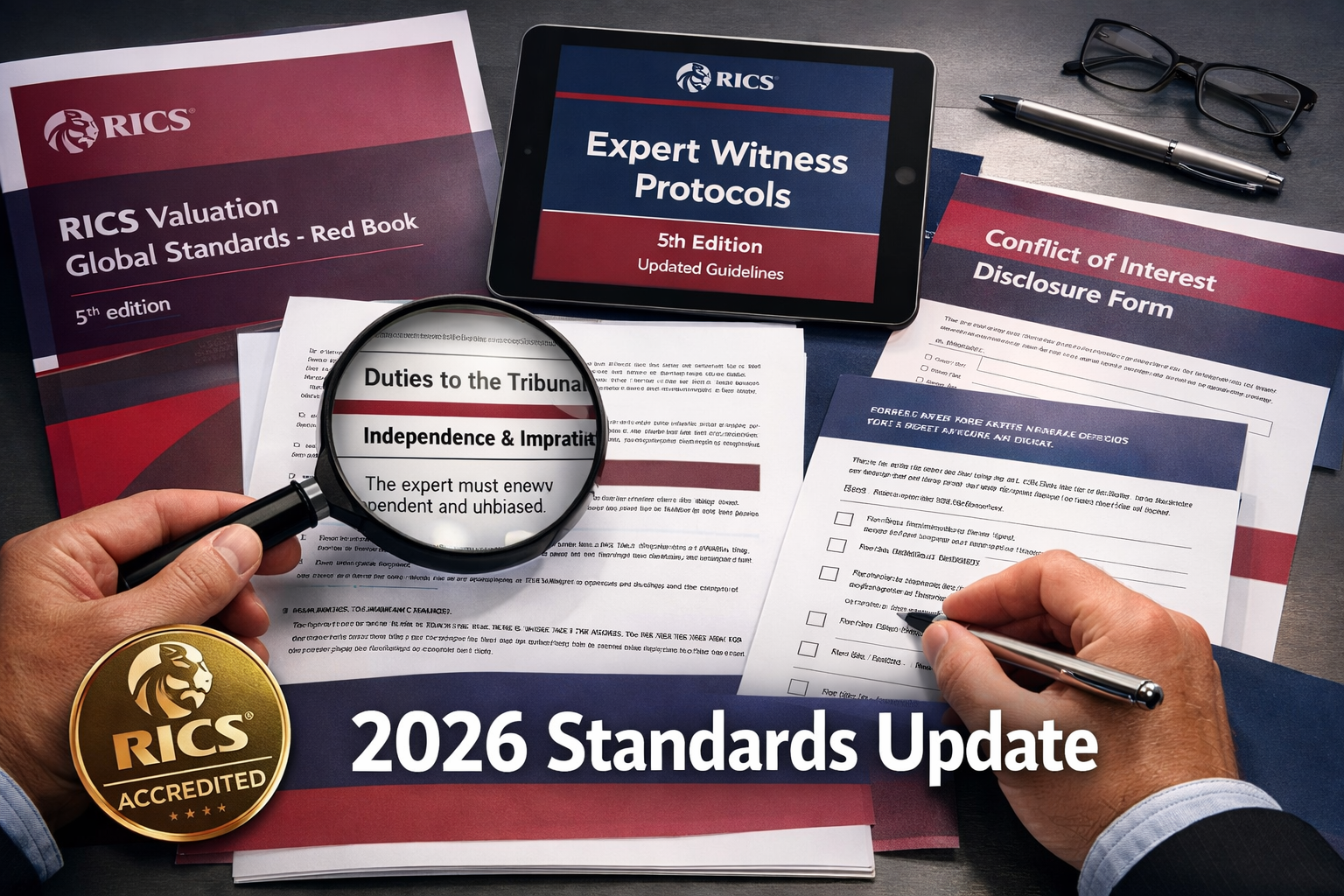
The RICS 5th edition expert witness standard, launched for consultation in August 2025 and implemented in early 2026, represents the first major update since 2014[4]. While the core principle remains unchanged—that an expert witness's primary duty is to the tribunal, not the client—the new standard provides significantly enhanced guidance for modern practice.
This fundamental duty means that even when instructed by one party in a dispute, the surveyor must provide impartial, objective evidence that assists the tribunal in reaching a fair decision. Personal opinions, advocacy for the instructing party, or selective presentation of evidence violates this duty and can result in professional sanctions.
Enhanced Professional Protection Provisions
One of the most significant improvements in the 5th edition addresses fee arrangements and professional independence[4]. The updated standard provides clear guidance on:
- Conditional and deferred fees: Explicit prohibition of fee arrangements that compromise independence or create incentives to favor one outcome
- High-volume case management: Risk mitigation strategies when handling multiple expert witness appointments simultaneously
- Template usage guidance: Appropriate use of standardized report formats while ensuring each case receives individual professional judgment
These provisions are particularly relevant in the 2026 lending volume uplift, where surveyors may face pressure to expedite reports or accept unfavorable fee terms due to increased demand.
Modern Practice Integration: AI and Digital Evidence
Perhaps the most forward-thinking aspect of the 5th edition is its recognition of technological developments in valuation practice[4]. The standard now addresses:
Artificial Intelligence Use: Guidelines for incorporating AI-assisted valuation tools while maintaining professional responsibility for all conclusions. The surveyor remains personally accountable for opinions, even when technology assists in data analysis or comparable property identification.
Digital Evidence Handling: Protocols for presenting digital evidence, including photographs, drone surveys, 3D property scans, and electronic comparable databases. The standard emphasizes authentication, metadata preservation, and clear explanation of digital evidence sources.
Remote Inspection Considerations: Guidance on when remote or hybrid inspection methods are appropriate for expert witness valuations, and how to disclose limitations when full physical inspection isn't possible.
For professionals conducting RICS home surveys that may later require expert witness testimony, understanding these technological considerations is essential.
Conflict of Interest Disclosure Requirements
The updated standard significantly strengthens conflict of interest provisions[4]. Surveyors must now:
- Conduct thorough conflict checks before accepting expert witness instructions, including relationships with parties, properties, and related transactions
- Disclose potential conflicts immediately, even if they seem minor or unlikely to affect independence
- Understand legal consequences of non-disclosure, which can include evidence being excluded and professional disciplinary action
- Maintain ongoing vigilance throughout the engagement, as conflicts can emerge during the case
In a high-volume lending environment, where surveyors may have previously valued properties in the same development, worked with the same lenders, or have other connections to parties, these disclosure requirements demand careful attention.
Global Applicability with Local Recognition
While RICS is a UK-based organization, the 5th edition expert witness standard is designed for global application[4]. The standard recognizes that legal systems vary internationally but maintains core professional principles that apply universally:
- Duty to the tribunal/court
- Independence and objectivity
- Competence within area of expertise
- Transparency and full disclosure
For surveyors working across jurisdictions or on international property portfolios, this global framework provides consistency while respecting local legal requirements.
Preparing Robust Evidence Strategies for Dispute Resolution
Building the Foundation: Comprehensive Valuation Methodology
When a routine RICS valuation may potentially become expert evidence, the surveyor must adopt enhanced documentation practices from the outset:
Detailed Inspection Records: Comprehensive notes, photographs, and measurements that go beyond typical valuation requirements. In disputes, opposing experts will scrutinize every detail of the inspection process.
Comparable Evidence Documentation: Thorough records of comparable property selection, including properties considered but rejected, with clear reasoning for all decisions. The factors of valuation must be explicitly documented and justified.
Market Analysis Transparency: Clear explanation of market conditions at the valuation date, trends, local factors, and any uncertainties affecting the opinion. This is particularly important in the recovering 2026 market where conditions may be changing rapidly.
Assumption and Limitation Clarity: Explicit statement of all assumptions made, special assumptions applied, and limitations of the inspection or available information.
The RICS Red Book Compliance Framework
All expert witness valuations must comply with the RICS Valuation – Global Standards (the "Red Book")[5]. This compliance provides the foundation for defensible expert evidence:
- VPS 1-5: Technical and performance standards covering terms of engagement, inspections, valuation approaches, bases of value, and reporting
- VPGA guidance: Specific application guidance for different property types and valuation purposes
- UK national supplement: Additional requirements for UK valuations
Understanding that valuers registered with the RICS must maintain these standards even under time pressure from increased lending volumes is crucial for professional credibility.
Specialized Valuation Contexts in 2026 Disputes
The lending volume uplift affects various valuation contexts differently, each with specific dispute considerations:
Residential Purchase Valuations
With first-time buyers driving market growth, disputes often arise from:
- Down-valuation disputes: When lender valuations come in below agreed purchase prices, jeopardizing transactions
- Defect identification disagreements: Whether observed defects justify valuation adjustments
- New build premium challenges: Disputes over appropriate valuation of new construction versus established properties
Surveyors providing RICS HomebuYer surveys should document findings with potential dispute resolution in mind.
Help to Buy and Government Scheme Valuations
Government-backed lending schemes have specific valuation requirements that can lead to disputes:
- Equity loan valuation disputes: Disagreements over property values when Help to Buy equity loans are repaid
- Shared ownership staircasing: Valuation disputes when shared owners purchase additional equity stakes
The RICS Help to Buy valuations process requires particular attention to scheme-specific requirements that may become dispute focal points.
Commercial Property Lending Valuations
The 2026 recovery includes renewed commercial lending, particularly for:
- Mixed-use developments: Complex valuations requiring multiple approaches
- Investment properties: Disputes over income capitalization assumptions and yield selection
- Development land: Disagreements over residual valuation inputs and planning assumptions
Professionals conducting commercial property surveying must maintain rigorous documentation standards for potential expert witness roles.
Report Writing for Expert Witness Purposes
An expert witness report differs significantly from a standard valuation report. The 2026 RICS protocols emphasize:
Structure and Clarity: Logical organization that guides the tribunal through complex valuation reasoning. Use of executive summaries, clear headings, and numbered paragraphs for easy reference during cross-examination.
Independence Statement: Explicit declaration of understanding of expert witness duties, confirmation of independence, and acknowledgment that the primary duty is to the tribunal[2].
Qualifications and Experience: Detailed explanation of relevant expertise, specific experience with the property type and valuation context, and any limitations of expertise.
Methodology Transparency: Step-by-step explanation of the valuation approach, with clear reasoning for method selection and application.
Evidence Base: Comprehensive presentation of all evidence relied upon, including comparable transactions, market data, and specialist inputs.
Alternative Scenarios: Where appropriate, consideration of alternative approaches or assumptions, explaining why the primary opinion is preferred.
Certainty and Limitations: Honest assessment of confidence levels and explicit identification of uncertainties or limitations affecting the opinion.
The RICS Accredited Expert Witnesses Register
The RICS Register of Accredited Expert Witnesses, updated in March 2026, identifies professionals who have demonstrated competence through rigorous assessment[3]. Registration requires:
- Four training modules covering expert witness duties, report writing, evidence presentation, and cross-examination skills
- Ethics assessment testing understanding of independence, conflicts, and professional responsibilities
- Interview process evaluating practical application of expert witness principles
- Ongoing reassessment ensuring continued competence and knowledge of updated standards
For surveyors seeking to establish credibility in the 2026 high-volume dispute environment, registration demonstrates commitment to expert witness excellence. The register is publicly available, and parties instructing experts can verify accreditation status.
RICS Dispute Resolution Services can also nominate suitable expert witnesses for specific cases, ensuring they are appropriately experienced, impartial, and available[3]. This service provides an additional quality assurance mechanism for parties seeking reliable expert evidence.
Practical Implementation: Managing Expert Witness Appointments in High-Volume Practice
Accepting Instructions: The Critical Initial Assessment
Before accepting any expert witness instruction, surveyors must conduct a thorough assessment:
Competence Verification: Is this property type, valuation context, and dispute issue within your genuine area of expertise? The 2026 standards emphasize that experts must not stray beyond their true competence, even under commercial pressure from increased demand[2].
Conflict Checking: Comprehensive review of potential conflicts, including:
- Previous involvement with the property or parties
- Relationships with instructing solicitors or parties
- Financial interests in the outcome
- Previous opinions expressed on related matters
Capacity Assessment: Can you provide the necessary attention and quality within required timeframes, considering your existing workload? The high-volume 2026 environment creates pressure to accept more instructions than can be properly managed.
Terms of Engagement: Clear agreement on scope, fees, timescales, and professional independence protections before commencing work.
Managing Multiple Expert Witness Roles
The 2026 lending uplift may result in surveyors handling multiple expert witness appointments simultaneously. The updated RICS standard provides risk mitigation guidance for this scenario[4]:
- Case management systems: Robust procedures ensuring each case receives individual professional attention
- Template discipline: Appropriate use of standardized formats while ensuring case-specific analysis and conclusions
- Quality assurance: Peer review processes for high-volume expert witness practices
- Time allocation: Realistic assessment of time requirements and capacity limitations
Collaboration with Legal Teams
Effective expert witness work requires productive collaboration with instructing solicitors while maintaining independence:
Understanding Legal Context: Learning the specific legal issues, burden of proof, and evidential requirements without allowing this to bias the valuation opinion.
Communication Boundaries: Maintaining appropriate professional distance—providing objective opinions while resisting pressure to advocate for the instructing party's position.
Joint Expert Meetings: When appointed by different parties, experts may be directed to meet and identify areas of agreement and disagreement. The 2026 protocols emphasize the importance of these meetings in narrowing disputes and assisting tribunals[2].
Cross-Examination Preparation: Working with legal teams to anticipate challenges while ensuring all preparation focuses on explaining the evidence truthfully, not on "winning" for one side.
Continuing Professional Development for Expert Witnesses
The evolving 2026 standards and changing market conditions require ongoing professional development:
- Regular training updates on expert witness protocols and legal developments
- Market knowledge maintenance ensuring current understanding of rapidly changing 2026 property market conditions
- Technical skill development in areas like digital evidence presentation and AI-assisted valuation tools
- Ethics reinforcement maintaining focus on independence and tribunal duties despite commercial pressures
Choosing an RICS Chartered Building Surveyor with demonstrated expert witness competence provides assurance of quality and professional standards.
Specific Dispute Contexts in the 2026 Lending Environment
Mortgage Valuation Disputes
The most common expert witness scenarios in the 2026 lending uplift involve mortgage valuation disagreements:
Down-Valuation Challenges: When a lender's valuation is below the agreed purchase price, buyers may instruct expert witnesses to challenge the assessment. The expert must independently evaluate whether the original valuation was reasonable, considering market evidence and professional standards, regardless of who provides the instruction.
Negligent Valuation Claims: When property defects emerge post-purchase, buyers may claim the original valuation was negligently prepared. Expert witnesses must assess whether the original surveyor met professional standards, considering what was reasonably observable and reportable at the time.
Lender Recovery Actions: When borrowers default and properties are repossessed, lenders may seek recovery for lending based on allegedly inflated valuations. Experts must evaluate the original valuation's reasonableness within the market context at the time it was prepared.
Leasehold and Enfranchisement Valuations
The 2026 market includes significant leasehold reform activity, creating specialized dispute scenarios:
Lease Extension Valuations: Disputes over premium calculations for lease extensions, involving complex relativity assessments and marriage value calculations.
Collective Enfranchisement: Disagreements when flat owners collectively purchase their freehold, requiring expert evidence on building values and development potential.
Right to Manage: Valuation disputes in right to manage applications, where expert evidence may be required on property values and cost implications.
Understanding right to buy valuations and similar statutory contexts is essential for experts working in these areas.
Matrimonial and Tax-Related Valuations
The lending uplift indirectly affects other valuation contexts requiring expert evidence:
Divorce Proceedings: Matrimonial valuations often require expert witness testimony when parties dispute property values in financial settlements.
Capital Gains Tax Disputes: Expert evidence on valuation for capital gains tax purposes, particularly for properties held during the market recovery period.
Inheritance Tax Valuations: Disputes with HMRC over property valuations for inheritance tax, requiring robust expert evidence on market value at the date of death.
Professional Negligence Claims
Increased survey volumes inevitably lead to more professional negligence claims against surveyors:
Standard of Care Assessment: Expert witnesses must evaluate whether a surveyor's work met the standard expected of a reasonably competent professional, considering the specific instructions, property type, and circumstances.
Causation and Loss: Experts may need to provide evidence on what the correct valuation or survey findings should have been, and the financial consequences of any breach of duty.
Limitation and Scope: Assessment of whether alleged failings fell within the scope of the surveyor's instructions and professional responsibilities.
Conclusion: Preparing for Expert Witness Excellence in 2026
The convergence of increased lending volumes and updated RICS expert witness protocols creates both challenges and opportunities for property professionals in 2026. Expert Witness Valuations in 2026 Lending Volume Uplift: RICS Protocols for Increased Survey Demands requires surveyors to elevate their practice standards, embrace technological developments, and maintain unwavering commitment to independence and objectivity.
Key Action Steps for Surveyors
1. Update Knowledge and Training 🎓
- Review the RICS 5th edition expert witness standard thoroughly
- Complete RICS accredited expert witness training modules
- Consider pursuing registration on the RICS Accredited Expert Witnesses Register
- Stay current with market conditions and valuation methodology developments
2. Strengthen Documentation Practices 📝
- Implement enhanced inspection and note-taking procedures
- Develop robust comparable evidence documentation systems
- Create comprehensive report templates that meet expert witness standards
- Establish quality assurance processes for high-volume practice
3. Manage Conflicts and Independence ⚖️
- Develop thorough conflict checking procedures
- Create clear policies on fee arrangements and professional independence
- Establish boundaries for client communication and legal team collaboration
- Maintain transparency in all professional relationships
4. Embrace Technology Appropriately 💻
- Understand capabilities and limitations of AI-assisted valuation tools
- Develop protocols for digital evidence handling and presentation
- Ensure technology enhances rather than replaces professional judgment
- Maintain accountability for all opinions regardless of technological assistance
5. Prepare for Increased Demand 📊
- Assess capacity realistically in light of 2026 lending volume projections
- Develop case management systems for handling multiple appointments
- Build relationships with legal professionals and dispute resolution services
- Consider specialization in specific property types or dispute contexts
The Professional Imperative
As the property market recovers and lending volumes surge, the role of expert witnesses becomes increasingly critical to fair dispute resolution. Surveyors who embrace the enhanced RICS protocols, maintain rigorous professional standards, and prepare robust evidence will serve the justice system effectively while building respected expert witness practices.
The 2026 environment demands excellence. By understanding Expert Witness Valuations in 2026 Lending Volume Uplift: RICS Protocols for Increased Survey Demands, professionals can navigate this complex landscape with confidence, integrity, and competence.
Whether you're conducting routine RICS valuations that may later require expert testimony, or actively building an expert witness practice, the principles remain constant: independence, objectivity, competence, and unwavering commitment to assisting tribunals reach fair decisions based on reliable evidence.
The lending uplift of 2026 presents an opportunity to demonstrate the value of professional surveying expertise in resolving property disputes. Those who rise to meet the challenge will find rewarding careers serving justice while advancing the profession's reputation for excellence.
References
[1] Expert Witness Valuations In 2026s Stabilizing Market Rics Standards For Mortgage Disputes And Property Disagreements – https://nottinghillsurveyors.com/blog/expert-witness-valuations-in-2026s-stabilizing-market-rics-standards-for-mortgage-disputes-and-property-disagreements
[2] Surveyors Acting As Expert Witnesses – https://www.rics.org/profession-standards/rics-standards-and-guidance/sector-standards/dispute-resolution-standards/surveyors-acting-as-expert-witnesses
[3] Rics Register Of Accredited Expert Witnesses March 2026 – https://www.rics.org/content/dam/ricsglobal/documents/surveying/RICS-Register-of-Accredited-Expert-Witnesses_March-2026.pdf
[4] Rics Launches Global Consultation On Updated Expert Witness Standard – https://www.rics.org/news-insights/rics-launches-global-consultation-on-updated-expert-witness-standard
[5] Valuation Standards – https://www.rics.org/profession-standards/rics-standards-and-guidance/sector-standards/valuation-standards