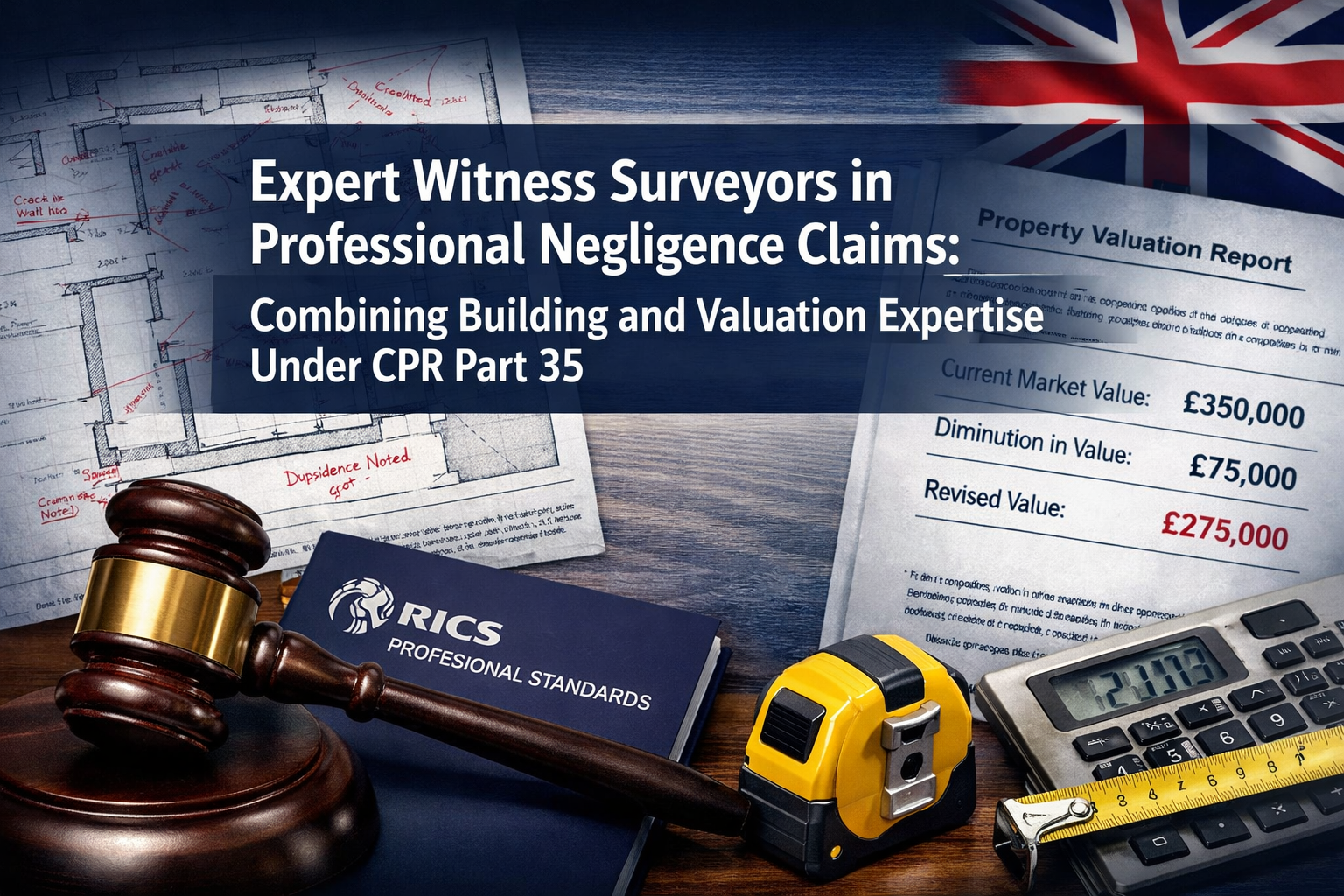
Professional negligence claims against surveyors cost the UK property industry millions annually, with the average claim settlement exceeding £75,000 in 2026. When a surveyor fails to identify critical defects during a property inspection, the consequences cascade through purchase decisions, mortgage valuations, and ultimately, substantial financial losses for buyers. This complex litigation landscape demands expert witnesses who can seamlessly integrate building defect analysis with diminution in value calculations—a dual expertise that proves essential in establishing both breach of duty and quantifiable damages.
Expert Witness Surveyors in Professional Negligence Claims: Combining Building and Valuation Expertise Under CPR Part 35 represents a specialized practice area where technical building knowledge intersects with valuation methodology, all governed by strict procedural requirements. These professionals must navigate the demanding standards of Civil Procedure Rules Part 35 while delivering reports that withstand rigorous cross-examination in court.
Key Takeaways
- Dual expertise requirement: Expert witness surveyors in negligence claims must demonstrate both building surveying competence and RICS-compliant valuation skills to establish causation and quantify losses
- CPR Part 35 primacy: The overriding duty to the court supersedes any obligation to the instructing party, requiring complete independence and objectivity in all expert opinions[1][2]
- Integrated reporting methodology: Successful expert reports combine technical defect analysis with diminution in value calculations, linking missed defects directly to financial impact
- RICS professional standards: The February 2023 RICS guidance provides mandatory frameworks for surveyors acting as expert witnesses, including specific requirements for professional indemnity insurance[8]
- Professional negligence exposure: Expert witnesses themselves face potential negligence claims if their reports fail to meet required standards, making proper compliance essential[7]
Understanding the Role of Expert Witness Surveyors in Professional Negligence Claims
The Dual Mandate: Technical Analysis and Financial Quantification
When homebuyers discover that their surveyor missed significant defects during a pre-purchase inspection, they face two critical questions: What exactly was missed, and how much has this cost them? Expert Witness Surveyors in Professional Negligence Claims: Combining Building and Valuation Expertise Under CPR Part 35 must answer both questions with precision and authority.
The first component requires comprehensive building surveying expertise. The expert witness must conduct a thorough building survey that identifies all defects that should have been discovered during the original inspection. This includes:
- 🏗️ Structural defects: Subsidence, settlement, foundation failures, and load-bearing wall issues
- 💧 Moisture-related problems: Rising damp, penetrating damp, condensation, and water ingress
- 🪵 Timber defects: Rot (wet and dry), woodworm infestation, and structural timber failures
- 🧱 Masonry issues: Cracking patterns, spalling, pointing failures, and cavity wall problems
- ⚡ Services deficiencies: Electrical, plumbing, heating, and drainage system failures
The second component demands valuation expertise compliant with RICS Red Book standards. The expert must establish the property's value in two scenarios: as it was represented by the original surveyor (with defects undisclosed) and as it actually existed (with defects present). This diminution in value calculation forms the basis for damages claims.
CPR Part 35: The Governing Framework
Civil Procedure Rules Part 35 establishes the fundamental framework governing all expert witnesses in civil litigation in England and Wales[2]. The cornerstone principle, codified in CPR 35.3, states unequivocally: "It is the duty of experts to help the court on matters within their expertise"[1][2].
This duty to the court overrides any obligation to the party instructing or paying the expert. As emphasized in recent judicial guidance, experts must not act as advocates for the instructing party but must provide independent, objective opinions based on their professional expertise[4][5].
For surveyors acting as expert witnesses, this creates specific obligations:
| CPR Part 35 Requirement | Application to Surveyor Experts |
|---|---|
| Independence | Must not allow instructing solicitor to influence technical opinions on defects or valuations |
| Objectivity | Must identify both strengths and weaknesses in the negligence claim |
| Transparency | Must clearly distinguish between facts, assumptions, and professional opinions |
| Completeness | Must address all material defects, not just those favorable to the instructing party |
| Qualification limits | Must acknowledge areas outside personal expertise and recommend additional specialists where needed |
The expert witness report must include a formal declaration confirming understanding of these duties, with the expert's signature affirming that they have complied with CPR Part 35 requirements[1].
RICS Standards for Expert Witness Surveyors
The Royal Institution of Chartered Surveyors provides comprehensive guidance specifically for surveyors acting as expert witnesses, with the most recent amendments published in February 2023[8]. This guidance operates alongside CPR Part 35, adding profession-specific requirements that chartered surveyors must observe.
Key RICS requirements include:
✅ Professional competence: Experts must only accept instructions in areas where they possess current, demonstrable expertise
✅ Professional indemnity insurance: Adequate cover must be maintained specifically for expert witness work
✅ Continuing professional development: Regular training on expert witness duties and current case law
✅ Conflicts of interest: Rigorous procedures to identify and manage potential conflicts before accepting instructions
✅ Record keeping: Comprehensive documentation of all materials reviewed, site visits conducted, and reasoning processes
The RICS guidance emphasizes that expert witness work differs fundamentally from standard surveying practice. While a routine homebuyer survey serves the client's interests, an expert witness report serves the court's need for impartial technical evidence[8].
Integrating Building Defect Analysis with Valuation Expertise Under CPR Part 35
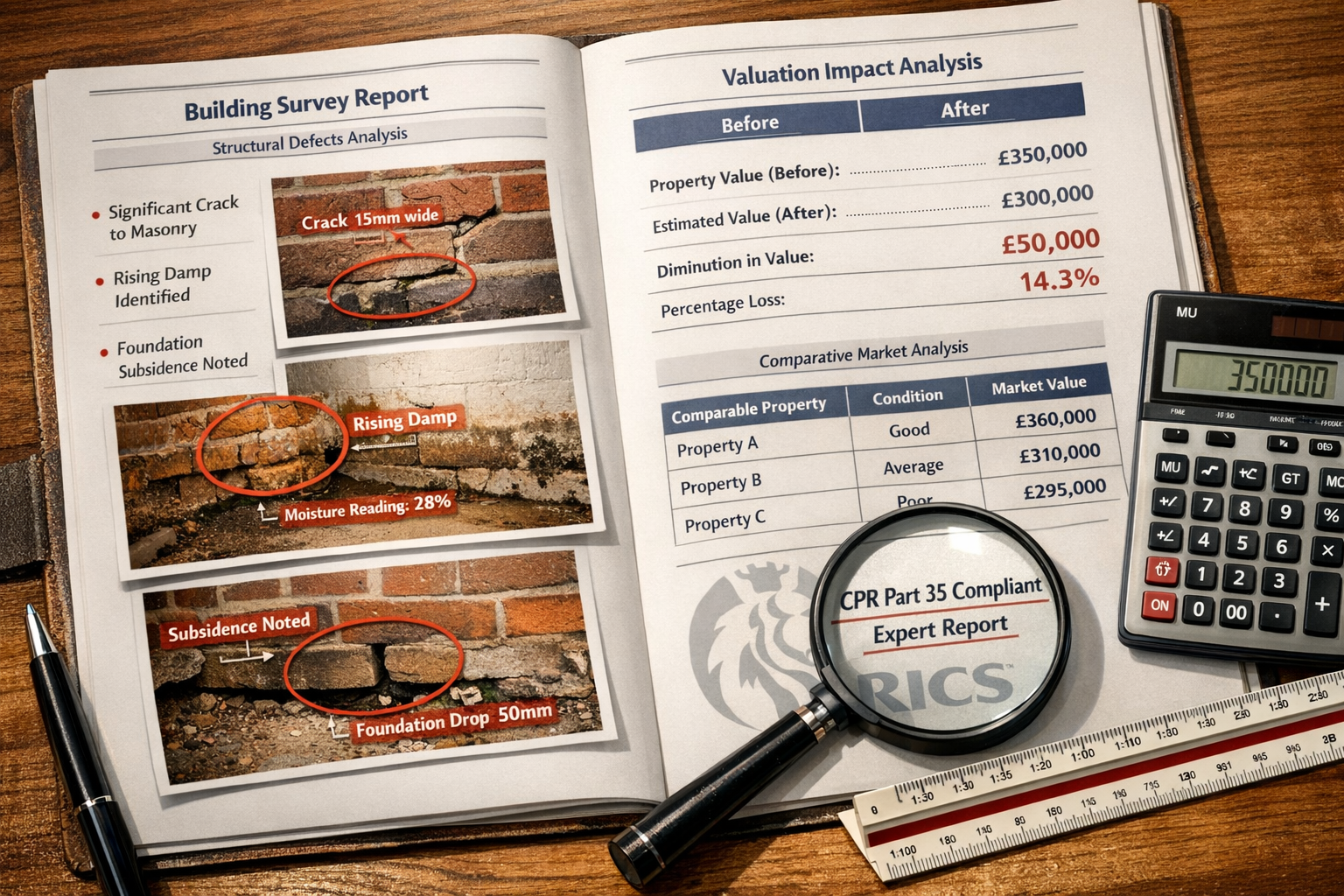
The Methodology: From Defect Identification to Diminution Calculation
Expert Witness Surveyors in Professional Negligence Claims: Combining Building and Valuation Expertise Under CPR Part 35 must employ a systematic methodology that links technical defects to financial consequences. This integration represents the core value proposition of dual-qualified experts.
Stage 1: Establishing the Baseline
The expert must first reconstruct what the original surveyor should have identified. This requires:
- Document review: Analyzing the original survey report, instructions, scope of work, and any limiting conditions
- Property inspection: Conducting a comprehensive inspection using current best practices and technology
- Comparative analysis: Identifying discrepancies between what was reported and what existed at the time of the original survey
- Causation assessment: Determining which defects were reasonably discoverable given the survey type and access limitations
This stage demands meticulous attention to temporality—the expert must establish what defects existed at the time of the original survey versus what has developed subsequently. Photographic evidence, contemporaneous records, and forensic analysis of defect progression all contribute to this determination.
Stage 2: Technical Defect Analysis
For each identified defect that should have been reported, the expert must provide:
- Detailed description: Nature, extent, location, and severity of the defect
- Causation analysis: Underlying causes and mechanisms of failure
- Remediation specification: Appropriate repair methodology and scope of works
- Cost estimation: Realistic repair costs based on current market rates
- Urgency classification: Whether immediate, medium-term, or long-term action is required
This analysis often requires collaboration with specialists. For example, structural engineering input may be necessary for foundation failures, while damp surveys specialists might provide detailed moisture analysis.
Stage 3: Valuation Impact Assessment
The valuation component requires RICS-compliant methodology to establish diminution in value. The expert must calculate:
Value as represented (V₁): The market value a reasonable purchaser would have paid based on the original surveyor's report, assuming the property was as described
Value as it actually was (V₂): The market value had the defects been properly disclosed
Diminution in value = V₁ – V₂
This calculation is rarely straightforward. The expert must consider:
- 📊 Market conditions: Property values at the transaction date, not current values
- 🏘️ Comparable evidence: Sales of similar properties with disclosed defects
- 💷 Purchaser behavior: How typical buyers respond to different defect types
- 🔧 Repair cost relationship: The correlation between repair costs and value impact (often not 1:1)
- ⏰ Stigma effects: Residual value impact even after repairs are completed
RICS valuation surveyors must apply Red Book standards to these retrospective valuations, ensuring methodology transparency and defensibility.
Real-World Application: Case Study Analysis
Scenario: Missed Subsidence in Victorian Terrace Property
A buyer purchased a Victorian terrace house in 2024 for £450,000 based on a homebuyer survey that reported no significant defects. Within six months, progressive cracking appeared, and a specialist investigation revealed active subsidence affecting the rear extension and main structure.
The Expert Witness Analysis:
Building Defect Component:
- External inspection revealed crack patterns consistent with subsidence that would have been visible during the original survey
- Monitoring confirmed ongoing movement exceeding 3mm annually
- Ground investigation identified clay shrinkage due to tree root activity
- Remediation specification: Underpinning to rear extension and main rear wall (£45,000), tree management (£3,000), internal redecoration (£8,000)
- Total repair cost: £56,000
Valuation Component:
- Value as represented (no defects disclosed): £450,000
- Value with subsidence disclosed: Analysis of comparable sales showed 15-20% reduction for properties with disclosed subsidence issues
- Adjustment for repair costs, purchaser perception, and mortgage lending restrictions
- Value as it actually was: £360,000
- Diminution in value: £90,000
The expert's report demonstrated that the diminution exceeded the repair costs due to market stigma, reduced mortgage availability, and purchaser risk aversion—factors that pure repair cost analysis would miss.
Common Challenges in Dual-Expertise Reporting
Expert Witness Surveyors in Professional Negligence Claims: Combining Building and Valuation Expertise Under CPR Part 35 frequently encounter specific challenges:
Challenge 1: Temporal Uncertainty
Establishing defect conditions years after the original survey requires forensic analysis. Experts must carefully distinguish between:
- Defects that definitely existed at the original survey date
- Defects that probably existed but may have been less severe
- Defects that have developed subsequently
Challenge 2: Scope of Inspection Disputes
Original surveyors often defend claims by citing inspection limitations. Experts must evaluate whether:
- The limitation was reasonable and properly communicated
- The defect was discoverable within the agreed scope
- Additional investigation should have been recommended
Challenge 3: Valuation Methodology Disputes
Opposing experts frequently disagree on diminution calculations. Common disputes involve:
- Selection of comparable properties
- Adjustment factors applied
- Market conditions assumptions
- Repair cost versus value impact relationships
Challenge 4: Causation Complexity
Establishing that the surveyor's breach caused the loss requires proving:
- The buyer would not have proceeded (or would have negotiated a lower price) had defects been disclosed
- The loss was foreseeable
- No intervening factors broke the chain of causation
Professional Standards, Compliance, and Risk Management for Expert Witnesses
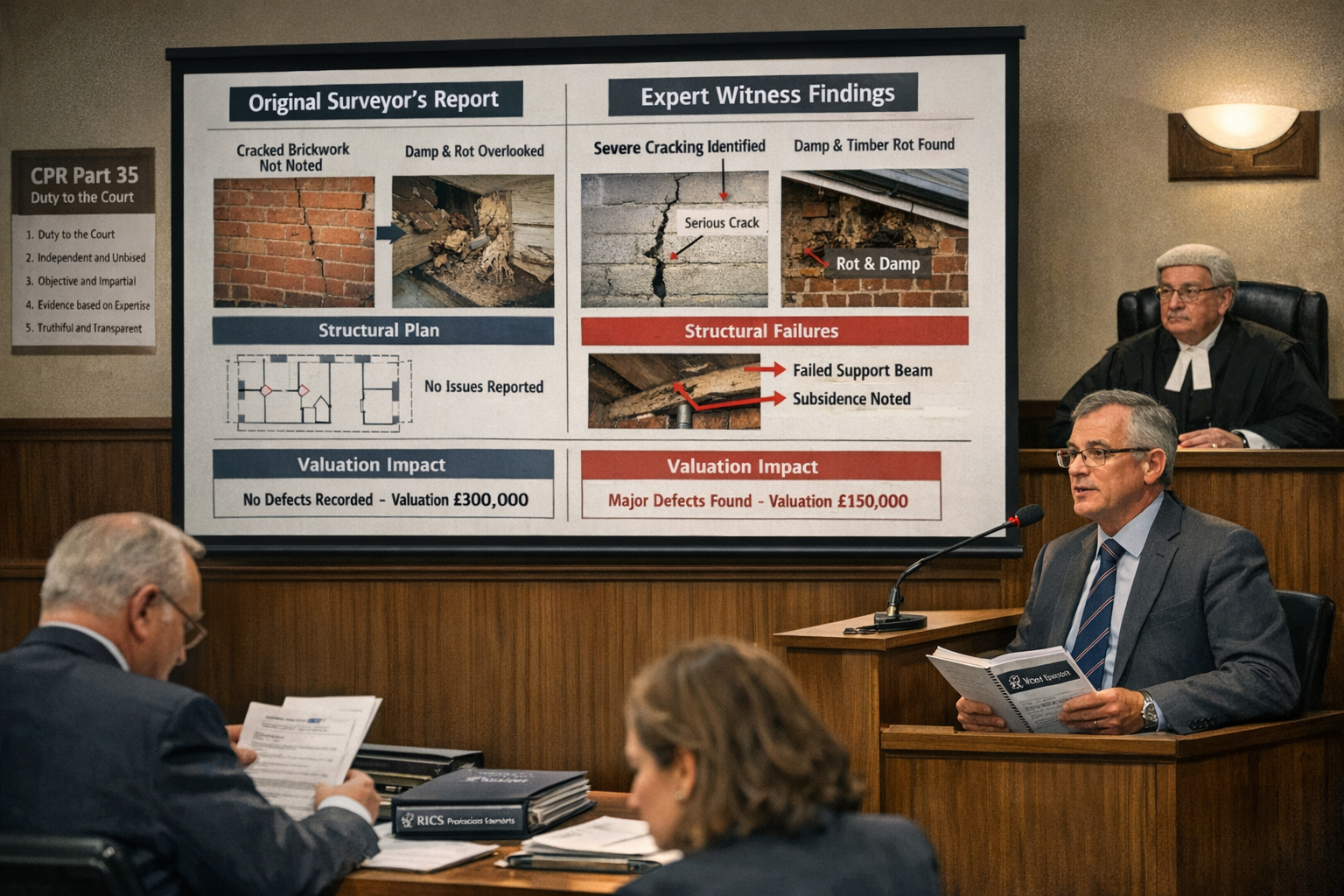
The Expert's Duty to the Court: Practical Implementation
The principle that experts owe their primary duty to the court rather than to the instructing party is well-established in CPR Part 35[2]. However, implementing this duty in practice requires conscious effort and professional discipline.
Independence in Practice:
Expert witness surveyors must establish clear boundaries with instructing solicitors:
- 🚫 Refusing inappropriate requests: Declining to amend technical opinions based on legal strategy considerations
- 📞 Controlled communication: Maintaining professional distance while remaining accessible for legitimate clarification
- 📝 Documentation: Recording all instructions and communications to demonstrate independence
- ⚖️ Balanced reporting: Identifying weaknesses in the instructing party's case as readily as strengths
The Civil Justice Council's guidance emphasizes that experts should not be "hired guns" but rather impartial assistants to the court[5]. This requires surveyors to resist subtle pressures to favor the instructing party's position.
"The expert witness should provide independent, unbiased opinion based on the facts of the case. The expert's duty is to the court, not to the party paying their fees." – Civil Justice Council Guidance[5]
Report Structure and Content Requirements
CPR Part 35 and associated Practice Directions specify mandatory content for expert reports[1][3]. For surveyor experts in professional negligence claims, a compliant report structure includes:
1. Introduction and Qualifications
- Expert's full name, address, and professional qualifications
- Relevant experience in building surveying and valuation
- Specific expertise in the defect types under consideration
- Details of RICS membership and professional indemnity insurance
2. Instructions and Scope
- Summary of instructions received
- Documents and materials reviewed
- Site visits conducted (dates, duration, access limitations)
- Any constraints on the inspection or analysis
3. Executive Summary
- Concise overview of key opinions
- Brief statement of conclusions on breach and causation
4. Factual Background
- Property description and construction details
- Transaction history and survey circumstances
- Chronology of defect discovery and subsequent events
5. Technical Analysis: Building Defects
- Detailed description of each defect identified
- Photographic and diagrammatic evidence
- Analysis of what should have been identified in the original survey
- Assessment of defect severity and remediation requirements
- Repair cost estimates with supporting quotations
6. Valuation Analysis
- Methodology statement compliant with RICS Red Book standards
- Market analysis at the relevant transaction date
- Comparable evidence and adjustments applied
- Calculation of diminution in value
- Consideration of alternative valuation scenarios
7. Causation and Breach Analysis
- Assessment of the original surveyor's standard of care
- Identification of specific breaches of professional duty
- Analysis of how the breach caused the claimant's loss
- Consideration of contributory factors or alternative causes
8. Responses to Opposing Expert
- Point-by-point analysis of areas of disagreement
- Explanation of methodological differences
- Identification of common ground
9. Statement of Truth
- Formal declaration of compliance with CPR Part 35
- Confirmation of understanding of duty to the court
- Statement that opinions are genuinely held
- Expert's signature and date
This structure ensures compliance while providing the court with a logical, comprehensive analysis that integrates building and valuation expertise.
Professional Indemnity Insurance and Liability Considerations
Expert witnesses face potential professional negligence claims if their reports fall below required standards[7]. This risk necessitates specific insurance coverage and risk management protocols.
Insurance Requirements:
Standard professional indemnity insurance for surveying practice may not adequately cover expert witness work. RICS guidance recommends:
- ✅ Separate expert witness cover: Policies specifically addressing litigation support services
- ✅ Adequate limits: Coverage reflecting the potential value of claims where expert evidence is provided
- ✅ Run-off provisions: Extended coverage for claims arising after retirement or practice closure
- ✅ Disclosure requirements: Informing insurers of expert witness instructions promptly
Liability Scenarios:
Expert witnesses can face claims arising from:
- Negligent opinions: Failing to identify relevant defects or applying incorrect valuation methodology
- Inadequate investigation: Insufficient site inspection or document review
- Bias or partiality: Allowing instructing party influence to compromise independence
- Procedural non-compliance: Failing to meet CPR Part 35 or RICS requirements
- Scope creep: Providing opinions outside areas of genuine expertise
Risk Management Strategies:
Prudent expert witnesses implement systematic risk controls:
| Risk Area | Mitigation Strategy |
|---|---|
| Competence | Accept only instructions within demonstrated expertise; engage specialists for ancillary issues |
| Independence | Establish clear terms of engagement; document all communications; resist inappropriate influence |
| Thoroughness | Allocate sufficient time for investigation; conduct comprehensive site inspections; review all relevant documents |
| Methodology | Apply recognized standards (RICS, CPR); document reasoning processes; consider alternative interpretations |
| Communication | Write clearly; distinguish facts from opinions; acknowledge uncertainties and limitations |
Continuing Professional Development for Expert Witnesses
The specialized nature of Expert Witness Surveyors in Professional Negligence Claims: Combining Building and Valuation Expertise Under CPR Part 35 demands ongoing professional development beyond standard surveying CPD.
Essential CPD Topics:
- 📚 Legal updates: Changes to CPR, case law developments, procedural reforms
- 🎓 Expert witness skills: Report writing, courtroom testimony, cross-examination techniques
- 🔍 Technical advances: New investigation technologies, emerging defect types, construction methodology changes
- 💼 Valuation methodology: Red Book updates, market analysis techniques, diminution calculation approaches
- ⚖️ Ethics and independence: Case studies on maintaining objectivity, managing conflicts of interest
Many expert witnesses participate in specialized training programs, such as those offered by the Academy of Experts, Expert Witness Institute, or RICS Expert Witness Faculty. These programs provide practical skills development and peer networking opportunities.
The Expert Witness Conference and Joint Statement Process
CPR Part 35 encourages experts to meet and narrow the issues in dispute[2][4]. This "without prejudice" discussion produces a joint statement identifying:
- ✅ Agreed facts: Matters not requiring court determination
- ⚠️ Disagreed issues: Specific points of contention with each expert's position
- 📋 Reasons for disagreement: Explanation of why opinions differ
For surveyor experts in negligence claims, joint statements often achieve agreement on:
- Property characteristics and construction details
- Repair cost estimates (or narrow the range)
- Valuation methodology (even if values differ)
- Factual timeline of events
Disagreements typically focus on:
- Whether specific defects were reasonably discoverable
- Appropriate valuation adjustments for disclosed defects
- Causation and foreseeability issues
The joint statement process requires careful preparation. Experts must maintain their independence while genuinely engaging with opposing views. The goal is not to compromise professional opinions but to clarify the genuine technical issues requiring court determination.
Emerging Trends in Professional Negligence Claims Against Surveyors
The landscape of surveyor negligence litigation continues to evolve in 2026, with several notable trends:
1. Technology-Enhanced Investigation
Expert witnesses increasingly employ advanced technologies:
- Drone surveys for roof and elevation inspection
- Thermal imaging for moisture and insulation defects
- Ground-penetrating radar for subsidence investigation
- 3D laser scanning for dimensional analysis
These technologies enhance defect identification but also raise questions about what original surveyors should have employed.
2. Climate Change Impact Claims
Increasing frequency of extreme weather events generates new claim types:
- Flood risk assessment failures
- Inadequate drainage system evaluation
- Climate adaptation deficiency identification
3. Cladding and Fire Safety Issues
Post-Grenfell scrutiny has elevated the standard of care for external wall system assessment, generating negligence claims where surveyors failed to identify or adequately report cladding concerns.
4. Leasehold and Shared Ownership Complexity
Valuation of shared ownership properties and leasehold interests presents increasing challenges, with claims arising from inadequate analysis of lease terms, service charge liabilities, and staircasing implications.
Conclusion
Expert Witness Surveyors in Professional Negligence Claims: Combining Building and Valuation Expertise Under CPR Part 35 occupy a critical position in the UK property litigation landscape. Their dual expertise—technical building defect analysis integrated with RICS-compliant valuation methodology—provides courts with the comprehensive evidence necessary to determine both breach of duty and quantum of damages in surveyor negligence claims.
The role demands exceptional technical competence, unwavering independence, and meticulous compliance with both CPR Part 35 procedural requirements and RICS professional standards. As the February 2023 RICS guidance emphasizes, expert witness work differs fundamentally from standard surveying practice, requiring specialized skills, dedicated professional indemnity insurance, and ongoing professional development[8].
For professionals considering this specialized practice area, success requires:
🎯 Dual qualification: Demonstrable expertise in both building surveying and RICS Red Book valuation
📋 Procedural mastery: Thorough understanding of CPR Part 35 duties and expert report requirements
⚖️ Independence commitment: Genuine dedication to serving the court rather than the instructing party
🔍 Investigative rigor: Comprehensive, forensic approach to defect identification and causation analysis
💼 Professional development: Ongoing training in expert witness skills, legal updates, and technical advances
Actionable Next Steps
For Solicitors Instructing Expert Witnesses:
- Verify dual building surveying and valuation qualifications before instruction
- Ensure experts hold appropriate professional indemnity insurance for expert witness work
- Provide comprehensive documentation and clear instructions on scope
- Respect expert independence and avoid inappropriate influence on technical opinions
For Surveyors Considering Expert Witness Work:
- Obtain specialized training in CPR Part 35 requirements and expert witness skills
- Arrange appropriate professional indemnity insurance coverage
- Develop systematic methodologies for integrated building defect and valuation analysis
- Join professional expert witness organizations for CPD and peer support
For Property Professionals:
- Understand that expert witness reports serve the court, not the instructing party
- Recognize the value of dual-expertise surveyors in complex negligence claims
- Appreciate the rigorous standards governing expert witness practice
The integration of building surveying and valuation expertise under the demanding framework of CPR Part 35 represents both a professional challenge and an opportunity to serve justice in property disputes. As professional negligence claims continue to evolve in complexity, the role of expert witness surveyors becomes ever more critical in ensuring that courts receive the independent, comprehensive technical evidence necessary for fair and informed decisions.
For parties involved in surveyor negligence claims, engaging properly qualified, genuinely independent expert witnesses who can seamlessly integrate technical defect analysis with robust valuation methodology remains essential to achieving just outcomes in this specialized area of property litigation.
References
[1] The Responsibilities Of An Expert Witness Under Civil Procedure Rules Part 35 – https://paramedic-expert.com/the-responsibilities-of-an-expert-witness-under-civil-procedure-rules-part-35/
[2] Part35 – https://www.justice.gov.uk/courts/procedure-rules/civil/rules/part35
[3] Expert Evidence Part 35 Of The Civil Procedure Rules – https://www.quantik.co.uk/insights/articles/expert-evidence-part-35-of-the-civil-procedure-rules/
[4] fenwickelliott – https://www.fenwickelliott.com/research-insight/newsletters/insight/39
[5] Experts Guidance Cjc Aug 2014 Amended Dec 8 – https://www.judiciary.uk/wp-content/uploads/2014/08/experts-guidance-cjc-aug-2014-amended-dec-8.pdf
[6] Partner Copy Apex Experts Redefining The Role Of The Expert Witness In Clinical Negligence Litigation – https://www.newlawjournal.co.uk/content/partner-copy–apex-experts–redefining-the-role-of-the-expert-witness-in-clinical-negligence-litigation
[7] New Guidance For Experts – https://www.kitsonboyce.co.uk/insights/new-guidance-for-experts/
[8] Surveyors%20acting%20as%20expert%20witnesses Feb2023amend – https://www.rics.org/content/dam/ricsglobal/documents/standards/Surveyors%20acting%20as%20expert%20witnesses_Feb2023amend.pdf