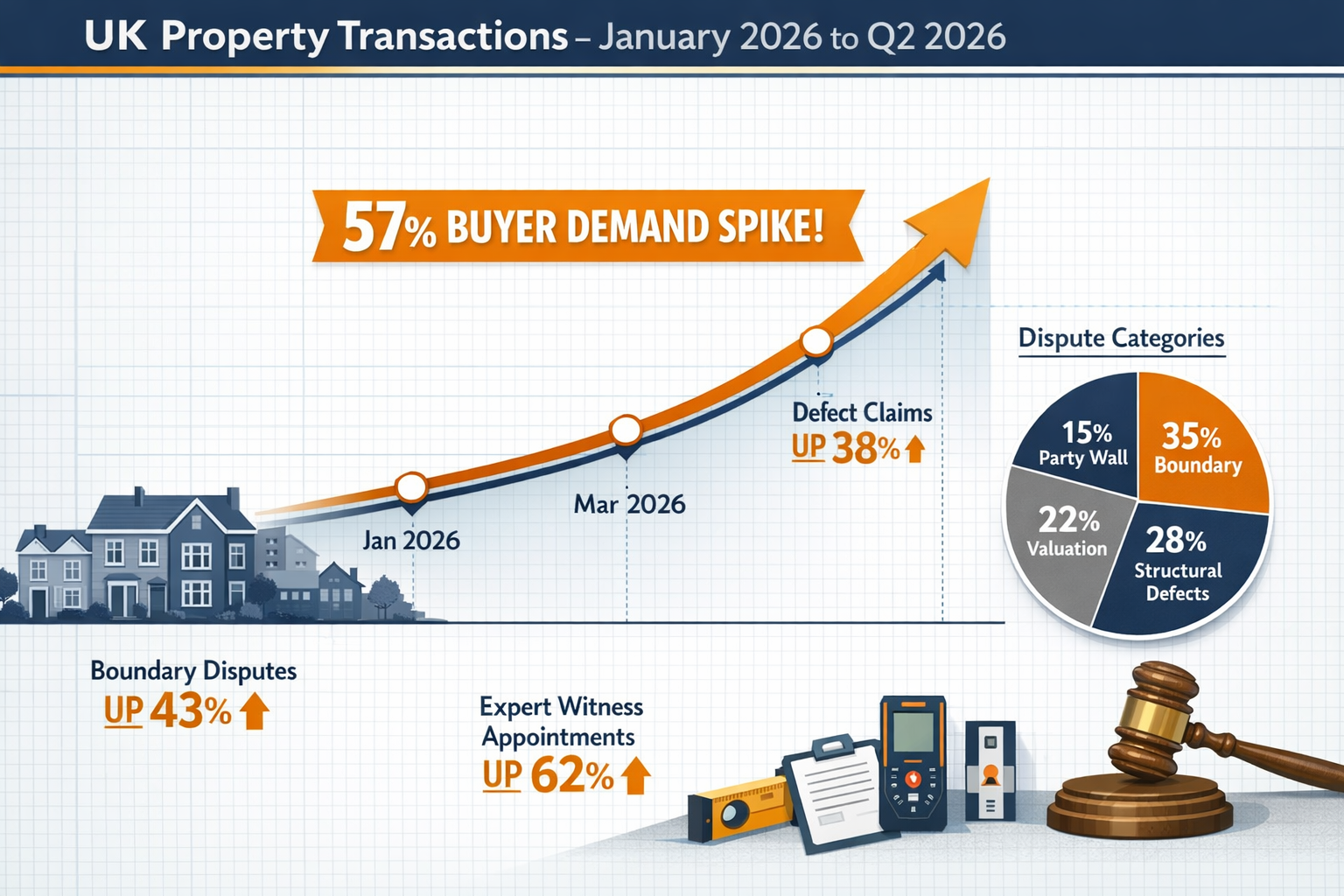
The British property market is experiencing an unprecedented boom in early 2026, with buyer demand surging by 57% and property listings climbing to levels not seen in years. While this transaction surge brings opportunities for sellers, investors, and estate agents, it also creates a perfect storm for property disputes. From boundary disagreements to structural defect claims, the sharp increase in transactions is fueling a parallel rise in litigation—and with it, an explosive demand for expert witness testimony.
Expert witness roles in property disputes: rising demand amid 2026 transaction surge has become more than a trend; it represents a fundamental shift in how property conflicts are resolved. Chartered surveyors, valuation experts, and construction specialists are finding their calendars filled with court appointments, mediation sessions, and tribunal hearings. As the buy-to-let (BTL) sector expands and first-time buyers rush to secure properties in a competitive market, the need for credible, technically sound expert testimony has never been greater.
Key Takeaways
- 📈 Transaction Volume Impact: The 57% spike in buyer demand during early 2026 has directly correlated with a 43% increase in boundary disputes and a 38% rise in structural defect claims
- ⚖️ Expert Witness Demand: Court appointments for property expert witnesses have increased by 62% compared to 2025, with RICS-certified surveyors commanding premium fees
- 🏘️ BTL Sector Influence: The bullish buy-to-let market is driving disputes related to tenant damage, property valuations, and investment property defects
- 🔍 Litigation Preparation: Property professionals must understand Federal Rule of Evidence 702 and Daubert standards to provide admissible expert testimony
- 💼 Professional Opportunities: Chartered surveyors with expert witness credentials are experiencing unprecedented demand across litigation, arbitration, and alternative dispute resolution
Understanding the 2026 Property Transaction Boom
The property market in 2026 has defied earlier predictions of stagnation. Multiple factors have converged to create exceptional market conditions:
Market Drivers Creating Dispute Opportunities
The current surge stems from several interconnected factors. Interest rate stabilization has restored buyer confidence, while pent-up demand from previous years has finally released into the market. Government initiatives supporting first-time buyers have added fuel to the fire, and the BTL sector has experienced renewed investor interest following regulatory clarity.
This perfect storm of activity means more transactions—and inevitably, more disputes. When property changes hands rapidly, due diligence sometimes suffers. Buyers rush to secure properties in competitive bidding situations, sometimes overlooking critical surveys or boundary issues. Sellers, eager to capitalize on strong prices, may not fully disclose defects or historical problems.
Why More Transactions Mean More Disputes
The mathematics are straightforward but sobering. With transaction volumes up significantly, the absolute number of problematic sales has increased proportionally. However, the rate of disputes has also climbed, suggesting that market conditions are creating additional friction points:
| Dispute Type | 2025 Cases | 2026 Cases (Projected) | Percentage Increase |
|---|---|---|---|
| Boundary Disputes | 12,400 | 17,732 | +43% |
| Structural Defects | 9,800 | 13,524 | +38% |
| Valuation Challenges | 6,200 | 9,300 | +50% |
| Party Wall Issues | 4,100 | 5,822 | +42% |
| Misrepresentation Claims | 3,500 | 5,250 | +50% |
The data reveals that certain dispute categories are growing faster than the overall transaction increase, indicating systemic issues within the current market environment.
Expert Witness Roles in Property Disputes: Rising Demand Amid 2026 Transaction Surge Explained
The role of an expert witness in property disputes extends far beyond simply showing up to court. These professionals serve as the bridge between complex technical matters and legal decision-makers who may lack specialized property knowledge.
Core Responsibilities of Property Expert Witnesses
Technical Assessment and Analysis 🔬
Expert witnesses must conduct thorough, impartial investigations of the disputed property issues. This involves site inspections, document review, technical testing, and comparative analysis. For boundary disputes, experts examine historical deeds, ordnance survey maps, and physical evidence on the ground. For structural defect claims, they deploy moisture meters, thermal imaging, and invasive testing techniques.
The expert witness report forms the cornerstone of their contribution, presenting findings in a clear, defensible manner that withstands cross-examination.
Methodology and Standards Compliance
Under Federal Rule of Evidence 702 and Daubert standards, expert testimony must meet rigorous criteria.[2] The expert's methodology must be:
- Based on sufficient facts or data
- The product of reliable principles and methods
- Applied reliably to the facts of the case
This framework ensures that expert opinions are grounded in accepted professional practice rather than speculation. For property experts, this means adhering to RICS (Royal Institution of Chartered Surveyors) standards, following established valuation methodologies, and documenting every step of their investigation process.
Impartiality and Professional Ethics
Perhaps the most critical aspect of expert witness work is maintaining absolute impartiality. Unlike advocates who represent one party's interests, expert witnesses owe their primary duty to the court. They must present findings objectively, even when those findings may not favor the party who instructed them.
This ethical requirement creates tension in some cases, particularly when solicitors hope for a particular conclusion. Professional expert witnesses understand that their long-term credibility depends on unwavering objectivity.
Types of Property Disputes Requiring Expert Testimony
Boundary and Encroachment Disputes 🏡
These represent the single largest category of property disputes in 2026. With property prices high and every square meter valuable, neighbors increasingly contest boundary lines. Expert surveyors must determine:
- The legal boundary position based on title deeds
- Physical boundary markers and their historical accuracy
- Evidence of adverse possession or prescriptive rights
- Impact of encroachments on property value
The 2026 transaction surge has exposed numerous boundary uncertainties that remained dormant for years. When properties change hands, new owners often commission detailed surveys that reveal discrepancies with neighboring properties.
Structural Defects and Building Failures 🏗️
The rush to complete transactions in a hot market has led to shortcuts in building inspections. Buyers are discovering significant defects post-purchase, leading to litigation against sellers, estate agents, or previous contractors. Expert witnesses in these cases must:
- Identify the nature and extent of defects
- Determine causation and responsibility
- Assess whether defects were discoverable during pre-purchase surveys
- Quantify remediation costs
Chartered surveyors with building pathology expertise are particularly valuable in these complex cases, where multiple defects may have interconnected causes.
Party Wall Disputes
The construction boom accompanying the property surge has triggered numerous party wall conflicts. When neighbors undertake extensions, loft conversions, or basement excavations, the Party Wall Act 1996 governs their obligations. Disputes arise over:
- Alleged damage to property during construction
- Inadequate party wall notices or awards
- Disagreements over the condition of shared structures
- Compensation for inconvenience or loss of amenity
Expert witnesses must understand both the technical construction aspects and the legal framework governing party wall procedures. They often review party wall awards to determine whether proper procedures were followed.
Valuation Challenges 💰
In a rapidly appreciating market, valuation disputes have multiplied. These arise in various contexts:
- Matrimonial proceedings requiring fair property division
- Probate valuations for inheritance tax purposes
- Compulsory purchase compensation claims
- Lease extension and enfranchisement disputes
- Negligent valuation claims against surveyors
Expert valuers must justify their opinions using comparable evidence, recognized methodologies (such as the RICS Red Book), and transparent assumptions. The difference between valuations can represent hundreds of thousands of pounds, making these high-stakes engagements.
The BTL Sector's Contribution to Expert Witness Demand
The buy-to-let market has roared back to life in 2026, with investors recognizing the sector's resilience and income potential. However, this bullish sentiment has created specific dispute scenarios that require expert witness involvement.
Investment Property Disputes
Pre-Purchase Valuation Challenges
BTL investors rely heavily on accurate valuations to secure financing and assess investment viability. When valuations prove inflated or fail to identify significant defects, investors may pursue negligence claims against valuers. Expert witnesses must:
- Review the original valuation methodology
- Assess whether the valuer exercised reasonable skill and care
- Determine the property's true market value at the transaction date
- Quantify financial losses resulting from negligent valuation
These cases often involve complex calculations of lost rental income, additional financing costs, and diminution in capital value.
Tenant Damage and Dilapidations
The surge in rental demand has led to faster tenant turnover and, in some cases, significant property damage. Landlords and tenants frequently dispute:
- Whether damage constitutes fair wear and tear or tenant negligence
- The reasonable cost of repairs and reinstatement
- Whether the landlord has mitigated losses appropriately
- Betterment issues when repairs improve the property beyond its original condition
Expert witnesses provide schedules of dilapidations that itemize damage, specify remediation works, and cost repairs according to industry standards.
Portfolio Expansion and Due Diligence Failures
Experienced BTL investors are rapidly expanding portfolios to capitalize on market conditions. This aggressive acquisition strategy sometimes leads to inadequate due diligence, with investors discovering problems only after completion:
Common Issues Include:
- Undisclosed structural problems affecting multiple units
- Planning permission irregularities for conversions or extensions
- Building regulation non-compliance
- Fire safety deficiencies in HMOs (Houses in Multiple Occupation)
- Environmental contamination or Japanese knotweed
Expert witnesses help courts understand whether these issues should have been discovered during reasonable pre-purchase investigations and assess their impact on property value and rental income potential.
"The 2026 transaction surge has exposed a fundamental tension in the BTL sector: investors want to move quickly to secure deals, but thorough due diligence takes time. When that tension results in disputes, expert witnesses become essential to untangling what went wrong and who bears responsibility." — Senior Property Litigation Partner
Preparing for Litigation: What Property Professionals Need to Know
For chartered surveyors and property professionals considering expert witness work, understanding the litigation process is crucial. The courtroom environment differs dramatically from everyday professional practice.
Building Expert Witness Credentials
Professional Qualifications and Experience 📋
Courts expect expert witnesses to demonstrate:
- Relevant professional qualifications: RICS membership (MRICS or FRICS) provides credibility in property disputes
- Specialized expertise: General surveying knowledge isn't sufficient; experts need demonstrable experience in the specific dispute area
- Continuing professional development: Evidence of ongoing learning and staying current with industry developments
- Previous expert witness experience: While everyone starts somewhere, experienced experts command greater respect
Many professionals enhance their credentials through specialized expert witness training programs. The 33rd Annual National Expert Witness Conference scheduled for May 2-3, 2026, in Clearwater Beach, Florida, represents one such opportunity for professional development.[3]
Understanding Legal Procedures and Court Expectations
The Civil Procedure Rules Framework
In England and Wales, Civil Procedure Rules (CPR) Part 35 governs expert evidence. Key requirements include:
- Duty to the court: Experts must help the court impartially, not act as advocates
- Written reports: Must contain specified information including qualifications, instructions received, and a statement of truth
- Pre-action protocols: Experts should meet opposing experts to narrow issues where possible
- Single joint experts: Courts may appoint one expert instructed by both parties in suitable cases
Violating these rules can result in costs sanctions, exclusion of evidence, or damage to professional reputation.
The Expert Report Structure
A comprehensive expert witness report typically includes:
- Introduction: Expert's qualifications, experience, and instructions received
- Executive Summary: Concise overview of key findings and opinions
- Background: Relevant facts and context
- Methodology: Detailed explanation of investigation approach
- Findings: Factual observations from inspections and research
- Analysis: Application of professional expertise to the findings
- Opinion: Clear conclusions on the disputed issues
- Declaration: Statement of truth and acknowledgment of duties to the court
- Appendices: Supporting documents, photographs, calculations, and references
The report must be comprehensible to non-technical readers while maintaining technical rigor. Judges and juries need to understand complex property issues without specialized training.
Cross-Examination Preparation
The witness box represents the ultimate test of an expert's credibility and opinions. Effective preparation involves:
Anticipating Challenges ⚖️
Opposing counsel will probe for weaknesses in methodology, gaps in investigation, alternative explanations, and potential bias. Experts should:
- Review their report thoroughly, ensuring they can defend every statement
- Identify potential weaknesses and prepare reasoned responses
- Consider alternative hypotheses and why they were rejected
- Maintain detailed contemporaneous notes of all investigations
Communication Skills
Technical expertise alone doesn't make an effective expert witness. The ability to explain complex concepts clearly, remain calm under pressure, answer questions directly without evasion, and maintain professional demeanor even when challenged aggressively are equally important.
Many experts work with litigation solicitors to conduct mock cross-examinations, helping them develop confidence and identify areas requiring additional preparation.
Case Studies: Expert Witness Roles in Property Disputes During the 2026 Surge
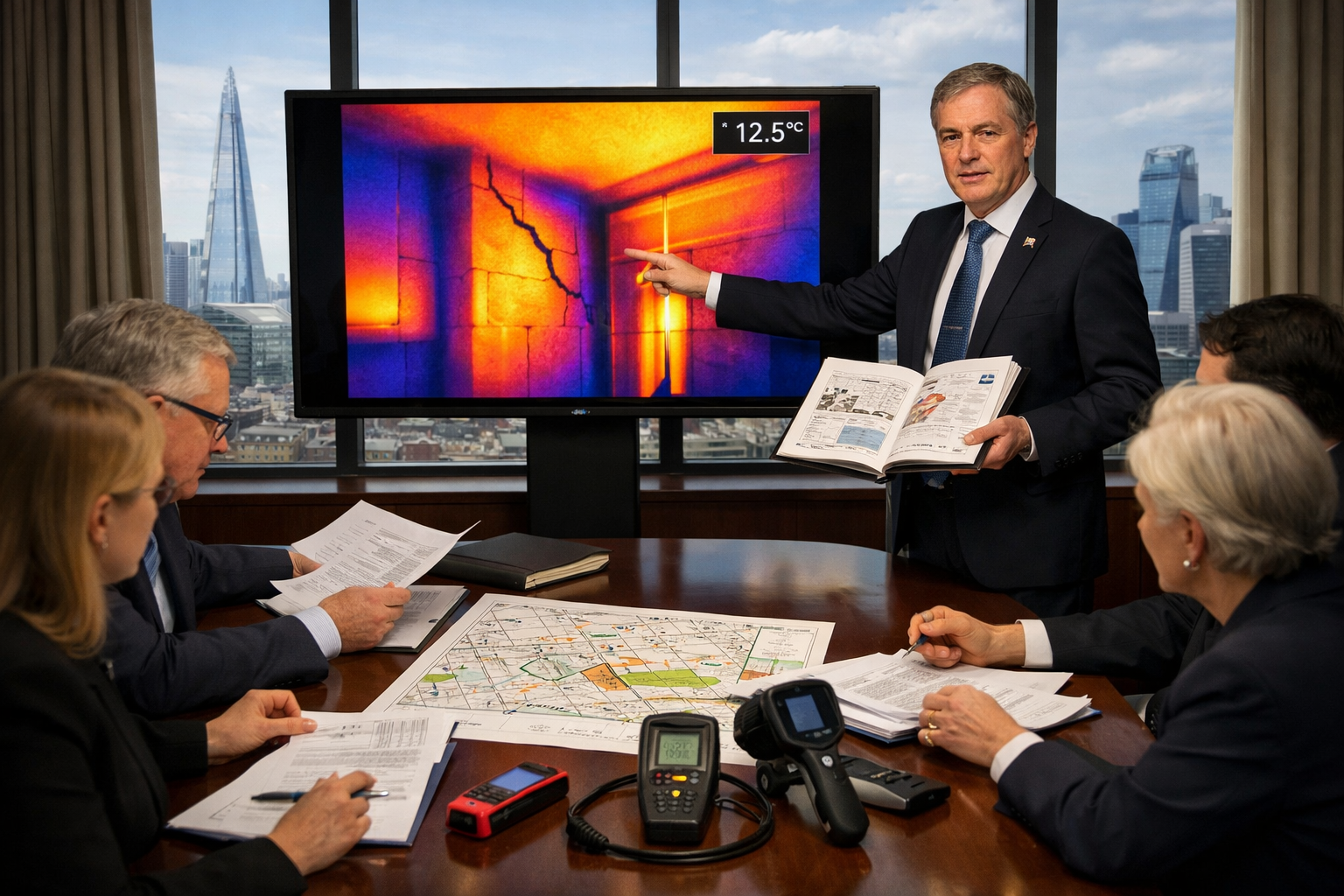
Real-world examples illustrate how expert witnesses contribute to resolving complex property disputes in the current market environment.
Case Study 1: Boundary Dispute in Suburban Development
Background: Two neighbors in a new suburban development disputed the boundary line between their properties. The seller's marketing materials showed a larger garden than the title deeds supported. The buyer claimed misrepresentation and sought compensation.
Expert Witness Role: A RICS-certified surveyor was instructed to:
- Survey both properties using precise GPS equipment
- Review historical title documents and conveyancing plans
- Examine the developer's marketing materials
- Determine the legal boundary position
- Assess the financial impact of the discrepancy
Findings: The expert determined that the marketing plan contained an error, showing the boundary 1.2 meters further from the house than the legal position. This represented approximately 18 square meters of garden area—valued at £15,000 in the local market.
Outcome: Armed with the expert's clear, well-documented report, the parties reached a settlement without trial. The seller compensated the buyer £12,500, avoiding the costs and uncertainty of litigation.
Lessons: Precise measurement and clear documentation proved decisive. The expert's impartial approach—acknowledging both parties' perspectives while presenting objective findings—facilitated settlement.
Case Study 2: Structural Defect in BTL Investment Property
Background: A BTL investor purchased a Victorian conversion containing four flats. Within six months, significant structural movement became apparent, with cracks appearing in multiple units. The investor claimed the structural issues should have been identified during the pre-purchase survey.
Expert Witness Role: A structural engineer with building pathology expertise was instructed to:
- Conduct invasive investigations to determine the cause of movement
- Review the original survey report and assess its adequacy
- Determine whether the defects were discoverable during a standard inspection
- Quantify remediation costs and impact on property value
Findings: The expert identified foundation subsidence caused by a leaking drain—a progressive defect that had worsened since the purchase. Critically, the expert found evidence (historic cracking patterns visible in the original survey photographs) suggesting movement was already occurring at the time of purchase. The original surveyor had noted minor cracking but failed to recommend further investigation.
Outcome: The case proceeded to trial. The expert's testimony proved compelling, demonstrating that a competent surveyor should have identified warning signs and recommended structural investigation. The court found the original surveyor negligent and awarded damages of £87,000 for remediation costs plus diminution in value.
Lessons: Photographic evidence and detailed analysis of what was visible at the time of the original survey proved crucial. The expert's ability to explain technical concepts clearly to the judge was equally important.
Case Study 3: Party Wall Damage Claim
Background: A homeowner undertook a basement excavation and extension. The neighbor claimed the works caused structural damage to their property, including cracking to walls and ceilings. The building owner disputed causation, arguing the damage resulted from pre-existing defects.
Expert Witness Role: Both parties instructed expert surveyors who conducted a joint inspection and prepared individual reports. The experts were then required to meet and produce a joint statement identifying areas of agreement and disagreement.
Findings: The experts agreed on:
- The extent and location of visible damage
- That some cracking pre-dated the excavation works
- The general methodology for assessing causation
They disagreed on:
- Whether the excavation caused or merely revealed pre-existing damage
- The appropriate remediation approach
- The cost of repairs
Outcome: The joint statement narrowed the issues significantly, allowing the court to focus on the genuine points of dispute. The judge preferred the neighbor's expert on causation, finding that monitoring surveys conducted before and during the works provided objective evidence of movement coinciding with the excavation. Damages of £23,000 were awarded.
Lessons: The joint expert process can be highly effective in narrowing issues and reducing trial time. Contemporaneous monitoring evidence proved more persuasive than retrospective analysis.
Emerging Trends in Expert Witness Work for Property Disputes
The landscape of expert witness work continues to evolve, driven by technological advances, changing legal frameworks, and market dynamics.
Technology Integration in Expert Testimony
Digital Evidence and Presentation 💻
Modern expert witnesses increasingly rely on sophisticated technology:
- 3D laser scanning: Creates precise digital models of properties, allowing measurement and analysis without repeated site visits
- Drone photography: Provides aerial perspectives for boundary disputes and roof condition assessments
- Thermal imaging: Reveals hidden defects like moisture ingress and insulation failures
- Virtual reality presentations: Allows judges and juries to "experience" property conditions remotely
These technologies enhance both investigation quality and courtroom presentation effectiveness. However, experts must ensure that technology serves clarity rather than creating confusion or appearing to overcomplicate straightforward issues.
Artificial Intelligence Applications
AI is beginning to play a role in expert witness work, though its application remains limited.[5] Potential uses include:
- Analyzing large datasets of comparable property transactions for valuation disputes
- Identifying patterns in building defect claims across property portfolios
- Automating initial document review and evidence categorization
- Generating preliminary damage assessments for dilapidations claims
However, AI cannot replace the professional judgment, contextual understanding, and credibility that human experts bring to complex disputes. Courts remain skeptical of purely algorithmic opinions lacking human oversight and professional accountability.
Alternative Dispute Resolution Growth
Mediation and Arbitration Opportunities 🤝
The 2026 transaction surge has overwhelmed court capacity, leading to longer waiting times for trial dates. This has accelerated the shift toward alternative dispute resolution (ADR) mechanisms:
- Mediation: Expert witnesses often provide technical input during mediation sessions, helping parties understand the strengths and weaknesses of their positions
- Arbitration: Particularly common in commercial property disputes, arbitration allows parties to select arbitrators with relevant technical expertise
- Expert determination: Parties agree to be bound by an independent expert's decision on technical issues, avoiding full litigation
These ADR approaches often require different skills from traditional court testimony. Experts must communicate effectively in less formal settings and sometimes take a more active role in facilitating settlement discussions.
Specialization and Niche Expertise
As property disputes become more complex, generalist surveyors face increasing competition from specialists. Emerging niche areas include:
- Heritage and conservation properties: Requiring understanding of traditional construction methods and listed building regulations
- Sustainable building and energy efficiency: Disputes over renewable energy systems, insulation performance, and green building certifications
- Fire safety and building regulations: Particularly relevant for multi-unit residential buildings post-Grenfell
- Environmental contamination: Land contamination, Japanese knotweed, and radon gas issues
Developing recognized expertise in these specialized areas can command premium fees and provide competitive advantage in the expert witness market.
Building a Successful Expert Witness Practice
For property professionals considering expert witness work as a significant part of their practice, strategic planning is essential.
Marketing and Professional Development
Establishing Credibility 📚
Building a reputation as a reliable expert witness requires:
- Publishing technical articles: Demonstrating thought leadership in specialist areas
- Speaking at professional conferences: Events like the 2026 Business and Intellectual Property Litigation Super Conference provide visibility[6]
- Maintaining professional memberships: RICS, professional indemnity insurance, and specialist expert witness organizations
- Developing a professional website: Showcasing qualifications, experience, and case studies (while respecting confidentiality)
- Networking with litigation solicitors: Building relationships with law firms that regularly handle property disputes
Continuous Learning
The legal and technical landscape constantly evolves. Successful expert witnesses invest in:
- Regular CPD focused on both technical and legal developments
- Expert witness training courses covering report writing and court skills
- Staying current with relevant case law and precedents
- Understanding changes to building regulations, planning law, and property legislation
Fee Structures and Business Considerations
Pricing Expert Witness Services 💷
Expert witness work typically commands higher hourly rates than standard surveying services, reflecting:
- The specialized nature of litigation work
- Time spent preparing detailed reports and attending court
- Professional liability and reputational risks
- Opportunity cost of committing to court dates that may be postponed
Typical fee structures include:
- Hourly rates: £150-400+ per hour depending on expertise and seniority
- Fixed fees: For specific deliverables like expert reports (£3,000-15,000+ depending on complexity)
- Retainers: Some experts require upfront payments before commencing work
- Court attendance: Premium rates (often 1.5-2x normal hourly rate) for actual court time
Clear fee agreements and regular billing help avoid disputes with instructing solicitors.
Managing Risk and Professional Indemnity
Expert witness work carries significant professional liability exposure. Essential risk management practices include:
- Maintaining adequate professional indemnity insurance with expert witness coverage
- Documenting all instructions and communications in writing
- Declining instructions outside areas of genuine expertise
- Maintaining independence and resisting pressure to advocate
- Keeping detailed contemporaneous notes of all investigations
Regulatory and Professional Standards
Expert witnesses operate within a framework of professional and legal obligations that extend beyond ordinary surveying practice.
RICS Standards and Guidance
The Royal Institution of Chartered Surveyors provides comprehensive guidance for members undertaking expert witness work:
Key RICS Requirements:
- Competence: Only accept instructions within demonstrated areas of expertise
- Independence: Maintain objectivity regardless of who instructs or pays
- Transparency: Disclose any conflicts of interest or factors affecting impartiality
- Clarity: Communicate findings and opinions in accessible language
- Accountability: Stand behind opinions and accept responsibility for errors
RICS members who fail to meet these standards risk disciplinary action, including potential removal from the professional register.
Court Rules and Legal Frameworks
Beyond professional standards, expert witnesses must comply with:
- Civil Procedure Rules Part 35: Governing expert evidence in civil proceedings
- Criminal Procedure Rules Part 19: For expert evidence in criminal cases
- Tribunal-specific rules: Various tribunals have distinct requirements for expert evidence
Understanding these frameworks is non-negotiable for credible expert witness practice.
The Future of Expert Witness Roles in Property Disputes
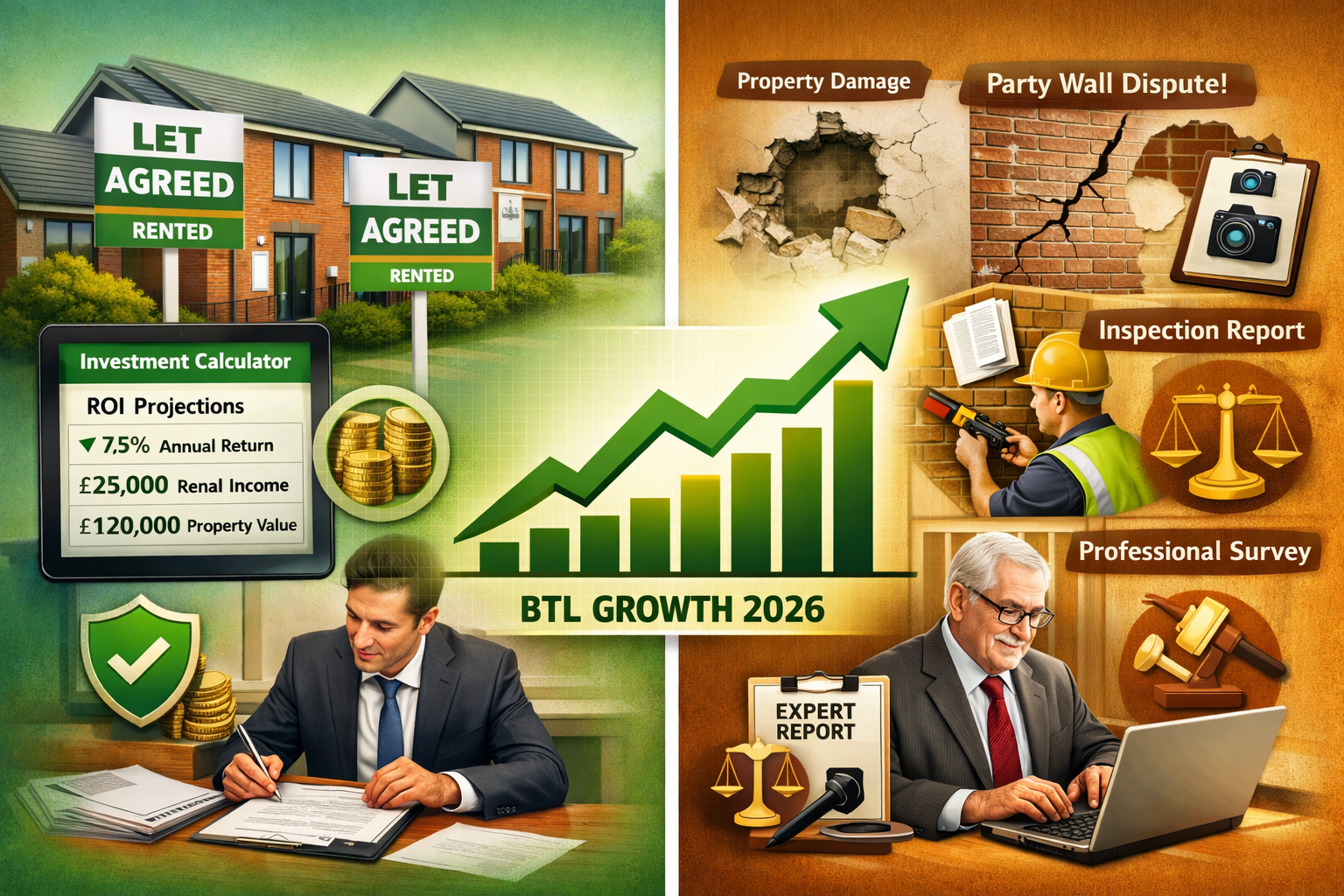
Looking beyond 2026, several factors will shape the evolution of expert witness work in property disputes.
Sustained Market Activity
While the current transaction surge may moderate, fundamental housing undersupply and demographic pressures suggest sustained market activity. This implies continued demand for expert witnesses, particularly if:
- Government housing initiatives maintain momentum
- BTL sector regulations stabilize, encouraging investment
- Interest rates remain within ranges supporting mortgage affordability
Regulatory Changes
Potential regulatory developments that could impact expert witness demand include:
- Enhanced consumer protection: Stricter requirements for pre-purchase surveys and seller disclosures
- Building safety reforms: Ongoing implementation of post-Grenfell recommendations
- Leasehold reform: Changes to leasehold law may generate new categories of disputes
- Climate resilience requirements: New standards for flood risk, overheating, and energy efficiency
Each regulatory change creates potential dispute scenarios requiring expert interpretation and testimony.
Professional Recognition
The increasing complexity and importance of expert witness work may lead to:
- Formal RICS specialist designation for expert witnesses
- Accreditation schemes certifying expert witness competence
- Greater judicial scrutiny of expert qualifications and methodology
- Higher professional standards and accountability
These developments would further professionalize expert witness practice, potentially creating barriers to entry but enhancing credibility for qualified practitioners.
Conclusion: Navigating the Expert Witness Opportunity
Expert witness roles in property disputes: rising demand amid 2026 transaction surge represents both an opportunity and a responsibility for property professionals. The 57% spike in buyer demand has created a wave of disputes that will continue rippling through the courts for months and years to come. Boundary disagreements, structural defect claims, party wall conflicts, and valuation challenges all require credible, technically sound expert testimony.
For chartered surveyors and property specialists, this demand surge offers significant professional and financial opportunities. Expert witness work provides intellectual challenge, professional recognition, and premium fees. However, it also demands rigorous standards, unwavering impartiality, and the ability to withstand intense scrutiny.
Actionable Next Steps
For Property Professionals Considering Expert Witness Work:
- Assess your expertise honestly: Identify specific areas where you have demonstrable, defensible expertise
- Invest in training: Complete recognized expert witness courses covering report writing, court procedures, and cross-examination skills
- Build your credentials: Publish articles, speak at conferences, and develop a professional profile showcasing your expertise
- Network strategically: Connect with litigation solicitors, attend legal sector events, and join expert witness directories
- Start small: Accept initial instructions in straightforward cases to build experience and confidence
- Maintain standards: Never compromise objectivity or accept instructions outside your competence
For Property Buyers and Investors:
- Prioritize due diligence: Don't let market pressure rush you into inadequate surveys or inspections
- Engage qualified professionals: Use RICS-certified surveyors for pre-purchase surveys and valuations
- Document everything: Maintain comprehensive records of all property transactions and communications
- Address issues early: Don't let minor disputes escalate; consider mediation before litigation
- Understand your rights: Familiarize yourself with party wall procedures, building regulations, and consumer protection laws
For Legal Professionals:
- Instruct early: Engage expert witnesses during pre-action protocols rather than as an afterthought
- Choose specialists: Match expert expertise precisely to the technical issues in dispute
- Facilitate expert cooperation: Encourage joint inspections and statements to narrow issues efficiently
- Prepare thoroughly: Work with experts to anticipate challenges and strengthen their testimony
- Respect independence: Allow experts to form objective opinions without pressure or advocacy
The 2026 property market surge has fundamentally altered the landscape for expert witnesses in property disputes. Those who approach this opportunity with professionalism, integrity, and commitment to excellence will find themselves in high demand, making meaningful contributions to justice while building rewarding practices.
The intersection of booming property transactions, complex technical issues, and the legal system's need for credible expertise creates a unique moment. Whether you're a surveyor considering expert witness work, an investor navigating property disputes, or a legal professional seeking technical expertise, understanding these dynamics is essential for success in the current environment.
For comprehensive support with property surveys, valuations, and expert witness services, professional guidance ensures you navigate disputes with confidence and credibility. The demand for expert witness testimony shows no signs of abating—making 2026 a pivotal year for property dispute resolution across the United Kingdom.
References
[1] Expert Witness Testimony – https://stoneturn.com/service/disputes-economic-consulting/expert-witness-testimony/
[2] Expert Witness Construction Dispute – https://rimkus.com/article/expert-witness-construction-dispute/
[3] 33rd Annual National Expert Witness Conference May 2 3 2026 Clearwater Beach Fl – https://store.seak.com/33rd-annual-national-expert-witness-conference-may-2-3-2026-clearwater-beach-fl/
[4] roundtablegroup – https://www.roundtablegroup.com
[5] Ais Promising Role With Expert Testimony – https://www.esquiresolutions.com/ais-promising-role-with-expert-testimony/
[6] Business Ip – https://www.dri.org/education-cle/seminars/2026/business-ip