


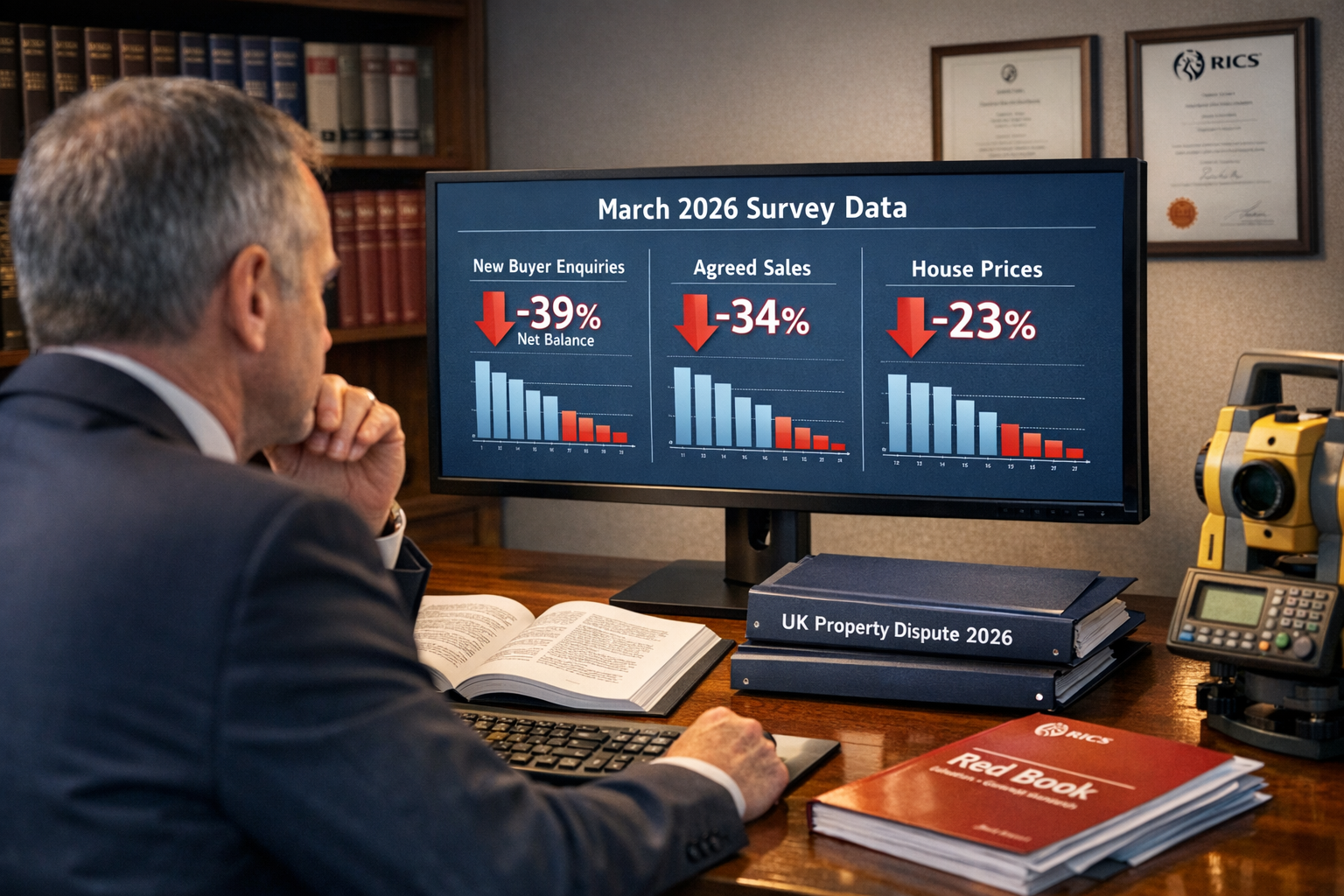
The RICS March 2026 residential market survey reveals a dramatic collapse: new buyer enquiries plunged to -39% net balance, the weakest reading since August 2023, while agreed sales deteriorated to -34% from just -13% the previous month[3]. These aren't merely statistics—they represent the quantifiable impact of geopolitical turmoil on UK property valuations, and they're reshaping how expert witnesses approach dispute resolution in 2026.
When Middle East conflicts drive oil prices higher and mortgage rates back above 5%, the ripple effects reach every corner of the UK housing market. For expert witnesses providing valuation evidence in disputes, understanding these macro-level impacts has become essential to credible testimony. The March 2026 RICS data provides the empirical foundation expert witnesses need to quantify geopolitical adjustments and defend valuation methodologies under cross-examination.

Key Takeaways
- Market sentiment collapsed dramatically in March 2026, with buyer enquiries at -39%, agreed sales at -34%, and house prices at -23% net balance, directly linked to Middle East conflict escalation
- Expert witnesses must incorporate geopolitical risk adjustments into valuation evidence, using RICS March 2026 data as empirical support for market sentiment shifts
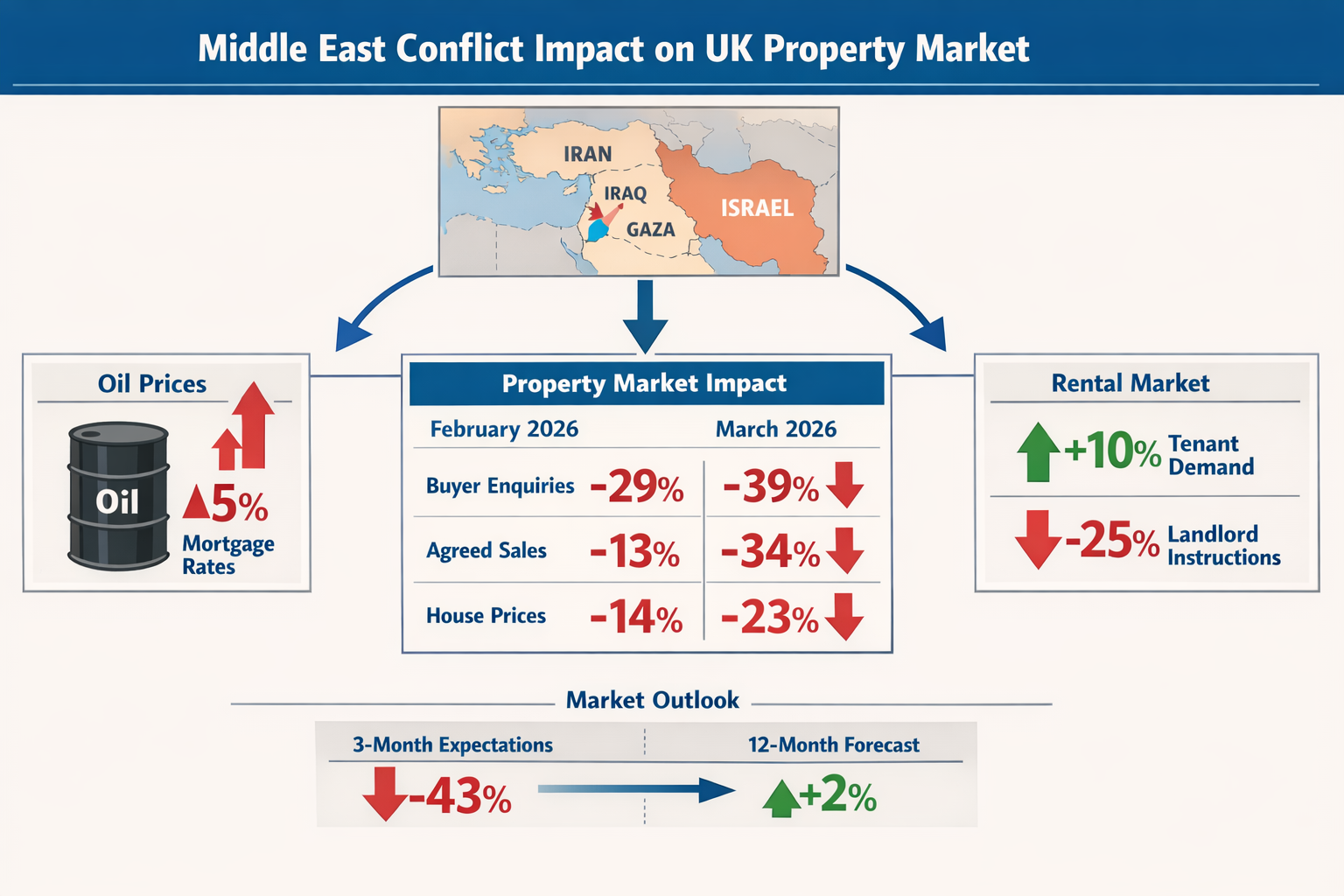
- Rental market dynamics diverged sharply, with tenant demand rising to +10% while landlord instructions fell to -25%, creating new dispute scenarios requiring specialist analysis
- Three-month price expectations dropped to -43%, requiring expert witnesses to adjust comparable evidence and future projections in ongoing dispute valuations
- Mortgage rate increases above 5% driven by conflict-related energy costs provide quantifiable evidence of external market forces affecting property values
Understanding the March 2026 RICS Survey Context for Expert Witness Roles in Middle East Conflict Valuation Impacts
The Royal Institution of Chartered Surveyors conducts monthly residential market surveys that serve as authoritative barometers of UK housing sentiment. The March 2026 data carries particular significance because it captures the immediate market response to escalating Middle East tensions and their secondary effects on borrowing costs.
The Geopolitical Connection to UK Property Values
Middle East conflicts don't impact UK property values through direct physical damage—the connection operates through economic transmission mechanisms. When tensions escalate in oil-producing regions, energy costs surge. This inflationary pressure forces central banks to maintain higher interest rates, which directly increases mortgage costs for UK homebuyers[3].
The March 2026 data shows this chain reaction clearly:
- Average fixed mortgage rates climbed back above 5%
- Buyer affordability deteriorated rapidly
- Transaction activity collapsed as purchasers withdrew from the market
- Price expectations turned sharply negative across all timeframes
For expert witnesses preparing valuation evidence, these aren't abstract economic concepts—they're material facts that must be reflected in valuation adjustments. A RICS valuation prepared in March 2026 without consideration of these market dynamics would fail the fundamental test of reflecting market conditions at the valuation date.
Key March 2026 Survey Metrics
| Metric | March 2026 | February 2026 | Change |
|---|---|---|---|
| New Buyer Enquiries | -39% | -29% | -10 points |
| Agreed Sales | -34% | -13% | -21 points |
| House Prices | -23% | -14% | -9 points |
| Three-Month Price Expectations | -43% | N/A | Significantly negative |
| Twelve-Month Price Outlook | +2% | N/A | Minimal growth |
| Short-Term Sales Expectations | -33% | -4% | -29 points |
These figures represent net balances—the percentage of respondents reporting increases minus those reporting decreases. The dramatic negative readings indicate widespread market pessimism directly attributable to external geopolitical factors[3].
Why Expert Witnesses Need This Data
When disputes involve property valuations dated in or around March 2026, expert witnesses face several challenges:
🔍 Establishing market context: Courts and tribunals require expert witnesses to demonstrate that valuation opinions reflect actual market conditions, not theoretical assumptions.
📊 Quantifying sentiment shifts: The RICS data provides objective evidence of how quickly market sentiment can deteriorate due to external factors.
⚖️ Defending methodology: Under cross-examination, expert witnesses must justify why they applied (or didn't apply) specific adjustments to comparable evidence.
💷 Addressing comparable evidence timing: Properties that sold in January or February 2026 may not provide reliable comparable evidence for March 2026 valuations without adjustment.
Chartered surveyors and valuers acting as expert witnesses must bridge the gap between macro-economic data and specific property valuations, demonstrating how broader market forces affect individual properties.
Expert Witness Protocols for Presenting Geopolitical Valuation Adjustments in UK Disputes
The role of an expert witness extends beyond simply producing a valuation figure. In disputes involving properties valued during periods of geopolitical turbulence, expert witnesses must follow rigorous protocols to ensure their evidence withstands scrutiny.
The RICS Expert Witness Framework
RICS maintains a Register of Accredited Expert Witnesses, which as of March 2026 includes specialists across various disciplines[4]. To achieve and maintain accreditation, expert witnesses must demonstrate:
- Independence and objectivity: Expert witnesses owe their primary duty to the court or tribunal, not to the party instructing them
- Technical competence: Specialized knowledge in valuation methodology and market analysis
- Understanding of legal procedures: Familiarity with Civil Procedure Rules and expert witness obligations
- Clear communication skills: Ability to explain complex valuation concepts to non-technical audiences
When presenting evidence related to Middle East conflict impacts, expert witnesses must balance technical rigor with accessibility, ensuring that judges, arbitrators, and legal counsel understand the causal connections between geopolitical events and property values.
Structuring Valuation Evidence with Geopolitical Adjustments
Expert witnesses incorporating March 2026 RICS data into dispute valuations typically follow this structured approach:
1. Establish Baseline Market Conditions
Begin by documenting the market environment immediately preceding the conflict escalation. This provides the "but for" scenario—what values would have been absent the geopolitical shock.
Evidence sources include:
- RICS survey data from January and February 2026
- Comparable sales from the pre-escalation period
- Mortgage availability and pricing data
- Economic forecasts published before the conflict intensified
2. Identify the Conflict Impact Timeline
Precisely date when market sentiment began shifting. The RICS March 2026 survey shows the deterioration occurred between February and March, with particularly sharp declines in agreed sales (-21 points) and short-term sales expectations (-29 points)[3].
This timeline matters because:
- Properties valued in early March may reflect different conditions than those valued in late March
- Comparable evidence must be adjusted based on transaction timing
- Expert witnesses must explain why certain comparables remain relevant despite market shifts
3. Quantify Market Sentiment Adjustments
The challenge for expert witnesses lies in translating macro-level survey data into property-specific adjustments. The RICS data provides the direction and magnitude of market movement, but expert witnesses must apply professional judgment to determine appropriate adjustments for individual properties.
Adjustment methodology considerations:
📉 Price expectation adjustments: With three-month expectations at -43%, expert witnesses might apply negative adjustments to comparable evidence from earlier periods to reflect anticipated price softening.
🏠 Property type sensitivity: Different property segments respond differently to market shocks. Luxury properties often show greater volatility than mid-market homes during economic uncertainty.
📍 Location-specific factors: Some UK regions may be more or less sensitive to geopolitical impacts depending on local economic drivers and buyer demographics.
💰 Transaction type variations: Investment properties may experience different valuation impacts than owner-occupied homes, particularly given the rental market dynamics shown in the March 2026 data.
4. Address Mortgage Availability and Affordability
The return of mortgage rates above 5% represents a quantifiable external factor that expert witnesses can incorporate into valuation analysis[3]. This isn't subjective opinion—it's an observable market fact with direct implications for buyer affordability and demand.
Expert witnesses should calculate:
- Monthly payment increases for typical buyers at different price points
- Affordability thresholds based on income multiples
- The proportion of potential buyers priced out by rate increases
- Comparable adjustments to reflect reduced buyer pools
5. Document the Reasoning Chain
Courts and tribunals expect expert witnesses to show their work. The valuation report should clearly trace the logical connection:
Middle East conflict escalation → Oil price increases → Inflation concerns → Interest rate pressure → Mortgage rate increases → Buyer affordability reduction → Demand collapse → Price pressure → Valuation adjustment
Each link in this chain should be supported by objective evidence, with the RICS March 2026 survey data providing crucial empirical support[3].
Cross-Examination Preparation
Expert witnesses presenting geopolitical valuation adjustments should anticipate several lines of cross-examination:
❓ "How do you know the conflict caused the market decline?"
Response framework: Reference the timing correlation between conflict escalation, oil price movements, mortgage rate increases, and the RICS survey deterioration. Acknowledge that correlation doesn't prove causation, but explain why the economic transmission mechanism is well-established.
❓ "Aren't you just speculating about future market movements?"
Response framework: Distinguish between forecasting future values and reflecting current market sentiment. The RICS data shows that as of March 2026, market participants had already adjusted their behavior and expectations[3]. Valuation reflects current market psychology, not predictions.
❓ "Why didn't you use comparable sales from March 2026?"
Response framework: Explain the time lag between market shifts and completed transactions. Agreed sales in March 2026 likely reflect negotiations from earlier periods. The RICS data on new enquiries and agreed sales provides more current market sentiment than completed transactions.
❓ "How can you quantify something as subjective as geopolitical risk?"
Response framework: Emphasize that the valuation doesn't attempt to quantify geopolitical risk directly—it reflects the observable market response to that risk, as evidenced by the RICS survey data, mortgage rate movements, and transaction activity[3].
Rental Market Divergence and Emerging Dispute Scenarios in Expert Witness Roles for Middle East Conflict Valuation Impacts
While the sales market deteriorated dramatically in March 2026, the rental sector showed strikingly different dynamics. This divergence creates new categories of disputes requiring expert witness analysis.
The Rental Market Paradox
The March 2026 RICS data reveals:
- Tenant demand rose to +10% net balance, indicating continued strong rental demand
- Landlord instructions fell to -25%, showing significant supply withdrawal
- Near-term rental expectations climbed to +29%, suggesting accelerating rental growth[3]
This supply-demand imbalance occurs because:
🏘️ Frustrated buyers become renters: As mortgage affordability deteriorates, potential buyers remain in or return to the rental market, sustaining demand.
🚪 Landlords exit the market: Regulatory pressures, tax changes, and uncertainty drive landlords to sell rather than re-let properties, reducing supply.
📈 Rental yields become relatively attractive: With house prices under pressure but rents rising, investment returns shift in favor of rental income.
New Dispute Categories for Expert Witnesses
This rental market divergence generates several dispute scenarios requiring specialist expert witness input:
Lease Renewal Disputes
When commercial or residential leases come up for renewal during periods of rapid rental growth, disputes frequently arise over appropriate rental values. Expert witnesses must:
- Analyze comparable rental evidence from the March 2026 period
- Adjust for the timing lag between market shifts and rental transactions
- Consider whether the rental growth is sustainable or represents temporary dislocation
- Address the impact of reduced supply on rental values
Lease extension valuations become particularly complex when rental and capital values move in opposite directions.
Investment Property Valuations
Properties valued on an investment basis require expert witnesses to reconcile:
- Declining capital values (reflected in the -23% house price net balance)
- Rising rental values (reflected in the +29% rental expectations)
- Changing yield requirements as investors reassess risk
The March 2026 data suggests that investment property valuations might hold up better than owner-occupied properties, as improving rental income partially offsets capital value pressure. Expert witnesses must quantify this effect for specific properties.
Matrimonial Disputes
Matrimonial valuations during March 2026 present particular challenges:
- Parties may dispute whether the property should be valued for vacant possession or with sitting tenants
- The timing of valuation becomes critical given rapid market shifts
- One party may argue for rental investment value while the other argues for vacant possession value
- Expert witnesses must address whether the market dislocation is temporary or represents a longer-term shift
Probate and Tax Valuations
Valuations for probate and capital gains tax require expert witnesses to determine market value at specific dates. When those dates fall in March 2026, expert witnesses must:
- Determine whether the geopolitical impact had already affected values at the valuation date
- Consider whether the impact was reflected in market transactions or only in sentiment
- Address HMRC's expectations for valuation methodology during periods of market turbulence
- Provide evidence that valuations reflect actual market conditions, not theoretical values
Regional Variations in Impact
The RICS March 2026 survey data represents UK-wide averages, but expert witnesses must consider regional variations. Some areas may experience:
Greater sensitivity to geopolitical shocks:
- Regions heavily dependent on financial services employment
- Areas with high proportions of international buyers
- Luxury property markets with discretionary purchasers
Lesser sensitivity:
- Areas with strong local employment drivers unrelated to global markets
- Regions with housing shortages that provide price support
- Markets with limited investor activity and predominantly owner-occupier demand
Expert witnesses should reference regional RICS data where available and explain why specific locations might diverge from national trends.
The Middle East Construction Dispute Context
While the RICS March 2026 survey focuses on UK residential markets, expert witnesses should understand the broader context of Middle East construction disputes, which frequently involve UK-based professionals and legal proceedings.
Research shows that capital projects in the Middle East routinely exceed planned schedules by over 80%, with claims reaching as high as one-third of total project expenditure[1]. More than 50% of Middle East projects experience disputes due to scope change, and over 25% face disputes related to project delays[1].
This context matters for UK-based expert witnesses because:
- Many UK construction professionals work on Middle East projects
- Disputes often proceed under English law in UK courts or arbitration
- Valuation of delay claims, variations, and disruption requires specialist expertise
- The geopolitical environment affects project risk assessments and valuation assumptions
Expert witnesses providing evidence in Middle East construction disputes must demonstrate:
✅ Understanding of local market conditions: Including how conflict affects material costs, labor availability, and project timelines
✅ Knowledge of regional construction practices: Which may differ significantly from UK norms
✅ Familiarity with international contract forms: Such as FIDIC, which are commonly used in Middle East projects
✅ Ability to quantify geopolitical risk impacts: On project valuations and delay assessments
Practical Guidance for Expert Witnesses
When preparing evidence for disputes involving March 2026 valuations, expert witnesses should:
📋 Maintain detailed records: Document all data sources, including specific RICS survey releases, mortgage rate data, and comparable evidence with precise dates.
🔄 Update analysis as new data emerges: The March 2026 survey represents a snapshot; subsequent months may show whether the market decline continues, stabilizes, or reverses.
💼 Engage early with instructing parties: Help legal teams understand the evidentiary requirements for establishing geopolitical impacts on valuations.
📚 Reference authoritative sources: The RICS guidance on valuation issues associated with Middle East conflict provides professional context for valuation adjustments[2].
🎯 Tailor analysis to property type: A RICS building survey approach may reveal property-specific factors that make certain properties more or less sensitive to market-wide trends.
⚖️ Maintain independence: Expert witnesses must resist pressure to adjust opinions to favor the instructing party, even when geopolitical impacts create valuation uncertainty.
The Importance of RICS Accreditation
The RICS Register of Accredited Expert Witnesses provides assurance to courts and tribunals that expert witnesses meet professional standards[4]. For disputes involving complex geopolitical valuation impacts, RICS accreditation signals:
- Technical competence in valuation methodology
- Understanding of professional standards and ethics
- Commitment to continuing professional development
- Familiarity with expert witness duties and procedures
Parties instructing expert witnesses for disputes involving March 2026 valuations should verify RICS accreditation and relevant specialist experience.
Conclusion
The RICS March 2026 survey data reveals the profound impact of Middle East conflict on UK property markets, with buyer enquiries collapsing to -39%, agreed sales falling to -34%, and house prices declining to -23% net balance. These aren't merely statistics—they represent the empirical evidence expert witnesses need to quantify geopolitical adjustments in valuation disputes.
For expert witnesses, the March 2026 data provides several critical tools:
📊 Objective evidence of market sentiment shifts that can be referenced in valuation reports and testimony
⏱️ Precise timing of market deterioration enabling appropriate adjustment of comparable evidence
🔗 Clear causal connections between geopolitical events, mortgage rates, and market activity
📈 Divergent rental market dynamics highlighting new dispute scenarios requiring specialist analysis
As disputes involving March 2026 valuations proceed through UK courts and tribunals in the coming months, expert witnesses who thoroughly understand and appropriately apply this RICS data will provide more credible and defensible evidence. The key lies not in mechanically applying adjustments, but in demonstrating the logical reasoning chain from geopolitical events to observable market impacts to property-specific valuation conclusions.
Actionable Next Steps
For professionals involved in property disputes:
✅ Review existing valuation instructions: Determine whether any pending disputes involve valuation dates in or around March 2026 that may require supplementary analysis.
✅ Update valuation methodologies: Ensure approaches account for rapid market sentiment shifts and incorporate relevant RICS survey data.
✅ Engage qualified expert witnesses early: RICS-accredited expert witnesses with experience in geopolitical valuation impacts can help shape dispute strategy from the outset.
✅ Document market conditions contemporaneously: Maintain records of mortgage rates, transaction activity, and market sentiment at specific dates to support future valuation evidence.
✅ Consider alternative dispute resolution: Given the complexity of quantifying geopolitical impacts, mediation or expert determination may offer more efficient resolution than full litigation.
The intersection of Middle East geopolitical events and UK property valuations represents a challenging but navigable terrain for expert witnesses. By grounding analysis in authoritative data sources like the RICS March 2026 survey, maintaining professional independence, and clearly communicating reasoning, expert witnesses can provide the evidence courts and tribunals need to resolve disputes fairly and efficiently.
Whether you're involved in matrimonial valuations, probate assessments, or commercial property disputes, understanding how expert witnesses incorporate geopolitical factors into valuation evidence has become essential in 2026's complex market environment.
References
[1] Building Trust In Disputes Across The Middle East Why Expertise Matters – https://www.rics.org/dispute-resolution-service/drs-information-hub/building-trust-in-disputes-across-the-middle-east-why-expertise-matters
[2] Valuation Issues Associated With The Conflict In The Middle East – https://www.rics.org/news-insights/valuation-issues-associated-with-the-conflict-in-the-middle-east
[3] Uk Housing Market Slows As Ongoing Middle East Conflict Raises Borrowing Costs – https://www.rics.org/news-insights/uk-housing-market-slows-as-ongoing-middle-east-conflict-raises-borrowing-costs
[4] Rics Register Of Accredited Expert Witnesses March 2026 – https://www.rics.org/content/dam/ricsglobal/documents/surveying/RICS-Register-of-Accredited-Expert-Witnesses_March-2026.pdf









