
In 2026, global economic uncertainty and geopolitical tensions have created unprecedented challenges for property valuations. When disputes arise over asset values affected by international conflicts, sanctions, or political instability, Expert Witness Roles in Geopolitical Risk Valuation Disputes: Using March 2026 RICS Data for Robust Cases become critical to achieving fair outcomes. The March 2026 RICS Register of Accredited Expert Witnesses provides a framework for professionals navigating these complex scenarios, where traditional valuation methods must adapt to rapidly changing global conditions.
The intersection of geopolitical risk and property valuation has never been more relevant. From sanctions affecting cross-border investments to regional conflicts impacting real estate markets, expert witnesses must now demonstrate how external political and economic factors materially affect asset values. This article explores how chartered surveyors and valuation professionals can leverage the latest RICS standards and March 2026 data to build compelling, defensible cases in tribunal settings.
Key Takeaways
- RICS March 2026 standards establish clear protocols for expert witnesses handling geopolitical risk valuation disputes, with approximately 75% pass rates for accreditation[3]
- Expert witnesses' primary duty is to the tribunal, not the client, according to updated RICS global professional standards currently under consultation[5]
- Geopolitical risk factors require systematic documentation and quantification using recognized methodologies and current market data
- Evidence-based approaches combining RICS Red Book principles with geopolitical risk assessment frameworks strengthen expert testimony
- Professional accreditation through RICS voluntary services enhances credibility and demonstrates commitment to rigorous standards[1]
Understanding Expert Witness Responsibilities in Valuation Disputes
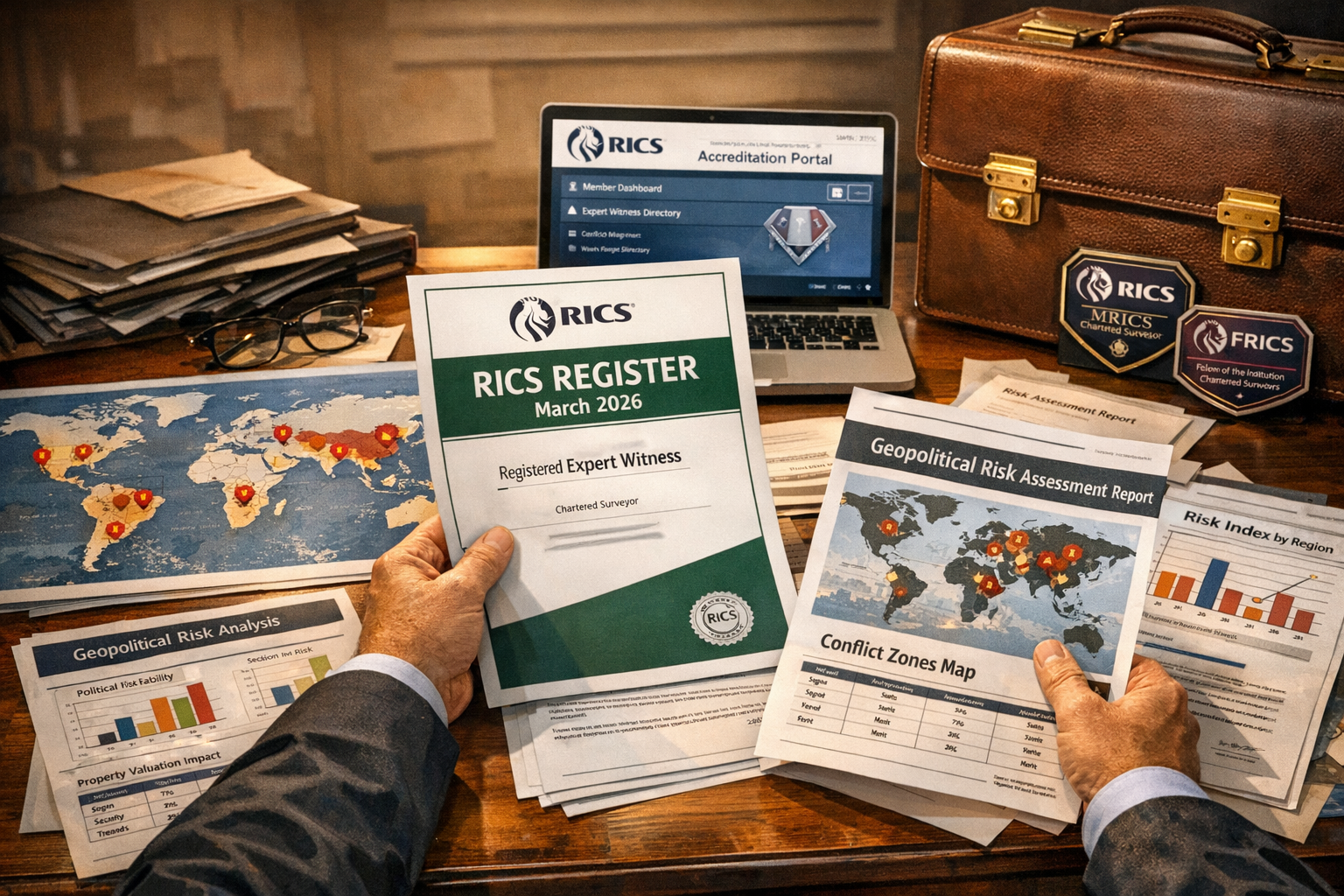
The Foundation of Expert Witness Duties
The role of an expert witness in valuation disputes extends far beyond simply providing an opinion. According to RICS standards, expert witnesses must maintain complete independence from the parties who engage them. This fundamental principle ensures that testimony serves the interests of justice rather than advocacy for one side[2].
In 2026, RICS has reinforced this principle through its consultation on updated global expert witness professional standards. The proposed revisions emphasize that experts must:
- Provide objective, unbiased opinions based on their expertise
- Clearly distinguish between facts and opinions
- Acknowledge limitations in their knowledge or methodology
- Remain impartial regardless of the outcome's impact on their client[5]
RICS Accreditation and Professional Standards
The March 2026 RICS Register of Accredited Expert Witnesses represents a voluntary accreditation service designed to demonstrate a chartered surveyor's competence in expert witness work[3]. With pass rates hovering around 75% in 2026, this accreditation signals to tribunals and legal teams that the professional has met rigorous standards[7].
Accredited experts must demonstrate:
✅ Technical competence in their valuation specialty
✅ Understanding of legal procedures and tribunal expectations
✅ Communication skills for presenting complex technical matters clearly
✅ Ethical awareness of their duties to the court or tribunal
For professionals working with RICS valuations, this accreditation provides a competitive advantage in securing appointments and establishing credibility.
The Expert Witness Process in Valuation Disputes
When geopolitical factors affect property values, the expert witness typically follows a structured process:
- Initial instruction and scope definition – Understanding the dispute parameters and specific questions to address
- Evidence gathering – Collecting market data, transaction comparables, and geopolitical risk assessments
- Analysis and opinion formation – Applying recognized valuation methodologies adjusted for risk factors
- Report preparation – Documenting findings in compliance with RICS and legal requirements
- Pre-hearing procedures – Participating in expert discussions and joint statements
- Testimony delivery – Presenting evidence and responding to cross-examination
Throughout this process, experts must maintain detailed records of their methodology and assumptions, particularly when dealing with the uncertainties inherent in geopolitical risk assessment.
Geopolitical Risk Factors in Property Valuation
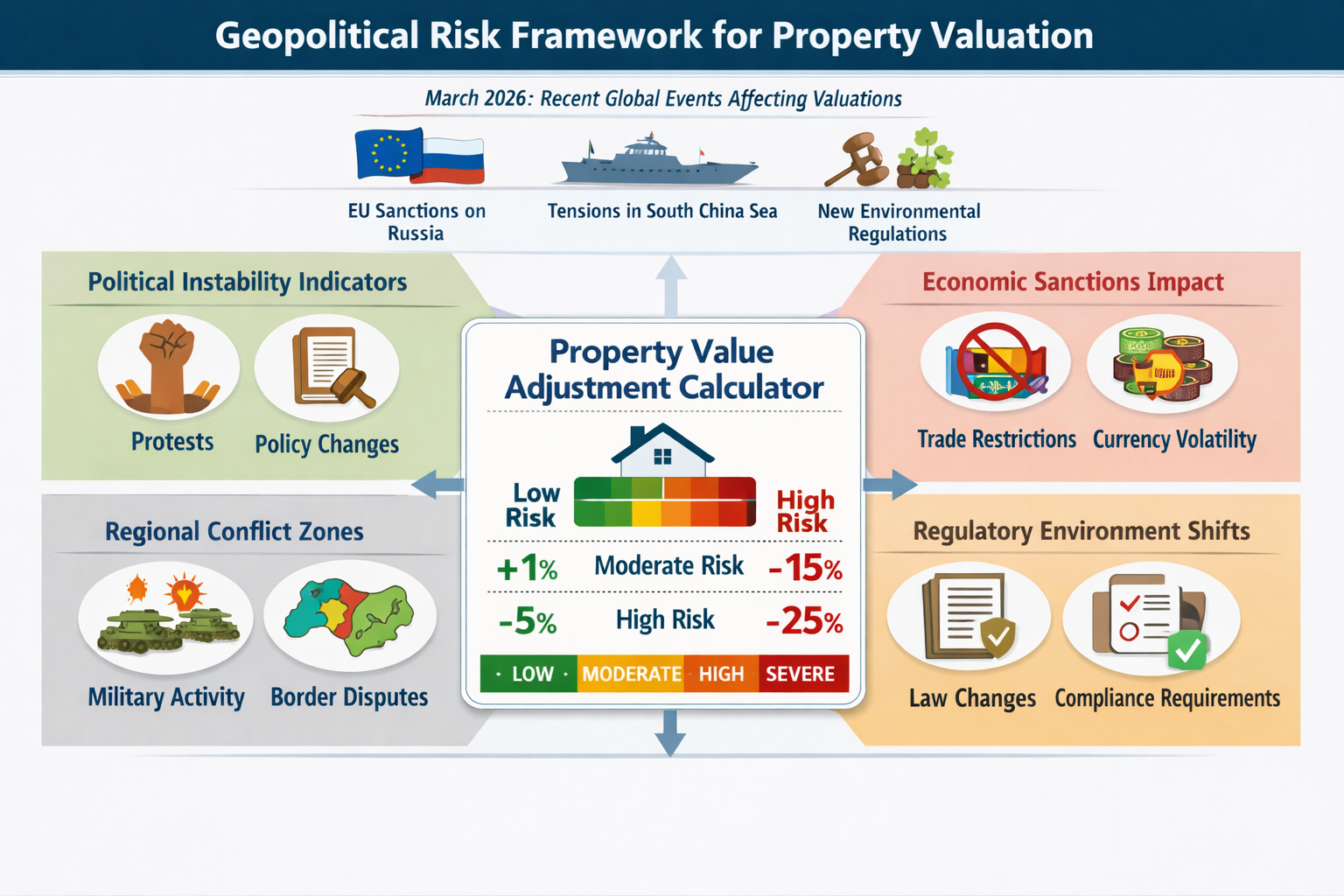
Defining Geopolitical Risk in Valuation Context
Geopolitical risk refers to the potential for political decisions, events, or conditions to affect economic outcomes and asset values. In property valuation, these risks manifest in several ways:
| Risk Category | Examples | Valuation Impact |
|---|---|---|
| Political Instability | Government changes, civil unrest, policy uncertainty | Reduced investor confidence, lower demand, higher discount rates |
| Economic Sanctions | Trade restrictions, asset freezes, financial system exclusions | Limited market access, reduced liquidity, forced sales |
| Regional Conflicts | Armed conflicts, border disputes, territorial claims | Physical damage risk, evacuation zones, insurance costs |
| Regulatory Changes | Foreign ownership restrictions, capital controls, tax changes | Legal uncertainty, compliance costs, reduced marketability |
Quantifying Geopolitical Risk Adjustments
One of the greatest challenges in Expert Witness Roles in Geopolitical Risk Valuation Disputes: Using March 2026 RICS Data for Robust Cases involves translating qualitative political assessments into quantitative valuation adjustments. Several methodologies have emerged:
Discount Rate Adjustments 🎯
Adding a risk premium to the discount rate used in income capitalization approaches. For example, a property in a politically stable jurisdiction might use a 6% discount rate, while a comparable property in an unstable region might require 9-12% depending on specific risk factors.
Probability-Weighted Scenarios
Developing multiple valuation scenarios based on different geopolitical outcomes, then weighting them by probability. This approach acknowledges uncertainty while providing a defensible range of values.
Market Evidence Analysis
Examining actual transaction data from comparable markets experiencing similar geopolitical pressures. The March 2026 RICS data provides valuable benchmarks for these comparisons across different regions and risk profiles.
Time Horizon Adjustments
Shortening the investment horizon or exit assumptions to reflect increased uncertainty about future conditions.
Using March 2026 RICS Data for Evidence-Based Adjustments
The March 2026 RICS data provides several critical resources for expert witnesses:
- Market confidence indicators across different regions and property sectors
- Transaction volume trends showing how geopolitical events affect liquidity
- Yield adjustments observed in markets experiencing political or economic stress
- Professional sentiment surveys capturing valuers' assessments of risk factors
Valuers registered with RICS can access this data to support their risk adjustment methodologies with empirical evidence rather than purely subjective assessments.
Case Study Framework: Sanctions Impact on Cross-Border Investments
Consider a dispute over the valuation of a commercial property portfolio affected by international sanctions. An expert witness might structure their analysis as follows:
Pre-Sanctions Baseline – Establish the property values before geopolitical events using standard RICS Red Book methodology
Direct Impact Assessment – Quantify immediate effects such as:
- Loss of specific tenants due to sanctions compliance
- Increased vacancy rates and letting periods
- Reduced pool of potential purchasers
- Banking and financing restrictions
Indirect Impact Assessment – Evaluate secondary effects including:
- Broader market sentiment deterioration
- Currency volatility affecting returns
- Insurance cost increases or coverage limitations
- Operational cost changes
Comparable Evidence – Reference March 2026 RICS data showing how similar properties in comparable geopolitical situations have been valued
Risk-Adjusted Valuation – Apply defensible adjustments to arrive at a current market value reflecting the geopolitical reality
This structured approach, grounded in RICS standards and supported by current data, provides tribunals with a clear rationale for valuation conclusions.
Building Robust Cases with RICS Standards and Current Data
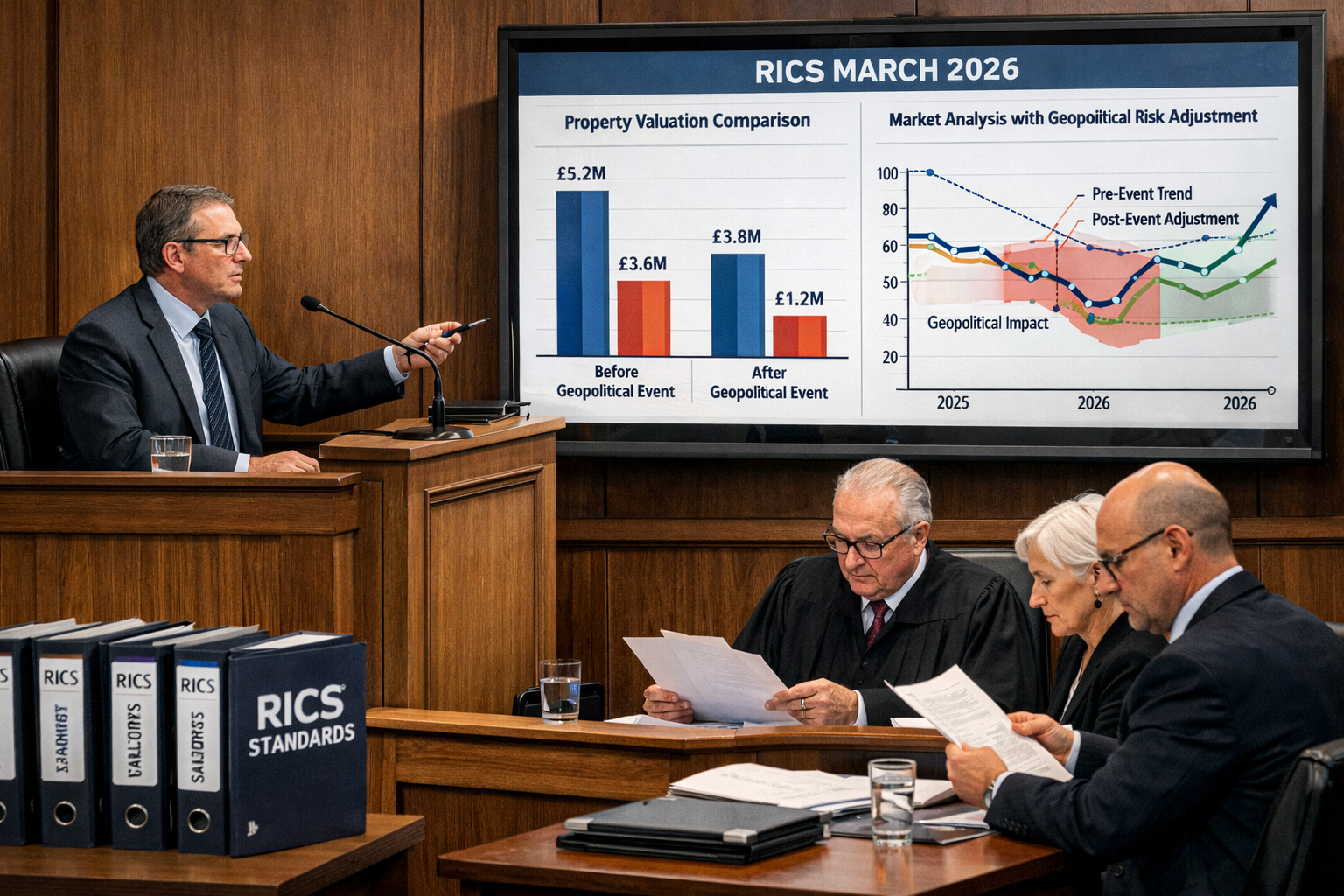
Integrating RICS Red Book Principles with Geopolitical Analysis
The RICS Valuation – Global Standards (Red Book) provides the foundation for professional valuation work. When addressing geopolitical risk in Expert Witness Roles in Geopolitical Risk Valuation Disputes: Using March 2026 RICS Data for Robust Cases, experts must demonstrate how their risk assessments comply with these core principles:
Transparency 💡
Clearly documenting all assumptions about geopolitical conditions, their likelihood, and their impact on value. Expert reports must explain why specific risk factors were considered material and how they influenced the valuation conclusion.
Consistency
Applying geopolitical risk adjustments consistently across comparable properties and scenarios. If a 15% discount is applied for political instability in one case, similar circumstances should warrant similar adjustments unless differences are clearly explained.
Objectivity
Basing risk assessments on verifiable evidence rather than speculation. This includes referencing:
- Published political risk indices
- Economic data from recognized sources
- Transaction evidence from affected markets
- March 2026 RICS survey data on market sentiment
Competence
Demonstrating appropriate expertise in both valuation methodology and geopolitical risk assessment. This may require collaboration with political risk consultants or economists for particularly complex scenarios.
Leveraging March 2026 RICS Market Data
The March 2026 RICS Register and associated market data provide expert witnesses with several strategic advantages:
Benchmarking Credibility
Referencing the approximately 75% pass rate for RICS expert witness accreditation helps establish the rigorous standards that accredited professionals meet[3]. This context reinforces the expert's qualifications when challenged during cross-examination.
Market Sentiment Evidence
RICS conducts regular surveys of chartered surveyors regarding market conditions, confidence levels, and emerging risks. The March 2026 data captures professional sentiment during a period of heightened geopolitical uncertainty, providing contemporaneous evidence of how the profession viewed risk factors at the relevant valuation date.
Comparative Transaction Analysis
RICS data includes transaction volumes and pricing trends across different regions and property types. Expert witnesses can use this information to demonstrate how geopolitical events have affected market activity and values in comparable situations.
Professional Practice Standards
The updated RICS expert witness standards under consultation in 2026 provide a framework for addressing complex issues like geopolitical risk[5]. Demonstrating compliance with these evolving standards strengthens the expert's position.
Documentation and Evidence Management
Strong expert witness cases in geopolitical risk valuation disputes require meticulous documentation:
📋 Source Materials
- Political risk assessments from recognized providers
- Economic indicators and forecasts
- News reports and government announcements
- Industry analyses and academic research
📊 Market Data
- Transaction comparables with dates and circumstances
- Rental evidence and yield data
- Market reports from RICS and other professional bodies
- Historical data showing pre-crisis and post-crisis values
📝 Methodology Records
- Detailed calculations showing how adjustments were derived
- Sensitivity analyses demonstrating the impact of different assumptions
- Peer review or validation from other professionals
- References to accepted valuation literature and standards
For professionals handling matrimonial valuations or capital gains tax valuations affected by geopolitical events, this documentation becomes particularly important when values are disputed.
Addressing Challenges and Limitations
Honest acknowledgment of limitations strengthens rather than weakens expert testimony. In geopolitical risk valuation, experts should address:
Uncertainty and Ranges
Geopolitical events are inherently unpredictable. Providing a range of values based on different scenarios demonstrates sophistication rather than indecision. The March 2026 RICS data can support the reasonableness of the range selected.
Data Limitations
In rapidly evolving situations, comparable transaction evidence may be limited. Experts should acknowledge this constraint while explaining how they've used the best available evidence, including RICS market intelligence and professional surveys.
Assumption Dependencies
Clearly stating that conclusions depend on specific assumptions about future geopolitical developments protects the expert if circumstances change. This approach aligns with RICS standards requiring transparency about valuation basis[2].
Scope Boundaries
Defining what the expert is and isn't qualified to opine on. For example, a valuation expert might rely on published political risk assessments rather than claiming expertise in international relations.
Effective Communication in Tribunal Settings
The most rigorous analysis loses impact if poorly communicated. Expert witnesses in geopolitical risk valuation disputes should:
✅ Use Visual Aids
Maps showing affected regions, charts illustrating market trends, and timelines connecting geopolitical events to value changes help tribunals understand complex relationships.
✅ Provide Clear Summaries
Executive summaries and conclusion sections should state opinions clearly before diving into supporting detail. Busy tribunal members appreciate knowing the destination before the journey.
✅ Explain Technical Terms
Not all tribunal members have valuation expertise. Terms like "discount rate," "yield compression," or "market liquidity" may need brief explanations.
✅ Anticipate Challenges
Prepare for cross-examination by identifying weaknesses in the analysis and developing responses. Understanding the opposing expert's likely arguments allows for proactive rebuttal.
✅ Maintain Professional Demeanor
Remaining calm, respectful, and focused on the technical issues—even under aggressive questioning—reinforces credibility and professionalism.
Ethical Considerations and Professional Conduct
The RICS consultation on updated expert witness standards emphasizes that the expert's primary duty is to the tribunal, not the client[5]. This principle becomes particularly challenging in geopolitical risk cases where clients may have strong views about political situations.
Experts must resist pressure to:
- Minimize geopolitical risks to support a higher valuation
- Exaggerate risks to justify a lower valuation
- Selectively present evidence that favors one outcome
- Modify opinions based on client feedback rather than evidence
The factors of valuation in geopolitical contexts require objective assessment, and experts who maintain this objectivity build long-term credibility that transcends individual cases.
Practical Strategies for 2026 and Beyond
As global uncertainty continues, expert witnesses can strengthen their practice by:
🌍 Developing Geopolitical Literacy
Regularly reviewing political risk publications, attending relevant seminars, and understanding how international events affect property markets in different regions.
📚 Building Reference Libraries
Maintaining collections of RICS data, market reports, and case studies showing how geopolitical events have affected valuations historically.
🤝 Networking with Specialists
Establishing relationships with political risk consultants, international economists, and other experts who can provide specialized input for complex cases.
📖 Continuing Professional Development
Pursuing RICS expert witness accreditation and participating in training on emerging valuation challenges, including geopolitical risk assessment.
💻 Leveraging Technology
Using data analytics tools to process large datasets from RICS and other sources, identifying patterns and trends that support risk assessments.
For professionals offering RICS reinstatement build cost valuations or lease extension valuations, understanding how geopolitical factors might affect construction costs or market values adds valuable expertise to their service offering.
Conclusion
Expert Witness Roles in Geopolitical Risk Valuation Disputes: Using March 2026 RICS Data for Robust Cases represents a critical competency for valuation professionals navigating today's uncertain global environment. The March 2026 RICS Register of Accredited Expert Witnesses and updated professional standards provide a framework for delivering credible, defensible testimony in these complex disputes[3][5].
Success in this specialized area requires a combination of technical valuation expertise, geopolitical awareness, rigorous methodology, and effective communication. Expert witnesses must balance the inherent uncertainties of political risk with the tribunal's need for clear, evidence-based opinions. By grounding their analysis in RICS Red Book principles, leveraging current market data, and maintaining unwavering objectivity, professionals can build cases that withstand scrutiny and serve the interests of justice.
Actionable Next Steps
For chartered surveyors and valuation professionals looking to strengthen their capabilities in this area:
-
Pursue RICS Expert Witness Accreditation – Demonstrate commitment to professional standards and enhance credibility in tribunal settings[1]
-
Access March 2026 RICS Data – Review the latest market intelligence, confidence indicators, and professional sentiment surveys relevant to your practice areas
-
Develop Geopolitical Risk Frameworks – Create systematic approaches for assessing and quantifying political and economic risks in valuations
-
Build Documentation Systems – Establish processes for maintaining comprehensive records of methodology, assumptions, and evidence
-
Engage in Continuous Learning – Stay current with evolving RICS standards, particularly the updated global expert witness professional standard under consultation[5]
-
Network with Specialists – Develop relationships with political risk analysts, economists, and other experts who can provide specialized knowledge
-
Review Case Studies – Study how courts and tribunals have approached geopolitical risk in valuation disputes, learning from both successful and unsuccessful expert testimony
The intersection of geopolitical risk and property valuation will remain a significant challenge throughout 2026 and beyond. Expert witnesses who invest in developing these specialized capabilities position themselves as valuable resources for legal teams, clients, and tribunals navigating increasingly complex disputes in an uncertain world.
By combining rigorous technical analysis with the credibility conferred by RICS accreditation and adherence to professional standards, valuation experts can make meaningful contributions to fair dispute resolution—even when global headwinds and economic uncertainty create unprecedented challenges for asset valuation.
References
[1] Expert Witness Accreditation Service – https://www.rics.org/dispute-resolution-service/panel-of-experts/expert-witness-accreditation-service
[2] Surveyors Acting As Expert Witnesses – https://www.rics.org/profession-standards/rics-standards-and-guidance/sector-standards/dispute-resolution-standards/surveyors-acting-as-expert-witnesses
[3] Rics Register Of Accredited Expert Witnesses March 2026 – https://www.rics.org/content/dam/ricsglobal/documents/surveying/RICS-Register-of-Accredited-Expert-Witnesses_March-2026.pdf
[5] Rics Launches Consultation On Updated Global Expert Witness Professional Standard – https://www.lexisnexis.co.uk/legal/news/rics-launches-consultation-on-updated-global-expert-witness-professional-standard
[7] Expert Witness Challenges In 2026 Interest Rate Volatility Disputes Rics Data Driven Preparation – https://nottinghillsurveyors.com/blog/expert-witness-challenges-in-2026-interest-rate-volatility-disputes-rics-data-driven-preparation